Skin profile
Where this herb sits in skin practice: the pattern it corrects, the skin signs it suits, and what it should not be used for.
Skin signs that suggest it
- Skin that is hot and dry to the touch, often with a flushed face and a low fever rising in the afternoon or evening
- Night sweats that leave the skin hot rather than cooled, with a dry mouth and throat
- A fine red or faintly purplish rash during a feverish illness, when heat has moved into the Blood level
- Prickly heat, a fine itchy red eruption, or an itch that appears in hot and humid weather
- Itching that is worse for warmth, with no oozing, crusting or obvious infection
- A red tongue with scanty coating, and a pulse that is thin and fast
When it is not the right herb
Not for cold skin. A pale, cool, dry surface with no heat signs, or a chronic dry eczema in a person who is always cold, has nothing for this herb to clear, and its bitter coldness will thin the skin's resources further. It is also wrong at the very start of an exterior illness, when there are chills, a stiff neck and no settled heat, because a herb that reaches the interior can pull the pathogen inwards and leave the person shivering. Use is short and targeted: this is not a herb for indefinite daily use, and it is not a substitute for assessing a fever that will not settle.
What it does for skin
Skin-relevant actions only. Each one describes a mechanism in TCM terms and what it looks like on the skin.
Vents hidden heat out of the Yin level
When heat has settled deep, the surface may be only mildly red while the person feels burning inside, sweats at night and is hot in the bones. Qing Hao is described as entering that layer and leading the heat back out, an action the tradition calls clearing within and venting without. On the skin this looks like generalised heat that slowly lifts, with the flushing and the night-time warmth settling as the deep heat is dispersed rather than suppressed.
Clears summer-heat and dampness from the surface
Summer-heat belongs to the hot, humid weeks: the head feels heavy, the chest feels stuffed, there is thirst, and a fine itchy rash appears where skin folds and clothing trap the damp. The aromatic side of the herb scatters what is light and rising, while its coldness brings the temperature down, and because it does not dry in the manner of the bitter fire-drainers, the surface is not left parched afterwards. It suits prickly heat and the itchy eruptions that arrive with a heatwave.
Quiets wind-itch driven by heat
Classical summaries credit the herb with settling wind itch, and later practice uses it where itching comes with warmth, dryness and a general sense of heat rather than with oozing or infection. It is not a sedating antipruritic and it does not numb the skin, so the relief is gradual: the itch reduces as the heat behind it is cleared.
Cools the Blood without heavy drying
Where a rash is faintly purplish or appears during a feverish illness, the herb is used to cool the Blood level. Its sweetness is slight, so it protects fluid better than the harsh bitter-cold herbs, but it still cannot replace a true Yin-nourishing medicine. In practice it is paired with Sheng Di Huang or Bie Jia so that cooling and restoring proceed together.
Skin conditions it is used for
Mapped to the condition pages on this site. The pattern column shows what the skin is doing when this herb is the right choice.
| Condition | Pattern | Why it suits | Typical setting |
|---|---|---|---|
| Heat Rash | Heat in the Blood, stirred by summer-heat and dampness | Prickly heat arrives when summer-heat and dampness are trapped at the surface, and the fine red papules with their stinging itch fit that picture. Qing Hao is chosen when the rash comes with a heavy head, thirst and a low fever rather than with a hot, weeping lesion, and it is taken as a light infusion, so the aromatic oils survive. It is combined with heat-clearing and damp-draining herbs, and the rash usually settles as the weather heat is dispersed. | A light infusion with Jin Yin Hua and Lian Qiao, or within a summer-heat formula |
| Itchy Skin | Wind-heat with dryness: itching worse in warmth, no ooze | Itch without a primary lesion, worse in warm weather and at night under the covers, is read as wind-heat sitting in the surface with some dryness. Qing Hao clears the heat and settles the wind itch at the same time, and it is chosen when the skin is hot and dry rather than red and weeping. It is paired with Bai Xian Pi or Fang Feng when the itch moves about the body. | Qing Hao with Bai Xian Pi, Fang Feng and Sheng Di Huang |
| Dry And Hot Skin | Empty-heat from Yin deficiency: hot, dry skin with night sweats | Skin that is hot, dry and thin, with sweats at night, a dry mouth and a fever that climbs in the afternoon, is the deficiency-heat picture. Qing Hao vents that heat while doing less damage to the remaining fluid than the bitter fire-drainers, but it clears rather than nourishes, so it is always given with a Yin-nourishing herb such as Sheng Di Huang or Zhi Mu. The skin becomes less hot to the touch before it becomes less dry. | Qing Hao Bie Jia Tang with Sheng Di Huang and Zhi Mu |
| Warm Skin | Lingering heat in the Yin level after a febrile illness | A surface that stays warm for weeks after an infection, with a low evening temperature and a dry mouth, is read as heat left behind in the Yin layer. This is the residue the herb was classically paired with turtle shell for: it reaches the depth where the heat is held and leads it out, so the warmth fades instead of flaring each evening. The skin is warm rather than inflamed, and there is no rash to treat. | Qing Hao Bie Jia Tang |
| Macular Rash | Heat in the Ying level with a faint red rash and a lingering fever | A faint, blanching red rash in a feverish person, with restlessness, a dry mouth and a fine rapid pulse, points to heat that has entered the Ying level. Qing Hao cools that layer and vents it outward, and it is used where the rash is slow to clear and the fever lingers rather than raging. The rash is the guide: while it is faint and the person is hot at night, the heat is still deep. | Modified Qing Ying Tang with Qing Hao and Mu Dan Pi |
Combinations for skin
Herbs it is paired with when the skin, not an internal organ, is the target.
| Partner | Ratio | Why the pair is used |
|---|---|---|
| Bie Jia | 6 to 10 g Qing Hao with 10 to 15 g Bie Jia | The pair the classical literature turns on: the shell is said to lead the herb into the Yin level, and the herb is said to lead the shell's cooling back out to the surface. Together they treat a low fever that has outlasted the illness, with night sweats and skin that is hot to the touch. It is the standard setting for lingering heat after a febrile rash has faded. |
| Sheng Di Huang | 6 to 10 g Qing Hao with 10 to 15 g Sheng Di Huang | Raw rehmannia restores the Yin and cools the Blood while Qing Hao disperses the heat that is consuming it. The combination suits hot, dry, thin skin with night sweats and a dry mouth, where clearing alone would leave the surface drier. It is a pair for the aftermath of a fever rather than for an acute eruption. |
| Mu Dan Pi | 6 to 10 g each | Both cool the Blood, but Mu Dan Pi also moves it, which suits the purplish tinge and sluggish circulation that accompany deep heat. Qing Hao adds the outward venting that carries the cooled heat away from the skin. Both herbs are cold, so it suits someone who genuinely runs hot and digests well. |
| Bai Xian Pi | 6 to 10 g each | Bai Xian Pi is the skin herb that quiets itch and clears wind-heat, and Qing Hao supplies the deeper cooling that stops the itch returning. The pair is used for generalised itching that is worse in warmth, without oozing or infection, and it is a practical combination for heat-provoked itch in the summer months. |
Formulas where it leads
- Qing Hao Bie Jia Tang (青蒿鳖甲汤) - The classical formula for heat left in the Yin level after a febrile illness: a low fever, night sweats, skin that is hot to the touch and a dry mouth, with a red tongue and little coating. Qing Hao vents the heat outward while Bie Jia, Sheng Di Huang and Mu Dan Pi cool and restore what the fever consumed.
Safety for skin use
What to check before recommending or using it, including the cautions that matter most for skin patients.
Do not use, or use with caution
- Spleen and Stomach deficiency-cold: a pale tongue, a cold abdomen, loose stools or a poor appetite. A bitter, cold herb sits badly on a digestion that already lacks warmth, and loose bowels with nausea are the usual consequence.
- Cold, dry skin without heat signs, including chronic dry eczema in a person who is always cold. There is no heat to clear, and prolonged use leaves the skin drier and the digestion weaker.
- The exterior stage of a cold, with chills, shivering, a stiff neck and no settled heat. The herb works on heat that is already inside, and giving it at the surface stage can push the pathogen deeper, leaving the person shivering with the illness unresolved.
- A fever that will not settle, weight loss or night sweats that persist. These need medical assessment rather than a longer course of a cooling herb, and the classical antimalarial reputation of the plant does not make a decoction a treatment for malaria.
Pregnancy and breastfeeding
Use only with practitioner supervision. The herb is not among the classical prohibitions, but it is bitter, cold, and not a herb to give in quantity in pregnancy. The purified compound calls for more care, because artemisinin derivatives have damaged the embryo in animal work at high dose; that argues for a low herbal dose and a short course, not for alarm about a properly prescribed formula. A wash on a small area is considered lower risk, though it should still be checked, and the same caution applies while breastfeeding, with topical use kept off the nipple area.
Interactions
- Artemisinin changes liver enzyme activity. Laboratory and volunteer work reports that one pathway is inhibited early in a course and several others are induced afterwards, so concentrations of other medicines can drift over days.
- The drugs that matter are the ones with little room for error: warfarin and other anticoagulants, ciclosporin, calcium channel blockers, some statins, anti-epileptics, and HIV protease inhibitors. A decoction carries much less artemisinin than a drug dose, but a person taking any of these should tell both prescribers before starting it.
- Do not combine the herb with artemisinin-based combination therapy for malaria, or use it instead of that treatment; incomplete or duplicated dosing is one of the drivers of resistance. A wash should be applied at a different time of day from a prescribed steroid cream.
Allergy and patch testing
Contact dermatitis from herbal washes and creams is well recognised, and Qing Hao belongs to the daisy family, so people who react to mugwort, ragweed, chrysanthemum or chamomile may react to it as well. Patch test any wash on a small area of normal skin for 24 hours, stop at once if the skin becomes more irritated rather than calmer, and do not use it on broken or ulcerated skin without supervision.
General safety references
General references for herbal hepatotoxicity and herb-drug interactions; they are not specific to this herb.
- Review article: Herbal hepatotoxicity - an update on traditional Chinese medicine preparations. Alimentary Pharmacology & Therapeutics, 2014. PMID: 24844799.
- Interactions between herbal medicines and prescribed drugs: an updated systematic review. Drugs, 2009. PMID: 19719333.
- Warfarin and food, herbal or dietary supplement interactions: a systematic review. British Journal of Clinical Pharmacology, 2021. PMID: 32478963.
Evidence
The classical record is quoted with its source. The modern note states the level of evidence plainly.
Classical record
The plant receives the rising spring qi of the shaoyang earlier than any other, so the conditions it treats all belong to the blood level of the shaoyang and jueyin.
Ben Cao Gang Mu (Compendium of Materia Medica), Li Shizhen - Li Shizhen's explanation of why a herb used on the skin is classed with the Liver and Gallbladder: its territory is the Blood level rather than the surface.
Qing Hao cannot enter the yin level on its own; turtle shell leads it in. Turtle shell cannot leave the yang level on its own; Qing Hao leads it out.
Wen Bing Tiao Bian (Systematic Differentiation of Warm Diseases) - The sentence that defines the deepest use of the herb, and the reason it is paired with Bie Jia for heat that lingers beneath hot, dry skin.
This is the best herb for the heat that smoulders in the bones and wastes the body, and for draining the fire of the hot season; it settles wind itch, calms the restless night sweating of depletion, revives the appetite and eases pain in the chest.
Ben Cao Xin Bian (New Compilation of Materia Medica) - A Qing summary that names the skin use directly, joining wind itch to the deficiency heat and the heat of the season.
Modern evidence
Evidence status
- The plant is the source of artemisinin, an established antimalarial, but that pharmacology does not transfer to the skin: no clinical trial has shown that a decoction helps eczema, heat rash or any other skin condition, and a home decoction does not deliver the antimalarial dose.
- Laboratory work on artemisinin, artesunate and the whole-herb extract reports anti-inflammatory and immune-modulating activity in cell and animal models, including models of skin inflammation. These are early findings and do not establish a clinical effect.
- Case reports from Chinese centres describe the purified derivative artesunate being used in lupus erythematosus, including its skin manifestations. Reports of that kind are uncontrolled and are not evidence that the herb treats the skin.
PubMed records
Selected real PubMed records for this herb's species or its constituents, chosen by species name and title relevance. They are references for the non-TCM discussion above, not proof that the herb treats any skin condition.
- The immunosuppressive activity of artemisinin-type drugs towards inflammatory and autoimmune diseases.. Medicinal research reviews, 2021. PMID: 34288018 (skin-related record).
Dose and forms
Skin-practice dosing and the preparations that suit skin complaints.
| Form | Dose and notes |
|---|---|
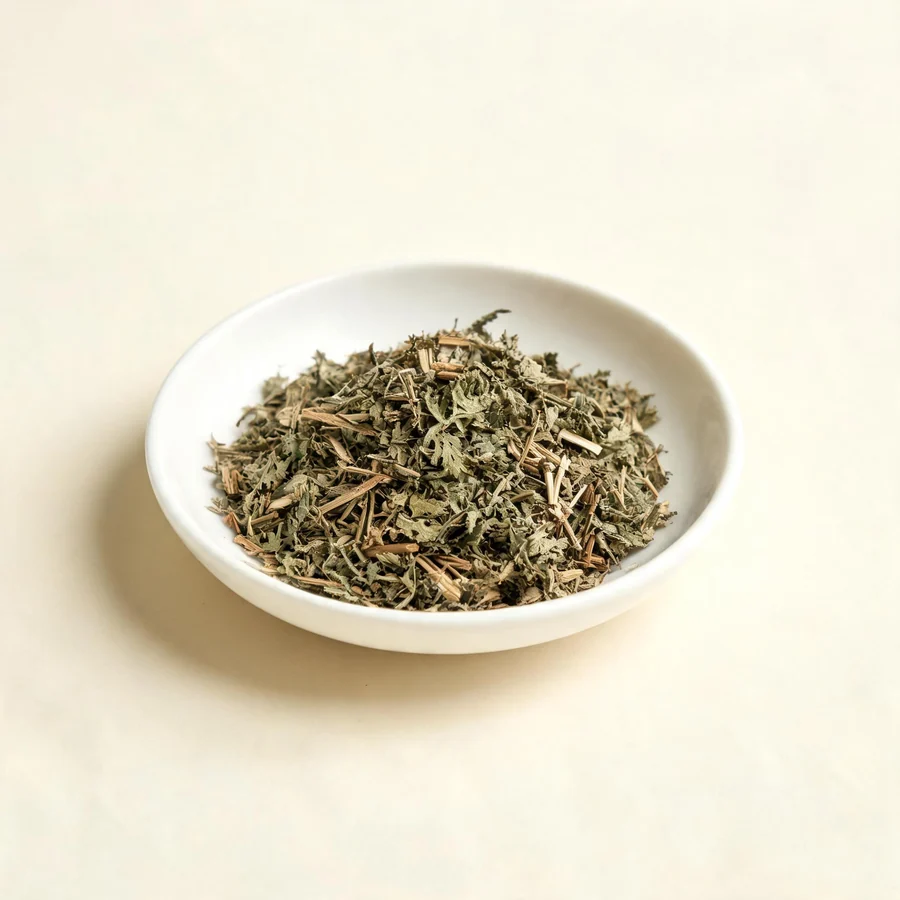
| Decoction | 6 to 12 g of dried aerial parts daily for skin-related heat, in a formula rather than alone. Add the herb near the end of decoction, or use a covered infusion, so that the aromatic oils are not lost. |
| Light infusion | A weaker infusion is used for summer-heat, prickly heat and heat-provoked itch, taken in small cups through the day. The infusion is not equivalent to the extracted antimalarial drug and is not a malaria treatment. |
| Course length | Three to five days for a lingering fever or a summer flare, stopped once the heat settles. Prolonged use is avoided because the coldness tires digestion, not because the herb accumulates. |
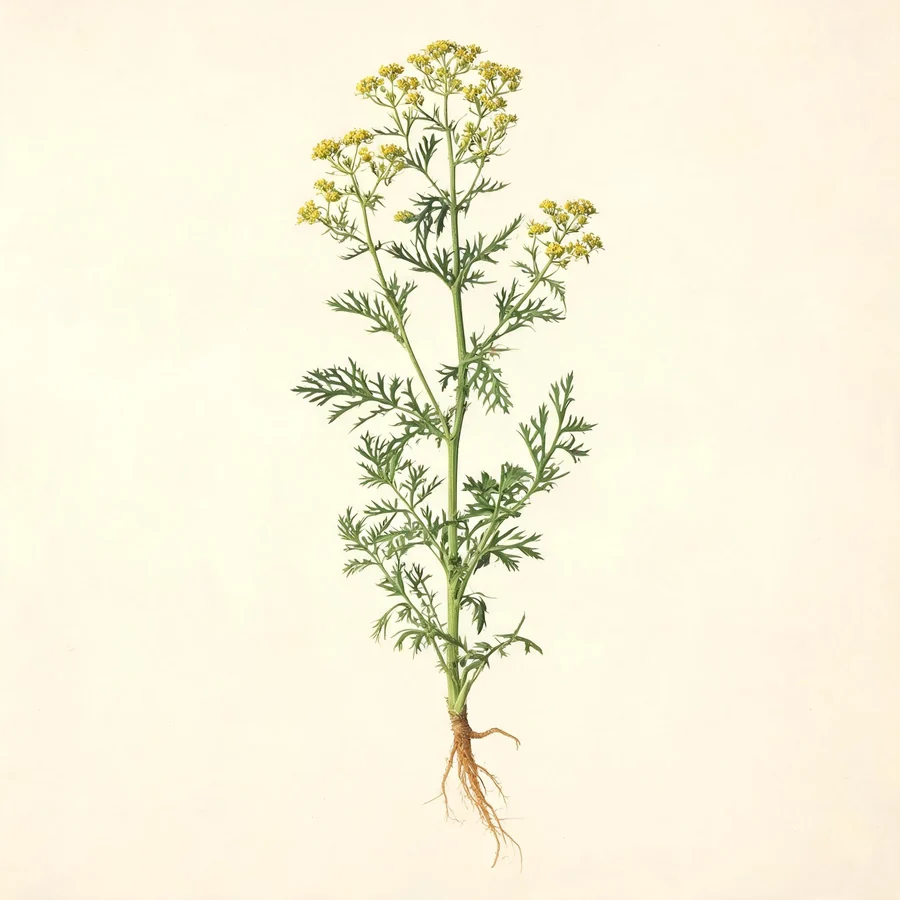
For skin work the dried aerial parts are used, and the quality of the material matters more than the dose: good herb is green, finely cut and strongly aromatic, and the aroma fades as the essential oil is lost. Because the compound that made the plant famous is poorly extracted by boiling water, the traditional decoction and the pharmaceutical drug are not interchangeable, and a decoction should not be stretched into an antimalarial course. The herb is given in short courses and stopped when the heat has gone rather than continued as a tonic.
Citations and further reading
Only real sources are listed: the classical materia medica passages quoted above, and the source works behind the botanical and safety statements.
- Ben Cao Gang Mu (Compendium of Materia Medica), Li Shizhen, 1578 - the passage on the shaoyang and the blood level is quoted above.
- Wen Bing Tiao Bian (Systematic Differentiation of Warm Diseases), Wu Tang, 1798 - the passage on Qing Hao and turtle shell is quoted above.
- Ben Cao Xin Bian (New Compilation of Materia Medica), Chen Shiduo, 1687 - the summary naming wind itch is quoted above.
- Pharmacopoeia of the People's Republic of China, Artemisiae Annuae Herba monograph - source for the accepted species, part used and quality requirements.
- Modern evidence statement: laboratory and trial literature on artemisinin, artesunate and Artemisia annua, summarised as a statement about the level of evidence rather than as a cited finding.
- Botanical literature on Artemisia annua, Asteraceae, for identification and for the species confusion described in the text.
Educational reference for qualified practitioners. This page is not medical advice, and skin conditions should be diagnosed by a clinician before treatment.