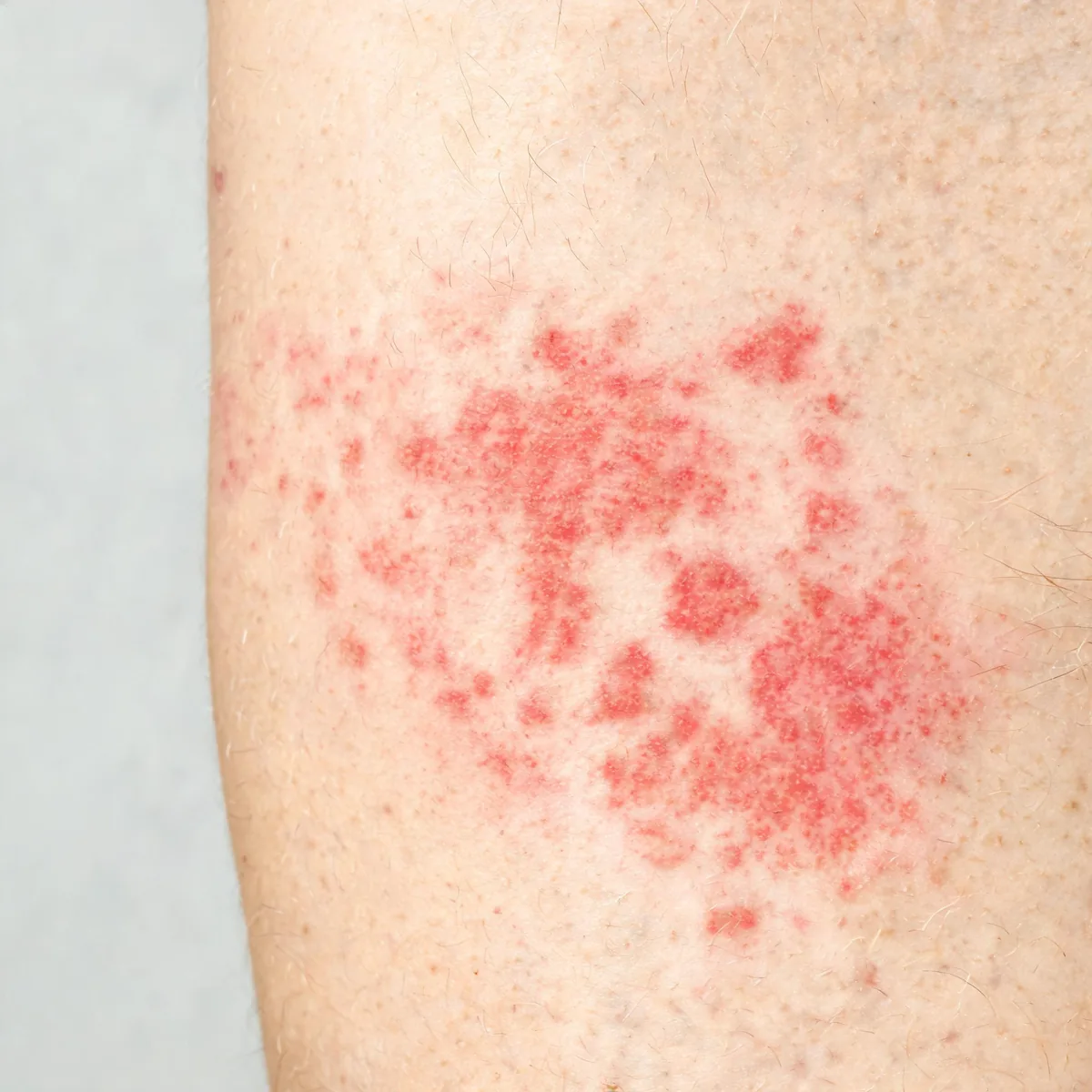
Understanding Macular rash
Note a source overlap recorded rather than resolved: this page on macular rash and the Macules page both describe flat coloured spots. Both are kept because the source treats them separately, and this page covers the febrile rash context.
The classical literature uses the classic four-level framework here. Heat in the Ying level gives fever worse at night with faint reddish macules, mental restlessness, a deep crimson tongue with little coating and dry mouth without much thirst - heat that has moved inward.
Wind-Heat invading the Lungs gives sudden red itchy macules and papules with sore throat, mild fever, cough and nasal congestion - heat that is still at the surface.
Damp-Heat in the Stomach and Spleen gives oozing macules that feel moist, with bloating and a heavy body. Heat in the Blood gives deep red or purplish macules with a bleeding tendency. Blood stagnation gives dark purplish macules that do not blanch, with fixed stabbing pain. Empty-Heat from Yin deficiency gives faint dry macules worse at night with night sweats.
The framework the classical literature borrows is one of depth. A flat coloured spot is not read as a disease in itself but as a marker of how far heat has travelled, so the same appearance can mean two quite different things. Heat that is still near the surface, having arrived with Wind, is trapped in the layers the Lungs govern, and the Lungs are the organ the classical literature gives charge of skin and body hair. Because their work of spreading and lowering is disrupted, the heat cannot disperse, and it surfaces as a sudden crop of red, itchy macules with a sore throat or a mild fever.
Deeper heat behaves differently. Once it has passed the Qi level it reaches the Ying, where it disturbs Blood and the spirit, and the tradition describes faint macules that are worse at night, restlessness and a crimson tongue with almost no coat. If it moves further still, into the Blood, it drives Blood out of the vessels, so the spots become deep red or purple and do not fade when pressed, and bleeding from the gums or nose may follow. These are read as more serious stages, needing stronger cooling and, in the reference's own framing, medical assessment alongside.
Not every macular rash is hot. Where the Spleen and Stomach carry dampness and heat, the turbid fluid they produce steams upward and leaves the skin moist or weepy, usually on the trunk, with bloating and a greasy yellow coat. When a rash keeps returning over months, the classical literature shifts its explanation: macules that are dark purple and stay put, with pain that stabs, are read as Blood Stagnation, and faint dry spots that flare with tiredness and night sweats as empty heat from Yin deficiency. The chronic pictures need moving and nourishing rather than more cooling, which is why one symptom is treated in opposite ways depending on its history.
Conventional view
In conventional medicine a macular rash means flat spots of altered colour, red, pink or purple, that are not raised above the surrounding skin. They can appear suddenly with a viral illness such as measles or rubella, as a reaction to a drug, or as part of an allergic response, and they may also point to something more systemic, such as a vasculitis or a blood disorder. Assessment rests on where the spots are, what accompanies them, and where needed on blood tests or a skin biopsy.
Treatment follows the cause. Topical or oral corticosteroids and antihistamines cover allergic and inflammatory rashes, a viral rash is handled with rest, fluids and fever control, and autoimmune or blood-related cases may need immunosuppressants or disease-modifying drugs. Moisturisers and cool compresses are used for comfort, and the rash itself is often left to fade as the underlying problem is treated.
Where no cause is found, management can become purely symptomatic, and that is the gap the classical literature points to. Steroid creams and antihistamines relieve what is visible without addressing why the skin keeps flaring, and they do not distinguish a rash that is hot and dry from one that weeps and feels heavy. In TCM those are different imbalances with different treatments, which is why the classical literature offers pattern differentiation as a complement to investigation rather than as a replacement for it.
Selected PubMed records
Real PubMed records for the conventional discussion above, selected by condition name and title relevance. They are references, not a claim that any treatment is proven for this condition.
- The terminology of skin disorders. Primary Care, 2000. PMID: 10815043.
How it connects
The classical literature reads the company a rash keeps as part of the pattern rather than as coincidence. With Wind-Heat the same pathogen reaches the throat, which it calls the doorway of the Lung system, so pharyngitis and tonsillitis often arrive with the spots and both settle when the surface is released. With damp-heat the turbid fluid fails to descend through the gut and steams out through the skin instead, so abdominal distention and a heavy, bloated feeling come with the weeping rash. Heat in the Blood shows elsewhere as bleeding gums or nosebleeds. In the chronic stage, Yin deficiency brings afternoon fever and a restless anxiety along with the faint rash, because the spirit is unsettled by the same emptiness.
How it is assessed
The practitioner assesses the rash colour, its relation to fever and any bleeding.
What a practitioner looks for
- Depth: faint macules with high fever and restlessness suggests heat in the Ying level.
- Onset: sudden itchy macules with sore throat suggests Wind-Heat invading the Lungs.
- Moisture: oozing macules suggest Damp-Heat.
- Red flags: blistering, peeling, mucosal sores or severe systemic illness.
The practitioner looks at the rash before asking anything else, because colour, moisture and the way it began carry most of the information. Bright, dry macules with a high fever suggest heat that has gone inward; a weepy, oozing rash with heaviness suggests dampness instead. Onset narrows it further. If the spots appeared abruptly after a cold or a sore throat, with a mild chill and a pulse that floats, Wind-Heat invading the Lungs is the reading. If fiery red macules arrive with a high fever, a deep red tongue that has almost no coat, and a thirst that is hard to quench, the heat has reached the Ying level.
Deepening and duration change the answer. Spots that have turned purple, with nosebleeds or bleeding gums and a crimson tongue, are placed in the Blood level, a more serious stage. A rash that oozes clear or yellow fluid, feels heavy and comes with a bloated stomach, a poor appetite and a greasy yellow coat points to damp-heat stewing in the Stomach and Spleen rather than to fever. For rashes that have lasted months, the classical literature looks for two chronic patterns: fixed, dark purple macules with stabbing pain and a choppy or wiry pulse for Blood Stagnation, and faint, dry, red macules that flare at night or with fatigue, with a red tongue that has almost no coat and a thin, rapid pulse, for empty heat.
TCM patterns in Macular rash
Six patterns are set out, ordered by depth. At the surface, Wind-Heat invading the Lungs gives a sudden crop of red, itchy macules and papules with a sore throat, mild fever, cough and a floating, rapid pulse. One level in, Heat in the Ying Level gives faint reddish macules with fever that rises at night, restlessness and a deep crimson tongue with little coat. Further in, Heat in the Blood gives deep red or purple macules, with bleeding gums or nosebleeds. Damp-Heat in the Stomach and Spleen is not a heat-depth picture: the macules weep and sit with bloating, a heavy body and a greasy yellow coat. The chronic patterns are told apart by colour and timing, with Blood Stagnation leaving fixed, dark purple spots that stab, and Empty-Heat from Yin Deficiency giving faint, dry spots that flare at night. A rash can move between these levels, so the pattern is read as the present position.
| Pattern | Key signs | The itch | Tongue | Main formula |
|---|---|---|---|---|
| Heat in the Ying Level | Faint reddish skin macules; Dry mouth with little thirst | Not specified | Body: Deep crimson and dry, sometimes with red prickles at the tipCoat: Little or none | Not specified |
| Wind-Heat invading the Lungs | Not specified | Sudden red itchy macules and papules | Body: Slightly red, with a red tipCoat: Thin yellow | Not specified |
| Damp-Heat in Stomach and Spleen | Oozing or weeping macules that feel moist | Not specified | Body: Red, possibly swollen with teeth marksCoat: Thick, yellow and greasy in the centre and root | Not specified |
| Heat in the Blood | Deep red or purplish macules that may bleed easily | Not specified | Body: Deep red, often with red points or pricklesCoat: Thin, yellow and dry | Not specified |
| Blood Stagnation | Fixed stabbing pain in the rash; Dry rough scaly skin | Not specified | Body: Purple, dusky or with dark stasis spots; sublingual veins dark and distendedCoat: Often thin white; a yellow coat would suggest Heat as the cause | Not specified |
| Empty-Heat caused by Yin Deficiency | Faint red dry macules worse at night; Dry mouth with small sips | Not specified | Body: Red, thin and dry, often crackedCoat: Little or none; the tongue may look peeled | Not specified |
Heat in the Ying Level
Fever with faint red macules, restlessness and a crimson tongue.
The classical literature places this pattern in the warm-disease tradition, where heat that is not cleared at the surface sinks deeper instead of dispersing. At the Ying level it disturbs the Blood and the spirit, and the rash that results is faint rather than bright, because the heat is working from within rather than pushing at the skin. Night is when it shows most clearly: Yin should be dominant then, so an already restless Blood is less contained, and the fever and the agitation rise with it. It is treated as a serious deepening, not as a skin complaint in isolation.
The tongue is deep crimson and dry with little or no coat, sometimes with red prickles at the tip, and the pulse is fine and rapid. Spicy and fried food, alcohol, emotional strain, heat and humidity and overexertion all make it worse, while a cool room, quiet rest, light cooling food and a calm mind make it more bearable. Qing Ying Tang is the formula named, with Shui Niu Jiao, Xuan Shen and Lian Qiao to cool the level, protect Yin and vent the heat outward, and the points are Dazhui (DU-14), Neiguan (PC-6) and Xuehai (SP-10).
Signs
- Fever worse at night
- Faint reddish skin macules
- Mental restlessness or insomnia
- Deep crimson tongue with little coating
- Dry mouth with little thirst
Diet and lifestyle for this pattern: Eat light, cooling, Yin-nourishing food such as pear, cucumber, mung beans and tofu, and avoid spicy, fried and greasy food as well as alcohol and coffee. Rest in a cool quiet place and avoid heavy sweating or overwork, and gentle mindfulness or meditation can help calm the mind.
Wind-Heat invading the Lungs
Sudden red itchy macules with sore throat and cough.
This is the surface pattern, and the classical literature explains it through the Lungs. They have charge of the skin and the body hair, and the nose is their opening, so an external Wind-Heat pathogen meets them first; their work of spreading outwardly and moving downward is disrupted, and heat is trapped in the superficial layers. The result is a rash of red, itchy macules and papules that appears all at once, with the signs of the invasion itself: a sore throat, a mild fever or a chill, a cough with yellow phlegm and a blocked nose with yellow mucus.
The tongue has a red tip and edges with a thin yellow coat, and the pulse floats and runs fast. Spicy and greasy food, stuffy rooms, draughts, stress and overexertion aggravate it, while cool drinks, rest, a well-ventilated room, a gentle sweat and peppermint or chrysanthemum tea help. Yin Qiao San is the formula named, with Jin Yin Hua and Bo He to release the exterior and clear the heat, and the points are Hegu (LI-4), Lieque (LU-7) and Dazhui (DU-14).
Signs
- Sudden red itchy macules and papules
- Sore throat with mild fever or chills
- Cough with yellow phlegm
- Thirst with nasal congestion
Diet and lifestyle for this pattern: Drink plenty of cool fluids such as chrysanthemum or peppermint tea, eat light cooling food, and avoid spicy, greasy and fried dishes. Rest in a well-ventilated room but keep out of draughts.
Damp-Heat in Stomach and Spleen
Oozing moist macules with bloating and heaviness.
Here the source is digestion rather than invasion. When dampness and heat leave the Spleen and Stomach waterlogged, the turbid fluid they generate cannot be processed; it is pushed up and out instead, and leaves by way of the skin. The rash therefore looks different from the heat patterns: it is moist and weepy rather than dry, and it sits most often on the trunk, where those channels run. The same fluid explains the other complaints, a bloated upper abdomen, a sticky or bitter taste and a stool that is incomplete and clings to the bowl.
The tongue body is red, possibly swollen with teeth marks, with a thick yellow greasy coat that is heaviest at the centre and root, and the pulse is soggy and rapid, often slippery, especially at the right middle position. Greasy, fried and sweet food, dairy, humid weather, overeating and a sedentary routine all aggravate it, while light cooked meals, bitter vegetables, daily walking and dry cool weather ease it. Lian Po Yin is the formula named, with Huang Lian, Hou Po and Yi Yi Ren, and the points are Zhongwan (REN-12), Tianshu (ST-25), Yinlingquan (SP-9), Fenglong (ST-40) and Quchi (LI-11).
Signs
- Oozing or weeping macules that feel moist
- Bloating and fullness
- Sticky incomplete bowel movements
- Heavy sluggish body
Diet and lifestyle for this pattern: Avoid greasy, fried and very sweet food as well as dairy and cold raw food, which all create Dampness. Eat light, cooked, easy meals such as congee, steamed vegetables and barley, and bitter greens such as dandelion or bitter melon help drain Damp-Heat. Gentle daily walking or stretching helps Qi flow and transforms Dampness.
Heat in the Blood
Deep red or purplish macules with a bleeding tendency.
Heat in the Blood is the deepest of the excess patterns. The tradition describes it agitating and accelerating the Blood until it is forced out of the vessels, which is why the macules are deep red or purple and stay coloured when pressed. The same force damages the walls of the vessels and makes them fragile, so bleeding appears alongside the rash, from the gums, the nose or, in some people, as heavy periods. The tradition describes this level as needing the strongest cooling, because heat here is no longer confined to the surface.
The tongue is red with red spots or prickles and a thin, yellow, dry coat, and the pulse is rapid and forceful, wiry or slippery. Spicy and fried food, alcohol and coffee, anger and stress, hot weather and overheating, and the night hours all intensify it, while a cool room, cool drinks, cooling food and rest settle it. The classical literature gives no formula title for this pattern, only a classical blood-cooling formula with Shui Niu Jiao as its key herb, and the points are Xuehai (SP-10) and Quchi (LI-11).
Signs
- Deep red or purplish macules that may bleed easily
- Bleeding gums or nosebleeds
- Internal heat worse at night
- Restlessness and irritability
Diet and lifestyle for this pattern: Focus on cooling, Yin-nourishing food such as cucumber, watermelon, mung beans and leafy greens, and avoid alcohol, coffee, spicy dishes and fried food that add Heat. Stay hydrated with room-temperature or cool water, and relieve stress gently with slow breathing or a walk in nature.
Blood Stagnation
Dark purple macules that do not blanch, with fixed pain.
Chronic rashes leave their own pattern. Where Qi and Blood have been held up for a long time, circulation slows in the smallest vessels of the skin, and the Blood that settles shows as fixed, dark purple macules that do not fade under pressure. Unlike heat rashes, which come and go, these marks stay where they are and may ache or sting, particularly at night, when the body is still and movement is at its lowest. The classical literature adds dry, rough, scaly skin and a history of long-standing skin trouble to the same picture.
The tongue is duskily purple with stasis spots and distended dark veins beneath it, and the pulse is choppy or wiry. Sitting still for long periods, cold weather, cold food and drink, stress and anger, heavy greasy meals and lost sleep all make it worse, while gentle movement, warmth such as a warm bath, turmeric and ginger, massage, stress reduction and regular sleep make it better. Xue Fu Zhu Yu Tang is the formula named, with Tao Ren and Hong Hua, with Tao Hong Si Wu Tang as the alternative, and the points are Xuehai (SP-10) and Geshu (BL-17).
Signs
- Dark purplish macules that do not blanch
- Fixed stabbing pain in the rash
- Worse at night or after rest
- Dry rough scaly skin
Diet and lifestyle for this pattern: Gentle daily exercise such as walking or yoga keeps Qi and Blood moving. Avoid cold and raw food that can congeal Blood, and use warming spices such as turmeric, ginger and a little vinegar in cooking. Manage stress with meditation or breathing, since emotional tension worsens stagnation.
Empty-Heat caused by Yin Deficiency
Faint dry macules at night with night sweats.
The last pattern is depletion rather than excess. Yin is the cooling, moistening half of the body's resources, and the classical literature traces its loss to overwork, a long illness or too many late nights. With less Yin to hold it, a low-grade heat rises to the skin and produces faint, dry, reddish macules that are mild but persistent. The timing follows the same logic: Yin is naturally weaker at night, so the rash, the warmth and the itching all sharpen in the evening or when the person is tired, and dryness elsewhere, such as a dry mouth and night sweats, confirms the picture.
The tongue is red, thin and dry with cracks and little or no coat, and the pulse is fine and rapid. Late nights and overwork, spicy fried food, alcohol and coffee, hot dry weather and frustration all consume what remains, while cool quiet surroundings, pear, tofu and black sesame, gentle restorative exercise and early nights rebuild it. Zhi Bai Di Huang Wan is the formula named, with Mu Dan Pi, Zhi Mu and Huang Bo, and the points are Taixi (KI-3), Sanyinjiao (SP-6), Zhaohai (KI-6), Xuehai (SP-10) and Shenmen (HT-7).
Signs
- Faint red dry macules worse at night
- Night sweats
- Heat in palms, soles and chest
- Dry mouth with small sips
- Irritability
Diet and lifestyle for this pattern: Be in bed before eleven to protect Yin reserves, and avoid overwork or exercise that leaves you depleted. Eat moistening, cooling food such as pear, lily bulb, tofu, black sesame and cucumber, sip warm water through the day, and strictly limit alcohol, coffee, spicy dishes and deep-fried food that fan empty heat.
Treatment approach
How the tradition treats macular rash, with the herbs, formulas and points used for it.
Principles
- Assess fever and systemic illness medically first; a febrile rash can be serious.
- Cool the Ying level where macules are faint with high fever and restlessness.
- Dispel Wind-Heat where the rash is superficial with sore throat.
- Nourish Yin where macules are faint, dry and recurrent.
- The aim is twofold: clear the factor that has surfaced on the skin, and correct the imbalance that let it surface. Excess pictures are treated by dispersal, by clearing heat, by transforming dampness or by cooling the Blood, each according to which level the heat has reached. Deficiency is treated by nourishing and moistening, so that empty heat has something to restrain it, and stasis by moving what has stopped. Herbs remain the main tool, with acupuncture added to regulate the channels involved, and the formula is expected to change as a rash moves from bright and superficial to faint or dusky and chronic.
Herbs used
Formulas
- Qing Ying Tang
- Yin Qiao San
- Lian Po Yin
- Xue Fu Zhu Yu Tang
- Tao Hong Si Wu Tang
- Zhi Bai Di Huang Wan
Acupoints
- DU-14 (Dazhui)
- PC-6 (Neiguan)
- SP-10 (Xuehai)
- LI-4 (Hegu)
- LU-7 (Lieque)
- zhongwan-ren-12
- ST-25 (Tianshu)
- SP-9 (Yinlingquan)
- ST-40 (Fenglong)
- LI-11 (Quchi)
- BL-17 (Geshu)
- KI-3 (Taixi)
- SP-6 (Sanyinjiao)
- KI-6 (Zhaohai)
- HT-7 (Shenmen)
What to expect
- Superficial wind-heat rashes are described as settling within days.
- Ying-level heat indicates deeper illness and needs medical management alongside.
- Blistering or mucosal involvement is an emergency.
- Timing follows depth. Itching, redness or weeping usually begin to settle within one to two weeks of starting herbs; a superficial Wind-Heat rash may clear entirely in that time, while deeper heat takes three to four weeks and damp-heat or stasis patterns improve over four to eight weeks with slower gains after that. Needling is typically weekly or twice weekly during the active phase and then spaced out, and the formula is taken daily as a decoction or granules. As the visible rash fades the prescription is adjusted towards the underlying pattern, so the last part of treatment is usually quieter than the first.
Safety and when to get help
Seek medical help urgently for
- Rash with blisters, peeling skin or sores in the mouth or eyes.
- Rash with high fever, confusion or severe illness.
- A rapidly spreading rash with bleeding or bruising.
For anything severe, sudden or spreading quickly, read when a skin problem needs urgent care.
Cautions
- A febrile rash needs medical diagnosis.
- Do not delay care to try herbs.
- Do not use strong topical treatments without advice.
Using this alongside conventional care
- TCM is described as complementary to conventional care: medical assessment of a febrile rash comes first, with herbs alongside appropriate care.
- Herbs sit alongside conventional treatment rather than replacing it, but the combination needs managing. Antihistamines and topical steroids can continue, and herbs that cool or move the Blood, Mu Dan Pi, Chi Shao and Tao Ren among them, may add to the effect of anticoagulants or antiplatelet drugs, so the prescriber has to know about them. Oral corticosteroids and immunosuppressants are never stopped abruptly; if the rash improves, any reduction is planned with the doctor who prescribed them. A complete medication list at the TCM consultation is the simple safeguard that makes the rest possible.
Diet and lifestyle
- Avoid spicy, greasy and deep-fried food and favour cooling fluids while feverish.
- The general rule is to take out what generates heat and dampness and to put in what the pattern lacks. Spicy, fried and very sweet food, alcohol, coffee, sugar and dairy are the usual offenders. Cooling, easily digested food, such as leafy greens, cucumber, pear, mung bean and plenty of water, suits the hot patterns. Where the rash is dry and chronic, moistening items are added: tofu, black sesame and cooked apple. Where it weeps, bitter vegetables such as bitter melon and celery are used to dry the dampness. The classical literature also suggests keeping a food diary and eating at regular times, since an unsettled Spleen belongs to the damp and deficient patterns.
If you're pregnant
Pregnancy does not change the patterns but it changes what may be used. Wind-Heat is still treated by releasing the exterior, with strong sweating herbs such as Ma Huang excluded; Yin Qiao San is generally considered safe at modified doses, though Bo He is used with care. Heat in the Blood and Blood Stagnation are the difficult ones, because blood-moving herbs such as Tao Ren, Hong Hua, Chi Shao and Mu Dan Pi can stimulate the uterus and are avoided or used only under close professional supervision. Needling is preferred in the first trimester, with Hegu (LI-4), Sanyinjiao (SP-6) and any lower abdominal or lumbosacral points omitted.
Where the rash is mild, diet and rest carry most of the treatment, which the tradition describes as supporting the mother's constitution while gently clearing the pathogen.
If you're breastfeeding
Bitter-cold herbs can enter the milk and upset a nursing baby's digestion. For damp-heat, the classical literature suggests avoiding Huang Lian or replacing it with a milder herb such as Huang Qin; for Heat in the Blood, Shui Niu Jiao is generally regarded as safe, but strong blood-cooling formulas are given in short courses only. Needling is well tolerated while feeding and does not affect the milk. Gentle cooling food and drink, mung bean soup or pear juice for instance, may be enough for mild cases, and where a formula is needed the timing of the dose can be arranged around the baby's longest sleep.
If treating a child
Children most often show the Wind-Heat or the damp-heat pattern, and their rashes can appear and spread quickly, particularly after a cold or a dietary indiscretion. Assessment leans on observation of colour, moisture and distribution plus the tongue coating, because a small child cannot describe the sensation. Doses are between a quarter and a half of an adult's, scaled to age and weight. Needling may be replaced by acupressure or paediatric tui na, Yin Qiao San is often given as granules in warm water, and parents are advised to keep greasy, sweet and cold food out of the diet while the rash settles.
If treating an elderly patient
In older patients the rash is more often faint, persistent and worse at night, and it stems from Yin deficiency or from long-standing Blood Stagnation rather than from fresh heat. The skin is thinner and drier, strong cooling or blood-moving formulas are used at about two thirds of the usual dose, and interactions with other medicines are checked. Needling is a good option here because it avoids drug interactions, with points used gently to nourish Yin or move Blood. Courses run longer, and restorative habits, early nights, gentle exercise and moistening food, carry equal weight.
Urgent-sign guidance is based on standard sources: NHS anaphylaxis, NHS cellulitis, NHS Stevens-Johnson syndrome, NHS melanoma.
Evidence
Evidence status
Compiled for this page from the classical and modern literature; not a systematic review, so treat it as a pointer to sources rather than clinical guidance.
Evidence specifically for macular rash is limited, because research addresses named diseases such as urticaria, eczema and psoriasis. The patterns and formulas overlap substantially. Trials and reviews of acupuncture for chronic urticaria suggest reduced itch and lesion severity, though studies are small and at risk of bias, and formulas such as Yin Qiao San and Qing Ying Tang appear in case series for rash with heat signs.
The classical literature is honest that most research concerns named diseases rather than the symptom itself. Trials and reviews of acupuncture for chronic urticaria point to less itching and milder lesions, though the samples are small and the risk of bias is real. Case series and uncontrolled trials report that Yin Qiao San and Qing Ying Tang shorten febrile rashes in warm diseases. For purpuric rashes, Xi Jiao Di Huang Tang has some observational support in Henoch-Schonlein purpura. Taken together the clinical experience is substantial and the rigorous evidence is still thin, which is the position the classical literature itself takes.
Studies often cited
Randomised trials and reviews suggest reduced itching and lesion severity, with small samples and risk of bias. Randomised trials and systematic reviews (as recorded in the source)
Reported in case series for rashes with heat signs, reflecting the overlapping pattern logic. Case series (as recorded in the source)
Observational studies in Henoch-Schonlein purpura are recorded as offering some support for this blood-cooling formula where the rash is purpuric, though the classical literature notes that high-quality randomised trials are scarce. Observational studies in Henoch-Schonlein purpura (as recorded in the source)
Classical record
In Yangming disease, when the mouth is dry but the patient only wishes to rinse and not swallow, there will inevitably be epistaxis. This illustrates the early stage of heat entering the blood, where blood heat rises and may soon manifest as a macular rash or bleeding.
- Shang Han Lun (Treatise on Cold Damage), line 202, Yangming disease. The Chinese original is not reproduced here: it could not be recovered reliably from the source record, and is not guessed.
斑属血者恒多,疹属气者不少。
Flat macules most often belong to the Blood level, while raised papules are often still at the Qi level.
Wen Re Lun, section on macules and papules - Classical citation: which credits the line to Ye Tianshi and uses it as the basis for reading a rash by depth: flat marks as deeper heat, raised ones as heat still near the surface.
Common questions
What is a macular rash?
Flat spots of changed colour that do not rise and do not blanch. The classical literature reads their depth as a sign of how deep the heat has gone.
Is a febrile rash serious?
It can be, and needs medical assessment for infection and drug reaction.
What is the Ying level?
The fourth level in the classic warm-disease framework, describing heat that has moved deeper and produces faint macules with fever and restlessness.
When is it an emergency?
Blistering, peeling, mucosal sores, or a high fever with severe illness.
Why is the rash worse at night?
Night is the yin part of the day in TCM, and the classical literature uses that to explain the timing. When Yin is deficient, the cooling side that should restrain heat is at its weakest after dark, so empty heat rises and the skin reddens and itches more. Blood-level heat also becomes more active at night, when the body is warm and still. That pattern of timing is one of the clues a practitioner uses to place the rash.
Can acupuncture help a rash?
It is used to regulate the movement of Qi and Blood, clear heat and calm inflammation. The classical literature lists points such as Hegu (LI-4), Quchi (LI-11), Xuehai (SP-10) and Dazhui (DU-14), chosen for cooling the Blood and dispersing Wind. It is usually combined with herbs rather than used alone, and the response is judged over weeks rather than after a single session.
How long does treatment take?
It depends on the level the heat has reached. Wind-Heat rashes that are still superficial often clear within one to two weeks, deeper heat takes three to four, and chronic damp-heat or stasis patterns improve gradually over four to eight weeks and sometimes longer. Consistency with herbs, needling and diet is described as the factor that decides the pace.
Can I use my steroid cream while taking herbs?
Generally yes, but both practitioners need to know. The classical literature notes that some herbs that cool or move the Blood can add to the effect of anticoagulants, and that prescribed steroids or immunosuppressants are never stopped abruptly. Herbs may reduce how much steroid is needed, but any change to a prescription is a decision for the doctor who wrote it.
Will the rash come back?
The aim is to correct the imbalance behind the rash, which the classical literature presents as reducing the likelihood of recurrence compared with suppressing the visible spots alone. A return to a diet and routine that generate heat or dampness can bring it back, and occasional maintenance treatment is described as a reasonable way to keep it at a distance.