
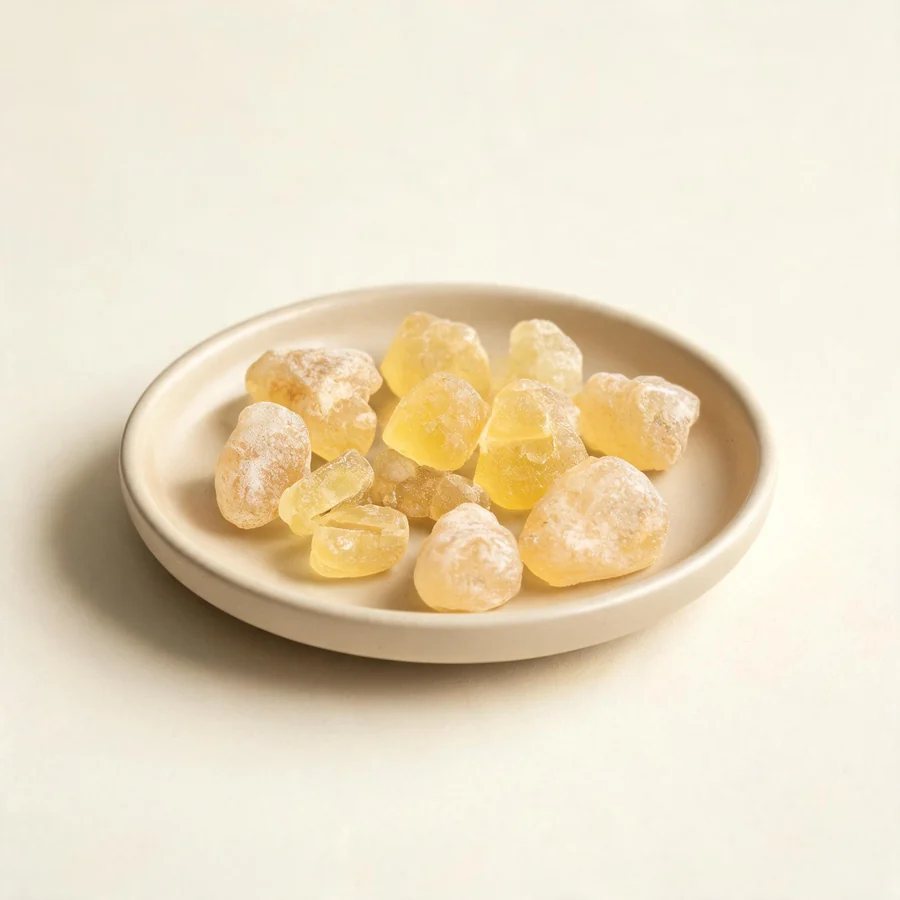
Skin profile
Where this herb sits in skin practice: the pattern it corrects, the skin signs it suits, and what it should not be used for.
Ru Xiang is a mover for hard, dusky, painful tissue and a vulnerary for a sore that has stopped closing. It belongs to short courses, small doses and unbroken skin, and its most important practical limit is the stomach.
Skin signs that suggest it
- A hard, dusky, tender swelling that has not yet softened or pointed
- A shallow ulcer with a pale, flat base that will not fill in and shows little new tissue at its edges
- Purple or blue-black bruising with a firm lump that stays tender for weeks
- Pain fixed in one spot, sharp, worse on pressure and worse at night
- A raised, firm scar that itches or aches, with a glossy surface and a purple tinge
When it is not the right herb
Not while a sore is open and draining freely, and not once an abscess has burst, since the classical commentaries stop oral use at that point: the work is done while the swelling is still hard and pus has not collected. Not for hot, extending redness with fever, which is infection that needs medical care rather than a moving resin. Not for a depleted person with no stasis to show for treatment, not for heavy periods that flow freely without clots, and not where the stomach reacts to it.
What it does for skin
Skin-relevant actions only. Each one describes a mechanism in TCM terms and what it looks like on the skin.
Moves Blood and Qi in a fixed, painful lesion
Pungency and warmth are the qualities the tradition works with here, and they are said to reach the Qi and the Blood together, which is why a lesion that is hard, discoloured and sore in one spot responds while a diffuse red reaction does not. Pain that stays in one place, is sharp and is worse under pressure is the signature. That profile separates a stasis lesion from plain inflammation, and it is why a bruise, a tender scar or an indurated plaque is a better candidate than a spreading rash.
Reduces swelling and promotes new tissue
This is the action that made the resin a staple of external medicine. Given early, before pus collects, it is described as holding a swelling back; applied as a powder late, it is described as filling a pale ulcer that has stopped progressing. The two halves belong to different stages, the oral route to the hard phase and the topical route to the quiet, non-healing phase, and pressing a warming resin into a cavity that is already draining is the common error.
Eases pain by unblocking rather than numbing
The relief described is the kind that follows restored movement, not the numbness of an anaesthetic. Where Qi and Blood have stalled, the area is tender, tight and often cool or dusky, and warming and moving it changes the quality of the pain over days rather than minutes. This matters for expectations: the resin is not an analgesic for a headache or a toothache, and it is used for pain that belongs to a defined lesion or injury.
Loosens bound, tight tissue
The classical description includes relaxing the sinews and freeing the channels, and on the skin that becomes the case of tissue that is bound down over a scar or a joint and feels tight rather than merely dry. Massage with a resin ointment is the traditional way to apply that action, and the massage itself does part of the work. A scar that is spreading, painful or changing colour is a reason to stop and be assessed, not to massage harder.
Skin conditions it is used for
Mapped to the condition pages on this site. The pattern column shows what the skin is doing when this herb is the right choice.
| Condition | Pattern | Why it suits | Typical setting |
|---|---|---|---|
| Boils and abscesses | Early toxic swelling, hard and not yet pointing | The classical formula for the early boil contains both resins, and the reasoning is that the swelling is a blockage of Qi and Blood with toxin caught inside it. The resin is used while the lesion is hard and before pus collects, alongside herbs that clear the toxin and protect the surface. Once the boil has burst and is draining, the internal resin stops; a large boil with fever, spreading redness or a person who is unwell needs medical care rather than a formula. | Xian Fang Huo Ming Yin, with Jin Yin Hua and Zao Jiao Ci |
| Skin abscess | Stasis and toxin in a deep, indurated swelling | A deep, hard, tender swelling that does not resolve reads as toxin held in static Blood, and the moving action is directed at the hardness rather than at the colour. The resin is a support inside a formula, never the sole treatment, and it is not applied into a cavity. An abscess that fluctuates, is very painful or comes with fever needs drainage, and delaying that in favour of herbs is the main risk with this indication. | A modified Xian Fang Huo Ming Yin, or Qi Li San applied as a powder to the intact skin over a small injury-related swelling |
| Bruising | Traumatic stasis with a firm, tender lump | A blow tears the small vessels, and blood that has left them pools where it does not belong, so the area swells, discolours and hurts sharply on pressure. That state is the traditional territory of the resin, and it is why the classical injury powders so rarely omit it. It is applied to unbroken skin and after the injury has been assessed, because a swelling that is rapidly enlarging, very tense or over a bone may need imaging rather than a plaster. | Qi Li San, taken internally in small doses or applied as a paste in rice wine to unbroken skin |
| Keloids | Stasis held in a mature scar | A raised, firm, glossy scar that aches or itches is read as Blood stasis held in tissue that never remodelled properly, and the traditional approach is a warming, moving ointment massaged in over weeks. This is the weakest of the skin indications in terms of evidence, and it should be presented as traditional practice rather than as a treatment likely to flatten a scar. Corticosteroid injection and silicone sheeting are the established options, and a scar that is growing quickly should be seen by a clinician. | A resin and myrrh ointment massaged into the scar, with Dang Gui and Mo Yao internally where a practitioner advises |
| Burns | A burn wound stalled in the repair phase | Once a superficial burn has closed over or is granulating cleanly, a resin ointment or powder is a traditional vulnerary for a surface that has stopped progressing. It is not for the acute burn, for a deep burn, or for any burn that is infected, and it does not replace dressings and analgesia. The distinction matters because a resin applied to a fresh, weeping burn is painful and adds nothing to proper care. | A resin-containing ointment on a healed but slow-closing superficial burn, alongside conventional wound care |
Combinations for skin
Herbs it is paired with when the skin, not an internal organ, is the target.
| Partner | Ratio | Why the pair is used |
|---|---|---|
| Mo Yao | 3 to 5 g of each, in equal parts | The classical resin pair, treated by the tradition almost as one medicine with two halves. Frankincense is said to free the Qi inside the Blood, which suits stiffness, spasm and pain that wanders; myrrh works on the Blood itself, which suits a clot or a mass. Of the two, myrrh dries more and tolerates the stomach less. For a hard tender swelling or a pale ulcer that will not fill, they are given together, briefly. |
| Xue Jie | 1 part Ru Xiang to about 7 parts Xue Jie, as in the seven-tenths powder | Dragon's blood both stops bleeding and disperses stasis, an unusual double action, and that is why the classical injury powders carry so much of it. The sealing resin and the opening resin are wanted at the same moment in a bruise or a sprain, so both appear. The proportions are deliberate rather than decorative: the sealing half dominates and the frankincense is a small leavening that keeps the pooled blood moving. |
| Huang Qi | 9 to 15 g Huang Qi with 3 to 5 g Ru Xiang | Astragalus lifts and supports the surface while the resin moves what is stuck, so a chronic sore that discharges and will not fill in is addressed from both directions. The pairing is chosen for a pale, tired person with a shallow ulcer or a leg wound that has stopped progressing, and the tonifying herb also cushions the stomach against the resin. It is a longer course than most resin prescribing, with review of the wound at each stage. |
| Dang Gui | 10 to 15 g Dang Gui with 3 to 5 g Ru Xiang | Angelica supplies the Blood that the resin is spending as it moves it, which is what makes the pair usable over weeks rather than days. It suits dry, thin scar tissue and a pale person with a sluggish, painful area, and it answers the objection that pure movers leave the tissue depleted. Both are warming, so a thin, dry, restless person with heat signs is not the right candidate. |
Formulas where it leads
- Xian Fang Huo Ming Yin (仙方活命饮) - The classical formula for the early stage of a boil or carbuncle, when the swelling is hard, red and painful and pus has not yet formed. It clears toxin, moves Blood and disperses swelling, and the two resins are its moving element. It is a formula for the early phase only, and a lesion that is already pointing or discharging calls for a different approach.
- Qi Li San (七厘散) - The seven-tenths powder, the best known injury preparation in the tradition, built on dragon's blood with a small amount of the two resins, plus borneol and musk. It is used for bruising, sprains and closed injuries, taken internally in very small doses or applied as a paste in wine to unbroken skin. It is not for open wounds, and the resins in it mean the same cautions on pregnancy and stomach apply.
Topical use
The external use is where the resin earns its place on a skin page, and it is old: powders for chronic ulcers, plasters for bruises, and ointments massaged into hard or scarred tissue. The material is sticky and aromatic, it softens with warmth, and it is applied to unbroken or clean, shallow surfaces only. Because it is a recognised sensitiser, a small trial area comes before any wider use.
| Preparation | How and when it is used |
|---|---|
| Powder for a chronic ulcer | Grind the resin with a little calcined mineral powder and dust it sparingly on a clean, shallow, non-infected ulcer once daily after washing with saline. Remove the old layer first, cover with a non-stick dressing, and stop if the edges redden or the discharge changes smell. Do not pack it into a cavity. |
| Ointment for a firm scar | Melt a small amount of the resin into a plain ointment base, cool it, and massage a thin film into a firm scar or an indurated patch twice daily for several weeks. The massage matters as much as the resin. A scar that is spreading, painful or changing colour should be assessed rather than massaged. |
| Warm plaster for a bruise | Mix equal parts of Ru Xiang and Mo Yao with a little rice wine or warm water to a paste, spread it on cloth and bind it over an unbroken bruise for a few hours. Keep it off broken skin and off the face, and do not leave it on overnight in anyone with sensitive skin. |
Patch test and cautions
The resin is a recognised contact sensitiser, and a plaster or an ointment containing it can produce a red, itchy, spreading dermatitis. Patch test for 24 hours, keep the area small, use it on unbroken skin only, and stop at once if the skin becomes more irritated rather than calmer. Do not apply it to an open, discharging or deep wound, and do not combine it with an occlusive dressing on a first trial.
Safety for skin use
What to check before recommending or using it, including the cautions that matter most for skin patients.
Do not use, or use with caution
- Pregnancy. The resin moves Blood and Qi with some force, the classical texts are explicit that a pregnant woman should not take it, and the bar covers the oral route. External use is best confined to a small area of unbroken skin, if it is used at all.
- An abscess that has already opened and is draining. Oral use stops there, and a resin plaster should not be packed into a draining cavity.
- A weak or irritable stomach. Nausea, burning and loose stools are the dose-dependent effects that earned the slightly toxic grading, and processed forms in small doses are the alternative to giving it raw.
- Deficiency with no stasis, and heavy periods that flow freely without clots. A moving resin draws on Qi and Blood as it works, so there is nothing for it to open in a depleted person, and it can make an already heavy period heavier.
- A known allergy to the Burseraceae resins, or a previous reaction to a plaster or an incense containing frankincense.
Pregnancy and breastfeeding
Oral use is avoided. The resin is a strong mover of Blood and Qi, the classical sources prohibit it in pregnancy, and the recorded use during obstructed labour was a supervised intervention in a stalled delivery rather than a precedent for ordinary pregnancy. For the skin, the same reasoning applies to a large area or a broken surface, where more is absorbed, and even a small plaster on intact skin is worth raising with a practitioner. No data exist on how much reaches breast milk, so a nursing mother should keep any course short and at the lowest dose.
Interactions
- Anticoagulants and antiplatelet drugs. Boswellic acids showed mild antiplatelet activity in laboratory work, and a pharmacovigilance signal links Boswellia products to a rising INR in people taking warfarin. Anyone taking warfarin, heparin or a direct oral anticoagulant should tell the prescriber first.
- Medicines handled by the CYP450 enzymes. Extracts inhibit several of these pathways in laboratory work, so drugs with a narrow therapeutic window, among them ciclosporin, tacrolimus and some antiarrhythmics, could in theory reach different levels.
- NSAIDs and immunosuppressants. Boswellic acids and the NSAIDs share inflammatory targets and a capacity to irritate the stomach, so the combination adds to gastric risk more than to benefit; the same acids modulate immune signalling, which is a theoretical concern with transplant medicines.
Allergy and patch testing
Frankincense is a known contact allergen, and allergic contact dermatitis from plasters, ointments and incense has been reported. Patch test a small area for 24 hours, stop if itching or redness develops, and remember that a resin reaction can spread well beyond the site of application. A reaction to one resin makes a reaction to the other more likely, since the two are so often used together.
General safety references
General references for herbal hepatotoxicity and herb-drug interactions; they are not specific to this herb.
- Review article: Herbal hepatotoxicity - an update on traditional Chinese medicine preparations. Alimentary Pharmacology & Therapeutics, 2014. PMID: 24844799.
- Interactions between herbal medicines and prescribed drugs: an updated systematic review. Drugs, 2009. PMID: 19719333.
- Warfarin and food, herbal or dietary supplement interactions: a systematic review. British Journal of Clinical Pharmacology, 2021. PMID: 32478963.
Evidence
The classical record is quoted with its source. The modern note states the level of evidence plainly.
Classical record
乳香香窜,入心经,活血定痛,故为痈疽疮疡、心腹痛要药。
Its fragrance is penetrating and it enters the Heart channel; it quickens the Blood and settles pain, and that is why it is a leading medicine for abscesses, sores and ulcers, and for pain in the chest and abdomen.
Ben Cao Gang Mu (Compendium of Materia Medica), Li Shizhen - Li Shizhen, 1578. The sentence ties the smell, the channel and the two great indications together, and the sore half of it is the whole basis of the skin use.
活血去风,舒筋止痛之药也。……咸取其香辛走散,散血排脓,通气化滞为专功也。
It is a medicine for quickening the Blood, expelling Wind, loosening the sinews and stopping pain. Its strength is taken from the way its aromatic pungency scatters: dispersing Blood, discharging pus, freeing Qi and transforming stagnation is its particular work.
Ben Cao Hui Yan (Collected Words on Materia Medica), Ni Zhuomo - The commentary explains the surgical use through the aromatic quality rather than through any specific affinity for tissue, which is why the same resin serves a bruise and a sore.
乳香,微温。
Frankincense is slightly warm in nature.
Ming Yi Bie Lu (Supplement to the Classic of Materia Medica) - Third to fourth century. The earliest statement of its temperature, and the basis for the later grading of its character as warming and dispersing.
微毒。
It is graded as slightly toxic, a note that refers to its local irritant effect rather than to poisoning of the whole body.
Ri Hua Zi Ben Cao (Materia Medica of Ri Huazi) - The grading that governs the small dose and the preference for processed forms; the recorded harm is gastric irritation, not systemic toxicity.
Modern evidence
Evidence status
- Boswellic acids are the fraction studied most. Laboratory and animal work reports anti-inflammatory activity through several pathways, including inhibition of 5-lipoxygenase, and the volatile oils carry much of the smell rather than the measured activity. None of this is a skin trial.
- Small randomised trials of oral Boswellia extracts exist for osteoarthritis and a few other inflammatory conditions, and they are not skin trials: no controlled study of Ru Xiang in a dermatological condition was identified, so the sore and scar uses rest on traditional external practice.
- The safety literature is better developed than the efficacy literature. A pharmacovigilance signal for raised INR in people taking Boswellia with warfarin is on record, and contact sensitisation to the resin in plasters and ointments is well documented. The slightly toxic grading describes gastric irritation, which processed forms are used to reduce.
PubMed records
Selected real PubMed records for this herb's species or its constituents, chosen by species name and title relevance. They are references for the non-TCM discussion above, not proof that the herb treats any skin condition.
- Episiotomy wound healing by Commiphora myrrha (Nees) Engl. and Boswellia carteri Birdw. in primiparous women: A randomized controlled trial.. Journal of ethnopharmacology, 2021. PMID: 32971163 (skin-related record).
- Effects of an acetone extract of Boswellia carterii Birdw. (Burseraceae) gum resin on rats with persistent inflammation.. Journal of alternative and complementary medicine (New York, N.Y.), 2005. PMID: 15865500 (skin-related record).
Dose and forms
Skin-practice dosing and the preparations that suit skin complaints.
| Form | Dose and notes |
|---|---|
| Decoction | 3 to 5 g of the resin, added near the end of the boil so that the volatile oils are not driven off, or put in a cloth bag. Up to 10 g is on record where pain is severe, and most practice stays at the lower end. |
| Pills and powders | 1 to 3 g a day in prepared pills or powder, taken with or after food. The resin is normally vinegar-processed or dry-fried before use, both to spare the stomach and to make it easy to powder. |
| Topical | The quantity is set by the area rather than by weight: a thin dusting on a shallow ulcer, or a small amount melted into an ointment base for a scar. Keep to a small area and a short trial before using it more widely. |
| Course length | Days to a few weeks for a defined problem. The resin is not a long-term tonic, and continuous use over months needs a reason and a review of the stomach. |
The quantity is small because the resin is concentrated and irritant, not because it is dangerous. Much of the activity sits in the volatile fraction, which prolonged boiling drives off, so a decoction carries less than its weight implies; this is why so much traditional prescribing went through pills and powders. Nausea, burning or loose stool means the amount is too high or the raw form is wrong. The old grading of slight toxicity names that local harm, and it is no licence to take a natural gum for months.
Citations and further reading
Only real sources are listed: the classical materia medica passages quoted above, and the source works behind the botanical and safety statements.
- Ben Cao Gang Mu (Compendium of Materia Medica), Li Shizhen, 1578 - passage quoted above.
- Ben Cao Hui Yan (Collected Words on Materia Medica), Ni Zhuomo, 1624 - passage quoted above.
- Ming Yi Bie Lu (Supplement to the Classic of Materia Medica), Tao Hongjing, Southern and Northern Dynasties - entry quoted above.
- Ri Hua Zi Ben Cao (Materia Medica of Ri Huazi), Five Dynasties period - source of the slightly toxic grading.
- Olibanum monograph: Pharmacopoeia of the People's Republic of China - accepted species, part used and quality requirements for the resin.
- Pharmacovigilance and sensitisation statements: based on case reports of raised INR with warfarin and on reports of allergic contact dermatitis to frankincense, given as safety findings rather than as claims of benefit.
- Botany and chemistry: literature on Boswellia carterii and related species of the Burseraceae, and on the boswellic acids.
Educational reference for qualified practitioners. This page is not medical advice, and skin conditions should be diagnosed by a clinician before treatment.