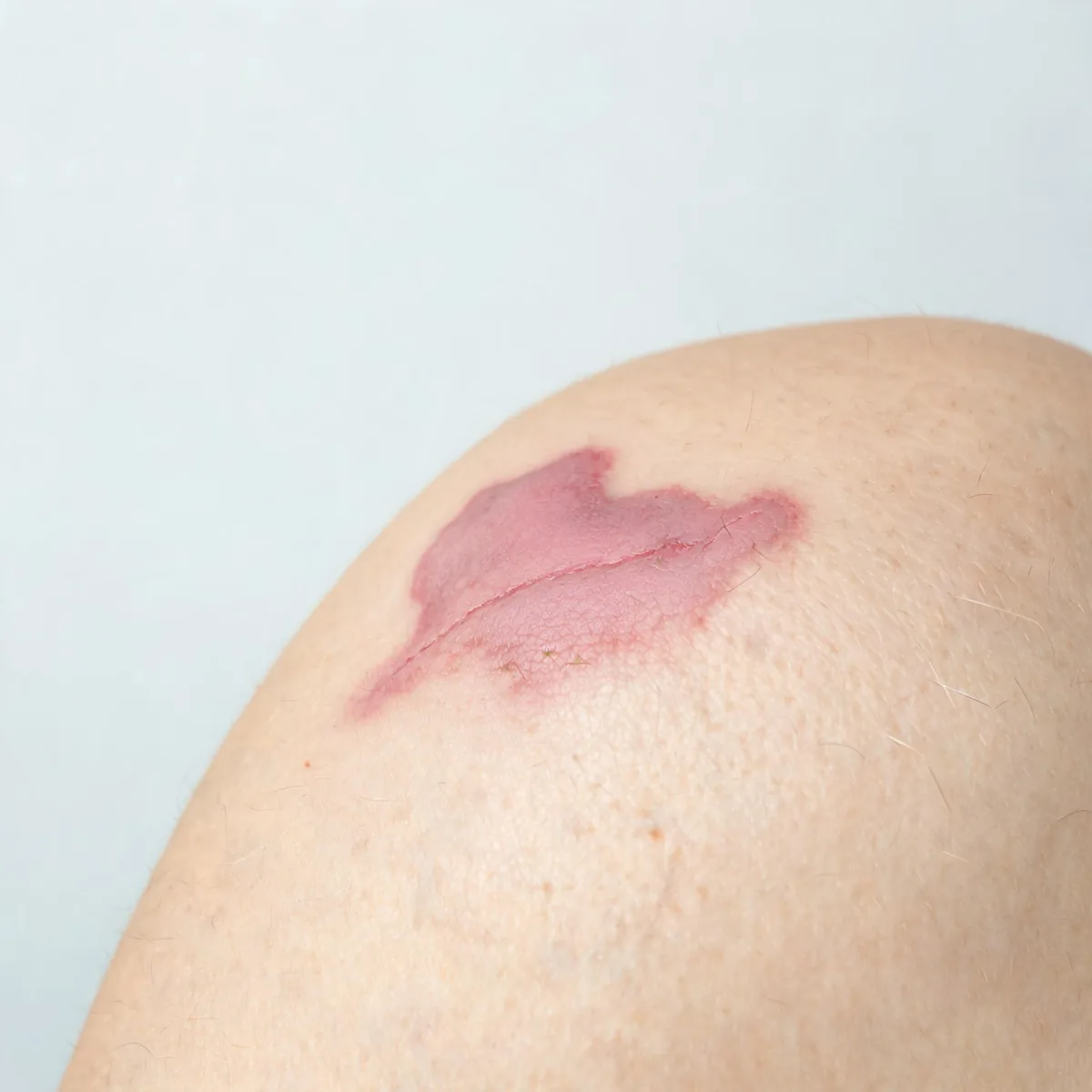
Understanding Keloids
The tradition describes a keloid as a local manifestation of deeper disharmony involving the Blood, Spleen and Liver. A healthy body heals a wound cleanly; when internal heat or stasis remains, the scar keeps thickening.
Damp-Heat gives a red raised scar with heat and intense itch, a heavy sluggish body, a sticky taste and poor appetite. Blood Stagnation gives stabbing fixed pain at the scar, worse at night and with pressure, with a hard dark red-purple keloid.
Excess-Heat gives intense local redness and heat with swelling and severe stabbing pain, thirst for cold drinks and restlessness. Toxic-Heat adds pus or oozing exudate from the keloid with throbbing pain, red swollen hot skin and restlessness - that suggests infection.
Qi and Blood deficiency gives a keloid that is less red and less hot, in a person with persistent fatigue, a pale complexion, dizziness and poor appetite. That is the pattern where the scar is a sign of slow, poor healing rather than active heat.
The Chinese name still used for a keloid, xie zu zhong, translates as crab's claw swelling, and it describes the way the tissue creeps outward past the edge of the original wound. Classical writers took that creeping as evidence that the body was already carrying heat, dampness or stagnant blood before the skin was ever broken, so repair ran on and never knew where to stop. The Spleen is the organ that keeps fluids moving, and a diet of greasy, sweet or pungent food weakens it, letting dampness gather and mix with heat inside the Blood. Once a wound exists, that mixture has somewhere to go: it pools at the injury, and the new tissue rises red, hot and maddeningly itchy. People in this state often describe themselves as heavy and foggy, and their tongue coating is greasy.
The Liver governs the smooth movement of Qi and Blood, and its role explains the hard, dark, quiet keloid that aches rather than burns. Frustration, grief or a constitution that holds tension can jam the flow of Qi; when Qi stops, Blood stops behind it, and the scar sets like a knot with a stabbing pain that is always louder at night. A third possibility is heat on its own, arriving after surgery or injury as an angry red and painful lesion with little dampness in the picture. Two further patterns complete the set. Where Qi and Blood are too depleted to finish the job, the scar grows slowly, stays pale and hard, and sits on a person who tires easily. Where toxin has entered the wound, the keloid suppurates, oozes and throbs, and that is the picture that needs the most urgent attention.
Conventional view
A keloid is a benign overgrowth of fibrous tissue that follows an injury to the skin, whether that injury was surgery, a piercing, acne or a small cut. It is distinguished from an ordinary scar by its behaviour: it spreads beyond the original wound margin and does not fade or shrink on its own. Itching, tenderness, pain and appearance are the usual complaints, and the tendency runs in families and is more common in people with darker skin. Diagnosis is made by looking at the scar and taking the history, and a biopsy is only needed when the diagnosis is genuinely uncertain, because a keloid is not a cancer.
Conventional care aims to flatten the scar and relieve the symptoms. Injecting a corticosteroid into the lesion is the usual first step, since it reduces inflammation and slows collagen production. Silicone sheets or gels, pressure garments, cryotherapy and laser treatment are used alongside it, and surgical excision is reserved for lesions that do not respond, because cutting a keloid out on its own carries a high chance of it returning larger. Combinations of these methods are common, and the sequence is chosen according to site, size and previous response.
The limitation is that all of these approaches work on the scar rather than on the tendency to form it. Shrinkage achieved with steroids or surgery is often temporary, recurrence after excision is frequent, and repeated injections can thin the skin or leave it discoloured. Conventional practice also treats keloids as one condition, whereas a hot red oozing lesion and a dark hard stabbing one behave differently and may need different management. That gap, between controlling a scar and correcting the ground it grew from, is where TCM is offered.
Selected PubMed records
Real PubMed records for the conventional discussion above, selected by condition name and title relevance. They are references, not a claim that any treatment is proven for this condition.
- Keloids and Hypertrophic Scars.. Dermatologic clinics, 2023. PMID: 37236718.
- Hypertrophic Scars and Keloids: Advances in Treatment and Review of Established Therapies.. American journal of clinical dermatology, 2023. PMID: 36662366.
- Keloid treatments: an evidence-based systematic review of recent advances.. Systematic reviews, 2023. PMID: 36918908.
How it connects
Keloids and acne frequently appear together because they share a root in Damp-Heat or Blood-Heat. When someone with acne-prone skin develops a keloid, it signals that the internal Heat and Dampness are strong enough to disrupt normal wound healing, and clearing that root calms active acne while helping prevent new keloids forming after breakouts heal. If a keloid becomes infected it can progress to an abscess, which in TCM reflects the pattern deepening from Damp-Heat or Blood Stagnation into Toxic-Heat. Treating the root early with herbs that cool the Blood and resolve Toxins can stop that progression and avoid the need for drainage.
How it is assessed
The practitioner assesses colour, temperature, growth and the constitutional picture.
What a practitioner looks for
- Growth: a keloid that grows beyond the original wound edge is characteristic.
- Colour and heat: red hot itchy scars suggest heat; pale cool scars suggest deficiency.
- Pain: fixed stabbing night pain suggests Blood stagnation.
- Red flags: rapid growth over days or weeks, ulceration, or discharge.
A practitioner reads the scar before asking anything else, noting its colour, its temperature and whether it itches, weeps or simply sits there. A bright red lesion that is hot and tender to touch, on a person who feels heavy and has loose sticky stools, points to Damp-Heat held in the Blood; the coating is yellow and greasy and does not scrape off easily, and the pulse runs slippery and rapid. When the redness is fierce and the pain sharp while the tongue is red and almost bare of coating, with a large flooding pulse, the diagnosis shifts to Excess-Heat burning locally, which often appears suddenly after an operation or an accident.
A dark red-purple nodule that has hardened, with pain that stabs and stays in one place, sends the practitioner looking for Blood Stagnation. The tongue is dusky or spotted with purple, the veins beneath it are swollen and dark, and the pulse is wiry or choppy; the scar itself is not especially hot, which is the clue that old congealed blood, rather than active fire, is keeping it there. If the surface breaks down or begins to discharge pus, the coating thickens and yellows, the pulse becomes slippery and rapid while the pain sharpens, which marks a move into Toxic-Heat and a need for prompt review.
In someone who looks pale and tires quickly, whose scar has formed without much heat and has barely changed in months, the practitioner suspects Qi and Blood Deficiency, and confirms it with a pale tongue, a thin coat and a weak pulse. Red flags are asked about directly: growth over days rather than months, ulceration that will not heal, bleeding that pressure does not stop, or a foul discharge with fever all belong with a dermatologist rather than a herbalist.
TCM patterns in Keloids
Differentiation for keloids turns on three things: how the scar behaves, what the person feels elsewhere, and what tongue and pulse show. Heat with dampness brings redness, swelling, heat and itch, a heavy body, a sticky taste and a greasy yellow coating. Heat without dampness is drier and angrier, with a red tongue that lacks coating and a flooding pulse. Blood that has stopped moving gives a different picture entirely: the scar is hard, dark and purple, the pain is fixed and stabbing and worse at night, and the tongue is dusky with purple spots. Where toxin has entered, the lesion suppurates and throbs. Deficiency is the quietest pattern, with a pale cool scar, fatigue, dizziness and a weak pulse. These are stages of one process, not separate diseases: a scar can begin as Damp-Heat and harden into stasis over a year or two, and the formula changes as the picture shifts.
| Pattern | Key signs | The itch | Tongue | Main formula |
|---|---|---|---|---|
| Damp-Heat | Not specified | Red raised scar with heat and intense itching | Body: Red, often swollen with teeth marksCoat: Yellow, greasy and thick, usually in the middle and at the root | Not specified |
| Blood Stagnation | Stabbing fixed pain at the scar; Pain worse at night and with pressure | Not specified | Body: Purple, dusky or with dark stasis spots; sublingual veins dark and distendedCoat: Often thin white; a yellow coat would suggest Heat as the cause | Not specified |
| Excess-Heat | Intense local redness and heat; Swelling and severe stabbing pain | Not specified | Body: Red, possibly with raised red pointsCoat: Thick, dry and yellow | Not specified |
| Toxic-Heat | Pus formation or oozing exudate from the keloid; Intense throbbing pain | Not specified | Body: Red, often with raised red pointsCoat: Yellow, dry, sometimes thick | Not specified |
| Qi and Blood Deficiency | Keloid less red and less hot | Not specified | Body: Pale, possibly thin or with teeth marksCoat: Thin white | Not specified |
Damp-Heat
Red raised itchy scar with a heavy body and sticky taste.
Damp-Heat appears when the Spleen stops transforming fluids cleanly. Greasy, sweet and pungent food, taken often enough, leaves dampness to gather, and heat follows it into the Blood. A fresh wound then becomes the place where that mixture collects, so the tissue rises, holds warmth and itches intensely, and the dampness makes it thick while the heat keeps the inflammation alive.
The tongue shows a red body under a yellow greasy coat that is hard to scrape away, sometimes swollen with teeth marks, and the pulse is soggy and rapid or slippery and rapid. Spicy and fried meals, alcohol, smoking, humid weather, stress and scratching all make the scar angrier, while a light cooling diet, gentle exercise, stress management and keeping the lesion clean and dry settle it. Long Dan Xie Gan Tang is the formula named for this presentation, supported by Huang Qin, Huang Lian, Zhi Zi, Mu Dan Pi and Chi Shao, with LI-11 Quchi, LI-4 Hegu, SP-10 Xuehai, SP-9 Yinlingquan and LR-3 Taichong as the points.
Signs
- Red raised scar with heat and intense itching
- Body heavy and sluggish
- Sticky taste with poor appetite
- Loose stools
Diet and lifestyle for this pattern: Keep the diet clean and light: plenty of vegetables, mung beans, barley and celery to drain Dampness. Avoid spicy, greasy, fried and sugary food as well as alcohol, which generate internal Damp-Heat.
Blood Stagnation
Hard dark purple scar with fixed stabbing night pain.
Blood Stagnation begins with a healing process that has been interrupted. Qi and Blood arrive at the site after surgery or injury and then fail to move on, so the tissue that should have settled into a soft pale scar stays congested and hardens into a dark purple lump that spreads like a claw. The pain belonging to this pattern is stabbing and fixed, and it reports itself more loudly at night, when energy withdraws inward and blood runs slower still.
Under this pattern the tongue is purple or dusky with stasis spots and swollen dark veins beneath it, and the pulse is choppy or wiry. Long sitting and inactivity, cold weather, anger and worry, heavy greasy meals and any pressure on the scar all make it worse, while gentle movement, warmth, light massage around the edge and turmeric or ginger in the diet ease it. Xue Fu Zhu Yu Tang is the classical choice, with Tao Ren, Hong Hua and Chi Shao carrying the work, and LI-4 Hegu, LR-3 Taichong and SP-10 Xuehai as the main points.
Signs
- Stabbing fixed pain at the scar
- Pain worse at night and with pressure
- Hard dark red-purple keloid
Diet and lifestyle for this pattern: Eat blood-moving food such as turmeric, black fungus, dark leafy greens and a little vinegar, and avoid cold raw food that congeals Blood. Gentle daily walking or stretching keeps Qi and Blood flowing, and protect the scar from further trauma and tight clothing that presses on it.
Excess-Heat
Intensely red hot scar with severe stabbing pain.
When the body carries more heat than it can disperse, a healing wound becomes a natural outlet for it. The area turns bright red, hot, swollen and painful, and the agitated Blood both stagnates and overfeeds the tissue, which is how a scar ends up thick and wider than the injury that started it.
The tongue is red, sometimes prickly, under a thick dry yellow coat, and the pulse is rapid and forceful, often overflowing and surging under the fingers. Sun and heat, spicy or deep-fried food, coffee, alcohol and frustration all feed the fire, while a cool room, a cold compress, rest and a light cooling diet calm it. Xian Fang Huo Ming Yin is the formula named here, with Mu Dan Pi, Chi Shao, Kun Bu and Chong Lou, and the points are LI-11 Quchi, LI-4 Hegu, SP-10 Xuehai and LR-3 Taichong.
Signs
- Intense local redness and heat
- Swelling and severe stabbing pain
- Thirst for cold drinks
- Restlessness with dark urine
Diet and lifestyle for this pattern: Avoid spicy, greasy and deep-fried food as well as alcohol and coffee, which add Heat. Eat more cooling food such as cucumber, mung beans and watermelon, keep the keloid cool and out of direct sun and hot compresses, and keep movement gentle so Qi flows without overheating.
Toxic-Heat
A scar with pus or oozing and throbbing pain.
Toxic-Heat describes a wound that has been taken over by heat and toxin rather than merely irritated by them. The local Qi and Blood stop moving and putrefy, the tissue breaks down, and fluid collects as pus. A keloid in this state has stopped being only an overgrowth: it suppurates, oozes and throbs, and the pain climbs rather than settling.
Here the tongue is red and thorny under a dry yellow coating, while the pulse is rapid and forceful, full or slippery. Spicy fried food, humid weather, stress and tight occlusive clothing that traps heat all aggravate it, while a cool environment, light cooling meals and an uncovered dry lesion help. Xian Fang Huo Ming Yin and Huang Lian Jie Du Tang are both named for this pattern, with Jin Yin Hua, Lian Qiao and Pu Gong Ying clearing the toxin, and LI-11 Quchi, LI-4 Hegu and BL-40 Weizhong used as points.
Signs
- Pus formation or oozing exudate from the keloid
- Intense throbbing pain
- Red swollen hot to the touch
- Restlessness
Diet and lifestyle for this pattern: Avoid all spicy, greasy and fried food, which add fuel to the fire. Eat cooling, detoxifying food such as mung beans, cucumber and pear, keep the keloid clean and protected from irritation, and rest well, since overexertion stirs up Heat.
Qi and Blood Deficiency
A paler, cooler scar in a fatigued person.
Where Qi and Blood are short, the body cannot fund a clean repair. The tissue that forms is disorganised and slow to mature, so the keloid stays hard and only faintly coloured, and it barely changes from month to month. The tiredness, pallor and poor circulation that accompany it belong to the same shortage, because skin that is badly supplied cannot remodel what it has already built.
The tongue is pale, perhaps thin or marked by the teeth, with a thin white coat, and the pulse is fine and weak, most noticeably at the right guan position. Overwork, cold raw or irregular meals and emotional strain deplete the person further, while rest, warm soups and stews and gentle exercise rebuild them. Dang Gui, Chuan Xiong, Dan Shen and Bai Xian Pi are the herbs recorded for this pattern, supported by ST-36 Zusanli, SP-6 Sanyinjiao, SP-10 Xuehai and LI-11 Quchi.
Signs
- Persistent fatigue and lack of energy
- Pale or sallow complexion
- Dizziness with poor appetite
- Keloid less red and less hot
Diet and lifestyle for this pattern: Eat warm cooked food such as soups and stews with added red dates, goji berries and a little ginger, and avoid cold raw food and overexertion. Gentle daily movement such as walking or qigong builds Qi without depleting it.
Treatment approach
How the tradition treats keloids, with the herbs, formulas and points used for it.
Principles
- Move Blood and resolve stasis where the scar is hard, dark and painful.
- Clear heat and resolve toxicity where it is red, hot and itchy, or discharging.
- Support Qi and Blood where healing has been poor and the scar is pale.
- Use conventional scar therapy as the mainstay, since silicone and pressure have the best evidence.
- Every formula choice follows the same logic: treat the branch that is visible, then the root that produced it. Damp-Heat is drained and cooled, stagnant Blood is moved and broken up, toxin is resolved and pus drained, and a deficient constitution is built up so that healing has something to draw on. The internal formula is paired with external work, an ointment, a paste or needling around the scar, because local tissue responds to local treatment even when correcting the root is slow.
Herbs used
Formulas
Acupoints
- LI-11 (Quchi)
- LI-4 (Hegu)
- SP-10 (Xuehai)
- SP-9 (Yinlingquan)
- LR-3 (Taichong)
- BL-40 (Weizhong)
- ST-36 (Zusanli)
- SP-6 (Sanyinjiao)
What to expect
- Keloids are described as slow and often persistent; the classical literature does not promise flattening.
- Conventional scar treatment remains the primary approach.
- Rapid growth or ulceration needs dermatological review.
- Session frequency matters less than consistency: the plan usually runs to weekly acupuncture, a daily formula and external applications several times a week. Scars that are red and itchy can calm within four to eight weeks, old hard scars take three to six months to soften, and a deficient pattern can need six months or longer. Because the tendency is constitutional, a seasonal course of acupuncture, or a brief run of herbs after any new injury, is often advised to protect the next wound.
Safety and when to get help
Seek medical help urgently for
- Rapid growth of the keloid over days or weeks.
- Signs of infection: pus, oozing, spreading redness or fever.
- A scar that ulcerates or bleeds.
For anything severe, sudden or spreading quickly, read when a skin problem needs urgent care.
Cautions
- Avoid unnecessary trauma, piercings and tattoos if you form keloids.
- Do not apply strong topical agents to the scar without advice.
- Sun protection helps scar appearance.
Using this alongside conventional care
- TCM is described as complementary to conventional care: silicone, pressure and steroid injection therapy continue alongside herbs.
- Steroid injections and silicone sheeting can continue while herbs and acupuncture are added, provided the dermatologist and the practitioner both know what the other is doing. Surgery is a different matter: a keloid-prone person may produce a larger scar after excision, so TCM is best started before the operation and continued afterwards. Blood-moving herbs such as Tao Ren and Hong Hua deserve caution alongside warfarin or other anticoagulants, and a complete medication list should be brought to the first consultation.
Diet and lifestyle
- Avoid spicy and greasy food and alcohol while the scar is active.
- The baseline is a diet that does not manufacture dampness or heat: mung bean soup, cucumber and celery on the plate, with bitter greens alongside, and deep-fried food, heavy red meat, alcohol and sweet treats kept rare. Pattern detail then adjusts the emphasis. With Damp-Heat the light cooling foods do most of the work; with Blood Stagnation, turmeric, black fungus, dark greens and a little vinegar are added; with deficiency, bone broth, congee, red dates, goji berries and cooked root vegetables are used instead, so that food rebuilds rather than drains.
If you're pregnant
Several of the herbs used for keloids move Blood strongly and are avoided in pregnancy, among them Hong Hua, Tao Ren and Chuan Xiong, because they can stimulate the uterus. The bitter-cold formulas, Long Dan Xie Gan Tang among them, are set aside as well, since their cold nature is considered harsh for the developing fetus. Acupuncture is the gentler route, though points on the lower abdomen and the lumbosacral area are left alone. Where a deficiency pattern is present, small doses of Dang Gui and Huang Qi may be used to build Qi and Blood. External applications are often preferred, because they keep systemic exposure low.
If you're breastfeeding
Huang Lian and Zhi Zi are bitter and cold, and both can reach a nursing infant through milk, where they may provoke diarrhoea, so they are usually avoided at this stage. For a Damp-Heat picture, milder options such as Fu Ling and Yi Yi Ren clear dampness without the same harsh cold. Blood-moving herbs are used sparingly, since they may reduce milk supply. Acupuncture is a commonly used choice while nursing, although trial evidence is limited, and local needling around the keloid softens the scar without exposing the baby to anything.
If treating a child
In children, a keloid usually appears after a burn, an operation or severe acne, and the two pictures that appear most often are Damp-Heat and Excess-Heat, because a child's Spleen is still developing and generates dampness easily. Herbal doses are reduced to a third or a half of the adult amount, and strong blood-moving herbs are avoided unless there is a clear reason. Children rarely tolerate deep needling, so shallow technique is used instead. External poultices made with Jin Yin Hua or Lian Qiao can work well, and Bai Zhu is often added to protect digestion.
If treating an elderly patient
In older patients a keloid more often reflects Qi and Blood Deficiency: the scar is pale, less inflamed and slow to change. Treatment concentrates on strengthening the Spleen and Stomach so that Qi and Blood are generated, using points such as Sanyinjiao SP-6 and Zusanli ST-36, with herbs such as Huang Qi and Dang Gui. Doses are typically two thirds of the adult amount, and interactions with common prescription medicines are reviewed carefully. Acupuncture is often tolerated better than herbs, and timelines are longer because an older body rebuilds slowly.
Urgent-sign guidance is based on standard sources: NHS anaphylaxis, NHS cellulitis, NHS Stevens-Johnson syndrome, NHS melanoma.
Evidence
Evidence status
Compiled for this page from the classical and modern literature; not a systematic review, so treat it as a pointer to sources rather than clinical guidance.
Research is limited but encouraging. Small Chinese studies suggest Xue Fu Zhu Yu Tang and Long Dan Xie Gan Tang can reduce keloid size, itching and pain, alone or alongside corticosteroid injection, and acupuncture and moxibustion are reported to soften scar tissue and improve local circulation. Most studies are uncontrolled, small and published only in Chinese, and a proprietary formulation, Xiao Ji Pai Tong San, has only anecdotal reports. Conventional scar therapy remains the mainstay.
What the literature cannot yet show is efficacy in a controlled sense: the reports are small, uncontrolled and published in Chinese, so they establish that the approach is used and tolerated rather than that it outperforms standard scar therapy. That gap is why a practitioner will usually keep silicone, pressure or steroid treatment in place while herbs are trialled.
Studies often cited
Small studies suggest reduced keloid size, itch and pain, alone or with steroid injection. Small Chinese clinical studies (as recorded in the source)
Reported to soften scar tissue and improve local circulation, without controlled trials. Clinical reports (as recorded in the source)
Anecdotal reports only; no rigorous trial evidence. Anecdotal (as recorded in the source)
PubMed records for the TCM evidence
Real PubMed records for the TCM clinical evidence discussed above, selected by condition name and title relevance. They are references, not proof of benefit.
- Natural products - Dawn of keloid treatment.. Fitoterapia, 2024. PMID: 38554887.
- Fibrosis-associated non-coding RNAs in keloids: Dual roles in pathogenesis and therapy: A review.. International journal of biological macromolecules, 2025. PMID: 40967540.
Classical record
Keloid (crab foot swelling) occurs after injury when Qi and Blood congeal and Damp-Heat binds together, causing a fleshy protrusion shaped like a crab foot.
- Wai Ke Zheng Zong (Orthodox Manual of External Medicine), chapter on scars and masses. The Chinese original is not reproduced here: it could not be recovered reliably from the source record, and is not guessed.
肉蟹螯,形如蟹螯,长数寸,生于皮里膜外,由湿热毒邪流注而成。
The flesh centipede is shaped like a crab's claw, several inches long, growing between the skin and the membrane, and it forms when Damp-Heat Toxin pours down and accumulates.
The flesh centipede, Yi Zong Jin Jian - Yi Zong Jin Jian (Golden Mirror of Medicine), volume 74 on surgery, recorded from the reference; the quotation is given here with its Chinese original.
Common questions
Can herbs flatten a keloid?
The tradition describes moving Blood and clearing heat, but does not promise flattening. Silicone and pressure therapy are the mainstay.
Why do I form keloids?
The classical literature reads it as lingering heat or stasis in the tissue plus slow healing; conventional medicine relates it to genetic tendency and wound tension.
Should I have it cut out?
That is a dermatological decision, because surgery alone can cause a larger keloid.
When should a keloid be checked?
Rapid growth, ulceration, bleeding or infection signs.
How soon do the itching and pain settle?
Itch and pain are usually the first things to change, often within two to three weeks of starting herbs and acupuncture, even while the scar still looks the same. Softening and flattening follow over months, and the pace depends on which pattern is driving the keloid.
Can a keloid return after treatment?
The aim is to reduce the tendency that produced it rather than to remove one scar, which lowers the risk compared with treating the scar alone. Nothing guarantees that a keloid will not return, particularly where the family tendency is strong, so dietary and lifestyle advice is continued after the scar has flattened.
Can acupuncture soften a keloid that is years old?
It can help, but slowly. Needles are placed around the lesion rather than into its thickest part, which improves local circulation without provoking further growth. Old hard scars usually need a longer course and are best combined with herbs.