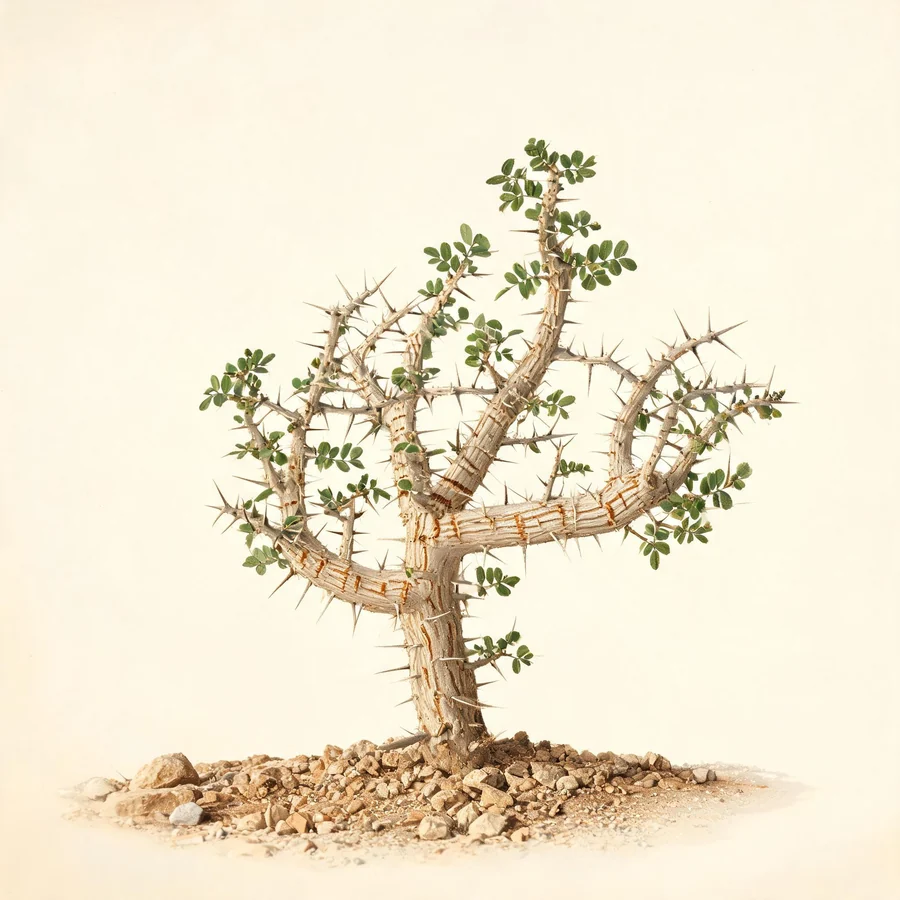
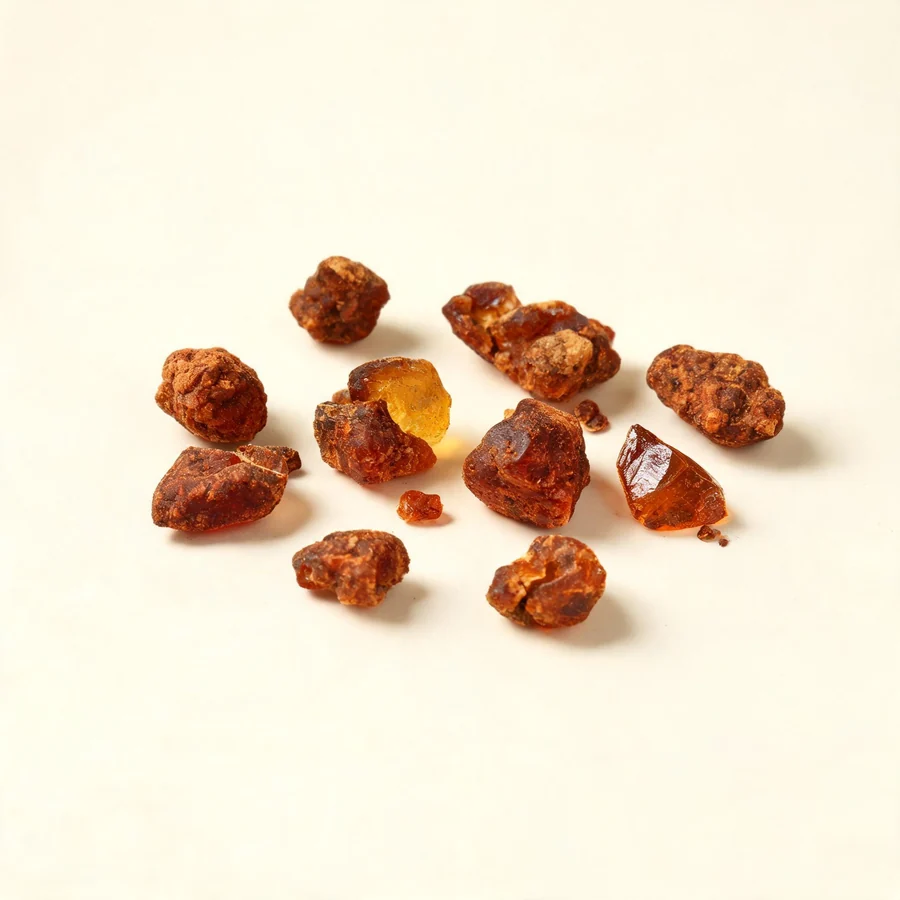
Skin profile
Where this herb sits in skin practice: the pattern it corrects, the skin signs it suits, and what it should not be used for.
Mo Yao is the stasis herb of the skin: hard, fixed, dusky and slow to resolve. It moves the Blood, softens the induration and helps new tissue close over a sore that has stopped healing, and it is kept away from open draining lesions, from depleted patients without stasis and from pregnancy.
Skin signs that suggest it
- A bruise or swelling that stays hard, dark and tender long after the injury (Blood stasis)
- Fixed, stabbing pain in a lesion or a limb, worse at night and on pressure
- A boil, abscess or nodule that is hard and unbroken, with a dusky or purplish colour
- A scar that keeps thickening and spreading beyond its original edge (stasis congealed in the tissue)
- A chronic ulcer or slow-healing sore with a dark, indurated rim and little new tissue
When it is not the right herb
Not for a lesion that is already open and draining freely, where the aim is to clear and drain rather than to disperse, and not for pain or swelling that comes from Blood deficiency rather than from stasis. The resin is drying and Blood-breaking, so it is a poor choice in a depleted person with dark, dry skin and no fixed pain. It also irritates the stomach, so a history of gastritis is a reason to choose something else.
What it does for skin
Skin-relevant actions only. Each one describes a mechanism in TCM terms and what it looks like on the skin.
Invigorates the Blood and disperses stasis in the skin
Stasis in the skin shows as a fixed colour change, a hard swelling or a plaque that does not move, and the tradition treats it by restoring the movement of Blood rather than by covering the lesion. The resin is bitter and acrid: the bitterness breaks up what has congealed and the acridity keeps it moving. It is chosen where the lesion has a physical density to it, and success is judged by whether that density starts to soften.
Reduces swelling and relieves fixed pain
Stasis pain is sharp, stays in one place and is worse at night. The tradition puts it this way: Blood that no longer circulates obstructs instead of nourishing, so restoring movement and relieving pain are one act. The resin therefore does not numb: the ache eases because what has collected is dispersed, which is why it is used for a hard boil before it points and for the ache of an old injury.
Promotes tissue repair in a sore that will not close
A sore that has resisted healing for months is read as stasis standing in the way of new flesh. The resin is dusted on as a powder and taken internally in small doses, and few substances serve both a new bruise and a lesion that has lingered for months. A sore that is infected, spreading or slow for another reason still needs medical assessment.
Breaks up hard nodules and thickened scars
Where stasis has been present for a long time the tissue itself changes: a scar thickens, a nodule forms, an old injury leaves a firm lump. The pungent, penetrating quality of the resin is read as reaching into that density, and it is used in formulas that move Blood and soften hardness. Progress is slow, and the aim is to reduce the hardness and the pulling sensation rather than to remove the tissue.
Skin conditions it is used for
Mapped to the condition pages on this site. The pattern column shows what the skin is doing when this herb is the right choice.
| Condition | Pattern | Why it suits | Typical setting |
|---|---|---|---|
| Bruising | Blood that has left the vessels and stopped moving | A bruise is the simplest stasis picture: blood outside the vessels, dark, tender and slow to clear. The resin is used when the bruise stays hard and painful rather than fading in a few days, and it is paired with frankincense so that the Qi-moving and Blood-moving halves of the picture are both addressed. It is applied externally as a powder or plaster and taken internally in a small dose, and a bruise that keeps expanding needs assessment. | Xiao Huo Luo Dan, or Mo Yao with Ru Xiang in a plaster |
| Boils | Toxic heat with a hard, unbroken, painful swelling | Before a boil points it is a hard, tender mass, and the tradition treats that stage by dispersing rather than by cutting. The resin addresses the stasis inside the swelling while the cooling herbs address the heat, and the combination of the two actions is why it is used for a boil that feels dense and fixed. Once the lesion has opened and is draining, the herb loses its target and the treatment changes. | Mo Yao and Ru Xiang with Jin Yin Hua and Lian Qiao in a toxin-resolving formula |
| Skin abscess | Stasis with toxin, the swelling indurated and slow to resolve | An abscess that neither resolves nor points has both heat and stagnant Blood in it, and the induration is the sign that stasis is part of the picture. The resin is added to a toxin-resolving formula when the swelling is hard and the pain fixed, and its neutral temperature means it does not disturb the balance of the cooling herbs. Deep, spreading or facial abscesses need medical care rather than a formula. | Modified Si Miao Yong An Tang with Mo Yao and Ru Xiang |
| Keloids | Stasis congealed in a scar that keeps growing | A keloid is read as a scar that keeps growing because heat, stasis or toxicity remains in the tissue. Mo Yao is not a cure for a keloid, but it is used in formulas that move Blood and soften hardness when the scar is firm, dark, painful or itchy, and its penetrating quality is why it is chosen over milder blood-movers. Injections and other conventional treatments remain the main options for a keloid that is spreading. | Modified Xue Fu Zhu Yu Tang with Mo Yao and E Zhu |
| Chilblains | Cold congealed Blood in the extremities | Chilblains are read as cold that has congealed the Blood in the small vessels of the fingers and toes, and the result is a dusky, painful, itchy swelling that returns each winter. A neutral, moving, penetrating resin suits a cold stasis lesion without adding heat, and it is used with warming herbs that carry the Blood outward to the limbs. The feet must also be kept warm and dry, and ulcerated chilblains need medical advice. | Modified Dang Gui Si Ni Tang with Mo Yao and Ru Xiang |
Combinations for skin
Herbs it is paired with when the skin, not an internal organ, is the target.
| Partner | Ratio | Why the pair is used |
|---|---|---|
| Ru Xiang | equal parts, 3 to 6 g each | The most famous pair in the materia medica. The warm, piercing resin works on Qi and the neutral, bitter one on Blood, and together they break stasis and reduce swelling wherever it sits. Neither displaces the other, and the division of labour is neat: frankincense opens the way and myrrh disperses what has collected. Used for injury, fixed pain and a boil that will not soften. |
| Dang Gui | 9 to 15 g Dang Gui with 3 to 6 g Mo Yao | Dang Gui both nourishes and moves the Blood, and myrrh breaks what has set, so obstruction is cleared without draining what remains. That matters in a pale, tired person, after illness, or in a chronic sore where the tissue is stagnant and undernourished at once. Dang Gui is used generously and the resin sparingly, which is the right way round for a depleted patient. |
| Xue Jie | 3 to 5 g each | Dragon's blood also moves Blood, and unlike myrrh it arrests bleeding. That is what makes the pair useful when a wound bleeds as bruising and swelling gather, and in a chronic sore that neither heals nor stops oozing. It also shows that moving Blood and stopping haemorrhage are not always opposites. |
| Dan Shen | 9 to 12 g Dan Shen with 3 to 5 g Mo Yao | Dan Shen moves and cools the Blood and calms the spirit, while the resin contributes harder stasis-breaking and stronger pain relief. The pairing suits a dusky, warm lesion with restlessness, and it balances the dryness of myrrh against the cooling quality of Dan Shen. It is used for stasis with heat rather than for cold congealed Blood. |
Formulas where it leads
- Xiao Huo Luo Dan (小活络丹) - A formula for chronic painful obstruction with stasis, in which Mo Yao appears with Ru Xiang, Chuan Wu, Cao Wu, Di Long and Dan Nan Xing. Its role is the stasis component: the pain that has become fixed and the tissue that has thickened. The formula contains toxic herbs and belongs to a practitioner rather than to self-treatment.
- Shen Tong Zhu Yu Tang (身痛逐瘀汤) - Wang Qingren's formula for generalised body pain from Blood stasis, built on the principle that long-standing pain eventually involves congealed Blood. Mo Yao is a minor but characteristic member, included to break the stasis while the blood-moving and channel-opening herbs restore flow. It is the formula most often cited for fixed limb and joint pain with a dark tongue.
Topical use
Mo Yao has a long external history, and for the skin it is often the more direct route. The raw resin is ground and applied as a powder or worked into a plaster, either alone or with frankincense, over an unbroken hard swelling, a bruise, a keloid or a slow-healing sore. External use puts the dispersing action into the tissue without the gastric irritation the resin causes when swallowed, which is why it is common for injuries and less common in internal formulas.
| Preparation | How and when it is used |
|---|---|
| Resin powder | Finely ground raw resin is dusted sparingly over an unbroken bruise or hard swelling, or mixed to a paste with a little warm water or vinegar. Keep it off broken skin and out of the eyes, and cover only lightly, since an occlusive dressing traps the aromatic resin against the skin. |
| Plaster and poultice | The powdered resin is combined with frankincense and a base such as honey or wax to make a plaster for a fixed, painful swelling or an old injury. Change it daily, check the skin underneath for redness, and stop if the area becomes more irritated rather than calmer. |
| Ointment for slow sores | Small amounts of a myrrh-containing ointment are used on a chronic, indurated sore that is not infected. A sore that is spreading, hot, foul or discharging pus needs medical care, and a resin ointment must not be used to cover it. |
Patch test and cautions
Patch test on normal skin for 24 hours before the first proper use. Do not apply to broken, ulcerated, infected or bleeding skin without clinical supervision, keep the resin away from the eyes and mucous membranes, and stop at once if burning, stinging or spreading redness develops. Pregnant women should not use it, even externally, without practitioner advice, and a plaster should not be left on for more than a day at a time.
Safety for skin use
What to check before recommending or using it, including the cautions that matter most for skin patients.
Do not use, or use with caution
- Pregnancy. The resin moves the Blood strongly and excites uterine muscle in laboratory work; it is contraindicated rather than merely cautioned, and the ban covers the processed form.
- Pain or swelling from Blood deficiency rather than stasis. Unless there is a sign of stasis, such as pain that stays in one spot, a dark tongue or clots, a drying, Blood-breaking resin drains the patient while missing the cause.
- Weak or inflamed digestion. The raw resin irritates the stomach and can cause nausea, vomiting and loose stools, so a history of gastritis, reflux or a sensitive stomach argues for the processed form, a small dose after food, or another herb.
- An open, freely draining sore, and a known sensitivity to myrrh that has caused rash, itching or flushing. Both are absolute reasons not to start, or to stop at once.
Pregnancy and breastfeeding
Contraindicated. This is not a herb to weigh cautiously in pregnancy; it is one to avoid. The classical texts state the prohibition plainly, and laboratory work describes an initial excitation of uterine muscle, so the risk of contraction and miscarriage is the reason. The ban covers the vinegar-processed form and external plasters. There are no data for breastfeeding, and the volatile oils together with the strong Blood-dispersing action mean that while breastfeeding it is best avoided unless a practitioner can give a specific reason.
Interactions
- Anticoagulants and antiplatelet drugs. Because myrrh has shown antithrombotic activity, a prescriber should be told before a course starts in anyone taking warfarin, heparin, aspirin, clopidogrel or one of the newer oral anticoagulants.
- Diabetes medicines. Research on Commiphora species has noted a fall in blood glucose, so insulin or an oral hypoglycaemic could in theory act more strongly than expected.
- Stomach medicines. Because the resin increases gastric secretion and bowel movement, antacids, proton pump inhibitors and drugs for delayed gastric emptying may be absorbed or timed differently.
Allergy and patch testing
Rash, itching and facial flushing are recorded in sensitive people, and a known allergy to myrrh is an absolute reason to stop. Reactions can follow external use as well as internal, so patch test any resin plaster on normal skin for a day before applying it more widely. Stop immediately if the skin becomes more irritated rather than calmer, and seek urgent care for lip or throat swelling, wheeze or faintness.
General safety references
General references for herbal hepatotoxicity and herb-drug interactions; they are not specific to this herb.
- Review article: Herbal hepatotoxicity - an update on traditional Chinese medicine preparations. Alimentary Pharmacology & Therapeutics, 2014. PMID: 24844799.
- Interactions between herbal medicines and prescribed drugs: an updated systematic review. Drugs, 2009. PMID: 19719333.
- Warfarin and food, herbal or dietary supplement interactions: a systematic review. British Journal of Clinical Pharmacology, 2021. PMID: 32478963.
Evidence
The classical record is quoted with its source. The modern note states the level of evidence plainly.
Classical record
散血消肿,定痛生肌。乳香活血,没药散血,皆能止痛消肿生肌,故二药每每相兼而用。
It disperses Blood, reduces swelling, settles pain and generates flesh. Frankincense invigorates the Blood and myrrh disperses it; both relieve pain, reduce swelling and promote repair, which is why the two are so often used together.
Ben Cao Gang Mu (本草纲目), Li Shizhen - This is the line that made the partnership standard, and the division of labour it describes is still taught.
没药味苦平无毒。凡恶疮痔漏,皆因血热瘀滞而成...此药苦能泄,辛能散,寒能除热。
Myrrh is bitter, neutral and non-toxic. Malignant sores and fistulae arise from Blood heat and stagnation; its bitterness drains, its acridity disperses and its cooling quality removes heat.
Ben Cao Jing Shu (本草经疏) - A correction to the simple view: the passage treats such sores as heat combined with stasis, not stasis alone, which is why cooling herbs join the resin.
没药,大概通滞血,打扑损疼痛,皆以酒化服。血滞则气壅凝,气壅凝则经络满急,经络满急,故痛且肿。
Myrrh generally unblocks stagnant Blood, and injuries with pain are all taken dissolved in wine. When Blood stagnates Qi congests, the channels become tense and full, and that fullness is why there is pain and swelling.
Ben Cao Yan Yi (本草衍义), Song dynasty - The sequence it traces, from stagnant Blood to congested Qi to tense channels, is the clearest account of why the resin is expected to ease both pain and swelling.
Modern evidence
Evidence status
- Laboratory studies of myrrh resin and its volatile oil, including the furanosesquiterpenes, report anti-inflammatory, analgesic and antimicrobial activity in cell and animal models. These are laboratory findings and do not establish benefit in skin disease.
- Clinical trial evidence for myrrh in skin disease is very limited. It appears mainly in studies of multi-herb plasters and ointments for wounds and inflammation rather than as a single agent, and no trial supports it as a treatment for keloids, boils or chronic ulcers.
- Safety: unprocessed resin irritates the stomach lining, which is why the vinegar-processed form is standard internally, and the main interaction signal is added bleeding risk with anticoagulants. The statements here describe traditional practice and the state of the evidence, not proof of effect.
PubMed records
Selected real PubMed records for this herb's species or its constituents, chosen by species name and title relevance. They are references for the non-TCM discussion above, not proof that the herb treats any skin condition.
- Cytotoxic sesquiterpenoid dimers from the resin of Commiphora myrrha Engl.. Phytochemistry, 2022. PMID: 36169037 (safety record).
Dose and forms
Skin-practice dosing and the preparations that suit skin complaints.
| Form | Dose and notes |
|---|---|
| Decoction or pills (internal) | 3 to 5 g daily, usually as pills or powder, since the resin dissolves poorly in water. Up to 6 g is the ordinary ceiling, and the processed form is standard. |
| Vinegar-processed form | Cu Mo Yao is the usual internal preparation. Vinegar processing softens its action on the stomach and directs it more to the Liver, while the raw resin is reserved for unbroken swellings on the skin. |
| External powder | For external use the quantity depends on the size of the area, and the powder is applied thinly to unbroken skin once or twice a day. |
| Course length | Short courses. The stomach is the practical limit, so nausea, a poor appetite or loose stools mean stopping rather than trimming the dose. |
A small dose is enough because the resin is potent and aromatic, and the form matters more than the gram count. Three to five grams of the vinegar-processed resin, taken as pills or powder and after food if the stomach is tender, is the ordinary internal range, while the raw resin belongs on the skin. Larger figures in older texts come from decoction practice under supervision and are not a household measure.
Citations and further reading
Only real sources are listed: the classical materia medica passages quoted above, and the source works behind the botanical and safety statements.
- Ben Cao Gang Mu (Compendium of Materia Medica), Li Shizhen, 1578 - classical passage quoted above.
- Ben Cao Jing Shu (Commentary on the Classic of Materia Medica), Ming dynasty - classical passage quoted above.
- Ben Cao Yan Yi (Extended Meaning of Materia Medica), Song dynasty - classical passage quoted above.
- Mo Yao monograph: Pharmacopoeia of the People's Republic of China - source for the accepted botanical source, part used and quality requirements.
- Modern evidence statement: based on laboratory literature on Commiphora myrrha resin and its volatile oil, summarised as a statement about the level of evidence rather than as a cited finding.
- Botanical description and identification: botanical literature on Commiphora myrrha, Burseraceae.
Educational reference for qualified practitioners. This page is not medical advice, and skin conditions should be diagnosed by a clinician before treatment.