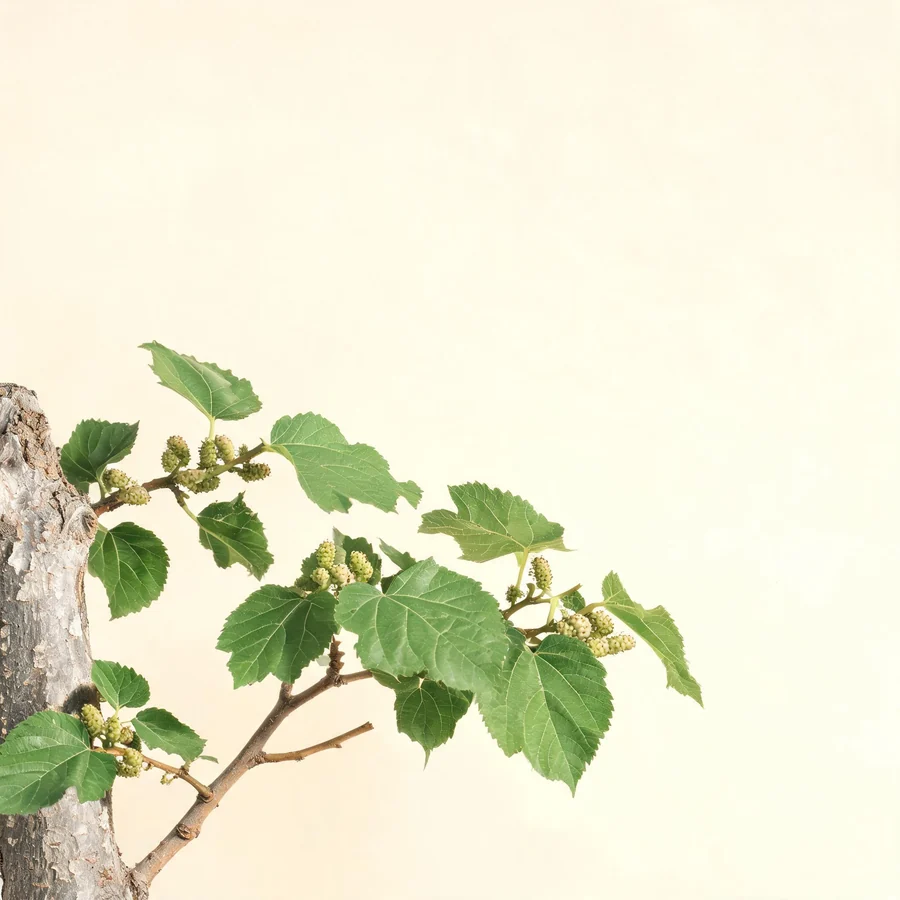
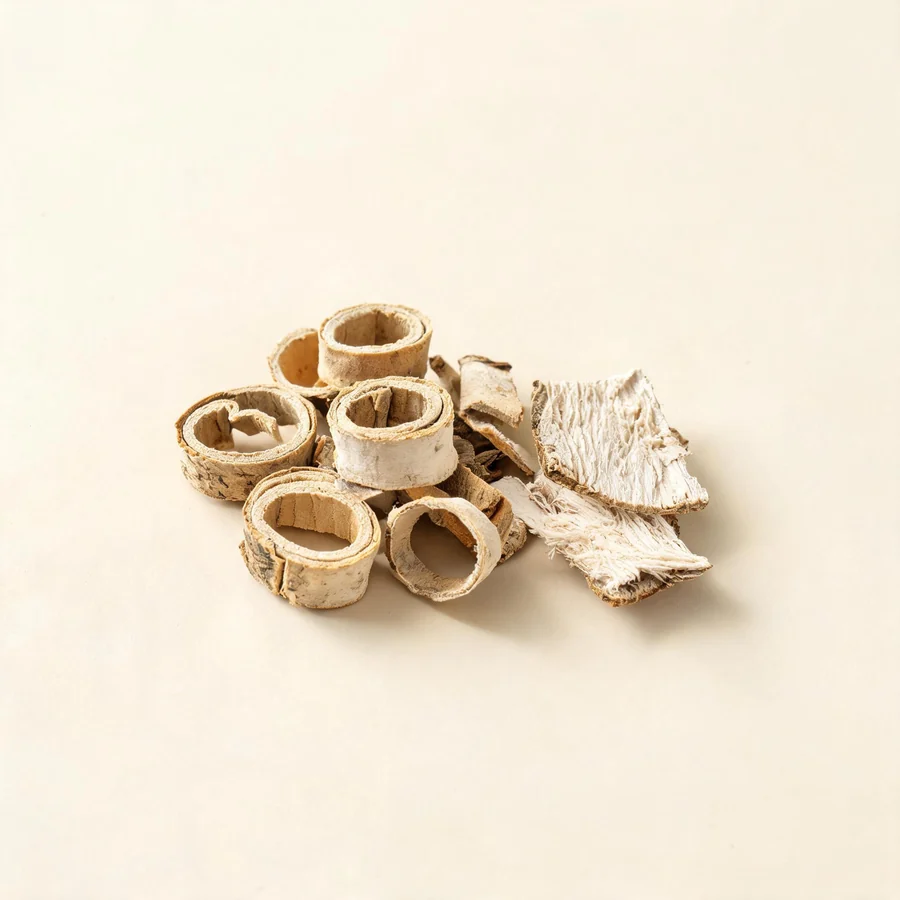
Skin profile
Where this herb sits in skin practice: the pattern it corrects, the skin signs it suits, and what it should not be used for.
Sang Bai Pi is the gentle Lung-heat bark: it cools the upper body, settles a cough and opens the water passages, so it suits a puffy face and a waterlogged surface as well as the red, greasy skin of Lung heat. It is mild enough for a child and too mild for a wet, infected eruption.
Skin signs that suggest it
- Puffiness of the eyelids and a full-looking face on waking, with scanty urine and a heavy chest
- Skin that looks waterlogged and holds a slight dent when pressed, worst in the morning and in humid weather
- A red, flushed face with greasy skin and small inflamed papules, with a hot feeling in the chest
- A dry or tickly cough that runs alongside the skin problem, so the chest and the surface complain together
- A red tongue with a thin yellow coat, and a pulse that is floating or slippery
When it is not the right herb
Wrong for the unproductive cough of a worn-out person, and wrong for skin that is pale, cold and dry with nothing hot or swollen about it. Cold and descending, the bark has nothing to work on in those states and leaves the Lung drier and the digestion cooler. The cough of wind-cold is also the wrong target: a white coat, a chill and watery clear mucus call for warming and dispersing. Since it increases urine, it is avoided where urine is already abundant, and a swollen face accompanied by breathlessness, frothy urine or fast weight gain needs a doctor rather than a decoction.
What it does for skin
Skin-relevant actions only. Each one describes a mechanism in TCM terms and what it looks like on the skin.
Cools heat held in the Lung
The Lung is held to send moisture and warmth out to the skin, so heat sitting there surfaces as redness, flushing and a greasy, congested look. The bark cools it gently, and the signs that point to it are a hot red face, a tight chest and a yellow-coated tongue. Loquat leaf and this bark together form the old acne formula, on the reasoning that the heat originates in the chest rather than the stomach.
Gets water moving again from above
Fluid is dispatched from the top of the body before the Kidney and Bladder deal with it further down, which is why the old texts give the Lung charge of the upper part of that route. Jam it with heat or phlegm and water pools in the wrong place, leaving a puffy, heavy surface. Restoring the downward direction is the mechanism behind its use for a swollen face and a waterlogged skin, and no action on the vessels themselves is implied.
Quiets the cough that keeps the skin irritable
When a dry, tickly or phlegm-laden cough drags on while the skin stays red and sensitive, the two are treated as a single disorder, and settling the Lung is part of settling the surface. The bark achieves this without the dryness that the bitter herbs produce, which makes it the usual pick for a child, a thin adult or someone convalescing. Apricot kernel joins it for wheeze and liquorice for the throat.
Takes down puffiness of the face and eyelids
Swelling that begins around the eyes and spreads over the face is read as water trapped at the surface, with the Lung failing to send it down. For this the bark is the standard choice, generally inside a compound of peels that act at different depths, and improvement comes in days. Most such swelling is harmless, but the same look can be the first sign of kidney or heart trouble, so a first episode deserves investigation.
Skin conditions it is used for
Mapped to the condition pages on this site. The pattern column shows what the skin is doing when this herb is the right choice.
| Condition | Pattern | Why it suits | Typical setting |
|---|---|---|---|
| Facial Swelling | Lung heat failing to descend water: puffy eyelids and a full face, worse on waking | Waking with a puffy face, soft tissue swelling under the eyes, a heavy chest and little urine points to water trapped at the surface, the Lung failing to pass it down. The bark opens the upper gate gently and is combined with apricot kernel or with peels that move water at the same time. Swelling that arrives suddenly, affects one side only or comes with breathlessness is a different matter and needs urgent attention. | Within a formula of peels for surface oedema, with Xing Ren and Fu Ling Pi |
| Skin Swelling | Water at the surface: pale, puffy, waterlogged skin with scanty urine | A skin that looks full and soft, dents under pressure and passes little pale urine has a fluid problem at the surface rather than a hot or red one. The bark addresses the face-led, upper-body version, acting from above to restore the descent that distributes fluid, and it supports a compound rather than standing alone. Swelling that starts in the legs in a cold, tired person points instead to Spleen or Kidney deficiency. | Wu Pi San, or with Fu Ling Pi and Sheng Jiang Pi |
| Acne | Lung heat with greasy skin and inflamed papules on the face | Small inflamed spots and pustules on cheeks and forehead, with an oily surface, a hot chest and a yellow-coated tongue, are read as Lung heat, and this bark is one of the standard ingredients in the formula that clears it. It is mild, used to cool the upper body rather than to dry individual lesions, while the stronger heat-clearing and toxin-resolving medicines work locally. Nodules, scarring and a sudden severe outbreak belong with a doctor, not a herbal decoction alone. | Pi Pa Qing Fei Yin |
| Rosacea | Lung and Stomach heat rising to the face, with flushing and small papules | Flushing that persists across nose and cheeks, dotted with small papules, is read as heat rising to the face; the bark is added when the chest is hot and a dry cough shows the heat is in the Lung. Its part is supporting, and the medicines that clear stomach fire and cool the blood do the main work. Flushing brought on by sun or alcohol, or redness with a swollen nose, needs a dermatological opinion first. | Pi Pa Qing Fei Yin with Huang Qin and Zhi Zi |
Combinations for skin
Herbs it is paired with when the skin, not an internal organ, is the target.
| Partner | Ratio | Why the pair is used |
|---|---|---|
| Xing Ren | 1 to 1, about 10 g of each | Apricot kernel sends Qi downward while the bark removes the heat that was holding it up, so a cough and a puffy face are addressed together. Of the two the kernel is the stronger descender and the bark the cooler, and the pair suits someone whose Lung is hot and whose face is puffy in the morning. The kernel is given processed and in a measured dose, and both are stopped when the cough and swelling settle. |
| Fu Ling Pi | 1 to 1, about 10 g of each | Here the herbs act at different levels: the bark opens the gate above by sending Lung Qi down, and poria skin works at the surface itself, moving water and supporting the Spleen responsible for it. One above and one at the surface is the arrangement used in the peel formula for water-led swelling, and it is the pairing for a puffy face with a cough and a body that feels heavy. |
| Huang Qin | 1 to 1, about 10 g of each | The skullcap brings the bitter, drying quality the sweet bark does not have. Coolness and fluid movement come from the bark without stripping moisture, while skullcap clears heat hard and dries a greasy, oozing surface. Use the pair when the face is red and oily and the skin has begun to weep; because skullcap is the stronger and harsher partner, a child or a thin adult is given more bark and less of it. |
| Gan Cao | about 10 g of bark to 3 g of liquorice | Liquorice is what holds the old children's prescription together, the one that also includes a little rice. It shields the stomach from the bark's coldness and soothes the throat, and the small proportion is deliberate: the action belongs to the bark, while the liquorice prevents the whole from draining a child too hard. |
Formulas where it leads
- Xie Bai San (泻白散) - A Song formula for heat lodged in the Lung, containing mulberry root bark, lycium root bark, liquorice and a little rice to protect the stomach. Skin practice borrows it for a flushed, oily face with a dry cough and a hot chest, where heat sits above and there is no dampness to dry. It is light and is given briefly.
- Pi Pa Qing Fei Yin (枇杷清肺饮) - The classic prescription for acne understood as Lung heat, formed on loquat leaf and this bark with coptis and phellodendron. The bark cools and descends while the bitter herbs clear heat and cut oil, and this is the traditional basis for treating inflamed facial spots. Cold, dry or cystic lesions are not its business.
- Wu Pi San (五皮散) - Five peels for swelling that shows first in the face and eyelids: mulberry bark, poria skin, ginger skin, tangerine peel and areca peel. Each works at its own depth, and the mulberry bark's role is to open the way above so water can descend. It is used briefly, and not where a failing heart or kidney is the cause.
Safety for skin use
What to check before recommending or using it, including the cautions that matter most for skin patients.
Do not use, or use with caution
- An unproductive cough in a thin, run-down person, with a pale dry tongue and a weak voice. Nothing is hot and nothing is stuck, so a cold downward-moving bark simply leaves the Lung weaker.
- Skin that is pale, cold and dry, with no swelling and no redness, and cold-type eczema where the patches are dry and thickened. Cooling and draining are the opposite of what such a surface needs.
- Cold weakness of the Spleen and Stomach: watery stools, poor appetite, a cold belly and constant tiredness. The bark is cold and pushes fluid down, so the stool may loosen further.
- Large volumes of pale urine or a fluid-depleted state, including after vomiting or diarrhoea, because the bark increases urine and would drain an already low reserve.
Pregnancy and breastfeeding
Given carefully rather than freely. Cold, descending and water-moving at once, it was thought by Qing commentators to threaten a pregnancy's stability, most of all where the Spleen and Lung were weak already. No harm to a fetus has been recorded, and ordinary doses with professional oversight are the usual middle course. Swelling of face or ankles during pregnancy should be assessed clinically before any herb is used, since it can be an early sign of a serious complication.
Interactions
- Diabetes medicines. Mulberry root bark extracts lower blood glucose in animal studies, and one component blocks alpha-glucosidase as a prescription drug does. With metformin, a sulphonylurea or insulin the effect could in principle drive glucose too low, so readings should be monitored and the prescriber informed.
- Blood pressure medicines and diuretics. Extracts lower blood pressure in animal work, so an antihypertensive may be reinforced and standing up may bring dizziness. The bark also promotes urine, and adding it to furosemide or a thiazide can remove more fluid than intended and upset electrolytes.
- Lithium. Anything that raises urine output can raise lithium levels by reducing clearance, and lithium's therapeutic range is narrow. Regular use of a diuretic herb alongside lithium needs the prescriber's agreement and blood monitoring.
Allergy and patch testing
Reactions to mulberry material are uncommon but real. People who react to mulberry fruit or pollen may be sensitive to the bark, and a herb that provokes a rash or a worsening itch should be stopped rather than continued at a lower dose. Because the material is a bark sold in strips, contamination with other Morus species or with trunk bark is possible, and a reaction may be to what the product actually contains.
General safety references
General references for herbal hepatotoxicity and herb-drug interactions; they are not specific to this herb.
- Review article: Herbal hepatotoxicity - an update on traditional Chinese medicine preparations. Alimentary Pharmacology & Therapeutics, 2014. PMID: 24844799.
- Interactions between herbal medicines and prescribed drugs: an updated systematic review. Drugs, 2009. PMID: 19719333.
- Warfarin and food, herbal or dietary supplement interactions: a systematic review. British Journal of Clinical Pharmacology, 2021. PMID: 32478963.
Evidence
The classical record is quoted with its source. The modern note states the level of evidence plainly.
Classical record
桑根白皮,味甘,寒。主伤中,五劳六极,羸瘦;崩中;脉绝;补虚益气。
Sweet and cold. The material is the pale bark of the mulberry root; its old uses were damage inside the body, the five strains and six exhaustions, wasting, uterine flooding and a pulse on the point of failing, and it was held to fill emptiness and fortify Qi.
Shen Nong Ben Cao Jing (Divine Husbandman's Classic of Materia Medica), Han compilation - The oldest entry reads as a tonic and says nothing of cough or water, which is worth knowing when the bark is presented as a draining herb.
去肺中水气,唾血,热渴,水肿,腹满胪胀,利水道,去寸白,可以缝金疮。
Water-Qi gathered in the Lung is removed by it. The same bark served for spitting blood, for thirst caused by heat, for oedema, for a bloated and distended belly; it opened the waterways, expelled intestinal worms and was even said to stitch a wound.
Ming Yi Bie Lu (Supplement to the Classic of Materia Medica) - Here the bark turns into the Lung and water medicine later practice knows, and the oedema use is stated outright rather than implied.
桑白皮,长于利小水,乃实则泻其子也,故肺中有水气及肺火有余者宜之。
Moving urine is what the bark does best. Li Shizhen's rule is that a surplus in the mother organ is drained by treating her child, which makes the bark apt for a Lung holding water-Qi or one with more Fire than it can carry.
Ben Cao Gang Mu (Compendium of Materia Medica), Li Shizhen, 1578 - Li Shizhen gives the reasoning that skin practice inherited: the Lung mothers the Kidney, so cooling the upper organ also drains the water organ beneath it, and that is why the bark suits a swollen face.
Modern evidence
Evidence status
- Extracts of the root bark, and its flavonoids and stilbenes such as morusin and the kuwanons, have been studied in the laboratory and in animals for anti-inflammatory, antibacterial, diuretic and blood-pressure-lowering activity. These are not trials in people, and they do not establish a benefit for facial swelling, acne or any skin disease.
- No controlled clinical trial of Sang Bai Pi in a skin condition was identified. The acne use rests on the formula tradition around Pi Pa Qing Fei Yin rather than on a trial of the single bark, and the oedema use rests on the classical water-passage reading, which modern medicine would investigate with kidney and heart tests first.
- Regulatory status: the root bark is an accepted article in the Chinese Pharmacopoeia as Cortex Mori, and the quality question is identity, since trunk and branch bark and other Morus species are sold without distinction. What this page describes is traditional practice and the state of the evidence, not a claim of proven benefit.
PubMed records
Selected real PubMed records for this herb's species or its constituents, chosen by species name and title relevance. They are references for the non-TCM discussion above, not proof that the herb treats any skin condition.
- Prenylated phenolics from Morus alba against MRSA infections as a strategy for wound healing.. Frontiers in pharmacology, 2022. PMID: 36532741 (skin-related record).
Dose and forms
Skin-practice dosing and the preparations that suit skin complaints.
| Form | Dose and notes |
|---|---|
| Decoction | 6 to 12 g of dried bark daily within a formula, with 6 to 9 g usual when it supports other herbs. It goes into the pot with the rest of the prescription and needs no special handling. |
| Honey-fried form | Honey-fried bark is milder and moister, the form for an established cough with a dry throat, and for a child or thin adult whose stomach dislikes cold. Raw bark drains hardest and is the one for water that is collecting. |
| Course length | One to two weeks for water-led puffiness, and two to four weeks for the heat-led facial picture, with review. Stop or reduce if the stool loosens, the appetite falls or the skin becomes drier than it was. |
Form counts for more than the figure. Raw bark drains and suits water that is collecting; honey-frying makes it gentler and is the version for a cough in someone who cannot tolerate a cold, harsh medicine, with the dry-fried form in between. Raw bark is not continued long in a weak digestion, and treatment stops when the swelling has gone rather than being carried on as maintenance.
Citations and further reading
Only real sources are listed: the classical materia medica passages quoted above, and the source works behind the botanical and safety statements.
- Shen Nong Ben Cao Jing (Divine Husbandman's Classic of Materia Medica), Han compilation - the passage on the sweet, cold bark is quoted in the original above.
- Ming Yi Bie Lu (Supplement to the Classic of Materia Medica), attributed to Tao Hongjing - the water-Qi and swelling passage is quoted in the original above.
- Ben Cao Gang Mu (Compendium of Materia Medica), Li Shizhen, 1578 - the note on draining the child is quoted in the original above.
- Lei Gong Pao Zhi Lun (Master Lei's Treatise on Processing) - the processing passage on stripping the outer cork with a copper knife, and its warning against iron and lead.
- Cortex Mori monograph, Pharmacopoeia of the People's Republic of China - accepted source, part and quality requirements.
- Modern evidence statement: based on published laboratory and animal work on Morus alba root bark constituents, presented as a statement about the level of evidence rather than as a cited finding.
Educational reference for qualified practitioners. This page is not medical advice, and skin conditions should be diagnosed by a clinician before treatment.