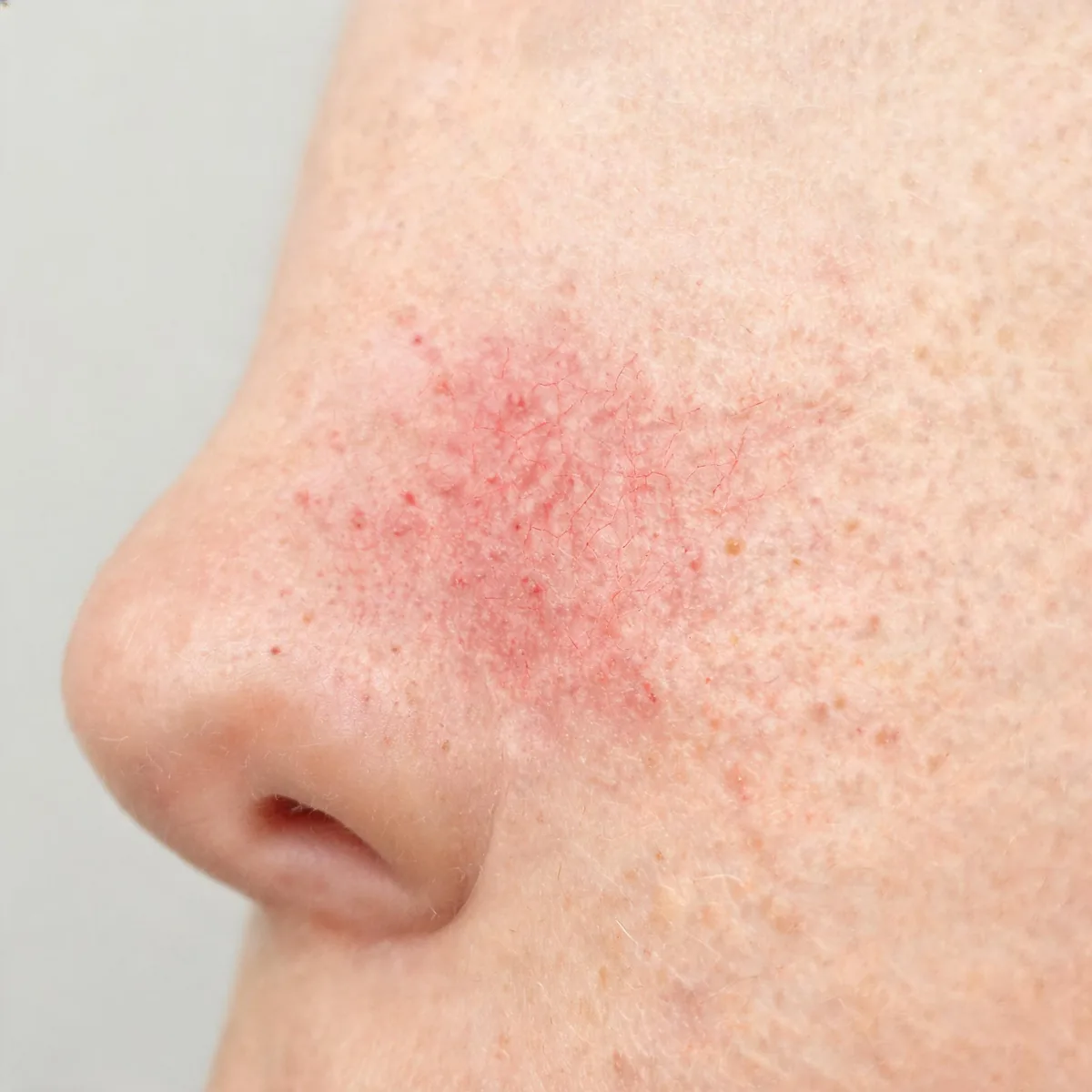
Understanding Rosacea
The tradition describes rosacea through heat, specifically heat that builds in the Stomach and Lungs and travels along the channels that end in the face.
Because the Stomach channel runs to the nose and cheeks, excess Stomach heat from spicy food, alcohol and rich meals is said to flush the face directly. The result is redness and flushing that worsens after eating or drinking, with thirst and a dry mouth.
Where heat has been present for a long time, Toxic-Heat develops: red inflamed papules and pustules on top of the flushing, with burning, thirst and constipation.
In long-standing cases the picture changes again, to Qi and Blood stagnation, described as thickened bumpy skin on the nose with a purplish-red colour, enlarged pores and fixed tenderness. The classical literature treats this as the late stage of the same process.
The organising idea is that heat moves upward and the face is where it arrives. The Stomach channel runs to the nose and cheeks, so heat gathered in the Stomach from hot spices, alcohol and heavy meals has a direct route to the skin, which is why a heavy dinner can redden the face within an hour. The Lungs matter for a different reason: they have charge of the skin and the nose is their opening, so heat held there, whether from smoke, a lingering chest complaint or long strain, also escapes through the face. Early rosacea is read as the two together.
If that heat is not cleared it changes character rather than simply increasing. The tradition describes it becoming toxic, and toxicity is what produces the inflamed papules and pustules that make rosacea look like acne, with burning, thirst and constipation. The tongue reddens and takes a thick yellow coat, and the pulse becomes slippery and rapid. Months or years of this leave a further trace, because heat that persists congeals the movement of Qi and Blood in the small vessels of the nose, and the skin grows thick, takes a purplish-red tone and turns bumpy or nodular.
That progression explains why treatment is staged rather than fixed. One person's redness settles with cool food and a break from alcohol; another needs the toxicity resolved before anything changes; a third needs the stagnation moved before the nose softens at all. The classical literature treats these as one process at different points, and expects the formula to be revised as the skin moves from flushing to papules to thickening.
Conventional view
Rosacea is a chronic inflammatory condition of the central face, and it affects the forehead, nose, cheeks and chin. It usually starts with episodes of flushing, then settles into constant redness, visible vessels and bumps that look like acne; the nose skin thickens into a bulbous shape called rhinophyma in some people, more often men. The cause is unknown, though sun, stress, hot drinks, alcohol and spicy food are recognised triggers and there is often a family tendency. Diagnosis is made from the look of the skin and the history of symptoms.
Conventional care aims to control symptoms and avoid triggers. Mild cases are managed with topical metronidazole, azelaic acid or ivermectin; inflamed bumps may be treated with oral doxycycline, prescribed for its anti-inflammatory effect rather than for infection; laser and light therapy reduce visible vessels and background redness; and severe rhinophyma may be reshaped surgically. There is no cure, and maintenance treatment is usually needed to keep flares away.
The shortfall is that these measures calm what is visible without changing the tendency behind it, so symptoms often return once treatment stops, and long courses of antibiotics carry their own costs in gut disturbance, sun sensitivity and resistance. The classical literature also argues that conventional care treats rosacea as one condition graded by severity, where a face that reddens after wine and a face that burns with pustules and constipation may need quite different internal strategies. That is the gap it offers to fill, alongside dermatological care rather than in place of it.
Selected PubMed records
Real PubMed records for the conventional discussion above, selected by condition name and title relevance. They are references, not a claim that any treatment is proven for this condition.
- Incidence and prevalence of rosacea: a systematic review and meta-analysis.. The British journal of dermatology, 2018. PMID: 29478264.
- Rosacea: New Concepts in Classification and Treatment.. American journal of clinical dermatology, 2021. PMID: 33759078.
How it connects
Rosacea often appears alongside digestive symptoms such as acid reflux, bad breath, a sensation of Heat in the abdomen and a bitter taste in the mouth, because they share a root in Bright Yang Stomach Heat. That pattern arises when Heat accumulates in the Stomach, often from spicy food, alcohol or emotional stress: the Heat rises along the Stomach channel to the face, causing redness and flushing, while disturbing the Stomach's descending function and leading to reflux and a bitter taste. When the Heat intensifies into Toxic-Heat, the skin may erupt with pustules and the digestive symptoms worsen with constipation and foul breath. Treating the Stomach Heat at its root often relieves skin and digestion together. Rosacea also clusters with emotional tension: Liver Qi stagnation from stress and frustration generates Heat that rises to the face, so flushing often worsens before a deadline, after an argument or when sleep is poor, and the person may notice irritability, sighing and a tight chest alongside the redness. When Stomach Heat and Liver Heat combine, spicy food and alcohol can set off a flush within minutes, while the pustular form tends to follow the same digestive pattern. This is why treatment that clears Stomach Heat and settles Liver Qi can calm the skin, the digestion and the mood together rather than treating the face in isolation.
How it is assessed
Diagnosis looks at what triggers the flushing, and whether papules, pustules or thickening have appeared.
What a practitioner looks for
- Triggers: flushing after spicy food, alcohol or hot drinks supports Stomach heat.
- Lesion type: papules and pustules on a red base point to Toxic-Heat; thickening and bumpiness to stagnation.
- Systemic signs: thirst, dry mouth, constipation and irritability support the heat patterns.
- Duration: long-standing redness with skin thickening is read as stagnation rather than active heat.
The practitioner reads the stage from the skin and then confirms it from the rest of the body. Redness that comes and goes, arriving after spicy food or alcohol and settling again, with thirst, a dry mouth and a sluggish bowel, is placed in Bright Yang Stomach Heat. The tongue is expected to be red, with a coat that is thin and slightly yellow, and the pulse rapid, possibly floating or wiry. That combination is read as excess heat climbing the Stomach channel rather than as a problem of the skin alone.
When the redness becomes fixed and acne-like papules or pustules appear with a distinct burning, the reading moves to Toxic-Heat; the tongue is redder with a thicker, yellower and greasier coat, and the pulse slippery and rapid. Where the nose has thickened, become bumpy or bulbous and taken a purplish-red colour, the pattern is Qi and Blood Stagnation, with a dark red or purple-spotted tongue and a choppy or wiry pulse. The classical literature reads that last change as structural, which is why it is expected to respond slowly and why the history of the redness matters as much as its present appearance.
TCM patterns in Rosacea
Three patterns are set out, and they mark stages of one process. In the first, Bright Yang Stomach Heat, the face flushes and reddens, particularly after spicy food, alcohol or a hot drink, with heat that has dried the fluids: thirst for cold drinks, dry lips, a red tongue with a yellow dry coat and a surging pulse at the right middle position. In the second, Toxic-Heat, the heat has become sharper: redness with inflamed papules and pustules, burning skin, intense thirst, dark scanty urine, a redder tongue with a dry yellow coat and a rapid, forceful, slippery pulse. The third, Qi and Blood Stagnation, is the late picture, where months of heat have congealed the flow in the nose: thickened bumpy skin, a purplish-red colour, enlarged pores, fixed tenderness and a wiry, choppy pulse. Because they follow one another, two may appear at once, and the formula follows whichever dominates.
Bright Yang Stomach Heat
The flushing picture: redness on nose and cheeks that worsens after spicy food or alcohol.
The mechanism is a channel and a fuel supply. Heat collected in the Stomach, from hot spices, alcohol or simply rich meals, rises along the Stomach channel, which ends at the nose and cheeks, and where it reaches the skin it produces a flush that stays longer each time. Because the same heat is drying the fluids, the mouth and lips feel dry and thirst is for cold drinks, and the bowel becomes dry or constipated. The classical literature reads this as the earliest stage, the one most closely tied to what the person ate or drank the day before.
The tongue is red with a yellow dry coat, sometimes with early cracks, and the pulse is surging and overflowing, rapid, and strongest at the right middle position. Spicy, greasy and fried food, alcohol and hot coffee, anger and stress, hot weather and saunas, and overwork with lost sleep all push the heat upward, while cooling food and drink, cool compresses, regular bowel movements and a calmer routine settle it. Tiao Wei Cheng Qi Tang is the formula named, with Huang Lian to clear the Stomach fire and drain the heat downward, and the points are Yingxiang (LI-20), Quchi (LI-11), Hegu (LI-4), Zusanli (ST-36) and Neiting (ST-44).
Signs
- Redness and flushing on nose and cheeks
- Worse after spicy food or alcohol
- Thirst for cold drinks
- Dry mouth and lips
- Constipation or dry stools
Diet and lifestyle for this pattern: Avoid alcohol, coffee, spicy and greasy food that stoke Stomach Fire. Eat cooling, moistening food such as cucumber, pear, mung beans and watermelon, keep the face cool and protected from sun, and exercise gently so Qi flows without overheating.
Toxic-Heat
The papulopustular picture: red inflamed papules and pustules with burning.
Toxicity, in the reference's use of the word, is heat that has thickened into something that damages tissue rather than merely reddening it. Years of Stomach and Lung heat from diet and emotion accumulate until it turns toxic, and the toxic heat then climbs the channels into the face, where it produces the raised, red, tender papules and pustules that define this stage. The same heat dries the fluids, so thirst becomes intense and the bowel or the urine reflects the loss, and the skin itself feels hot and irritated.
The tongue is red with prickly thorns and a dry yellow coat, and the pulse is rapid and forceful, often slippery. Spicy and fried food, alcohol and hot coffee, hot weather and saunas, sun exposure and stress all feed it, while cool compresses, cooling food and drink and clean, gentle skin care calm it and prevent a second irritation. Huang Lian Jie Du Tang is the formula named, with Huang Lian, Huang Qin, Jin Yin Hua and Lian Qiao to drain the fire and resolve the toxicity, and the points are Yingxiang (LI-20), Quchi (LI-11), Hegu (LI-4), Zusanli (ST-36) and Dazhui (DU-14).
Signs
- Red inflamed papules and pustules on nose and cheeks
- Burning sensation
- Intense thirst for cold drinks
- Constipation or dark scanty urine
Diet and lifestyle for this pattern: Avoid spicy, greasy and fried food as well as alcohol and coffee, which add Heat. Eat more cooling, moisture-rich food such as mung beans, cucumber, pear and watermelon, protect the face from direct sun and wind, use gentle non-irritating skincare, and keep stress in check with light exercise such as walking or yoga, since emotional upset can stir up Heat.
Qi And Blood Stagnation
The late picture: thickened bumpy skin with purplish-red discolouration.
The late stage is read as the consequence of the earlier ones. Heat and toxicity that have inflamed the face for years eventually congeal and obstruct the movement of Qi and Blood in the fine vessels of the nose, and what should flow begins to settle. The tradition describes the visible result: a purplish-red or dark red colour, enlarged pores, and skin that has become thick, bumpy and nodular, the change called rhinophyma. Any discomfort is fixed and stabbing rather than burning, which is the signature of stasis caught in the tissue itself.
The tongue is dark purple with stasis spots, distended veins beneath it and a thin white coat, and the pulse is wiry and choppy. Cold exposure, anger and frustration, spicy and fried food, alcohol and coffee, and picking or squeezing the skin all make it worse, while warm compresses, gentle facial massage, stress management and small amounts of hawthorn and turmeric ease it. Xue Fu Zhu Yu Tang is the formula named, with Tao Ren, Hong Hua and Chuan Xiong to move Blood and Qi, and the points are Yingxiang (LI-20), Xuehai (SP-10), Taichong (LR-3) and Zusanli (ST-36).
Signs
- Thickened bumpy skin on the nose
- Purplish-red or dark red discolouration
- Enlarged pores
- Fixed stabbing pain or tenderness
- Chest tightness or rib distension
Diet and lifestyle for this pattern: Avoid spicy, greasy and deep-fried food as well as alcohol, which can reignite Heat. Eat small amounts of blood-moving food such as hawthorn berry, turmeric and peach, use gentle facial massage without rubbing to promote local circulation, protect the skin from sun and extreme cold, and keep up relaxation, since emotional tension stagnates Qi.
Treatment approach
How the tradition treats rosacea, with the herbs, formulas and points used for it.
Principles
- Clear Stomach heat and cool the Blood while the pattern is active flushing.
- Resolve toxicity when papules and pustules appear.
- Move Qi and Blood in the late, thickened stage, where clearing alone is no longer enough.
- Avoid the dietary triggers the classical literature names: alcohol, spicy food, coffee and rich fried meals.
- One thread runs through every stage: heat is cleared from the face and from the organs that supply it. What changes is the method. Simple heat is cooled and drained downward; toxic heat needs stronger detoxifying herbs added; stagnation needs Blood moved and hardness softened, because clearing alone will not shift tissue that has already thickened. The classical literature also relies on a small set of points across all three patterns, Yingxiang (LI-20), Quchi (LI-11), Hegu (LI-4) and Zusanli (ST-36), with further points chosen for whichever pattern is dominant.
Herbs used
Formulas
Acupoints
- LI-20 (Yingxiang)
- LI-11 (Quchi)
- LI-4 (Hegu)
- ST-36 (Zusanli)
- ST-44 (Neiting)
- DU-14 (Dazhui)
- SP-10 (Xuehai)
- LR-3 (Taichong)
What to expect
- Flushing and papules are described as improving within weeks once the heat pattern is treated and triggers are removed.
- Skin thickening responds slowly, if at all, and is described as the least reversible stage.
- Ongoing dietary care is treated as part of maintenance.
- Most people notice the face feeling cooler and reacting less within the first few weeks, with flushing episodes becoming shorter and less intense and bumps flattening gradually. The classical literature also expects change away from the face, in digestion, sleep or stress, because the same heat is being addressed. Treatment usually begins with a daily formula and needling once or twice a week, and as the skin steadies the sessions are spaced out and the herbs adjusted or stopped. Thickened skin is the slowest element and is not promised a quick result.
Safety and when to get help
Seek medical help urgently for
- Sudden severe swelling of the face, lips or eyes.
- Fever with facial redness and pain, which may indicate cellulitis.
- Eye pain, light sensitivity or visual change, which needs urgent ophthalmological review.
For anything severe, sudden or spreading quickly, read when a skin problem needs urgent care.
Cautions
- Do not apply strong topical preparations to inflamed facial skin without advice.
- Prescribed topical or oral treatment should not be stopped abruptly.
- Rosacea affecting the eyes needs medical assessment, not herbs alone.
Using this alongside conventional care
- TCM is described as complementary to conventional care: prescribed topical and oral treatment can continue alongside herbs and acupuncture, and eye involvement needs ophthalmological care.
- Topical gels and creams can be used alongside herbs and needling without difficulty, and the classical literature sees no direct conflict with oral antibiotics either, though it suggests taking the herbs at a separate hour so that digestion is not asked to handle both at once. Blood-moving herbs such as Tao Ren and Hong Hua need to be declared to a practitioner when anticoagulants are in use. Prescribed treatment is never stopped abruptly, and any reduction is made with the doctor as the skin improves.
Diet and lifestyle
- Avoid food and drink that heat the body: spicy dishes, alcohol, coffee, fried and greasy food and excess red meat. Cooling, moistening foods are favoured.
- The dietary rule is simple to state and takes discipline to follow: remove what heats the body. Alcohol, coffee, spicy dishes, fried or greasy food and a heavy intake of red meat are the named offenders. What replaces them is cooling and moistening: cucumber and pear, mung bean and watermelon, bitter greens, chrysanthemum tea. The classical literature adds regular, moderate meals so the Stomach is not overwhelmed, room-temperature water rather than iced drinks, protection from sun and wind, and enough calm that stress does not send heat upward. In the stagnant stage, small amounts of hawthorn and turmeric are suggested to help move Blood.
If you're pregnant
Treatment in pregnancy avoids anything that strongly moves Blood or purges downward. Tiao Wei Cheng Qi Tang is not used because it contains Da Huang, which drives the bowel and is regarded as unsuitable in pregnancy, and Xue Fu Zhu Yu Tang is avoided because Tao Ren and Hong Hua carry a risk of miscarriage. Diet and needling are the usual alternatives: Yingxiang (LI-20) and Quchi (LI-11) may be used gently, without strong stimulation, and mild teas such as chrysanthemum or honeysuckle can cool the heat. A practitioner experienced in pregnancy care should make the decision.
Any redness that spreads, blisters or comes with fever needs medical review rather than self-treatment.
If you're breastfeeding
Bitter-cold herbs such as Huang Lian can pass into milk and cause loose stools or colic, so formulas built around it, Huang Lian Jie Du Tang among them, are used with caution and only with professional guidance. Milder options such as Jin Yin Hua and Lian Qiao are considered safer. Needling is described as safe during feeding because there is no drug to transfer, and dietary change, with cooling foods such as cucumber, mung bean and pear, can do a good deal of the work on its own.
If treating a child
Rosacea is rare in children, and when it appears it is usually a mild flushing provoked by dietary heat or by fever. The Bright Yang Stomach Heat pattern may be present, but herbs are used at between a quarter and a half of the adult dose and only under supervision. Older children generally tolerate needling, with fewer needles and a gentler technique. Correcting the diet, in particular removing spicy and greasy food, is the first line and is often enough on its own.
If treating an elderly patient
In older patients rosacea more often presents as the chronic, thickened type, so Qi and Blood Stagnation dominates. Yin deficiency is also common at this age, so a purely blood-moving formula such as Xue Fu Zhu Yu Tang may need modifying to avoid over-drying the skin. Doses are reduced to about two thirds of the adult standard. Polypharmacy matters here because blood-moving herbs can interact with anticoagulants, which makes needling an attractive option, and warm compresses with gentle facial massage can help, provided the skin is handled carefully.
Urgent-sign guidance is based on standard sources: NHS anaphylaxis, NHS cellulitis, NHS Stevens-Johnson syndrome, NHS melanoma.
Evidence
Evidence status
Compiled for this page from the classical and modern literature; not a systematic review, so treat it as a pointer to sources rather than clinical guidance.
Research is growing but limited in quantity and quality. Small randomised trials suggest acupuncture reduces facial flushing and papule and pustule counts, with effects comparable to topical metronidazole, and a 2020 meta-analysis of acupuncture for rosacea found moderate evidence of benefit while noting high risk of bias in many included studies. Huang Lian Jie Du Tang shows anti-inflammatory and antimicrobial effects in laboratory work, and Chinese clinical trials report improvement.
Research is growing but still limited in both size and quality. Small randomised trials report that acupuncture reduces flushing and the count of papules and pustules, with results described as comparable to topical metronidazole, and a 2020 meta-analysis found moderate evidence of benefit while noting a high risk of bias across many of the studies pooled. Laboratory work on Huang Lian Jie Du Tang has demonstrated anti-inflammatory and antimicrobial activity. Trials published in Chinese describe less redness and fewer lesions. The reference's own conclusion is that double-blind, placebo-controlled work is still needed.
Studies often cited
Moderate evidence of benefit, with high risk of bias in many included studies. 2020 meta-analysis (as recorded in the source)
Small randomised trials report comparable reductions in flushing and papules and pustules. Small randomised controlled trials (as recorded in the source)
Laboratory evidence of anti-inflammatory and antimicrobial effects, supported by Chinese clinical trials. Laboratory and clinical studies (as recorded in the source)
PubMed records for the TCM evidence
Real PubMed records for the TCM clinical evidence discussed above, selected by condition name and title relevance. They are references, not proof of benefit.
- The role of skin barrier and immune abnormalities in the pathogenesis of Rosacea.. Clinical and experimental medicine, 2025. PMID: 41137965.
Classical record
Red patches on the nose are mostly due to accumulated heat in the Lung and Stomach, with secondary invasion of wind-cold, leading to blood stasis and coagulation.
- Wai Ke Zheng Zong (Orthodox Manual of External Medicine), chapter on facial sores. The Chinese original is not reproduced here: it could not be recovered reliably from the source record, and is not guessed.
酒齇鼻者,由飲酒過度,熱氣內熏,肺胃受熱,上沖於面,令鼻頭生赤疱。
Jiu Zha Bi, the drinker's nose, comes from taking too much alcohol: heat and qi steam within, the Lung and Stomach receive that heat and it rushes upward to the face, so that red vesicles form on the tip of the nose.
Zhu Bing Yuan Hou Lun, Volume 27, chapter on skin diseases - Classical citation: which uses this passage as the earliest description of the flushed, nodular nose and of alcohol as its named cause.
Common questions
Can TCM reduce rosacea redness?
The tradition describes clearing heat and cooling the Blood for the flushing pattern and records improvement over weeks. It does not claim to reverse established skin thickening.
Do I have to give up alcohol and spicy food?
The classical literature names both as direct triggers of Stomach heat flushing, so reducing them is treated as part of treatment rather than optional advice.
Is rosacea the same as acne?
No. Rosacea is described as heat-driven flushing with papules and pustules and no comedones, and its late stage thickens the nose; acne is a different pattern picture.
Can it affect the eyes?
Yes, and the classical literature treats eye pain, light sensitivity or visual change as needing urgent medical review.
How does acupuncture help the redness?
Points on the face cool the area directly, while points on the limbs regulate the Stomach and Lung channels that supply the heat. The classical literature lists Yingxiang (LI-20) for the nose and cheeks, with Quchi (LI-11), Hegu (LI-4) and Zusanli (ST-36) for the root, and records that patients often see the redness calm within hours of a session.
Is rosacea a digestive problem?
In TCM it often is. The Stomach is the usual origin of the heat that climbs to the face, so bloating, reflux, a sluggish bowel or heaviness after eating alongside the redness is read as support for a Stomach Heat pattern. Clearing that heat is described as improving the gut and the skin at the same time, which is why the classical literature asks about digestion at the first consultation.
How long before the skin improves?
Redness and flushing typically begin to settle within two to four weeks, inflamed bumps usually flatten over three to six weeks, and thickened skin changes slowly, over three to six months if at all. Consistency with herbs, needling and diet is described as making the largest difference to how quickly things move.