Skin profile
Where this herb sits in skin practice: the pattern it corrects, the skin signs it suits, and what it should not be used for.
Fu Ling Pi is a surface drainer: it suits skin that is puffy, heavy and waterlogged, not skin that is hot, red or dry. It works as a support, and its most important safety point is that swelling can be a sign of something that needs a doctor rather than a diuretic.
Skin signs that suggest it
- Puffiness of the eyelids and face on waking that settles as the morning goes on
- Pale, slightly shiny skin that pits when pressed and feels heavy rather than tight
- Ankles and lower legs that swell by evening, worse in humid weather
- Small blisters or vesicles that weep clear, thin fluid with little surrounding redness
- A pale, swollen tongue with a greasy coat, and a soft pulse
When it is not the right herb
Not where the body is short of fluid: thirst, a dry mouth, scanty dark urine and night sweats mean there is little to drain and much to lose. Not for hot, red, weeping skin, which needs cooling and drying herbs rather than a neutral peel. Not as a stand-alone answer to swelling that came on suddenly, affects one leg, or comes with breathlessness, reduced urine or a puffy face in pregnancy, all of which need medical assessment that day. It is a support herb, and giving it alone for a chronic tendency is a thin plan.
What it does for skin
Skin-relevant actions only. Each one describes a mechanism in TCM terms and what it looks like on the skin.
Draws water out of the skin and flesh
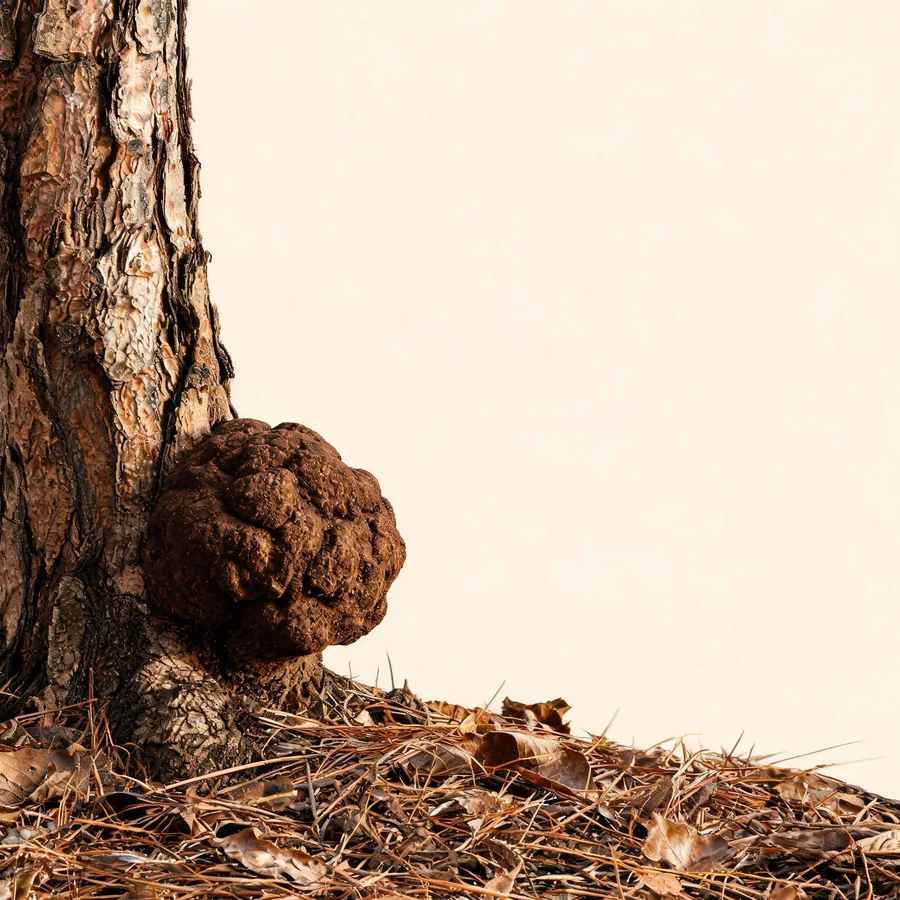
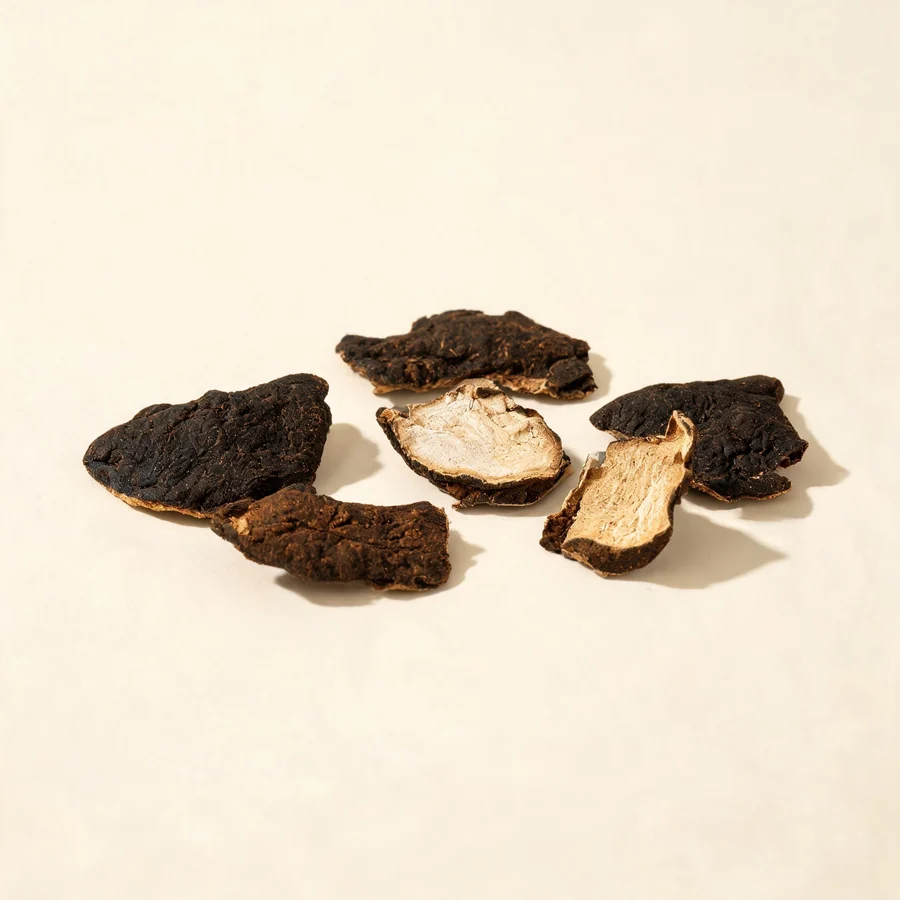
The peel is the surface layer of the fungus, and the tradition treats that anatomy as a clue to where it works: it moves fluid that has collected in the skin and the flesh rather than in the deeper organs. On the body that is the puffy face, the heavy limb and the swelling that leaves a dent when pressed. It is a gentle action, suited to a slow, damp constitution rather than to an emergency, and it works best when the Spleen is supported at the same time.
Opens a route out through the bladder
Water that has collected at the surface has to leave somewhere, and the peel's mild diuretic effect is the exit. The change is noticed as more frequent, less concentrated urine over the following days, with the puffiness easing behind it. Because the effect is mild, it does not force fluid out of a depleted body the way a strong diuretic can; that is also why it is a supporting herb rather than a rescue one.
Supports a Spleen that is failing to transform fluids
In the framework, fluid gathers when the Spleen fails to move it, and the peel addresses the result rather than the cause. It is therefore paired with tonics such as Bai Zhu and Fu Ling, so that the water is drained and the tendency behind it is treated at the same time. Given alone for months, it simply drains what keeps being produced, and the swelling returns when it stops.
Reduces the fluid that keeps a vesicle weeping
A blister or vesicle with clear, thin contents and little redness is read as Dampness at the surface, and draining that Dampness is the logic behind the peel's use in these rashes. It is a supporting move, not a primary one: the leading herbs are chosen for the pattern, and the peel reduces the fluid load behind the lesion. Dry, scaly lesions or weeping yellow ones are a different pattern and are not helped by it.
Skin conditions it is used for
Mapped to the condition pages on this site. The pattern column shows what the skin is doing when this herb is the right choice.
| Condition | Pattern | Why it suits | Typical setting |
|---|---|---|---|
| Bullous dermatitis | Flaccid blisters weeping clear fluid on a Spleen-deficient base | In the damp phase of a blistering eruption, lesions break easily and release a thin, pale fluid, the surrounding skin is not bright red, and the person is tired and heavy. The peel is included as a draining support while the main herbs address the cause, and it suits the subacute, recurrent picture rather than a sudden widespread blistering with fever, which needs urgent medical care. | A damp-draining formula with Fu Ling, Bai Zhu and Yi Yi Ren, alongside the prescribed treatment |
| Skin swelling | Wind-Damp or Damp-Phlegm swelling that is puffy and not hot | A swelling that is pale, heavy and not red is the surface-water picture the peel was separated from the parent fungus to treat. It is combined with herbs that move Qi or warm the channels, because the peel drains the fluid but does not shift the stagnation that let it gather. A hot, red, tender swelling is infection and belongs to a cooling strategy, and a swelling that is hard and fixed is not water at all. | Wu Pi Yin, or with Fu Ling, Yi Yi Ren and Chen Pi |
| Facial swelling | Spleen Yang deficiency with soft morning puffiness | A face that is puffy on waking, pale and cool, with a heavy feeling and loose stools, fits a Spleen that is not moving fluids. The peel drains the surface while warming herbs address the deficiency, and the pair is more useful than either alone. Sudden eyelid swelling with breathlessness, throat tightness or a rash is an emergency and not a pattern to treat with a diuretic. | With Bai Zhu, Gan Jiang and Fu Ling in a warming, draining formula |
| Swollen ankle | Dampness that has settled in the lowest joint | An ankle that swells through the day, is heavy rather than hot, and improves with rest and elevation is read as Dampness sinking to the lowest point. The peel's mild diuresis is a support while the ankle is assessed, and it does not replace strapping, elevation or the exclusion of a fracture. A hot, red, very painful ankle, or one that swells after an injury, needs examination first. | With Yi Yi Ren, Fu Ling and Chi Xiao Dou in a damp-draining formula |
| Itchy vesicular rashes | Spleen deficiency with Dampness: dull, oozing lesions | Where the rash is more oozing than red, the itch is less intense than an acute flare, and the person is bloated and loose-stooled, the pattern is a Spleen that cannot transform Dampness. The peel reduces the fluid behind the vesicles and supports the herbs that lead. Red, hot, blistering rashes with yellow discharge are damp-heat and need cooling, not this neutral peel. | With Fu Ling, Bai Zhu and Yi Yi Ren in a Spleen-supporting, damp-draining formula |
Combinations for skin
Herbs it is paired with when the skin, not an internal organ, is the target.
| Partner | Ratio | Why the pair is used |
|---|---|---|
| Fu Ling | 15 to 30 g peel with 10 to 15 g of the white interior | The two parts of the same fungus are given together because they work in different directions. The white interior strengthens the Spleen and calms, addressing the source of the fluid, while the peel drains what has already collected in the skin and flesh. It is the clearest example of the tradition's habit of dividing one material by its layers. A puffy, heavy person with poor digestion is the usual candidate, and the pair is given for a few weeks with review. |
| Yi Yi Ren | 15 to 30 g each in decoction | Coix seed drains Dampness and has its own long use in skin conditions where the lesions are damp rather than hot. Both are neutral and mild, so the pair can be continued longer than a bitter-cold formula, and both suit the heavy, puffy, loose-stooled picture. It is a slow combination: the aim is a gradual reduction in fluid load while the Spleen is strengthened, not a rapid diuresis. |
| Bai Zhu | 10 to 15 g Bai Zhu with 15 to 30 g peel | Bai Zhu tonifies and dries the Spleen, and the peel drains the surface water that the weakness has produced. One treats the root and the other the branch, and together they are the standard response to a damp constitution that keeps producing puffiness and clear-fluid blisters. The pair is warming enough for a cold, pale picture and too drying for someone with a dry mouth and scanty urine. |
| Sheng Jiang Pi | 9 to 15 g each | Fresh ginger peel pushes water outward at the surface, while Poria peel draws it down through the bladder. They work on one layer from opposite directions, and both belong to the five-peel formula for generalised puffiness. It is the pairing for a cold, puffy picture with sluggish digestion, and it is not for any swelling that is red or hot. |
Formulas where it leads
- Wu Pi Yin (五皮饮) - The five-peel formula for generalised puffiness, in which the peels of five plants and fungi drain water together. It is the formula that gave Fu Ling Pi its identity, and it is used for oedema with a heavy, puffy quality rather than for hot or inflamed skin. It is a short course, and swelling with breathlessness or reduced urine needs medical assessment before it is considered.
Safety for skin use
What to check before recommending or using it, including the cautions that matter most for skin patients.
Do not use, or use with caution
- Fluid depletion or Yin deficiency: thirst, a dry mouth, scanty dark urine, night sweats and a thin rapid pulse. A draining herb given to a dry body removes what little fluid remains.
- Hot, red, weeping or infected skin. The peel is neutral and mild, and damp-heat needs cooling herbs; using it alone lets the inflammation continue.
- Swelling that is sudden, one-sided, painful, or accompanied by breathlessness, reduced urine, or high blood pressure in pregnancy. These need same-day medical assessment, not a diuretic herb.
Pregnancy and breastfeeding
At ordinary doses it is treated as compatible, since the fungus itself is mild and close to a food, but the peel is a stronger drainer than the white interior. It is not a casual remedy for ankle swelling in late pregnancy, which can be a sign of pre-eclampsia and needs a blood pressure check. Use it under guidance, at a sensible dose, and only where there is a clear damp pattern rather than a simple shortage of fluid.
Interactions
- Diuretics and antihypertensives: additive fluid and electrolyte loss. Watch for thirst, dizziness on standing, cramps and changes in kidney blood tests.
- Lithium: anything that changes urine output can raise lithium levels, so the combination needs monitoring rather than guesswork.
- Diabetes medicines: the parent fungus has shown glucose-lowering activity in laboratory and animal work, so blood sugar may need watching when it is taken regularly alongside insulin or a sulphonylurea.
Allergy and patch testing
Rare but recorded: itching and skin rash have been reported with Poria preparations, with aching limbs, dizziness or nausea in some cases. Sulphur residues and heavy metals from poor processing are a quality issue rather than an effect of the fungus, so buy from a supplier who tests. Stop if a rash appears.
General safety references
General references for herbal hepatotoxicity and herb-drug interactions; they are not specific to this herb.
- Review article: Herbal hepatotoxicity - an update on traditional Chinese medicine preparations. Alimentary Pharmacology & Therapeutics, 2014. PMID: 24844799.
- Interactions between herbal medicines and prescribed drugs: an updated systematic review. Drugs, 2009. PMID: 19719333.
- Warfarin and food, herbal or dietary supplement interactions: a systematic review. British Journal of Clinical Pharmacology, 2021. PMID: 32478963.
Evidence
The classical record is quoted with its source. The modern note states the level of evidence plainly.
Classical record
茯苓皮主水肿肤胀,开水道,开腠理。
Poria peel governs oedema with skin distension, opens the water pathways and opens the interstices.
Ben Cao Gang Mu (Compendium of Materia Medica), Li Shizhen - Li Shizhen, 1578. The sentence is the clearest classical statement that the peel acts on the surface: it names skin distension and the interstices, not the organs.
It moves the water that lies within the skin.
Yi Lin Zuan Yao (Collected Essentials of the Medical Grove) - A Qing line that is almost a definition: it points to the tissue rather than to a disease, which is why later writers quote it for the peel's identity. The original text is not reproduced here.
Modern evidence
Evidence status
- Poria is a food-grade fungus, and laboratory work on its polysaccharides reports immune-modulating and anti-inflammatory activity. None of that work is specific to the outer peel, and none of it is a skin trial.
- No controlled trial of Fu Ling Pi in a skin condition was identified. The diuretic and anti-oedema uses rest on traditional practice, and the peel's mild effect is not a substitute for assessing why fluid is collecting.
- The peel's chemistry is close to that of the white interior; the difference claimed in practice is one of direction and strength rather than of kind, and that distinction has not been tested.
PubMed records
Selected real PubMed records for this herb's species or its constituents, chosen by species name and title relevance. They are references for the non-TCM discussion above, not proof that the herb treats any skin condition.
- Poria cocos Wolf extracts represses pigmentation in vitro and in vivo.. Cellular and molecular biology (Noisy-le-Grand, France), 2018. PMID: 29729698 (skin-related record).
- Beneficial Effect of Gastrodia elata Blume and Poria cocos Wolf Administration on Acute UVB Irradiation by Alleviating Inflammation through Promoting the Gut-Skin Axis.. International journal of molecular sciences, 2022. PMID: 36142744 (skin-related record).
Dose and forms
Skin-practice dosing and the preparations that suit skin complaints.
| Form | Dose and notes |
|---|---|
| Decoction | 15 to 30 g of the dried peel in a decoction, in a formula rather than alone. The peel is light and bulky, so it is weighed rather than spooned. |
| Concentrated powder | 3 to 5 g of concentrated granule or powder, following the manufacturer's figure, because the concentration is several times that of the raw peel. |
| Course length | Two to four weeks with review. The aim is to move fluid and then support the Spleen, not to stay on a diuretic indefinitely. |
The peel is given at a larger weight than the white interior because it is light and its action is at the surface; fifteen to thirty grams is ordinary for a decoction. Wrap it in cloth if the pieces float and escape the strainer. The concentrated figure is much smaller and is not interchangeable with the raw weight, which is the commonest dosing error with this herb.
Citations and further reading
Only real sources are listed: the classical materia medica passages quoted above, and the source works behind the botanical and safety statements.
- Ben Cao Gang Mu (Compendium of Materia Medica), Li Shizhen, 1578 - passage quoted above.
- Yi Lin Zuan Yao (Collected Essentials of the Medical Grove), Qing dynasty - line quoted above.
- Poria monograph: Pharmacopoeia of the People's Republic of China - accepted species, part used and quality requirements.
- Modern evidence statement: based on laboratory work on Poria polysaccharides, summarised as a statement about the level of evidence rather than as a cited finding.
- Fluid balance and interaction statements: general pharmacology of diuretics, lithium handling and glucose-lowering medicines, given as safety reasoning rather than as trial findings.
- Botany and processing: literature on Poria cocos and on the separation of its outer peel from the white interior.
Educational reference for qualified practitioners. This page is not medical advice, and skin conditions should be diagnosed by a clinician before treatment.