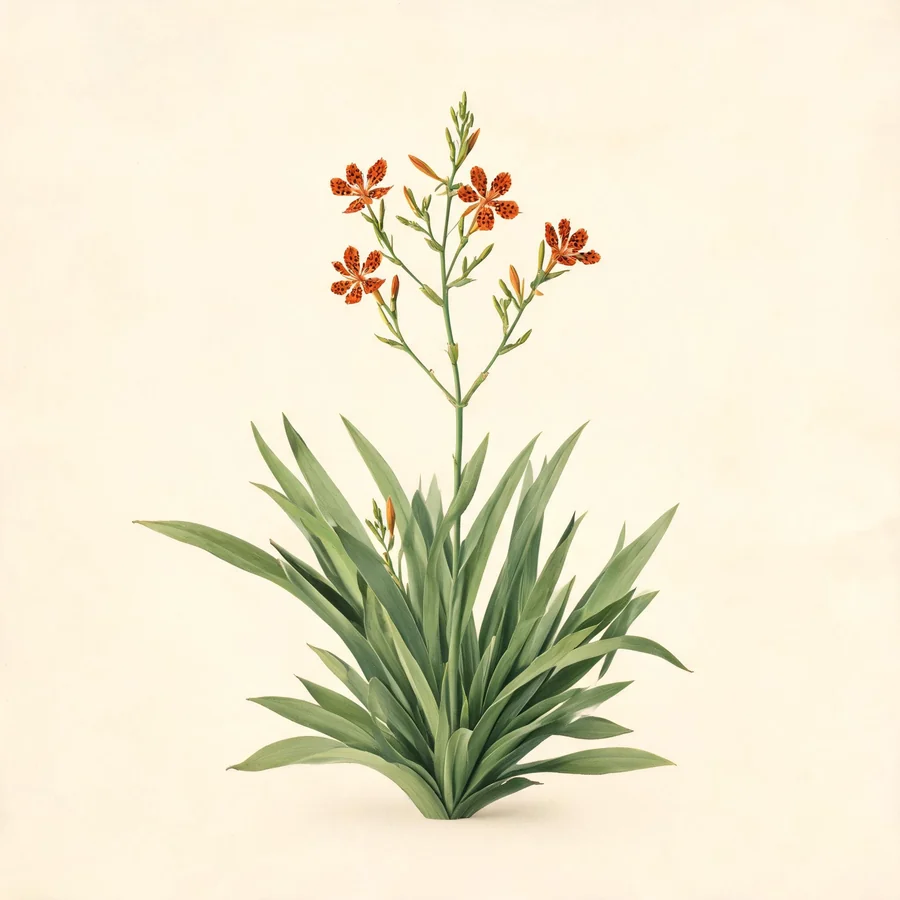
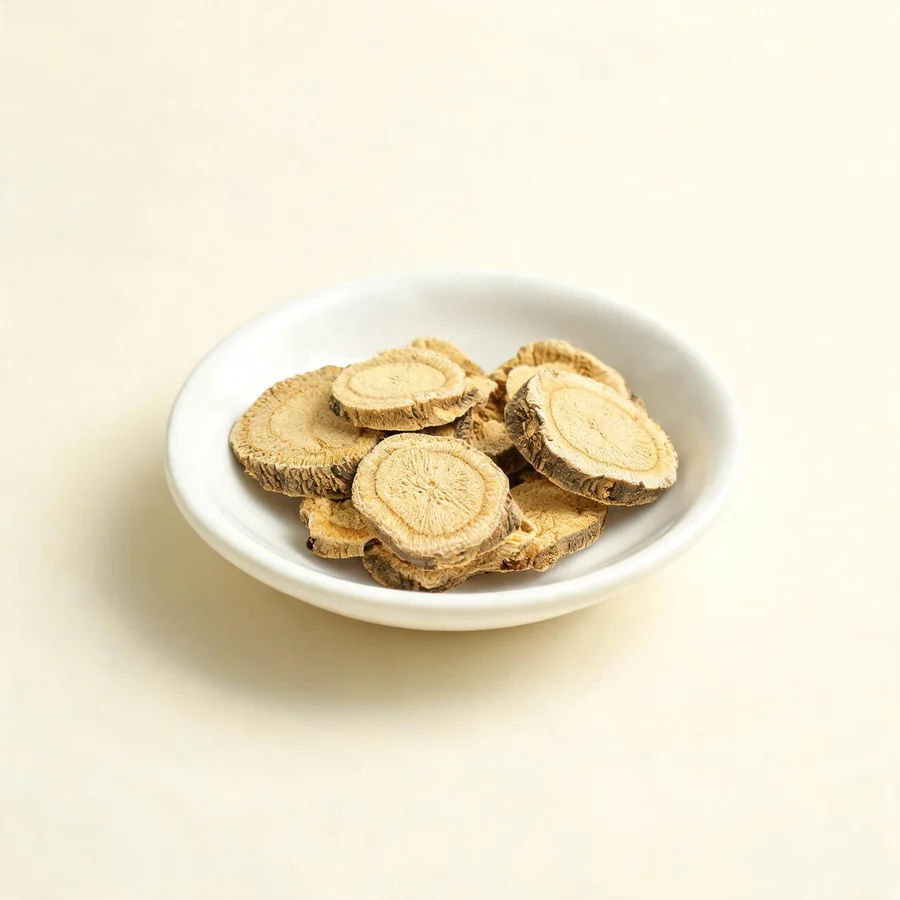
Skin profile
Where this herb sits in skin practice: the pattern it corrects, the skin signs it suits, and what it should not be used for.
She Gan is a throat herb with a small, narrow reach onto the skin: a hot, hard, bounded swelling, an early boil, a cool nodule. It is cold, bitter, descending and intended for short courses, and every skin use on this page is a supporting one inside a formula.
Skin signs that suggest it
- A hot, red, painful, clearly bounded swelling of the skin or of the tissue beneath it
- A hard mass under the skin that is warm and tender, with the overlying skin reddened
- A sore, swollen throat with thick phlegm in a person whose skin lesion is also hot and red
- Dusky redness at the edge of a lesion, with a yellow tongue coating and a rapid pulse
- Thick yellow phlegm and a rattling throat in a febrile person with flushing and thirst
When it is not the right herb
Not for a cold, pale, weeping or dry lesion, and not for the chronic relapsing skin of a depleted person: a bitter cold descending rhizome drains what little Qi and Yang are left. It is wrong where no genuine heat or heat toxin is present, and it is wrong for a swelling that is cold and pitting rather than red and hot. It is avoided in pregnancy and while breastfeeding, and it is not a long-term herb, because the old literature says plainly that prolonged use causes deficiency. A hot, spreading, rapidly enlarging red plaque, a facial swelling or a lesion with fever needs urgent medical care rather than a decoction.
What it does for skin
Skin-relevant actions only. Each one describes a mechanism in TCM terms and what it looks like on the skin.
Clears heat toxin from a hot, red swelling
The lesion it suits is a concentration of heat and toxin: red, hot, painful, clearly bounded, often with a hard centre and a rapid pulse. Its bitterness drains and its coldness cools, so the local fire is reduced and the swelling settles instead of spreading. It is used with other toxin-clearing herbs such as Lian Qiao and Pu Gong Ying, and a rapidly spreading red plaque, a facial swelling or one with fever needs medical assessment, because those are the pictures where antibiotics come first.
Disperses static blood and reduces a swelling that will not settle
The second half of its action is the one that reaches the skin at all: it disperses stasis and reduces swelling, which in the old literature made it useful for masses and for external application to a painful swelling. On the skin that means a hard, tender lesion with dusky overlying colour rather than a bright superficial one. It is a supporting herb in that role, because the blood-moving herbs do the main work and this rhizome adds the cooling and the descending direction rather than the movement itself.
Loosens phlegm that is congealing into a nodule
Phlegm that thickens instead of dispersing becomes a lump, and the old commentary says that when its fire descends, blood disperses, swelling subsides and phlegm nodules loosen. That is the reasoning behind its use for a hard, cool mass under the skin, and it is a slow and uncertain business. A mass that is new, enlarging, fixed or painful needs imaging before anything is prescribed, and a herb should never delay that assessment.
Descends the heat that is rising to the head and throat
The rhizome is described as bringing fire down, which is why the old formulas relied on it for a throat that was swollen and blocked. Applied to the skin, that descending action explains why it is chosen when a hot lesion sits high on the body and the person is flushed, thirsty and hoarse. It is a supporting action and not a reason to use the rhizome on its own for a facial rash, which needs a proper look and a proper diagnosis.
Skin conditions it is used for
Mapped to the condition pages on this site. The pattern column shows what the skin is doing when this herb is the right choice.
| Condition | Pattern | Why it suits | Typical setting |
|---|---|---|---|
| Skin swelling | Heat toxin with static blood in a hot, bounded swelling | Swelling is read as fluid metabolism going off track, and the type this rhizome addresses is the hot, red, painful, clearly bounded kind where heat toxin and static blood have collected in one place. It clears the toxin and disperses the stasis at once, which is why it is used as a supporting herb in formulas for a painful local swelling. A swelling that is cold and pitting belongs to a different pattern entirely, and a swelling with fever or rapid spread needs urgent care. | Modified Wu Wei Xiao Du Yin with She Gan and Lian Qiao |
| Boils | Early heat toxin with a hot, hard, unpointed swelling | A boil is read as the body pushing heat and toxin outward, and the rhizome is used in the early phase, when the lesion is hot, hard and unpointed and the surrounding tissue is red and tender. Its cold bitterness clears the toxin and its dispersing quality softens the hardness, and it is given with toxin-resolving herbs rather than alone. A boil on the face, a boil with spreading redness or fever, or one that does not settle needs medical care first. | Modified Xian Fang Huo Ming Yin with She Gan |
| Erysipelas | Fire toxin in the skin with a bright red spreading plaque | Erysipelas is fire toxin in the skin, and the bright, raised, sharply bordered plaque that burns and spreads is read as fire that has to be brought down. The rhizome's descending quality and its heat-toxin action fit that reading, and it would be a supporting herb inside a cooling formula. The clinical fact comes first: erysipelas needs antibiotics promptly, and a decoction is an adjunct rather than an alternative to them. | Modified Pu Ji Xiao Du Yin with She Gan and Ban Lan Gen |
| Subcutaneous lipomas and nodules | Phlegm congealed into a hard, cool mass | A lipoma is read as phlegm the Spleen has failed to transform, and the old commentary's phrase about phlegm nodules loosening when the fire descends is the basis for using the rhizome here. It is chosen for a firm, cool mass without inflammation and combined with herbs that soften hardness. The honest limit is that a fatty lump rarely dissolves, the effect is uncertain, and a lump that grows quickly, is fixed or is painful needs imaging before it is treated. | Modified Er Chen Tang with She Gan and Mu Li |
Combinations for skin
Herbs it is paired with when the skin, not an internal organ, is the target.
| Partner | Ratio | Why the pair is used |
|---|---|---|
| Huang Qin | 6 to 10 g each | The classical pair for phlegm-heat with wind: Huang Qin drains the heat and dries the dampness while the rhizome breaks the phlegm and brings the fire down. For the skin it is used where a hot, red, swollen lesion sits on a background of sore throat, thirst and a yellow coating. Both are bitter and cold, so the pair is kept short and avoided in a person with a cold digestion. |
| Jie Geng | 5 to 10 g each | These two work against each other by design, one lifting and carrying other herbs upward while the rhizome clears heat and draws phlegm and Qi down, which is why they are held together rather than chosen between. A blocked area is opened from both ends at once. The pairing appears wherever thick phlegm sits above a hot swelling, and the balance between the two directions is the point of it. |
| Lian Qiao | 6 to 10 g each | Forsythia clears heat and resolves toxin with a particular reach to hot, swollen glands and sores, and the rhizome adds the descending and phlegm-breaking action. Together they suit a hot, hard swelling with feverishness and a red throat, set inside a larger toxin-resolving formula. Both are cold, so the pair belongs to an acute hot phase rather than to a dry or cold skin. |
| Mu Li | 2:1, Mu Li 30 g with She Gan 9 g | Oyster shell softens hardness while the rhizome breaks the phlegm and brings the fire down, so one works on the texture of a mass and the other on what made it. It is a slow pairing for a firm, cool nodule and is used inside a formula over months rather than as a short course. A mass that is changing still needs a diagnosis before this reasoning applies to it. |
Formulas where it leads
- Wu Wei Xiao Du Yin (五味消毒饮) - The classical formula for heat toxin with a hot, red, painful swelling, built on Jin Yin Hua, Ju Hua, Pu Gong Ying, Zi Hua Di Ding and Tian Kui Zi. The rhizome is not one of its five herbs and is added in modified versions where a swelling is hard and the throat or the upper body is involved, which is how it is used in practice: as an addition to a toxin-clearing formula rather than as the formula's engine.
Topical use
The rhizome has a recorded external use against painful swellings, and it is applied as a paste of the powdered dried rhizome in water or vinegar, kept to a small area of intact skin. It is a short, local application for a hot, hard, clearly bounded swelling and it is not a wash or a bath herb, because the material is bitter, drying and irritant to a broad surface. The old external use for snakebite is not a reason to delay antivenom, and a bite needs hospital care at once.
| Preparation | How and when it is used |
|---|---|
| Paste for a hot, hard swelling | Three to five grams of the finely ground dried rhizome is mixed with a little warm water or rice vinegar to a thick paste and spread over the swelling, leaving a margin of normal skin. It is left for twenty to thirty minutes and then washed off, once daily for a few days, and it is stopped when the swelling softens or the skin reddens further. |
| Powder with a cooling base | In traditional practice the powder is blended with other cooling, swelling-dispersing powders and applied sparingly to a single lesion. Because the mixture is more drying than the rhizome alone, it is used only on small, well-defined areas and never on dry, cracked or broken skin. |
Patch test and cautions
Patch test on a small area of normal skin for twenty-four hours before the first application, and do not apply the paste to a deep, spreading or badly infected lesion without clinical supervision. Keep it away from the eyes, the mouth and broken skin, and stop at once if burning, stinging or spreading redness appears. No occlusive dressing is used over it, and a swelling with fever, rapid spread or severe pain needs medical assessment rather than a paste.
Safety for skin use
What to check before recommending or using it, including the cautions that matter most for skin patients.
Do not use, or use with caution
- Weak digestion with loose stools, or a cold deficient person. A bitter cold herb that moves downward can weaken Spleen Yang further and make the stool looser, and coolness given to a cold pattern only spends Qi and Yang for nothing.
- No genuine heat or heat toxin. A pale, cold, weeping or dry lesion is the wrong picture, and the herb makes it worse rather than better.
- Pregnancy. Treated as a contraindication: the old sources say the rhizome opens menstruation and moves blood, and a bitter cold herb with a strong downward direction is thought to harm the fetus.
- Prolonged use. The old literature is explicit that long courses cause deficiency, so the rhizome is given for a defined period and then reviewed rather than continued as a tonic.
Pregnancy and breastfeeding
Avoided. The old sources say the rhizome opens menstruation and moves the blood, which suggests a risk of uterine stimulation, and the pharmacopoeia lists pregnancy among its contraindications. Tectorigenin and the other isoflavones of the root attach to oestrogen receptors, one more reason for avoidance. While breastfeeding it is also left out, because those isoflavones could in principle reach the infant and the cooling bitterness may reduce milk by weakening digestion. Skin use creates no exemption, so a hot swelling in pregnancy is assessed by a clinician rather than self-treated.
Interactions
- Hormone treatments. Tectorigenin and its relatives bind to both oestrogen receptors, so a hormone replacement, an oral contraceptive or a modulator such as tamoxifen could in theory be affected. Any such treatment should be combined only with clinical supervision, never self-prescribed.
- Diabetes medicines. Isoflavonoids in the rhizome inhibit aldose reductase and lower blood sugar in animals, so the effect could add to insulin or an oral hypoglycaemic, though how much it matters in a person is unknown.
- Warfarin and other blood thinners. The old texts call the rhizome a mover of blood, and although pharmacological work gives no strong sign of anticoagulant activity, caution is sensible, especially over a long course.
Allergy and patch testing
A reaction to the rhizome is uncommon, but a bitter cold herb taken for a hot swelling can produce nausea and stomach discomfort that is mistaken for allergy. True sensitivity is more likely with an external paste, and the powder is a better candidate for irritation than the decoction. Patch test for twenty-four hours before applying a paste, keep it off broken skin and away from the eyes, and stop at once if burning, stinging or spreading redness appears. A rash with swelling of the lips or face needs urgent care.
General safety references
General references for herbal hepatotoxicity and herb-drug interactions; they are not specific to this herb.
- Review article: Herbal hepatotoxicity - an update on traditional Chinese medicine preparations. Alimentary Pharmacology & Therapeutics, 2014. PMID: 24844799.
- Interactions between herbal medicines and prescribed drugs: an updated systematic review. Drugs, 2009. PMID: 19719333.
- Warfarin and food, herbal or dietary supplement interactions: a systematic review. British Journal of Clinical Pharmacology, 2021. PMID: 32478963.
Evidence
The classical record is quoted with its source. The modern note states the level of evidence plainly.
Classical record
It governs cough with Qi rebelling upward, throat obstruction and throat pain so severe that the patient can find no rest, disperses knotted Qi, and treats pathogenic rebellion in the abdomen and great heat from food and drink.
Shen Nong Ben Cao Jing (Divine Husbandman's Classic of Materia Medica) - Throat and downward direction are both here in the oldest notice, and the phrase about dispersing knotted Qi is the one later practice took for masses and hard swellings.
It treats old blood lodged between Heart and Spleen, cough and spitting, foul breath, and disperses heat in the chest. Taken over a long period it leaves the patient deficient.
Ming Yi Bie Lu (Supplement to the Classic of Materia Medica) - Where the warning about long courses comes from, and the phrase about old blood lodged in the tissue is the nearest the early record gets to a stasis reading of the skin.
She Gan brings Fire down, and so the old formulas made it the key herb for throat obstruction and throat pain. Sun Simiao had a paste for the throat, Zhang Zhongjing used it for cough with rising Qi and a frog-like sound in the throat, and the pill for malarial masses used it roasted. All of them rely on its power to lower the ministerial Fire of Jue Yin; when Fire descends, blood disperses, swelling subsides, Phlegm nodules loosen and masses resolve.
Ben Cao Gang Mu (Compendium of Materia Medica), Li Shizhen - The passage gathers the classical applications into one explanation, and its last clause is the only classical warrant for using the rhizome on a hard swelling or a nodule.
Bitter, it drains downward and so is good at descending; a little acrid, it is good at dispersing. That is why it governs cough with rising Qi and throat obstruction, disperses knotted Qi and resolves rebellion in the chest. Descending and dispersing, and slightly cold as well, it treats great heat from food and drink.
Ben Cao Jing Shu (Commentary on the Materia Medica) - A taste-based explanation of the double action, and the reason the herb is chosen for a swelling that needs both cooling and dispersal rather than one or the other.
Modern evidence
Evidence status
- Several iridal triterpenoids with cytotoxic activity have been isolated from the rhizome, together with oleandrin-related glycosides that are flagged as potentially toxic. That is bench chemistry: at the doses used in practice no toxic effect has appeared in laboratory animals, and none of it speaks to a lesion on a person's skin.
- No controlled clinical trial of She Gan in any skin condition is available to cite. Its external use for swellings is recorded practice, and its modern clinical reputation is as a throat herb in preparations for pharyngitis and tonsillitis rather than in dermatology.
- Regulatory status: the dried rhizome is an accepted herbal substance in the Chinese Pharmacopoeia and is classified as non-toxic, although one early text called it slightly toxic and later materia medica repeat the old caution about long courses producing deficiency. The practical cautions are duration, a cold digestion and pregnancy.
PubMed records
Selected real PubMed records for this herb's species or its constituents, chosen by species name and title relevance. They are references for the non-TCM discussion above, not proof that the herb treats any skin condition.
- Traditional Uses, Phytochemistry, Pharmacology, and Toxicology of Belamcanda chinensis: A Review.. Plants (Basel, Switzerland), 2025. PMID: 41375398 (safety record).
- Belamcanda chinensis (L.) DC-An ethnopharmacological, phytochemical and pharmacological review.. Journal of ethnopharmacology, 2016. PMID: 27032710 (pharmacology or review record).
Dose and forms
Skin-practice dosing and the preparations that suit skin complaints.
| Form | Dose and notes |
|---|---|
| Decoction | Three to nine grams of the dried rhizome, sliced, cooked with the rest of the formula. It needs no special handling, and the lower end of the range is used when it is combined with other bitter cold herbs. |
| Acute hot swelling | Six to ten grams for a marked hot swelling with phlegm-heat, and up to fifteen grams only in severe obstruction, under supervision. Ordinary use stays at or below ten. |
| Course length | A defined short course, usually one to two weeks, then review. The classical warning is that a long course depletes, and an excess shows itself in the digestion rather than in chemical poisoning. |
Old processing left the rhizome to steep overnight in water from washed rice, then simmered it with bamboo leaves and dried it; a modern pharmacy slices and dries it and stops there, and the dose is the same either way. What limits this herb is duration, not a toxicity ceiling: it is given for a fixed period and the person is then reassessed, since a cold bitter descending quality wears down appetite and energy over weeks. Applied to the skin, the powder goes on a small area for a short time and the surrounding skin is left alone.
Citations and further reading
Only real sources are listed: the classical materia medica passages quoted above, and the source works behind the botanical and safety statements.
- Shen Nong Ben Cao Jing (Divine Husbandman's Classic of Materia Medica), attributed compilation of the Han period - classical entry quoted above.
- Ming Yi Bie Lu (Supplement to the Classic of Materia Medica), Tao Hongjing - classical entry quoted above.
- Ben Cao Gang Mu (Compendium of Materia Medica), Li Shizhen, 1578 - classical entry quoted above.
- Ben Cao Jing Shu (Commentary on the Materia Medica) - classical entry quoted above.
- She Gan monograph: Pharmacopoeia of the People's Republic of China - accepted botanical source, part used, the non-toxic classification and the pregnancy contraindication.
- Modern evidence statement: based on phytochemical and pharmacological literature on the iridal triterpenoids and isoflavones of Belamcanda chinensis, summarised as a statement about the level of evidence rather than as one cited finding.
- Botanical description and identification: botanical literature on Belamcanda chinensis (Iris domestica), Iridaceae.
Educational reference for qualified practitioners. This page is not medical advice, and skin conditions should be diagnosed by a clinician before treatment.