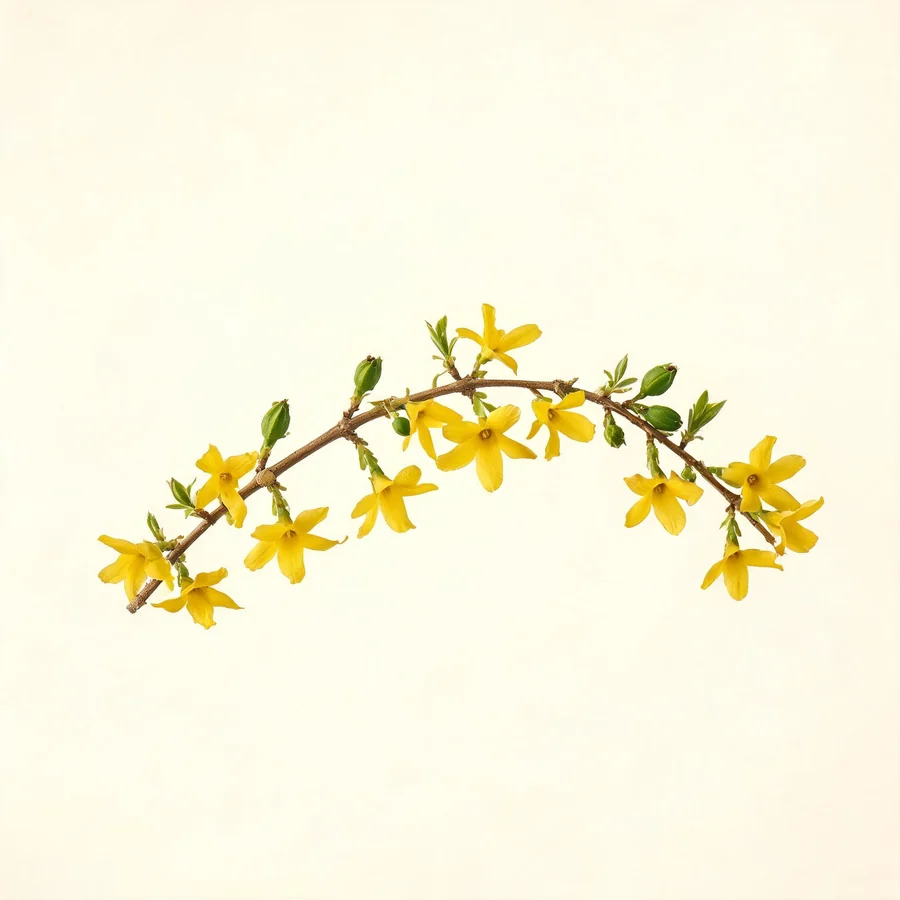
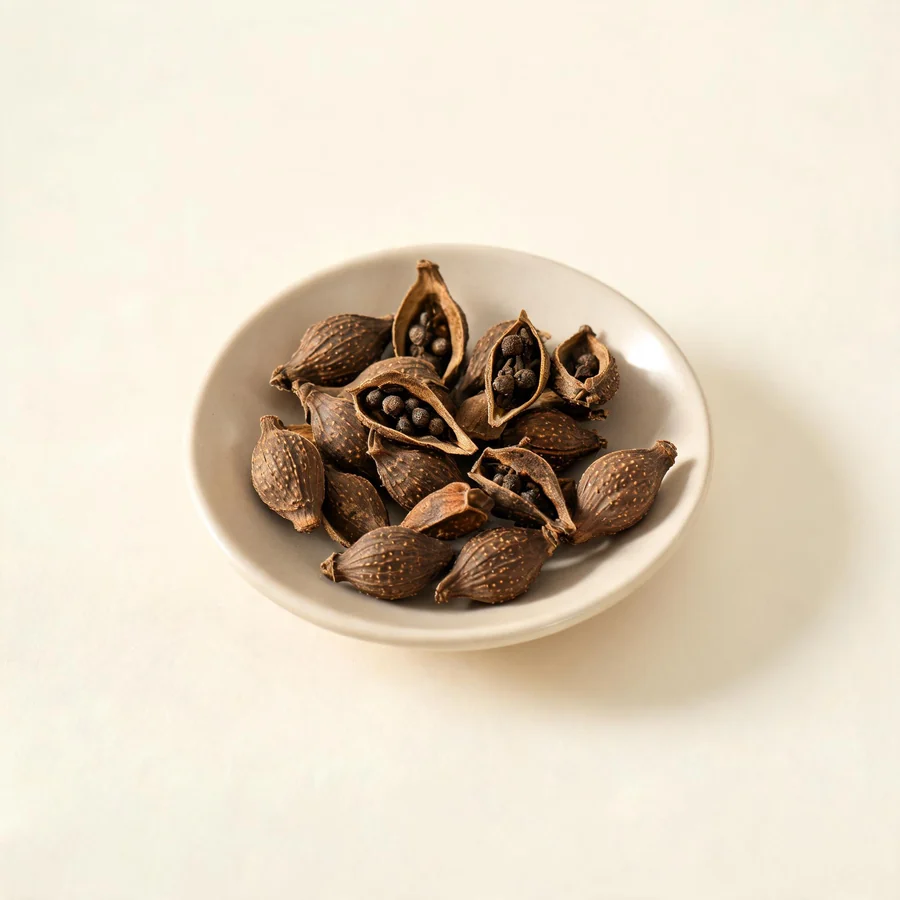
Skin profile
Where this herb sits in skin practice: the pattern it corrects, the skin signs it suits, and what it should not be used for.
Lian Qiao is the herb for the early, hard, hot stage of a skin infection, when the lesion is red and tender and has not yet pointed, and for the same heat toxin when it follows a feverish cold. It is lighter and less drying than the bitter roots, and it is stopped once the lesion discharges.
Skin signs that suggest it
- A hot, hard, tender swelling that has not yet come to a head
- Red, raised plaques with a clear edge, warmth and pain (heat toxin in the flesh)
- Small pustules at the hair follicles with surrounding redness
- Honey-coloured crusts, or a red edge that is spreading outward
- A sore throat and tender neck glands at the start of a rash, with a red tongue and a yellow coating
When it is not the right herb
Not for a lesion that has already opened and is draining thin clear fluid, where the aim is healing rather than dispersing. Not for cold-deficient digestion, with loose stools and a pale tongue, because the bitter cool nature makes the looseness worse. Not for chronic dry eczema, pale indolent ulcers, or a wind-cold illness with chills and a clear nasal discharge. It is a short-term herb for an acute hot phase, and continuing it after the heat has gone only chills the digestion.
What it does for skin
Skin-relevant actions only. Each one describes a mechanism in TCM terms and what it looks like on the skin.
Clears Heat and resolves Toxin in the skin
Lian Qiao is one of the herbs the tradition calls indispensable for sores, and on the skin it is used wherever heat toxin is producing redness, heat, swelling and pain. It is slightly cool rather than bitterly cold, so it clears without the hard drying of the root bitters, which makes it suitable for the face and for skin that is already a little dry. It is used for boils, folliculitis, impetigo and infected eczema.
Disperses nodules and reduces swelling
The fruit is specifically for the stage of a lesion when heat and toxin have congealed into a hard, tender mass that has not yet pointed. Its bitter taste is said to break through that stagnation, and it is used for early boils and abscesses, for swollen and tender neck glands, and for indurated plaques that feel firm under the finger. Once the lesion has opened and is draining, the dispersing action is no longer wanted.
Releases Wind-Heat from the surface
Many hot rashes begin as a wind-heat illness, with a sore throat, fever, headache and thirst before the skin changes appear. Lian Qiao is light and floating, so it lifts the pathogen out through the surface rather than only cooling it where it sits. This is why it is a lead herb in the formulas for the opening days of a feverish illness and why it is used when a rash is spreading with a cold.
Cools the Blood through the Heart channel
The fruit enters the Heart, which governs the blood and the vessels, so its clearing reaches the blood aspect of a lesion as well as the surface. That is the traditional explanation for its use in spreading red plaques and in eruptions that are dusky rather than bright, where the heat has gone deeper than the skin surface. It is combined with blood-cooling herbs when the colour of the lesion suggests the blood level is involved.
Skin conditions it is used for
Mapped to the condition pages on this site. The pattern column shows what the skin is doing when this herb is the right choice.
| Condition | Pattern | Why it suits | Typical setting |
|---|---|---|---|
| Boils | Toxic heat gathering before it points | A hard, hot, tender swelling with a red rim and no head yet is the stage at which dispersing can still prevent a larger collection. Lian Qiao clears the toxin and breaks up the congealed mass, and it is combined with stronger toxin-clearing herbs such as Jin Yin Hua and Pu Gong Ying. It is used while the lesion is still hard and painful, and the approach changes once it drains. | Wu Wei Xiao Du Yin, or Huang Lian Jie Du Tang with Lian Qiao and Pu Gong Ying |
| Skin abscess | Heat toxin with swelling and pus forming | A deeper collection with heat, pain and a spreading red edge is treated by clearing the toxin and dispersing the swelling before the pressure builds. Lian Qiao is a standard supporting herb for this, because its dispersing quality works on the mass while its toxin-clearing quality addresses the infection. A large, deep or febrile abscess needs urgent medical care, and herbs are used only alongside it. | Wu Wei Xiao Du Yin with Jin Yin Hua and Pu Gong Ying |
| Folliculitis | Heat toxin in the follicles of the upper body | Scattered pustules at the hair follicles, especially on the scalp, the beard area and the back, are read as heat toxin lodging where the hair exits the skin. Lian Qiao clears the toxin and its upward tendency matches the upper-body site. It is combined with Huang Qin for the heat and with Pu Gong Ying for the suppuration, and the pattern is treated while the pustules are new rather than after they have crusted over. | Huang Lian Jie Du Tang with Lian Qiao, or a modified formula with Pu Gong Ying |
| Impetigo | Damp-heat toxin with yellow crusting | Honey-coloured crusts over red, oozing skin around the nose and mouth are read as damp-heat toxin near the surface, and the lesion often spreads from one site to another by contact. Lian Qiao clears the toxin and disperses the swelling, while drying herbs in the same formula handle the ooze. A small local patch may be treated alongside a wash, but a spreading or febrile infection needs medical assessment. | A modified Huang Lian Jie Du Tang with Jin Yin Hua and Lian Qiao |
| Erysipelas | Heat toxin spreading across the skin | A bright red, hot, tender plaque with a sharp, advancing edge and fever is the classic picture of heat toxin moving through the skin. Lian Qiao is used because it clears the toxin and disperses the swelling, and it is combined with the strongest fire-purging herbs. This is a condition that can progress quickly, so it needs urgent medical treatment, and herbs belong only in a supervised supportive role. | Huang Lian Jie Du Tang with Lian Qiao, within supervised care |
| Acne | Lung and Stomach heat with heat toxin | Red papules and pustules on the face and upper trunk, with oiliness and a red tongue, are read as heat in the Lung and Stomach with toxin. Lian Qiao clears the toxin and lightens the formula so that it acts on the upper body, and it is used in the classical acne formulas beside Huang Qin and Mu Dan Pi. It is less suitable for deep, cold, slow-healing lesions. | Qing Shang Fang or Pi Pa Qing Fei Yin, with Huang Qin and Mu Dan Pi |
Combinations for skin
Herbs it is paired with when the skin, not an internal organ, is the target.
| Partner | Ratio | Why the pair is used |
|---|---|---|
| Jin Yin Hua | 9 to 15 g each, in equal parts | The most famous pairing in heat-clearing medicine: one herb clears the toxin at the Qi and Blood levels, the other releases the surface and disperses nodules. Together they cover the outside and the inside at once, which is why they lead the formulas for wind-heat illness and also serve for hot, swollen sores anywhere on the body. |
| Pu Gong Ying | 9 to 15 g each | Both clear heat toxin, and together they make a stronger combination for sores and infection. Lian Qiao has the lighter, upper-body action and disperses nodules, while Pu Gong Ying has a particular affinity for the breast and for hot, swollen lesions with a Stomach or Liver component. The pair is used when a boil is spreading or when a red, tender mass is still hard. |
| Huang Qin | 9 to 12 g Lian Qiao with 6 to 10 g Huang Qin | Huang Qin is the bitter, drying member of the pair, clearing heat and dampness from the upper and middle burners and cooling the blood. Lian Qiao releases the surface and resolves toxin more gently. Together they are used where a hot skin lesion comes with internal heat, since the lighter herb carries the surface while the bitter one works underneath. |
| Xia Ku Cao | 9 to 15 g each | Xia Ku Cao clears Liver fire and softens hardness; the forsythia cools the Heart and breaks up nodules. The two attack the same lump through different channels, which is why they are paired for scrofula, thyroid nodules and firm neck swellings. On the skin this matters for indurated lesions and for tender glands beside an infected area. |
Formulas where it leads
- Yin Qiao San (银翘散) - The foundational formula for wind-heat at the start of an illness, where Lian Qiao and Jin Yin Hua lead. It is used when a feverish cold brings a sore throat and a rash is beginning, and it is taken as a light decoction rather than boiled hard, because the aromatic herbs are volatile.
- Wu Wei Xiao Du Yin (五味消毒饮) - The formula of five toxin-clearing herbs for boils, abscesses and hot painful swellings before they point. Lian Qiao is often added to supply the nodule-dispersing action. It is used in the early, hard stage, and the emphasis shifts once a lesion has opened.
- Huang Lian Jie Du Tang (黄连解毒汤) - The strong fire-purging formula used when heat toxin is severe enough to threaten spread, such as a spreading red plaque with fever. Lian Qiao is added for its dispersing and surface-clearing qualities. The formula is drying and strong, and it is given for a short period under supervision.
Safety for skin use
What to check before recommending or using it, including the cautions that matter most for skin patients.
Do not use, or use with caution
- Spleen and Stomach deficiency-cold: a cold, weak digestion, with loose stools that cold food makes worse, a pale tongue and a pulse that is slow and weak. A cooling herb of this kind leaves the stools looser and the appetite lower.
- A lesion that has already opened and is draining thin clear fluid. The discharging stage belongs to deficiency or to healing, and the dispersing action is no longer appropriate.
- Wind-cold illness, with chills greater than fever and a clear nasal discharge. A cooling, surface-releasing herb does not suit that pattern and may deepen it.
- Prolonged use after the heat has resolved. Continuing a bitter cooling fruit once the fever and redness have gone, when no heat is left, only adds cold to the digestion and brings no benefit.
Pregnancy and breastfeeding
For a genuine wind-heat illness, brief supervised courses at ordinary doses are common in practice, and no classical prohibition covers the fruit in pregnancy. It is not classed as a blood mover, and no action on the uterus has been established. The caution is constitutional: a pregnancy already running cold, with loose stools or a poor appetite, should not take a bitter cooling herb for long.
Interactions
- Clinical reports describe no serious interaction with this fruit. The points below come from laboratory work and pharmacological reasoning, and they matter most when several medicines are in use.
- Cardiac glycosides such as digoxin: oleanolic acid in the fruit shows a mild cardiotonic and diuretic effect in experiments. At herbal doses that effect is probably slight, but a digoxin dose that is finely balanced deserves review before the fruit is added.
- Blood pressure and clotting medicines: in animals, water extracts have lowered blood pressure, and some laboratory work points to an effect on platelets. Neither finding is strong, but someone on antihypertensives or warfarin should be monitored rather than treated as if the herb did nothing.
- Polypharmacy in general: because the fruit is cooling and can loosen the stool, it may add to the gut effects of other medicines, and anyone with several prescriptions should mention it to their prescriber.
Allergy and patch testing
Allergic reaction to forsythia is uncommon, but contact dermatitis to herb-containing washes and creams is well recognised, so a patch test is sensible before external use. A known sensitivity to the olive family of plants is a reason for care, although cross-reaction with the fruit is not established. Stop if the skin becomes more irritated rather than calmer.
General safety references
General references for herbal hepatotoxicity and herb-drug interactions; they are not specific to this herb.
- Review article: Herbal hepatotoxicity - an update on traditional Chinese medicine preparations. Alimentary Pharmacology & Therapeutics, 2014. PMID: 24844799.
- Interactions between herbal medicines and prescribed drugs: an updated systematic review. Drugs, 2009. PMID: 19719333.
- Warfarin and food, herbal or dietary supplement interactions: a systematic review. British Journal of Clinical Pharmacology, 2021. PMID: 32478963.
Evidence
The classical record is quoted with its source. The modern note states the level of evidence plainly.
Classical record
连翘之用有三:泻心经客热,一也;去上焦诸热,二也;为疮疡须用,三也。
Three uses are recorded for this fruit: it clears intrusive heat from the Heart, it removes heat from the whole upper burner, and it is indispensable in the treatment of sores and ulcers.
Zhen Zhu Nang (Pearl Pouch) - Sores are named as one of only three uses, which explains why the fruit serves feverish illness and skin disease at once.
连翘状如人心,两片合成,其中有仁甚香,乃少阴心经、厥阴包络气分主药也。诸痛痒疮疡皆心火,故为十二经疮家圣药。
The fruit resembles a human heart, two halves joined with a fragrant kernel inside. It is the chief herb for the qi aspect of the Heart and Pericardium channels, and because painful, itching sores are all traced to Heart fire, it became the sovereign remedy for lesions of all twelve channels.
Ben Cao Gang Mu (Compendium of Materia Medica) - The shape is a mnemonic for the channel, not a point of botany, yet it records how the fruit came to be the standard remedy for skin lesions.
Modern evidence
Evidence status
- Laboratory studies of forsythiaside, phillyrin and the whole-fruit extract report anti-inflammatory, antibacterial and antioxidant activity in cell and animal models. These findings are at concentrations that a decoction does not reliably achieve in skin, and they do not establish a clinical effect.
- The fruit has been studied mainly as a component of formulas for upper respiratory infection, where it is one of several herbs. Trials of the single fruit in skin disease are not available in the mainstream literature.
- Reports of toxicity from the whole fruit at ordinary doses are essentially absent from the review literature, and the practical limit is how well the digestion tolerates it. The fruit is an accepted substance in the Chinese Pharmacopoeia; the material here describes traditional practice and the state of the evidence.
PubMed records
Selected real PubMed records for this herb's species or its constituents, chosen by species name and title relevance. They are references for the non-TCM discussion above, not proof that the herb treats any skin condition.
- Phillygenin inhibits LPS-induced activation and inflammation of LX2 cells by TLR4/MyD88/NF-κB signaling pathway.. Journal of ethnopharmacology, 2020. PMID: 31683033 (skin-related record).
Dose and forms
Skin-practice dosing and the preparations that suit skin complaints.
| Form | Dose and notes |
|---|---|
| Decoction | 6 to 15 g of dried fruit daily. Six to nine grams suits a mild wind-heat picture or a supporting role, and nine to fifteen grams is used when heat toxin is established with a boil or a high fever. |
| Preparation | Crush or break the dried capsule before decoction so that the woody valves release their contents. It goes in with the main batch, needs no special handling, and the seeds, when used separately, are wrapped in cloth to stop them dispersing. |
| Course length | A short course of days, stopped when the fever, the redness and the swelling settle. It is a herb for the acute hot phase rather than a daily tonic. |
| Grade | The green, unripe fruit clears heat more strongly than the ripe grade, so a formula written for green fruit should not be filled with ripe material at the same weight. |
The fruit is light, and a large volume of crushed capsules yields a comparatively modest amount of active material, which is why the dose is generous relative to the bitter roots. It is meant for the acute hot phase: once the fever has passed and the throat has lost its redness, more of it only adds cold to the digestion. The unripe and ripe grades are not interchangeable, and the batch should state which one it is.
Citations and further reading
Only real sources are listed: the classical materia medica passages quoted above, and the source works behind the botanical and safety statements.
- Zhen Zhu Nang (Pearl Pouch), Jin period - classical entry quoted above.
- Ben Cao Gang Mu (Compendium of Materia Medica), Li Shizhen, 1578 - classical entry quoted above.
- Forsythia suspensa monograph: Pharmacopoeia of the People's Republic of China - source for the accepted botanical source, part used and quality requirements.
- Modern evidence statement: based on laboratory and review literature on the fruit, summarised as a statement about the level of evidence rather than as a cited finding.
- Botanical description and identification: botanical literature on Forsythia suspensa, Oleaceae.
Educational reference for qualified practitioners. This page is not medical advice, and skin conditions should be diagnosed by a clinician before treatment.