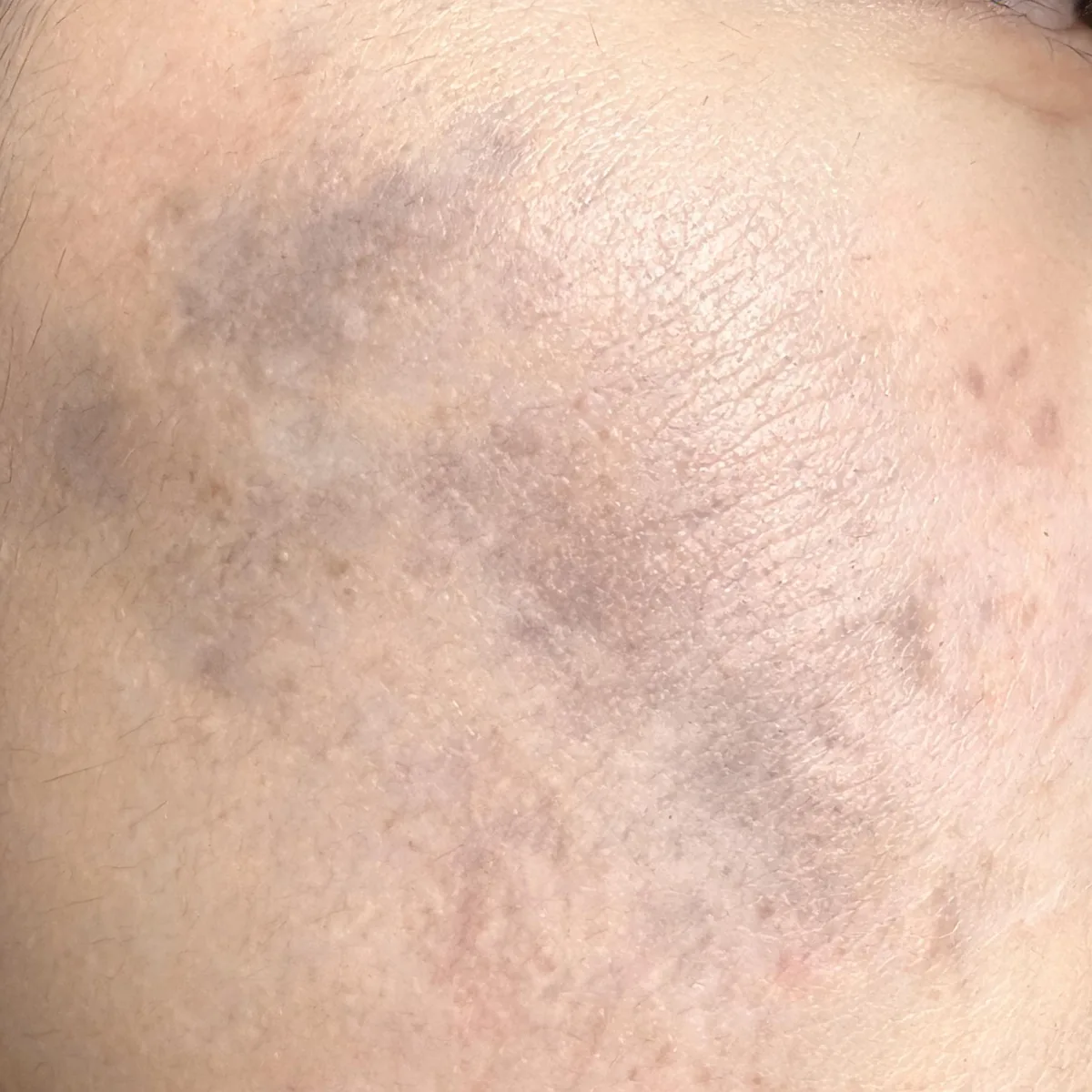
Understanding Dark face
The tradition describes a healthy complexion as bright and lustrous because Qi and Blood flow freely to the skin. When that flow is blocked or depleted the face becomes dark, dull or purplish.
Blood stagnation gives a dark dusky complexion with fixed stabbing pain worse at night, dark menstrual blood with clots, and purple lips and nails. Qi deficiency causing stagnation gives a dark dull face with extreme fatigue, breathlessness and fixed pain.
Kidney and Liver Yin deficiency gives a dark withered complexion with malar flush in the afternoon, night sweats, dry eyes and low back soreness. Heart Blood stagnation gives a dark facial tone with fixed stabbing chest pain, purple lips, palpitations and pain radiating to the back.
Spleen deficiency with dampness gives a dark sallow greasy complexion with bloating, loose stools and a swollen tongue with teeth marks. Phlegm in the channels gives a dark complexion with fixed joint pain, hard swelling and nodules near joints.
The classical literature ties the complexion to four organs at once. The Heart governs the vessels and its state shows on the face, the Spleen turns food into Qi and Blood, the Liver keeps movement smooth, and the Kidney stores the essence that keeps skin supple. When any of them falters the face loses its lustre, and the shade of darkness differs with each root, so practitioners read the face as a summary of the whole body rather than a local blemish.
Because the shade, texture and distribution of the darkness vary, the classical literature treats the face as a guide to where the problem sits. A bruised, purplish tone points to blood that has stopped moving, a dull greyish tone to Qi too weak to lift nourishment upward, a withered and dry tone to Yin that has run low, and a greasy sallow film to turbid dampness rising from a weak Spleen. Treating the surface alone leaves the cause untouched, which is why a course of herbs and acupuncture is matched to the pattern rather than to the pigment.
Conventional view
Conventional medicine files a darkening complexion under hyperpigmentation. Extra melanin can follow sun exposure, hormonal change such as melasma in pregnancy or with the contraceptive pill, inflammation after acne or injury, or a medicine, and in rare cases it points to an endocrine disorder such as Addison's disease. A dermatologist usually examines the skin, sometimes with a Wood's lamp or a biopsy, before deciding on treatment.
Treatment aims to fade existing pigment and slow new pigment forming. Standard options are topical hydroquinone, retinoids or vitamin C, chemical peels, microdermabrasion, and laser or light-based therapy, with sun protection advised for everyone and oral tranexamic acid sometimes prescribed for melasma.
The limitation is that these approaches act on the surface. Pigment often returns once treatment stops, particularly after sun, stress or hormonal shifts, which commits people to repeated courses. They also do not ask whether the darkening is a visible sign of sluggish circulation, fluid retention or an organ-level deficiency, and that question is where the TCM assessment begins.
Selected PubMed records
Real PubMed records for the conventional discussion above, selected by condition name and title relevance. They are references, not a claim that any treatment is proven for this condition.
- Rare Defects: Looking at the Dark Face of the Thrombosis.. International journal of environmental research and public health, 2021. PMID: 34501736.
- The two faces of IL-6 in the tumor microenvironment.. Seminars in immunology, 2014. PMID: 24602448.
How it connects
The classical literature lists two companions that share the same root. Fixed stabbing abdominal pain often travels with a dusky face because stagnant blood obstructs the lower burner as well as the complexion, and easing the stasis tends to relieve both at once. Bloating belongs to the Spleen deficiency picture: when the Spleen cannot transform fluids, dampness and turbidity rise to dim the face while the belly fills and the digestion slows, so the two are expressions of one weakness rather than separate complaints.
How it is assessed
The practitioner notes the tone and distribution, and looks for systemic signs.
What a practitioner looks for
- Chest pain: fixed stabbing chest pain with dark lips suggests Heart Blood stagnation - assess urgently.
- Fatigue: dark dull face with profound fatigue suggests Qi deficiency with stagnation.
- Dampness: greasy sallow complexion with bloating suggests Spleen deficiency.
- Red flags: sudden darkening with weight loss, dizziness or low blood pressure needs medical review.
A consultation starts with the exact quality of the darkness: whether it is dull and ashen, or purple like an old bruise, and what else arrives with it. The tongue and pulse carry most of the diagnostic weight, because several patterns darken the face while arising from very different roots. Practitioners also ask about pain, sleep, digestion, menstrual loss and energy, since each of those separates a stagnation picture from one of depletion or turbidity.
In practice the pictures overlap. Phlegm rarely darkens the face by itself and usually sits alongside blood stasis, giving a cloudy tone with a thick greasy coating and a pulse that is both slippery and wiry. A pulse that is knotted or intermittent, with darkness at the tongue tip and tightness in the chest, moves the assessment toward the Heart and calls for medical review rather than herbs alone. Sudden darkening, or darkness with weight loss, dizziness or low blood pressure, needs a doctor first.
TCM patterns in Dark face
Six patterns are recorded for a dark face, and they are told apart less by the darkness itself than by what travels with it. Blood stasis gives a bruised, dusky tone with fixed stabbing pain that is worse at night. When Qi is too weak to push blood along, the face is dull rather than deep, and fatigue, breathlessness and sweating on effort dominate. Kidney and Liver Yin deficiency leaves the skin withered, adding afternoon flushing, night sweats and low back ache. Where the Heart's blood is congested the darkness comes with chest tightness, palpitations and purple lips. Spleen deficiency lets dampness rise, so the face looks sallow and greasy and the digestion bloats. Phlegm in the channels adds fixed joint pain, hard swelling and numbness. Deciding which of these fits settles whether the treatment moves, tonifies, nourishes or drains.
| Pattern | Key signs | The itch | Tongue | Main formula |
|---|---|---|---|---|
| Blood Stagnation | Fixed stabbing pain worse at night; Rough dry scaly skin | Not specified | Body: Purple, dusky or with dark stasis spots; sublingual veins dark and distendedCoat: Often thin white; a yellow coat would suggest Heat as the cause | Not specified |
| Qi Deficiency causing Blood Stagnation | Fixed stabbing pain worse with pressure | Not specified | Body: Pale-dark or pale-purple, teeth-marked, possibly with stasis spots and dark sublingual veinsCoat: Thin white | Not specified |
| Kidney and Liver Yin Deficiency | Dark withered facial complexion; Dry eyes with blurred vision | Not specified | Body: Red, thin and dry, often crackedCoat: Little or none; the tongue may look peeled | Not specified |
| Heart Blood Stagnation | Stabbing or pricking chest pain in a fixed location; Palpitations or anxiety during pain | Not specified | Body: Purple or dark red with stasis spots and distended sublingual veinsCoat: Thin white | Not specified |
| Spleen Deficiency with Dampness | Not specified | Not specified | Body: Pale and swollen, often with teeth marks along the edgesCoat: White, greasy and moist, thick in the middle | Not specified |
| Phlegm in the Channels (Joints and Muscles) | Fixed stabbing joint pain; Hard swelling or nodules near joints | Not specified | Body: Purple, with stasis spots and distended sublingual veinsCoat: White and greasy | Not specified |
Blood Stagnation
Dark dusky face with fixed night pain and clotty periods.
Blood should carry fresh nourishment to the skin of the face. When its flow becomes sluggish or stuck, the complexion is left with old, pooled blood showing through, which reads as a dusky, bruised or almost purplish tone. The same log-jam explains the dark clots in the menstrual loss and the purple cast of the lips and nails, because colour deepens wherever blood collects.
The tongue body is dark purple, often with stasis spots and distended veins beneath it, under a thin white coat, and the pulse is choppy or wiry. Cold drinks, cold weather, long hours of stillness and swallowed frustration all tighten the flow, while gentle movement and warmth loosen it. Xue Fu Zhu Yu Tang and Tao Hong Si Wu Tang are the formulas recorded here, with Dan Shen, Tao Ren and Chuan Xiong among the herbs, and treatment often uses SP-10 (Xuehai), BL-17 (Geshu), SP-6 (Sanyinjiao) and LR-3 (Taichong).
Signs
- Dark or dusky facial complexion
- Fixed stabbing pain worse at night
- Dark menstrual blood with clots
- Purple or dark lips and nails
- Rough dry scaly skin
Diet and lifestyle for this pattern: Eat warm cooked food that gently moves Blood, such as turmeric, ginger, dark leafy greens and a little black vinegar. Avoid iced drinks and raw food that congeal Blood, keep moving daily with walking or tai chi without overexerting, and manage stress through breathing, since held emotion tightens the flow of Qi and Blood.
Qi Deficiency causing Blood Stagnation
Dark dull face with extreme fatigue and breathlessness.
Qi is the force that drives blood through the vessels. When it runs short the push weakens, blood moves less briskly and starts to gather, so the face looks dull and dusky rather than deeply bruised. The tell-tale feature is that the darkness never arrives alone: it comes with heavy fatigue, breathlessness on exertion, a reluctance to speak and sweating from slight effort, so emptiness and stasis are present in the same picture.
The tongue is pale with a dark or purplish tinge, sometimes marked by teeth and by spots of stasis, and the pulse is deep, fine and choppy. Overwork, stress and cold raw food drain Qi further, while rest, warmth and building foods restore it. Bu Yang Huan Wu Tang is the formula named, led by Huang Qi with Dang Gui, and the points recorded are ST-36 (Zusanli), REN-6 (Qihai), SP-10 (Xuehai) and BL-17 (Geshu).
Signs
- Dark dull or dusky facial complexion
- Extreme fatigue and lack of strength
- Shortness of breath on exertion
- Fixed stabbing pain worse with pressure
Diet and lifestyle for this pattern: Build Qi with warm, easy food such as congee, stews, sweet potato, oats and dates, and avoid cold raw food and iced drinks that chill digestion and deplete Qi. Keep movement gentle, with a walk, tai chi or restorative yoga, and put rest ahead of overwork, because pushing through fatigue deepens both deficiency and stasis.
Kidney and Liver Yin Deficiency
Dark withered face with afternoon flushing and night sweats.
The glow of the face depends on Kidney essence and Liver blood. When both are depleted the moisture that keeps skin supple dries up, and the complexion turns dark, withered and baked-in, as though a shadow lies over it. Empty heat rising from that lack of Yin adds the afternoon flush and the night sweats, because there is not enough cooling fluid to anchor the body's warmth.
The tongue is red and thin with cracks, a dry surface and almost no coating, and the pulse is fine, rapid and often wiry, feeling weakest at the Kidney position on the left wrist. Late nights, spicy and fried food, coffee and overwork empty the reserves fastest, while sleep and moistening foods refill them. Zhi Bai Di Huang Wan is the formula given, with Shu Di Huang, Shan Zhu Yu, Zhi Mu and Huang Bo, alongside KI-3 (Taixi), KI-6 (Zhaohai), BL-23 (Shenshu) and BL-18 (Ganshu).
Signs
- Dark withered facial complexion
- Malar flush especially in the afternoon
- Night sweats with hot palms and soles
- Dry eyes with blurred vision
Diet and lifestyle for this pattern: Be in bed before eleven and keep screens out of the late evening, since Liver and Kidney recharge during sleep. Eat moistening, cooling food such as pear, black sesame, goji berries, mulberries and millet, avoid spicy, fried and barbecued food that consumes Yin, and choose walking or restorative yoga over intense sweating.
Heart Blood Stagnation
Dark face with fixed chest pain and palpitations.
The Heart governs the vessels and its state is written on the face, so when its blood congests the upward supply of nourishment is blocked and the complexion takes on a dark or purplish cast. The darkness is not a cosmetic matter here: it points to blood not moving cleanly through the chest, and to a rhythm that may be disturbed, which is why chest pain in this picture is assessed medically before anything else.
The tongue body is a deep purple, most marked toward the tip, with stasis spots and engorged veins below, and the pulse is choppy or knotted at the left Cun position. Emotional tension, cold and heavy greasy food tighten the chest, while warmth, gentle movement and slow breathing release it. Xue Fu Zhu Yu Tang is the formula recorded, with Dan Shen, Tao Ren and Chuan Xiong, and the points named are PC-6 (Neiguan), BL-15 (Xinshu) and SP-10 (Xuehai).
Signs
- Stabbing or pricking chest pain in a fixed location
- Purple or dark discolouration of lips and nails
- Palpitations or anxiety during pain
- Pain radiating to the back
Diet and lifestyle for this pattern: Eat warming, blood-moving food such as hawthorn berries, turmeric and black fungus, and avoid cold raw food and iced drinks that congeal Blood. Keep moving daily with walking or tai chi without overexertion, and manage stress with breathing or meditation, since emotional tension tightens the chest and worsens stagnation.
Spleen Deficiency with Dampness
Dark sallow greasy face with bloating and loose stools.
The Spleen turns food into Qi and Blood and moves fluids on. When it is weak, fluids gather as dampness, and that turbid mixture rises to the face, veiling the clear Yang that should brighten it. The result is not a deep bruise but a sallow, greasy film over the skin, and the same failure shows below as bloating after eating, loose stools and heaviness in the limbs.
The tongue is pale and swollen with teeth marks and a white greasy coat on a wet surface, and the pulse is soft, soggy and slowed, sometimes slippery. Cold raw food, humid weather, fried and sweet dishes and long sitting all add to the load, while warm cooked meals and gentle walking reduce it. Liu Jun Zi Tang is the formula, with Bai Zhu, Fu Ling and Chen Pi, and the points recorded are BL-20 (Pishu), ST-36 (Zusanli), SP-9 (Yinlingquan) and ST-40 (Fenglong).
Signs
- Dark sallow or greasy facial complexion
- Abdominal bloating worse after eating
- Loose stools
- Heaviness in the body
- Swollen tongue with teeth marks
Diet and lifestyle for this pattern: Focus on warm cooked meals such as soups and congees, and avoid cold, raw, greasy and sweet food that burdens the Spleen. Gentle daily walking helps Qi circulate and Dampness transform.
Phlegm in the Channels (Joints and Muscles)
Dark face with fixed joint pain, hard swelling and puffiness.
Sticky phlegm and stagnant blood can clog the channels so that clear Yang cannot rise to the face. Turbidity and stasis then cast a cloudy, dark hue over the complexion, and the blockage shows elsewhere in the same channels as fixed stabbing joint pain, hard swellings or nodules near the joints, numbness and a heavy feeling in the limbs, with puffy eyelids and a sense of tightness in the chest.
The tongue is purple with stasis spots and a white greasy coat, and the pulse is wiry with a choppy feel, or wiry and slippery where phlegm predominates. Cold damp weather, greasy fried food, stillness and held-back emotion all thicken the obstruction, while warmth, movement and dry weather ease it. Xiao Huo Luo Dan is the formula, with Ban Xia, Dan Shen and Wei Ling Xian, and treatment draws on ST-40 (Fenglong), SP-10 (Xuehai) and GB-34 (Yanglingquan).
Signs
- Fixed stabbing joint pain
- Hard swelling or nodules near joints
- Heavy numb sensation in the limbs
- Puffy eyelids with chest tightness
- Excess phlegm
Diet and lifestyle for this pattern: Avoid cold, raw and greasy food that creates Dampness and phlegm. Eat warm cooked meals with ginger and turmeric to support circulation, and keep moving gently so Qi and Blood flow through the channels.
Treatment approach
How the tradition treats dark face, with the herbs, formulas and points used for it.
Principles
- Move Blood and resolve stasis where the face is dusky and pain is fixed.
- Support Qi where fatigue drives the stagnation, since moving alone would deplete further.
- Nourish Kidney and Liver Yin where there is afternoon flushing and night sweats.
- Assess chest pain medically first - Heart Blood stagnation describes a symptom that needs cardiac review.
- Because the root varies, the strategy is chosen by pattern: move blood where the tone is bruised and the pain is fixed, build Qi first where fatigue drives the stasis, nourish Yin where the face is withered and hot, and dry dampness or transform phlegm where the skin looks greasy or the joints are swollen. Most courses combine these approaches, since deficiency and stasis usually sit together, and the mixture is adjusted as the complexion and the other symptoms change.
Herbs used
Formulas
- Xue Fu Zhu Yu Tang
- Tao Hong Si Wu Tang
- Bu Yang Huan Wu Tang
- Zhi Bai Di Huang Wan
- Liu Jun Zi Tang
- Xiao Huo Luo Dan
Acupoints
- SP-10 (Xuehai)
- BL-17 (Geshu)
- SP-6 (Sanyinjiao)
- LR-3 (Taichong)
- ST-36 (Zusanli)
- qihai-ren-6
- KI-3 (Taixi)
- KI-6 (Zhaohai)
- BL-23 (Shenshu)
- BL-18 (Ganshu)
- PC-6 (Neiguan)
- BL-15 (Xinshu)
- BL-20 (Pishu)
- SP-9 (Yinlingquan)
- ST-40 (Fenglong)
- GB-34 (Yanglingquan)
What to expect
- Complexion change is described as slow, improving over months as the pattern resolves.
- Cardiac and endocrine causes need medical assessment before herbal treatment.
- Stagnation patterns often respond faster than deficiency patterns.
- Timelines follow the pattern. The tradition describes a visible lift in colour within three to four weeks where stasis is the whole story, six to eight weeks where Qi has to be rebuilt first, two to four weeks for dampness once the Spleen is supported, and two to three months or more for Kidney and Liver Yin, which is the deepest depletion. Weekly acupuncture and daily herbs are assumed, and missed doses slow the change.
Safety and when to get help
Seek medical help urgently for
- Sudden facial darkening with severe fatigue, weight loss and low blood pressure.
- Chest pain with breathlessness, sweating or pain radiating to the arm or jaw.
- Dark facial patches with fever or spreading skin change.
For anything severe, sudden or spreading quickly, read when a skin problem needs urgent care.
Cautions
- Chest pain needs urgent medical assessment, not herbal treatment.
- Generalised darkening needs endocrine review.
- Do not use unregulated lightening products.
Using this alongside conventional care
- TCM is described as complementary to conventional care: cardiac and endocrine assessment comes first, with herbs for the constitutional pattern.
- The classical literature treats TCM as an addition to dermatological care rather than a replacement. Prescribed creams such as hydroquinone or tretinoin are continued as directed, with both practitioners told about them so that irritant products are not layered on top of each other. Herbs that move blood, including Dang Gui and Chuan Xiong, may interact with warfarin or aspirin, so every medication is disclosed. If oral tranexamic acid is being taken for melasma, herbs can usually continue but the practitioner watches for signs of increased clotting, and sun protection stays essential throughout.
Diet and lifestyle
- Favour warm cooked easily digestible food that supports the Spleen and Blood production.
- Across all six patterns the classical literature favours warm, cooked, easily digested meals such as soups, stews and congees, because they support the Spleen and give it material for making Blood. Dark leafy greens, beetroot and a little lean protein nourish the Blood, while iced drinks, raw food, greasy fried dishes and refined sugar either chill the digestion or add turbid dampness that clouds the face. Where heat signs are present, chilli, garlic and alcohol are reduced. Pattern-specific additions matter too: turmeric, ginger and a dash of black vinegar for stasis, dates and oats for Qi, pear and black sesame for Yin, and no dairy or sugar where phlegm dominates.
If you're pregnant
Pregnancy directs Blood and Yin toward the growing baby, and the patterns behind a dark face can shift with it. The herbs that move blood most strongly, including Tao Ren, Hong Hua and Chuan Xiong, are avoided because they can stimulate the uterus, which rules out Xue Fu Zhu Yu Tang and Tao Hong Si Wu Tang. Where stasis follows mild Qi deficiency, the classical literature allows gentle Qi tonics such as Huang Qi with blood-nourishing Dang Gui, but only under close professional supervision.
Acupuncture is the safer route. Points with a strong downward action, especially Hegu (LI-4) and Sanyinjiao (SP-6), are traditionally avoided, and a practitioner instead uses light stimulation at ST-36 (Zusanli) or SP-10 (Xuehai). Any plan is agreed with the obstetric team as well as the TCM practitioner.
If you're breastfeeding
Most of the herbs used here, such as Dang Gui, Dan Shen and Shu Di Huang, are regarded as compatible with breastfeeding and may even help postpartum recovery. The bitter-cold pair used for Yin deficiency heat, Huang Bo and Zhi Mu, can pass into milk and loosen an infant's stools, so they are used cautiously and in smaller doses. Acupuncture carries no risk to the nursing baby and works well alongside the herbs.
If treating a child
A dark face is uncommon in childhood. When it appears, the classical literature points to blood stasis from a difficult birth or to long-standing Spleen deficiency with dampness, and the assessment leans heavily on tongue and pulse because children describe sensations poorly. Doses are reduced to roughly a third to a half of the adult amount by age and weight, and gentle Spleen-building formulas such as Liu Jun Zi Tang are preferred over strong blood-moving ones.
If treating an elderly patient
In older patients the picture is usually mixed, most often Kidney and Liver Yin deficiency with stasis layered on top, or Qi deficiency that has left circulation sluggish. Amounts are cut back to roughly two thirds of what a younger adult would take, and strong blood movers such as Tao Ren are handled carefully because the risk of bleeding rises, particularly for anyone on anticoagulant medication. Gentle acupuncture is often the safest first step.
Urgent-sign guidance is based on standard sources: NHS anaphylaxis, NHS cellulitis, NHS Stevens-Johnson syndrome, NHS melanoma.
Evidence
Evidence status
Compiled for this page from the classical and modern literature; not a systematic review, so treat it as a pointer to sources rather than clinical guidance.
Research largely overlaps with melasma and chloasma. Randomised trials and systematic reviews suggest acupuncture can reduce melanin index and lighten hyperpigmented patches, often outperforming placebo or topical treatment, with moderate evidence quality and small samples. Formulas targeting blood stasis and Yin deficiency, such as Xue Fu Zhu Yu Tang and Zhi Bo Di Huang Wan, have also been studied.
The recorded evidence is drawn largely from research into melasma and chloasma, which overlaps closely with a dark complexion. Several randomised trials and reviews indicate that needling can bring the melanin index down and fade patches of excess pigment, frequently beating placebo or standard topical care, though the studies are small and blinding is inconsistent. Chinese-language trials of formulas for stasis and Yin deficiency, including Xue Fu Zhu Yu Tang and Zhi Bo Di Huang Wan, report improvement in both complexion and accompanying symptoms, but large English-language trials are still scarce.
Studies often cited
Trials and reviews suggest reduced melanin index and lighter patches, often exceeding placebo or conventional topical treatment. Randomised trials and systematic reviews (as recorded in the source)
Studied for blood stasis and Yin deficiency patterns in facial pigment, with moderate quality evidence. Clinical studies (as recorded in the source)
Classical record
The patient has chest fullness, withered lips, a bluish tongue, and a dry mouth with a desire to rinse but not swallow. There is no fever or chills, and the pulse is slightly large and slow. Although the abdomen does not appear distended, the patient complains of fullness; this indicates blood stasis. The face is dark and dusky, and the skin is rough and scaly.
- Jin Gui Yao Lue (Essential Prescriptions of the Golden Cabinet), chapter 16, pulse and syndrome section. The Chinese original is not reproduced here: it could not be recovered reliably from the source record, and is not guessed.
心之合脉也,其荣色也… 色黑如黧者,血凝泣而不行。
The Heart pairs with the vessels, and the complexion is where its state shows. A blackish, dull face like dark lacquer means the blood is congealed and no longer moving.
Huang Di Nei Jing, Su Wen, chapter 10 - Classical citation: for this condition (Su Wen, chapter 10, on the five zang). It is the textual root of reading a dusky complexion as blood stasis.
Common questions
Why is my face dark and dull?
The classical literature reads it as Blood stagnation, Qi deficiency, Yin deficiency, dampness or phlegm - each with different accompanying signs.
Is a dark face a heart problem?
Not usually, but fixed chest pain with dark lips and nails needs urgent cardiac assessment.
When should I see a doctor?
Sudden darkening with fatigue and low blood pressure, or any chest pain with breathlessness.
Can herbs brighten the complexion?
The tradition describes improving flow and nourishment, with gradual change over months.
What if my symptoms overlap?
It is common. Long-standing Qi deficiency slows the blood, and chronic Yin deficiency dries it, so stasis can sit on top of either. The classical literature suggests noticing what changes the darkness: a face that brightens with rest and dulls with fatigue leans toward Qi deficiency, while darkness that deepens after stress or a sleepless night points to Yin deficiency or Liver stagnation. Chest tightness suggests the Heart, and bloating with heavy limbs suggests the Spleen.
How long before the complexion changes?
The tradition describes a visible change within three to four weeks for pure stasis, six to eight weeks where Qi must be rebuilt, two to four weeks for dampness once the Spleen is supported, and two to three months or longer for Kidney and Liver Yin deficiency. Weekly acupuncture and daily herbs are assumed, and consistency matters more than intensity.
Can TCM lighten the skin?
Not by bleaching it. The aim is to restore the circulation and nourishment that give the face its own even tone, so the darkness fades as the pattern corrects and the result holds rather than needing constant upkeep.