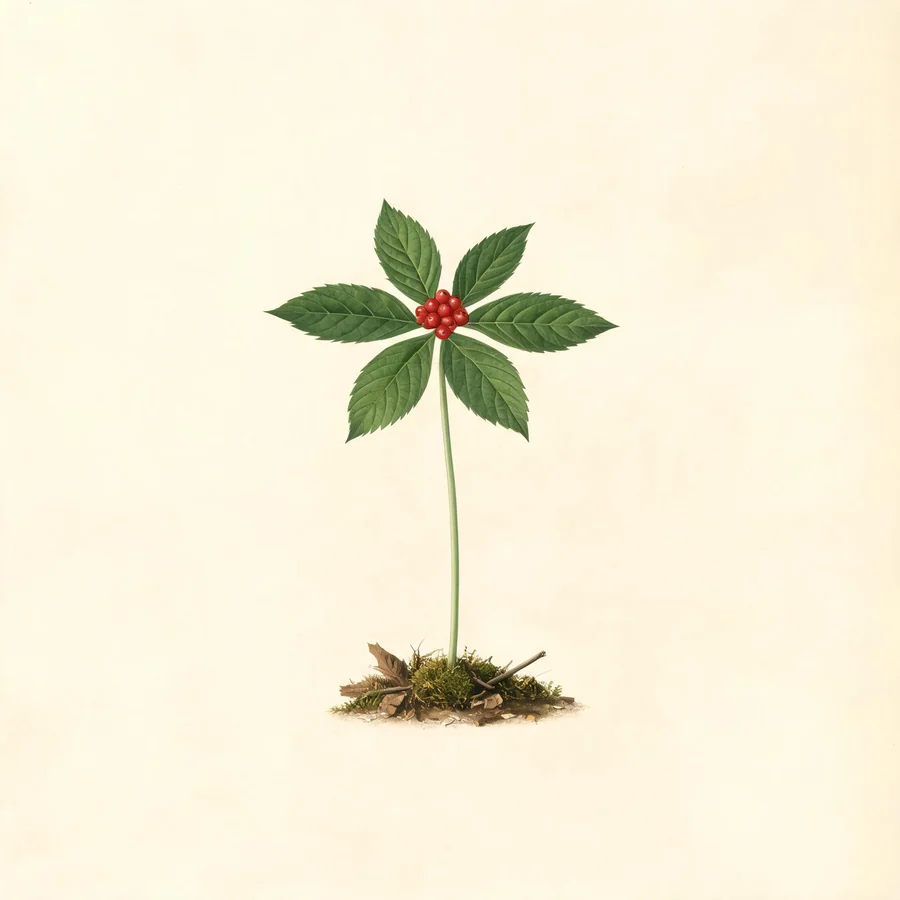
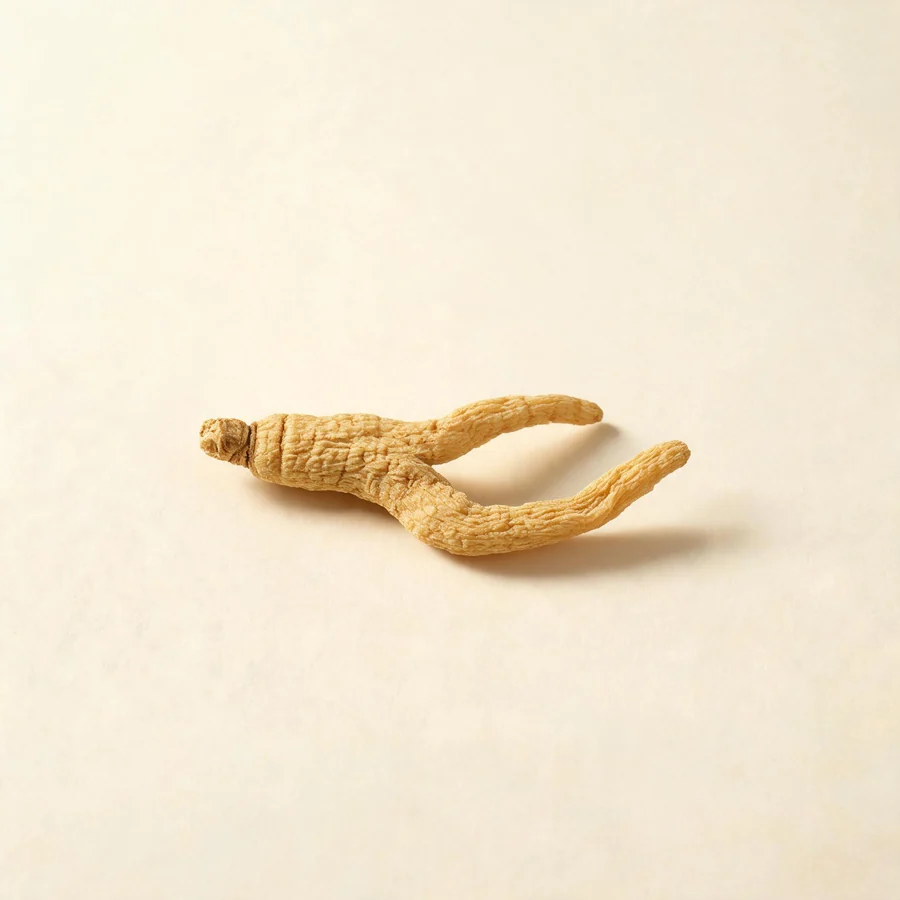
Skin profile
Where this herb sits in skin practice: the pattern it corrects, the skin signs it suits, and what it should not be used for.
Xi Yang Shen is the cool tonic at the dry end of skin practice. It suits a person who is tired, dry and a little warm, and it is wrong for cold, damp or acutely inflamed skin. It is gentle but not trivial: it interacts with warfarin and glucose-lowering drugs, it is substituted in trade, and it is not a general anti-ageing remedy.
Skin signs that suggest it
- Dry, thin skin with a dull, tired look and a faint flush over the cheeks (Qi and Yin deficiency)
- Skin that feels warm to the touch without obvious inflammation, worse in the afternoon or evening (deficiency heat)
- Tightness and dryness after washing, with thirst and a dry mouth (fluid depletion)
- A washed-out, sagging look after illness, with fatigue and slow healing (Qi deficiency)
- Night sweats that leave the skin clammy and then dry by morning (Yin deficiency with fluid loss)
When it is not the right herb
Not for cold, damp or greasy skin, and not for a person with loose stools, cold limbs and a white greasy coating. It is not for the early stage of a cold or for pronounced Yang deficiency with constant cold, and it is not a treatment for hot, red, inflamed skin. A warm or dry patch that is new, one-sided or accompanied by weight loss needs assessment rather than a tonic.
What it does for skin
Skin-relevant actions only. Each one describes a mechanism in TCM terms and what it looks like on the skin.
Tonifies Qi and gives the skin tone
Qi is what holds the surface firm and drives repair, and a deficiency of it shows as skin that is slack, sallow and slow to heal. Xi Yang Shen tonifies Qi without the warmth of Asian ginseng, so it is chosen when the person is tired and dry rather than cold. It is a supporting action over weeks, and it is paired with herbs that nourish Blood or Yin when the loss of tone is marked.
Nourishes Yin and moistens dryness
The root is cool and moistening, and it replenishes the Yin that keeps the skin supple. It suits dryness that comes with heat signs: a dry mouth, thirst, a red tongue with little coating and skin that is thin and dry rather than thick and scaly. It is not a strong Yin tonic like Sheng Di Huang, but it is gentler and can be taken for longer, which is why it is used in convalescence and in older people.
Clears deficiency heat that warms the skin
Deficiency heat is a low-grade warmth from lack of Yin rather than excess Fire. It shows as a faint flush, warmth to the touch, night sweats and a dry mouth, and it is worse in the afternoon or evening. Xi Yang Shen clears that heat while it supplements, which is exactly what the older ginseng could not do, and it is the reason the root is chosen when a person is both depleted and warm.
Generates fluids and supports recovery
Thirst, a dry mouth and skin that feels wrung out after heat, exertion or a fever are read as loss of both Qi and fluid. The root generates fluid and benefits Qi in one action, so it restores both rather than replacing water alone. It is taken as a weak decoction, a tea or a few slices held in the mouth, and the dose is deliberately small because the aim is restoration over days.
Skin conditions it is used for
Mapped to the condition pages on this site. The pattern column shows what the skin is doing when this herb is the right choice.
| Condition | Pattern | Why it suits | Typical setting |
|---|---|---|---|
| Dry and hot skin | Qi and Yin deficiency with empty heat in the skin | Skin that is dry and yet warm, with a faint flush, a dry mouth and a red tongue with little coating, is read as Qi and Yin deficiency with empty heat. Xi Yang Shen supplements the Qi, nourishes the Yin and clears the low-grade heat at once, which is why it suits this mixed picture better than a warming tonic or a cold draining herb. It is a gentle, longer-term herb and not a treatment for hot, red, swollen skin. | Sheng Mai San with Xi Yang Shen in place of Ren Shen |
| Warm skin | Deficiency heat raising the surface temperature | A persistent feeling of warmth in the skin without redness, swelling or infection is read as deficiency heat. Xi Yang Shen is chosen when the warmth comes with fatigue, dryness and a red tongue with little coating, and it is taken over weeks rather than as a single dose. A warm patch that is new, one-sided or accompanied by weight loss or fever needs assessment before it is treated as deficiency. | Qing Shu Yi Qi Tang with Xi Yang Shen |
| Skin tightness | Fluid depletion making the skin feel too small | Tightness after washing, with a dry mouth and thirst, is read as fluid depletion rather than as a surface disorder. Xi Yang Shen generates fluid and benefits Qi, so it addresses the dryness from within, and it is paired with moistening herbs such as Mai Dong and Shi Hu. It is a slow support, and tight, shiny, bound-down skin that is spreading needs a clinical opinion. | Sheng Mai San with Mai Dong and Wu Wei Zi |
| Skin dryness | Dry skin in a depleted, warm patient | Generalised dryness in a person who is tired, thirsty and a little warm is the skin expression of Qi and Yin deficiency. Xi Yang Shen is a gentle option because it moistens without being cloying and supplements without adding heat, and it can be continued while the person rebuilds. It is not a substitute for emollient care, and dryness with scaling, cracking or bleeding needs a proper assessment. | A modified Sheng Mai San with Shi Hu and Mai Dong |
| Wrinkled and shrunken skin | Loss of Yin and Qi with ageing or chronic illness | Skin that looks shrunken, thin and lined is read as a loss of the Yin and Qi that keep it full. Xi Yang Shen is used as a gentle restorative where the person is also tired, dry and warm, usually with Yin-nourishing herbs and over a long period. The effect is modest and supportive, and it does not reverse established skin ageing or replace sun protection. | A modified Sheng Mai San or Qing Shu Yi Qi Tang |
Combinations for skin
Herbs it is paired with when the skin, not an internal organ, is the target.
| Partner | Ratio | Why the pair is used |
|---|---|---|
| Mai Dong | Equal parts in decoction | Mai Dong nourishes the Yin and generates fluid, while Xi Yang Shen supplements the Qi and clears the deficiency heat. Together they suit the depleted, dry, warm patient whose skin is thin and dry and whose mouth and throat are dry. The ginseng supplies the energy and the Mai Dong the moisture, which is why the pair runs through the Yin-nourishing formulas for convalescence and dryness. |
| Shi Hu | Shi Hu the larger share | Both are cool and moistening, but they enter by different doors: the American root works from the Lung and Kidney, the Dendrobium stem from the Stomach. Used together they cover the middle and upper body in prolonged dryness, which is the state often left behind by a long febrile illness. The proportion usually gives the orchid the larger share, because it is the more specifically moistening of the two. |
| Wu Wei Zi | Two parts root to one part Wu Wei Zi | One herb gives and the other keeps. Xi Yang Shen restores Qi and fluid, while Wu Wei Zi astringes and holds them in, so that what has been replaced is not lost again through sweat, cough or leakage. This is the dynamic behind Sheng Mai San, and it is why the pair is used for sweating with fatigue, for night sweats and for a dry, depleted skin that never seems to recover its moisture. |
| Huang Lian | Huang Lian at about half the weight of the root | A root and a rhizome pulling in opposite directions and meeting in the middle: the ginseng addresses the deficiency of Qi and Yin, while Huang Lian clears the active Heat or Fire burning on top of it. The pairing is chosen where the patient is both depleted and irritable, or where deficiency heat is pronounced, and the bitter cold herb is given at about half the weight of the root so that it clears without overwhelming the tonic. |
Formulas where it leads
- Sheng Mai San (生脉散) - A three-herb formula for Qi and Yin depletion with sweating and thirst. Xi Yang Shen is a common cool substitute for Ren Shen in the formula, and in skin practice it is the setting for dry, warm, tired skin that has lost its moisture.
- Qing Shu Yi Qi Tang (清暑益气汤) - A formula for summer heat that has damaged both Qi and fluids, with exhaustion, thirst and clammy skin. Xi Yang Shen is its leading herb in the version that uses the American root, and it is the classical context for the cool tonic action.
Safety for skin use
What to check before recommending or using it, including the cautions that matter most for skin patients.
Do not use, or use with caution
- Cold-Damp in the Spleen and Stomach. Loose stools, cold limbs, a poor appetite, abdominal distension and a white greasy coating describe a digestion that is already cold and wet, and a cool, moistening tonic makes it worse.
- An acute wind-cold pattern. Early in a cold, with chills, a stiff neck and no sweating, a supplementing herb is said to trap the pathogen inside and delay resolution.
- Yang deficiency with pronounced cold signs, a pale face, constant cold and watery stools. The thermal direction of the root is simply wrong for it.
- Veratrum (Li Lu). The Eighteen Incompatibilities set every member of the Shen group against it, and a formula containing both should not be dispensed.
- Allergy to ginseng species. A rash or blisters after taking the root means stopping it and not repeating it.
Pregnancy and breastfeeding
Use only under practitioner supervision. A rat embryo culture study found ginsenoside Rb1 teratogenic at high concentrations, and several pharmacological sources classify ginseng as likely unsafe in pregnancy, although no human study confirms harm. Its cool nature is a further theoretical issue for a constitutionally cold mother. The cautious line is to avoid medicinal doses unless a practitioner recommends them, and to keep topical or food-level exposure minimal. While breastfeeding there are no clinical data on whether ginsenosides pass into milk, so consultation and standard doses are the sensible limits.
Interactions
- Warfarin and other anticoagulants. A controlled trial in healthy volunteers found that American ginseng lowered the peak INR and the plasma level of warfarin and weakened its anticoagulant effect. Anyone on warfarin should tell the prescriber before starting the root, because the drug dose may need to change.
- Insulin, metformin and sulfonylureas. Multiple trials have shown a fall in post-meal glucose with the root, so the combined effect could take glucose too low and monitoring is the practical answer.
- MAO inhibitors. Ginsenosides have a mild stimulant effect on the nervous system, so combining the root with phenelzine or tranylcypromine could in principle add to headache, restlessness or insomnia.
- Immunosuppressants. Because the root may stimulate immune function, it could work against immunosuppressant treatment after a transplant or in autoimmune disease, which is a reason for the prescriber to know about it.
Allergy and patch testing
Allergy to ginseng species is an absolute reason to stop. A rash, itching or blisters after taking the root means it should not be repeated, and the reaction should be reported. Rare skin reactions of this kind have been described with ginseng, and they are distinct from the dryness or warmth that the herb is being used to treat.
General safety references
General references for herbal hepatotoxicity and herb-drug interactions; they are not specific to this herb.
- Review article: Herbal hepatotoxicity - an update on traditional Chinese medicine preparations. Alimentary Pharmacology & Therapeutics, 2014. PMID: 24844799.
- Interactions between herbal medicines and prescribed drugs: an updated systematic review. Drugs, 2009. PMID: 19719333.
- Warfarin and food, herbal or dietary supplement interactions: a systematic review. British Journal of Clinical Pharmacology, 2021. PMID: 32478963.
Evidence
The classical record is quoted with its source. The modern note states the level of evidence plainly.
Classical record
补肺降火,生津液,除烦倦。虚而有火者相宜。
It tonifies the Lung and draws Fire downward, generates fluid, and relieves irritability with fatigue. It is appropriate for those who are depleted yet have Fire.
Ben Cao Cong Xin (New Compilation of Materia Medica), Wu Yiluo - That single sentence is the whole case for the root: a tonic for a depleted patient who is also hot, which the older ginseng could not supply. On the skin it is the basis for using a supplementing herb where the skin is dry and warm rather than cold.
性凉而补,凡欲用人参而不受人参之温者,皆可以此代之。
Its nature is cool, and yet it tonifies; wherever ginseng is wanted but its warmth cannot be tolerated, this root may take its place.
Yi Xue Zhong Zhong Can Xi Lu (Records of Tradition and Modern Medicine), Zhang Xichun - Zhang Xichun's line is the one every later writer quotes. It is also the reason substitution in the opposite direction is damaging: this is the cool stand-in, not the warm original.
清肺肾,凉心脾以降火,消暑,解酒。
It clears the Lung and Kidney, cools the Heart and Spleen so that Fire descends, dispels summer heat, and counters the effects of alcohol.
Ben Cao Qiu Yuan (Seeking the Source of Materia Medica) - Quoted for the summer-heat and Heart indications rather than for a formula. The summer-heat entry anticipates the formula in which the root is the leading herb, and it is the classical basis for its use in heat that has damaged Qi and fluid.
Modern evidence
Evidence status
- Modern work centres on the ginsenosides. Laboratory and small human studies report effects on glucose, immune markers and fatigue, but the evidence for skin outcomes is absent, and the root is not established as a treatment for dry or ageing skin.
- A practical safety issue is substitution. Asian ginseng is warmer, cheaper and often sold in place of the American root, which reverses the meaning of a prescription for a hot, dry patient. Species confirmation by taste, appearance or laboratory testing is the safeguard.
- No clinical trial evidence supports Xi Yang Shen for any skin condition. The skin indications on this page come from the traditional use of a cool Qi and Yin tonic, and the modern literature is best read as pharmacological interest rather than as proof of benefit.
PubMed records
Selected real PubMed records for this herb's species or its constituents, chosen by species name and title relevance. They are references for the non-TCM discussion above, not proof that the herb treats any skin condition.
- A review for discovering bioactive minor saponins and biotransformative metabolites in Panax quinquefolius L.. Frontiers in pharmacology, 2022. PMID: 35979234 (pharmacology or review record).
- Geographical origin of American ginseng (Panax quinquefolius L.) based on chemical composition combined with chemometric.. Journal of chromatography. A, 2022. PMID: 35792442 (pharmacology or review record).
Dose and forms
Skin-practice dosing and the preparations that suit skin complaints.
| Form | Dose and notes |
|---|---|
| Decoction | 3 to 6 g of dried root in decoction, simmered separately and the liquid added to the main formula before drinking. This is a small dose by the standards of Asian ginseng. |
| Slices | One or two thin slices held in the mouth at a time, 2 to 4 g over a day. This is the traditional way to take the root for thirst and fatigue. |
| Powder | 3 to 5 g of powder a day, taken dry or in capsules. The powder is convenient but harder to adjust, so the label and the practitioner's direction matter. |
| Upper range | Up to 9 to 10 g under supervision for marked Qi and Yin depletion. Higher doses are not a route to a faster effect. |
The dose is small compared with Asian ginseng, and the comparison is the point: this root is cooler and is not interchangeable with Ren Shen. It is often taken on its own rather than inside a formula, which makes the dose more important rather than less, because there is no other herb to moderate it. Simmering it apart from the rest of a formula, or steeping a few slices under a lid, is the traditional way of drawing out the ginsenosides without losing them to the surrounding herb material.
Citations and further reading
Only real sources are listed: the classical materia medica passages quoted above, and the source works behind the botanical and safety statements.
- Ben Cao Cong Xin (New Compilation of Materia Medica), Wu Yiluo, Qing dynasty - classical entry quoted above.
- Yi Xue Zhong Zhong Can Xi Lu (Records of Tradition and Modern Medicine), Zhang Xichun, early twentieth century - classical entry quoted above.
- Ben Cao Qiu Yuan (Seeking the Source of Materia Medica), Qing dynasty - classical entry quoted above.
- Xi Yang Shen monograph, Radix Panacis Quinquefolii: Pharmacopoeia of the People's Republic of China - source for the accepted species and part.
- Botanical description and identification: botanical literature on Panax quinquefolius, Araliaceae.
Educational reference for qualified practitioners. This page is not medical advice, and skin conditions should be diagnosed by a clinician before treatment.