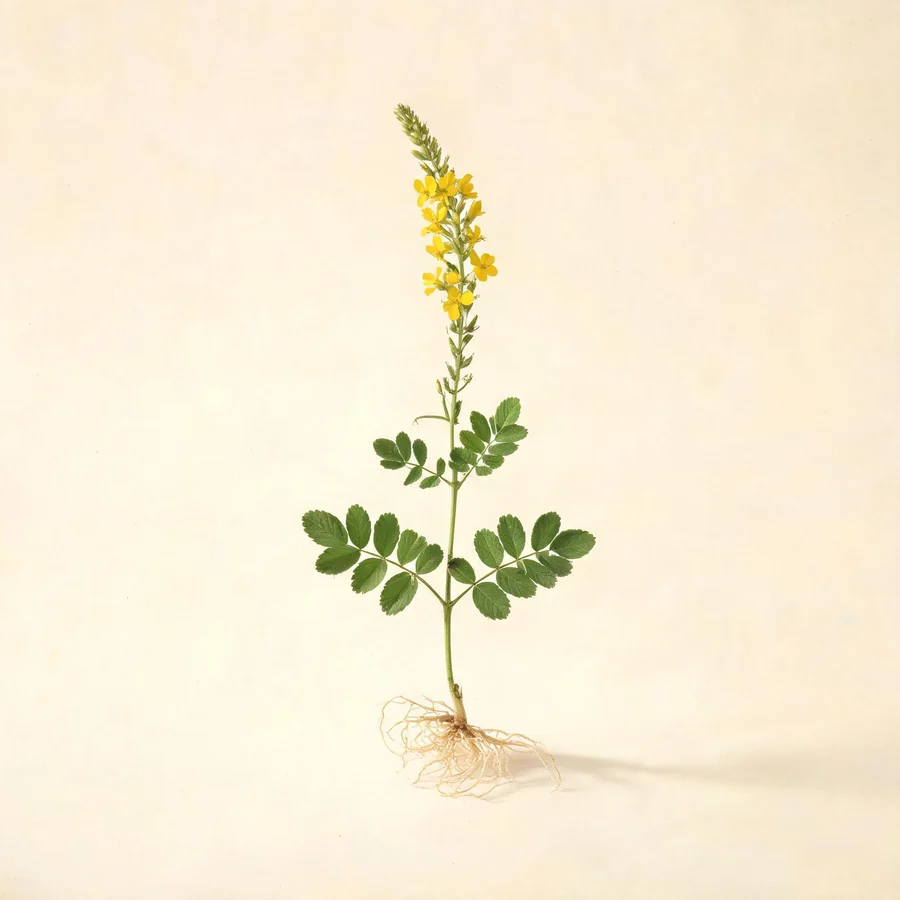
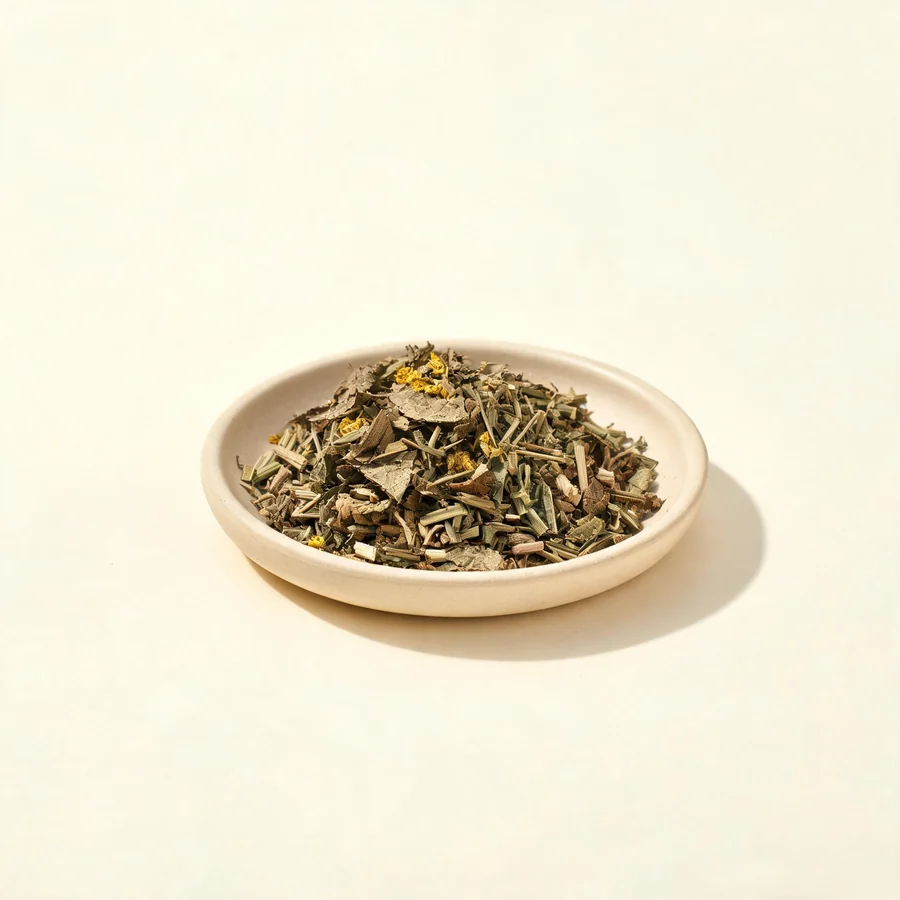
Skin profile
Where this herb sits in skin practice: the pattern it corrects, the skin signs it suits, and what it should not be used for.
Xian He Cao is for skin that leaks and a person who is depleted: weeping, eroded, bleeding or scratched-raw skin, with fatigue behind it. It astringes and tonifies at once, and the routine range is the safety point.
Skin signs that suggest it
- Weeping, eroded patches that will not dry, with clear or blood-tinged ooze
- Itch that has been scratched raw, leaving a glazed or raw surface
- Purpura or petechiae in a tired, pale person with a weak pulse (Spleen failing to hold blood)
- Small skin lesions that bleed slowly and persistently after scratching or minor trauma
- A pale tongue, fatigue and poor appetite alongside a chronic skin problem
When it is not the right herb
Not for blood stasis: fixed, boring pain, a dark tongue and no active bleeding are the pattern in which an astringent holds stagnation in place. Not for an acute spreading skin infection, which needs antibiotics rather than a wash, and not for dry, scaly skin with no ooze, where astringency adds to the dryness. Unexplained or persistent bleeding needs a diagnosis before a haemostatic is relied on, and the high-dose range is not a target to aim for.
What it does for skin
Skin-relevant actions only. Each one describes a mechanism in TCM terms and what it looks like on the skin.
Astringes and dries a weeping surface
The tannins in the leaf bind surface proteins and tighten the skin, which reduces the clear or blood-tinged ooze that keeps a patch macerated and raw. A cooled decoction used as a compress or a wash suits the wet phase of eczema, an eroded patch and skin that has been scratched open. Contact is kept short and the wash is not left to dry on the skin, because a strong astringent can leave the surface tight and uncomfortable.
Stops small-vessel bleeding in the skin
For purpura, petechiae and small lesions that bleed on contact, the herb is given internally to help close the leaking vessels. Its temperature is neutral, so it fits a blood-cooling formula or a warming Qi tonic without tipping the balance either way. It is not a treatment for a platelet disorder on its own, and any unexplained purpura needs a blood count and a diagnosis before herbs are used.
Settles itch that comes with ooze and rawness
Itch that is wet, raw and worse after scratching responds to astringency rather than to sedation. A cooled wash reduces the surface film and the rawness, and the internal herb addresses the depletion that follows long-standing itch. Dry, neuropathic itch and itch from blood deficiency are different pictures, where a drying wash makes the skin tighter and the itch worse.
Restores strength where skin disease has depleted
The old nickname for the plant translates as fatigue-relieving grass, and the tonic use is traditional: a decoction with red dates for someone worn out by long illness, heavy work or persistent blood loss. In skin practice it is added where a chronic eruption has left the person pale, tired and slow to heal. It supplements the Qi and Blood that the skin needs to repair, and it is given over weeks rather than days.
Clears toxin in sores and genital itch
Agrimony has a traditional place in washes for boils, sores and genital itching, where its astringency and its toxin-resolving quality are used together. A cooled decoction is applied or used as a sitz bath, and the herb is also taken internally in some formulas. It is an adjunct, and an infection that is spreading, febrile or deeply ulcerated needs medical treatment.
Skin conditions it is used for
Mapped to the condition pages on this site. The pattern column shows what the skin is doing when this herb is the right choice.
| Condition | Pattern | Why it suits | Typical setting |
|---|---|---|---|
| Itchy Skin | Moist itch with a raw, weeping surface | When scratching has left the skin raw and slightly oozing, agrimony is used as a wash to tighten the surface and reduce the wetness that sustains the itch. It is combined with Ku Shen and Bai Xian Pi when damp-heat is also present, and with a tonic formula when the person is depleted. Dry, thin, itchy skin without ooze is not the right target. | A Xian He Cao, Ku Shen and Bai Xian Pi wash, with a tonic formula internally where deficiency is clear |
| Skin Erosion | Dampness and heat eroding the surface | A superficial erosion that weeps and will not close is read as dampness working out through a broken surface. A cooled agrimony wash astringes the area and helps it dry, and it is used on limited areas for short periods. Infection, spreading redness or a deep ulcer needs medical assessment, and a wash is not a substitute for treating it. | A cooled Xian He Cao wash, with Huang Qin and Ku Shen internally where heat is marked |
| Eczema | Chronic weeping eczema with depletion | In long-standing eczema that weeps and leaves the person tired, the herb does two jobs at once: it astringes the surface and it tonifies the deficiency that has built up. It is used as a wash for the wet areas and internally with Spleen-supporting herbs. It is not a first choice for a dry, lichenified plaque, where a drying wash adds to the tightness. | Xian He Cao with Bai Zhu and Fu Ling, plus a cooled wash on weeping areas |
| Itchy Genitalia | Damp-heat with discharge and itch | Genital itch with discharge and a moist, inflamed surface is a damp-heat picture in which astringent washes have a long traditional place. Agrimony is used as a cooled sitz bath or wash, sometimes with Ku Shen, and the underlying cause still needs to be identified, because infection, irritation and skin disease are treated differently. Symptoms that persist or come with bleeding need examination. | A Xian He Cao and Ku Shen sitz bath, with a damp-heat formula internally where indicated |
| Purpura | Spleen deficiency failing to hold the blood | Purpura in a tired, pale person with a weak pulse is read as the Spleen failing to keep blood inside the vessels. Agrimony both astringes and tonifies, which suits that combination, and it is given with Huang Qi, Dang Shen and red dates. A blood count and a diagnosis come first, because purpura can reflect a platelet disorder or a drug reaction, and the herb is never used to explain away a serious cause. | A modified Gui Pi Tang with Xian He Cao |
Combinations for skin
Herbs it is paired with when the skin, not an internal organ, is the target.
| Partner | Ratio | Why the pair is used |
|---|---|---|
| Da Zao | 30 g Xian He Cao with 10 Da Zao | About thirty grams of the herb with ten red dates is the traditional decoction for exhaustion after heavy work, and it shows the tonic side most clearly. The dates nourish the Spleen, build Blood and make the drink pleasant, while the herb provides the restorative action behind its nickname. In skin practice it suits a chronic eruption that has left the person tired, and it is taken over weeks rather than days. |
| Bai Mao Gen | 15 to 30 g each | Bai Mao Gen is sweet and cold, cooling the Blood and promoting urination, so it is the natural partner whenever heat is plainly driving the bleeding. It provides the cooling that agrimony lacks, so cause and symptom are addressed together. The pair suits heat-type purpura and small skin lesions that bleed bright red. |
| E Jiao | 10 to 15 g E Jiao with 15 to 30 g Xian He Cao | Donkey-hide gelatin nourishes the Blood and has a mild haemostatic effect of its own, so the pair both checks a loss and replaces it. It is stirred into the finished, strained decoction at the end of cooking instead of being boiled with the herbs. The pairing suits blood loss that leaves someone pale, dizzy and dry-skinned, the signs of deficient Blood itself. Gelatin is heavy, and unsuited to a damp, sluggish digestion. |
| Han Lian Cao | 15 to 30 g each | Han Lian Cao is a Blood-cooling herb that also nourishes Liver and Kidney Yin, settling the restlessness behind errant movement of blood, while agrimony closes the leak. Equal weights are used, and the setting is usually purpura, nosebleed or uterine bleeding in someone with a dry mouth, night sweats and a thin pulse. This is a Yin-deficiency pairing, not a general one. |
| Bai Xian Pi | 15 g Xian He Cao with 10 g Bai Xian Pi in a wash | Bai Xian Pi is the skin-specific herb for damp-heat and itch, and agrimony adds an astringency that reduces ooze. The pair is used as a cooled wash on weeping, itchy patches, and it is kept to short contact because both are drying. It is not for dry, scaly skin or for an area of broken skin that is spreading. |
Formulas where it leads
- Gui Pi Tang (归脾汤) - The Spleen-and-Heart tonic for deficiency with bleeding, built on Huang Qi, Dang Shen, Bai Zhu, Long Yan Rou, Suan Zao Ren and Dang Gui. Agrimony is added when there is purpura or a weeping skin lesion that will not settle, and the addition supplies the astringent, haemostatic half that the tonic lacks. It is a formula for a depleted, pale person, not for an acute hot eruption.
Topical use
Agrimony is used on the skin as a cooled wash, a compress or a sitz bath, and this is where its astringency shows most clearly. The dried aerial parts are simmered, strained and cooled, and the liquid is applied to weeping, itchy, eroded or bleeding areas for short periods. It is a drying treatment, so it is kept off dry and scaly skin, and the wash is made fresh and discarded after use.
| Preparation | How and when it is used |
|---|---|
| Cooled compress | Simmer 15 to 30 g of dried herb in 500 ml of water for 15 to 20 minutes, strain and cool. Soak clean gauze, wring it out and hold it on a weeping or raw patch for 10 to 15 minutes, once or twice a day. Pat dry afterwards and do not leave the compress on to dry. |
| Sitz bath | Make a stronger decoction with 30 to 50 g in 2 litres of water, strain it into a clean basin and sit for 10 minutes. Use it for genital or perianal itch on intact skin, pat dry afterwards, and do not share the basin or the towel. |
| Combined wash | Simmer 15 g agrimony with 10 g Ku Shen and 10 g Bai Xian Pi in 750 ml of water for 20 minutes, strain and cool. Use as a rinse for itchy, weeping areas, and stop if the skin stings or tightens uncomfortably. |
Patch test and cautions
Patch test a small area first, and stop if the skin stings, reddens or tightens. Do not use the wash on an acute spreading infection, on a deep ulcer or on a rash with fever, and do not cover a treated area with an airtight dressing. Make the decoction fresh each day, and do not use it on an infant without medical advice.
Safety for skin use
What to check before recommending or using it, including the cautions that matter most for skin patients.
Do not use, or use with caution
- Blood stasis without active bleeding: fixed, boring pain, a dark tongue and palpable cords. An astringent can hold the stagnation in place.
- Known allergy to Agrimonia pilosa or to other rose-family plants. Very rare anaphylaxis has been reported, so a previous reaction is a clear reason to avoid it.
- Unexplained or persistent bleeding, including purpura and bleeding from the bowel or uterus. A haemostatic can hide a serious cause, so a diagnosis comes first.
- Acute spreading skin infection, or a rash with fever. A wash is not a treatment for cellulitis or a systemic infection.
- High doses above the routine range, and especially 60 g or more, where the case reports of visual disturbance, breathlessness, rash and heavy sweating cluster. The ceiling is a clinical decision, not a target.
- Dry, scaly or lichenified skin with no ooze, where an astringent wash adds to tightness.
Pregnancy and breastfeeding
Agrimony is not among the herbs that the classical literature firmly forbids in pregnancy, but it is no neutral drink: the tannins are abundant, platelet and clotting effects have been reported, and some of its partners carry a blood-moving reputation, which is a second reason for care. It is taken only on a practitioner's direction, never as a self-prescribed tonic for tiredness. Nothing is known about its constituents in breast milk; ordinary doses are mild, but the tannin load is the theoretical worry, so a nursing mother should use it briefly and watch the infant's feeding and stool.
Interactions
- Anticoagulants and antiplatelet drugs. Laboratory work shows a pro-coagulant tendency, which fits the traditional use, and also an antiplatelet effect, so what happens with warfarin, aspirin or clopidogrel cannot be predicted; clotting is monitored and the prescriber informed.
- Oral iron and tetracycline antibiotics. Tannins bind iron and protein within the gut and may cut absorption, so the doses are kept at least two hours apart.
- Insulin and sulfonylureas. Extracts have lowered blood glucose in animal work, so anyone on these medicines should test more often when starting the herb.
- Other haemostatics and clotting support. Because the effect on clotting is not predictable, the herb is not layered on top of other haemostatic treatment without supervision.
Allergy and patch testing
A reaction to agrimony is uncommon but has been reported, including a very rare anaphylactic reaction. Anyone with a rose-family allergy should avoid it, and a topical preparation should be patch tested for 24 hours on a small area of normal skin. Stop at once if the skin stings, reddens or swells, and do not continue a wash that has caused any reaction.
General safety references
General references for herbal hepatotoxicity and herb-drug interactions; they are not specific to this herb.
- Review article: Herbal hepatotoxicity - an update on traditional Chinese medicine preparations. Alimentary Pharmacology & Therapeutics, 2014. PMID: 24844799.
- Interactions between herbal medicines and prescribed drugs: an updated systematic review. Drugs, 2009. PMID: 19719333.
- Warfarin and food, herbal or dietary supplement interactions: a systematic review. British Journal of Clinical Pharmacology, 2021. PMID: 32478963.
Evidence
The classical record is quoted with its source. The modern note states the level of evidence plainly.
Classical record
味辛涩,温,无毒。
The entry records the plant as acrid and astringent in taste, warm in nature and free of toxicity. It is one of the earliest descriptions of the herb's properties in a printed materia medica, and the taste it gives is the one later texts keep.
Lü Chan Yan Ben Cao - A warm nature is given here, unlike the neutral temperature assigned today; such properties were revised over the centuries rather than settled at the start.
治妇人月经或前或后,赤白带下,面寒腹痛,日久赤白血痢。
Lan Mao lists irregular menstruation that comes early or late, red and white vaginal discharge, a cold face with abdominal pain, and long-standing dysentery with blood and mucus. The gynaecological and intestinal uses that dominate the later record are already present.
Dian Nan Ben Cao (Materia Medica of Yunnan), Lan Mao - A Ming work from Yunnan and the earliest to lay out the clinical range in any detail; the skin use extends the same astringency at a later date.
下气活血,理百病,散痞满;跌扑吐血,血崩,痢,肠风下血。
The passage says the herb lowers Qi, quickens the blood and settles a hundred complaints, disperses distension and fullness, and treats blood brought up after an injury, flooding uterine bleeding, dysentery and bleeding from the bowel attributed to intestinal wind.
Bai Cao Jing - Quicken blood is an odd claim beside the later fame of a pure astringent, and it suggests the plant was once thought to do much more.
为强壮性收敛止血剂,兼有强心作用。适用于肺病咯血,肠出血,胃溃疡出血,子宫出血,齿科出血,痔血,肝脓疡等症。
A twentieth century handbook describes it as a strengthening astringent that stops bleeding and adds a tonic action on the heart. It lists coughing blood from lung disease, intestinal bleeding, bleeding from a stomach ulcer, uterine bleeding, bleeding after dental work, bleeding haemorrhoids and liver abscess among the conditions it suits.
Xian Dai Shi Yong Zhong Yao (Modern Practical Chinese Materia Medica) - This is where the modern pairing of haemostatic and tonic claims began, and where the high-dose use started that later case reports taught practitioners to treat with care.
Modern evidence
Evidence status
- Laboratory work reports a high tannin content, put at up to about sixteen per cent in the leaf, together with agrimonolide, and describes astringent, anti-inflammatory and clotting-related activity. These are cell and animal studies, not trials in skin disease.
- Case reports at high doses describe visual disturbance labelled optic neuritis, breathlessness, skin rash, headache, flushing, nausea, vomiting, heavy sweating and, very rarely, anaphylaxis. The dose context is the point: reports cluster well above the routine range.
- No controlled trial of agrimony in eczema, itch or purpura was identified. Tannin-containing washes have a recognised astringent effect on skin, which explains the traditional use without proving benefit in a named disease.
PubMed records
Selected real PubMed records for this herb's species or its constituents, chosen by species name and title relevance. They are references for the non-TCM discussion above, not proof that the herb treats any skin condition.
- Use of a novel herbal medicine in a 75-year-old woman with multi-metastatic pancreatic cancer: A case report and review of the literature.. Oncology letters, 2015. PMID: 26171011 (pharmacology or review record).
Dose and forms
Skin-practice dosing and the preparations that suit skin complaints.
| Form | Dose and notes |
|---|---|
| Decoction | 6 to 15 g of dried aerial parts in a formula, for weeping skin, small bleeding lesions or itch. The herb is one voice in the formula at this range, and the course runs for one to three weeks with review. |
| Tonic decoction | About 30 g with 10 red dates for depletion after long illness or persistent blood loss, taken as a simple decoction. This is the traditional fatigue preparation, and it is used for weeks rather than days. |
| Wash | 15 to 30 g simmered in 500 ml of water for a cooled compress, or 30 to 50 g in 2 litres for a sitz bath. External use has no fixed weight, and the decoction is made fresh and discarded. |
| High-dose range | 30 to 50 g, and historically more, belongs to supervised practice for a defined indication such as chronic thrombocytopenia, with the person watched. The recorded cases of visual disturbance, and the rare anaphylaxis, cluster from 60 g upward. |
Six to fifteen grams is the routine range, and a figure above thirty is a clinical decision, tied to a defined indication and a set period. The dried aerial parts are used, never the root buds: He Cao Ya is a separate antiparasitic medicine with its own dose and toxicity, and confusing the two is a serious error. A wash is made fresh and thrown away, and the herb is not taken for months as a general tonic.
Citations and further reading
Only real sources are listed: the classical materia medica passages quoted above, and the source works behind the botanical and safety statements.
- Lü Chan Yan Ben Cao, Song dynasty - classical entry quoted above.
- Dian Nan Ben Cao (Materia Medica of Yunnan), Lan Mao, 1436 - classical entry quoted above.
- Bai Cao Jing - classical entry quoted above.
- Xian Dai Shi Yong Zhong Yao (Modern Practical Chinese Materia Medica), twentieth century - classical entry quoted above.
- Xian He Cao monograph: Pharmacopoeia of the People's Republic of China - source for the accepted aerial parts and the safety classification.
- Modern safety statement: based on pharmacological and case-report literature on Agrimonia pilosa, summarised as a statement about the level of evidence rather than as a cited finding.
- Botanical description and identification: botanical literature on Agrimonia pilosa, Rosaceae.
Educational reference for qualified practitioners. This page is not medical advice, and skin conditions should be diagnosed by a clinician before treatment.