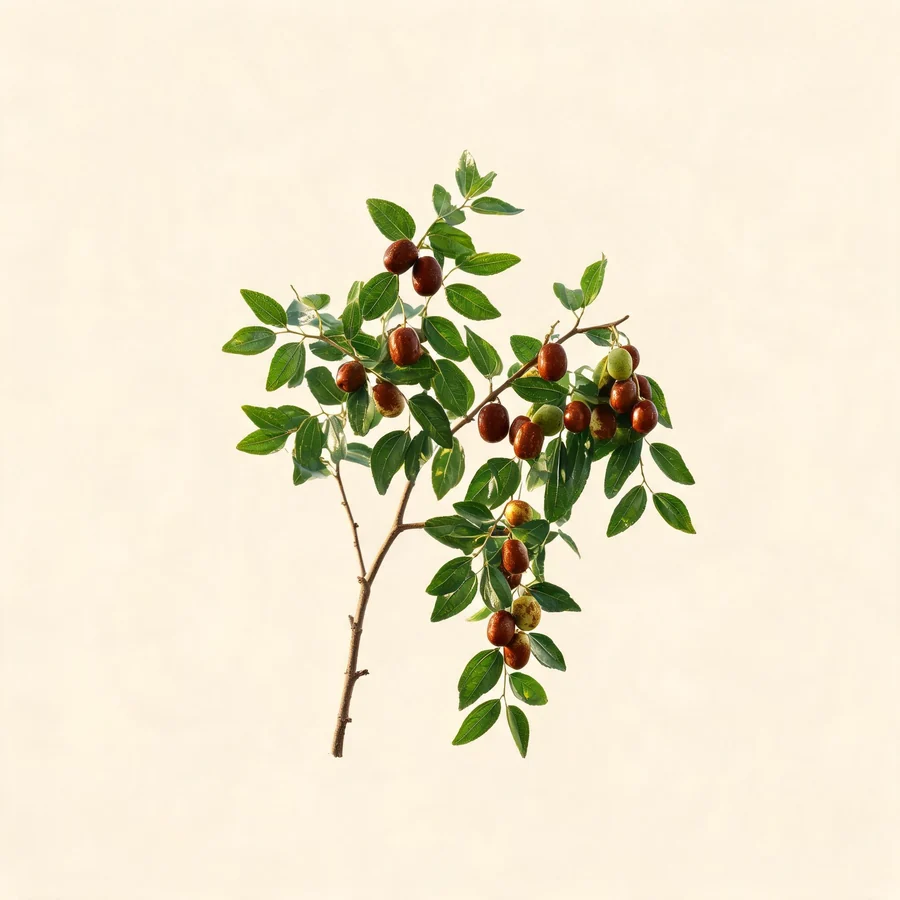
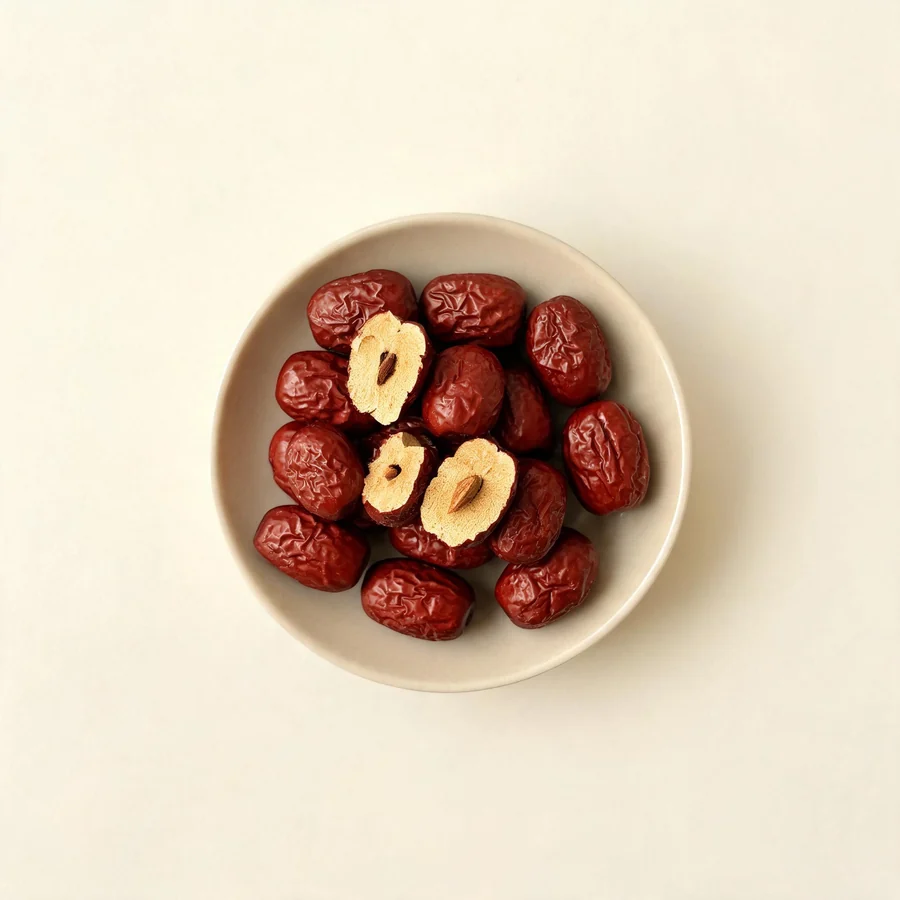
Skin profile
Where this herb sits in skin practice: the pattern it corrects, the skin signs it suits, and what it should not be used for.
Da Zao is a sweet, moistening food-medicine: on skin it nourishes Blood, softens dryness, settles night-time restlessness and makes a harsh prescription tolerable. It is support rather than treatment for an eruption, and it is wrong wherever dampness or stagnation is present.
Skin signs that suggest it
- Dry, thin, pale skin that itches in the evening and feels tight after washing
- A sallow face with little colour, and a tiredness that is worse after eating
- Chronic itchy patches that settle with rest and sleep and flare with worry or poor sleep
- Dry, cracked lips and heels, with a pale tongue and a fine, weak pulse
- Skin that heals slowly and leaves a thin, pale scar
When it is not the right herb
Wrong where there is dampness, phlegm or food stagnation: a full, distended abdomen, a greasy tongue coat, heaviness in the limbs and a sluggish feeling all worsen with a sweet, cloying fruit. It is also wrong in an acute hot or weeping rash, and in a warm febrile illness where its sweetness is said to hold the pathogen in. Because the dried fruit is close to two thirds sugar by weight, a large daily intake is a real consideration for someone with diabetes or dental decay, and it is not a substitute for treating a dry itch that arrives with weight loss, fever or a spreading rash.
What it does for skin
Skin-relevant actions only. Each one describes a mechanism in TCM terms and what it looks like on the skin.
Builds Blood from the middle
The Spleen is held to make Blood from food, and the jujube is the sweet food that supports that work. The old texts rank it above Qi tonics for nourishing Blood, which is why it is reached for in pallor, dryness and a pale tongue rather than in fatigue alone. It is a supporting herb in blood-nourishing formulas, and it is given over weeks because the effect accumulates.
Moistens dry, itchy skin
Dryness that comes with a sallow face, a fine pulse and a history of poor sleep is read as Blood that is not reaching the surface. The fruit is used with angelica, white peony and rehmannia to supply the moisture the skin lacks, and it adds a little of its own. It will not settle an itch driven by heat or infection, and a sudden generalised itch needs investigation before it is called dryness.
Settles the restlessness that keeps skin irritable
The fruit enters the Heart and is used where a person is restless, wakes easily and scratches at night without much to see. It is combined with wheat and liquorice in the classical formula for that state, and the logic is that a calmer spirit scratches less. It is not a sedative and it does not replace treatment of the skin itself.
Makes a harsh skin formula tolerable
Bitter, cold, drying medicines are what an inflamed eruption needs, and they are also what upsets a weak stomach. The fruit is added in small quantity to soften them and protect the digestion, which allows the clearing medicines to be given at the dose the skin requires. This is its commonest appearance in a skin prescription, and it is a practical contribution rather than a therapeutic one.
Skin conditions it is used for
Mapped to the condition pages on this site. The pattern column shows what the skin is doing when this herb is the right choice.
| Condition | Pattern | Why it suits | Typical setting |
|---|---|---|---|
| Chronic urticaria | Blood deficiency with wind: pale wheals that come and go, worse at night and when tired | Hives that recur for months in a pale, tired person who sleeps badly are read as Blood too thin to hold the surface, so that wind moves through it. The fruit nourishes the Blood and settles the spirit while wind-releasing herbs deal with the wheals, and the approach is slow. A wheal that lasts more than a day, leaves a bruise or comes with breathlessness or swelling of the lips is a different problem and needs urgent care. | Dang Gui Yin Zi, with Da Zao added to nourish the Blood |
| Neurodermatitis | Blood deficiency with wind and dryness: thickened, lichenified, intensely itchy patches | Skin that has been scratched for months becomes thick, dry and grooved, and the tradition reads that as dryness with wind, often on a base of Blood deficiency. The fruit is a supporting herb in the nourishing, wind-releasing formula, and it adds moisture and a little calm. It is used for the chronic stage, not for an acute weeping flare, and the scratching habit itself has to be addressed. | Dang Gui Yin Zi with Da Zao and Bai Xian Pi |
| Senile pruritus | Blood and Yin deficiency in later life: generalised dryness and itch, worse at night | Itch in an older person with dry, thin, pale skin, a fine pulse and broken sleep is read as Blood and fluid that no longer reach the surface. The fruit nourishes Blood, moistens and settles the spirit, and it is used with nourishing and wind-releasing herbs over weeks. Persistent generalised itch in later life should be checked for diabetes, kidney disease, thyroid disease and blood disorders before it is treated as dryness. | Dang Gui Yin Zi, or a blood-nourishing formula with He Shou Wu |
| Ichthyosis | Dry, scaly, fish-skin surface from Blood failing to moisten the skin | Skin that is dry and divided into scales, worse in winter and on the shins, is read as Blood and fluid that cannot keep the surface supple. The fruit is a modest moistening support inside a nourishing formula, and it is used for months rather than weeks. It relieves dryness and itching; it does not remove an inherited tendency, and a child with generalised scaling should be assessed by a dermatologist. | With Dang Gui, Bai Shao and Mai Dong in a blood-nourishing formula |
Combinations for skin
Herbs it is paired with when the skin, not an internal organ, is the target.
| Partner | Ratio | Why the pair is used |
|---|---|---|
| Sheng Jiang | the classical pair, in most harmonising formulas | Fresh ginger disperses and the jujube holds, and the two are the standard pair for harmonising the nutritive and defensive layers. On skin the combination is used in formulas for hives that come with a chill, where the surface needs both release and support. The ginger is the moving half and the jujube the holding half. |
| Gan Cao | about 10 g of jujube to 3 to 6 g of liquorice | Two sweet herbs that both settle the middle, and together they underpin a great many prescriptions. Liquorice brings the harmonising, toxin-softening work; the date brings Blood nourishment and moisture, so a harsh skin formula goes down without losing its force. They are usually prescribed together rather than chosen between. |
| Dang Gui | about 10 g of jujube to 10 g of angelica | Angelica is the leading Blood tonic, and the date feeds the production behind it, which is why the pair occurs in prescriptions for pallor, dizziness and dry, itchy skin. The angelica both moves and builds and can dry a little; the date moistens and calms the stomach, which makes a rich tonic bearable for weeks. |
| Bai Shao | about 10 g of each | White peony nourishes Blood and holds it in, while the date gives the Spleen the material to make more. Cramping pain, a tense dry constitution and tight dry skin are its targets; one herb is cool and astringent, the other warm and moistening, so each tempers the other. |
Formulas where it leads
- Gui Zhi Tang (桂枝汤) - Cinnamon twig, white peony, ginger, jujube and liquorice, the classical formula for wind at the surface with a disharmony of the nutritive and defensive layers. Skin practice uses it for hives that appear with a chill and settle with warmth, where the jujube carries the harmonising and nourishing work. It is a warming formula and is wrong for a hot, red eruption.
- Huang Qi Gui Zhi Wu Wu Tang (黄芪桂枝五物汤) - Astragalus with cinnamon twig, peony, ginger and jujube, written for a body whose skin has gone numb and wooden. The jujube supports the middle and moistens, and the formula is used for dry, sensationless skin in a depleted person. It is the warmer, more nourishing relative of the cinnamon twig formula.
Safety for skin use
What to check before recommending or using it, including the cautions that matter most for skin patients.
Do not use, or use with caution
- Dampness, phlegm or food stagnation: a full, distended abdomen, a greasy tongue coat and a heavy body. The sweet cloying quality adds to the clogging and can cause wind and bloating.
- An acute hot, weeping or spreading rash, and warm febrile illness, where sweetness is said to hold the pathogen in and the fruit adds nothing.
- Diabetes, or any need to watch sugar intake: dried jujube is largely sugar, and a big daily handful is a genuine carbohydrate load.
- Tooth decay or a tendency to gum problems, since the sticky flesh clings to the teeth and the classical texts already warned that habitual eating damages them.
Pregnancy and breastfeeding
Regarded as suitable at food and formula doses. Sweet, warm and gently nourishing, it neither moves Blood nor stimulates the uterus, and classical prenatal prescriptions include it. The caution is quantity rather than safety: a sweet moistening fruit may bloat a sluggish pregnancy and add heartburn, and it counts towards the day's sugar. It is not a treatment for swelling, raised blood pressure or itching in pregnancy, all of which need clinical review.
Interactions
- Caffeine, theophylline and other CYP1A2 substrates. Rats given jujube extract cleared the substrates of this enzyme faster, in theory speeding elimination of drugs handled the same way; whether people behave likewise is unmeasured, so a prescriber should be told before the fruit is taken regularly alongside such a medicine.
- Diabetes medicines. Dried jujube is sugary, yet some studies report mild glucose-lowering activity, so the two pull against each other and the net effect is unpredictable; regular use should be counted as carbohydrate and glucose monitored.
- Sedatives and epilepsy medicines. Animal work records mild sedation, so extra drowsiness with a sleeping tablet or a benzodiazepine is plausible; someone stable on epilepsy treatment should not alter a regular herbal tea without informing the prescriber.
Allergy and patch testing
Reactions to the fruit are uncommon but recognised, and a person who reacts to other members of the buckthorn family may be more likely to. A herb-containing cream or wash with jujube extract can produce contact redness, and preserved fruit is sometimes treated with sulphur, which can provoke wheeze in a sensitive person. Stop if a rash worsens after a new product, and check the label of any preserved fruit.
General safety references
General references for herbal hepatotoxicity and herb-drug interactions; they are not specific to this herb.
- Review article: Herbal hepatotoxicity - an update on traditional Chinese medicine preparations. Alimentary Pharmacology & Therapeutics, 2014. PMID: 24844799.
- Interactions between herbal medicines and prescribed drugs: an updated systematic review. Drugs, 2009. PMID: 19719333.
- Warfarin and food, herbal or dietary supplement interactions: a systematic review. British Journal of Clinical Pharmacology, 2021. PMID: 32478963.
Evidence
The classical record is quoted with its source. The modern note states the level of evidence plainly.
Classical record
《素问》言枣为脾之果,脾病宜食之,谓治病和药,枣为脾经血分药也。若无故频食,则损齿,贻害多矣。
The Su Wen calls the date the fruit of the Spleen and advises eating it when the Spleen is ill; it is used to treat illness and to reconcile medicines, and it is counted in the Blood division of the Spleen channel. Eaten habitually for no reason, however, it ruins the teeth, and the damage is considerable.
Ben Cao Gang Mu (本草纲目), Li Shizhen, 1578 - Li Shizhen keeps both halves in view: the nourishment, and the harm done by treating a sweet tonic as an unlimited food.
大率姜与枣联,为和营卫之主剂,姜以主卫,枣以主营。
Ginger and jujube are generally coupled, and the pair is the chief means by which the nutritive and defensive layers are harmonised: ginger takes charge of the defensive, the date of the nutritive.
Ben Jing Shu Zheng (本经疏证), Zou Shu, 1832 - Zou Shu finds fifty-eight prescriptions in the two Han classics that use the date, and only eleven of them omit the ginger.
其味浓而质厚,则长于补血,而短于补气。
Rich in flavour and thick in substance, it excels at supplementing Blood and does less for Qi.
Chang Sha Yao Jie (长沙药解), Huang Yuanyu, 1753 - This explains why a sweet fruit serves as a Blood tonic rather than a Qi tonic, and later writers return to the point repeatedly.
Modern evidence
Evidence status
- Laboratory work on the fruit reports antioxidant, anti-inflammatory and mild sedative activity, and effects on liver enzymes, largely in animals and cell models. These are not trials in people and they do not establish benefit for dry skin, hives or any other skin condition.
- No controlled clinical trial of Da Zao in a skin disease was identified. Its skin use follows from the classical reading of Blood nourishment and from its role as the harmonising fruit in prescriptions, so the page describes traditional practice rather than demonstrated outcomes.
- Regulatory status: the dried ripe fruit is an accepted article in the Chinese Pharmacopoeia as Fructus Jujubae and is widely used as a food. Its sugar content, rather than any toxicity, is the practical limit on how much is taken.
PubMed records
Selected real PubMed records for this herb's species or its constituents, chosen by species name and title relevance. They are references for the non-TCM discussion above, not proof that the herb treats any skin condition.
- Brightening effect of Ziziphus jujuba (jujube) fruit extract on facial skin: A randomized, double-blind, clinical study.. Dermatologic therapy, 2022. PMID: 35460145 (skin-related record).
- Can dietary jujube (Ziziphus jujuba Mill.) fruit extract alter cutaneous mucosal immunity, immune related genes expression in skin and growth performance of common carp (Cyprinus carpio)?. Fish & shellfish immunology, 2019. PMID: 31505247 (skin-related record).
Dose and forms
Skin-practice dosing and the preparations that suit skin complaints.
| Form | Dose and notes |
|---|---|
| Decoction | 6 to 15 g, or three to ten pieces, daily in a formula; larger amounts, up to 30 g, are used when the fruit is protecting the stomach from harsh medicines. |
| As food | A handful stewed in soup or steeped as a tea is the kitchen measure; split or stone the fruit first, or the flesh releases almost nothing. |
| Course length | As long as the formula runs, usually a few weeks. Reduce if the abdomen distends or the stool loosens. |
Classically the date was counted in pieces and today it is weighed, so the gram figure varies with the fruit in hand. Splitting or stoning before decoction is not fussiness: an intact date releases very little, and the stone is hard and has no medicinal value. As a concentrated sweet it adds to the sugar budget as well as to the formula, and it is reduced or left out where dampness is a problem.
Citations and further reading
Only real sources are listed: the classical materia medica passages quoted above, and the source works behind the botanical and safety statements.
- Ben Cao Gang Mu (本草纲目), Li Shizhen, 1578 - the passage on the jujube as the fruit of the Spleen is quoted in the original above.
- Ben Jing Shu Zheng (本经疏证), Zou Shu, 1832 - the passage on ginger and jujube is quoted in the original above.
- Chang Sha Yao Jie (长沙药解), Huang Yuanyu, 1753 - the line on Blood and Qi is quoted in the original above.
- Fructus Jujubae monograph, Pharmacopoeia of the People's Republic of China - accepted source, part and quality requirements.
- Modern evidence statement: drawn from published laboratory work on Ziziphus jujuba, presented as a statement about the level of evidence rather than as a cited finding.
- Botanical description and identification: botanical literature on Ziziphus jujuba, family Rhamnaceae.
Educational reference for qualified practitioners. This page is not medical advice, and skin conditions should be diagnosed by a clinician before treatment.