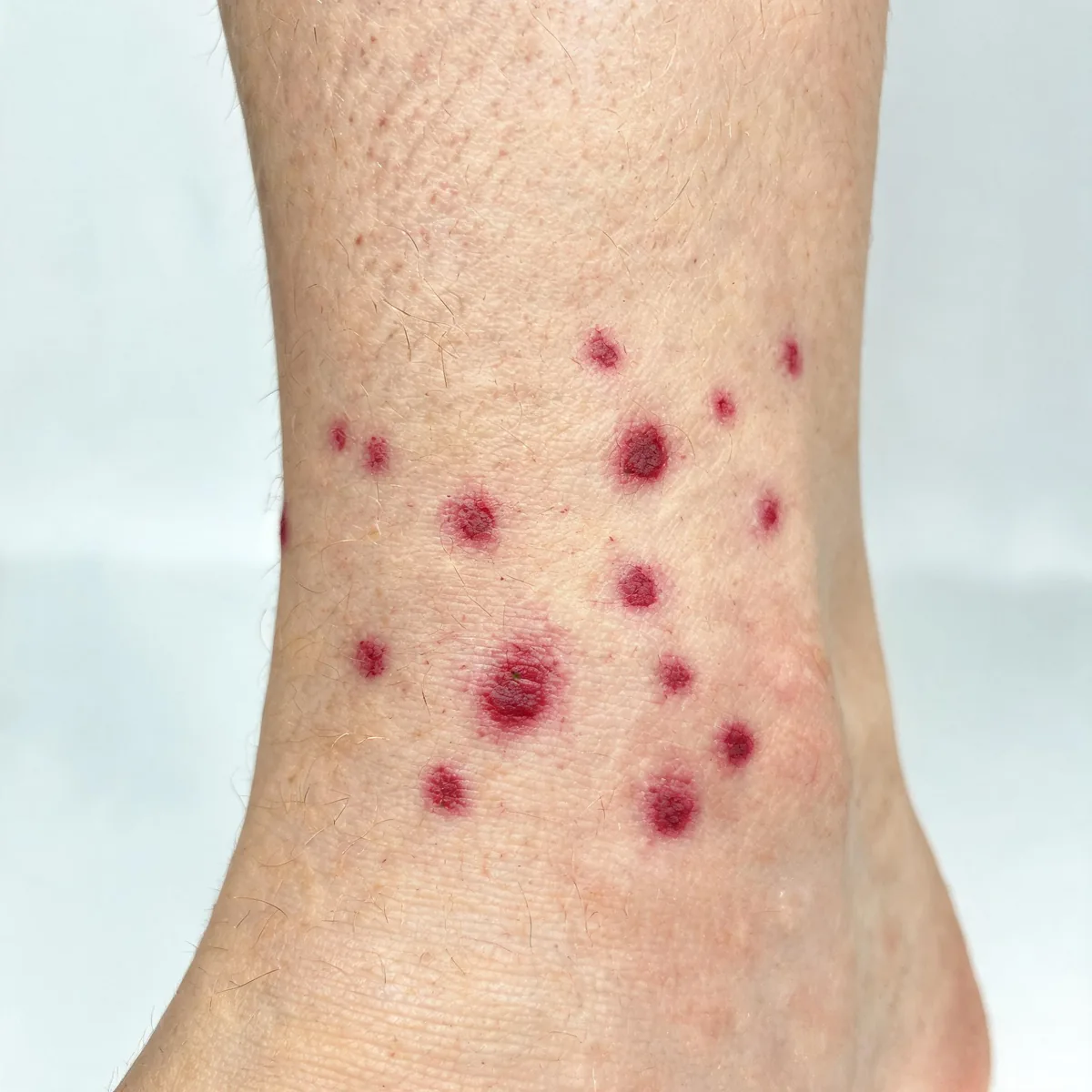
Understanding Purpura
Blood is described as held inside the vessels by the Spleen grasping function and by the integrity of the vessel walls.
When heat enters the blood, the classical literature calls the blood reckless: it moves chaotically and forces its way out of the vessels, producing bright red or dark purpura. That may follow an external Wind-Heat invasion, or arise internally as Heat in the Blood.
The alternative route is failure of containment. Qi not controlling Blood gives pale purple spots that appear gradually, with chronic bruising, fatigue, poor appetite and loose stools. Spleen deficiency with dampness gives dull or dark red purpura with heaviness and the same digestive picture.
Two further patterns are described: Kidney and Liver Yin deficiency causing heat in the blood, where purpura comes and goes with night sweats and low back soreness, and Damp-Heat in the Lower Burner, where dark purplish spots appear on the lower limbs with sticky stools and blood in the urine or stool.
One classical idea shapes how the whole picture is read. Anger and frustration are said to drive Qi upward and outward against its normal direction, and where Qi goes, Blood can follow, which is why an emotional upheaval can be followed by bleeding. The classical literature uses this to explain why the same spots can appear after a fright, an argument or a fever, and why treatment so often includes something that settles Qi as well as something that cools or holds Blood.
The other point the classical literature stresses is that purpura is a sign rather than a disease. Spots on the skin may be the only visible evidence of bleeding that is also happening in the nose, the gums, the gut or the urinary tract, which is why the same physical sign carries a different urgency in different people. A few spots on the shins in a child after a sore throat is a common and usually short-lived picture. The same spots in an older person with fatigue and a long history of bruising point to a deeper failure of containment. The pattern is judged with the whole person in view.
Conventional view
In Western medicine purpura means purple spots or patches on the skin produced by bleeding from small vessels. It can arise when platelets are low, when the vessel walls are inflamed, or when clotting is deficient, and the common causes include immune thrombocytopenia, Henoch-Schonlein purpura, reactions to medication and infection. Assessment usually combines a physical examination with blood tests for platelet count and clotting, and occasionally a skin biopsy. Bleeding elsewhere, in the gums, nose, gut or urine, is what determines how urgent the picture is.
Treatment follows the cause. Immune thrombocytopenia may be managed with corticosteroids, intravenous immunoglobulin or immunosuppressants, and in some cases with removal of the spleen. Henoch-Schonlein purpura often needs only rest and hydration, with steroids reserved for severe belly pain or when the kidneys are involved. The aim is to stop acute bleeding and prevent complications, and in that it is usually successful.
The shortfall is recurrence. Steroids carry weight gain, mood change and bone thinning over the long term, immunosuppressants raise the risk of infection, and none of this addresses why the bleeding started. The conventional model also treats purpura as one problem, without separating the different internal states that produce it, which is where a pattern-based approach adds something: it can name the imbalance, treat it, and in doing so reduce both recurrence and the reliance on medication.
Selected PubMed records
Real PubMed records for the conventional discussion above, selected by condition name and title relevance. They are references, not a claim that any treatment is proven for this condition.
How it connects
Purpura often brings companions rather than appearing alone: abdominal pain and joint pain are classic alongside it, especially in the acute Henoch-Schonlein picture, because the same Heat that drives blood from vessels in the skin can agitate blood in the intestines and settle into the joints. Damp-Heat pouring downward can also show as blood in the stool or urine, and the Spleen's failure to manage Dampness often underlies these combined symptoms, which is why they tend to be read as one Damp-Heat or Blood-Heat pathology rather than separate diseases. Features of more than one pattern often coexist, especially early on: an itchy Wind-Heat rash can quickly turn into deeper painful purpura as heat intensifies and blood stagnates. Joint pain with purpura may mean Damp-Heat layered on Blood-Heat, and chronic purpura with fatigue can mean Qi deficiency has developed after repeated heat episodes, so the tongue and pulse are needed to see which pattern dominates. Severe abdominal pain, blood in the stool or tea-coloured urine need urgent medical attention.
How it is assessed
Diagnosis starts with colour, speed of onset, and whether bleeding occurs elsewhere.
What a practitioner looks for
- Colour and onset: bright red sudden purpura suggests Wind-Heat or Heat in the Blood; pale gradual spots suggest Qi failing to control Blood.
- Bleeding elsewhere: nosebleeds, gum bleeding, or blood in urine or stool raises urgency.
- Digestive signs: fatigue, poor appetite and loose stools support the Spleen patterns.
- Constitutional signs: night sweats and low back soreness suggest Yin deficiency with Empty-Heat.
The first questions are about time and colour. Spots that appeared over a day or two, bright red and raised, in someone who has had a sore throat or a fever, are read as an external pathogen that has reached the collaterals. Spots that have been appearing and fading for months, pale violet and flat, in someone who is tired and has lost their appetite, are read as a failure of the Spleen to hold Blood. Dark spots on the legs with sticky stools, offensive urine or a dragging heaviness point downward to Damp-Heat. Between those extremes sits the Yin deficiency picture, where spots come and go with night sweats, a dry mouth and heat in the palms and soles.
The tongue and pulse are then used to separate patterns that look alike. Wind-Heat gives a red tongue with a thin yellow coat and a floating, rapid pulse. Heat in the Blood gives a deep red tongue, sometimes with red spots or prickles, a thin dry yellow coat, and a rapid, wiry, forceful pulse. Qi not controlling Blood gives a pale, puffy tongue with teeth marks, a thin white coat and a fine, weak pulse. Damp-Heat gives a yellow greasy coat thickest at the root and a slippery, rapid pulse. Empty heat from Yin deficiency gives a red, thin, dry tongue with little coat and a fine, rapid pulse. The practitioner also asks about bleeding elsewhere, because that changes the urgency rather than only the pattern.
TCM patterns in Purpura
Six patterns are described, and they are separated by three observations. The first is the colour and timing of the spots: bright red spots that arrive within a day or two point to an external pathogen, deep red widespread spots with bleeding from the nose or gums point to Heat in the Blood, pale violet spots that build up slowly point to the Spleen losing its grip, and dark spots on the legs point to Damp-Heat settling downward. The second is what else the body is doing, since fever with a sore throat, abdominal pain, blood in the urine or a dragging heaviness in the legs each belong to a different pattern. The third is the constitutional background: energy, appetite, stools, night sweats, low back strength and menstrual history. A sixth pattern, Spleen deficiency with Dampness, shows how a deficiency and a pathogen can occupy the same body at once.
| Pattern | Key signs | The itch | Tongue | Main formula |
|---|---|---|---|---|
| Wind-Heat | Bright red purpura appearing suddenly | Itching of the skin | Body: Red at the tip and edgesCoat: Thin yellow or white turning yellow | Not specified |
| Heat in the Blood | Bright or dark red purpura, often widespread | Not specified | Body: Deep red, often with red points or pricklesCoat: Thin, yellow and dry | Not specified |
| Qi not controlling Blood | Not specified | Not specified | Body: Pale and puffy with teeth marksCoat: Thin white | Not specified |
| Kidney and Liver Yin Deficiency causing Heat in the Blood | Dry mouth and throat at night | Not specified | Body: Red and thin, dry, with possible cracks, red spots and red sidesCoat: Little or none | Not specified |
| Damp-Heat in the Lower Burner | Not specified | Not specified | Body: Red, slightly swollen, with a coating thickest at the rootCoat: Yellow and greasy | Not specified |
| Spleen Deficiency with Dampness | Dull or dark red purpura | Not specified | Body: Pale and swollen, often with teeth marks along the edgesCoat: White, greasy and moist, thick in the middle | Not specified |
Wind-Heat
Bright red purpura appearing suddenly, often after a respiratory infection.
Wind-Heat reaches the skin through the nose and throat and then enters the small collaterals, the fine vessels that keep Blood inside the surface. Heat within those vessels makes the Blood move restlessly, and the Wind pushes it outward, so vessels that should be sealed begin to leak. Spots appear quickly and are bright red because the Blood is still fresh and the heat still active. Itching and a scratchy throat belong to the same Wind-Heat pathogen rather than to the skin alone, and fever with mild chills shows that the exterior is still involved.
The tongue is red, especially at the tip and edges, coated thinly and yellow, and the pulse is floating and rapid. Outbreaks often follow a respiratory infection and are made worse by spicy, greasy or fried food, hot weather, wind exposure and overwork, while rest, cooling food and drink and a cool room help. Yin Qiao San, built on Jin Yin Hua, Lian Qiao and Mu Dan Pi, is the formula named for this presentation, and needling uses LI-4 Hegu and LU-7 Lieque to release the exterior, GB-20 Fengchi to clear Wind from the head and neck, and SP-10 Xuehai to cool the Blood.
Signs
- Bright red purpura appearing suddenly
- Fever with mild chills
- Itching of the skin
- Sore throat
- Acute onset after a cold
Diet and lifestyle for this pattern: Avoid spicy, greasy and fried food that generates internal Heat. Eat cooling food such as mung beans and cucumber, and drink chrysanthemum tea, rest well and stay out of wind, and keep the skin clean without scratching.
Heat in the Blood
Widespread bright or dark red purpura with bleeding.
Here the heat has gone deeper than the surface. Once it reaches the Blood level the Blood is described as reckless: it moves fast, in the wrong direction and without restraint, so it leaves the vessels in several places at once. That is why the purpura is widespread and either bright or dark red, and why the same process produces nosebleeds, bleeding gums and blood in the urine or stool. Thirst for cold drinks, a flushed face and restlessness are the body's response to the heat itself rather than separate complaints.
The tongue is deep red, often with red spots or prickles, with a thin yellow dry coat, and the pulse is rapid, wiry and slippery, and forceful. Heat is added by spicy food, alcohol, coffee, anger and hot weather, all of which make the bleeding worse, while cooling food, a cool room and rest settle it. The formula named is the classic blood-cooling one, with Shui Niu Jiao and Mu Dan Pi among its herbs, commonly adjusted by adding Bai Mao Gen for bleeding or Ce Bai Ye to astringe and cool. DU-14 Dazhui, LI-11 Quchi and SP-10 Xuehai are used to reduce heat and cool the Blood.
Signs
- Bright or dark red purpura, often widespread
- Nosebleeds or gum bleeding
- Blood in urine or stool
- Internal heat worse at night
- Thirst for cold drinks
Diet and lifestyle for this pattern: Avoid all warming and spicy food, alcohol and coffee. Eat plenty of cooling, hydrating food such as cucumber, watermelon and mung beans, keep the body cool and calm, and avoid overexertion and emotional upset that can stir up internal fire.
Qi not controlling Blood
Pale purple spots appearing gradually with fatigue.
The Spleen is said to hold Blood inside the vessels, and that holding is a function of Qi. When Qi is weak the vessel walls are not the problem; the grip on their contents is. Blood seeps out slowly instead of bursting out, which is why the spots are pale violet, appear a few at a time, and persist for weeks rather than days. The same weakness shows elsewhere: fatigue that does not lift with rest, a sallow complexion, a poor appetite, loose stools and heavy or prolonged menstrual bleeding.
The tongue is pale and puffy with teeth marks and a thin white coat, and the pulse is fine and weak, most noticeably at the right middle position, which is the Spleen position. Overwork, worry and raw or cold food all drain the Spleen and make the spots more likely, while warm cooked meals, rest and gentle movement support it. Gui Pi Tang, containing Huang Qi, Dang Shen and Bai Zhu, is the formula that strengthens the Spleen and holds Blood, and ST-36 Zusanli, SP-6 Sanyinjiao and REN-6 Qihai are needled, or treated with moxa, to tonify Qi and lift what has sunk.
Signs
- Pale purple spots appearing gradually
- Chronic recurrent bruising
- Fatigue and exhaustion
- Poor appetite with loose stools
- Pale complexion and lips
Diet and lifestyle for this pattern: Eat warm, cooked, easy meals such as congee, soups and stews, and avoid raw, cold and greasy food that taxes the Spleen. Gentle daily walking supports Qi circulation, and rest when you feel tired.
Kidney and Liver Yin Deficiency causing Heat in the Blood
Recurring purpura with night sweats and low back soreness.
This pattern takes years to develop. Kidney and Liver Yin are the deep reserves that keep Yang anchored, and when those reserves thin the Yang has nothing to hold it down. The result is empty heat: a low, smouldering fire that rises in the afternoons and evenings, dries the mouth and throat, and makes the palms, soles and chest feel hot. That fire stirs the Blood just enough to make it leak intermittently, which is why the spots come and go rather than erupting all at once, and why late nights, overwork and emotional strain reliably bring them back.
The tongue is thin, red and dry, shows little or no coating and sometimes cracks at the sides, and the pulse is fine and rapid, wiry where the left Guan is felt and weak at the left Chi. Hot dry weather, spicy food, alcohol and coffee all consume Yin and add heat, while rest, a cool quiet room, pears, black sesame and steady hydration rebuild it. Zhi Bai Di Huang Wan, with Shu Di Huang and Nu Zhen Zi, is the formula that nourishes Yin and clears deficiency heat, and KI-3 Taixi, BL-23 Shenshu, SP-10 Xuehai and SP-6 Sanyinjiao are used to nourish the deeper reserves and cool the Blood.
Signs
- Purpura comes and goes
- Night sweats or afternoon heat
- Dry mouth and throat at night
- Low back and knee soreness
- Dizziness with tinnitus
Diet and lifestyle for this pattern: Prioritise deep rest on a regular sleep schedule, with bedtime before eleven especially protective of Yin. Eat cooling, moistening food such as pear, black sesame, tofu and lightly cooked leafy greens, avoid spicy, fried or grilled food, alcohol and coffee, which add Heat and consume Yin, and use gentle practice such as restorative yoga, tai chi or quiet walking to settle the mind and preserve Yin without overheating.
Damp-Heat in the Lower Burner
Dark spots on the lower limbs with sticky stools.
Dampness is heavy and tends to sink, and heat trapped in dampness cannot disperse. Together they sink into the lower half of the body and obstruct the movement of Qi in the channels, damaging the small vessels, so Blood leaks into the skin and appears as dark purplish spots, most often on the legs. Because the lower burner is also where urine is formed, the same damp-heat can scorch the urinary tract and produce blood in the urine, and the heaviness and dragging in the legs belongs to the dampness rather than to the bleeding.
The tongue is red and slightly swollen with a yellow greasy coat thickest at the root, and the pulse feels slippery, rapid and often soggy, most pronounced at the rear position. Hot humid weather, greasy fried food, alcohol and overwork all feed it, and a cool dry environment, a light bland diet and plenty of water drain it. Si Miao San, with Huang Bo, Cang Zhu, Yi Yi Ren and Zi Cao, is the formula that drains Damp-Heat downward and stops the bleeding, and SP-9 Yinlingquan, REN-12 Zhongwan, BL-23 Shenshu and SP-10 Xuehai are the points chosen.
Signs
- Dark purplish spots, often on lower limbs
- Blood in urine or stool
- Heavy dragging sensation in the legs
- Foul sticky stools
- Yellow greasy coating
Diet and lifestyle for this pattern: Avoid greasy, fried, spicy and overly sweet food as well as alcohol and dairy, which all generate Dampness and Heat. Eat cooling, light food such as barley, mung beans, cucumber and bitter gourd, drink plenty of water to help flush the urinary system, keep the living environment dry, and avoid prolonged sitting or standing in humid conditions.
Spleen Deficiency with Dampness
Dull purpura with heaviness and a digestive deficiency.
A weak Spleen does not transform fluids properly, and fluid that is not transformed becomes Dampness. Dampness then clogs the channels, which further weakens the Spleen's ability to hold Blood, so the two problems reinforce each other. The purpura that results is dull or dark red and appears without drama, and it travels with heaviness in the body and limbs, fatigue, a poor appetite and loose stools. The spots look unremarkable, which is exactly why the digestive picture matters more than the skin in identifying the pattern.
The tongue is pale and swollen with teeth marks and a white greasy coat, and the pulse is soggy and slow, soft and without force. Greasy, sweet or raw food, large meals, damp or rainy weather and overwork all make it worse, while warm cooked food, smaller meals, a dry warm climate and gentle walking help. Shen Ling Bai Zhu San, with Bai Zhu, Fu Ling and Shan Yao, is the formula named for strengthening the Spleen, draining Dampness and stopping the leakage, and ST-36 Zusanli, SP-9 Yinlingquan and SP-6 Sanyinjiao are the points used.
Signs
- Dull or dark red purpura
- Fatigue and exhaustion
- Poor appetite with loose stools
- Heaviness of body and limbs
- Pale swollen tongue with teeth marks
Diet and lifestyle for this pattern: Eat warm, cooked food such as soups, stews and congees, and avoid raw, cold, greasy and sweet food that creates Dampness. Eat smaller meals and chew thoroughly, and gentle daily walking helps Qi move and Dampness disperse.
Treatment approach
How the tradition treats purpura, with the herbs, formulas and points used for it.
Principles
- Cool the Blood where heat is making it reckless, and stop the bleeding.
- Strengthen the Spleen where Qi is failing to hold blood in the vessels.
- Nourish Yin where Empty-Heat keeps provoking recurrence.
- Investigate the cause: purpura is a sign that needs a diagnosis, not only a pattern.
- The strategy is to treat the branch and the root in the same prescription. Cooling the Blood, holding it in the vessels or draining Dampness stops the current episode, while clearing Wind-Heat, tonifying Qi, nourishing Yin or strengthening the Spleen removes the reason it began. Which formula is chosen follows the pattern rather than the platelet count, and the two stages are combined rather than given one after the other.
Herbs used
Formulas
- Yin Qiao San
- Gui Pi Tang
- Zhi Bai Di Huang Wan
- Si Miao San
- Shen Ling Bai Zhu San
Acupoints
- LI-4 (Hegu)
- LU-7 (Lieque)
- GB-20 (Fengchi)
- SP-10 (Xuehai)
- DU-14 (Dazhui)
- LI-11 (Quchi)
- ST-36 (Zusanli)
- SP-6 (Sanyinjiao)
- qihai-ren-6
- KI-3 (Taixi)
- BL-23 (Shenshu)
- SP-9 (Yinlingquan)
- zhongwan-ren-12
What to expect
- The tradition describes improvement over weeks once the pattern is treated, but purpura always requires medical investigation.
- Recurrence is common while the underlying cause persists.
- Widespread or multi-site bleeding needs emergency care.
- Recovery is measured by the absence of new spots before it is measured by the fading of old ones. Spots already under the skin take weeks to clear whatever is done, and the first sign that treatment is working is usually a longer gap between crops. Fluctuation with infections, stress or seasonal damp is expected, and the classical literature treats a return of symptoms as a reason to review the pattern rather than to abandon treatment.
Safety and when to get help
Seek medical help urgently for
- Sudden widespread purpura covering large areas, which may reflect a rapidly falling platelet count.
- Bleeding from several sites at once: nose, gums, urine or stool.
- Purpura with fever, or with a rapidly spreading rash.
For anything severe, sudden or spreading quickly, read when a skin problem needs urgent care.
Cautions
- Purpura needs medical investigation, including a platelet count.
- Do not stop prescribed treatment such as steroids or immunosuppressants abruptly.
- Herbs that move Blood should be used cautiously where bleeding is active.
Using this alongside conventional care
- TCM is described as complementary to conventional care: prescribed treatment continues unchanged, and the underlying cause must be medically diagnosed.
- Herbs are usually begun while conventional treatment continues, and the two are managed together rather than in sequence. The practitioner needs to know about steroids, immunosuppressants, immunoglobulin and any anticoagulant or antiplatelet drug, because blood-cooling and blood-moving herbs such as Mu Dan Pi and Chi Shao can affect platelet function, which matters most when the platelet count is already low. Huang Qi is often included to support the Spleen and immunity and sits comfortably alongside standard care. Any reduction in prescribed medication is a decision for the prescribing doctor, planned rather than abrupt.
Diet and lifestyle
- Avoid spicy food, alcohol, greasy fried food and excess sugar, and favour cooling blood-nourishing food.
- The general rule is to eat for the pattern rather than for the diagnosis. If Heat is active, cooling and hydrating food helps, cucumber, pear, mung beans and plenty of water, while spicy, greasy and fried food, alcohol and coffee work against it. If the Spleen is weak the same cooling diet would make matters worse, and warm cooked meals, congee and stews, eaten in smaller amounts more often, are what the classical literature advises. If Damp-Heat is present, a light bland diet and generous hydration help drain it, and greasy, sweet and heavy food adds to the load.
If you're pregnant
During pregnancy the commonest pictures are Spleen Qi failing to contain Blood and Yin deficiency with empty heat, since the growing fetus makes heavy demands on the mother's Qi and Blood. Herbs that move Blood or break stasis, Tao Ren, San Leng and Hong Hua among them, are avoided because they can stimulate the uterus, and even a cooling herb such as Mu Dan Pi is used cautiously and in small doses. Acupuncture is generally preferred in the first trimester, and while ST-36 Zusanli and SP-6 Sanyinjiao can gently strengthen Qi, SP-6 and LI-4 Hegu are left to an experienced practitioner. Care should be coordinated with the obstetric team.
If you're breastfeeding
Bitter-cold herbs that clear heat, Huang Lian and Huang Bai among them, can pass into breast milk and cause loose stools or discomfort in the infant, so milder cooling choices, Sheng Di Huang or Zi Cao for instance, are preferred and kept to a moderate dose. Strengthening formulas such as Gui Pi Tang are usually well tolerated and may even help milk supply by supporting the Spleen. Acupuncture carries no risk of transfer and remains available throughout. A qualified practitioner should oversee treatment so that mother and baby are both considered.
If treating a child
Purpura in children is most often the Henoch-Schonlein type and often follows an upper respiratory infection. Wind-Heat reaching the collaterals and Damp-Heat sinking downward are the patterns that dominate, with Spleen weakness underneath, and pure Yin deficiency is rare. The acute phase brings fever, a sore throat and bright red spots, and the later phase brings a poor appetite, tiredness and paler spots. Doses are reduced to roughly a quarter to a half of the adult amount, formulas such as Yin Qiao San are adapted so they are gentler on a young digestive system, and non-needle techniques are often used instead of needles.
If treating an elderly patient
In older adults purpura is nearly always a deficiency picture, most often Qi failing to control Blood, sometimes with empty heat from thin Kidney and Liver Yin. The skin is thinner and the vessels more fragile, so even mild weakness produces visible spots, and the bruising that appears across the back of the hand in older age is the classic example. Treatment is gentle and sustained, doses are usually about two thirds of the standard adult amount, and building formulas such as Gui Pi Tang are preferred to strong cooling ones. Polypharmacy is a real concern, and a single herb, Dan Shen, can potentiate warfarin.
Urgent-sign guidance is based on standard sources: NHS anaphylaxis, NHS cellulitis, NHS Stevens-Johnson syndrome, NHS melanoma.
Evidence
Evidence status
Compiled for this page from the classical and modern literature; not a systematic review, so treat it as a pointer to sources rather than clinical guidance.
Evidence is strongest in allergic (Henoch-Schonlein) purpura, where randomised trials and meta-analyses show Chinese herbal medicine, alone or with conventional care, reducing recurrence and protecting kidney function. The 2013 Chinese guideline on TCM diagnosis and treatment of allergic purpura provides a standardised framework that later studies largely follow. Evidence for immune thrombocytopenic purpura is smaller but growing, with some studies of Gui Pi Tang and Zhi Bo Di Huang Wan suggesting benefit in stabilising counts.
Two areas carry most of the evidence. In allergic purpura, trials and meta-analyses have found that herbal treatment, given on its own or with conventional care, reduces recurrence and protects kidney function, and the 2013 Chinese guideline gives that work a shared diagnostic framework. In immune thrombocytopenia the base is thinner, with Gui Pi Tang and the Zhi Bo Di Huang Wan combination the formulas most often reported to help stabilise platelets. The trials are generally small and unblinded, so the consistency of the direction of effect is more persuasive than any single result, and acupuncture for purpura rests on case reports and small series.
Studies often cited
Randomised trials and meta-analyses show reduced recurrence and kidney protection when used alone or with conventional care. Randomised trials and meta-analyses (as recorded in the source)
Standardised TCM diagnostic and treatment framework, followed by most later studies. 2013 Chinese guideline (as recorded in the source)
Some studies suggest help in stabilising platelet counts; the evidence base is smaller. Clinical studies (as recorded in the source)
Classical record
When the patient has a feeling of fullness in the chest, withered lips, a bluish tongue, a dry mouth with a desire only to rinse but not swallow, no fever or chills, and a pulse that is faint, large and slow, and the abdomen is not objectively distended but the patient insists it feels full - this indicates blood stasis.
- Jin Gui Yao Lue, chapter 16. This early description of blood stasis signs connects to the dark, fixed purpura seen in stasis patterns today. The Chinese original is not reproduced here: it could not be recovered reliably from the source record, and is not guessed.
Common questions
Is purpura serious?
It can be. Purpura may reflect a low platelet count or vasculitis, so it needs medical assessment; widespread or multi-site bleeding is an emergency.
Can herbs raise my platelets?
The classical literature treats heat in the blood and Spleen deficiency. It does not claim to raise platelets, and the cause needs conventional investigation.
What is the difference between purpura and a bruise?
Purpura is blood escaping without injury; a bruise follows trauma. In this framework both are blood out of the vessels, but purpura is treated with more urgency.
Should I keep taking my medication?
Yes. Do not stop prescribed treatment without medical advice.
How does TCM stop blood leaking under the skin?
By treating the cause the pattern describes rather than by using a single styptic. If Heat is making Blood reckless, cooling and clearing it is what stops the leak. If Spleen Qi is too weak to hold Blood in place, tonifying Qi restores the grip. If Damp-Heat is obstructing the lower burner, draining it removes the pressure on the vessels. Acupuncture is used alongside to regulate the same function, and the formula changes as the pattern changes.
Do the spots return once I stop taking the herbs?
The aim is to correct the imbalance rather than to suppress the spots, so once the tongue and pulse are normal and energy has come back, the tendency to leak should be much reduced. Some people with a constitutional weakness need a maintenance formula or seasonal treatment, but a return of the problem is not the expected outcome when the root has been treated properly.
Can children with purpura be treated safely?
It is commonly used, particularly for Henoch-Schonlein purpura, with doses and needling adjusted for age and build. Children more often show the acute patterns, Wind-Heat reaching the collaterals and Damp-Heat sinking lower, with a Spleen weakness underneath, and they respond well to gentle cooling herbs. Yin deficiency is rare in this age group. Treatment should be supervised by a practitioner used to treating children.