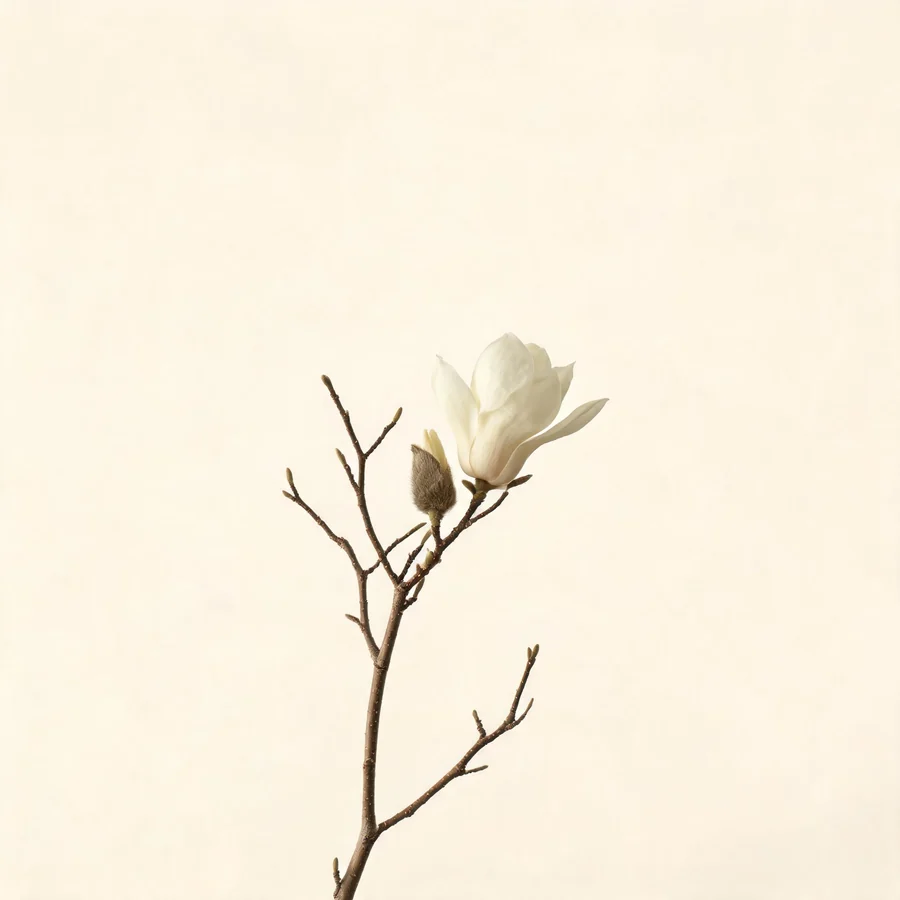
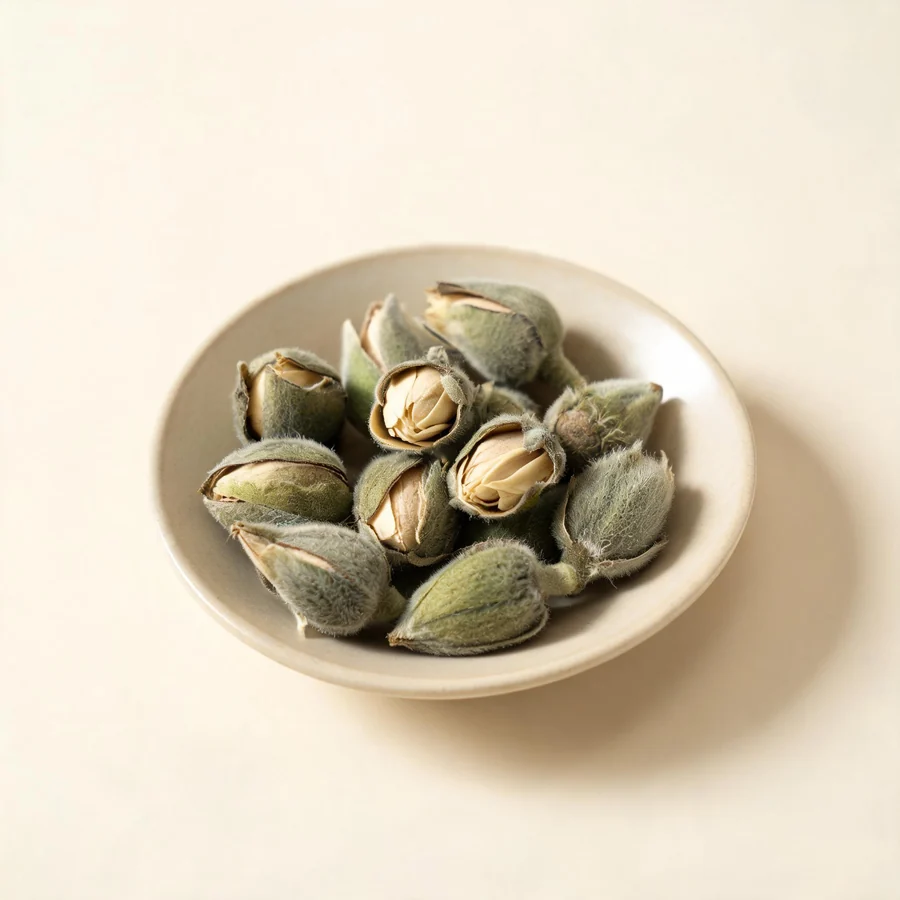
Skin profile
Where this herb sits in skin practice: the pattern it corrects, the skin signs it suits, and what it should not be used for.
Xin Yi Hua is on this page for the face rather than the nose alone: the red nose, the heavy cheek and the itch that arrives with a blocked nose. Its warm dispersal opens what is closed, its limits are dryness and pregnancy, and in a hot picture it is the carrier for cooling herbs rather than the treatment itself.
Skin signs that suggest it
- A red, swollen or congested nose, often with visible vessels and a burning sensation
- Facial puffiness or heaviness with a blocked nose and pressure at the root of the nose
- Itching or tingling of the face with sneezing and a clear, watery nasal discharge
- Skin around the nostrils that is red, sore and macerated by constant nasal discharge
- A pale tongue with a white coat in the cold pattern, or a red tongue with a yellow coat when heat leads
When it is not the right herb
Not for dry, crusted or atrophic nasal passages, a dry mouth, afternoon flushing and a tongue with little coating: the bud is warm and drying, and it leaves those membranes drier still. Not for a hot, red, spreading skin infection, for a single firm lump, or for a nosebleed that will not stop, all of which need assessment rather than a dispersing herb. Not in pregnancy, and not for a child without reducing the dose, wrapping the buds and straining the decoction through fine cloth.
What it does for skin
Skin-relevant actions only. Each one describes a mechanism in TCM terms and what it looks like on the skin.
Disperses Wind-Cold from the face
Wind-Cold settling in the face is read as sneezing, a blocked nose, aversion to cold and a heavy, dull forehead, with a pale tongue and a white coat. The bud's warm, acrid, strongly scented quality pushes that cold outward and upward, and it is the reason the herb is used for the early, clear-discharge stage of a cold that has settled in the sinuses. The same movement reaches the skin of the face, which is why it is added when cold exposure brings on facial itch or flushing.
Opens the nasal passages and the skin around them
A blocked nose is an opening that has shut, and the tradition treats aroma as the key to openings, so a strongly scented warm bud is used to reopen it. The skin consequence is practical: when the discharge stops running constantly, the skin above the lip and around the nostrils stops being macerated, red and sore. The herb is not a skin antiseptic; it removes the irritant that keeps the area wet.
Raises clear Yang to the head and face
Li Shizhen's explanation is that the Lung opens into the nose, the Stomach channel runs around it, and when clear Yang fails to rise the head feels heavy and the openings fail. The bud is gathered closed, before it opens, and a closed bud is the most upward-reaching part of the whole tree, so that quality is used when the face is dull, heavy and congested rather than red and inflamed. It is a supporting action, not a treatment for a systemic deficiency on its own.
Clears Heat from the nose when paired with cooling herbs
The classical formula for the red, thickened nose puts this warm bud with Huang Qin, Zhi Zi and Shi Gao, so the nose is opened without adding heat to an inflamed surface. The logic is that the bud supplies the route and the cooling herbs supply the temperature, which is why a warm aromatic can serve a hot nasal picture. Used alone in that picture it would dry and irritate.
Skin conditions it is used for
Mapped to the condition pages on this site. The pattern column shows what the skin is doing when this herb is the right choice.
| Condition | Pattern | Why it suits | Typical setting |
|---|---|---|---|
| Rosacea | Lung and Stomach Heat rising to the nose | The redness, flushing and papules of the nose and cheeks are read as heat rising through the Stomach channel, and the bud is the classical opener for the red nose, the leading herb in the formula built for it. It carries the cooling herbs to the surface and keeps the nasal passages open, while the temperature of the formula is set by Huang Qin, Zhi Zi and Shi Gao rather than by the bud. Rosacea that is pustular, painful or spreading, or that involves the eyes, needs medical assessment, and the bud alone will not settle a hot flush. | Xin Yi Qing Fei Yin |
| Rhinophyma | Heat with Qi and Blood stagnation thickening the nose | The late, thickened stage of the red nose is read as heat that has been present long enough for tissue to change, and the bud's place there is as an opener rather than as the main herb. It keeps the local channels open while blood-moving and softening herbs do the work of reducing the nodularity, and expectations are set low, because established thickening is structural. A nose that is changing quickly, ulcerating or bleeding needs dermatological assessment before it is treated as a pattern. | Modified Xin Yi Qing Fei Yin with Hong Hua and Chi Shao |
| Facial swelling | Wind-Heat in the Stomach channel of the face | The old entry describes the bud as treating a face swollen until the teeth ache, which is a hot, tight, tender swelling in the territory of the Stomach channel rather than a pitting oedema. It is used there with cooling and wind-releasing herbs to open the face and move what is stuck, and it is not a herb for fluid retention or for kidney oedema. Facial swelling with fever, breathing difficulty, a spreading red edge or a single firm lump needs urgent assessment. | Modified Xin Yi Qing Fei Yin with Jin Yin Hua and Lian Qiao |
| Face itching | Wind in the face, cold or wind-heat | Facial itch is read as Wind on the most exposed surface, and the bud is used for the version that comes with sneezing, a blocked nose, and itching that moves around the cheeks and nose rather than staying in one plaque. Its warm dispersal suits the cold, clear-discharge picture, and it is combined with cooling herbs when the itch is hot and the face flushes. Itch without a rash, itch with a spreading rash, or itch that disturbs sleep needs assessment rather than a stronger decoction. | Modified Xiao Feng San with Xin Yi Hua and Bai Zhi |
Combinations for skin
Herbs it is paired with when the skin, not an internal organ, is the target.
| Partner | Ratio | Why the pair is used |
|---|---|---|
| Cang Er Zi | 6 to 10 g each | Both herbs open the nose, and the pair is the standard answer to chronic congestion. Xin Yi Hua is the warmer and gentler of the two, while Cang Er Zi is the stronger and the more drying, so the balance is adjusted to the discharge: clear and watery leans on the bud, thick and persistent leans on the seed. Both are given wrapped or in a formula, and neither is used long term without review. |
| Huang Qin | 6 to 10 g Huang Qin with 6 to 10 g Xin Yi Hua | Bitter and cold, Huang Qin clears Heat from the Lungs and the upper body, which allows the warm bud to open the nose without heaping more heat onto a sinus that is already full of thick yellow discharge. The pair answers the obvious objection: how can a warm herb be given when the sinus is infected and the discharge thick and yellow? The bud supplies the route, the root supplies the temperature. |
| Bai Zhi | 6 to 10 g each | Bai Zhi is warm, aromatic and directed to the face, where it relieves the deep, boring pain of the forehead and the bridge of the nose. Combined with the bud it opens the nasal passages and settles the facial pressure together, which is the pairing used in the classical sinus powders. Both are warm and drying, so the pair is short and is avoided in the dry, atrophic picture. |
| Huang Qi | 10 to 15 g Huang Qi with 6 to 9 g Xin Yi Hua | Huang Qi supports the defensive Qi that keeps the surface shut and checks a thin discharge which otherwise runs without pause, while the bud opens the nose again whenever it closes. The pair is used for the repeated rhinitis of someone depleted, and the proportions change as the attacks grow rarer. The bud is symptomatic and the root is constitutional, and neither is a substitute for assessing a one-sided or progressive obstruction. |
Formulas where it leads
- Xin Yi Qing Fei Yin (辛夷清肺饮) - The classical formula for the red, thickened nose, built on the bud with Huang Qin, Zhi Zi, Shi Gao, Mai Men Dong, Bai He, Zhi Mu, Pi Pa Ye, Sheng Ma and Gan Cao. Its design is exactly the logic of the herb: a warm opener to carry cold, draining herbs to the face. It is a practitioner's formula, and a nose that is ulcerating, bleeding or changing rapidly needs assessment rather than a stronger decoction.
- Xin Yi San (辛夷散) - The classical powder for deep nasal obstruction with thick discharge, pairing the bud with Fang Feng, Bai Zhi, Xi Xin and Chuan Xiong. It is the formula behind the reputation of the herb as the leading opener of the nose, and it is given as a decoction of the powders rather than as a snuff. On a skin page it matters for a practical reason: while the discharge runs, the skin above the lip and around the nostrils stays red, sore and macerated, and easing the obstruction lets that skin settle. The hairs are strained out, and the course is short.
Safety for skin use
What to check before recommending or using it, including the cautions that matter most for skin patients.
Do not use, or use with caution
- Dryness of the nose and throat: a dry, crusted nasal lining, a dry mouth, afternoon flushing and a tongue with little coating. A warm drying bud makes those membranes drier still and leaves the congestion no better.
- Pregnancy. Extracts of the bud have been shown to stimulate uterine smooth muscle, so it is kept out of any formula given in pregnancy, however blocked the nose.
- A hot, spreading skin infection, a single firm or growing lump, or a nosebleed that will not stop. These need assessment, not a dispersing herb.
- Children under supervision only, with the dose reduced and the hairs strained out, because the hairs irritate a small throat.
Pregnancy and breastfeeding
Avoid in pregnancy. Laboratory work shows that the extract makes uterine muscle contract, which offers a plausible route to early miscarriage and to premature labour late in pregnancy. The herb is not a classical abortion drug, and its evidence rests on isolated tissue rather than on outcomes in women, but the margin is too narrow to test, so it is kept out of pregnancy formulas however blocked the nose. A woman who conceives during a course stops it and tells her practitioner. While breastfeeding there is no classical prohibition and little of it is likely to reach the milk, but the oil can irritate and a baby's digestion is not yet mature, so it is reserved for clear need and kept to the lowest dose.
Interactions
- Anticoagulants and antiplatelets such as warfarin, aspirin or clopidogrel. In laboratory work the extract has slowed platelet clumping, so the herb is raised with the prescriber before a course begins, especially in anyone whose clotting is fragile.
- Antihypertensives, sedatives and sedating antihistamines. In animal studies the oil has reduced blood pressure and caused mild sedation, so it might slightly add to those medicines, though herbal doses have not been shown to do this in people.
- Decongestant sprays and other nose medicines. The combination is not established as dangerous, but a person using both should tell the prescriber, because the bud's drying action can make a rebound spray problem worse.
Allergy and patch testing
Contact dermatitis from the bud or from a herb-containing nasal preparation is possible, and the hairs are a mechanical irritant even without allergy. A first external use is patch tested, and a preparation that produces sneezing, wheeze or facial swelling is stopped at once. True allergy to magnolia is uncommon but a previous reaction to a related aromatic herb is a reason for care.
General safety references
General references for herbal hepatotoxicity and herb-drug interactions; they are not specific to this herb.
- Review article: Herbal hepatotoxicity - an update on traditional Chinese medicine preparations. Alimentary Pharmacology & Therapeutics, 2014. PMID: 24844799.
- Interactions between herbal medicines and prescribed drugs: an updated systematic review. Drugs, 2009. PMID: 19719333.
- Warfarin and food, herbal or dietary supplement interactions: a systematic review. British Journal of Clinical Pharmacology, 2021. PMID: 32478963.
Evidence
The classical record is quoted with its source. The modern note states the level of evidence plainly.
Classical record
Warm and acrid, it governs wind that brings cold and heat into the five organs, pain of the head and brain, and complaints of the face. Long use is said to lower Qi and to make the body light and the eyes bright.
Shen Nong Ben Cao Jing (Divine Husbandman's Classic of Materia Medica) - The oldest entry already lists the head and face as its ground, which is the basis of its skin use.
It warms the centre, opens the muscle layer, unblocks the nine orifices and clears a stuffy nose with discharge. It treats a swollen face that pulls at the teeth, and a dizziness like being on a moving boat.
Ming Yi Bie Lu (Supplement to the Classic of Materia Medica) - The nasal use arrives here, together with the facial swelling that later practice treats with the same herb.
The Lungs have their opening in the nose, and the Stomach channel passes around it; where central Qi is weak and the clear Yang cannot rise, the head droops and the orifices are not free. Entering the Lung, this warm pungent bud lifts the clear Yang of the Stomach, hence its use for the head, face and nose.
Ben Cao Gang Mu (Compendium of Materia Medica), Li Shizhen - This is Li Shizhen's account of why the bud rises, and later writers quote it when they use the herb for a heavy, congested face.
Modern evidence
Evidence status
- No controlled trial of Xin Yi Hua for rosacea, rhinophyma or facial itch was identified for this page. The herb's skin use rests on the classical head-and-face territory and on formulas built around it, not on trial evidence.
- Laboratory work on magnolia bud extracts reports anti-inflammatory, antihistamine-like and antimicrobial activity in cell and animal systems, and volatile oils are the usual focus. These findings are consistent with a decongestant effect; they do not establish a benefit for rosacea or for the skin around the nose.
- The main practical finding in the literature is not efficacy but uterine activity: extracts have contracted uterine smooth muscle in isolated tissue, which is the basis of the pregnancy prohibition on this page. The herb is otherwise of low toxicity, and the hairs are a mechanical irritant rather than a chemical one.
PubMed records
Selected real PubMed records for this herb's species or its constituents, chosen by species name and title relevance. They are references for the non-TCM discussion above, not proof that the herb treats any skin condition.
- Dual targeting of MEK1 and PDE4 by Total lignans from flower buds of Magnolia biondii Pamp. Alleviates atopic dermatitis.. Fitoterapia, 2026. PMID: 42031117 (skin-related record).
Dose and forms
Skin-practice dosing and the preparations that suit skin complaints.
| Form | Dose and notes |
|---|---|
| Decoction | 3 to 10 g a day, wrapped in cloth before decoction so the hairs do not end up in the cup. Where the cold is mild and the nose merely stuffy, three to five grams suffices; chronic sinus trouble or allergic rhinitis calls for six to nine. |
| Wrapping and straining | The buds go into the pot in a tied cloth bag, and before serving, the decoction is passed through fine cloth a second time, which matters most when it is for a child. Buds that have been dry-fried need no bag, though passing the liquid through cloth is still sensible. |
| Powder and external use | As a snuff the amount is tiny and the hairs are taken off first, and in drops or in an ointment the amount is not weighed in grams at all. External preparations are made by a practitioner rather than at home. |
| Course length | Short courses of one to two weeks with review. At larger doses the oil may bring on nausea, stomach burning and headache, one reason the range stays modest. |
The buds are wrapped because the fine hairs are a physical irritant, not out of fussiness; unwrapped buds make a drink that scratches the throat. Open buds are weaker and cannot replace closed ones weight for weight, so a closed-bud recipe cannot simply be doubled with open ones. Dry-fried buds need no bag. Within the range the aim sets the number, the smallest dose that opens the nose being preferred for a child or for a first course.
Citations and further reading
Only real sources are listed: the classical materia medica passages quoted above, and the source works behind the botanical and safety statements.
- Shen Nong Ben Cao Jing (Divine Husbandman's Classic of Materia Medica), attributed compilation of the Han period - classical entry quoted above.
- Ming Yi Bie Lu (Supplement to the Classic of Materia Medica), Tao Hongjing - classical entry quoted above.
- Ben Cao Gang Mu (Compendium of Materia Medica), Li Shizhen, 1578 - classical entry on the ascending action.
- Pharmacopoeia of the People's Republic of China - Magnoliae Flos monograph, accepted source species and quality standards.
- Modern evidence statement: laboratory literature on magnolia bud extracts and volatile oils, summarised as a statement about the level of evidence rather than as a cited finding.
- Botanical description: botanical literature on Magnolia biondii and related Magnolia species, Magnoliaceae.
Educational reference for qualified practitioners. This page is not medical advice, and skin conditions should be diagnosed by a clinician before treatment.