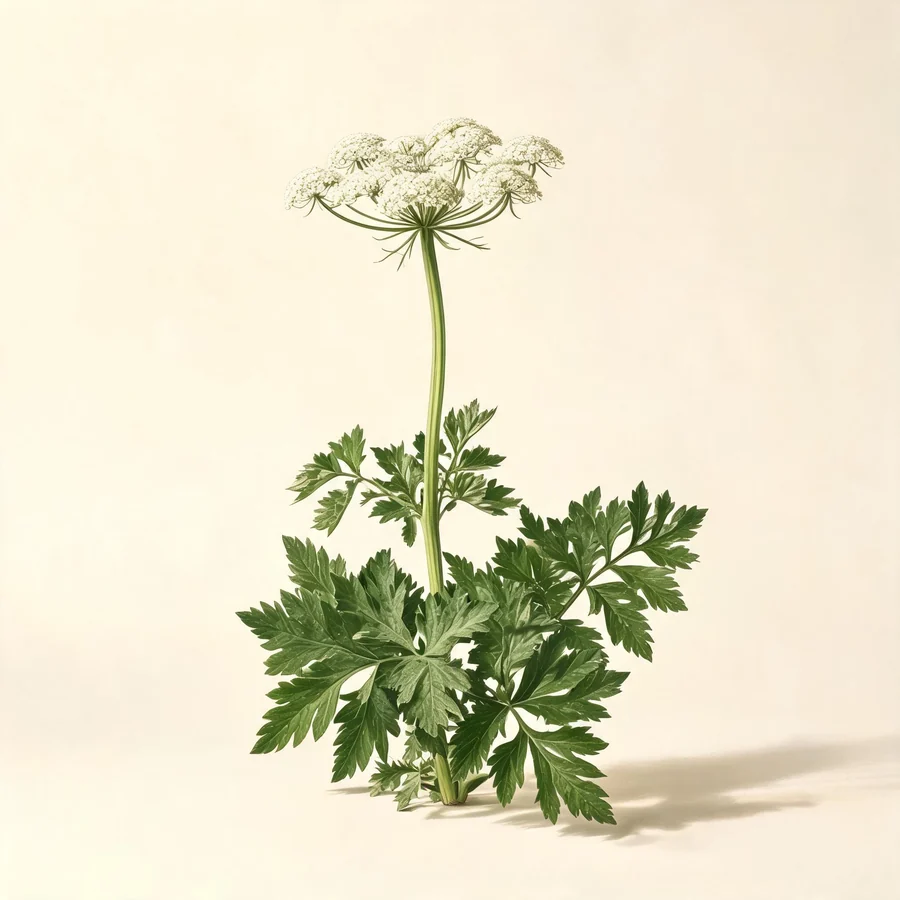
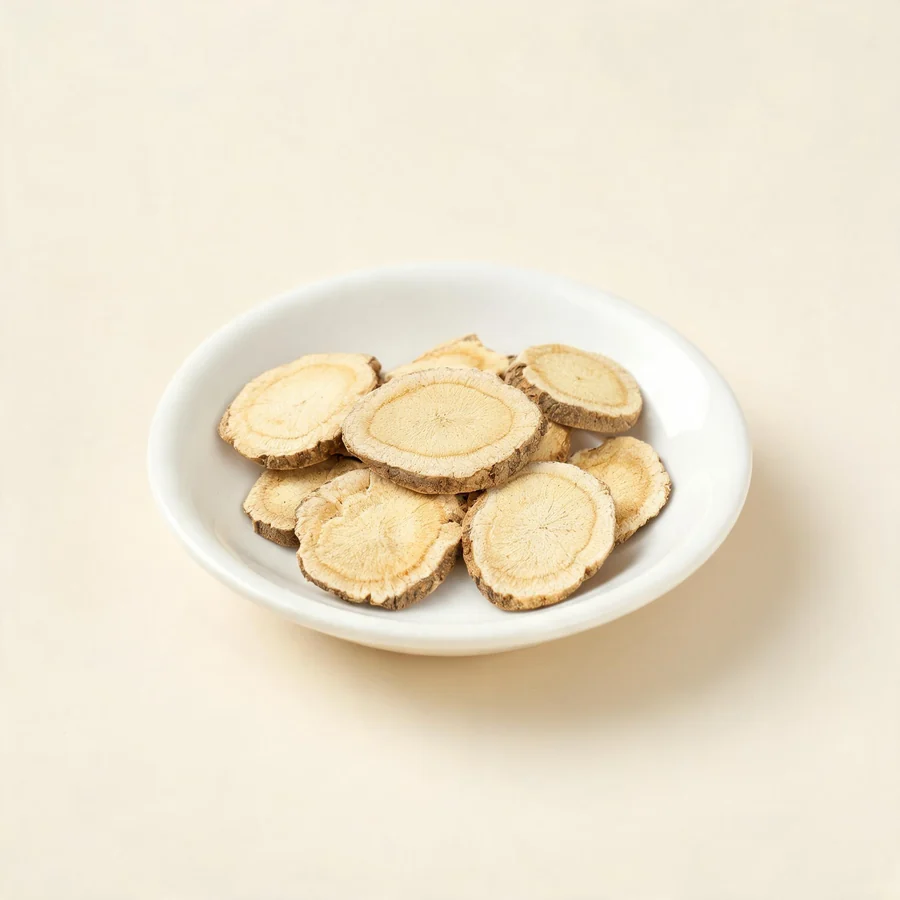
Skin profile
Where this herb sits in skin practice: the pattern it corrects, the skin signs it suits, and what it should not be used for.
Bai Zhi is a face herb first and a general warming herb second. It is used in small doses to move what has stalled in the skin and the sinuses, and every use on skin carries the furanocoumarin caution: assume sun sensitivity, keep the treated area covered, and stop at the first sign of a burn-like reaction.
Skin signs that suggest it
- An early boil or abscess: hard, red, tender, with no head yet formed
- Acne concentrated on the forehead, nose and cheeks, with oiliness and a dull complexion
- Facial puffiness or pressure over the brow and cheeks with a blocked nose
- Patches of uneven, dull or darkened facial colour
- An itchy rash that moves from place to place, worse on the face and in wind
When it is not the right herb
Not for hot, dry, red skin with a burning sensation, and not for a rash that is already spreading with fever. Its warmth and dryness are wrong where Yin is deficient, with night sweats, a dry mouth and a red tongue with little coating, and it can aggravate a dry, scaly dermatosis. It is not used on an abscess that is already open and draining freely, because its job is to move a swelling that has not settled. It should not be applied to the face before sun exposure, or used at all by someone taking a photosensitising medicine, until a practitioner has reviewed the combination.
What it does for skin
Skin-relevant actions only. Each one describes a mechanism in TCM terms and what it looks like on the skin.
Disperses Wind and settles a migrating itch
Wind in the tradition is what moves: an itch that shifts from one patch to another, a rash that appears on the face and neck and then elsewhere, or a swelling that comes and goes. Bai Zhi is warm and aromatic, and it is used to push that Wind out at the surface, usually with Jing Jie or Fang Feng. It suits the early, moving stage rather than a fixed, lichenified patch, and it is not a sedating antipruritic.
Draws a hard swelling to a point, or scatters it
Before pus forms, the pungent warmth is said to move the stagnant Qi and Blood behind a red, hard swelling so that it may scatter; after pus has formed, the same movement encourages it to point and discharge. That twofold use explains why the root sits among the supporting herbs of surgical formulas rather than at their head. It is not a substitute for draining a collection, and an abscess that is tense and fluctuant needs a clinical procedure.
Dries dampness at the surface
The drying quality is used where moisture keeps a lesion macerated, and it is also the reason the root is given for a thin, white vaginal discharge in the classical record. On the skin it suits a weeping patch that is not frankly infected, and it is stopped once the surface dries, because continued use leaves the skin tight and uncomfortable. It is not a treatment for dry skin, and it makes dryness worse.
Brightens a dull complexion by moving facial stagnation
The cosmetic use is old: the root was made into a face preparation, and it is still included in products sold for uneven or darkened facial colour. The traditional reasoning is that it moves the stagnation that dulls the complexion and disperses the dampness that makes it look heavy. The modern caution cuts against the claim, since the same furanocoumarins can cause the pigmentation the product is meant to treat, and no controlled evidence supports a brightening effect.
Skin conditions it is used for
Mapped to the condition pages on this site. The pattern column shows what the skin is doing when this herb is the right choice.
| Condition | Pattern | Why it suits | Typical setting |
|---|---|---|---|
| Acne | Wind-heat and dampness congesting the Yang Ming face | Acne on the forehead, nose and cheeks sits in the channel the root is said to enter, and the traditional reading is heat and dampness congesting the face with a little Wind. Bai Zhi is used in a small guiding dose to carry the formula upward and to disperse the surface congestion, with Huang Qin, Mu Dan Pi and Pi Pa Ye doing the clearing. It is not a stand-alone acne treatment, and it makes inflamed, dry acne worse if the dose is pushed. | Modified Pi Pa Qing Fei Yin, or Qing Shang Fang with Bai Zhi added |
| Boils | Early heat toxin with Qi and Blood congestion | An early boil is hard, red and tender, and the aim is to help it either settle or come to a clean head. The root's pungent movement is added to a cooling, toxin-clearing formula for that purpose, and it is a supporting herb rather than the main one. A boil with spreading redness, fever or a large collection of pus needs medical care, and a compress is not a substitute for drainage. | Xian Fang Huo Ming Yin |
| Skin abscess | Toxic swelling with pus forming | In a forming abscess the root is used to help the swelling localise and discharge, which is the classical rationale for its presence in surgical formulas. It does not empty a cavity, and a tense, fluctuant swelling needs drainage. Its drying quality is also a reason to stop once the lesion is open and draining freely. | Xian Fang Huo Ming Yin or Tuo Li Xiao Du San |
| Dark face | Wind and dampness dulling the facial complexion | The classical face use is the oldest thing about this root, and darkened or uneven facial colour was treated with it in a preparation applied to the skin. Modern products make the same claim on the same traditional basis. Honesty requires two points: the brightening effect is unproven, and the furanocoumarins can themselves produce lasting pigmentation after sun exposure, so sun protection is not optional and a patch test comes first. | Bai Zhi with Bai Fu Ling in a compounded face preparation |
| Melasma | Stasis and dampness in the face, often with Liver Qi stagnation | Melasma is read as stagnation and dampness in the facial channels, and the root appears in both internal and topical brightening formulas, usually with Liver-moving and Blood-quickening herbs. The evidence for benefit is weak, and the photosensitivity is a particular problem in a condition that sun exposure already worsens. A topical preparation should be used only with strict sun avoidance, and a practitioner should review the internal formula. | Modified Xiao Yao San with Bai Zhi |
| Facial swelling | Wind attacking the Yang Ming face, with nasal congestion | Facial puffiness with pressure over the brow and cheeks and a blocked nose is the picture the root shares with the nose-opening herbs. It disperses Wind at the face and opens the nasal passages, and it is used with Cang Er Zi and Xin Yi in the classic sinus formula. Facial swelling with fever, dental pain or eye symptoms needs assessment, because a spreading dental or sinus infection is not a case for a herbal wash. | Cang Er Zi San |
Combinations for skin
Herbs it is paired with when the skin, not an internal organ, is the target.
| Partner | Ratio | Why the pair is used |
|---|---|---|
| Chuan Xiong | 3 to 6 g each | The classic pair for pain in the head and face. Bai Zhi opens the channel of the Yang Ming, which crosses the forehead; Chuan Xiong moves Qi and Blood and reaches the temples and crown, so together they cover a headache or facial ache that shifts about. Both are warm and aromatic, and both are kept to small doses in skin formulas. |
| Huang Qin | 3 to 6 g Bai Zhi with 6 to 10 g Huang Qin | The root's warmth is balanced by a bitter-cold herb that clears the heat behind inflamed acne or rosacea-like redness, while Bai Zhi carries the formula to the face. The pair is a study in contrast: one dries and moves, the other cools and drains, and the proportion matters more than the total dose. |
| Bai Zhu | 6 to 10 g each | Bai Zhu works by strengthening the Spleen that generated the dampness, while Bai Zhi dries it where it has gathered at the surface. The two treat a damp skin condition or a thin discharge without leaving the Spleen making more, and the pair suits a problem that keeps returning in someone with weak digestion. |
| Jie Geng | 6 to 10 g each | The two herbs move pus by different routes: Bai Zhi loosens the swelling and the stagnant Qi at the site of the lesion, while Jie Geng lifts the Qi of the Lung and sends the clearing action upward. The pair is used for an abscess where pus has formed but will not drain, and it appears in formulas for abscess in the lung and in the skin. |
| Cang Er Zi | 6 to 10 g each | Cang Er Zi is aimed at the nose and the sinuses; Bai Zhi opens the channel of the Yang Ming and eases pressure over the brow. The two form the core of the classical sinus formula and are used where chronic blockage, thick discharge and a heavy forehead accompany a facial skin complaint. |
Formulas where it leads
- Cang Er Zi San (苍耳子散) - The classical formula for deep-source nasal congestion, with Cang Er Zi, Xin Yi, Bai Zhi and Bo He. It is included here because the face, the nose and the skin of the central face are treated as one territory, and because the root's guiding action to the Yang Ming face is easiest to see in this formula.
- Xian Fang Huo Ming Yin (仙方活命饮) - A surgical formula for hot, hard toxic swellings, combining toxin-clearing herbs with Blood-moving and pus-expelling ones. Bai Zhi is one of its supporting herbs, present to disperse the congestion at the surface so that the swelling may resolve or point.
Topical use
Bai Zhi is applied to the face and to localised lesions as a powder, a paste or an ointment base. The traditional face preparation is a fine powder blended with a little water, honey or a cream base, and the root also appears in poultices for early boils. Every topical use carries the same hazard: the furanocoumarins make the treated skin react to ultraviolet light, so the preparation is used at night or under clothing, and the area is kept out of the sun while the herb is on it and for a day or two afterwards.
| Preparation | How and when it is used |
|---|---|
| Face powder or paste | Grind the dried root to a fine powder and blend a small amount with water, honey or a plain cream to a thin paste. Apply to the affected area for 15 to 20 minutes, then wash it off, and use it in the evening rather than before going outdoors. Keep it away from the eyes and lips. |
| Poultice for an early boil | Mix the powdered root with enough warm water to make a paste and spread it on a cloth over the hard, red swelling, leaving the centre uncovered. Leave it for 20 minutes, then clean the skin. Do not use it on an open or fluctuant lesion. |
| Ointment base | The root is included in some prepared ointments sold for facial blemishes. Buy only from a maker that lists the full ingredients and the strength, and check the label for a photosensitivity warning. |
Patch test and cautions
Patch test on the inner forearm for 24 hours before the first facial use. Keep treated skin out of direct sun, do not use a sunbed, and stop at once if redness, burning or blistering develops, because a phototoxic reaction can leave lasting pigment. Do not apply to broken or infected skin, keep the preparation away from the eyes, and do not use it on a child's face without advice.
Safety for skin use
What to check before recommending or using it, including the cautions that matter most for skin patients.
Do not use, or use with caution
- Yin deficiency with heat: night sweats, a dry mouth, a red tongue with little coating and skin that is dry and hot. A warm, pungent, drying root adds to that dryness and can intensify flushing and bleeding.
- Photosensitivity, or a medicine that sensitises the skin such as amiodarone, a tetracycline, a fluoroquinolone or a sulphonamide. Herb and drug act together on the same skin, and the reaction can be severe even at ordinary topical amounts.
- An abscess that has already broken open and is draining freely. The root's work is to move a swelling that has not settled, and its drying quality can slow healing once the lesion is open.
- Allergy to this root or to the carrot family, which takes in celery, parsley and fennel. Skin rash, swelling and difficulty in breathing have all been reported, and a known sensitivity rules out any use.
- Prolonged use at any dose. Warmth and dryness show up as a parched mouth, a dry throat and skin that feels tighter, and that is the moment to stop rather than to increase the dose.
Pregnancy and breastfeeding
Use only under practitioner guidance, not as a routine herb. A warm, pungent, dispersing root raises a theoretical concern about unsettling foetal Qi, and its furanocoumarins argue for keeping any treated skin out of the sun. The old sources do not forbid it, and one even names it for threatened miscarriage, but present practice admits it in pregnancy only where a practitioner judges the indication clear and the course short. A small topical area is a lesser exposure and still needs sun protection.
Interactions
- Anticoagulants and antiplatelet drugs. Imperatorin and isoimperatorin, two of the root's furanocoumarins, have reduced platelet clumping in the laboratory, so combining it with heparin, warfarin, clopidogrel or aspirin may in theory raise bleeding risk. Nobody has measured that effect in people taking decoction doses, which argues for monitoring and for informing the prescriber before surgery.
- Photosensitising medicines. Bergapten, xanthotoxin and imperatorin react with ultraviolet light, and alongside amiodarone, a tetracycline, a fluoroquinolone or a sulphonamide the phototoxic effect can be pronounced. Strict sun protection is needed, and the combination is a reason to keep the root off the face.
- Medicines handled by CYP3A4. In laboratory studies the same compounds inhibit this enzyme, so levels of immunosuppressants, statins and calcium channel blockers could in theory rise. The clinical size of the effect is unknown, so it matters most for narrow-margin drugs and for concentrated extracts.
Allergy and patch testing
Apiaceae allergy is the one to ask about, because celery, parsley, fennel and coriander share proteins that can cross-react with this root. Contact dermatitis from a face powder is also described, and a first use should be a patch test on the forearm rather than a full application. Stop at once if the skin becomes red, swollen or itchy rather than calmer.
General safety references
General references for herbal hepatotoxicity and herb-drug interactions; they are not specific to this herb.
- Review article: Herbal hepatotoxicity - an update on traditional Chinese medicine preparations. Alimentary Pharmacology & Therapeutics, 2014. PMID: 24844799.
- Interactions between herbal medicines and prescribed drugs: an updated systematic review. Drugs, 2009. PMID: 19719333.
- Warfarin and food, herbal or dietary supplement interactions: a systematic review. British Journal of Clinical Pharmacology, 2021. PMID: 32478963.
Evidence
The classical record is quoted with its source. The modern note states the level of evidence plainly.
Classical record
It governs the skin and the face, and it treats white discharge.
Shen Nong Ben Cao Jing (Divine Husbandman's Classic of Materia Medica) - The oldest entry already places the root on the face, which is where its later reputation was built.
It is non-toxic. It is used for Wind with persistent thirst, vomiting, fullness below the ribs, Wind pain with dizziness, and itchy eyes.
Ming Yi Bie Lu (Supplement to the Classic of Materia Medica) - A short entry concerned with the head and the surface, where the root has remained ever since.
It serves for deep-source nasal congestion, nosebleed, brow pain and toothache; for blood in the urine; for constipation of the Large Intestine from Wind; for giddiness in women from Wind in the Blood; and for vomiting caused by rebellious Stomach Qi.
Ben Cao Gang Mu (Compendium of Materia Medica), Li Shizhen - Li Shizhen packs the entire clinical range into a single sentence, and the brow, the nose and the gum line sit exactly in the Yang Ming territory this root is said to enter.
Dang Gui serves as its envoy, and it is incompatible with Xuan Fu Hua.
Ben Cao Jing Ji Zhu (Collected Annotations on the Classic of Materia Medica), Tao Hongjing - One short line that still guides prescribing: pair the root with Dang Gui, keep it away from Inula flower.
Modern evidence
Evidence status
- The best-established modern finding is phototoxicity. Imperatorin, bergapten, isoimperatorin and xanthotoxin are furanocoumarins that intercalate with DNA and, on exposure to ultraviolet A, produce a burn-like reaction and lasting pigmentation. The effect is predictable, dose-related and the reason the root is restricted in cosmetic products in some markets.
- Laboratory studies of the root and its coumarins report anti-inflammatory, analgesic and antimicrobial activity in cell and animal models, and the root has been examined for effects on melanin production. These are mechanistic findings and do not establish a clinical effect on acne, melasma or abscesses.
- Clinical evidence in skin disease is lacking: no adequately controlled trial of Bai Zhi in acne, melasma or wound healing was identified, and the brightening claims in cosmetic products rest on tradition and on laboratory work rather than on tested outcomes.
PubMed records
Selected real PubMed records for this herb's species or its constituents, chosen by species name and title relevance. They are references for the non-TCM discussion above, not proof that the herb treats any skin condition.
- Proteomics and transcriptomics explore the effect of mixture of herbal extract on diabetic wound healing process.. Phytomedicine : international journal of phytotherapy and phytopharmacology, 2023. PMID: 37267693 (skin-related record).
- High hepatic exposure of furanocoumarins in Radix Angelica dahuricae is associated with transporter mediated active uptake.. Journal of ethnopharmacology, 2018. PMID: 29055720 (safety record).
Dose and forms
Skin-practice dosing and the preparations that suit skin complaints.
| Form | Dose and notes |
|---|---|
| Decoction (internal) | 3 to 9 g of dried root daily in a formula. Three to five grams is the guiding dose where the root supports a formula for facial congestion or pain; six to nine grams where it is given for its own indications. Ten to fifteen grams is on record where sinusitis is acute or the headache severe, under supervision. |
| External use | The amount is set by the area treated rather than by weight. A small quantity of fine powder is enough for a face preparation or a poultice, and the strength should be the weakest that works because of the phototoxic risk. |
| Course length | Short courses, typically a week or two, with review. Prolonged use dries the mouth, throat and skin, and the root is not a maintenance herb. |
Bai Zhi is a small-dose root, and the useful question is direction rather than size: a little carries a formula to the face and the forehead, while more mostly adds dryness. For pain in the Yang Ming channel it usually shares equal weight with Chuan Xiong. The topical dose is a separate matter, because the furanocoumarins make the skin react to sunlight, and no amount is safe on skin that will be exposed without protection.
Citations and further reading
Only real sources are listed: the classical materia medica passages quoted above, and the source works behind the botanical and safety statements.
- Shen Nong Ben Cao Jing (Divine Husbandman's Classic of Materia Medica), attributed compilation of the Han period - classical entry quoted above.
- Ming Yi Bie Lu (Supplement to the Classic of Materia Medica), Tao Hongjing, Southern and Northern Dynasties - classical entry quoted above.
- Ben Cao Gang Mu (Compendium of Materia Medica), Li Shizhen, 1578 - classical entry quoted above.
- Ben Cao Jing Ji Zhu (Collected Annotations on the Classic of Materia Medica), Tao Hongjing - classical entry quoted above.
- Radix Angelicae Dahuricae monograph: Pharmacopoeia of the People's Republic of China - accepted botanical source, part used and quality requirements.
- Modern evidence statement: based on photochemical and pharmacological literature on Angelica dahurica furanocoumarins, summarised as a statement about the level of evidence rather than as a cited finding. No clinical trial is presented as proof of effect.
Educational reference for qualified practitioners. This page is not medical advice, and skin conditions should be diagnosed by a clinician before treatment.