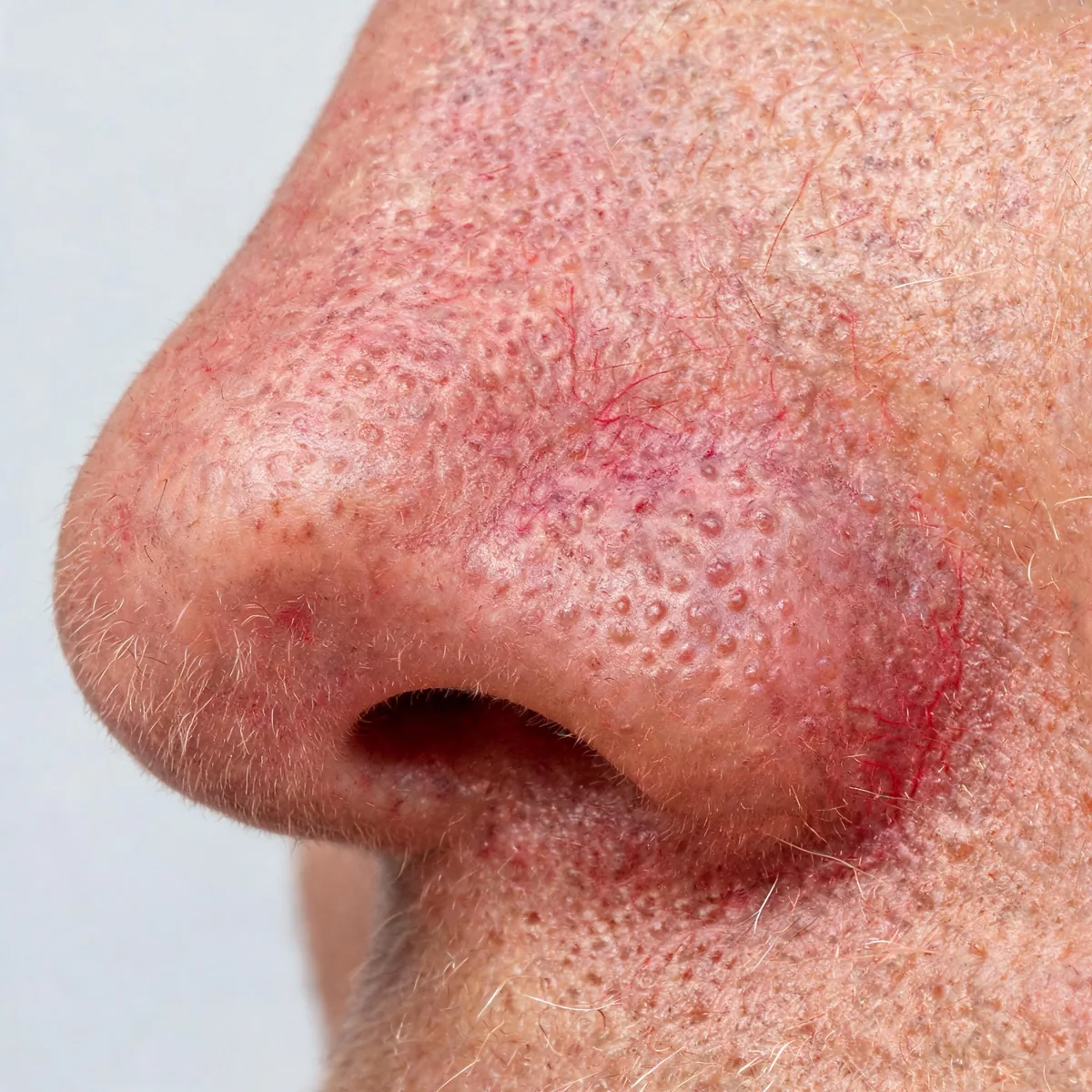
Understanding Rhinophyma
The classical literature understands rhinophyma primarily through the Lungs and Stomach: the Lung opens into the nose and governs the skin, so heat in the Lung rises to the nose, and Stomach fire does the same along its channel.
Lung heat gives facial redness especially on the nose and cheeks, with flushing worsened by heat, spicy food or alcohol, plus dry mouth and thirst. Bright Yang Stomach heat adds burning upper abdominal pain, excessive hunger, foul breath, bleeding gums and flushing after meals.
Heat in the Blood gives a persistent dark-red or purplish nose with visible broken blood vessels, a feeling of heat worse at night and thirst. Toxic-Heat adds painful pustules and abscesses on the nose with intense thirst and restlessness.
Qi and Blood stagnation is the late picture: a dark purplish-red thickened nodular nose with fixed stabbing pain or tenderness, chest oppression or rib distension and irritability. The classical literature treats that as the stage where tissue has changed, which is why conventional treatment may be needed.
The Lung is the organ that opens at the nose and rules the skin, which gives heat held there a direct route to the face. Spicy food, alcohol and emotional strain all feed that heat, and it rises along the channel, dilating the small vessels of the nose and cheeks so that flushing, redness and small papules appear. The Stomach channel crosses the cheeks and passes the side of the nose, and its own fire rises after a heavy or greasy meal, which is why some noses flare specifically after eating. Both kinds of heat can be present at once, and in the early years the redness comes and goes between episodes.
Heat that is never cleared does not stay where it started. It sinks deeper into the Blood, and the redness becomes fixed while the capillaries grow fragile and visible. Intensify it further and it turns into toxic heat, with pustules and abscesses that are painful and slow to settle. Years of that process, combined with the stagnation that emotional strain creates, produce the late picture: a thickened, nodular, dark purplish nose in which the tissue itself has changed. The same nose can travel through all of these stages, which is why the pattern is reassessed at each visit rather than fixed at the first consultation.
Conventional view
Rhinophyma is the late stage of rosacea in which the skin of the nose thickens, turns red and bumpy and develops prominent oil glands. It usually follows years of rosacea that was untreated or severe, and it affects men more often than women. The cause is not fully understood, but chronic inflammation and dilated vessels are involved, and alcohol is not the cause although it can make flushing worse. A dermatologist usually makes the diagnosis on appearance alone.
Treatment aims to reduce inflammation and, where the shape has changed, to reshape the nose. Topical metronidazole or azelaic acid is used for milder redness, oral antibiotics such as doxycycline to control inflammation, and isotretinoin for severe cases. Thickened bumpy tissue is addressed with laser therapy, dermabrasion or surgical shaving, which remove excess skin and improve appearance. These approaches control the visible disease but do not alter the tendency to flush and to form new lesions.
Surgery and lasers can improve the shape of the nose substantially, but they do not stop the process that caused the overgrowth, so redness and bumps tend to return unless the triggers are managed. Long-term medication carries its own side effects. TCM is offered at this point as a different route: cooling internal heat, moving stagnant blood and reducing the flare-ups that drive the condition forward, usually alongside rather than instead of dermatological care.
Selected PubMed records
Real PubMed records for the conventional discussion above, selected by condition name and title relevance. They are references, not a claim that any treatment is proven for this condition.
- Rosacea and rhinophyma.. Clinics in dermatology, 2014. PMID: 24314376.
- Rhinophyma: a systematic review and meta-analysis of its epidemiology, associations, and treatment outcomes.. European archives of oto-rhino-laryngology : official journal of the European Federation of Oto-Rhino-Laryngological Societies (EUFOS) : affiliated with the German Society for Oto-Rhino-Laryngology - Head and Neck Surgery, 2026. PMID: 41786951.
How it connects
Rhinophyma rarely appears in isolation: it often travels with a cluster of symptoms sharing the same internal Heat. Acne is the most common companion, because both arise when Lung Heat and Stomach Fire surge upward to the face; the Lung governs the skin and opens into the nose, so excess Heat reddens the nose and fuels pustules and papules on the cheeks, chin and forehead, and clearing the pattern often improves both. Bad breath and a bitter taste in the mouth are digestive red flags that frequently accompany it, especially in the Stomach Fire and Toxic-Heat patterns: the same Heat that flames the nose disturbs the Stomach, causing foul breath and a bitter taste, so draining Stomach Fire can calm the facial redness and freshen the breath together.
How it is assessed
The practitioner distinguishes active heat from established tissue change.
What a practitioner looks for
- Redness and flushing: flushing with heat triggers suggests Lung heat.
- Digestive heat: hunger, foul breath and post-meal flushing suggest Stomach heat.
- Vessels: persistent dark red nose with visible vessels suggests Heat in the Blood.
- Thickening: nodular thickened nose with fixed pain suggests Qi and Blood stagnation.
The consultation opens with triggers, because they separate the patterns more cleanly than the appearance alone. A nose and cheeks that redden after spice, alcohol or a tense moment, with the flush fading again afterwards, suggest Lung Heat, and the tongue is red under a thin yellow coat while the pulse is rapid and floating. Where flushing follows heavy meals and comes with unremitting thirst, offensive breath, a wish for cold drinks or constipation, Stomach Fire is more likely, with a thicker yellow coat and a rapid forceful pulse.
As the condition settles in, the practitioner looks for evidence that heat has moved deeper. A darker, more persistent redness with visible vessels, a face that stays hot at rest, a tongue bearing red spots under a thin yellow coating, and a pulse that is rapid, wiry and slippery all point to Heat in the Blood. Pus-filled bumps with sharp pain, yellow tender lesions, a greasy yellow coat and a slippery rapid pulse mark Toxic-Heat instead, which is the stage that needs the most urgent cooling.
In long-standing cases the practitioner palpates the nose as well as looking at it. Thickened, bumpy, dark reddish-purple skin with fixed stabbing pain or tenderness, a dusky tongue with purple spots and a wiry or choppy pulse describe Qi and Blood Stagnation, and the assessment then turns to how much of the change is structural. Red flags are checked separately: pain and redness spreading rapidly across the face, fever with pustules, eye pain or light sensitivity, and any new non-healing lump.
TCM patterns in Rhinophyma
The patterns form a sequence, and reading it right is most of the work. Lung Heat comes first, with flushing on exposure to heat, spice or alcohol that then leaves, a red tongue tip and a rapid floating pulse. Stomach Fire follows the digestive route, with burning epigastric pain, unsatisfied hunger, foul breath, bleeding gums and flushing after meals. Heat in the Blood is where redness stops retreating: the nose stays dark, capillaries show, the face is hot at night and the tongue carries red spots. Toxic-Heat is hotter still, with pustules, abscesses and a greasy yellow coating. Qi and Blood Stagnation is the late structural picture: a thickened nodular nose, fixed pain, and a dusky tongue with purple spots. Two adjacent stages may coexist, and the practical question is which one is doing most of the work now, since that decides whether the formula cools, resolves toxin or moves blood.
| Pattern | Key signs | The itch | Tongue | Main formula |
|---|---|---|---|---|
| Lung Heat | Facial redness especially nose and cheeks; Dry mouth and thirst | Not specified | Body: Red, with possible raised red points on the front thirdCoat: Yellow and dry | Not specified |
| Bright Yang Stomach Heat | Burning or gnawing upper abdominal pain; Facial redness and nose flushing after meals | Not specified | Body: Red, dry, possibly with early cracksCoat: Yellow and dry | Not specified |
| Heat in the Blood | Persistent dark-red or purplish nose | Not specified | Body: Deep red, often with red points or pricklesCoat: Thin, yellow and dry | Not specified |
| Toxic-Heat | Painful pustules and abscesses on the nose; Significant redness and swelling of the nose | Not specified | Body: Red, often with raised red pointsCoat: Yellow, dry, sometimes thick | Not specified |
| Qi And Blood Stagnation | Dark purplish-red thickened nodular nose; Fixed stabbing pain or tenderness | Not specified | Body: Purple or dark, with stasis spots; sublingual veins dark and distendedCoat: Thin white | Not specified |
Lung Heat
Facial and nasal redness flushing with heat and alcohol.
The nose is the Lung's own opening and the skin is its charge, so heat held there has an obvious way out. Spicy food, alcohol and emotional strain feed it, and it travels up the channel to dilate the small vessels of the nose and cheeks, producing flushing, redness and small papules that come and go at first. Because the heat is still shallow, the nose can return to normal between episodes.
The tongue is red, most clearly at the tip, under a yellow dry coat, sometimes with prickly papillae across the front third, and the pulse is rapid and slippery, possibly overflowing at the right cun position. Heat, sun, spicy food, alcohol, fried meals and stress bring on a flush, while cool compresses, plenty of water, chrysanthemum tea and rest settle it. Pi Pa Qing Fei Yin is the formula named, with Pi Pa Ye, Huang Qin and Sang Bai Pi, and LI-20 Yingxiang, BL-13 Feishu, LU-5 Chize and DU-14 Dazhui are the points.
Signs
- Facial redness especially nose and cheeks
- Flushing worsens with heat, spicy food or alcohol
- Dry mouth and thirst
- Red tongue tip and edges
Diet and lifestyle for this pattern: Avoid spicy, greasy and fried food as well as alcohol, which all generate internal Heat. Eat cooling food such as cucumber, pear and watermelon, manage stress gently with deep breathing or a walk in nature, and protect the face from excessive sun and heat.
Bright Yang Stomach Heat
Burning epigastric pain with hunger, foul breath and post-meal flushing.
The Stomach is treated as a furnace that turns food into energy, and when it overheats the fire has a direct line to the face. The Stomach channel runs up across the cheeks and beside the nose, so rich meals, alcohol and stress produce flushing that arrives after eating, together with burning epigastric discomfort, hunger that eating does not satisfy, foul breath and gums that are swollen or bleed.
The tongue is red, often with central prickles, under a thick dry yellow coating; the pulse is rapid and forceful, slippery, strongest at the right middle position. Cold drinks, light non-greasy meals and a rest after eating relieve it, while overeating, fried food, alcohol and stress aggravate it. Qing Wei San is the formula recorded, with Huang Lian and Zhi Mu, and ST-44 Neiting, LI-4 Hegu and ST-36 Zusanli are the points.
Signs
- Burning or gnawing upper abdominal pain
- Excessive hunger or eating large amounts without feeling full
- Foul breath with swollen or bleeding gums
- Facial redness and nose flushing after meals
- Thirst with constipation and dry stools
Diet and lifestyle for this pattern: Eat plenty of cooling, moistening food such as cucumber, watermelon, pear and leafy greens. Avoid alcohol, coffee, spicy dishes and fried or greasy food that stoke Stomach Fire, eat smaller regular meals rather than large feasts, and wind down after eating rather than rushing around.
Heat in the Blood
Persistent dark red nose with visible vessels and night heat.
When heat has moved into the Blood level, the Blood itself overheats, usually after repeated bouts of Lung or Stomach fire have pushed deeper. The vessels of the nose dilate and grow fragile, so the redness stops coming and going and settles into a dark persistent colour with visible capillaries. Heat also consumes Yin and fluids, which is why the face feels hot at night and the skin turns dry.
The tongue is red with spots or prickles under a thin yellow dry coat, and the pulse is rapid, wiry, slippery and forceful. Spicy food, alcohol, anger, heat, saunas, late nights and overwork all intensify it, while cool compresses, cool water, chrysanthemum tea, a cool quiet room and gentle breathing ease it. Liang Xue Qing Fei Yin is the formula named, with Sheng Di Huang, Mu Dan Pi and Chi Shao, and the points are SP-10 Xuehai, LI-11 Quchi and LI-20 Yingxiang.
Signs
- Persistent dark-red or purplish nose
- Visible broken blood vessels
- Heat in the face and nose worse at night
- Thirst for cold drinks
Diet and lifestyle for this pattern: Eat plenty of cooling food such as cucumber, watermelon and mung beans, and avoid alcohol, spicy dishes and fried food that add Heat. Protect the face from strong sun and keep stress low with gentle activity such as walking or meditation.
Toxic-Heat
Painful pustules and abscesses on the nose.
When heat is never properly cleared it deepens into toxin. The nose is where the Lung opens, and where the Yang of the face gathers, so toxic heat shows there as painful pustules and abscesses, with redness and swelling of the whole area. This is a more severe stage, in which the inflammation has begun to damage tissue and produce pus.
The tongue carries prickly thorns over a dry yellow coating, while the pulse runs rapid, forceful and slippery. Alcohol, spicy and greasy food, stress and heat exposure drive it, while cool compresses, rest, plenty of water and cooling food soothe it. Huang Lian Jie Du Tang is the formula named, with Jin Yin Hua and Lian Qiao, and LI-20 Yingxiang, LI-4 Hegu, LI-11 Quchi and DU-14 Dazhui are the points.
Signs
- Painful pustules and abscesses on the nose
- Significant redness and swelling of the nose
- Intense thirst for cold drinks
- Restlessness and irritability
Diet and lifestyle for this pattern: Avoid alcohol, spicy and fried food and prolonged sun exposure. Drink plenty of water and eat cooling food such as cucumber and mung beans, keep the face clean and avoid picking at lesions.
Qi And Blood Stagnation
The late picture: thickened nodular nose with fixed pain.
In the late stage, years of heat and emotional strain leave Qi stagnant, and stagnant Qi can no longer move Blood. The nose becomes the place where that congestion settles: the tissue thickens, nodules form and the colour turns dark purplish-red, because sluggish flow deposits waste and prompts overgrowth.
The tongue is dark purple with stasis spots and distended sublingual veins, and the pulse shows wiry, choppy qualities. Anger and stress, alcohol, spicy food, cold weather and a sedentary life worsen it, while warm compresses, gentle facial massage, stress reduction and a break from alcohol ease it. Tong Qiao Huo Xue Tang is the formula named, with Hong Hua and Chi Shao, and LI-20 Yingxiang, SP-10 Xuehai, SP-6 Sanyinjiao and LR-3 Taichong are the points.
Signs
- Dark purplish-red thickened nodular nose
- Fixed stabbing pain or tenderness
- Chest oppression or rib distension
- Irritability
Diet and lifestyle for this pattern: Avoid alcohol, spicy and greasy food, which generate internal Heat and worsen stasis. Manage stress with meditation or gentle yoga to prevent Qi stagnation, keep walking daily to promote smooth circulation, and protect the face from cold wind and excessive sun.
Treatment approach
How the tradition treats rhinophyma, with the herbs, formulas and points used for it.
Principles
- Clear Lung and Stomach heat where flushing is active.
- Cool the Blood where the nose is persistently dark red with visible vessels.
- Move Qi and Blood where the tissue has thickened and become nodular.
- Avoid alcohol and spicy food, which both frameworks treat as major triggers.
- Root and branch are separated deliberately. The branch is the visible nose, treated with local points and, once tissue has thickened, with blood-moving herbs; the root is whatever is pushing heat upwards, whether that is the Lung, the Stomach or the Blood level itself. That is why an early flushing nose is treated by cooling and dispersing while an established nodular nose needs movement and softening, and why a formula is not carried forward unchanged as the picture shifts.
Herbs used
Formulas
- Pi Pa Qing Fei Yin
- Qing Wei San
- Liang Xue Qing Fei Yin
- Huang Lian Jie Du Tang
- Tong Qiao Huo Xue Tang
Acupoints
- LI-20 (Yingxiang)
- BL-13 (Feishu)
- LU-5 (Chize)
- DU-14 (Dazhui)
- ST-44 (Neiting)
- LI-4 (Hegu)
- ST-36 (Zusanli)
- SP-10 (Xuehai)
- LI-11 (Quchi)
- SP-6 (Sanyinjiao)
- LR-3 (Taichong)
What to expect
- Active flushing and pustules improve with treatment and trigger avoidance.
- Established thickening and nodularity respond slowly, if at all, and may need procedural treatment.
- Progression can be slowed by addressing triggers consistently.
- Change usually arrives in a set order. Flushing and the sensation of heat ease first, pustules and papules settle next, and persistent redness fades more slowly. Thickened nodular tissue responds least and latest, often over many months, and may never return to its earlier shape without a procedural treatment. Because triggers such as alcohol, heat and stress remain part of a life, the plan usually settles into a maintenance rhythm rather than a fixed course.
Safety and when to get help
Seek medical help urgently for
- Sudden severe pain, swelling or rapidly spreading redness from the nose.
- Fever with nasal redness and swelling.
- Eye pain, redness or visual change with facial flushing.
For anything severe, sudden or spreading quickly, read when a skin problem needs urgent care.
Cautions
- Do not squeeze pustules on the nose.
- Alcohol and spicy food aggravate the condition in both frameworks.
- Structural change may need dermatological or surgical assessment.
Using this alongside conventional care
- TCM is described as complementary to conventional care: prescribed topical treatment continues, and structural rhinophyma may need procedural care.
- Creams and gels applied to the skin do not interact with herbs, so they continue unchanged. Oral antibiotics and isotretinoin are a different matter, since both the drug and several cooling herbs are processed by the liver, so liver function is monitored and each prescriber is told what the other is doing. Blood-moving herbs such as Hong Hua may add to the effect of anticoagulants. Treatment that has been prescribed is tapered with the prescriber and never stopped abruptly.
Diet and lifestyle
- Avoid alcohol, spicy food, coffee and fried food, and favour cooling light meals.
- The general rule is to eat light, cool and regular. Watermelon, pear, cucumber and celery, with mung beans, along with chrysanthemum or peppermint tea, suit the heat patterns, while alcohol, coffee, chilli, deep-fried food, fatty meat and very hot drinks should be rare. Where Stomach Fire dominates, smaller meals taken slowly matter as much as the ingredients, because overeating itself generates Stomach heat. Where the nose has thickened, the same cooling base is kept and rich greasy food is reduced further.
If you're pregnant
Rhinophyma is uncommon in pregnancy, but where it occurs the treatment is adjusted carefully, because pregnancy itself tends to create heat and blood stasis and can make facial redness worse. Strong heat-clearing and blood-moving formulas, Huang Lian Jie Du Tang and Tong Qiao Huo Xue Tang among them, are contraindicated, since they may stimulate the uterus or affect fetal development. A milder formula such as Pi Pa Qing Fei Yin is a safer starting point under supervision. Acupuncture is often the first-line approach: gentle stimulation at ST-36, LI-4 and LI-20, with the lower abdomen left alone.
If you're breastfeeding
Huang Lian and Huang Qin are bitter and cold, and both can reach an infant through milk, where they may provoke diarrhoea or digestive upset, so strong heat-draining formulas such as Huang Lian Jie Du Tang or Qing Wei San are avoided or greatly reduced while nursing. Topical treatment, dietary adjustment and acupuncture are safer alternatives, and where herbs are needed a qualified practitioner selects gentle options and keeps an eye on the baby's stools.
If treating a child
Rhinophyma is extremely rare in children, since it usually takes years of heat exposure to develop. Where a child has a persistently red, thickened nose, other explanations are excluded first, among them haemangioma, allergic rhinitis and eczema. Any pattern found is nearly always simple Lung Heat, without the deep stasis of adult disease. Doses are a quarter to a half of the adult amount, the milder herbs such as Sang Bai Pi and Ju Hua are preferred, and acupuncture is rarely used, with dietary and topical cooling measures taking its place.
If treating an elderly patient
Older patients usually present with Qi and Blood Stagnation of long standing, with a nose that may be dark purple, thickened and nodular, while Kidney Yin Deficiency in the background leaves the skin dry and slow to repair. Doses are conservative, usually two thirds of the adult amount, and blood-moving herbs such as Hong Hua are used cautiously where anticoagulants are prescribed. The focus shifts from aggressive clearing towards nourishing Yin, moving Blood gently and supporting vitality, with acupuncture sessions spaced further apart.
Urgent-sign guidance is based on standard sources: NHS anaphylaxis, NHS cellulitis, NHS Stevens-Johnson syndrome, NHS melanoma.
Evidence
Evidence status
Compiled for this page from the classical and modern literature; not a systematic review, so treat it as a pointer to sources rather than clinical guidance.
The evidence is review-level and case-based. A review of rosacea and rhinophyma from the Lung and Spleen perspective presents cases in which modified formulas and spleen-supporting herbs reduced facial erythema, papules and nasal thickening. There are no controlled trials of rhinophyma itself, and the structural thickening of long-standing disease is unlikely to reverse with herbs alone, so expectations should be set accordingly.
Case reports also cover acupuncture and bloodletting for rosacea and rhinophyma, describing less redness and swelling after a handful of sessions, though each is a single case rather than a trial. No large randomised study has been published in English, which is why the structural thickening of long-standing disease should not be expected to reverse on herbs alone.
Studies often cited
The review discusses Lung Heat and Spleen Dampness as the pathogenesis of rosacea and rhinophyma, and presents cases in which modified formulas and spleen-fortifying herbs reduced facial erythema, papules and nasal thickening. Zhang Y, et al. Traditional Medicine Research. 2020;5(6):1-8.
PubMed records for the TCM evidence
Real PubMed records for the TCM clinical evidence discussed above, selected by condition name and title relevance. They are references, not proof of benefit.
- Evaluating the Efficacy of Five-Blades Scratcher Surgery in Rhinophyma Treatment: A 3D Reconstruction Approach.. The Journal of craniofacial surgery, 2026. PMID: 41481886.
Classical record
Rhinophyma is caused by blood heat in the Lung channel.
- Yi Zong Jin Jian (Golden Mirror of Medicine), Surgical Heart Methods.
肺胃素有积热,又饮酒食辛辣,热气上蒸,故令鼻准赤。
Where the Lung and Stomach have long held accumulated heat, and alcohol and pungent food are taken, the heat steams upward and the tip of the nose turns red.
Accumulated heat in the Lung and Stomach, Sheng Ji Zong Lu - Sheng Ji Zong Lu, section on nasal diseases, recorded from the reference; the quotation is given here with its Chinese original.
Common questions
Can herbs reverse rhinophyma?
Active redness and pustules improve; established thickening is structural and may need procedural treatment. The page does not promise reversal.
Why does alcohol make it worse?
Both frameworks treat alcohol as a vasodilator and trigger for flushing in rosacea-spectrum conditions.
When should I see a doctor?
Spreading redness with pain or fever, eye symptoms, or progressive nasal changes.
Is it the same as rosacea?
It is described as the late thickened stage of the rosacea spectrum.
How long before the redness improves?
Flushing usually settles within two to four weeks of herbs, and the sensation of heat and the redness itself follow over four to eight weeks. Where thickening and nodularity are already present, softening is measured over months rather than weeks, and diet, herbs and acupuncture all need to continue for that to happen.
Does acupuncture help the redness itself?
It is used for exactly that. Points are chosen on the face and on the arm and leg channels to drain heat from the Lung and Stomach, cool the Blood and improve circulation at the site, and many people notice a cooler, paler nose after treatment. The effect builds with regular sessions.
Must alcohol and spicy food be given up for good?
During active treatment they are the two most important things to remove, because both push heat upward and undo the work of the herbs. Once the condition is stable, small occasional amounts may be tolerated, but most people find the nose stays clearer when they remain rare. The decision is made with the practitioner, pattern by pattern.