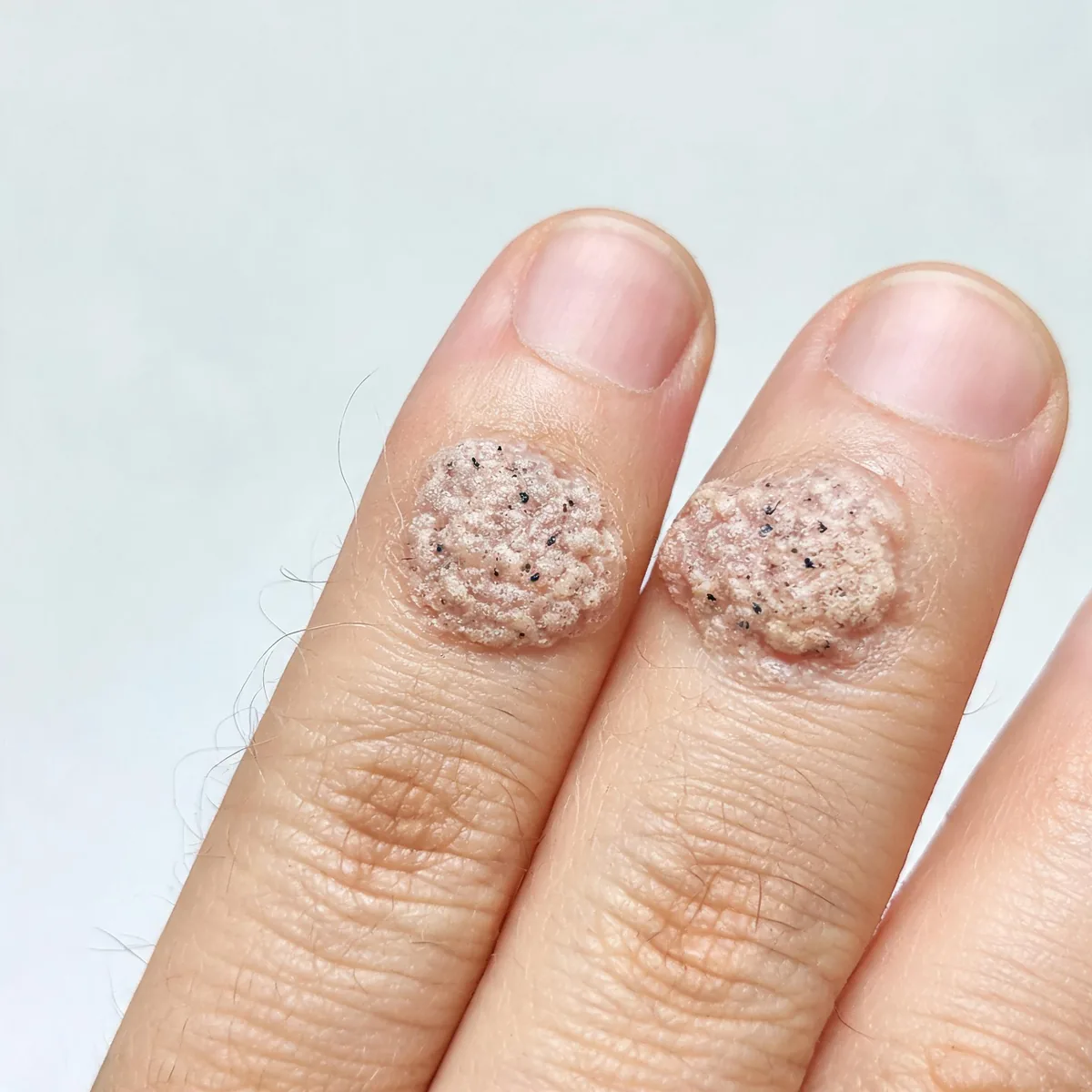
Understanding Warts
The classical literature links the skin to the Lung and to defensive Qi. When that defence is strong, Wind, Heat and Dampness are said to be unable to lodge; when it is weakened, they can.
Wind-Heat toxins are described as invading the surface and lodging in the local channels, obstructing Qi and Blood where the wart appears. That explains why warts are described as common at times of stress or poor diet, and why they can spread locally.
The pattern then depends on the lesion. Numerous red or pale-red flat warts with acute onset are read as Wind-Heat. Soft grey-brown moist nodules with a sluggish body are read as Damp-Heat. Hard dark-brown or purplish warts that resist treatment are read as Blood stagnation with heat.
Dry yellowish hard warts with itch that shifts, in a pale person, are read as Blood deficiency with external wind. Dark purplish fixed warts with chest tightness are read as Qi and Blood stagnation.
Defensive Qi is the layer that keeps Wind, Heat and Dampness at the surface rather than inside the body. When it is thin, through stress, poor food or a constitution that never had much of it, those pathogens settle into the small channels of the hands and feet, and the place where they lodge stops moving properly. Qi and Blood pool behind the obstruction, and the pooled, thickened patch is what shows as a wart. The virus named by conventional medicine is not denied in this account, but it is treated as an opportunist that takes hold where the ground has already been weakened.
What follows from that is practical: two people with a similar number of warts may need different treatment. A wart that appeared a month ago on a stressed student is read as an invasion that has not yet settled, and it is cleared and dispersed. A wart that has sat unchanged for three years on a cold-handed person with a choppy pulse is read as stagnation, and it is moved and softened. The internal formula works on the ground, while a wash, a moxa cone or fine needling around the base of the lesion works on the knot itself. Most courses combine the two, and the combination is why the tradition expects the pattern to improve as well as the lesion.
Conventional view
Warts are benign growths caused by the human papillomavirus. They appear as rough, raised bumps, most often on the hands, feet and face, and a doctor usually diagnoses them by sight, since flat warts and plantar warts have characteristic appearances. Most are harmless and a good number clear without treatment over months or years, but they can persist, spread, and be painful where weight or friction falls.
Conventional treatment works either by destroying the wart tissue or by provoking an immune response against it. Over-the-counter salicylic acid is the usual first step, followed by cryotherapy with liquid nitrogen, laser treatment, or prescription topical agents such as imiquimod. Cantharidin and minor surgery are used in selected cases. These methods remove what is visible, but they act on the lesion rather than on the infection behind it.
That distinction is where the approaches part company. Destruction can be painful and can scar, and most methods need several sessions before a lesion clears. Recurrence is common because the susceptibility that let the virus establish itself has not changed, and the same person often returns with new lesions elsewhere. The traditional approach treats that susceptibility as the main target, on the argument that skin which is better defended is less likely to be reinfected.
Selected PubMed records
Real PubMed records for the conventional discussion above, selected by condition name and title relevance. They are references, not a claim that any treatment is proven for this condition.
- Clinical guideline for the diagnosis and treatment of cutaneous warts (2022).. Journal of evidence-based medicine, 2022. PMID: 36117295.
- Paediatric Cutaneous Warts and Verrucae: An Update.. International journal of environmental research and public health, 2022. PMID: 36554279.
How it connects
Warts cluster with other skin problems because they share a terrain. Where Damp-Heat or Blood Heat primes the skin, the same factors that produce warts can produce acne or eczema at the same time, so a person may present with rough lesions on the hands, spots on the face and itching patches in the elbow creases, and be told that one imbalance runs through all three. Blood Deficiency links warts with dry eczematous skin, since thin Blood leaves the surface dry and open to Wind. Treating the shared root is why strengthening and moistening the Blood can clear warts and calm the accompanying itch together. Warts do not appear in isolation. When the body's terrain is primed by Damp-Heat or Blood Heat, the same factors that allow warts can trigger other eruptions such as acne, and when the Blood is too weak to nourish the skin it becomes dry and vulnerable to external Wind, so warts and atopic dermatitis can appear together. This is why treatment that clears Damp-Heat, cools the Blood or nourishes the Blood can help several skin complaints at once rather than only the warts.
How it is assessed
Diagnosis looks at the wart itself, its number and site, and the constitutional picture.
What a practitioner looks for
- Appearance: flat red or pale-red warts in crops suggest Wind-Heat; soft moist grey-brown nodules suggest Damp-Heat.
- Behaviour: hard dark warts resisting treatment suggest stagnation; dry itchy warts in a pale person suggest Blood deficiency.
- Constitution: fatigue, complexion, digestion and stress are part of the picture.
- Red flags: any wart that changes colour, bleeds or grows rapidly needs dermatological review.
The examination starts with the lesion and works inward. Colour, how firm it feels, whether the surface is dry or moist, how many there are and how fast they arrived are all noted, along with the site, since the face and hands point one way and a single longstanding lesion on a foot points another. Questions follow about itching, tenderness on pressure, and whether the surrounding skin is dry, scaling or unchanged. Only then are the tongue and pulse checked, because their job is to confirm or overturn the impression the skin has already given.
The confirmations are fairly consistent. New crops of pink or pale-red flat warts with a red tongue edge, a thin yellow coat and a floating rapid pulse are read as Wind-Heat. Hard dark or purplish lesions with a dark tongue, purple spots and a choppy or wiry pulse are read as Blood Stagnation with Heat. Soft grey-brown nodules, a greasy coat and a slippery rapid pulse point to Damp-Heat, and the practitioner will ask about appetite, nausea and loose sticky stools. Dry yellowish warts in a pale person with a thin pulse suggest Blood Deficiency with External Wind, while dark fixed lesions, a choppy pulse and tightness across the chest suggest Qi and Blood Stagnation.
One question runs through the consultation, and that is how long the lesion has been there. Duration separates an invasion from a stagnation more reliably than size does, and it changes the plan, from dispersing and clearing at one end to moving and softening at the other. The practitioner also asks what has already been tried, because a wart that has survived freezing has usually had time to consolidate, and that history feeds back into the reading.
TCM patterns in Warts
Five patterns are described for warts, and they are not five names for the same thing. What separates them is a small set of observations: how quickly the lesions arrived, whether they are soft or hard, moist or dry, pink or dark, and what else is going on in the body at the same time. A crop that appears over a few weeks reads as an invasion that has not settled. A single hard dark nodule that has resisted two winters of freezing reads as stagnation that has had time to consolidate. Moisture is the next fork: soft grey-brown lesions that feel damp, in someone heavy and sluggish with a greasy tongue, point to Damp-Heat rather than heat alone. The last fork is constitutional: dry yellowish warts on dry skin in a pale, tired person suggest Blood too thin to nourish the surface, while dark fixed lesions with chest tightness and a choppy pulse suggest that Qi has stopped moving.
| Pattern | Key signs | The itch | Tongue | Main formula |
|---|---|---|---|---|
| Wind-Heat | Red or pale-red flat warts, often numerous | Not specified | Body: Red at the tip and edgesCoat: Thin yellow or white turning yellow | Not specified |
| Blood Stagnation with Heat | Tender or painful when pressed; Dry rough scaly skin around the warts | Not specified | Body: Reddish-purple, with stasis spots and dark sublingual veinsCoat: Thin, dry and yellow | Not specified |
| Damp-Heat | May ooze or feel moist | Not specified | Body: Red, often swollen with teeth marksCoat: Yellow, greasy and thick, usually in the middle and at the root | Not specified |
| Blood Deficiency with External Wind | Dry yellowish bean-like hard warts; Dry flaky rough skin | Itch that comes and goes | Body: Pale and thin, sometimes slightly dryCoat: Thin, white and a little dry | Not specified |
| Qi And Blood Stagnation | Tender or painful when pressed | Not specified | Body: Purple or dark, with stasis spots; sublingual veins dark and distendedCoat: Thin white | Not specified |
Wind-Heat
Numerous red or pale-red flat warts appearing acutely on face and hands.
The surface is the weak point here. When the layer of defensive Qi is not holding, Wind-Heat toxin enters through exposed skin, and the face and the backs of the hands are where it most often lands. Wind keeps the lesion spreading, Heat gives it colour, and together they obstruct the local flow so that small raised papules form in quick succession. Because the process is acute, several lesions tend to arrive within weeks rather than months, and the picture is often accompanied by the ordinary signs of Wind-Heat at the surface, such as a sore throat or a mild fever.
The tongue usually shows a red tip and edges with a thin yellow coat, and the pulse floats and runs fast. Spicy, greasy and fried food adds internal heat and makes the outbreak worse, as does direct exposure to wind and heat, while picking at a lesion spreads it and breaks the skin barrier further. Cool compresses, cooling food such as cucumber and mung beans, and genuine rest all help. Fang Feng Tong Sheng San is the formula usually named, and LI-11 Quchi, LI-4 Hegu and SP-10 Xuehai are the points, with local needling around the wart to break the stagnation at the site.
Signs
- Red or pale-red flat warts, often numerous
- Acute onset
- Located on face and back of hands
- Mild fever, chills or sore throat
Diet and lifestyle for this pattern: Eat cooling food such as cucumber, watermelon and mung beans, and avoid spicy, greasy and fried food that generates internal Heat. Keep the skin clean and avoid scratching or picking at warts to prevent spread, and give yourself adequate rest and stress reduction to support the immune system.
Blood Stagnation with Heat
Hard dark-brown or purplish warts that resist treatment.
A heat toxin that stays in the skin long enough changes what it touches. The prolonged heat thickens the local blood and slows it, so a knot of heat and stasis forms, and that knot hardens into a dark or purplish wart that no longer feels like the skin around it. The longer it sits, the more the trapped heat dries the fluids nearby, which deepens the stasis and makes the lesion progressively harder to shift. This is the pattern that most often explains warts which have survived freezing, acids and patience.
The tongue is reddish-purple with stasis spots and distended veins beneath it, carrying a thin dry yellow coat, and the pulse feels choppy and fast, often wiry at the left Guan position. Spicy and greasy food, frustration, hot humid weather and constant pressure or friction on the lesion all make it worse. Cool compresses, gentle daily movement, rest and a break from spicy food help. Tao Hong Si Wu Tang is the base, commonly adjusted with Xia Ku Cao and Ban Lan Gen, and the points are SP-10 Xuehai, LI-11 Quchi and LR-3 Taichong.
Signs
- Hard dark-brown or purplish warts
- Tender or painful when pressed
- Dry rough scaly skin around the warts
- Restlessness with internal heat
Diet and lifestyle for this pattern: Avoid spicy, greasy and deep-fried food that generates internal Heat. Eat cooling, blood-moving food such as celery, hawthorn, radish and mung beans, and keep moving gently such as walking or stretching so Qi and blood flow and further stagnation is prevented.
Damp-Heat
Soft grey-brown moist nodules with a sluggish, heavy picture.
Dampness and heat together behave differently from heat alone. Dampness is heavy and sticky, so instead of a dry hard nodule the result is a soft, grey-brown, slightly raised lesion that may feel moist or itch mildly. The mixture clogs the pores and the small channels, which traps the toxin at the surface, and its sticky quality explains why these warts clear slowly and return readily in humid weather or after a run of rich, greasy meals.
The tongue is red with a yellow greasy coat and may be swollen with teeth marks, and the pulse is soggy and fast or slippery and fast. Humidity, greasy or sweet food, dairy, alcohol and lingering damp on the skin all aggravate the picture, while a dry climate, plain meals, barley or mung bean soup, clean dry skin and gentle exercise ease it. Pu Ji Xiao Du Yin is the named formula, adjusted with Ma Chi Xian and Yi Yi Ren, and the points are LI-11 Quchi, SP-9 Yinlingquan, SP-6 Sanyinjiao and ST-36 Zusanli.
Signs
- Soft grey-brown slightly raised nodules
- May ooze or feel moist
- Heavy sluggish body sensation
- Greasy taste with poor appetite
- Loose sticky stools
Diet and lifestyle for this pattern: Avoid greasy, fried and sweet food that creates Dampness and Heat, and limit dairy, alcohol and rich meats. Eat cooling, Dampness-draining food such as barley, adzuki beans, mung beans, cucumber and bitter greens, keep the skin dry and clean, change out of sweaty clothes promptly, and after exercise that brings a light sweat, shower to remove Dampness from the skin.
Blood Deficiency with External Wind
Dry yellowish hard warts with shifting itch in a pale person.
Here the wart is the second problem. When Blood is insufficient the skin loses its nourishment and turns dry and fragile, and that dryness opens a route for external Wind to lodge. The pathogen then sits in undernourished tissue and slowly forms the dry, yellowish, bean-like hard lesions most people recognise as common warts. Because the root is a shortfall rather than an excess, these warts are usually fewer and less inflamed than the heat-driven kinds, and they resist treatment in proportion to how long the deficiency has been present.
The tongue is pale and thin with a thin white, slightly dry coat, and the pulse is fine and wiry, most obvious in the left middle position, and floats at the surface. Stress and overwork, spicy or drying food, cold wind and picking at the lesion all make it worse, and the itch tends to wander rather than stay in one place. Blood-building meals, moisturising and protecting the skin, gentle exercise, adequate rest and warm shelter help. Dang Gui Yin Zi is the formula, and the points are SP-6 Sanyinjiao, SP-10 Xuehai, ST-36 Zusanli, GB-20 Fengchi and LI-11 Quchi.
Signs
- Dry yellowish bean-like hard warts
- Itch that comes and goes
- Dry flaky rough skin
- Pale or sallow complexion
- Aversion to wind and drafts
Diet and lifestyle for this pattern: Eat blood-building food such as dark leafy greens, beetroot, liver, eggs and black sesame, and avoid spicy, greasy or overly drying food that can consume Blood and aggravate Wind. Keep the skin well moisturised, protect it from harsh wind and cold, keep movement gentle such as walking or tai chi, and prioritise restful sleep so Blood can regenerate.
Qi And Blood Stagnation
Dark purplish fixed warts with chest tightness.
Stagnation of Qi comes first and drags Blood with it. Qi is what pushes Blood through the smallest vessels, so when Qi stops moving the Blood in those vessels pools, and the pooled Blood becomes the hard, dark, fixed lesion that will not soften. Because the Liver is the organ charged with keeping Qi in motion, this picture often brings tightness or distension across the chest and ribs, irritability, and a dark complexion or purplish lips, and the wart itself may be tender when pressed.
The tongue is dark purple with stasis spots and dark distended veins underneath, and the pulse is wiry and choppy, described in the classics as a taut string scraping bamboo. Frustration, long sedentary days and heavy fatty food all deepen it, while gentle exercise, rest, a warm compress over the area and lighter meals loosen it. Xue Fu Zhu Yu Tang is the formula, and LR-3 Taichong, SP-10 Xuehai, SP-6 Sanyinjiao and LI-4 Hegu are the points, with Hegu often paired with Taichong for stubborn skin lesions.
Signs
- Dark purplish or brown hard fixed warts
- Tender or painful when pressed
- Tightness or distension in chest and ribs
- Irritability or mood swings
Diet and lifestyle for this pattern: Regular gentle exercise such as walking or tai chi keeps Qi and Blood moving. Avoid greasy, heavy food that bogs down the Spleen and worsens stagnation, and manage stress with slow breathing or meditation, since emotional tension tightens Liver Qi and locks up Blood flow.
Treatment approach
How the tradition treats warts, with the herbs, formulas and points used for it.
Principles
- Clear Wind-Heat toxin where warts are new and spreading.
- Move Qi and Blood where lesions are hard, dark and resistant.
- Drain dampness where the warts are soft, moist and spreading.
- Support defensive Qi, since the classical literature treats weak defence as the reason the toxin could lodge.
- The shared aim is to clear the heat toxin where it has lodged and to release the stagnation, and the patterns differ only in method. Wind-Heat is dispersed with cooling herbs that release the surface, Blood Stagnation is moved and broken, Damp-Heat is drained while heat is cleared, Blood Deficiency is nourished while Wind is expelled, and Qi and Blood Stagnation is treated by moving Qi and breaking stasis. External measures such as washes, moxibustion or needling around the base of the wart run alongside the internal formula, so the lesion is treated where it sits while the pattern is corrected underneath.
Herbs used
Formulas
Acupoints
- LI-11 (Quchi)
- LI-4 (Hegu)
- SP-10 (Xuehai)
- LR-3 (Taichong)
- SP-9 (Yinlingquan)
- SP-6 (Sanyinjiao)
- ST-36 (Zusanli)
- GB-20 (Fengchi)
What to expect
- Warts can resolve slowly, and the classical literature does not promise a fixed timeline.
- New lesions may appear while old ones regress.
- Destructive conventional treatments can be used alongside; ask before combining them with topical herbs.
- Fresh warts in the Wind-Heat picture often respond within two to four weeks, while hard lesions from stagnation or damp-heat commonly need two to three months of consistent treatment, and Blood Deficiency or Qi stagnation patterns take longer again because the underlying resources have to be rebuilt. Some lesions look angrier for a week or two as the immune response is stirred, then darken, flatten and separate. Stopping early is the usual reason for recurrence, and the formula is adjusted as the pattern changes rather than kept fixed.
Safety and when to get help
Seek medical help urgently for
- A wart that changes colour, bleeds or grows rapidly needs dermatological review.
- Warts on the genitals or anus need medical evaluation.
- Signs of infection in or around a treated wart.
For anything severe, sudden or spreading quickly, read when a skin problem needs urgent care.
Cautions
- Do not cut or pick warts; this spreads them.
- Avoid strong topical acids on the face or on broken skin without advice.
- People who are immune-suppressed should have warts medically reviewed.
Using this alongside conventional care
- TCM is described as complementary to conventional care: cryotherapy and topical treatments can continue alongside herbs, with care not to overlap strong topical agents.
- Combining is straightforward as long as both sides know. Salicylic acid, cryotherapy and prescription creams can continue while herbs are taken, but tell the TCM practitioner that the skin is already being treated, because an inflamed or peeling surface changes what can be applied on top. Herbs that move Blood, Dang Gui and Chi Shao among them, may thin the blood slightly, so anyone on anticoagulants should clear the combination with both clinicians. Nothing prescribed should be stopped without medical advice, and the herbal side is best used to shorten the course rather than to replace the dermatologist.
Diet and lifestyle
- Avoid greasy, fried and heavily processed food, excess sugar and dairy, and favour light whole foods.
- Broadly the advice is to stop feeding Dampness and Heat, which means cutting back on fried, greasy and heavily processed food, sugar and dairy, and eating more cooling, cleansing food such as mung beans, bitter gourd, cucumber and leafy greens. Pattern detail refines that. Wind-Heat does best with cucumber, watermelon and mung bean and no spicy food. Stagnation does best with celery, hawthorn, radish and mung beans plus daily movement. Damp-Heat needs dairy, alcohol and rich meat limited and barley or adzuki beans added. Blood Deficiency needs beetroot, dark greens, eggs, liver and black sesame, and Qi stagnation needs lighter meals and less fat.
If you're pregnant
Warts often flare in pregnancy, partly because dietary habits change and partly because Blood is diverted to nourish the fetus, which makes the Blood Deficiency with External Wind picture more prominent and calls for nourishing and gentle dispersing rather than strong heat-clearing. Blood-moving and stasis-breaking herbs are out of bounds here, and the ones named are Tao Ren, Chuan Xiong, E Zhu and Hong Hua. Even Ban Lan Gen is used only in small doses and with caution. External treatment is the first choice, such as a paste of mashed Ya Dan Zi or a vinegar soak applied to the lesion, since absorption is minimal. Acupuncture is reasonable with a trained practitioner who avoids LI-4 Hegu and SP-6 Sanyinjiao.
If you're breastfeeding
The concern here is transfer into milk. Bitter-cold heat-clearing herbs, among them Da Qing Ye, Ban Lan Gen and Pu Gong Ying, can reach breast milk and may loosen an infant's stools or cause colic, so if internal treatment is needed milder options, Yi Yi Ren or Ma Chi Xian, are chosen at a low dose. Topical treatment is the safest route because it acts locally. Where Blood Deficiency is pronounced, Dang Gui and Bai Shao nourish Blood without affecting supply. Leaving at least two hours between nursing and a dose reduces any transfer.
If treating a child
Warts are a common childhood complaint, most often on the hands, knees and face, and Wind-Heat is the pattern seen most, because a child's defensive Qi is still maturing and is easily invaded. Lesions tend to arrive in sudden clusters and may look slightly red. Damp-Heat appears in children who eat a great deal of sweet, greasy or cold food, giving soft moist warts and a greasy coating. Treatment leans on external measures, since children resist bitter decoctions: gentle pastes, moxibustion on the wart or very brief needling with fine needles. Where internal herbs are used the dose is roughly a third to a half of the adult amount, and Fang Feng Tong Sheng San needs a practitioner who will adjust for age and weight.
If treating an elderly patient
In older patients warts more often reflect deficient Qi and Blood or settled stagnation than a strong heat toxin, so lesions tend to be chronic, hard and dark, and to clear slowly. Thinner, drier skin makes strong acids and repeated moxibustion a poor choice. A gentle nourishing approach suits better, using Dang Gui, Dan Shen and Shu Di Huang at around two thirds of the usual dose. Medication lists need reviewing, because Dang Gui may potentiate anticoagulants and Ban Lan Gen can affect liver enzymes. Acupuncture with SP-10 Xuehai and ST-36 Zusanli is well tolerated. Timelines stretch, and the aim is usually fewer new lesions and less discomfort rather than complete clearance.
Urgent-sign guidance is based on standard sources: NHS anaphylaxis, NHS cellulitis, NHS Stevens-Johnson syndrome, NHS melanoma.
Evidence
Evidence status
Compiled for this page from the classical and modern literature; not a systematic review, so treat it as a pointer to sources rather than clinical guidance.
The evidence is limited and mainly negative on certainty. A Cochrane review of 85 randomised trials of topical wart treatments included herbal preparations such as You Bi Qing and noted that some showed promise, but concluded the evidence was insufficient for firm conclusions because of risk of bias and heterogeneity. Many warts resolve without treatment, which makes uncontrolled reports hard to interpret.
Most of the trial evidence comes from China and consists of small randomised studies and case series, with little published in English. The picture is promise without proof: several reviews pooling Chinese herbal trials report benefit, but the trials they draw on are methodologically weak, and the Cochrane review of topical wart treatments rated the certainty of the herbal evidence as low to very low. Acupuncture and moxibustion, particularly local needling or moxa at the lesion, appear in a handful of small trials with clearance rates that compare well with cryotherapy and lower recurrence, though the numbers are small and sham controls are usually absent.
Studies often cited
The review assessed 85 randomised trials of topical treatments, including herbal preparations, and found that some herbal treatments showed promise but the evidence was insufficient to draw firm conclusions because of risk of bias and heterogeneity. Kwok CS, et al. Cochrane Database of Systematic Reviews. 2012;9:CD001781. doi:10.1002/14651858.CD001781.pub4
PubMed records for the TCM evidence
Real PubMed records for the TCM clinical evidence discussed above, selected by condition name and title relevance. They are references, not proof of benefit.
- Clinical guideline for the diagnosis and treatment of cutaneous warts (2022).. Journal of evidence-based medicine, 2022. PMID: 36117295.
- Effectiveness and mechanism of the Chinese medicine Weiren Xiaoyou formula in improving palmoplantar warts.. Heliyon, 2024. PMID: 38818172.
Classical record
Remove the shell of Ya Dan Zi, take the kernel, mash it into a paste, apply it to the wart, fix with adhesive tape and change every five days; after several applications it will fall off on its own.
- Wai Ke Zheng Zong (Orthodox Manual of External Medicine).
鸦胆子去壳取仁,捣烂敷于疣上,以胶布固定,五日换一次,数次自落。
Remove the shell of Ya Dan Zi and take the kernel, mash it into a paste and apply it to the wart, fix it with adhesive tape and change it every five days; after several applications the wart falls off on its own.
Wai Ke Zheng Zong (Orthodox Manual of External Diseases), Volume 4, Treatment of Warts - Classical citation; the translation is our own. Ya Dan Zi is Brucea javanica.
Common questions
Can herbs remove warts?
The tradition describes treating the pattern behind them, with slow and variable results. It does not promise removal, and changing lesions need dermatological review.
Why do warts keep appearing?
The framework explains recurrence as persistent weakness of defensive Qi plus lingering toxin in the channels, which is why treatment addresses both.
Are warts contagious?
Yes, they are caused by a virus and spread by contact and by picking.
Can I combine herbs with cryotherapy?
Ask your practitioner, because overlapping strong topical treatments can damage the surrounding skin.
What do Chinese herbs actually do against the wart virus?
They are not antiviral drugs. The herbs are chosen to change the conditions that let the virus persist: Ma Chi Xian and Ban Lan Gen clear heat and toxin from the skin, while Tao Ren and Hong Hua move Blood and break the stagnant knot where the lesion sits. Correcting the underlying excess, whether heat, dampness or stasis, is held to help the body's own defences recognise and remove the infection.
Does needling near a wart hurt?
Usually not. Most of the needling is done at ordinary points on the hands, legs or ears, away from the lesion. Where local needling is used, very fine needles are placed around the base of the wart and the sensation is a brief prick rather than lasting pain, since the purpose is to break up local stagnation. Most people find the session relaxing.
Will the warts come back after treatment?
They can, since no treatment guarantees a permanent cure. The argument for treating the pattern as well as the lesion is that recurrence is driven by the same weakness of defence that allowed the first crop to settle. People who complete a course that includes internal treatment generally report fewer recurrences than with destruction alone, and diet and stress management reduce the risk further.
Can TCM be used for warts in children?
Yes, with a practitioner who treats children. Doses are scaled to age and weight, needling can be replaced by acupressure or paediatric tui na, and gentle pastes or moxibustion on the wart are often preferred because children dislike bitter decoctions. Parents frequently choose this route to avoid the pain and scarring of repeated freezing.