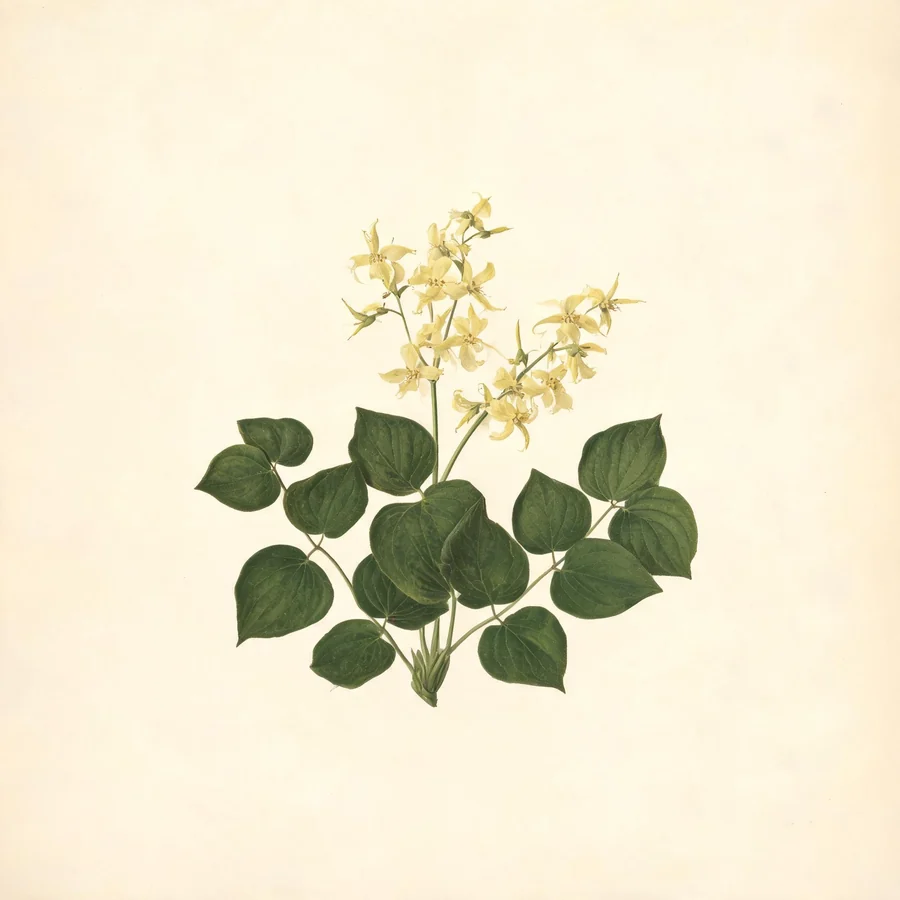
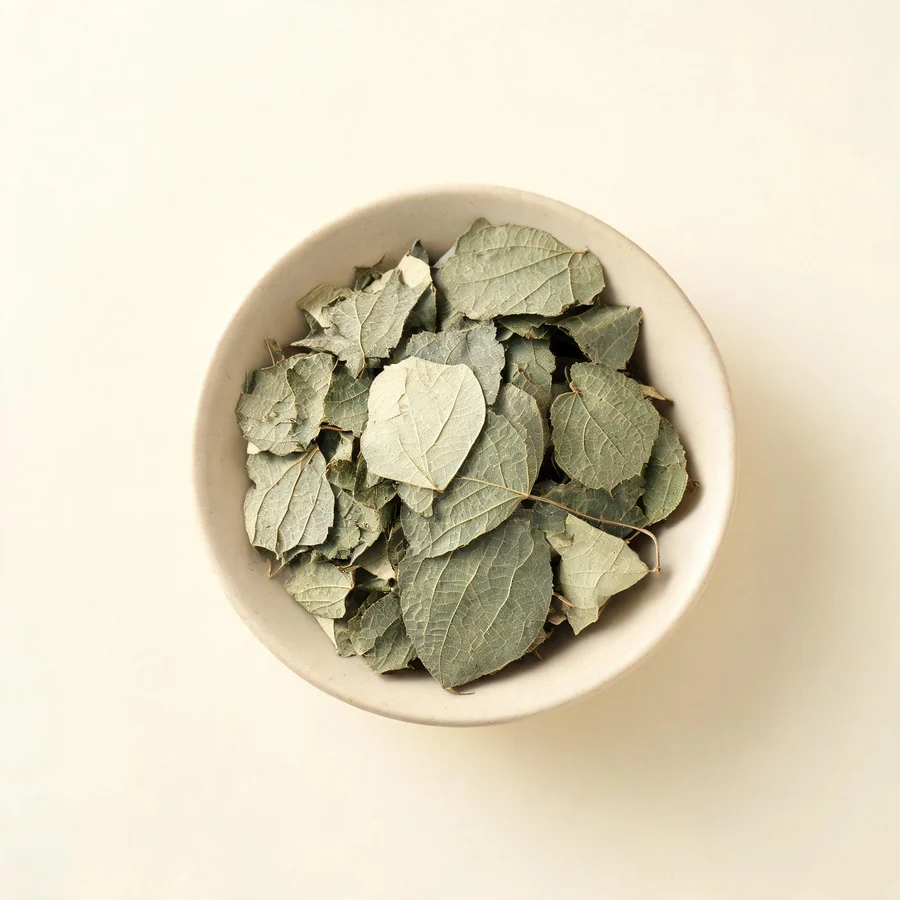
Skin profile
Where this herb sits in skin practice: the pattern it corrects, the skin signs it suits, and what it should not be used for.
Yin Yang Huo is a warming base for skin that has gone cold and pale: cold hands and feet, fingers that change colour in the cold, winter chilblains and patches that have lost their colour in a depleted person. It is not a surface herb, it does nothing for a red or weeping lesion, and its hormonal activity is the reason it is avoided in pregnancy and in hormone sensitive conditions.
Skin signs that suggest it
- Hands and feet that are cold all year, with pale or waxy skin and slow warming after coming indoors
- Fingers that turn white, then blue, then red in the cold, with numbness or tingling, the Raynaud sequence
- Red purple, swollen and itchy toes or fingers in cold damp weather, recurring every winter
- Patches of skin that have lost their colour, with no scale and no redness, in a person with cold limbs and a weak low back
- A pale, swollen tongue with a moist coat, a deep weak pulse at the kidney position, and cold knees with an aching low back
When it is not the right herb
Not for red, hot, inflamed or weeping skin, and not for acne, rosacea, seborrhoeic dermatitis or any lesion with heat in it, since a warming tonic feeds that kind of eruption. It is wrong in Yin deficiency with empty heat: sweating at night, heat in the palms and soles, afternoon flushing, a red tongue without coating and thirst, where the warmth consumes fluid that is already short. It is wrong in damp-heat and in excess fire, including a person with a red face and strong sexual desire, where it can produce headache, dizziness, nosebleed and agitation. It is avoided in pregnancy, in children, in breastfeeding and in hormone sensitive conditions, and it is not a supplement for a healthy young person. A cold white finger or a chronic ulcer needs a diagnosis before it is treated as Yang deficiency.
What it does for skin
Skin-relevant actions only. Each one describes a mechanism in TCM terms and what it looks like on the skin.
Warms the Kidney so the surface is supplied
The older texts place the body's warmth in the Kidney and treat a cold, pale periphery as a failure of that source rather than as a local problem. The leaf is given to warm the source over weeks, and the change is seen first in the hands, the feet and the colour of the skin. A lesion that was indolent begins to granulate only after that, and it is a slow action that does not substitute for treating an infected or an ischaemic lesion.
Strengthens the sinews and bones that support the skin
The Kidney rules bone and the Liver rules sinew, and since the leaf reaches both channels, weakness of structure is met from two directions. On the skin the visible result is a surface that fills out and holds its shape, and a person who can stand and walk without the skin of the legs breaking down. This is the traditional reasoning behind its use in the fragile skin of later life, and it is a supporting action rather than a cure for bone loss.
Scatters Wind-Dampness that has settled into cold tissue
Aching that is worse in damp cold weather, with stiffness and a cold feeling in the limb, is read as Wind-Dampness lodged in tissue that is too cold to resist it. The leaf dries and warms, and it also strengthens the Kidney and Liver that failed to resist the invasion. That is why it suits a chronic case in a depleted person rather than an acute hot swollen joint.
Restores colour to skin that has lost its supply
A pale patch with no scale, in a person whose limbs are cold and whose low back aches, is read as the surface not being reached rather than as a disease of the pigment. The leaf is used inside a Kidney tonifying formula for that picture, over months, and the response is slow and partial. Vitiligo has several patterns and a strong autoimmune component, and any patch that is spreading or changing needs a dermatological opinion.
Skin conditions it is used for
Mapped to the condition pages on this site. The pattern column shows what the skin is doing when this herb is the right choice.
| Condition | Pattern | Why it suits | Typical setting |
|---|---|---|---|
| Chilblains | Deficient Yang failing to warm the extremities in cold damp weather | Recurring red purple, itchy or painful toes and fingers in winter are read as cold that has lodged where the Yang is too weak to push it out. The leaf warms the Kidney, scatters the cold and moves blood at the edge, and it is given for weeks before the cold season rather than only during an attack. Keeping the feet warm and dry does more in the short term, and a chilblain that ulcerates or becomes infected needs treatment. | Within a warming formula with Gui Zhi and Dang Gui, such as a modified Dang Gui Si Ni Tang |
| Frostbite | External cold overcoming the Yang, with freezing of the small channels | Frostbite is a contest between outside cold and inside Yang, and the stage of the injury decides the treatment. The leaf belongs to recovery and prevention in a person whose Yang is plainly deficient, not to the acute rewarming of frozen tissue, which is a medical matter. It is given once the tissue has been assessed and the risk of further cold injury is understood, and it does not restore tissue that has already died. | Within a warming and blood-moving formula during recovery, under supervision |
| Raynaud's Disease | Qi and Blood failing to reach the fingers, with Yang deficiency | The white, blue and red sequence of an attack is read as blood being driven out of the fingers and then returning, and the pattern describes why the supply fails. Where coldness, a weak low back and a deep pulse point to Yang deficiency, the leaf warms the source and is combined with herbs that move blood to the extremities. It is a supporting herb. Attacks are managed by warming and by avoiding triggers, and the distinction between primary and secondary Raynaud matters, since the secondary form can accompany a connective tissue disease. | A modified Dang Gui Si Ni Tang with Huang Qi and Dan Shen |
| Vitiligo | Liver and Kidney insufficiency, with the surface no longer supplied | Vitiligo is read as a failure of supply rather than a surface problem: pigment is lost where Qi and Blood no longer reach. The pattern that fits the leaf is that of a depleted, cold person with a weak low back and a pale tongue, and it is treated with a Kidney tonifying formula over months. No herb reliably restores pigment, sun protection matters, and a spreading patch should be assessed by a dermatologist rather than treated with a tonic alone. | Within a Kidney tonifying formula with Bu Gu Zhi, Gou Qi Zi and Dang Gui |
| Cool Or Clammy Skin Sensation | Yang deficiency with cold: the surface not warmed from the centre | Skin that feels cold to the hand, with cold limbs, a pale face and a deep weak pulse, is the Yang deficient surface. The leaf warms from the centre outwards over weeks and is combined with herbs that warm the channels. Cold clamminess with chest pain, breathlessness or profuse sweating is a different matter altogether and is a medical emergency. | Within a warming formula with Ren Shen and Rou Gui |
Combinations for skin
Herbs it is paired with when the skin, not an internal organ, is the target.
| Partner | Ratio | Why the pair is used |
|---|---|---|
| Xian Mao | 9 to 12 g Yin Yang Huo with 6 to 9 g Xian Mao | Two herbs nicknamed the two immortals, and the reasoning behind them is balance: curculigo runs hotter and dries dampness, while the leaf warms without scorching, so together they heat the body strongly without drying up its fluids. The combination suits cold limbs, a cold low back and a mixed hot and cold picture in a depleted person, and it is one of the few warming pairs that can be continued into the warmth of spring. |
| Ba Ji Tian | 9 to 12 g each | Both warm the Kidney and strengthen the sinews and bones. Ba Ji Tian adds a stronger Qi moving quality, while the leaf adds the Wind-Dampness action. The pair is used for a cold, aching low back and legs with skin that is thin and slow to heal, and the proportion keeps them equal rather than piling one on the other. Neither is a treatment for an acute injury. |
| Dang Gui | 6 to 9 g Yin Yang Huo with 10 to 15 g Dang Gui | The leaf warms and moves, and Dang Gui builds and moistens the Blood that the warmth is meant to carry, so the pair addresses a cold periphery in a person whose blood is thin. It is the pairing behind the use of the herb in chilblains and in cold, dusky skin, and the Dang Gui is deliberately the larger share so that the warming does not use up what little blood there is. |
| Huang Qi | 9 g Yin Yang Huo with 15 to 30 g Huang Qi | Huang Qi drives Qi and Blood towards the surface and the limbs, and the leaf warms the Kidney so that the drive has a source behind it. The pair is used for slow healing skin, indolent ulcers and the dusky, under-supplied edge of a limb, and the root is in the larger share because the work is to deliver rather than to warm. A chronic ulcer still needs pressure relief, dressing and a circulation check. |
Formulas where it leads
- Er Xian Tang (二仙汤) - The two immortals decoction, with Xian Mao, Yin Yang Huo, Ba Ji Tian, Huang Bo, Zhi Mu and Dang Gui: warming herbs and cooling herbs together for the menopause, where cold limbs and a low back ache coexist with flushing and night sweats. It is the clearest illustration of the leaf's role in skin practice, which is to warm a deficient centre without adding to the heat already showing on the face and chest. It is given over weeks and is not used where heat is the whole picture.
Safety for skin use
What to check before recommending or using it, including the cautions that matter most for skin patients.
Do not use, or use with caution
- Yin deficiency with empty heat: a parched mouth, heat in the palms and soles, sweating at night, flushing and a red tongue without coating. A warming Yang tonic consumes the fluids that are already short.
- Damp-heat or excess fire in the skin: red, greasy, weeping or pustular lesions, and a red face with a bitter taste, where warmth adds to what is already too much.
- Pregnancy and breastfeeding: the leaf is avoided in pregnancy, and its icariin content shows hormonal activity in laboratory work, while whether it reaches milk in a relevant amount is unknown.
- Hormone sensitive conditions and hormone therapy: the laboratory signal of both oestrogen and androgen type activity means it should not be combined with hormone replacement or anti oestrogen treatment, or used in a hormone sensitive tumour, without the cancer team knowing about it.
- Children before puberty, except under a paediatric practitioner, since it warms Yang and acts on hormones, and its uses belong to adults.
Pregnancy and breastfeeding
Avoided. The warming and moving quality could disturb the stability of a pregnancy, and the main flavonoid, icariin, has acted like oestrogen and like androgen in the laboratory, which raises a theoretical worry about how hormones develop. There are no adequate human safety data, so avoidance is the position, and the same applies while breastfeeding, where the hormonal flavonoids could in principle reach the milk. A topical preparation is not a safe substitute, since the flavonoids are absorbed through skin.
Interactions
- Drugs for erectile dysfunction: icariin weakly blocks the enzyme that sildenafil and tadalafil target, so blood pressure may fall further and headache and flushing may worsen if the leaf is taken with either drug. Layering the two is best avoided.
- Blood pressure medicines: in animal and small human studies the leaf opens peripheral vessels and brings pressure down, so blood pressure needs watching on treatment for hypertension instead of a set dose.
- Glucose lowering medicines and anticoagulants: a glucose lowering signal has appeared in some studies, so readings should be watched if it is taken with insulin or a sulfonylurea, and the flavonoids affect platelet behaviour, so a possible bleeding risk with heparin, warfarin or antiplatelet drugs should be raised before starting.
Allergy and patch testing
Genuine allergy is rarely reported, and the practical risk is the product rather than the plant. More than fifty species exist in the genus and only four are official, and the leaf is routinely replaced by unofficial relatives, so a reaction may be to what the packet contains. Plant contact can irritate sensitive skin, and a topical product should be patch tested. Stop if a rash, itch or swelling appears and have the material identified.
General safety references
General references for herbal hepatotoxicity and herb-drug interactions; they are not specific to this herb.
- Review article: Herbal hepatotoxicity - an update on traditional Chinese medicine preparations. Alimentary Pharmacology & Therapeutics, 2014. PMID: 24844799.
- Interactions between herbal medicines and prescribed drugs: an updated systematic review. Drugs, 2009. PMID: 19719333.
- Warfarin and food, herbal or dietary supplement interactions: a systematic review. British Journal of Clinical Pharmacology, 2021. PMID: 32478963.
Evidence
The classical record is quoted with its source. The modern note states the level of evidence plainly.
Classical record
The oldest notice is brief and bodily: impotence and grave injury, pain inside the urethra, free passage of urine, more strength and a settled will. Being put in the middle grade and not the top one marks something taken for a reason rather than every day, and the sexual use appears at the outset.
Shen Nong Ben Cao Jing (Divine Husbandman's Classic of Materia Medica), middle grade - The passage is one line only, and the rendering given here is plain on purpose. Nothing in the oldest record mentions the skin; the link is the warming of a cold surface.
A working list rather than a theory: cold wind and fatigue, cramping and stiffness in sinew and bone, and numb limbs on all four sides, and support for the low back and the knees.
Ri Hua Zi Ben Cao (Materia Medica of Ri Huazi), Song dynasty - The numbness of the limbs is the line that reaches the skin, since numbness is a surface sign of warmth and blood not arriving.
For Chen Shiduo the leaf nourishes the gate of vitality and does not turn fiercely hot, which in his view leaves it more useful than cinnamon bark for that job.
Ben Cao Xin Bian (New Compilation of Materia Medica), Chen Shiduo - This is a practitioner's judgement, not a drug claim, and it is why the leaf suits months of use in cold, dry skin.
Modern evidence
Evidence status
- Laboratory work on icariin and related flavonoids reports effects on bone forming and bone resorbing cells, on blood flow and on inflammatory signalling, mostly in cell and animal models. That is a plausible basis for the traditional bone and circulation uses, not evidence that the leaf treats a skin condition.
- Small human studies of epimedium preparations in bone loss and in sexual function have been published, largely in Chinese, but no controlled trial in chilblains, Raynaud phenomenon, vitiligo or cold skin was identified. The supplement market makes claims well beyond this literature.
- Quality is part of the evidence question. More than fifty Epimedium species grow in China, four are official, and the official species are frequently replaced in trade, so the icariin content of a product can be far from what the label states. Regulatory status: the leaf is an accepted article in the Chinese Pharmacopoeia.
PubMed records
Selected real PubMed records for this herb's species or its constituents, chosen by species name and title relevance. They are references for the non-TCM discussion above, not proof that the herb treats any skin condition.
- Safety Evaluation of Natural Drugs in Chronic Skeletal Disorders: A Literature Review of Clinical Trials in the Past 20 years.. Frontiers in pharmacology, 2021. PMID: 35095508 (safety record).
Dose and forms
Skin-practice dosing and the preparations that suit skin complaints.
| Form | Dose and notes |
|---|---|
| Decoction | 3 to 10 g of dried leaf a day for skin support, inside a formula. Nine to 15 g is used for pronounced cold deficiency, under supervision. |
| Course length | Six to twelve weeks, running through the cold season where that is the trigger, with review. Stop if a dry mouth, irritability, dizziness or a nosebleed appears. |
| Prepared forms | The leaf fried in sheep tallow is the form chosen for Kidney Yang work, since the fat contributes warmth and softens the acrid, dispersing nature. For reaching the channels and driving out Wind-Dampness, the wine preparation is used instead. |
The warming, not the toxicity, sets the limit: a parched mouth, sore throat, irritability, dizziness or bleeding from the nose mean this person has had enough, and the answer is to stop, not to carry on at a reduced dose for ever. Processing shifts where the emphasis lies rather than how much is given, with the tallow preparation preferred for Kidney Yang work and the wine preparation when the aim is to reach the channels. There is no special handling: it is boiled with the rest of the formula.
Citations and further reading
Only real sources are listed: the classical materia medica passages quoted above, and the source works behind the botanical and safety statements.
- Shen Nong Ben Cao Jing (Divine Husbandman's Classic of Materia Medica), attributed compilation of the Han period - the middle grade entry is summarised above.
- Ri Hua Zi Ben Cao (Materia Medica of Ri Huazi), Song dynasty - the list of sinew, bone and limb uses is summarised above.
- Ben Cao Xin Bian (New Compilation of Materia Medica), Chen Shiduo, Qing dynasty - the judgement on the gate of vitality is summarised above.
- Herba Epimedii monograph, Pharmacopoeia of the People's Republic of China - the accepted species, the part used and quality requirements.
- Botanical literature on the genus Epimedium, Berberidaceae - the number of species and the extent of substitution in trade.
- Modern evidence statement: based on published laboratory work on icariin and on small clinical studies of the leaf, stated as a level of evidence rather than as a cited finding.
Educational reference for qualified practitioners. This page is not medical advice, and skin conditions should be diagnosed by a clinician before treatment.