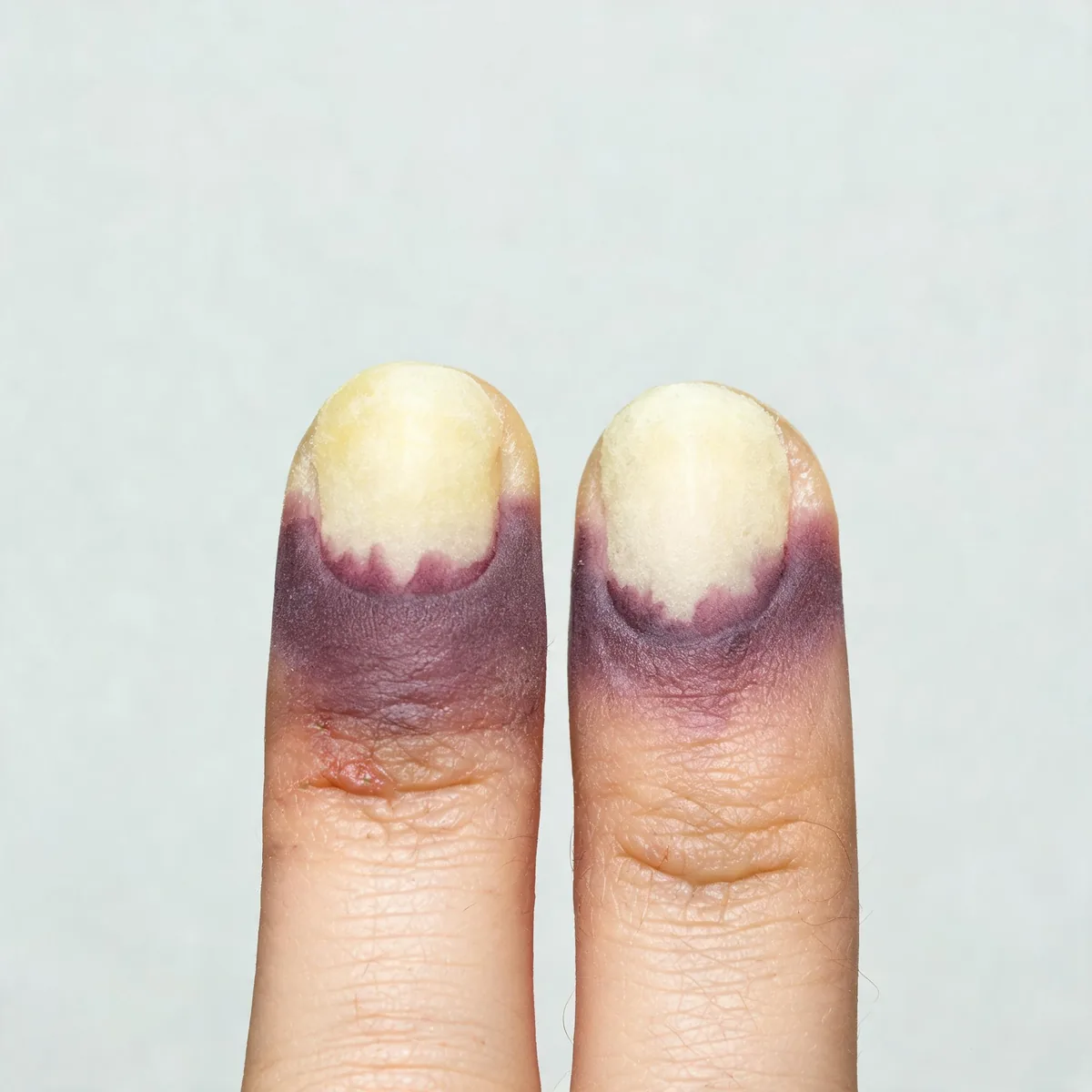
Understanding Frostbite
Note a source collision recorded rather than resolved: this page and the Chilblains page both carry the Chinese name 冻疮 (dòng chuāng). The two pages describe different severities of cold injury and are kept separate.
The tradition describes frostbite as a battle between external cold and the body Yang Qi that keeps blood moving and tissue alive. When cold penetrates the fingers, toes, ears or nose, it freezes the channels and the tissue loses its supply.
The first pattern is cold invading the channels: pale or purplish-blue skin, cold to the touch, numb and tingling, painful in cold and eased by warmth, with swelling but no ulceration. Toxic-Heat stagnation describes the infected frostbite lesion, with pus, throbbing pain and fever.
Qi deficiency causing Blood stagnation gives non-healing frostbite sores that stay open for weeks with dull fixed pain and fatigue. The last pattern is Collapse of Yang: ice-cold limbs extending past the elbows and knees, cold sweating, loss of consciousness and a grey complexion. That is a medical emergency, not a herbal one.
Cold is the pathogen that starts everything here. When it settles into the channels of the fingers, toes, ears or nose, it congeals Qi and Blood, and the tissue that depends on them loses both movement and warmth. The first sign is a patch that turns pale or purplish-blue, feels icy and goes numb, and the defensive Qi that should have held the surface has plainly been overwhelmed. What follows depends on how deep the cold has gone and on the constitution it met.
A strong person with good Qi may end up with nothing worse than a swollen, itching, painful lesion that recovers once warmth returns. Where the cold lingers, or where Yang was weak to begin with, the stagnant blood may turn into heat, and the lesion becomes red, hot and ulcerating, which is a toxic-heat complication laid over a cold injury. Chronic deficiency produces a different problem: Qi so weak that blood barely reaches the extremities, so mild cold is enough to bring back purple sores that take weeks to close. At the extreme, cold overwhelms the Yang of the whole body, the limbs go cold past the elbows and knees, the pulse fades and consciousness goes, and that is a medical emergency rather than a matter for herbs.
Conventional view
Frostbite is a cold injury in which skin and the tissue beneath it freeze after prolonged exposure to freezing temperatures. Mild forms, often called chilblains or pernio, produce red, swollen, itchy patches on the fingers, toes, ears or nose. More severe frostbite causes blistering, numbness and tissue death that may require amputation. Diagnosis is clinical, based on the appearance of the skin and a history of cold exposure, and the immediate priority is to remove the person from the cold and assess the depth of injury.
Standard care is gentle rewarming in a warm water bath, never by rubbing the area, followed by dry sterile dressings and elevation to reduce swelling. Pain is managed with ibuprofen or stronger analgesia, blisters are left intact where possible, and topical or oral antibiotics are used if infection develops. Deep frostbite is treated in hospital, where intravenous vasodilators, thrombolytic therapy to restore blood flow or surgical debridement of dead tissue may be needed. Surgery is often deferred, because tissue that looks lost may still recover.
What conventional treatment does well is save tissue in the acute phase. What it does not explain is why one person develops a severe injury after brief exposure while another does not, or why some lesions linger for weeks and return every winter. Creams and vasodilators help the local problem but do not correct the underlying tendency towards poor circulation and cold sensitivity. TCM reads recurrent frostbite as a sign of deeper Qi or Yang deficiency and treats that root while the local injury heals.
Selected PubMed records
Real PubMed records for the conventional discussion above, selected by condition name and title relevance. They are references, not a claim that any treatment is proven for this condition.
- Wilderness Medical Society Clinical Practice Guidelines for the Prevention and Treatment of Frostbite: 2024 Update.. Wilderness & environmental medicine, 2024. PMID: 38577729.
How it connects
Frostbite rarely appears alone: it is almost always accompanied by a deep aversion to cold and icy, numb extremities. In TCM that is not a coincidence but the direct result of Cold invading the channels and congealing Blood, since the same pathogenic Cold that damages the skin also constricts the vessels in the limbs and produces the coldness and numbness patients describe. When Cold persists and Blood stasis deepens, the numbness can become fixed and the area may feel heavy or wooden. This is why arm numbness and aversion to cold with cold limbs are the most common companions, and warming the channels and moving Blood often resolves all three together.
How it is assessed
Diagnosis is about depth and viability: how far the cold injury has gone.
What a practitioner looks for
- Colour and sensation: pale or blue skin with numbness suggests cold in the channels; blackened hard skin suggests tissue death.
- Stage: swelling without ulceration is earlier; pus and fever indicate infection.
- Healing: sores open for weeks with fatigue suggest Qi deficiency with stagnation.
- Red flags: cold limbs beyond the elbows and knees with confusion suggest collapse of Yang and need emergency care.
The practitioner begins with depth, because frostbite is assessed by how far the injury has travelled. A purple or bluish patch that is cold and numb, with swelling but no break in the skin, a pale tongue with a thin white coat and a deep tight pulse, describes cold in the channels and is the earliest and most reversible picture. When the same area turns red, hot and swollen and begins to weep pus, with thirst, feverishness, a yellow coating and a rapid pulse, the stagnant blood has transformed into heat and toxin.
Sores that stay open for weeks, with dull fixed pain and a tired pale person whose pulse is weak and thready, point instead to deficiency, where repair never receives the resources it needs. The last picture is unmistakable: cold limbs extending past the elbows and knees, cold sweating, an ashen white face, blue lips and a pulse so faint it can barely be felt. That is collapse of Yang, and it needs an ambulance rather than a consultation.
TCM patterns in Frostbite
Frostbite is differentiated by stage, because the same injury changes character. Cold still dominates where skin is pale or bluish, icy, numb and tingling, painful in the cold and easier with warmth, swelling without redness: that is cold in the channels. The second question is whether heat has replaced cold. A lesion that has turned red, hot and swollen, with pus, throbbing pain, fever and thirst, has become toxic-heat stagnation, and treatment reverses from warming to cooling. Sores open for weeks, dull pain worse on pressure, fatigue and a dusky complexion say that Qi is too weak to move blood outward, so the approach shifts to tonifying. The fourth is the emergency: ice-cold limbs past the elbows and knees, cold sweats and ashen colour mean Yang is collapsing. Reading them in order, and again as the lesion changes, keeps treatment matched to the stage.
| Pattern | Key signs | The itch | Tongue | Main formula |
|---|---|---|---|---|
| Cold invading the Channels (Joints and Muscles) | Skin pale or purplish-blue; Pain worse in cold and eased by warmth | Not specified | Body: Pale, moistCoat: Thin white | Not specified |
| Toxic-Heat Stagnation | Red hot swollen frostbite lesion; Throbbing burning pain | Not specified | Body: Deep red or crimson with raised red pointsCoat: Thick, dry and yellow | Not specified |
| Qi Deficiency causing Blood Stagnation | Dull fixed pain worse with pressure | Not specified | Body: Pale-dark or pale-purple, teeth-marked, possibly with stasis spots and dark sublingual veinsCoat: Thin white | Not specified |
| Collapse of Yang | Not specified | Not specified | Body: Pale, moist and flaccidCoat: Thin white and slippery | Not specified |
Cold invading the Channels (Joints and Muscles)
The early reversible injury: pale blue skin, cold, numb and painful in cold.
External cold entering the skin and the channels congeals Qi and Blood, and the first thing that follows is constriction. Circulation to the fingers and toes falls away, so the skin goes pale or purplish-blue, is icy to the touch and loses sensation. As stagnant blood accumulates, swelling and a deep ache appear, but there is no redness, no heat and no ulceration, which is what marks this as the early and still reversible stage.
The tongue is pale under a thin white moist coat, and the pulse is tight and wiry, sometimes floating or slow. Cold and damp weather, inactivity and tight shoes or clothing make it worse, while warmth, gentle movement, warm compresses and warm drinks make it better. Dang Gui Si Ni Tang is the formula named, with Gui Zhi, Dang Gui and Xi Xin, and LI-4 Hegu, ST-36 Zusanli and SP-10 Xuehai are the points.
Signs
- Skin pale or purplish-blue
- Area cold to touch
- Numbness and tingling
- Pain worse in cold and eased by warmth
- Swelling without redness
Diet and lifestyle for this pattern: Keep affected areas warm with dry clothing and avoid sudden rewarming in hot water. Eat warm cooked food such as soups and stews with ginger and cinnamon, keep moving gently to encourage circulation, and stay out of extreme cold.
Toxic-Heat Stagnation
The infected frostbite lesion with pus and fever.
When frostbite is left long enough, the blood stasis that cold created begins to obstruct the movement of Qi, and obstruction that persists generates heat. The lesion turns red, hot and swollen, the tissue may break down and pus appears, while thirst, feverishness, restlessness and dark scanty urine show that the heat has become systemic rather than staying in the skin.
The tongue is deep red or crimson with prickly papillae under a thick dry yellow coat, and the pulse is rapid and forceful, sometimes overflowing. Spicy and greasy food, alcohol, direct heat on the lesion, stress and exhaustion aggravate it, and cool compresses, rest with the area raised, cooling food and cleanliness ease it. Si Miao Yong An Tang is the formula named, with Jin Yin Hua, Xuan Shen, Dang Gui, Pu Gong Ying and Ru Xiang, and SP-10 Xuehai, PC-7 Daling and ST-36 Zusanli are the points.
Signs
- Red hot swollen frostbite lesion
- Pus or purulent discharge
- Throbbing burning pain
- Fever with intense thirst
- Restlessness and irritability
Diet and lifestyle for this pattern: Avoid spicy, greasy and heating food such as chilli, garlic and alcohol, and eat cooling, detoxifying food such as mung beans, pear and cucumber. Keep the affected area clean and dry to prevent infection, avoid applying heat directly to the lesion, and use gentle cooling compresses if tolerated while still protecting it from further cold.
Qi Deficiency causing Blood Stagnation
Non-healing frostbite sores with fatigue.
Weak Qi cannot drive blood through the small vessels of the hands and feet with any force, so cold settles easily into tissue that is already poorly nourished. The blood that does arrive pools and turns purplish, and because the repair process never receives enough material, the sore stays open, heals slowly and gives a dull pain rather than a sharp one.
The tongue is pale and tinged dark or purple, perhaps spotted with purple or marked by the teeth; the coating is thin and white, and the pulse feels choppy, fine and deep. Cold and damp weather, overexertion, cold food and tight footwear make it worse, while warm soups and stews, gentle movement, warmth, shelter and sleep make it better. Ba Zhen Tang is the formula named, often modified with Gui Zhi and Ji Xue Teng, with Dang Gui, Huang Qi, Chuan Xiong and Hong Hua, and ST-36 Zusanli, SP-6 Sanyinjiao and SP-10 Xuehai as points.
Signs
- Non-healing frostbite sores open for weeks
- Dull fixed pain worse with pressure
- Persistent fatigue and weakness
- Pale or dusky greyish complexion
Diet and lifestyle for this pattern: Eat warm cooked food such as stews, soups with ginger and congee, and avoid raw, cold and iced items that further chill and weaken digestion. Gentle daily walking or qigong helps Qi move Blood to the hands and feet, and keep affected areas warm in loose wool or cotton without sudden intense heat such as a hot water bottle on numb skin.
Collapse of Yang
The emergency picture: ice-cold limbs with collapse.
In the most severe injury the cold is large enough to drain the body's core Yang, the warmth on which every function depends. Blood congeals within the vessels, the limbs lose their heat past the elbows and knees, and the spirit withdraws into apathy or unconsciousness, and the injury stops being local: it becomes a sign that the internal fire is nearly out.
The tongue is pale, moist and flaccid under a thin white slippery coat, and the pulse is minute and on the point of vanishing. Cold exposure, cold food and drink, exhaustion and rubbing or massaging frozen tissue all push the person further down, while warmth, shelter, warm drinks and rest protect what remains. Si Ni Jia Ren Shen Tang is the formula recorded, with Zhi Fu Zi, Ren Shen and Gan Jiang, and moxibustion at REN-4 Guanyuan, DU-14 Dazhui, ST-36 Zusanli and SP-6 Sanyinjiao. This pattern is an emergency, and hospital care comes first.
Signs
- Ice-cold limbs extending past elbows and knees
- Profuse cold sweating
- Loss of consciousness or extreme apathy
- Ashen-white or greyish complexion
- Blue or purple lips and fingertips
Diet and lifestyle for this pattern: This is a medical emergency. While waiting for help, keep the person warm with blankets, offer warm ginger tea if they are conscious, and never rub or massage frozen limbs. Once stable, a diet of warm cooked food such as lamb stew, congee with ginger and cinnamon tea helps gradually rebuild Yang.
Treatment approach
How the tradition treats frostbite, with the herbs, formulas and points used for it.
Principles
- Rewarm gently and medically; rapid rewarming is the medical standard and should not be improvised.
- Warm the channels and move Blood where the injury is superficial and reversible.
- Clear heat and resolve toxicity where infection has set in.
- Treat collapse of Yang as an emergency, not as a pattern for herbs.
- The root strategy is warmth and movement, but what sits underneath it changes with the stage. Cold in the channels is warmed and dispersed; toxic heat is cleared and resolved even though the injury began with cold; deficiency is tonified so that blood has the force to reach the periphery; and collapse of Yang is rescued rather than treated. The formula follows that order, which is why Gui Zhi and Dang Gui lead in the early stage while Jin Yin Hua and Xuan Shen lead once pus has appeared.
Herbs used
Formulas
Acupoints
- LI-4 (Hegu)
- ST-36 (Zusanli)
- SP-10 (Xuehai)
- PC-7 (Daling)
- SP-6 (Sanyinjiao)
- guanyuan-ren-4
- DU-14 (Dazhui)
What to expect
- Superficial cold injury is described as recovering over one to two weeks with warmth and care.
- Deep injury may leave lasting sensitivity or tissue loss even with treatment.
- Do not rewarm with direct high heat, which can cause further damage.
- The first week usually brings less pain and less itch, and the colour begins to normalise. If the lesion has become infected, discharge may increase briefly before it settles, which is expected rather than a setback. Recurrent winter chilblains and slow-healing deficiency sores are measured over months, and the real test is the following cold season: hands and feet that stay warmer, and lesions that either fail to appear or arrive much milder.
Safety and when to get help
Seek medical help urgently for
- Skin that turns black or hard and completely numb, which may be tissue death.
- Spreading redness, heat and pus with fever.
- Cold limbs with confusion, sweating and collapse - an emergency.
For anything severe, sudden or spreading quickly, read when a skin problem needs urgent care.
Cautions
- Do not rub or massage frozen tissue, and do not use direct high heat.
- Rewarming should be done properly, ideally with medical guidance.
- Protect the injured area from pressure and cold afterwards.
Using this alongside conventional care
- TCM is described as complementary to conventional care: medical rewarming and wound care come first, with herbs for the superficial and recovery phases.
- For mild chilblains, herbs and acupuncture can carry most of the treatment while the skin is protected. Deeper injury is a different order: rewarming, wound care and antibiotics come from the medical team, and TCM is added afterwards to speed healing and reduce the chance of another winter. Blood thinners are the main interaction to flag, since several blood-moving herbs have mild anticoagulant effects. Where tissue has died or infection is spreading, hospital care comes first and herbs wait.
Diet and lifestyle
- Favour warm cooked food and warm drinks, and avoid cold food and alcohol, which the classical literature says to avoid because it dilates vessels then loses heat.
- Warm, cooked and generous is the baseline: ginger tea, porridge with cinnamon, root vegetables and slow-cooked lamb or chicken, with nothing taken straight from the fridge and no iced drinks. Where heat and infection have taken hold in the lesion, the advice reverses for as long as they last, and cooling food such as mung bean soup, cucumber and watermelon replaces the warming dishes, with alcohol and spicy food removed until the inflammation clears.
If you're pregnant
Treatment in pregnancy is modified so that the fetus is protected. Hong Hua and Tao Ren move Blood strongly and are avoided, since both can provoke uterine contractions, and the warming herb Fu Zi is contraindicated. For cold in the channels, Dang Gui Si Ni Tang may be considered cautiously, with less Dang Gui and no Xi Xin, or replaced by warm compresses and moxibustion at a safe point such as Zusanli ST-36. Acupuncture is often the safer route, leaving the lower abdomen and lumbosacral area alone and using LI-4 and SP-6 with care in the first trimester.
If you're breastfeeding
The main concern while nursing is the bitter-cold group used for toxic-heat stagnation, since Huang Lian and Da Huang can reach an infant through milk and provoke diarrhoea or digestive upset. Milder alternatives, Pu Gong Ying and Jin Yin Hua among them, are preferred for that pattern, and herbal washes containing Huang Bai or Ku Shen clear heat topically with little absorption. Gan Jiang and Gui Zhi are both generally considered safe while nursing, and moxibustion and warm herbal soaks are low-risk options that avoid transfer to the baby entirely.
If treating a child
Children lose heat quickly and their Yang is still developing, so they are especially vulnerable. Cold in the channels is the usual presentation and tends to affect the cheeks, ears and fingers. Observation matters more than description, since a child may not report numbness, so parents and practitioners watch for pale or purplish skin, an icy touch and reluctance to move the part. Doses are a quarter to a half of the adult amount, Dang Gui Si Ni Tang is used in reduced form, and moxibustion and gentle compresses suit paediatric care. Collapse of Yang in a child is a hospital emergency.
If treating an elderly patient
Among older patients, cold injury usually reflects a Qi Deficiency that cannot push Blood out to the extremities, so the deficiency pattern with blood stasis is far commoner than in younger adults. Sores heal slowly and look dusky rather than brightly purple, alongside fatigue and breathlessness. Treatment prioritises tonifying Qi and Blood with a formula such as Ba Zhen Tang, adding warming herbs like Gui Zhi to dispel cold gently. Doses sit at about two thirds of the adult amount, aggressive warming is avoided, and points such as Guanyuan REN-4 and Zusanli ST-36 support vitality.
Urgent-sign guidance is based on standard sources: NHS anaphylaxis, NHS cellulitis, NHS Stevens-Johnson syndrome, NHS melanoma.
Evidence
Evidence status
Compiled for this page from the classical and modern literature; not a systematic review, so treat it as a pointer to sources rather than clinical guidance.
Evidence is limited to small uncontrolled trials and case series in Chinese journals. They suggest formulas such as Dang Gui Si Ni Tang and external washes with warming, blood-moving herbs improve local circulation, shorten healing and reduce recurrence, and that acupuncture and moxibustion relieve pain and numbness. Overall quality is low: most studies lack blinding, randomisation and adequate samples, and very few are published in English.
Acupuncture and moxibustion are reported to relieve pain and numbness, and external washes with warming herbs are described as shortening healing, but the studies behind these claims are few and none is a randomised trial. The practical reading is that the approach is safe alongside conventional care and plausible on historical grounds, while proof of benefit is still missing.
Studies often cited
Small uncontrolled studies report improved local circulation, shorter healing time and lower recurrence. Chinese small trials and case series (as recorded in the source)
Reported to relieve pain and numbness, with low-quality evidence. Clinical reports (as recorded in the source)
PubMed records for the TCM evidence
Real PubMed records for the TCM clinical evidence discussed above, selected by condition name and title relevance. They are references, not proof of benefit.
- The Effects of Recombinant Human Granulocyte-Macrophage Colony-Stimulating Factor Gel on Third-Degree Frostbite Wounds in Northeastern China: A Randomized Controlled Trial.. Journal of burn care & research : official publication of the American Burn Association, 2023. PMID: 32006002.
Classical record
Frostbite is caused by severe cold weather, which freezes and congeals the Qi and Blood.
- Wai Ke Zheng Zong (Orthodox Manual of External Medicine), volume on frostbite. The Chinese original is not reproduced here: it could not be recovered reliably from the source record, and is not guessed.
手足厥寒,脉细欲绝者,当归四逆汤主之。
When the hands and feet are cold and the pulse is fine and close to expiring, Dang Gui Si Ni Tang governs.
Cold hands and feet, Shang Han Lun - Shang Han Lun (Treatise on Cold Damage), line 351, recorded from the reference; the quotation is given here with its Chinese original.
Common questions
Should I rub snow on frostbite?
No. Rubbing frozen tissue causes further damage. Gentle rewarming is the correct approach.
Is frostbite the same as chilblains?
Both are cold injuries and both are called 冻疮 in this source, but frostbite describes deeper tissue injury including gangrene, while chilblains describes the superficial recurring form.
Can herbs save frostbitten tissue?
No. Tissue death needs medical and surgical assessment. Herbs are described for the superficial cold pattern and the recovery phase.
When is it an emergency?
Blackened or hard numb skin, spreading infection with fever, or collapse with cold limbs.
Can acupuncture really help frostbite?
For the cold-in-channels pattern it is one of the more useful things available. Points such as LI-4 Hegu and ST-36 Zusanli are needled to warm the channels and get blood moving again, and local points around the lesion improve circulation directly. Moxibustion adds warmth. Where heat or deficiency dominates, herbs carry more of the work.
How long does healing take with TCM?
Simple cold-stagnation frostbite often settles inside a week of starting herbs and acupuncture and is fully healed in two to three weeks. An infected lesion usually needs two to four weeks for the heat to clear and the wound to close. Slow-healing sores in a deficient person can take one to three months of steady treatment, and the aim then is to prevent the next winter.
Do I need to change my diet?
Diet supports the pattern rather than curing it. In the cold stage, warm cooked food such as ginger tea, lamb stew and cinnamon porridge helps, while cold drinks, salad and ice cream all work against it. Once heat and infection have taken hold, cooling food such as mung bean soup takes over and spicy or greasy dishes are dropped until the heat clears.