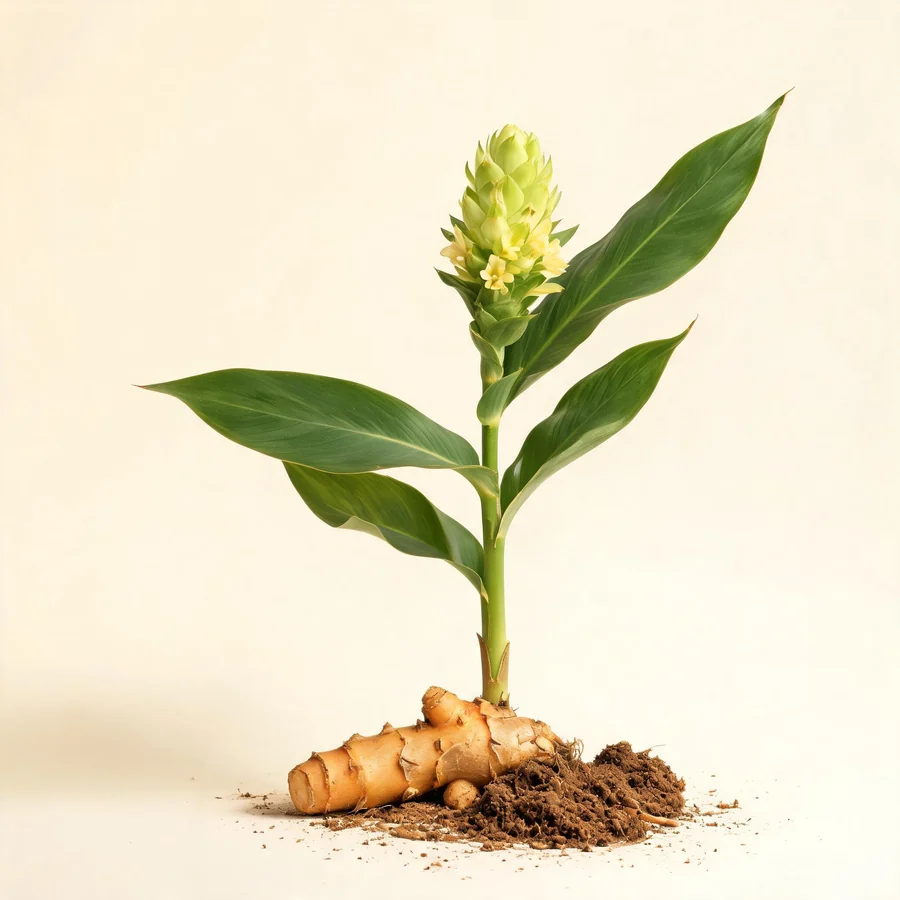
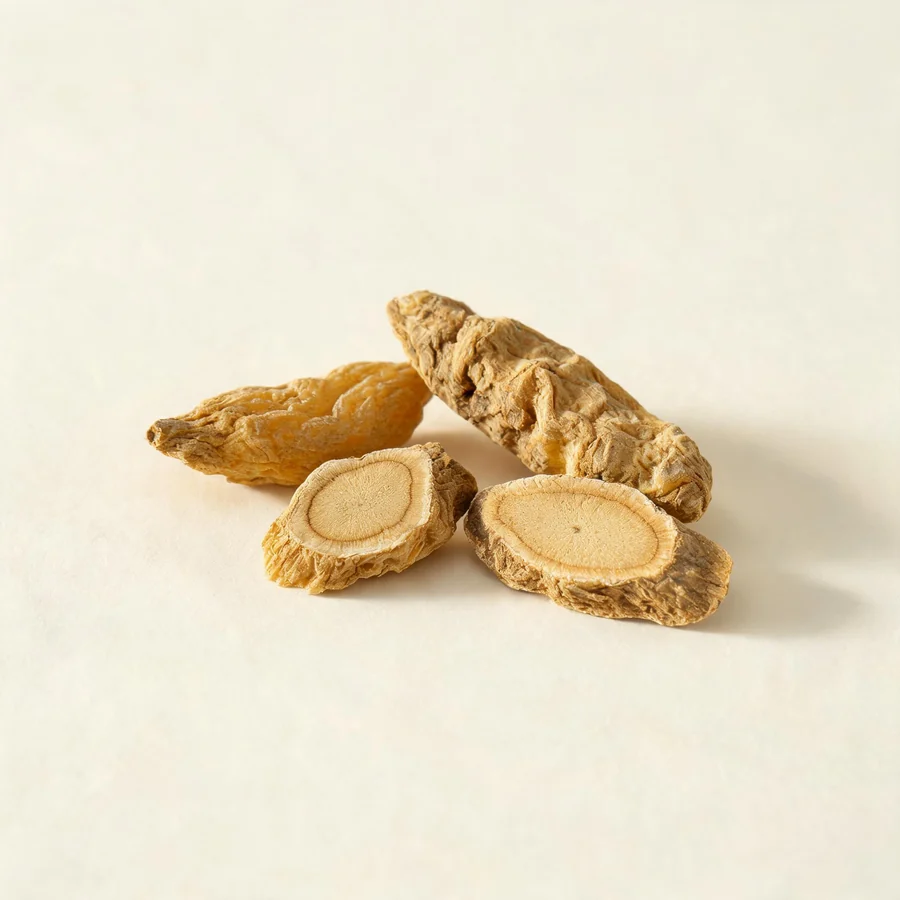
Skin profile
Where this herb sits in skin practice: the pattern it corrects, the skin signs it suits, and what it should not be used for.
Yu Jin is a blood-moving tuber with a cooling edge, and its skin work is with colour that has stopped changing: a bruise that will not fade, a facial patch that stays, a livid complexion in a constrained person. It is a supporting herb in all of those pictures, and the first thing checked is pregnancy.
Skin signs that suggest it
- Purple, dusky or brownish patches on the face that fade slowly and darken in stressful weeks
- A bruise that stays violet and tender well beyond the usual fortnight, with a fixed quality to the tenderness
- Pinpoint or blotchy bleeding into the skin in a person who is hot, restless and thirsty, with a red tongue
- A dull, livid complexion with dark rings under the eyes and a purple tongue with a dark sublingual vein
- Fixed pain in the chest or rib-side with a low mood, sighing and a wiry pulse, alongside the skin change
When it is not the right herb
Not for a fresh, red, weeping or infected lesion, and not for the hot, itchy, oozing rashes that the bitter cold drying herbs are chosen for: moving blood into inflamed tissue is the wrong direction. It is wrong for pale, dry, thin skin with no discolouration, and for a tired, thin-pulsed person, since there is no stasis to disperse and a moving herb leaves them weaker than it found them. It is avoided outright in pregnancy, and it is not combined with Ding Xiang. A bruise or a pigmented patch that is new, changing or unexplained should be assessed rather than treated.
What it does for skin
Skin-relevant actions only. Each one describes a mechanism in TCM terms and what it looks like on the skin.
Moves static blood and lifts a fixed discolouration
The lesion this tuber suits is a colour change rather than a rash: purple-brown, often sharply bordered, slow to fade and sometimes cool to the touch. Its acrid taste scatters while its bitter taste sends energy downward, so blood stagnant in the small vessels starts to move again and the colour clears. In practice it is chosen for a bruise that has organised into a long-standing tender lump, and for a facial patch that has stayed put for months, rather than for anything new and hot. It moves blood rather than making more of it, so it is paired with a nourishing herb when the person is also depleted.
Cools blood that heat is pushing out of the vessels
Where heat makes blood move too fast it leaves the vessels, and shows as petechiae, purpura or unexplained bruising, often in a person who is also restless, thirsty and feverish. Yu Jin cools the blood at the same time as it disperses what has already escaped, which is the reason it is chosen where heat has produced a purpuric rash rather than in the pale bleeding of deficiency. It is a supporting herb in that picture, given with Sheng Di Huang or Mu Dan Pi, and never a stand-alone treatment for a bleeding disorder, which needs a diagnosis before it needs a herb.
Releases Liver constraint that has tightened the flow
Constraint means Qi that is held back, and when it persists the blood beneath it stops too, which is why the facial stasis this tuber treats so often comes with a tightness across the chest, frequent sighing, a sensation of a lump in the throat and a mood that shifts from hour to hour. Because it works on both layers, it frees the Qi that began the problem and the blood that the Qi has pressed into stillness. On the skin the visible change is a dusky, uneven tone that deepens in stressful weeks and lifts in calm ones, and the treatment is measured in months rather than days.
Clears heat from the Heart and takes the flush out of the face
The tuber enters the Heart, and the face is read as a reflection of what the Heart and the vessels are doing. Where heat and constraint have produced a persistently blotchy or flushed face with palpitations, broken sleep and a red tongue, its cooling and descending action settles the fire being carried upward. It is a modest herb in this role and is given with stronger cooling herbs, so it should not be relied on as the main answer to a red face, and a fixed red plaque belongs to a different pattern altogether.
Skin conditions it is used for
Mapped to the condition pages on this site. The pattern column shows what the skin is doing when this herb is the right choice.
| Condition | Pattern | Why it suits | Typical setting |
|---|---|---|---|
| Bruising | Static blood with Qi constraint, slow to resolve | A bruise is blood that has left the vessel and stopped moving, and the tuber is chosen when the colour has settled into a fixed purple-brown that persists well beyond the expected fortnight and is tender to pressure. Its acridity disperses the congealed blood while its Qi-moving action addresses the constraint that keeps the surrounding flow sluggish, and it is given with herbs such as Tao Ren and Hong Hua in a formula rather than alone. A bruise that appears without injury, or that enlarges, needs a clinician rather than a blood-moving herb. | Modified Xue Fu Zhu Yu Tang, or with Tao Ren and Hong Hua |
| Purpura | Heat in the blood with stasis, blood leaving the vessels | Purpura is bleeding under intact skin, and the heat route to it is blood made restless by fire, so that it moves too quickly and escapes. Yu Jin is used where the spots are fresh, the person is hot and irritable, and the tongue is purple, because it cools the blood and disperses what has already leaked. It is never the leading herb in that picture, which is the territory of Sheng Di Huang and Mu Dan Pi, and it is only a support. Purpura with fever, joint pain, abdominal pain or kidney signs is a medical matter and not a prescribing one. | Modified Xi Jiao Di Huang Tang with Mu Dan Pi and Chi Shao |
| Melasma | Liver constraint with blood stasis showing as facial patches | Melasma is read as stasis written on the face, and the pattern that fits this tuber is the one where the patches deepen in stressful months and the person is irritable, sighing and low before a period. The tuber unbinds the constraint and moves the blood beneath the patches at the same time, which is why it appears in the soothing, blood-moving formulas used for chloasma rather than in the drying or toxin-clearing ones. Pigment change is slow and sun exposure matters more than any herb, so a realistic expectation is several months of treatment with daily sun protection throughout. | Modified Xiao Yao San with Yu Jin, Bai Ji Li and Hong Hua |
| Purple or dusky face | Blood not moving, with constraint and cold in the vessels | A livid, dusky or purplish face with dark rings under the eyes and a purple tongue suggests that blood is not reaching the surface properly, and this tuber is chosen when the cause is obstruction rather than shortage. It moves the blood and releases the constraint that produced the obstruction, and it is given with herbs that nourish blood where depletion is also present, so that movement does not empty what little there is. Lips or fingertips that turn blue suddenly, or a dusky face with chest pain or breathlessness, is an emergency and not a pattern to treat. | Modified Xue Fu Zhu Yu Tang, or with Chai Hu and Chi Shao |
Combinations for skin
Herbs it is paired with when the skin, not an internal organ, is the target.
| Partner | Ratio | Why the pair is used |
|---|---|---|
| Chai Hu | 6 to 10 g each | Chai Hu reaches the surface and spreads Liver Qi there, while the tuber goes deeper into the blood and clears the heat within it, so the pair releases a constraint that has already begun to press on the blood. For the skin it suits dusky facial patches that darken in stressful weeks, and it is the pairing at the heart of the formulas used for premenstrual flares. Both are dispersing, so the pair is chosen for a person with some strength rather than for someone depleted. |
| Hong Hua | 3 to 6 g Hong Hua with 6 to 10 g Yu Jin | Safflower is the warmer, more forceful blood mover and the tuber is the cooler, more Qi-oriented one, so the pair disperses a bruise or a fixed patch without the formula becoming heating. It is used where a bruise has organised into a hard tender lump, and where pigmented patches are dark and slow to fade. Safflower is the stronger of the two and sets the bleeding cautions for the pair, and neither herb is used in pregnancy. |
| Mu Dan Pi | 6 to 10 g each | Tree peony bark cools the blood and moves it at the same time, which is exactly the combination needed when static blood has begun to generate heat: the lesion is discoloured and warm, the person is irritable and the tongue is purple with red edges. The pair is used in purpuric rashes and in flushed, blotchy faces with a stasis element. Both are cooling, so the pair is kept short in a person who is cold. |
| Bai Ji Li | 6 to 10 g each | Bai Ji Li is the skin-directed Liver herb that moves Qi and blood in the face, and the tuber adds the deeper action on the blood itself. The pair is the traditional core of treatment for melasma and other facial pigmentation, given as a decoction over months. Bai Ji Li is warming and slightly drying, which balances the coldness of the tuber and makes the pair easier on the digestion. |
Safety for skin use
What to check before recommending or using it, including the cautions that matter most for skin patients.
Do not use, or use with caution
- Pregnancy. The tuber is avoided outright rather than used with caution: animal work describes preparations of it ending pregnancy at every stage, and the classical caution is severe. This applies to early pregnancy and to anyone trying to conceive.
- Deficiency without stasis. A tired, pale person with a thin pulse, no fixed pain and no patch of fixed colour has nothing for a dispersing herb to move, and the draining quality leaves them more depleted than before.
- Bleeding driven by deficiency fire, with night sweats, a dry mouth, a tongue that is red and peeled and a pulse that is thin and rapid. The coolness of the herb does nothing for the underlying loss of Yin, and its dispersing action can make the bleeding heavier.
- Ding Xiang (clove). Clove is named in the Nineteen Mutual Fears as the herb that fears Yu Jin, so the two are kept out of the same prescription, and the later formulas in which they appear together remain a matter of dispute.
- Fresh, red, weeping or infected skin. A blood-moving herb is not the tool for an inflamed, oozing surface, and adding movement to heat is the wrong direction.
Pregnancy and breastfeeding
Avoided rather than merely watched. One classical source warns against the tuber even touching the lips in pregnancy, and animal work describes pregnancy loss at every stage, with progesterone opposition and uterine stimulation the likely mechanism. The warning is therefore firmer than a non-toxic rating in the pharmacopoeia would suggest, and it covers early pregnancy and anyone attempting conception. Skin use offers no exemption: a blood-moving herb is not applied over the abdomen or the breast in pregnancy, and breastfeeding is treated with the same reserve, since how much of the curcuminoids passes into milk is not known.
Interactions
- Anticoagulants and antiplatelet medicines. The curcuminoids have anticoagulant activity in laboratory and animal work, and case reports describe INR climbing sharply when people stable on warfarin started turmeric products. Adding a blood-moving tuber to warfarin, aspirin, heparin or clopidogrel calls for coagulation monitoring and the prescriber's agreement.
- NSAIDs. They work through an overlapping anti-inflammatory route and add to stomach irritation and bleeding risk, which matters for a herb whose purpose is to move blood.
- Diabetes medicines. Curcumin is reported to lower blood glucose in some studies, so the effect could add to metformin, a sulfonylurea or insulin, though how large it is in people has not been settled.
- Narrow-therapeutic-index medicines. Laboratory work shows CYP3A4 inhibition, so levels could in theory rise, though the human significance is uncertain. Anyone on such a medicine should list the herb before starting it.
Allergy and patch testing
Sensitivity to Curcuma species is uncommon but recognised, and a reaction to one member of the ginger family makes another more likely. For skin use the warning is mostly about topical products rather than the decoction, because turmeric-based creams and pastes stain the skin and can irritate it. Patch test on normal skin for twenty-four hours before applying any preparation to a patch, keep it off broken skin, and stop at once if the area becomes redder, hotter or itchier rather than calmer.
General safety references
General references for herbal hepatotoxicity and herb-drug interactions; they are not specific to this herb.
- Review article: Herbal hepatotoxicity - an update on traditional Chinese medicine preparations. Alimentary Pharmacology & Therapeutics, 2014. PMID: 24844799.
- Interactions between herbal medicines and prescribed drugs: an updated systematic review. Drugs, 2009. PMID: 19719333.
- Warfarin and food, herbal or dietary supplement interactions: a systematic review. British Journal of Clinical Pharmacology, 2021. PMID: 32478963.
Evidence
The classical record is quoted with its source. The modern note states the level of evidence plainly.
Classical record
It treats in women the chronic pain of Blood and Qi in the heart region, and accumulations of cold Qi; it is ground and taken with warm vinegar.
Yao Xing Lun (Treatise on Drug Properties), Zhen Quan - The oldest entry for the drug, and it already links the tuber to static blood and to a vehicle chosen to carry it there. The skin reading of that is a fixed discolouration rather than a moving rash.
Yu Jin clears Qi and transforms Phlegm and disperses stagnant Blood. Its nature is light and rising, so it scatters what is bound and smooths rebellious Qi, reaching the top of the head while still moving freely in the lower burner; it is most reliable where Qi, Blood, Fire or Phlegm are held in the Heart, Lungs, Liver and Stomach.
Ben Cao Hui Yan (Collected Sayings on Materia Medica) - The fullest account of how the tuber works on Qi and blood together, and the reason it is trusted for a facial patch in which the two layers are stuck to each other rather than affected in turn.
Yu Jin is fundamentally a Qi medicine that enters the Blood division. It treats bleeding because Blood that rises wildly always follows internal Heat and flaring Fire; this herb descends Qi, and when Qi descends Fire descends, so the Blood stops moving without command.
Ben Cao Jing Shu (Commentary on the Classic Materia Medica), Miao Xiyong - This is the mechanism behind the purpura and flushing uses: cool the fire, descend the Qi, and blood that was escaping stays inside its vessels.
Modern evidence
Evidence status
- Laboratory work on the curcuminoids reports anti-inflammatory and anticoagulant activity, and animal studies describe uterine stimulation. None of it is a trial of the tuber in melasma, purpura or bruising, and activity in a dish is not evidence that a patch will fade or a bruise clear faster.
- No controlled clinical trial of Yu Jin alone in any skin condition is available to cite. What exists for facial pigmentation is small studies of multi-herb decoctions that contain the tuber among a dozen others, which cannot separate its contribution. The skin uses on this page are recorded tradition and are presented as such.
- Regulatory status: the dried tuber is an accepted herbal substance in the Chinese Pharmacopoeia, classified as non-toxic at ordinary doses, with the pregnancy warning and the clove incompatibility attached to it. Nothing on this page is a claim of proven benefit.
PubMed records
Selected real PubMed records for this herb's species or its constituents, chosen by species name and title relevance. They are references for the non-TCM discussion above, not proof that the herb treats any skin condition.
- Screening of blood-activating active components from Curcuma wenyujin Y.H. Chen et C. Ling rhizome based on spectrum-effect relationship analysis and network pharmacology.. Journal of chromatography. B, Analytical technologies in the biomedical and life sciences, 2022. PMID: 34933255 (pharmacology or review record).
Dose and forms
Skin-practice dosing and the preparations that suit skin complaints.
| Form | Dose and notes |
|---|---|
| Decoction | Three to ten grams of the dried tuber in a formula, taken as a decoction. For moving blood the usual working range is six to ten grams, and the dose is kept at the lower end in a thin or depleted person. |
| Powder | One and a half to six grams of fine powder, taken with warm water or stirred into a little ginger juice. The powder is used where the aromatic constituents matter, and it is dosed lower than the decoction because nothing is lost to boiling. |
| Course length | Six to twelve weeks for facial pigmentation, with review, because change is slow; two to four weeks for a bruise or a purpuric episode. Stop if the stool loosens, the appetite falls or the person becomes more tired. |
Vinegar processing is the traditional preparation for the constraint and pain picture, and wine processing for moving blood; neither replaces a review of the indication. The dose is set by what is being treated: a bruise or a fixed patch needs the middle of the range for a short period, while facial pigmentation is treated over months inside a broader formula and is rarely helped by pushing the dose up. Because the tuber disperses rather than builds, it is stopped once the discolouration has settled instead of being kept on as maintenance. Its curcuminoid content is why it is flagged for anyone on blood-thinning medication rather than sold as a free supplement.
Citations and further reading
Only real sources are listed: the classical materia medica passages quoted above, and the source works behind the botanical and safety statements.
- Yao Xing Lun (Treatise on Drug Properties), Zhen Quan, around 600 - classical entry quoted above.
- Ben Cao Hui Yan (Collected Sayings on Materia Medica) - classical entry quoted above.
- Ben Cao Jing Shu (Commentary on the Classic Materia Medica), Miao Xiyong - classical entry quoted above.
- Yu Jin monograph: Pharmacopoeia of the People's Republic of China - accepted botanical sources, part used, the non-toxic classification and the pregnancy contraindication.
- Nineteen Mutual Fears (shi jiu wei) - the classical list that pairs Ding Xiang against Yu Jin.
- Modern evidence statement: based on laboratory and animal literature on the curcuminoids and on small multi-herb formula studies, summarised as a statement about the level of evidence rather than as one cited finding.
- Botanical description and identification: botanical literature on Curcuma wenyujin and the related Curcuma species of the Zingiberaceae.
Educational reference for qualified practitioners. This page is not medical advice, and skin conditions should be diagnosed by a clinician before treatment.