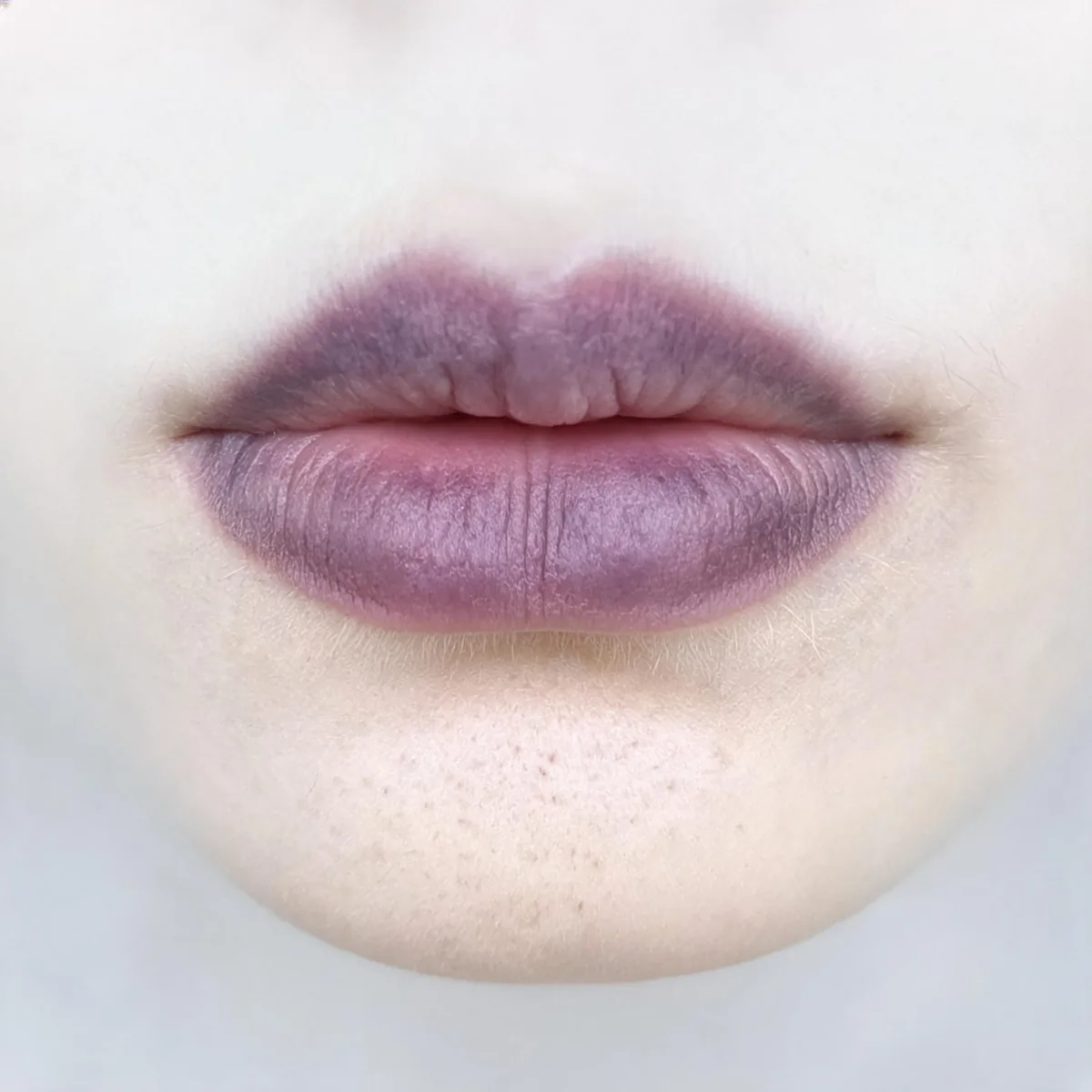
Understanding Purple face
The tradition describes the face as the mirror of the Heart and the Blood. The Heart governs the vessels; when flow is smooth the complexion is rosy, and when it is sluggish the face turns dusky or purple.
Blood Stagnation gives a dusky or purplish complexion with purple or dark lips and nails, fixed stabbing pain elsewhere, pain worse at night and dark clotty periods.
Heart Blood Stagnation gives the cardiac picture: stabbing chest pain in a fixed spot, purple lips and nails, palpitations with anxiety, and pain radiating to the shoulder, upper back or inner arm. The classical literature treats that as needing urgent medical assessment.
Qi and Blood stagnation gives a dull purplish face with distending chest or rib pain and irritability. Qi deficiency causing stagnation gives a pale-purple dusky tone with fatigue, breathlessness on exertion and fixed pain. Blood stagnation with heat gives a deep reddish-purple complexion with pain worse at night and a sensation of internal heat.
The colour is read as a report on flow. Blood that moves well carries warmth and colour to the surface, so a healthy face is bright and even. When movement slows and blood begins to collect, that same blood darkens, and skin that is thin and closely threaded with small vessels shows the change early. The shade itself carries information: a blue tinged dusky purple suggests cold and stasis, a pale purple suggests emptiness behind the pooling, and a deep red-purple suggests heat thickening what ought to flow.
What matters most here is not the tint but what is driving it, because one visible sign can sit on top of very different roots. Stagnation may follow an injury, years of cold, long held frustration, or simply too little Qi to keep blood in motion, and each of those asks for a different correction: warmth and movement, Qi support, emotional release, or cooling. That is also why a purple face is never treated as a cosmetic problem in isolation, and why a sudden change of colour, particularly with chest pain or breathlessness, is treated as a medical matter first.
Conventional view
Conventional medicine reads a purple or dusky complexion as a sign rather than a condition. It can point to poor circulation, low blood oxygen or a blood disorder, and it appears in long-standing heart and lung disease, where oxygen in the blood runs low, and in vascular problems that slow flow through the small vessels of the face. Assessment looks at oxygen saturation, heart function and blood counts, with the aim of ruling out serious underlying disease before anything cosmetic is considered.
When the colour is linked to a diagnosed condition, treatment is directed at that condition: heart function is supported, lung disease is treated, and blood disorders are corrected. Cosmetic options such as laser therapy and topical creams may be offered to reduce visible discolouration once the medical picture is clear.
Conventional practice tends to regard the complexion either as a symptom of disease elsewhere or as a cosmetic issue. What it rarely does is describe the subtle stagnation that this framework treats as the root, and the hue can persist after the underlying disease has been managed. It also does not separate the kinds of stagnation, whether the cause is weak Qi, emotional constraint or internal heat, which is exactly the distinction a pattern approach is built to make.
Selected PubMed records
Real PubMed records for the conventional discussion above, selected by condition name and title relevance. They are references, not a claim that any treatment is proven for this condition.
- Facial and neck erythema associated with dupilumab treatment: A systematic review.. Journal of the American Academy of Dermatology, 2021. PMID: 33428978.
How it connects
The patterns overlap because the underlying systems do. Someone with a pale purple tone from Qi deficiency can also feel chest tightness from stuck Qi, and long-standing constraint can end in stasis while deficiency deepens underneath it. Stagnation rarely happens in isolation, and the useful question is which feature leads: a face that brightens with rest and darkens with exhaustion puts deficiency at the root; a face that deepens with stress and chest tightness puts constraint first; and a face that changes with chest pain or palpitations sends the enquiry to the Heart.
How it is assessed
The first question is whether the discolouration is acute and cardiac; the pattern comes after.
What a practitioner looks for
- Onset: sudden purple or blue lips or face is an emergency.
- Chest pain: fixed stabbing chest pain with radiating pain suggests Heart Blood stagnation and needs urgent care.
- Fatigue: pale-purple tone with breathlessness suggests Qi deficiency with stagnation.
- Heat: deep reddish-purple with night heat suggests stagnation with heat.
The practitioner looks at where the colour sits and what travels with it. A face that is dark and bluish-purple, with no other organ signs, leans towards simple Blood Stagnation, with a purplish tongue carrying small dark spots and a pulse that is wiry or choppy. When colour settles on the lips and cheeks while the person describes palpitations, tightness in the chest or a heavy feeling around the heart, Heart Blood Stagnation is suspected, with a dark red tongue marked by purple dots and a thin hesitant pulse.
A dull purple face with sighing, rib-side distension and flares tied to stress points to Qi and Blood Stagnation, with a dusky purple tongue and a tight wiry pulse. A pale purple tone with fatigue, a weak voice and breathlessness suggests Qi deficiency behind the pooling. A deeper red-purple with heat, thirst and a dry mouth suggests Blood Stagnation with Heat, a less common picture that often accompanies inflammation or skin eruptions. Sudden purpling with severe chest pain, difficulty breathing or fainting is an emergency and takes precedence over pattern work.
TCM patterns in Purple face
Five patterns are recorded, and all involve blood that is not moving freely. What separates them is the force behind the pooling. Simple Blood Stagnation stands alone: a dusky face, dark lips and nails, stabbing pain fixed in one spot and worse at night. Heart Blood Stagnation puts the trouble in the chest: stabbing pain, palpitations, and pain that travels to the shoulder. Qi and Blood Stagnation carries the emotional signature, with a dull face, rib distension and irritability that follows stress. Qi deficiency behind stagnation gives a pale purple tone with fatigue and breathlessness. Blood Stagnation with Heat turns the face a deeper red-purple and adds thirst, restlessness and night heat. Two questions order the work: is the heart involved, and does the stagnation stand alone or sit on top of deficiency or heat? That decides whether treatment moves, supports, soothes or cools.
| Pattern | Key signs | The itch | Tongue | Main formula |
|---|---|---|---|---|
| Blood Stagnation | Fixed stabbing pain elsewhere; Pain worse at night | Not specified | Body: Purple, dusky or with dark stasis spots; sublingual veins dark and distendedCoat: Often thin white; a yellow coat would suggest Heat as the cause | Not specified |
| Heart Blood Stagnation | Stabbing chest pain in a fixed spot; Pain radiating to shoulder, upper back or inner arm | Not specified | Body: Purple or dark red with stasis spots and distended sublingual veinsCoat: Thin white | Not specified |
| Qi And Blood Stagnation | Distending pain in chest or ribs | Not specified | Body: Purple or dark, with stasis spots; sublingual veins dark and distendedCoat: Thin white | Not specified |
| Qi Deficiency causing Blood Stagnation | Fixed stabbing pain worse with pressure | Not specified | Body: Pale-dark or pale-purple, teeth-marked, possibly with stasis spots and dark sublingual veinsCoat: Thin white | Not specified |
| Blood Stagnation with Heat | Deep reddish-purple facial complexion; Pain worse at night | Not specified | Body: Reddish-purple, with stasis spots and dark sublingual veinsCoat: Thin, dry and yellow | Not specified |
Blood Stagnation
Dusky purple face with dark lips and fixed night pain.
When blood slows and collects, it stops being a moving stream and becomes a pool, and pooled blood looks darker than blood in motion. The face declares it early, both because the skin there is thin and fine threaded, and because stagnation above the shoulders has few other places to show itself. It usually arrives by degrees: cold that congeals, long hours of stillness, an old injury, or a stretch of emotional tightness that was never resolved. What belongs with it is pain that is fixed and stabbing rather than vague, and that is worse at night, when circulation slows.
The tongue is purple or dusky, sometimes with stasis spots, and the veins beneath it are dark and distended; the pulse is choppy or wiry. Cold weather, sitting still for long periods, stress, injury, and heavy greasy food all aggravate it, while gentle walking, warmth, warm cooked meals and rest relieve it. Xue Fu Zhu Yu Tang is named here, and Tong Qiao Huo Xue Tang for the head and face specifically, with Hong Hua, Chuan Xiong, Tao Ren and Dan Shen among the herbs. Xuehai (SP-10), Geshu (BL-17), Taichong (LR-3) and Hegu (LI-4) are the points.
Signs
- Dusky or purplish facial complexion
- Purple or dark lips and nails
- Fixed stabbing pain elsewhere
- Pain worse at night
- Dark menstrual blood with clots
Diet and lifestyle for this pattern: Gentle daily walking or tai chi keeps Blood flowing. Keep warm, especially the face and neck, and avoid cold raw food that can congeal Blood. Include warming spices such as turmeric, ginger and black pepper, with dark leafy greens and a small amount of black vinegar to move stasis gently.
Heart Blood Stagnation
Purple face with fixed chest pain radiating to the arm or back.
The Heart is described as the organ that drives blood through the vessels, and its state is read on the face. When blood within the Heart itself becomes stagnant, the face loses its smooth supply and takes on a purple or dark cast, most visible at the lips and cheeks. The stagnation usually has a cause behind it: emotional shock or long strain, cold that has settled in the chest, or illness that has drained the Heart's ability to push. Because the organ itself is involved rather than a vessel at the edge, the picture carries chest pain and palpitations.
The tongue is dark purple with stasis spots and distended veins underneath, and the pulse is choppy or knotted, often clearest at the left Cun position. Cold, emotional stress, heavy greasy meals and overexertion worsen it, while gentle movement, warmth, rest and light warm meals ease it. Xue Fu Zhu Yu Tang is the formula given, with Dan Shen and Chuan Xiong as its named herbs. Neiguan (PC-6), Xinshu (BL-15) and Xuehai (SP-10) are the points. Chest pain of this kind belongs to medical assessment first and to pattern treatment second.
Signs
- Stabbing chest pain in a fixed spot
- Purple or dark lips and nails
- Palpitations with anxiety
- Pain radiating to shoulder, upper back or inner arm
Diet and lifestyle for this pattern: Warm, cooked meals with gentle spices such as turmeric, ginger and cinnamon support blood flow, while cold raw food and heavy greasy meals clog circulation. Gentle walking or tai chi keeps blood moving without overstraining the Heart, and managing stress through meditation or breathing prevents the Qi stagnation that worsens stasis.
Qi And Blood Stagnation
Dull purplish face with distending chest pain and irritability.
Qi is the mover and Blood is what it moves, so once Qi is checked, blood soon follows. The commonest reason for checked Qi is emotional: frustration held in rather than expressed knots the Liver, and the Liver channel crosses the chest and flanks, which is why a dull purple face arrives with a tight, distending feeling along the ribs, sighing, and a temper that rises easily. The colour is dull rather than dark because the blood is stalled more than pooled, and mood and complexion tend to shift together.
The tongue is dark purple with stasis spots, distended veins beneath and a thin white coat, and the pulse is wiry and choppy. Emotional stress, prolonged sitting, heavy greasy food and cold raw food make it worse, while gentle movement, rest and warm cooked meals help. Xue Fu Zhu Yu Tang is the formula named, moving both Qi and Blood, with Chai Hu, Dang Gui and Chuan Xiong as its herbs. Taichong (LR-3), Hegu (LI-4) and Xuehai (SP-10) are the points used.
Signs
- Dull purplish facial complexion
- Distending pain in chest or ribs
- Irritability or restlessness
- Dark purple tongue with stasis spots
Diet and lifestyle for this pattern: Gentle daily walking or tai chi helps Qi push Blood along. Eat warm, lightly cooked food and include small amounts of blood-nourishing ingredients such as dark leafy greens and a little good quality red meat, and avoid heavy greasy meals that clog circulation and cold raw food that constricts flow.
Qi Deficiency causing Blood Stagnation
Pale-purple dusky face with fatigue and breathlessness.
Here the blood is not blocked but underpowered. Qi is what propels blood, and when Qi is chronically low the stream slows for want of force, so blood begins to collect in the smaller vessels with no obstruction to explain it. The result is a pale purple or dusky face that looks tired rather than congested, alongside the ordinary signs of deficiency: fatigue, a weak voice, breathlessness on exertion, dizziness, and pain that is fixed and worse under pressure. The pooling is real, but treating it only by moving blood would spend Qi the person does not have.
The tongue looks pale and faintly purple, stasis spotted and tooth marked, and the pulse is deep, weak and choppy. Overexertion, stress, cold raw food and long inactivity make it worse, while gentle movement, warm nourishing meals, rest and slow breathing help. Bu Yang Huan Wu Tang is the formula named, built to tonify Qi while it moves Blood, with Huang Qi, Dan Shen and Dang Gui as its herbs. Geshu (BL-17) and Zusanli (ST-36), with Xuehai (SP-10) also used, are the points.
Signs
- Pale-purple or dusky facial tone
- Persistent fatigue and weakness
- Shortness of breath on exertion
- Fixed stabbing pain worse with pressure
Diet and lifestyle for this pattern: Build Qi with warm, easy food such as rice congee, bone broth and soups with a little astragalus. Avoid cold raw food and iced drinks that weaken the Spleen and Qi, keep movement gentle such as walking, tai chi or qigong, and put rest first rather than pushing through fatigue.
Blood Stagnation with Heat
Deep reddish-purple face with night heat.
Heat changes the texture of blood. When heat reaches the blood level it thickens and concentrates it, so movement becomes sluggish and stasis forms even though the person feels hot rather than cold. The heat also drives upward and outward, deepening the colour, so this face looks a deeper red-purple than the others and carries internal warmth, thirst, and restlessness that is worse at night. It is the least common of the five, and the one most often seen alongside inflammation or an active skin eruption.
The tongue is reddish-purple with stasis spots, distended veins beneath and a thin dry yellow coat, while the pulse runs choppy and rapid, often wiry. Spicy greasy food, alcohol, stress, hot weather and overwork add to the heat, while cooling foods, a cool room, rest and gentle movement ease it. Xue Fu Zhu Yu Tang is named here too, with Sheng Di Huang and Chi Shao among its cooling herbs, and Chi Shao and Dan Shen listed as the key herbs. Xuehai (SP-10), Geshu (BL-17) and Quchi (LI-11) are the points.
Signs
- Deep reddish-purple facial complexion
- Pain worse at night
- Internal heat especially at night
- Irritability or restlessness
- Dark menstrual blood with clots
Diet and lifestyle for this pattern: Avoid spicy, greasy and fried food that adds Heat. Eat cooling, blood-moving food such as cucumber, celery, hawthorn and radish, keep movement gentle such as walking or stretching so blood flows without overheating, and stay calm and avoid overwork.
Treatment approach
How the tradition treats purple face, with the herbs, formulas and points used for it.
Principles
- Treat acute facial purpling as a medical emergency before considering any pattern.
- Move Blood and resolve stasis where the pattern is chronic stagnation.
- Support Qi where deficiency is driving the stagnation, since moving alone would deplete further.
- Clear heat where the complexion is deep reddish-purple with night heat.
- The unifying move is to restore flow, but flow returns differently depending on why it stopped. Where stasis stands alone, moving and warming lead. Where Qi is the obstacle, the Liver is soothed and Qi moved alongside the blood. Where Qi is the shortage, tonification comes first with Huang Qi leading, because moving blood in a depleted body only spends what is left. Where heat is present, cooling is built into the moving formula so that stasis is resolved without adding fire. Points follow the same logic: Geshu (BL-17) and Xuehai (SP-10) for stasis anywhere, with Taichong (LR-3) added where constraint is the driver.
Herbs used
Formulas
Acupoints
- SP-10 (Xuehai)
- BL-17 (Geshu)
- LR-3 (Taichong)
- LI-4 (Hegu)
- PC-6 (Neiguan)
- BL-15 (Xinshu)
- ST-36 (Zusanli)
- LI-11 (Quchi)
What to expect
- Chronic stagnation patterns are described as improving over months.
- Cardiac and respiratory causes need medical management, not herbs alone.
- Sudden onset requires emergency care.
- Change is gradual and usually shows first in how the body feels rather than in the mirror. Chest tightness, fatigue or irritability often lift before the colour shifts, and the complexion follows over weeks to months depending on how long the stagnation has been present. The colour also fluctuates with cold, stress and lost sleep, so a pale day after a bad night is not a relapse. Once the pattern has been corrected and the tone holds steady, sessions are spaced out, while the habits that produced the stasis are adjusted for the long term.
Safety and when to get help
Seek medical help urgently for
- Sudden purple or blue discolouration of the face or lips.
- Purple face with severe chest pain, breathlessness or palpitations.
- Purple face with confusion, fainting or cold extremities.
For anything severe, sudden or spreading quickly, read when a skin problem needs urgent care.
Cautions
- Chest pain needs urgent medical assessment.
- Do not stop cardiac medication without advice.
- Persistent facial discolouration needs cardiovascular and respiratory review.
Using this alongside conventional care
- TCM is described as complementary to conventional care: cardiac assessment and prescribed treatment continue, and herbs are used for the constitutional pattern.
- A purple face can sit on top of heart or lung disease, so the medical work comes first and continues alongside treatment. Blood moving herbs, Dan Shen, Chuan Xiong and Hong Hua among them, may increase bleeding risk in anyone taking warfarin, aspirin or clopidogrel, and the formula has to be adjusted rather than simply added. Both teams need the full medication list, supplements included, and no prescribed medicine is stopped or reduced to make room for herbs. Chest pain or difficulty breathing with a change in colour is a reason to seek emergency care, not to wait for the next appointment.
Diet and lifestyle
- Favour warm cooked food and avoid cold raw food, which is said to constrict vessels and slow circulation.
- Warmth and movement are the principles at the table. Cold raw food and iced drinks are limited because cold is described as constricting vessels and slowing flow, and heavy greasy or sugary food is limited because it produces dampness and phlegm that obstruct circulation further. What is added depends on the pattern: dark leafy greens, beetroot, goji berries and a little lean red meat or liver to nourish blood; turmeric and ginger to move it; cucumber and celery where heat is present; and soft, easily digested soups and congees where Qi is low and digestion is weak.
If you're pregnant
Blood stagnation in pregnancy is not treated as a cosmetic matter. Premature purpling in pregnancy needs urgent medical assessment, since it can signal a complication such as preeclampsia. Both of the classic formulas that move blood are contraindicated at this time. Xue Fu Zhu Yu Tang contains Tao Ren and Hong Hua, as does Tong Qiao Huo Xue Tang, herbs that may stimulate contractions and risk miscarriage.
Where supportive care is wanted, a practitioner may use gentle points, with Zusanli (ST-36) chosen first and Sanyinjiao (SP-6) avoided in the early weeks. Moxibustion and mild dietary support, including very small amounts of Dang Gui, are described as safer options. Any treatment at this time is supervised by both the obstetrician and a qualified practitioner, and the medical review comes before anything else.
If you're breastfeeding
Most herbs that move blood reach the milk in only small quantities. The formula Xue Fu Zhu Yu Tang is broadly regarded as safe when properly prescribed during breastfeeding, but it belongs under professional guidance rather than self-prescription. Where the tone comes from Qi deficiency, Bu Yang Huan Wu Tang is often chosen instead, because it tonifies while it moves blood gently.
Acupuncture is an excellent alternative because it carries no risk to the infant. A few herbs can change milk supply, or leave a baby drowsy, so the practitioner is told about feeding and asked to choose accordingly. Nothing is taken from a shop shelf without that review.
If treating a child
Purpling on a child's face is unusual, and it calls for prompt medical assessment to exclude congenital heart disease or a serious circulatory problem. When stasis does occur in a child, it is usually traced to Qi deficiency or to an injury rather than to chronic congestion.
Doses of any formula are reduced to a quarter or a half of the adult amount, according to age and weight, and needles are replaced by acupressure or tuina in young children. Xuehai (SP-10) and Zusanli (ST-36) are stimulated gently. Because a child cannot always describe chest pain, the practitioner leans on tongue and pulse and on what parents report about energy and colour.
If treating an elderly patient
In older adults the usual picture is Qi deficiency producing stagnation. The face tends to be pale purple rather than dark, and fatigue, breathlessness and cold limbs come with it. Bu Yang Huan Wu Tang is commonly used, at roughly two thirds of the usual adult dose, so that weakened digestion is not overtaxed.
Polypharmacy is the real concern. Many older patients already take blood thinning medication, and adding Dan Shen or Chuan Xiong can raise bleeding risk, so the medication list is reviewed first. Acupuncture is a safe first-line option. Timelines are longer because deficiency takes time to rebuild, and gentle exercise such as tai chi is a useful adjunct for getting Qi moving.
Urgent-sign guidance is based on standard sources: NHS anaphylaxis, NHS cellulitis, NHS Stevens-Johnson syndrome, NHS melanoma.
Evidence
Evidence status
Compiled for this page from the classical and modern literature; not a systematic review, so treat it as a pointer to sources rather than clinical guidance.
There is no trial evidence for a purple complexion itself; the relevant evidence concerns the blood-stasis patterns it signals. A meta-analysis of Xue Fu Zhu Yu Tang in stable angina found reduced attack frequency and improved ECG findings compared with conventional medication alone, and a review of 27 trials found acupuncture reduced menstrual pain, the pattern often accompanying a purple complexion. These support the underlying stasis concept rather than the facial sign.
Studies often cited
Pooled randomised trials showed the formula significantly reduced angina attacks and improved ECG results compared with conventional medication alone, with a favourable safety profile. Chen J, et al. Evid Based Complement Alternat Med. 2014;2014:984671.
The review found acupuncture significantly reduced menstrual pain compared with no treatment or NSAIDs, supporting its use in blood-stasis presentations that often accompany a purple complexion. Cho SH, Hwang EW. BJOG. 2010;117(5):509-521.
Classical record
A patient with blood stasis will have a dark, lustreless complexion; the tongue is blue-purple and the pulse is choppy.
- Zhang Zhongjing's classical description of blood stasis, as recorded in the classical literature source.
Common questions
Why is my face purple?
The classical literature reads it as Blood not moving, with the Heart governing the vessels. Sudden onset with chest pain or breathlessness is an emergency.
Is a purple face a heart problem?
It can be. The Heart Blood stagnation pattern describes fixed chest pain with purple lips and nails, which needs urgent cardiac assessment.
Can herbs improve circulation?
The tradition describes moving Blood and supporting Qi, with gradual change over months.
When should I call emergency services?
Sudden facial or lip purpling, especially with chest pain, breathlessness or fainting.
Does the shade of purple change the diagnosis?
It does. A bluish-purple tone with no other organ signs is read as simple stagnation, a pale purple with fatigue suggests Qi deficiency behind the pooling, and a deeper red-purple with heat and thirst suggests stagnation with heat. Location matters too, since colour concentrated at the lips and cheeks points towards the Heart.