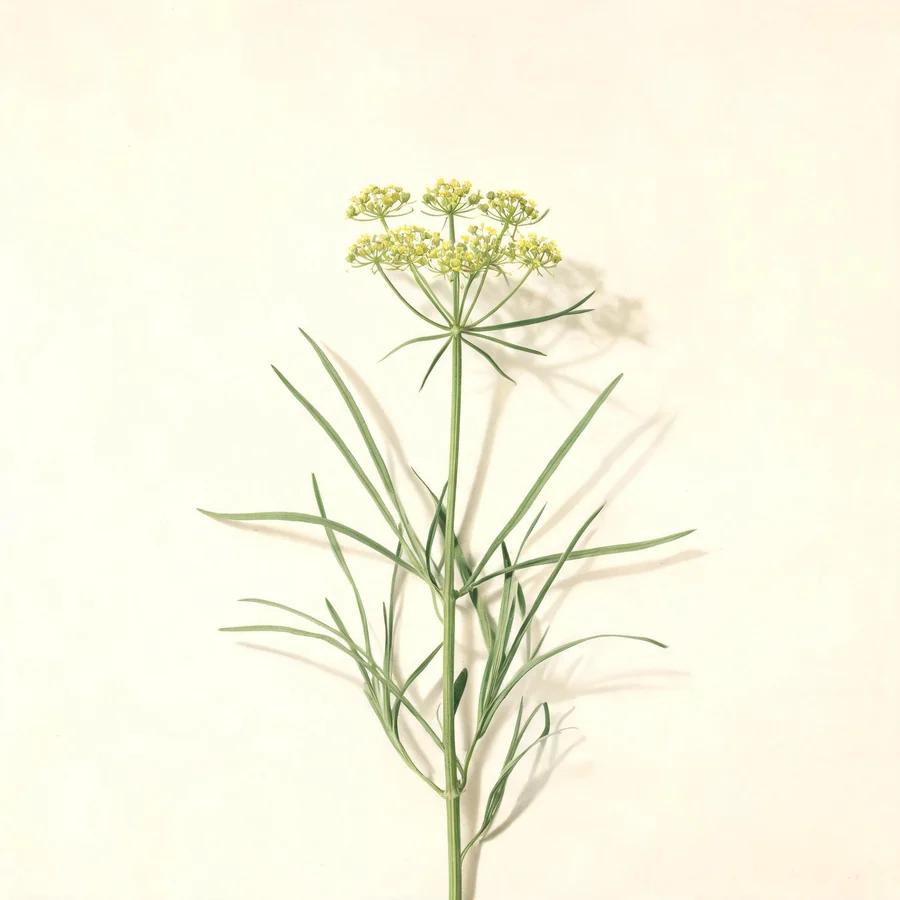
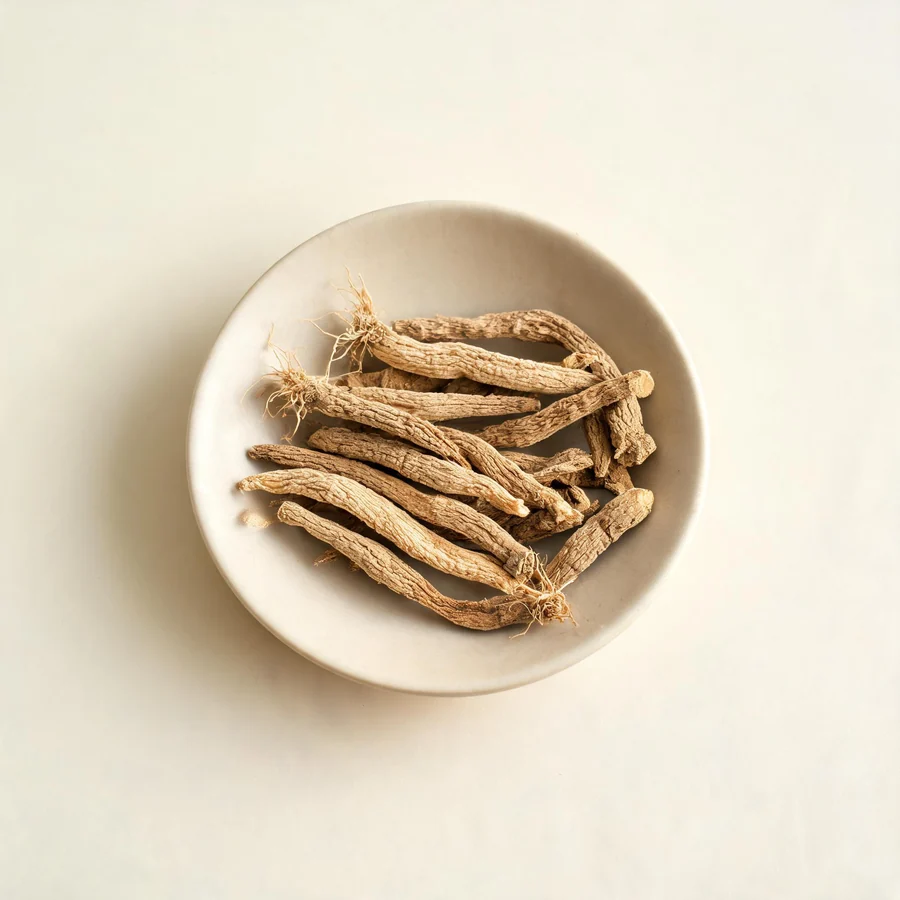
Skin profile
Where this herb sits in skin practice: the pattern it corrects, the skin signs it suits, and what it should not be used for.
Chai Hu is for skin that reacts to pressure: hives and plaques that flare with stress, pigment that settles in a difficult year, and the belt-like rash of shingles. It moves Qi and cools the small heat that stagnation makes, it is drying and ascending, and it is always an assistant rather than the herb that treats the lesion.
Skin signs that suggest it
- Skin that flares in step with stress, with tightness in the chest, sighing, irritability and a bitter taste in the mouth.
- Red wheals that come up after tension, a late night or an argument, and fade again when the pressure passes.
- Pigmentation across the cheeks and upper lip in a person with irregular periods and premenstrual breast distension.
- A band of red, blistered or burning skin along one side of the ribs or the waist, following a line rather than spreading evenly.
- A wiry pulse, a tongue that is dusky at the edges, and a complexion that is dull rather than bright.
When it is not the right herb
Not for Yin deficiency with heat: dryness in the mouth, a red tongue that has lost its coating and sweating at night mean the person is short of fluid, and an ascending, dispersing root spends it. Not for Liver Yang rising, with throbbing headache, dizziness and high blood pressure, where a lifting herb adds to the flare. Not for a cold, deficient Spleen with loose stools, and not for the acute hot infected flare on its own. Prolonged or high-dose use is avoided because of the liver signal, and material that could be the toxic large-leaf species must not be used at all.
What it does for skin
Skin-relevant actions only. Each one describes a mechanism in TCM terms and what it looks like on the skin.
Courses Liver Qi and eases the constraint behind stress-provoked flares
The Liver governs smooth flow, and when tension, frustration or unspoken anger stops it, the tradition reads the result as constraint: tight ribs, sighing, irritability, irregular periods and a wiry pulse. Skin that flares in that state is treated by moving the Qi, and the root is the standard herb for the job. It is not a sedative and does not treat anxiety itself; what it changes is the pattern the skin is expressing, and it works best with herbs that nourish the Blood so that movement does not dry the person out.
Cools the low-grade heat that stagnation produces
Anything that stops moving eventually warms, and the tradition reads the red margin, the burning sensation and the bitter taste as heat generated by constraint rather than heat from an infection. The root is only slightly cool, so it keeps that small heat from building without the harsh cold that would freeze the flow again. This is why it appears in formulas for red, irritable patches in tense people and rarely in formulas for a raging hot eruption.
Reaches the half-exterior layer where shingles begins
Shingles is read as heat and dampness that finally break through along the Liver channel, and its belt-like spread follows a line the tradition knows well. The root harmonises the layer between the surface and the interior, which is where the eruption starts, and it is paired with bitter cold herbs so that what it opens is cleared rather than redistributed. The rash itself needs antiviral treatment, and the herb belongs to the management of the pain and the pattern alongside it.
Lifts clear Yang so the face is nourished
In small doses inside a tonic formula, the root lifts what has sunk so that clear Yang reaches the head and the face. That is the reasoning behind its use for a dull, sallow, dry complexion in a tired person whose skin improves when the underlying fatigue is treated. The dose is the point: a few grams lift, and a larger amount does something quite different. It is not a tonic and does not replace the herbs that build Qi and Blood.
Skin conditions it is used for
Mapped to the condition pages on this site. The pattern column shows what the skin is doing when this herb is the right choice.
| Condition | Pattern | Why it suits | Typical setting |
|---|---|---|---|
| Melasma | Liver Qi constraint with Blood that no longer moves freely | Pigmentation that deepens during a stressful period, with premenstrual breast distension, irregular periods and a wiry pulse, is read as constraint that has slowed the Blood. The root moves the Qi and the blood-moving and Blood-nourishing herbs in the formula do the rest, which is the structure of the classic approach to melasma. It is used for months and always with sun protection, since no formula compensates for ultraviolet exposure. A sudden change in a pigmented patch needs a dermatological opinion. | Xiao Yao San with Bai Shao, Dang Gui and Mu Dan Pi |
| Chronic urticaria | Wind-Heat provoked by constraint, with wheals that flare under stress | Hives that appear after tension and fade when the pressure passes are read as Wind driven by constrained Qi that has warmed into heat. The root moves the Qi and cools the small heat while wind-releasing herbs deal with the surface, and the combination is used when the wheals are red, the pulse is wiry and the flares track the person's mood. Antihistamines remain the conventional treatment, and the herb is an addition to that plan rather than a replacement. | Xiao Yao San with Fang Feng and Chan Tui |
| Neurodermatitis | Constraint with Wind and static Blood in a thickened plaque | A plaque that thickens over years of scratching, in a person who is tense, wakes at night and cannot stop, is read as constraint that has let Wind settle and Blood stagnate. The root moves the Qi so the blood-moving herbs can reach the plaque, and it also addresses the irritability that drives the scratching. Behavioural work on the scratch cycle matters as much as the prescription, and a plaque that ulcerates or bleeds needs assessment. | Chai Hu Shu Gan San with Dan Shen and Bai Xian Pi |
| Herpes zoster infection | Liver and Gallbladder heat with constraint, following the channel | The belt-like band of red, blistered skin along one side is read as heat and dampness breaking out along the Liver channel, and the root is the herb that reaches that layer and moves it outward. It is used inside a bitter-cold formula, and the Japanese Kampo tradition has used a Chai Hu formula for the same condition, which is the best-known example of the root in skin practice. Antiviral treatment started early is the priority, and the herb does not replace it. | Xiao Chai Hu Tang with Long Dan Cao and Huang Qin |
| Psoriasis | Blood stasis with constraint in a long-standing plaque | Psoriasis is read as a disorder of the Blood, and one of the patterns behind a thickened, dusky, long-standing plaque is stasis with constraint. The root appears in the blood-moving formulas used for that type, where it moves the Qi so the Blood can follow. It is not the herb for a bright red, actively spreading flare, and it is not a treatment for the joint disease that can accompany psoriasis, which needs its own assessment. | Xue Fu Zhu Yu Tang with Dan Shen and Hong Hua |
Combinations for skin
Herbs it is paired with when the skin, not an internal organ, is the target.
| Partner | Ratio | Why the pair is used |
|---|---|---|
| Bai Shao | 6 to 10 g of each | The pairing that makes Liver-coursing safe. The root moves the Liver's function and Bai Shao feeds its substance; the organ is understood as Yin in structure and Yang in activity, so moving Qi in someone with thin Blood yields dryness and irritability instead of relief. The pair is the core of the formulas for premenstrual flares, melasma and stress-provoked hives. |
| Huang Qin | 10 g Chai Hu with 6 g Huang Qin | The defining pair of the half-exterior layer, and the reason the root appears in shingles formulas. The root pushes outward from the half-exterior and lifts the clear Yang, while Huang Qin clears heat from the half-interior and drives turbid fire downward. One rises and disperses, the other sinks and gathers, so the pair resolves what neither can settle alone. |
| Fang Feng | 6 to 10 g of each | Wind-releasing at the surface with Qi-moving underneath, which is the combination for hives and itch that flare with stress. The root addresses why the Wind keeps returning and Fang Feng addresses the surface it returns to. Both are dispersing, so a thin dry person needs a Blood-nourishing herb alongside, and the pair is stopped once the flares have settled. |
| Dang Gui | 9 to 12 g Dang Gui with 6 to 10 g Chai Hu | Closely related to the Bai Shao pairing but aimed at pigment and at dry dusky skin. Dang Gui nourishes and moves Blood while the root moves the Qi that has been holding it still, and the pair is used over months for melasma and for the dull, stagnant complexion that comes with long-standing constraint. It is not a rapid change and it is judged over a season. |
Formulas where it leads
- Xiao Yao San (逍遥散) - The formula for Liver constraint with Blood deficiency, and the most common context for the root in skin practice. It is used for stress-provoked hives, for melasma, for premenstrual flares of eczema and for the irritable, sighing patient whose skin improves when the constraint lifts. The root appears in a moderate dose as the moving element among herbs that nourish.
- Xiao Chai Hu Tang (小柴胡汤) - The formula that defines the half-exterior layer, built on the pair of this root and Huang Qin. In skin practice it is the model for shingles and for any eruption that comes with heat and chill alternating, a bitter taste and rib-side fullness. Its use in Japan for shingles is the best-documented example of this root in dermatology.
- Chai Hu Shu Gan San (柴胡疏肝散) - A stronger Qi-moving formula than Xiao Yao San, for constraint with marked rib-side distension, irritability and a wiry pulse. It is used for neurodermatitis and for itch that tracks emotional tension, and it is given for a defined period because it disperses rather than nourishes.
Safety for skin use
What to check before recommending or using it, including the cautions that matter most for skin patients.
Do not use, or use with caution
- Yin deficiency with heat: a dry mouth, a red tongue stripped of coating, night sweats and a thin rapid pulse. The ascending, dispersing nature spends fluids that are already short, and the heat worsens.
- Liver Yang rising, with throbbing headache, dizziness, tinnitus and high blood pressure. A herb that lifts adds to a flare that is already moving upward.
- Prolonged or high-dose use, and any history of liver disease. The saikosaponins carry a hepatotoxicity signal that is related to dose and duration, so a skin course is short and reviewed, and liver symptoms are taken seriously.
- Spleen deficiency with chronic loose stools, and Qi or Blood deficiency without a tonic in the same formula. A dispersing herb can loosen the bowel and scatter what is already thin unless it is anchored by herbs that build.
Pregnancy and breastfeeding
Use only in small doses under practitioner supervision. The root moves Qi and has a dispersing, lifting character, and the old texts worry that this may disturb the fetus, so it is not a herb to take on your own judgement in pregnancy. It is not among the herbs that are absolutely forbidden, and certain formulas built on it have been given in pregnancy under close supervision, which is the only setting in which its use makes sense. During breastfeeding there is no recorded prohibition at standard doses, but transfer into milk has never been measured, and short supervised courses for a clear reason are the sensible limit.
Interactions
- Mineral and vitamin preparations taken at the same time. The root contains flavonoids that chelate metal ions, so aluminium hydroxide, calcium, iron, zinc and bismuth preparations can bind it and lower uptake of both. Vitamin C can hydrolyse the saponins, and Chinese sources advise against taking it at the same moment. Spacing the doses a couple of hours apart deals with most of this.
- Antihypertensives and drugs that slow the heart. The root can depress blood pressure and heart rate, so using it with these medicines risks an excessive fall in pressure or a slowed pulse, and dizziness on standing should be reported.
- Interferon-alpha. In Japan, giving a Chai Hu formula alongside interferon-alpha for hepatitis was linked to reports of interstitial pneumonia, and Japanese guidelines now list the combination as contraindicated. Anyone on interferon should not take the root, and a new cough or breathlessness on treatment is a reason to stop and seek advice.
Allergy and patch testing
Allergy is uncommon. The root is a member of the carrot family, so a person with a known sensitivity to celery, fennel or carrot should be more cautious with an internal preparation. Stop if a rash, itching, wheezing or a swollen mouth appears, and note that a reaction to a herb-containing formula is not always caused by its most familiar ingredient.
General safety references
General references for herbal hepatotoxicity and herb-drug interactions; they are not specific to this herb.
- Review article: Herbal hepatotoxicity - an update on traditional Chinese medicine preparations. Alimentary Pharmacology & Therapeutics, 2014. PMID: 24844799.
- Interactions between herbal medicines and prescribed drugs: an updated systematic review. Drugs, 2009. PMID: 19719333.
- Warfarin and food, herbal or dietary supplement interactions: a systematic review. British Journal of Clinical Pharmacology, 2021. PMID: 32478963.
Evidence
The classical record is quoted with its source. The modern note states the level of evidence plainly.
Classical record
治阳气下陷,平肝、胆、三焦、包络相火,头痛、眩晕,目昏、赤痛障翳,耳聋耳鸣,诸疟及肥气寒热,妇人热入血室,经水不调,小儿痘疹余热,五疳羸热。
It treats Yang Qi that has sunk. It settles the ministerial fire of the Liver, Gallbladder, Triple Burner and Pericardium, and is used for headache and dizziness, dim vision, red painful eyes with films, deafness and ringing in the ears, the fevers and alternating cold and heat of masses, heat entering the blood chamber in women, irregular menstruation, the lingering heat of childhood eruptions, and the wasting heat of the five kinds of gan.
Ben Cao Gang Mu (Compendium of Materia Medica), Li Shizhen - A list rather than an argument, and useful for that reason: by the Ming the root already carries the lifting action, the Liver and Gallbladder fire action and the gynaecological use, and the line on childhood eruptions is its skin trace.
伤寒发汗解表要药,退六经邪热往来,痹痿,除肝家邪热、劳热,行肝经逆结之气,止左胁肝气疼痛,治妇人血热烧经,能调月经。
An essential herb for promoting sweat and releasing the exterior in cold damage, it drives out the alternating pathogenic heat of the six channels and treats impediment and flaccidity. It removes pathogenic and consumptive heat from the Liver, moves rebellious knotted Qi in the Liver channel, stops pain in the left flank from Liver Qi, and treats the menstrual scorching of blood heat in women, so that the menses are regulated.
Dian Nan Ben Cao (Materia Medica of Yunnan) - A regional materia medica that states the exterior-releasing and the Liver-moving uses in one breath, and the flank pain it describes is where shingles begins.
It governs the accumulation of Qi in the chest and abdomen, and the alternation of cold and heat.
Shen Nong Ben Cao Jing (Divine Husbandman's Classic of Materia Medica) - The origin of the half-exterior approach, and the reason the root defines that layer rather than belonging to the surface or the interior.
Modern evidence
Evidence status
- The safety signal is the most solid modern finding. The fractions blamed for liver injury are the saikosaponins, above all saikosaponin A and D, together with the volatile oil, and animal work has shown liver cell damage after high doses given daily for two weeks or so. Essential-oil preparations have damaged the liver at between one and a half and three and a half times the usual clinical dose, a narrow margin.
- Clinical trial evidence for the root in skin disease is thin. Shingles has the strongest tradition of use through a formula rather than the single herb, and no controlled trial of Chai Hu alone in melasma, urticaria or psoriasis was identified. Reports are mostly small, formula-based and published in Chinese or Japanese.
- Identity is a safety issue rather than a quality issue here. The large-leaf species carries bupleurotoxin and is named in the pharmacopoeia as unfit for medicine, and over twenty regional species, with different saponin profiles, have been sold in its place. Sliced root cannot be identified by eye, so the supplier carries the responsibility.
PubMed records
Selected real PubMed records for this herb's species or its constituents, chosen by species name and title relevance. They are references for the non-TCM discussion above, not proof that the herb treats any skin condition.
- Toxic polyacetylenes in the genus Bupleurum (Apiaceae) - Distribution, toxicity, molecular mechanism and analysis.. Journal of ethnopharmacology, 2016. PMID: 27693772 (safety record).
Dose and forms
Skin-practice dosing and the preparations that suit skin complaints.
| Form | Dose and notes |
|---|---|
| Decoction (internal) | 6 to 10 g of dried root daily for the Liver-coursing work that most skin formulas need. Between three and six grams is the lifting amount used inside a tonic, and ten to fifteen is reserved for the exterior and half-exterior patterns, which are not the usual skin use. |
| Vinegar-processed form | Cu Chai Hu is stir-fried with vinegar, which tempers the upward movement and aims the herb at the Liver, and it is the form chosen for constraint, melasma and stress-provoked flares. The raw root is kept for the fever and shingles uses. |
| Course length | A fortnight to six weeks with review for the skin use, and shorter when treating a feverish episode. Concentrated extracts taken for months are a different kind of exposure and not the traditional pattern. |
The dose is not a dial that simply increases the effect. A few grams lift Yang inside a tonic, six to ten course the Liver, and larger amounts release the exterior, so the same weight of root behaves differently according to what it is asked to do and what surrounds it. Because the liver signal is tied to duration and excess, the lowest effective dose for the shortest useful time is the right instinct, and anyone with a liver condition, or a heavy alcohol intake, should discuss it before starting.
Citations and further reading
Only real sources are listed: the classical materia medica passages quoted above, and the source works behind the botanical and safety statements.
- Ben Cao Gang Mu (Compendium of Materia Medica), Li Shizhen, 1578 - the entry on sunken Yang and the Liver and Gallbladder is quoted above.
- Dian Nan Ben Cao (Materia Medica of Yunnan), Lan Mao, 1436 - the entry on cold damage and Liver constraint is quoted above.
- Shen Nong Ben Cao Jing (Divine Husbandman's Classic of Materia Medica), attributed compilation of the Han period - the entry on accumulation and alternating cold and heat is quoted above.
- Radix Bupleuri monograph, Pharmacopoeia of the People's Republic of China - accepted species, part used, and the exclusion of large-leaf Bupleurum.
- Pharmacovigilance literature on Xiao Chai Hu Tang with interferon-alpha, and toxicological work on the saikosaponins, summarised as a statement about the level of evidence rather than as a cited trial.
Educational reference for qualified practitioners. This page is not medical advice, and skin conditions should be diagnosed by a clinician before treatment.