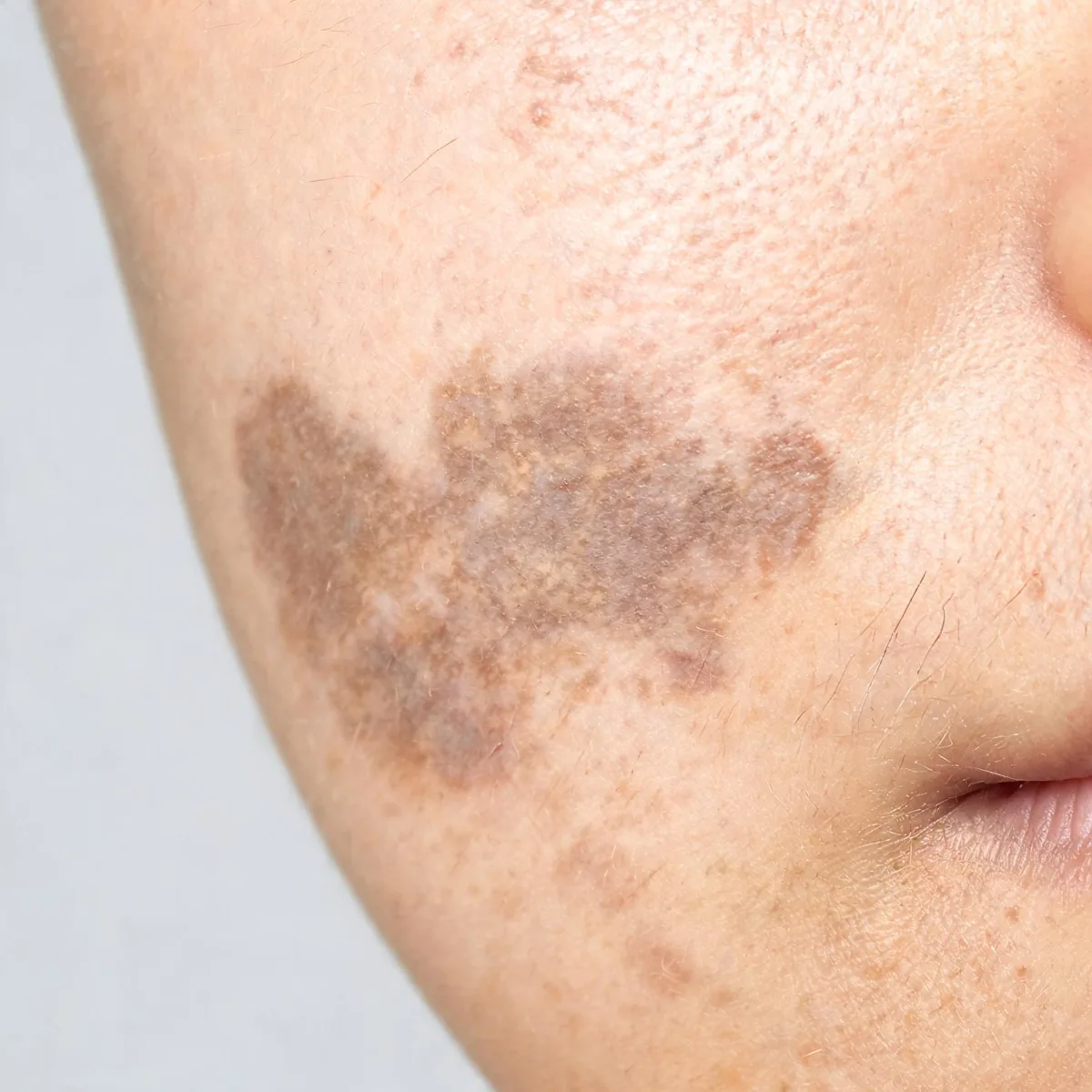
Understanding Melasma
The tradition describes the face as a mirror of the internal organs, and melasma as a visible sign that Qi and Blood are not flowing smoothly, or that fluids have become turbid in the skin.
The flowing pattern is Liver Qi stagnation: brown patches with clear borders, rib-side distension, irritability and sighing, worse with stress and premenstrually. Here the supply is present but the movement is blocked.
The deficient patterns are Spleen deficiency with dampness, where the patches are dull with blurred edges and the digestion is loose and bloated, and Qi and Blood deficiency, with large pale patches and marked fatigue.
Deeper patterns are described for darker patches: Kidney and Liver Yin deficiency with low back weakness and night sweats, Qi and Blood stagnation with fixed stabbing pain and very painful periods, and Kidney and Spleen Yang deficiency with cold limbs and early-morning diarrhoea.
Classical writers gave melasma two names, face dust and dark patches, and read both as reports from inside the body rather than faults in the skin. The face sits at the end of every channel, so whatever the organs fail to move or refine tends to surface there first, as a film or a stain. A patch is therefore evidence about circulation and about the clarity of fluids, not a local accident.
The Liver is examined first, because it keeps Qi moving and is easily upset by pressure, resentment and anger that is swallowed rather than spoken. When that flow tightens, Blood follows sluggishly and pigment gathers where the facial vessels are finest, so patches tend to have sharp edges and to deepen in the week before a period or during a tense stretch. Left long enough, the same blockage turns to Heat or settles into stasis, and the colour darkens with it.
Conventional view
Melasma appears as symmetrical brownish patches on skin that sees the sun, most often the cheeks, forehead, chin and upper lip. It is far more common in women and is associated with hormonal change, including pregnancy and oral contraceptives, with ultraviolet exposure and with family tendency. The patches are harmless but often distressing, and a dermatologist usually identifies them on sight, sometimes using a Wood's lamp to judge how deep the pigment sits. The medical account is of melanin overproduction in the pigment cells, switched on by ultraviolet light and hormones.
Conventional care rests on strict sun protection, topical lightening agents such as hydroquinone, tretinoin, corticosteroids, azelaic acid and kojic acid, and procedures including chemical peels, laser treatment and light-based work. Tranexamic acid, taken by mouth, is sometimes added for cases that resist everything else. Results are commonly temporary, and continuing maintenance is the norm if the patches are to stay faded.
The limits are well recognised. Bleaching agents can irritate the skin, provoke rebound pigmentation or, rarely, cause a permanent darkening known as ochronosis. Lasers and peels can make melasma worse, particularly in darker skin tones. More fundamentally, these approaches treat the surface and leave the internal contributors, such as stress, digestion and hormonal fluctuation, untouched, so patches frequently return once treatment stops.
Selected PubMed records
Real PubMed records for the conventional discussion above, selected by condition name and title relevance. They are references, not a claim that any treatment is proven for this condition.
- Melasma treatment: a systematic review.. The Journal of dermatological treatment, 2022. PMID: 33849384.
- Pathogenesis of Melasma Explained.. International journal of dermatology, 2025. PMID: 40022484.
- Laser therapy in the treatment of melasma: a systematic review and meta-analysis.. Lasers in medical science, 2022. PMID: 35122202.
How it connects
Melasma does not appear in isolation: in TCM it often signals deeper imbalances that produce other symptoms too. The most common companion is emotional strain, with anxiety, irritability and a sense of being stuck or frustrated, a cluster that arises from Liver Qi stagnation, the root pattern in many cases; when Liver flow is blocked it not only causes brown patches but also breast tenderness, menstrual irregularity and a tight wiry pulse, so treating the stagnation often eases skin and mood together. Digestive complaints such as bloating, loose stools and fatigue commonly accompany Spleen deficiency with Dampness, where a weak Spleen fails to transform fluids and Dampness rises to the face as dull, poorly defined patches while the body feels heavy and energy dips. With Kidney and Liver Yin deficiency, the patches sit alongside dizziness, tinnitus, lower back soreness and night sweats. The practical value of these clusters is that they show which pattern to treat first and give a second way to judge progress. If irritability, breast tenderness and premenstrual tension ease before the patches do, the Liver work is on track. If bloating and loose stools settle and the complexion brightens with them, the Spleen is responding. Because the same stagnation or depletion produces both the skin sign and the internal complaint, treating the root usually moves both, and the direction of travel in one is a fair guide to the other.
How it is assessed
Diagnosis looks at patch colour and border, the menstrual history and the digestive and constitutional signs.
What a practitioner looks for
- Border and colour: clear borders and brown patches suggest Liver Qi stagnation; blurred dull patches suggest Spleen deficiency; darker or purplish patches suggest stasis.
- Menstrual pattern: irregular, painful or clotted periods support stagnation patterns.
- Digestive and constitutional signs: loose stools, fatigue, low back weakness, night sweats and cold limbs decide the deficiency pattern.
- Triggers: pregnancy, oral contraceptives, sun exposure and stress are all asked about.
The consultation begins with the patches themselves: their shade, how cleanly the border is drawn, and which part of the face they occupy, since the cheeks, forehead, upper lip and jaw each belong to a different channel. The practitioner then asks about mood, digestion, energy, sleep and the menstrual cycle, and reads the tongue and pulse. The aim is not to grade the pigment but to separate several internal states that can look almost identical on the skin.
Defined brown patches that flare with frustration or in the premenstrual week, alongside rib-side fullness and sighing, belong to Liver Qi stagnation; the tongue may be normal or dusky with red or purple sides, and the pulse feels wiry, like a taut string. Patches that are dull and blurred at the edge, with bloating, loose stools and heaviness, indicate Spleen deficiency with Dampness, shown by a pale swollen tongue with a greasy coat and a soft or slippery pulse. Darker, irregular patches with dizziness, tinnitus, dry eyes, a sore lower back and night sweats point to Kidney and Liver Yin deficiency, with a red thin cracked tongue and a fine rapid pulse.
Deep, stubborn brown patches on a dusky complexion, with fixed stabbing pain and a purple tongue carrying stasis spots, mark Qi and Blood stagnation, and the pulse is wiry and choppy. Large, washed-out patches with a pale face, a weak voice and exhaustion indicate Qi and Blood deficiency, with a pale tongue and a thin weak pulse. Greyish-brown patches that look cold and puffy, with chilly hands and feet, loose stools and a swollen tooth-marked tongue, belong to Kidney and Spleen Yang deficiency, where the pulse is deep, slow and weak.
TCM patterns in Melasma
Melasma differentiation begins with the patch and works inward. Colour comes first: a warm surface brown with a crisp edge behaves differently from a greyish stain that dissolves into the skin, and a dusky purplish tone belongs to a third group. A clean edge points to a local blockage, a smeared edge to turbidity rising from weak digestion or a cold constitution, and site adds a clue, since cheeks, forehead and upper lip belong to different channels. What accompanies the skin decides the rest. Mood, cycle, appetite, stool, sleep and the state of the lower back show whether constraint, dampness, depletion or stasis is doing the work, and the tongue and pulse confirm it. The six patterns fall into two families: those where something is stuck or turbid, and those where something is missing, with stasis often sitting at the end of both routes.
| Pattern | Key signs | The itch | Tongue | Main formula |
|---|---|---|---|---|
| Liver Qi Stagnation | Not specified | Not specified | Body: Normal or slightly dark, with red or purple sidesCoat: Thin white | Not specified |
| Spleen Deficiency with Dampness | Not specified | Not specified | Body: Pale and swollen, often with teeth marks along the edgesCoat: White, greasy and moist, thick in the middle | Not specified |
| Kidney and Liver Yin Deficiency | Dry eyes, dry mouth and night sweats | Not specified | Body: Red, thin and dry, often crackedCoat: Little or none; the tongue may look peeled | Not specified |
| Qi And Blood Stagnation | Stabbing pain in a fixed location; Dark clotted menstrual blood with painful periods | Not specified | Body: Purple or dark, with stasis spots; sublingual veins dark and distendedCoat: Thin white | Not specified |
| Qi and Blood Deficiency | Not specified | Not specified | Body: Pale, possibly thin or with teeth marksCoat: Thin white | Not specified |
| Kidney and Spleen Yang Deficiency | Not specified | Not specified | Body: Pale, swollen and teeth-markedCoat: White and slippery | Not specified |
Liver Qi Stagnation
Brown patches with clear borders, worse with stress and premenstrually.
Pressure that lasts, whether from work, resentment or grief that is never spoken, stops the Liver from doing its job of keeping Qi in motion. The supply of Blood to the face is not short; it arrives badly paced and unevenly, so pigment settles where the smallest vessels run. Because the obstruction is local rather than general, the patches keep a tidy border. If the constraint is left to run, it warms into Heat and the same patches grow darker and more resistant.
The tongue is normal or slightly dark, with red or purple sides under a thin white coat, and the pulse is wiry, most obviously at the left middle position. Stress, anger, alcohol, greasy or spicy meals and the days before a period all make it worse, while rest, unhurried exercise, mint tea and slow breathing ease it. Xiao Yao San is the usual formula, and LR-3 Taichong, LR-14 Qimen and LI-4 Hegu are the points used to release the flow.
Signs
- Brown patches with clear borders
- Chest or rib-side distension
- Irritability and mood swings
- Frequent sighing
- Menstrual irregularity with breast tenderness
Diet and lifestyle for this pattern: Prioritise stress reduction through mindfulness, gentle yoga or walking, and avoid alcohol, fried food and excess caffeine, which can overheat the Liver. Sip mint or chrysanthemum tea to soothe Liver Qi, and keep exercise regular and moderate so Qi does not stagnate.
Spleen Deficiency with Dampness
Dull patches with blurred edges and a digestive picture.
A Spleen that cannot transform food and fluids leaves them half processed, and this turbid residue drifts upward to settle in the face. There it obstructs the fine channels and muddies the complexion, so the patches look dull, brownish and badly defined rather than neatly drawn. The digestive signs come from the same failure, and the skin typically worsens when digestion is sluggish, after rich or cold meals, or in humid weather.
The tongue is pale and swollen with teeth marks under a white greasy moist coat, and the pulse is soggy and slow, sometimes slippery. Cold, raw or greasy food, damp weather, long stretches of sitting and overwork aggravate it, while warm cooked meals, gentle movement and dry weather relieve it. Shen Ling Bai Zhu San strengthens the Spleen and drains the turbidity, and ST-36 Zusanli, SP-6 Sanyinjiao and BL-20 Pishu support that work.
Signs
- Dull poorly-defined brown patches
- Loose stools
- Bloating after eating
- Heaviness of body and limbs
- Fatigue
Diet and lifestyle for this pattern: Eat warm, cooked food such as soups, stews and congee, and avoid cold, raw, greasy and dairy-heavy food that creates Dampness. Gentle daily walking or yoga helps the Spleen move Qi and transform fluids, and managing stress matters because overthinking weakens the Spleen.
Kidney and Liver Yin Deficiency
Darker irregular patches with depleted Yin signs.
Liver and Kidney hold the deep cooling and moistening reserves between them, and they thin together with age. When stress, late nights and overwork draw those reserves down, a thin deficiency heat rises and dries the face, darkening the skin into irregular patches. With Yin unable to anchor the upper body, the head and senses are disturbed as well, which is why dizziness, ringing ears and dry eyes arrive alongside the pigment.
The tongue is red and thin, often cracked and dry, with little or no coating, and the pulse is fine, rapid and wiry, weak at the left distal position and thin at the left middle. Overwork, short sleep, spicy or fried food and strong sun all worsen it, while sleep, hydration and cooling moistening food help. Liu Wei Di Huang Wan is the base formula, and KI-3 Taixi, BL-23 Shenshu, BL-18 Ganshu, SP-6 Sanyinjiao and SP-10 Xuehai are the points.
Signs
- Dark brown or blackish patches
- Dizziness and ringing in the ears
- Sore weak lower back and knees
- Dry eyes, dry mouth and night sweats
- Heat in palms and soles
Diet and lifestyle for this pattern: Favour cooling, moistening food such as black sesame, goji berries, spinach, cucumber and pear, and avoid spicy, fried and drying food that consumes Yin. Protect deep sleep and keep movement gentle with yoga or walking, since overexertion and late nights drain Yin fastest, and always shield the skin from the sun with a hat or mineral sunscreen, as heat and UV worsen deficiency heat.
Qi And Blood Stagnation
Deep brown or purplish patches with fixed pain and dark menses.
When constraint goes unresolved for years, the movement of Blood slows until it no longer flows but sits. This stasis blocks the small vessels that feed the face, so fresh nourishment never reaches the surface and the patches become deep, fixed and faintly purple beneath the brown. A dusky complexion, dark lips and stabbing pain in one place belong to the same congestion, and painful clotted periods are its uterine version.
The tongue is dark purple with scattered stasis spots and distended sublingual veins under a thin white coat, and the pulse is wiry and choppy, like a knife scraping bamboo. Anger, cold food and cold weather, long sitting and greasy meals aggravate it, while gentle movement, warmth on the lower abdomen and warming spices such as turmeric and ginger relieve it. Tao Hong Si Wu Tang moves the Blood, with SP-10 Xuehai, LR-3 Taichong and SP-6 Sanyinjiao as the points.
Signs
- Deeper brown or purplish patches with dusky complexion
- Stabbing pain in a fixed location
- Dark clotted menstrual blood with painful periods
- Purple or dark lips
- Tightness in the chest
Diet and lifestyle for this pattern: Eat small amounts of warming, Blood-moving food such as turmeric, ginger and a splash of vinegar in cooking, and avoid iced drinks and cold raw food that congeal Blood. Gentle daily walking or yoga keeps Qi and Blood flowing, protect the skin from sun, and find healthy outlets for pent-up frustration.
Qi and Blood Deficiency
Large pale patches with marked fatigue and a pale complexion.
The face takes its colour from Blood, and Blood depends on a Spleen strong enough to make it. When Qi and Blood fall short, the face is undernourished and the skin fades into large, pale, poorly outlined patches, much as a plant pales when the soil is thin. The same shortage produces the accompanying tiredness, dizziness, pale lips and pale nail beds, and the marks stay light because nothing is congested.
The tongue is pale, sometimes thin or marked by teeth, with a thin white coat, and the pulse is fine and weak, often deep. Worry, skipped meals, cold or raw food and sustained overwork deplete it further, while warm cooked meals, sleep, iron-rich food and gentle exercise rebuild it. Ba Zhen Tang tonifies both Qi and Blood, and ST-36 Zusanli, SP-6 Sanyinjiao, SP-10 Xuehai and KI-3 Taixi are the points.
Signs
- Large poorly-defined brown patches
- Pale or sallow complexion
- Persistent fatigue and weakness
- Dizziness or light-headedness
- Poor appetite with pale lips
Diet and lifestyle for this pattern: Build meals around warm, cooked food such as soups, stews and congees, with small portions of well-sourced red meat or liver, dark leafy greens, black sesame and goji berries. Avoid raw cold food and iced drinks that weaken the Spleen, keep movement gentle such as walking or tai chi, and hold a consistent sleep schedule for Blood to regenerate.
Kidney and Spleen Yang Deficiency
Greyish-brown patches with cold signs and early-morning diarrhoea.
Yang is the warming and transforming force of the Spleen and Kidneys, and when it runs low the body keeps an internal winter. Cold and damp accumulate instead of being moved, and this cold-damp drifts up to the face, where it obstructs the fine channels and leaves greyish-brown patches with no clear edge. The same lack of warmth shows as cold hands and feet, a cold sore lower back, loose stools and swelling of the legs and ankles.
The tongue is pale, puffy and tooth-marked under a white slippery coat, and the pulse is deep, weak and slow, feeblest at the rear and right middle positions. Cold weather, cold raw or greasy food, irregular meals and overwork worsen it, while warmth from heating pads and warm baths, cooked meals, moxibustion and gentle exercise relieve it. Ji Sheng Shen Qi Wan and Fu Zi Li Zhong Tang are used, with DU-4 Mingmen, BL-23 Shenshu, BL-20 Pishu, ST-36 Zusanli and REN-4 Guanyuan.
Signs
- Greyish-brown patches with poorly defined borders
- Cold hands and feet
- Early-morning diarrhoea
- Chronic loose stools with undigested food
- Sore cold lower back
Diet and lifestyle for this pattern: Eat warm, cooked food such as soups, stews and congees with ginger, cinnamon and black pepper, and avoid raw, cold and iced food and drinks that damage Yang further. Keep the lower back and abdomen warm, especially in cold weather, and keep movement gentle such as walking or tai chi so Yang is supported without exhaustion.
Treatment approach
How the tradition treats melasma, with the herbs, formulas and points used for it.
Principles
- Unblock Liver Qi where the pattern is stagnation, since movement is the problem rather than supply.
- Strengthen the Spleen and resolve dampness where the patches are dull and digestion is loose.
- Nourish Yin and Yang where the picture is deficient, and move Blood where the patches are deep and fixed.
- Protect from sun exposure throughout, which both frameworks treat as essential.
- The order of work follows the pattern. Where something is blocked, the first task is to release it, because tonics given to a congested system sit and stagnate; where something is missing, the first task is to rebuild, because moving herbs given to an empty system only drain it further. Local needling around the patches is paired with body points chosen for the organ involved, and formulas are modified rather than used unchanged, so a Yin tonic can be given a little movement or a Blood-moving formula can be softened with nourishment. Sun protection runs alongside treatment rather than after it, because ultraviolet exposure recreates pigment faster than any formula can clear it.
Herbs used
Formulas
- Xiao Yao San
- Shen Ling Bai Zhu San
- Liu Wei Di Huang Wan
- Tao Hong Si Wu Tang
- Ba Zhen Tang
- Ji Sheng Shen Qi Wan
- Fu Zi Li Zhong Tang
Acupoints
- LR-3 (Taichong)
- LR-14 (Qimen)
- LI-4 (Hegu)
- ST-36 (Zusanli)
- SP-6 (Sanyinjiao)
- BL-20 (Pishu)
- KI-3 (Taixi)
- BL-23 (Shenshu)
- BL-18 (Ganshu)
- SP-10 (Xuehai)
- DU-4 (Mingmen)
- guanyuan-ren-4
What to expect
- The tradition describes improvement over months, not weeks, with the depth of the pigment setting the pace.
- Stabilising the patches and preventing new ones is treated as an early result.
- Hormonal and sun exposure factors need to be addressed or the pigment returns.
- Sessions are usually weekly at the start, with a daily formula, and the first month often changes overall skin tone before any single patch fades. Visible lightening of established pigment tends to take two to three months, with a fuller course of four to six months and less frequent maintenance afterwards. Patches can darken briefly as pigment is pushed towards the surface, which settles within a few weeks and is not a reason to stop. Because hormonal shifts and sun exposure continue to act, treatment is judged by stability and by fewer new patches as much as by fading.
Safety and when to get help
Seek medical help urgently for
- A new dark spot that is raised, bleeding or changing rapidly needs dermatological review.
- Facial patches with unexplained weight loss or fever.
- Signs of infection or ulceration in a patch.
For anything severe, sudden or spreading quickly, read when a skin problem needs urgent care.
Cautions
- Do not apply unregulated lightening creams, which can contain harmful ingredients.
- Pregnancy and breastfeeding require practitioner review before internal herbs.
- Sun protection is required during treatment.
Using this alongside conventional care
- TCM is described as complementary to conventional care: prescribed topical lightening treatment and sun protection can continue alongside herbs and acupuncture.
- Prescribed topical lightening agents such as hydroquinone or azelaic acid, and daily sun protection, can continue while herbs and acupuncture are used, provided both clinicians know what is being taken. Some herbs, Dang Gui among them, can raise sensitivity to sunlight, so protection matters more rather than less. Oral tranexamic acid and any other systemic medicine should be discussed with the prescriber before herbs are added. Sessions are spaced away from laser or peel dates so the skin is not irritated twice over, and no prescribed treatment is stopped abruptly.
Diet and lifestyle
- Avoid greasy, fried, sugary and dairy-heavy food said to generate dampness and heat, and favour lightly cooked vegetables, whole grains and lean protein.
- The general rule is to eat in a way that keeps the Spleen light and the Liver unconstrained: regular warm cooked meals, lightly cooked vegetables, whole grains, modest protein and warming spices such as ginger and turmeric, while greasy, fried, sugary and dairy-heavy food stays low. Pattern adds the detail. Yin deficiency does better with cooling moistening foods such as pear, black sesame and goji berries, and with less spice, frying and alcohol. Stasis responds to small amounts of turmeric and ginger, a splash of vinegar in cooking, and no icy drinks. Spleen and Yang deficiency need cooked warming meals and no raw or cold food, while Liver constraint eases when alcohol, fried food and excess caffeine are cut and meals are taken at regular times.
If you're pregnant
Melasma is often called the mask of pregnancy, and the hormonal shifts of the second trimester are a common trigger. Carrying a baby draws heavily on maternal Blood and Yin, so the patterns that appear are usually Liver constraint with Heat or Spleen weakness with Dampness. Treatment is deliberately cautious. Blood-moving herbs such as Chuan Xiong, Tao Ren and Hong Hua are avoided because of the risk of miscarriage, and a modified Xiao Yao San, with Dang Gui removed where necessary, or dietary support with cooling blood-nourishing food is preferred. Acupuncture is generally safe, but abdominal points and those that encourage uterine contractions, LI-4 Hegu and SP-6 Sanyinjiao among them, are avoided unless an experienced practitioner directs them. Many women find the colour settles after the birth as Qi and Blood rebuild, so the active phase is often postponed.
If you're breastfeeding
After childbirth the body is often running on empty, and the patches may persist or deepen while nursing continues to draw on the same reserves. The aim is to rebuild Qi and Blood without interfering with milk supply. Two formulas suit this stage, Shen Ling Bai Zhu San and Ba Zhen Tang, both generally considered suitable because they support digestion and build Blood without any strong moving action. Herbs that might reduce supply, Da Huang among them, and very bitter-cold herbs are avoided. Gentle facial acupuncture and herbal masks applied to the skin work well alongside. Let your practitioner know that you are nursing so that the formula and the dose can be adjusted, and watch for any change in the baby's feeding or sleep.
If treating an elderly patient
In older patients the picture is usually long-standing Yin deficiency of the Liver and Kidneys, or Yang deficiency with blood stasis, and the patches are darker and slower to respond. Treatment has to be gentle and sustained, since harsh Blood-moving formulas can drain Qi further. If Yin is depleted, Liu Wei Di Huang Wan and its modifications are used often, with Nu Zhen Zi and Gou Qi Zi added to nourish Yin, and Tu Si Zi added where Yang is weak at roughly two-thirds of the adult dose so as not to overheat. KI-3 Taixi and BL-23 Shenshu are emphasised. Older people often take several medicines, so interactions are checked carefully, particularly with anticoagulants when Blood-moving herbs are prescribed.
Urgent-sign guidance is based on standard sources: NHS anaphylaxis, NHS cellulitis, NHS Stevens-Johnson syndrome, NHS melanoma.
Evidence
Evidence status
Compiled for this page from the classical and modern literature; not a systematic review, so treat it as a pointer to sources rather than clinical guidance.
Research is growing but still limited in quality. Systematic reviews and meta-analyses suggest oral and topical Chinese herbal medicine can significantly reduce melasma severity compared with placebo or hydroquinone, and acupuncture and facial cupping show promise in small trials with improvements in melanin index and patient satisfaction. Studies are often small, unblinded, short in follow-up and published in Chinese, and high-quality trials remain scarce.
A small number of trials are worth naming. A meta-analysis of 23 randomised trials covering 2,456 patients reported that oral Chinese herbal formulas lowered melasma area and severity scores against placebo, with mild adverse events (Zhang Y, Journal of Ethnopharmacology, 2018). A twelve-week assessor-blind trial of 108 women found that facial acupuncture plus routine care reduced severity scores by about a third, against twelve per cent with routine care alone, and the gain held at three months (Li X, Acupuncture in Medicine, 2019). A double-blind trial of a cream made with Bai Shao, Bai Zhi and Bai Fu Ling reported a fall in melanin index of twenty-eight per cent after eight weeks, against eight per cent for placebo (Chen H, Journal of Cosmetic Dermatology, 2020). What these add is measured outcomes rather than impressions, though all three remain single studies.
Studies often cited
Significantly reduced melasma severity compared with placebo or conventional hydroquinone treatment. Systematic reviews and meta-analyses (as recorded in the source)
The meta-analysis of 23 randomised trials with 2,456 patients found oral Chinese herbal formulas significantly reduced melasma area and severity index scores compared with placebo, with commonly used herbs including Dang Gui, Bai Shao and Chai Hu and mild adverse events comparable to controls. Zhang Y, et al. Chinese herbal medicine for melasma: a systematic review and meta-analysis. Journal of Ethnopharmacology. 2018;220:1-12.
In a twelve-week trial of 108 women, facial acupuncture with routine care reduced melasma area and severity index scores by 35 percent against 12 percent with routine care alone, and the improvement was maintained at three-month follow-up with good tolerability. Li X, et al. Efficacy of facial acupuncture for melasma: a randomized, assessor-blind, controlled trial. Acupuncture in Medicine. 2019;37(3):150-158.
A cream containing extracts of Bai Zhi, Bai Fu Ling and Bai Shao applied twice daily for eight weeks reduced the melanin index by 28 percent against 8 percent with placebo, with no significant side effects reported. Chen H, et al. Topical application of a Chinese herbal cream for melasma: a double-blind, placebo-controlled trial. Journal of Cosmetic Dermatology. 2020;19(4):892-898.
PubMed records for the TCM evidence
Real PubMed records for the TCM clinical evidence discussed above, selected by condition name and title relevance. They are references, not proof of benefit.
- Targeting Melasma: Innovations in Pigment Deposition and Photoaging in Cosmetic Dermatology.. Journal of cosmetic dermatology, 2026. PMID: 41508749.
- Efficacy of acupuncture for melasma: A protocol of systematic review and meta-analysis.. Medicine, 2021. PMID: 34918707.
Classical record
Li hei ban (dark facial patches) is caused by Liver and Kidney Yin deficiency with blood stasis that does not disperse. It is appropriate to treat it with Liu Wei Di Huang Wan plus modifications.
- Wai Ke Zheng Zong (Orthodox Manual of External Diseases), section on Li Hei Ban. The Chinese original is not reproduced here: it could not be recovered reliably from the source record, and is not guessed.
Common questions
Can TCM fade melasma?
The tradition describes treating the internal pattern with improvement over months. It does not promise clearance, and sun protection remains essential.
Why does it worsen before my period?
The Liver Qi stagnation pattern is described as worsening premenstrually, when Qi is already constrained.
Is it caused by liver disease?
No. Liver Qi stagnation is a pattern description, not a diagnosis of liver disease; unexplained systemic symptoms need medical review.
How long before I see a change?
Months. The classical literature treats pigment change as slow, and stabilising the patches as the first meaningful result.
Can I keep using my own skincare while having treatment?
Yes, provided both your practitioner and your dermatologist know what is being used. Gentle, non-irritating products and sun protection are fine to continue. Some herbs increase sensitivity to sunlight, which makes daily protection more important rather than less, and harsh exfoliants or strong peels are best avoided while the skin is being needled. Tell your practitioner about any active ingredient, including retinoids and acids, so the plan can be timed around them.
Is melasma in pregnancy handled differently?
Yes, and far more cautiously. Hormonal shifts in pregnancy commonly bring the patches out, usually in the second trimester, and active treatment is limited while you are expecting. Blood-moving herbs, including Hong Hua, Tao Ren and Chuan Xiong, are not used, and points on the lower abdomen, together with LI-4 Hegu and SP-6 Sanyinjiao, are avoided except under experienced guidance. Gentle dietary support and, in some cases, a modified Xiao Yao San are preferred. Most women see the patches soften once the baby is born and Qi and Blood rebuild.
Do the patches return once treatment stops?
They can, because the triggers that produced them do not disappear. Correcting the internal pattern makes recurrence less likely than surface treatment alone, but the same stress, diet, sleep debt or sun exposure will eventually recreate the picture. Most people keep a maintenance formula or seasonal sessions, and treat sun protection as permanent rather than as part of a course. If patches return, they usually do so more slowly and more lightly than the first time.
Is the approach suitable whatever my skin tone?
The treatment is chosen from your internal pattern rather than from your skin tone, so it applies across complexions and ethnicities. It is often a reasonable option for deeper skin tones, which are more prone to irritation and post-inflammatory darkening from aggressive topical treatment. That said, any new or changing pigmentation should still be seen by a dermatologist before it is treated as melasma.