Skin profile
Where this herb sits in skin practice: the pattern it corrects, the skin signs it suits, and what it should not be used for.
Zhu Ye is the mildest way to cool heat that is showing on the skin and disturbing sleep. It is chosen for the hot, dry, restless picture with dark urine, not for a wet or a cold one, and it is a supporting herb rather than a main one.
Skin signs that suggest it
- Bright red, hot, itchy patches that worsen in warmth and at night, with restlessness and broken sleep
- Small, dark, burning urine alongside the skin flare, or mouth sores at the same time
- A red tongue, especially at the tip, with a thin yellow coat
- Thirst with a dry mouth in a feverish or convalescent person
- A prickling rash that appears in hot weather or after overheating, with little scale
When it is not the right herb
Not for dry, pale, cold skin, and not for a dull, weeping rash in a tired, chilly person, where the leaf adds cold to cold. It is not for someone who already passes urine often from weak Kidneys, because its draining action increases the loss. It is not the right choice for a severe, spreading or infected eruption, and a fever in a child with drowsiness, a stiff neck or laboured breathing is a medical emergency rather than an occasion for a cooling tea.
What it does for skin
Skin-relevant actions only. Each one describes a mechanism in TCM terms and what it looks like on the skin.
Clears Heart heat from hot, restless skin
Heat in the Heart is read as the source of lesions that burn and itch and of a person who cannot settle: wakeful, irritable, thirsty, with a red tongue tip. Bamboo leaf is cold and goes to the Heart, so it lowers that fire at its source, and the itch quietens as the restlessness does. It supports a formula rather than standing alone, and it is chosen for a bright red, dryish eruption rather than an oozing one.
Drains heat out through the urine
Heart and Small Intestine are paired in this framework, and heat that cannot leave by the surface is said to move down and produce scanty, dark, burning urine. A bland flavour is thought to draw dampness out by the same route, so the leaf both cools the source and opens an exit. That is why a hot rash with urinary symptoms is treated as one event, and why the leaf appears in formulas for both.
Generates fluids as it cools
Fever and heat dry the surface, and a leaf that is sweet as well as cold restores some moisture while it lowers the heat. That makes it suitable after the height of a fever, or in the low-grade heat that lingers with a dry mouth, a dry throat and skin that feels hot and tight. It is a mild fluid generator, so a truly dry, scaly skin with no heat needs nourishing herbs rather than this one.
Cools an eruption provoked by summer heat
Hot weather, a stuffy room or too many clothes produce a prickling red rash in the folds and on the trunk, and the tradition treats it as heat and dampness that the skin cannot vent. The leaf clears summer heat gently and is used internally in a light decoction and externally as a dilute wash. Cooling the room and loosening the clothing do at least as much, and a rash with fever or pus needs a clinician.
Skin conditions it is used for
Mapped to the condition pages on this site. The pattern column shows what the skin is doing when this herb is the right choice.
| Condition | Pattern | Why it suits | Typical setting |
|---|---|---|---|
| Atopic dermatitis | Heart fire blazing: bright red, hot, intensely itchy lesions with disturbed sleep | The wet, angry flare is usually read as damp-heat, but there is a variant in which the skin is bright red and burning, the itch is worse at night, and the person is restless, irritable and sleeping badly. That is Heart fire, and the classical answer is Dao Chi San, which cools the Heart and guides the heat downward. The leaf is the light cooling part of that formula; the lesion itself still needs stronger herbs, and a child losing sleep to itch needs the flare treated rather than a tea alone. | Dao Chi San, with Huang Lian and Zhi Zi |
| Heat rash | Summer heat and dampness trapped at the surface | Prickling red bumps in the folds and on the trunk after hot, humid weather are read as sweat that cannot escape because heat and dampness are held inside. A light cold leaf that clears summer heat and moves fluid out through the urine suits the mild case, used as a light decoction or a dilute wash. The practical measures matter more, and a rash with fever, spreading redness or pus is not a heat rash. | Shen Ling Bai Zhu San with Dan Zhu Ye, or a light cooling decoction |
| Itchy skin with restlessness | Heart fire disturbing the spirit, with heat in the blood and no ooze | When itch comes with hot, dry, red skin, a racing mind, a red tongue tip and broken sleep, the tradition treats the Heart as well as the skin, on the old principle that itch and sores are traced to that organ. The leaf cools and calms without sedating, and it is combined with blood-cooling and itch-quieting herbs rather than used alone. Itch with weight loss, night sweats, a new medicine or a rash that will not fade needs medical assessment. | Dao Chi San modified with Bai Xian Pi and Mu Dan Pi |
| Nappy rash in a hot, restless infant | Heat in the lower burner with dark, scanty urine | Red, excoriated skin in the nappy area of a hot, thirsty, restless baby, with strong-smelling dark urine, is read as heat that has moved down from the Heart to the Small Intestine. A mild cooling leaf that opens the urinary route is used in a small dose under a practitioner's direction and as a dilute wash, while the area is kept clean, dry and aired. Barrier cream and frequent changes do most of the work, and a rash with blisters, pus or fever needs a clinician. | Modified Dao Chi San in a reduced paediatric dose |
Combinations for skin
Herbs it is paired with when the skin, not an internal organ, is the target.
| Partner | Ratio | Why the pair is used |
|---|---|---|
| Sheng Di Huang | 10 to 15 g Sheng Di Huang with 6 to 10 g Zhu Ye | The root cools the Blood and builds Yin while the leaf clears heat and offers an exit by the urinary route, and the two are the core of the classical formula for mouth sores with dark, burning urine. Once the fire starts drying the fluids, clearing on its own leaves a person parched, while nourishing on its own lets the fire keep burning, so the pair is used rather than either herb. |
| Zhi Zi | 6 to 10 g of each | Gardenia cools the Heart and settles irritability with far more force than the leaf, and it also clears damp-heat and cools the Blood. The two are chosen by strength as much as by pattern: gardenia when the heat is fierce and the person can take it, the light leaf where the person is depleted, young or convalescent. Both are cold, and neither suits a pale, chilly picture. |
| Bai Xian Pi | 9 to 12 g Bai Xian Pi with 6 to 10 g Zhu Ye | Bai Xian Pi is the skin-specific herb for itch with heat and dampness, and it also has recorded antifungal activity. The leaf adds cooling from within and a route out through the urine, which suits a hot itchy rash in a child. The pair is used internally in a light formula and, separately, as a dilute wash. |
| Mu Tong | Classically 3 to 6 g with 6 to 10 g Zhu Ye | This was the other half of the classical pairing, one herb cooling the Heart above and the other opening the water passages below. It is now largely avoided: some Mu Tong material has contained aristolochic acid, which damages the kidney, and safer alternatives are used. The logic of pairing a Heart-cooling herb with a urinary one survives even where this particular herb does not. |
Formulas where it leads
- Dao Chi San (导赤散) - The classical formula for Heart fire moving down to the Small Intestine, with the leaf guiding heat out through the urine while Sheng Di Huang cools the Blood and nourishes Yin. In skin practice it is the model for a bright red, burning eruption with restlessness, broken sleep and dark burning urine, and for mouth sores that accompany a flare.
Topical use
The leaf is used as a dilute wash for a hot, prickling rash and for inflamed skin in a child, and it is one of the gentlest herbal washes in common use. The decoction is weak, cooled and applied briefly, and it is used beside the measures that actually relieve heat rash: a cool room, loose cotton, dry folds. It is not a treatment for broken skin or for a rash with pus.
| Preparation | How and when it is used |
|---|---|
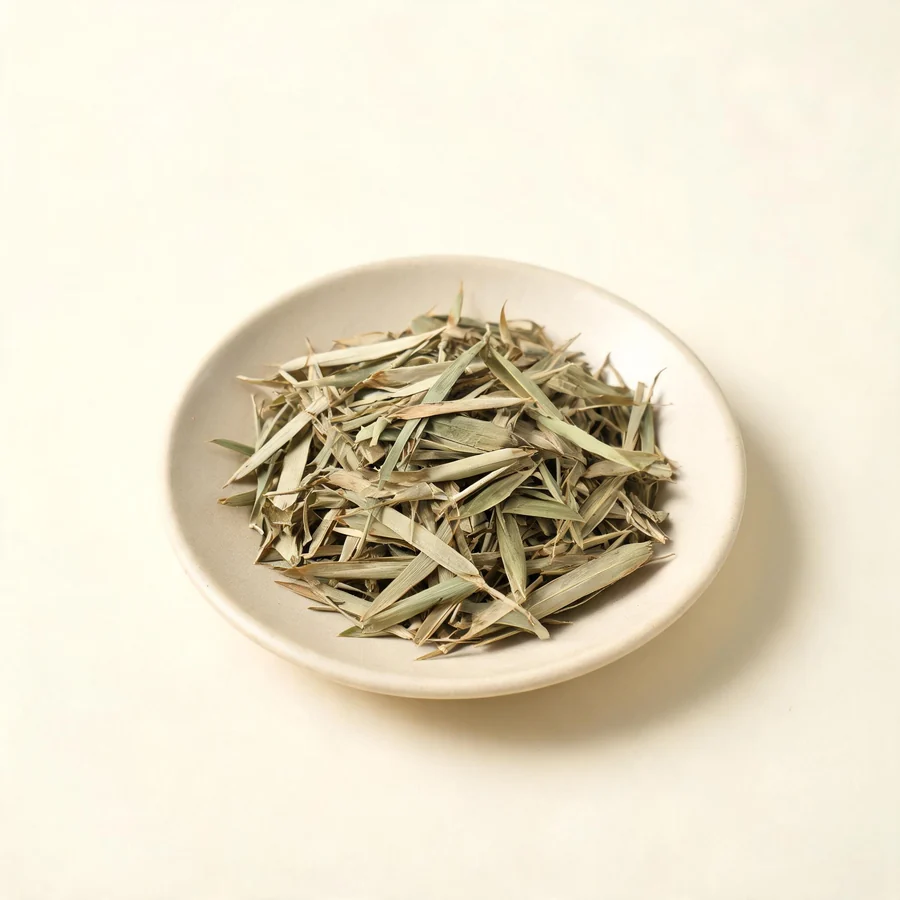
| Dilute wash | 10 to 15 g of dried leaf simmered in 500 ml of water for 10 minutes, strained and cooled to skin temperature. Cloth or gauze is soaked, wrung out and dabbed over the prickling area, then the skin is left to air dry. It is used once or twice daily and discarded after each use. |
| Cooling bath for a child | A strained, cooled decoction added to a shallow lukewarm bath, about 20 g to a small tub. The child is not left alone, the water is not cold, and the skin is patted dry rather than rubbed. |
Patch test and cautions
Patch test on the inner forearm for a day before the first use, especially in a child. Do not use on broken, weeping or infected skin, keep the wash away from the eyes and mouth, and stop if the skin stings or reddens further. A wash is not a substitute for cooling the room and loosening clothing.
Safety for skin use
What to check before recommending or using it, including the cautions that matter most for skin patients.
Do not use, or use with caution
- Digestion that runs cold: a leaf of this temperature burdens an already cold Stomach, bringing loose stools, a heavy feeling and a falling appetite, and a long course makes it worse.
- No heat at all, or dryness without heat: a cold diuretic given for a cold, dry condition drains fluid and leaves the person lower than before.
- Frequent urination from Kidney deficiency: the leaf adds to fluid loss instead of correcting it, and the same applies to a dry, depleted person with no heat.
- Pregnancy, unless a practitioner has prescribed it. The classical caution rests on the cold draining nature and on fluid loss, not on any recorded action on the womb.
Pregnancy and breastfeeding
Classical sources advised against it: the Pin Hui Jing Yao says pregnant women should avoid the leaf, and the objection rests on its cold, draining nature and on fluid loss rather than on any recorded action on the womb. Where a practitioner uses it, the prescription is short, the amount kept to the standard range, and the indication a clearly hot picture. No data exist on how much reaches breast milk; a short course for clear heat is unlikely to matter, while daily use over weeks is better avoided while nursing.
Interactions
- Diuretics: additive fluid and electrolyte loss, which matters in an older person or in someone treated for heart failure, where the balance is already being managed with a medicine.
- Antipyretics: animal work shows a mild temperature-lowering effect, so combining the leaf with paracetamol or an anti-inflammatory may add to it. This matters mainly when a fever is being followed as a sign of illness rather than treated for comfort.
- Glucose-lowering medicines: bamboo leaf flavonoids inhibited alpha-amylase in laboratory work, so insulin or a sulphonylurea could in theory act more strongly. Test more often and tell the prescriber rather than changing a drug dose.
Allergy and patch testing
A dilute wash should be patch tested on the inner forearm for a day. Bamboo is a grass, and a person with grass pollen allergy should watch for itching or redness where a wash is applied. Stop if the skin reacts, and do not use a wash on broken skin.
General safety references
General references for herbal hepatotoxicity and herb-drug interactions; they are not specific to this herb.
- Review article: Herbal hepatotoxicity - an update on traditional Chinese medicine preparations. Alimentary Pharmacology & Therapeutics, 2014. PMID: 24844799.
- Interactions between herbal medicines and prescribed drugs: an updated systematic review. Drugs, 2009. PMID: 19719333.
- Warfarin and food, herbal or dietary supplement interactions: a systematic review. British Journal of Clinical Pharmacology, 2021. PMID: 32478963.
Evidence
The classical record is quoted with its source. The modern note states the level of evidence plainly.
Classical record
竹叶,味苦平。主咳逆上气,溢筋急,恶疡,杀小虫。
Bamboo leaf is bitter in taste and level in nature. Its chief indications are cough with Qi rebounding upward, tightness and cramp in the sinews, malignant sores, and it destroys small worms.
Shen Nong Ben Cao Jing (Divine Husbandman's Classic of Materia Medica), Han compilation - The earliest entry names sores and parasites but says nothing of heat, irritability or urine, all of which the later tradition built.
竹叶清香透心,微苦凉热,气味俱清。治温以清,专清心气,味淡利窍,使心经热血分解。主治暑热消渴,胸中热痰,伤寒虚烦,咳逆喘促,皆用为良剂也。
The leaf carries a clear fragrance that reaches the Heart. Slightly bitter and cooling, both its Qi and its flavour are light, and it treats warm disease by clearing. It works on the Qi of the Heart in particular, its bland flavour opens the orifices, and it breaks up heat in the blood of the Heart channel. It is a good remedy for summerheat with wasting thirst, hot phlegm in the chest, the restless debility after a cold, and cough with wheezing.
Yao Pin Hua Yi (Collected Explanations of Materia Medica) - The passage that set the reading used ever since, joining the fragrance, the lightness and the Heart; later descriptions are largely a restatement of it.
退虚热烦躁不眠,止烦渴,生津液,利小水,解喉痹,并小儿风热惊痫。
It withdraws deficiency heat with restlessness and sleeplessness, settles vexing thirst, generates fluid, frees the passing of urine, relieves throat blockage, and treats wind-heat fits in children.
Ben Cao Zheng (Corrections to Materia Medica) - A compact list that matches the modern indications closely, including the paediatric use for febrile convulsion.
Modern evidence
Evidence status
- Laboratory work on bamboo leaf flavonoids reports antioxidant activity, mild antipyretic and diuretic effects in animals, and alpha-amylase inhibition in vitro. No clinical trial of the leaf in skin disease was identified, and the traditional skin uses rest on the framework rather than on trial evidence.
- Safety status: the dried leaf is not classed as toxic, and adverse effects at standard doses are not recorded. The practical limits are its coldness, its diuretic effect and the pregnancy caution, not toxicity.
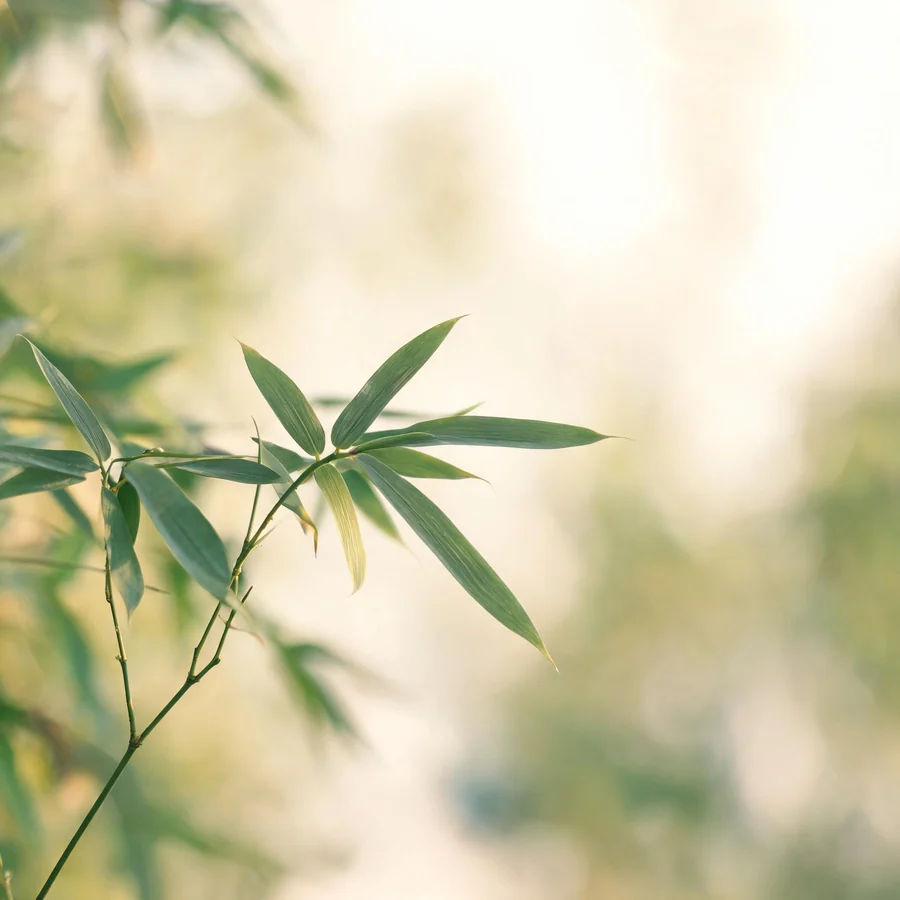
- Regulatory status: bamboo leaf is an accepted article in the Chinese Pharmacopoeia under Folium Phyllostachyis. Material sold under the same common name may be the related grass Lophatherum, which is a different drug with a stronger diuretic action.
PubMed records
Selected real PubMed records for this herb's species or its constituents, chosen by species name and title relevance. They are references for the non-TCM discussion above, not proof that the herb treats any skin condition.
- Phyllostachys nigra Munro var alleviates inflammatory chemokine expression and DNCB-induced atopic-like dermatitis in BALB/c mice.. Journal of ethnopharmacology, 2024. PMID: 37506780 (skin-related record).
Dose and forms
Skin-practice dosing and the preparations that suit skin complaints.
| Form | Dose and notes |
|---|---|
| Decoction | 6 to 12 g of dried leaf daily for skin use, inside a formula. It goes in during the last 10 to 15 minutes of boiling, because a long simmer is said to drive off the light, rising quality on which the clearing depends. |
| Fresh leaf | The fresh leaf is used at a slightly higher weight than the dried, since drying costs some of the aromatic quality. It is rinsed and added near the end of the decoction. |
| Rolled tips | The young curled tips are more concentrated and are used at 3 to 6 g. They are the form named in the warm disease prescriptions for heat that has entered the pericardium. |
| Children | A third to a half of the adult dose, by age and weight, in a short course. A febrile convulsion is an emergency that needs medical care before any herb. |
The dose is limited by coldness and by the diuretic effect, not by toxicity. Six to twelve grams of the dried leaf covers most skin use inside a formula, and the top of the range is for marked heat with thirst and restlessness. The leaf is added near the end of boiling, and a cold, depleted person who develops loose stools or a heavy stomach is showing that the dose or the course is too much.
Citations and further reading
Only real sources are listed: the classical materia medica passages quoted above, and the source works behind the botanical and safety statements.
- Shen Nong Ben Cao Jing (Divine Husbandman's Classic of Materia Medica), Han compilation - classical entry quoted above.
- Yao Pin Hua Yi (Collected Explanations of Materia Medica) - classical entry quoted above.
- Ben Cao Zheng (Corrections to Materia Medica) - classical entry quoted above.
- Folium Phyllostachyis monograph: Pharmacopoeia of the People's Republic of China - accepted source, part and quality requirements.
- Modern evidence statement: based on published laboratory work on bamboo leaf flavonoids and on animal studies of antipyretic and diuretic activity; no clinical trial in skin disease is presented as proof.
- Botanical description and identification: botanical literature on Phyllostachys nigra var. henonis, Poaceae.
Educational reference for qualified practitioners. This page is not medical advice, and skin conditions should be diagnosed by a clinician before treatment.