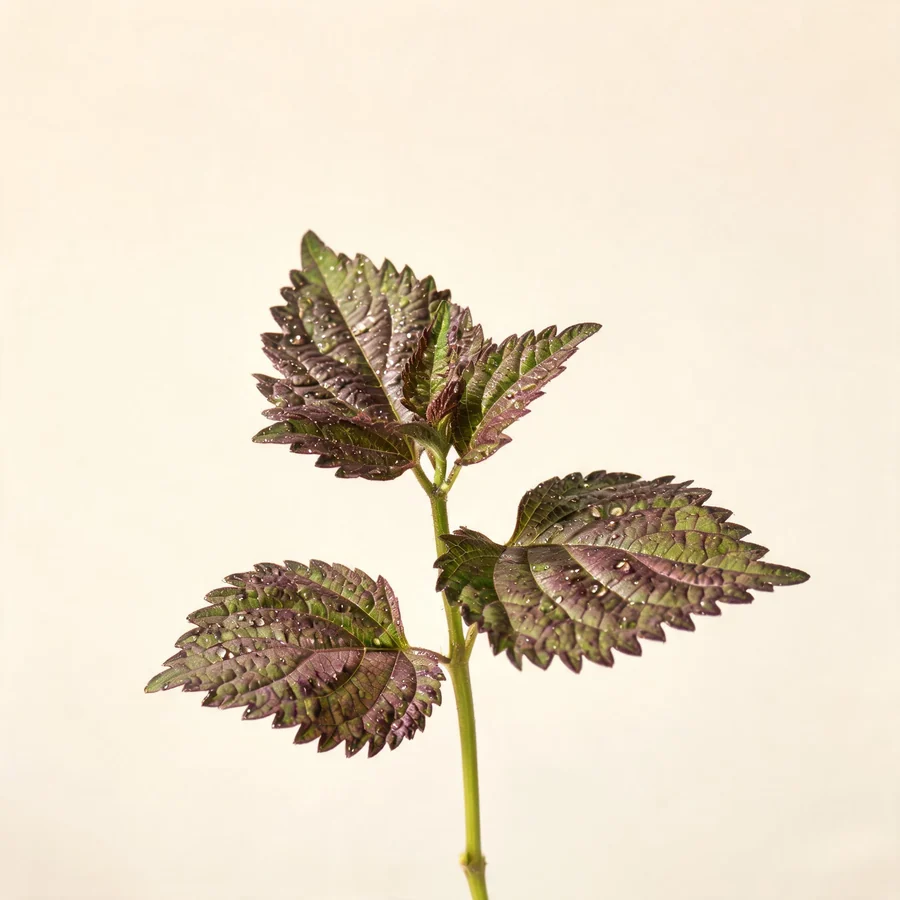
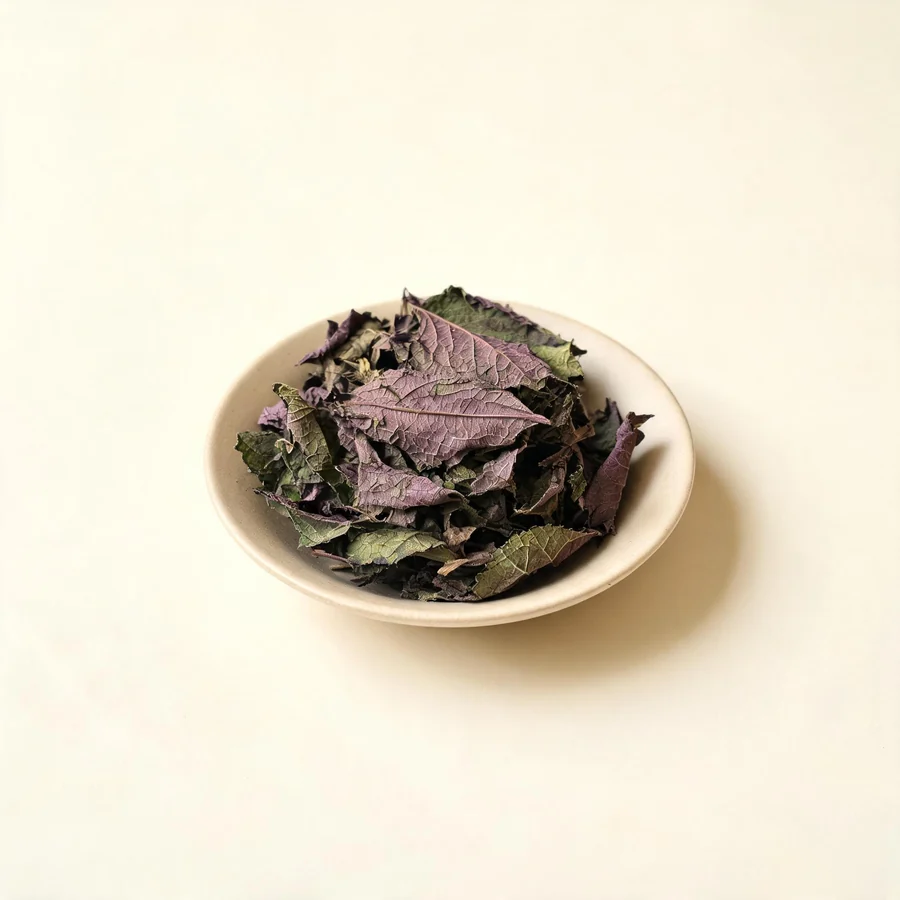
Skin profile
Where this herb sits in skin practice: the pattern it corrects, the skin signs it suits, and what it should not be used for.
Zi Su Ye is the warm, gentle leaf for skin that reacts to cold: pale wheals, itch after cold wind, and a rash that is slow to surface. It works by opening the surface and moving Qi, it suits short courses, and it is the wrong herb once the skin is red, hot and weeping.
Skin signs that suggest it
- Pale pink or white wheals that rise on cold exposure and settle in warmth
- Itch that begins on the neck, shoulders or other exposed skin after cold wind
- Skin that feels cool and clammy, with gooseflesh and no redness
- A rash that is slow to appear, with chills, sneezing and a blocked nose
- Hives or a flare after shellfish, with nausea and a tight, full abdomen
When it is not the right herb
Not for skin that is red, hot, weeping or crusted, which needs cooling and drying rather than warming and dispersing. Not for wind-heat with a sore throat, high fever and yellow sputum, and not for the dry, pale, itchy skin of blood deficiency, where the itch is worse at night and the skin has lost its moisture. It is a short-course herb: given for months it draws on the Qi it is meant to move. A rash with fever, blistering, bruising or mucosal involvement is not a case for a leaf.
What it does for skin
Skin-relevant actions only. Each one describes a mechanism in TCM terms and what it looks like on the skin.
Releases Wind-Cold from the surface
The leaf is warm, light and aromatic, and its first action is to open the surface and push out Cold that has closed it. On the skin that shows as the cold-provoked reaction: wheals that appear within minutes of going outside, itch that starts where the wind hits, and a general coolness and gooseflesh over the area. It is given early, while the reaction is still at the surface, and it is paired with other warm dispersing herbs rather than used alone.
Moves Qi and eases the tight chest that comes with the flare
Perilla leaf is as much a Qi-moving herb as an exterior-releasing one, and the two actions meet in the person whose skin reacts when they are tense: a tight chest, a blocked nose, a full abdomen and an itch that starts at the same moment. Moving Qi does not treat the skin directly, but it removes the constraint that keeps the surface closed, which is why the leaf is paired with Xiang Fu and Chen Pi when a chill settles into someone who is wound tight.
Helps an eruption come out when it is slow to surface
In the old practice a rash that was faint and slow to appear, with chills and no sweat, was treated by warming and releasing the surface so that the eruption could complete itself, and the leaf was one of the mild herbs used for that job in children. The reasoning belongs to an era before the diseases in question were understood, and modern use is limited: a rash that is not coming out, or one with fever, needs a diagnosis rather than a warming leaf.
Disperses the toxin of fish and crab
The classical indication for fish and crab poison is a food use as much as a medical one, and it survives in the custom of serving perilla with shellfish. The reasoning is that fish and crab are cold and damp and that a warm aromatic leaf counters them, which is why it was given for the nausea, abdominal pain and hives that follow a bad meal. It is a historical use: true shellfish poisoning and bacterial gastroenteritis need medical care, and a leaf is no substitute for fluids and assessment.
Skin conditions it is used for
Mapped to the condition pages on this site. The pattern column shows what the skin is doing when this herb is the right choice.
| Condition | Pattern | Why it suits | Typical setting |
|---|---|---|---|
| Urticaria | Wind-Cold wheals provoked by cold exposure | Pale wheals that rise when a person goes out into cold air or undresses in a cool room, and fade once warm, are the clearest skin expression of Wind-Cold. The leaf is used for exactly that pattern and not for the hot, red wheal: it warms and disperses, and it is combined with Fang Feng, Jing Jie and fresh ginger so that the surface opens and the reaction settles. Persistent or cold-induced hives should still be assessed, because cold urticaria can be associated with other conditions. | A wind-cold formula with Fang Feng, Jing Jie and Sheng Jiang |
| Itchy skin | Wind-Cold held at the surface with Qi stagnation | When itch arrives with cool, pale skin and a tight chest, and settles once the person warms up, the reading is Wind-Cold held at the surface with Qi unable to move. The leaf addresses both halves: it disperses the cold and gets the Qi moving, so it suits the winter itch of an otherwise healthy person better than the dry itch of deficiency. It is a supporting herb and is not used alone for generalised itch. | With Fang Feng, Chen Pi and Sheng Jiang in a warming formula |
| Cool or clammy skin sensation | Wind-Cold-Damp on the surface with weak defensive Qi | Skin that feels cool and clammy, with gooseflesh and a dislike of draughts, is read as Cold and Damp sitting at the surface while the defensive Qi fails to hold them out. The leaf warms and releases the surface, and it is paired with herbs that support the defensive Qi rather than with strong sweating herbs that would drain it further. Sudden cold clamminess with chest pain or breathlessness is an emergency, not a pattern. | With Huang Qi and Bai Zhu in a formula that supports the surface |
| Macular rash | Wind-Cold holding the rash at the surface so that it stays faint | A flat rash that is faint, slow to spread and accompanied by chills and a blocked nose was read as an eruption that had not completed its outward movement. The traditional response was to warm and release the surface with a mild aromatic leaf, and perilla was one of the herbs used for it in children. The reading is historical: a feverish rash needs a diagnosis, the leaf is never used where the rash is already bright and fully out, and it is not given in heat patterns. | With Jing Jie and Fang Feng in a surface-releasing formula |
Combinations for skin
Herbs it is paired with when the skin, not an internal organ, is the target.
| Partner | Ratio | Why the pair is used |
|---|---|---|
| Sheng Jiang | 3 to 6 g Sheng Jiang with 5 to 10 g Zi Su Ye | Fresh ginger brings warmth to the middle and quiets a queasy Stomach while the leaf releases the surface, so the pair covers both halves of the picture where a cold arrives with nausea and a tight abdomen. It is the household version of the treatment, taken as a warm infusion at the first chill, and it is used for a day or two rather than as a course. |
| Chen Pi | 5 to 10 g each | Tangerine peel dries dampness and moves Qi in the middle, and perilla leaf moves it at the surface, so together they reach a flare that comes with a coated tongue, a full epigastrium and nausea. Both are mild enough for an everyday infusion, and this is the usual pairing when a cold-provoked rash arrives with digestive heaviness rather than with fever. |
| Fang Feng | 6 to 10 g each | Fang Feng is the stronger wind-disperser and it works at the surface without adding much warmth, so it carries the leaf's action outward for wheals and wandering itch. Both are used at the start of a cold-provoked reaction, and the pair is the core of the warm, surface-releasing approach to urticaria. Neither is strong enough for a settled, deep eruption. |
| Jing Jie | 6 to 10 g each | Jing Jie is the other warm exterior herb, and it is the one chosen when the skin is the main battlefield: it reaches eruptions and itch more directly than the leaf does. Adding perilla leaf brings the Qi-moving and Stomach-settling action, so the pair suits a cold-provoked rash in a person who is also nauseated and tense. Where itch alone is the problem, Jing Jie carries more of the work. |
Formulas where it leads
- Xiang Su San (香苏散) - The mild formula of perilla leaf with Xiang Fu, Chen Pi and liquorice, built for an early cold that settles in a tense person with a constricted chest and little appetite. Its relevance to the skin is indirect: it is the formula that shows the leaf's Qi-moving half, which is the half that matters when a flare arrives with constraint.
Safety for skin use
What to check before recommending or using it, including the cautions that matter most for skin patients.
Do not use, or use with caution
- Heat patterns: red, hot, weeping or crusted skin, a sore throat with fever, or yellow sputum. A warm dispersing leaf adds to heat rather than clearing it.
- Dry, pale, itchy skin of blood or Yin deficiency, with sweating at night and a parched mouth. The leaf opens the pores and disperses, which loses more of the moisture the skin has already lost.
- Qi deficiency with spontaneous sweating and a dislike of draughts, where a dispersing leaf makes the surface leak further.
- Prolonged use. The classical commentary warns that a long course draws off the body's Qi, so a skin course stops when the flare settles rather than continuing for months.
Pregnancy and breastfeeding
Traditionally regarded as one of the gentle herbs used to settle a pregnancy and eaten as a food, so it is not prohibited. The evidence for that reputation is traditional rather than clinical, and the skin use is a short course for a cold-provoked flare. Keep the dose in the ordinary range, avoid combining it with strong dispersing or blood-moving herbs, and treat persistent vomiting or any bleeding in pregnancy as a medical matter rather than a reason to take more of the leaf.
Interactions
- Anticoagulants and antiplatelet medicines. Perilla may influence how platelets clump in laboratory work, so warfarin, aspirin or clopidogrel could in theory act more strongly alongside it, although no clinical report has been published.
- Glucose-lowering medicines. Animal work with perilla oil and perillaldehyde has reported raised glucose, the opposite of the usual herbal direction, so readings are worth checking in anyone on insulin or a sulfonylurea.
- Blood pressure medicines. Early animal work notes small cardiovascular changes, so the pairing is a theoretical caution rather than a known problem, and it is another reason to tell a prescriber about the leaf instead of treating a food as though it could do nothing.
Allergy and patch testing
Perilla is a mint-family leaf and belongs to the same family as basil and mint, so a person who reacts to those plants may react to it. Contact reactions to the leaf are uncommon and a culinary quantity is well tolerated, but a first medicinal dose should be watched, and a rash, swelling or breathlessness after taking it needs urgent attention.
General safety references
General references for herbal hepatotoxicity and herb-drug interactions; they are not specific to this herb.
- Review article: Herbal hepatotoxicity - an update on traditional Chinese medicine preparations. Alimentary Pharmacology & Therapeutics, 2014. PMID: 24844799.
- Interactions between herbal medicines and prescribed drugs: an updated systematic review. Drugs, 2009. PMID: 19719333.
- Warfarin and food, herbal or dietary supplement interactions: a systematic review. British Journal of Clinical Pharmacology, 2021. PMID: 32478963.
Evidence
The classical record is quoted with its source. The modern note states the level of evidence plainly.
Classical record
Its pungent flavour carries it into the qi level and its purple colour into the blood level. Paired with tangerine peel and Sha Ren it moves qi and steadies a pregnancy; with Huo Xiang and Wu Yao it warms the middle and relieves pain; with Xiang Fu and Ma Huang it opens the pores and releases the muscle layer.
Ben Cao Gang Mu (Compendium of Materia Medica), Li Shizhen - The point is that the leaf's destination is set by its partners, and the phrase that matters for the skin is the one about opening the pores and releasing the muscle layer, which is the surface action used for cold-provoked wheals.
Taken for too long it draws off the body's true qi, so the leaf suits a brief illness better than a long one.
Ben Cao Tong Xuan (本草通玄), on prolonged use - One line that fixes the duration rule: a warm dispersing leaf belongs to a short illness, and a skin course ends when the surface pattern has resolved.
Modern evidence
Evidence status
- Laboratory and animal work on perilla leaf, its volatile oil and its rosmarinic acid content reports anti-inflammatory and anti-allergic activity, including reduced scratching and lower histamine release in rodent models. These are mechanistic studies, and the doses do not translate directly into a cup of leaf infusion.
- Human evidence in skin disease is very limited. Perilla extracts have been studied in small trials for other indications, and the leaf appears mostly as one ingredient in multi-herb formulas, so no conclusion about efficacy in urticaria or itch can be drawn.
- Perillone, a volatile constituent, caused fatal pulmonary oedema when given intravenously to animals at 10 mg per kg, while 40 mg per kg by mouth produced no such effect. The finding concerns the route of administration and an isolated constituent, and it is why the leaf is treated as a food rather than as a hazard.
PubMed records
Selected real PubMed records for this herb's species or its constituents, chosen by species name and title relevance. They are references for the non-TCM discussion above, not proof that the herb treats any skin condition.
- Comparison of the Anti-Inflammatory Activities of Supercritical Carbon Dioxide versus Ethanol Extracts from Leaves of Perilla frutescens Britt. Radiation Mutant.. Molecules (Basel, Switzerland), 2017. PMID: 28218690 (skin-related record).
Dose and forms
Skin-practice dosing and the preparations that suit skin complaints.
| Form | Dose and notes |
|---|---|
| Infusion or decoction | 5 to 10 g of dried leaf daily, stirred into a hot decoction for its final couple of minutes, or simply steeped in water just off the boil, because the volatile oil is the action and a long simmer drives it off. |
| Fresh leaf | A small handful, three to five leaves picked fresh, in a cup for a simple cold-provoked flare. Material used fresh is more potent, so work with about twice the dried quantity. |
| Course length | A few days, stopped once the flare settles. It is not a maintenance herb, and a reaction that keeps returning needs a pattern review rather than a longer course. |
The leaf goes in late. Its active fraction is volatile, and a twenty-minute simmer yields a brown brew that hardly smells of perilla and hardly works, which is why the leaf is added at the end or simply steeped. The quantity is modest because the herb is mild and because the aim is to open the surface briefly; a child receives somewhere between a third and half of what an adult takes. Taken for months, the same warmth and dispersal that help a cold-provoked flare begin to dry the skin and draw on the Qi, so the course ends when the skin has settled.
Citations and further reading
Only real sources are listed: the classical materia medica passages quoted above, and the source works behind the botanical and safety statements.
- Ben Cao Gang Mu (Compendium of Materia Medica), Li Shizhen, 1578 - classical passage translated above.
- Ben Cao Tong Xuan (本草通玄), Li Zhongzi, Ming dynasty - classical passage translated above.
- Perilla frutescens monograph: Pharmacopoeia of the People's Republic of China - source for the accepted botanical source, part used and quality requirements.
- Modern evidence statement: based on laboratory and animal literature on perilla leaf, its volatile oil and rosmarinic acid, summarised as a statement about the level of evidence rather than as a cited finding.
- Botanical description and identification: botanical literature on Perilla frutescens, Lamiaceae.
Educational reference for qualified practitioners. This page is not medical advice, and skin conditions should be diagnosed by a clinician before treatment.