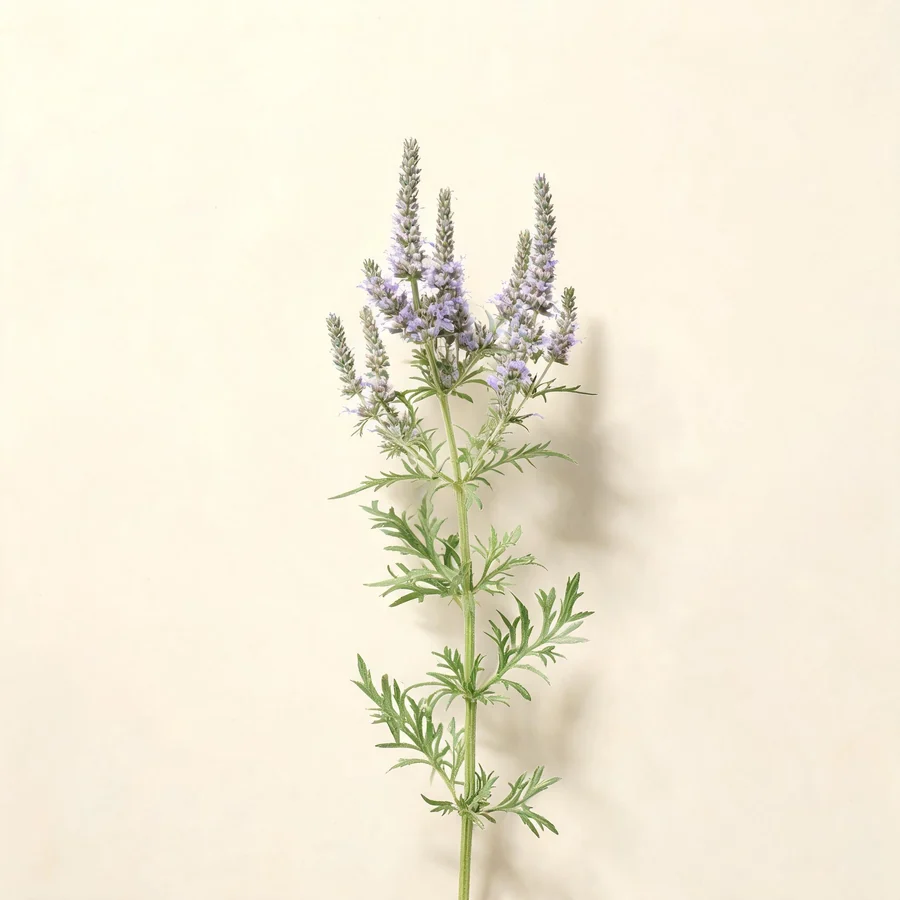
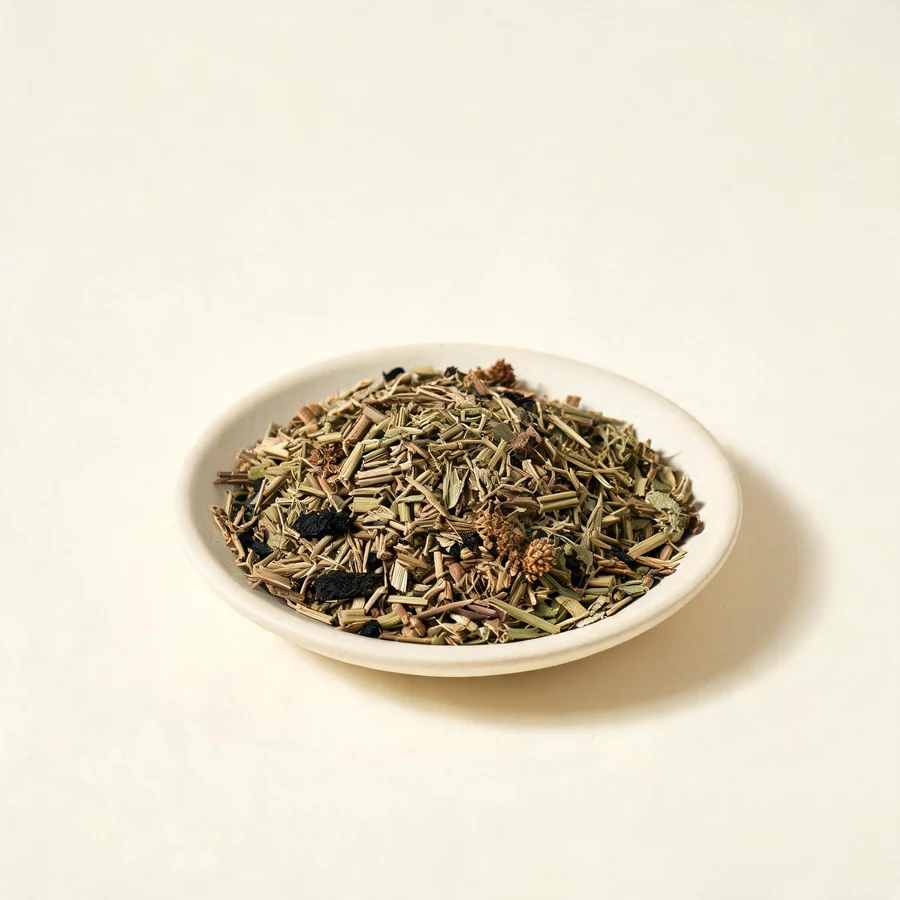
Skin profile
Where this herb sits in skin practice: the pattern it corrects, the skin signs it suits, and what it should not be used for.
Jing Jie is a herb of the moment. It fits an eruption that is still incomplete, an itch that still moves, or a sore that has not yet localised. Once the skin has settled into dryness, the treatment has to change.
Skin signs that suggest it
- Wheals that arrive, shift and melt away inside a few hours, often after exposure to wind, cold or a hot shower (wind in the skin)
- An itch that migrates about the body instead of settling in one patch (moving wind)
- An eruption that surfaced in a handful of spots and went no further, or receded after showing (an eruption that has not vented)
- A crawling, tickling itch under the skin, most troublesome at night and after perspiring
- A thin white or greasy coating on the tongue, with a floating pulse, during an acute itchy outbreak
When it is not the right herb
Not for skin that is already leaking: somebody who perspires with minimal effort and then feels chilled has a surface that cannot hold itself, and a dispersing, sweat-inducing herb will only make it weaker. Nor is it for parched, thin, blood-deficient skin with fine scaling and no wind element, since there is nothing at the surface to release. An eruption that has already finished, an ulcer that has opened and is discharging, and the tail end of a febrile rash are all the wrong moment for it.
What it does for skin
Skin-relevant actions only. Each one describes a mechanism in TCM terms and what it looks like on the skin.
Releases Wind from the surface
Wind is how this tradition describes an itch that refuses to stay put, and Jing Jie is the gentlest dependable means of pushing it back through the skin. It opens the pores without forcing a drenching sweat, so it can be repeated during a subacute outbreak without draining the person. On the skin that shows as less need to scratch, a quieter crawling sensation and wheals that subside sooner. Fang Feng is its almost constant partner, and the two together form the basic wind-releasing unit in skin prescribing.
Vents an eruption that has stalled
When a heat rash, a measles-like eruption or an itchy papular rash only half emerges, the heat left behind is understood to be sealed under a closed surface. Jing Jie opens that surface so the eruption can complete, and it needs other venting herbs to do it, because one dispersing plant cannot bring a rash out by itself. The right moment is while the eruption is still undecided; once it has spread, the herb is withdrawn, since dispersing a rash that has already finished weakens the surface.
Quiets itch that has reached the Blood level
Jing Jie's entry into the Liver channel, the reservoir of the Blood in this tradition, means its force is held to reach wind that has gone deeper than the surface. That is the thinking behind its place in the standard formula for chronic itch, where it works alongside herbs that nourish and move the Blood. It fits itch on skin that is normal or only slightly dry, with no active ooze, and it matters less when damp-heat is making the surface weep.
Disperses swelling as a sore begins
Before a boil or carbuncle settles, there is a stage of surface congestion with shivering, fever and a stiff neck, and the swelling has no clear centre. The light, dispersing quality is used then to ease the congestion and help the body break the lesion up before it hardens. Once the sore has burst and begun to discharge, the same outward force starts to work against healing, and the herb is dropped. It is a narrow action tied to a stage rather than to a diagnosis.
Stops bleeding when charred
Frying the herb until the outside blackens and the inside darkens replaces dispersal with astringency. The charred form is given when blood has escaped the vessels and needs binding rather than moving, including blood that has leaked into the skin in heat-type purpura. It is a separate medicine rather than a stronger version of the raw herb, and the two cannot be swapped for one another.
Skin conditions it is used for
Mapped to the condition pages on this site. The pattern column shows what the skin is doing when this herb is the right choice.
| Condition | Pattern | Why it suits | Typical setting |
|---|---|---|---|
| Urticaria | Wind in the skin with wheals that move and fade | Wheals that shift position, itch fiercely and are gone within a day are the clearest wind picture in skin practice. Jing Jie contributes the dispersing half of the treatment, opening the surface so the wheals can resolve, while cooling herbs in the same formula deal with any heat. It fits wheals triggered by wind, cold or a sharp change in temperature, and the standard wind formula includes it among its leading herbs. | Xiao Feng San, or Jing Jie with Fang Feng, Chan Tui and Bai Xian Pi |
| Chronic urticaria | Wind lodged in the Blood on a background of Blood deficiency | Once wheals have recurred for months, this tradition stops reading them as a purely surface event and treats wind as having taken up residence in the Blood, usually with dryness, a pale tongue and a background of depletion. Jing Jie still provides the outward push, but as a junior member of a formula that builds the Blood, so the surface is not left unsupported. The balance is the point: dispersing on its own in a depleted person tends to bring the attacks back more often. | Dang Gui Yin Zi, or a modified Xiao Feng San with Dang Gui and Bai Shao |
| Itchy skin with no primary rash | Wind in the surface with itch that moves | Itch with no visible primary lesion, particularly when it roams and is worse at night, is wind by definition here. Jing Jie is chosen less for an effect on the skin itself than for what it does to the movement, and it is given alongside Blood-nourishing, itch-quieting herbs so the result holds. It is a sensible opening herb for generalised pruritus when the skin surface is otherwise unremarkable. | Jing Jie with Fang Feng, Chan Tui and Bai Xian Pi in a modified Xiao Feng San |
| Eczema | Wind-damp itch in an acute or subacute flare | While an eczema flare is itchy, slightly raised and not yet weeping, Jing Jie adds surface release to the damp-heat clearing that drives the formula. Its contribution is symptomatic in the best sense, because it damps the scratch reflex that leads to lichenification. It is withdrawn once the lesions weep openly, since a surface that is wet needs drying, not opening. | Modified Xiao Feng San with Ku Shen and Bai Xian Pi |
| Contact dermatitis | External wind-heat at the point of contact | A rash confined to the place where something touched the skin, with redness, swelling and itch, is read as a pathogen that has struck the surface directly. The light dispersing action suits the acute stage, while the reaction is still superficial and the skin has not broken. A short course alongside cooling herbs is the usual approach, and it is stopped if the eruption turns vesicular or starts to ooze. | Jing Jie with Fang Feng, Chan Tui and Ku Shen as a short course |
| Macular rash that has not fully vented | Wind-heat with an eruption held back from the surface | A flat red eruption that shows in a few areas and then fades, in someone feverish, is understood as heat that has not entirely left by way of the skin. Venting helps the eruption finish, which this tradition considers safer than driving it back, and the herb is given with other surface medicines and with cooling herbs. In practice a febrile rash in a child should be assessed medically first, since the historical use long predates modern diagnostics. | Xuan Du Fa Biao Tang, or Jing Jie with Niu Bang Zi, Bo He and Chan Tui |
| Early boil with surface congestion | Wind and heat at the surface before the sore localises | A boil in its opening day or two, with shivering, fever, a stiff neck and a swelling that has not yet pointed, is treated by releasing the surface before the lesion consolidates. Jing Jie is one of a small group of dispersing herbs used at that stage, inside a formula that also clears heat and resolves toxin. After the boil opens, the dispersing herbs come out and the treatment changes direction. | Jing Fang Bai Du San in the early stage, then a toxin-resolving formula once it points |
Combinations for skin
Herbs it is paired with when the skin, not an internal organ, is the target.
| Partner | Ratio | Why the pair is used |
|---|---|---|
| Fang Feng | 6 to 10 g each in decoction | The standard wind pairing, and the reason a whole family of formulas carries both names. Fang Feng is the more forceful expeller and works on muscle and joint; Jing Jie is lighter, produces sweat more easily and works at the Blood level where itch originates. The two together reach both the skin and the tissue below it, which is how they came to replace the stronger warming diaphoretics in skin prescribing. When itch is the problem, add an itch-quieting herb instead of raising either dose. |
| Chan Tui | 6 to 10 g Jing Jie with 3 to 6 g Chan Tui | Cicada moult is light and ascending: it vents eruptions and settles the twitching, crawling quality of an itch that Jing Jie cannot address alone. The two are used together when an eruption is incomplete, or when hives come with restlessness, and they illustrate two dispersing herbs aimed at different targets rather than one doubled. Chan Tui brings almost no cooling, so a heat element needs a third herb. |
| Bo He | 6 to 10 g each | Peppermint is cool and clears the head and eyes, while Jing Jie, only slightly warm, supplies the push outward. The pairing suits a wind-heat picture with clear surface signs such as a sore throat, headache and a rash that has not settled. Jing Jie's warmth is so slight that the two can sit inside a cooling formula without adding heat, and equal parts is the customary proportion. |
| Bai Xian Pi | 6 to 10 g each | Bai Xian Pi is the skin-specific herb for wind-damp itch, and it dries where Jing Jie does not. The two are combined when itch coexists with a little moisture, as in a subacute eczema flare or a fungal itch. Bai Xian Pi handles the drying and the antifungal side while Jing Jie keeps the surface open, which explains why they are found together in washes as well as in decoctions. |
Formulas where it leads
- Xiao Feng San (消风散) - The standard formula for wind-heat with dampness, used when eruptions itch, redden and weep a little, and for urticaria. Jing Jie provides the surface release; the cooling and drying herbs deal with heat and ooze. It is the formula most often cited to show why a dispersing herb has a place in a skin prescription.
- Jing Fang Bai Du San (荆防败毒散) - For the opening stage of a sore, or an illness with shivering, fever, headache and no sweat. Jing Jie and Fang Feng take the lead. In skin practice it is used only while the lesion is still diffuse and unlocalised; once pus has formed it is the wrong instrument.
- Xuan Du Fa Biao Tang (宣毒发表汤) - A venting formula for a measles-type eruption slow to emerge, with fever, cough and red eyes. Jing Jie works with Niu Bang Zi, Bo He and Chan Tui to bring the rash out. Its indication is a febrile eruption in childhood, and such a rash needs medical assessment before any herbal approach.
Topical use
Externally, Jing Jie goes on as a wash or in a bath for itchy eruptions driven by wind, and it is among the herbs most frequently added to a medicated bath for hives. The aromatic oils that do much of the work evaporate, so the preparation is a fresh infusion or a brief decoction rather than a long simmer, and it is applied warm rather than hot. A wash of this kind relieves itch; it does not treat an infected or extensive eruption.
| Preparation | How and when it is used |
|---|---|
| Infusion wash | Put 10 to 15 g of dried aerial parts in a jug, pour over 500 ml of just-boiled water and leave for 15 minutes. Strain, let it cool to a comfortable warmth and sponge the itchy areas once or twice a day. Keep it away from the eyes and from broken skin, and mix a new batch each time because the aroma fades within a day. |
| Medicated bath | Tie roughly 30 g in a cloth and steep it in a comfortably warm bath, then soak for 10 to 15 minutes; this suits widespread itch and hives. Some people find that warmth itself provokes wheals, so keep the water lukewarm and get out if the itch worsens. |
| Combined wash with Fang Feng | About 10 g each of Jing Jie and Fang Feng, given a brief decoction and used as a wash. It is the external version of the internal wind pair and suits itchy eruptions on the limbs and trunk where the skin is unbroken. |
Patch test and cautions
Test a small patch of ordinary skin first, since contact reactions to aromatic mint-family plants do happen. Keep the preparation off open, weeping or infected areas, and do not use a hot bath when heat is what provokes the eruption. If the skin stings, burns or reddens further, stop. Avoid the eyes, and never put neat essential oil of the herb on skin.
Safety for skin use
What to check before recommending or using it, including the cautions that matter most for skin patients.
Do not use, or use with caution
- A surface that cannot hold itself, with sweating on little exertion followed by chill. Giving a dispersing, sweat-inducing herb to such a person adds to the loss rather than relieving the itch.
- Parched, thin, blood-deficient skin with fine scaling and no wind element. There is nothing superficial to release, and the herb's mild warmth can aggravate an internal heat picture with night sweats and a red tongue.
- An eruption that has already run its course, an ulcer that is open and discharging, and the closing stage of a febrile rash. Dispersal then opposes healing, and in a draining sore it depletes the tissue that is trying to close.
Pregnancy and breastfeeding
Reserve it for practitioner supervision, a clear indication, standard dose and a short course. It is not one of the herbs strongly avoided in pregnancy, because it neither moves the Blood with force nor stimulates the uterus, but its dispersing character is not negligible and it is never used just to make someone sweat. No reliable safety information exists for the concentrated oil, which should be avoided altogether. A small topical wash is generally thought to carry little risk; keep it off the abdomen and breasts, and stop if the skin reacts.
Interactions
- The volatile oil is broken down by liver enzymes that also clear many medicines, so it could in theory accelerate the clearance of drugs sharing those pathways and blunt their effect. Nothing has been confirmed in patients, but anyone on a drug with a narrow therapeutic window should let their prescriber know.
- Essential oil products are the real concern for liver load and interactions, because they concentrate the volatile fraction far beyond what a decoction contains. At ordinary decoction doses the amounts stay well under those used in the toxicity studies on isolated constituents.
- Antihistamines and sedatives are often taken alongside a herbal itch treatment. This herb does not increase drowsiness, but somebody already sleepy from medication should be cautious with a hot bath taken for itch, because of the risk of feeling faint.
Allergy and patch testing
Contact dermatitis from aromatic mint-family plants is a recognised problem, so anyone who reacts to mint, basil or another Lamiaceae should be wary of both the internal herb and any wash. Test a wash on the inner forearm for a day before using it widely. If the skin grows more irritated rather than calmer, stop at once; a herb that is safe to swallow is not automatically safe on damaged skin.
General safety references
General references for herbal hepatotoxicity and herb-drug interactions; they are not specific to this herb.
- Review article: Herbal hepatotoxicity - an update on traditional Chinese medicine preparations. Alimentary Pharmacology & Therapeutics, 2014. PMID: 24844799.
- Interactions between herbal medicines and prescribed drugs: an updated systematic review. Drugs, 2009. PMID: 19719333.
- Warfarin and food, herbal or dietary supplement interactions: a systematic review. British Journal of Clinical Pharmacology, 2021. PMID: 32478963.
Evidence
The classical record is quoted with its source. The modern note states the level of evidence plainly.
Classical record
主寒热,鼠瘘,瘰疬生疮,破结聚气,下瘀血,除湿痹。
It governs alternating cold and heat, scrofula and the sores that follow swollen lymph nodes, breaks up bound accumulations of Qi, moves stagnant Blood downward and removes damp impediment.
Shen Nong Ben Cao Jing (神农本草经) - The earliest entry, made under the name Jia Su, already ties the herb to sores and to the Blood level, the two ideas that later shape its skin use.
散风热,清头目,利咽喉,消疮肿。治项强,目中黑花,及生疮,阴颓,吐血,衄血,下血,血痢,崩中,痔漏。
It disperses wind-heat, clears the head and eyes, benefits the throat and reduces sore swellings. It treats neck stiffness, dark specks in the vision, sores, prolapse of the genitals, vomiting of blood, nosebleeds, bleeding from below, bloody dysentery, uterine flooding and haemorrhoidal fistulae.
Ben Cao Gang Mu (本草纲目), Li Shizhen - The line about reducing sore swellings is what later pharmacy used to justify the herb at the start of a boil, before the lesion settles.
凡一切风毒之证,已出未出,欲散不散之际,以荆芥之生用可以清之。
For every pattern of wind-toxin, whether the eruption has appeared or not, at the moment when it wants to disperse but has not, the raw herb can clear it.
Ben Cao Hui Yan (本草汇言) - The most exact classical description of venting: the herb belongs to the undecided moment, when a rash is neither out nor held back.
Modern evidence
Evidence status
- Cell and animal studies of the volatile oil describe antioxidant and anti-inflammatory activity, and the isolated constituents pulegone and menthofuran are liver-toxic in concentrated form. Those results concern the oil, not a water decoction, and they underpin the warning about essential oil products rather than about the dried herb.
- Trial evidence for Jing Jie in skin disease is thin. Chinese-language reports tend to study compound formulas such as Xiao Feng San rather than the single herb, and this page found no adequately controlled trial of Jing Jie alone in urticaria or eczema.
- Regulatory position: the dried aerial parts hold a monograph in the Chinese Pharmacopoeia, and the herb appears widely in over-the-counter cold and itch remedies in China. What is written here describes traditional practice and the current state of the evidence; it is not a claim of proven benefit.
PubMed records
Selected real PubMed records for this herb's species or its constituents, chosen by species name and title relevance. They are references for the non-TCM discussion above, not proof that the herb treats any skin condition.
- Review on Chemical Constituents of Schizonepeta tenuifolia Briq. and Their Pharmacological Effects.. Molecules (Basel, Switzerland), 2022. PMID: 36014489 (pharmacology or review record).
- Schizonepeta tenuifolia: chemistry, pharmacology, and clinical applications.. Journal of clinical pharmacology, 2002. PMID: 11817365 (pharmacology or review record).
Dose and forms
Skin-practice dosing and the preparations that suit skin complaints.
| Form | Dose and notes |
|---|---|
| Decoction | 4.5 to 9 g of dried aerial parts a day, within a formula, stirred in for the final five to ten minutes. Prolonged boiling drives off the aromatic oils that carry much of the effect. |
| Powder | 1.5 to 3 g at a time as a fine powder, swallowed with warm water or added to a decoction at the end. Powder suits a short course in which the volatile fraction matters. |
| Charred form | Jing Jie Tan, at 4.5 to 9 g, when bleeding is the target, including heat-type purpura with a wind element. Charring lowers the volatile oil and adds astringency, so it cannot stand in for the raw herb where itch is the problem. |
| Topical wash | 10 to 15 g steeped in 500 ml of hot water for a wash, or around 30 g in a bath, once or twice a day for itchy areas. Make it fresh, as both scent and effect are gone within a day. |
Timing, form and length of course matter more than the exact weight. The aromatic oils do the work, so the herb goes into the pot late and the decoction is not reduced for an hour. Raw and charred point in opposite directions, one opening the surface and venting a rash, the other binding and staunching blood. And because this herb belongs to the acute or subacute phase of an itchy eruption, a course that drags on for months without review usually means the underlying pattern has moved on.
Citations and further reading
Only real sources are listed: the classical materia medica passages quoted above, and the source works behind the botanical and safety statements.
- Shen Nong Ben Cao Jing, an attributed Han-period compilation - the first classical passage quoted above, where the herb is listed as Jia Su.
- Ben Cao Gang Mu, Li Shizhen, 1578 - classical passage quoted above.
- Ben Cao Hui Yan, Ming dynasty - classical passage quoted above.
- Pharmacopoeia of the People's Republic of China, Schizonepetae Herba monograph - basis for the accepted source species, plant part and quality standards.
- Botanical identification: taxonomic literature on Schizonepeta tenuifolia in the Lamiaceae, including how it differs from Nepeta cataria and from regional Schizonepeta species.
- Modern evidence: a summary of pharmacological work on the volatile oil and its constituents, given as an assessment of the level of evidence rather than as a cited result.
Educational reference for qualified practitioners. This page is not medical advice, and skin conditions should be diagnosed by a clinician before treatment.