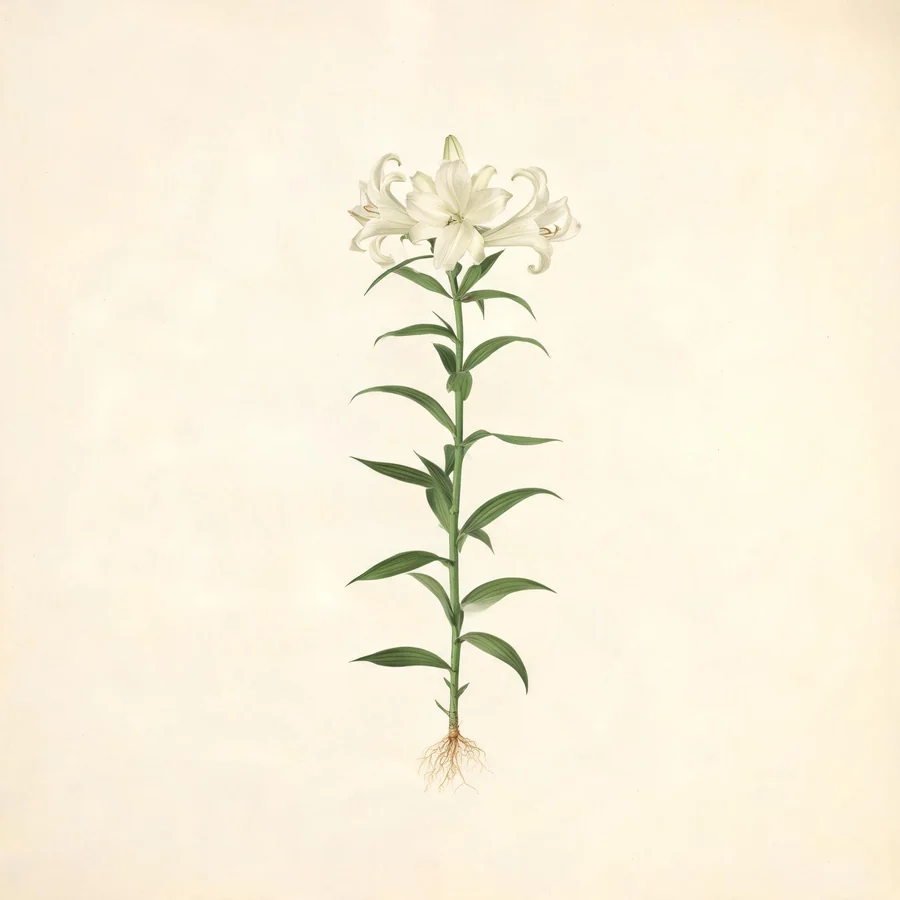
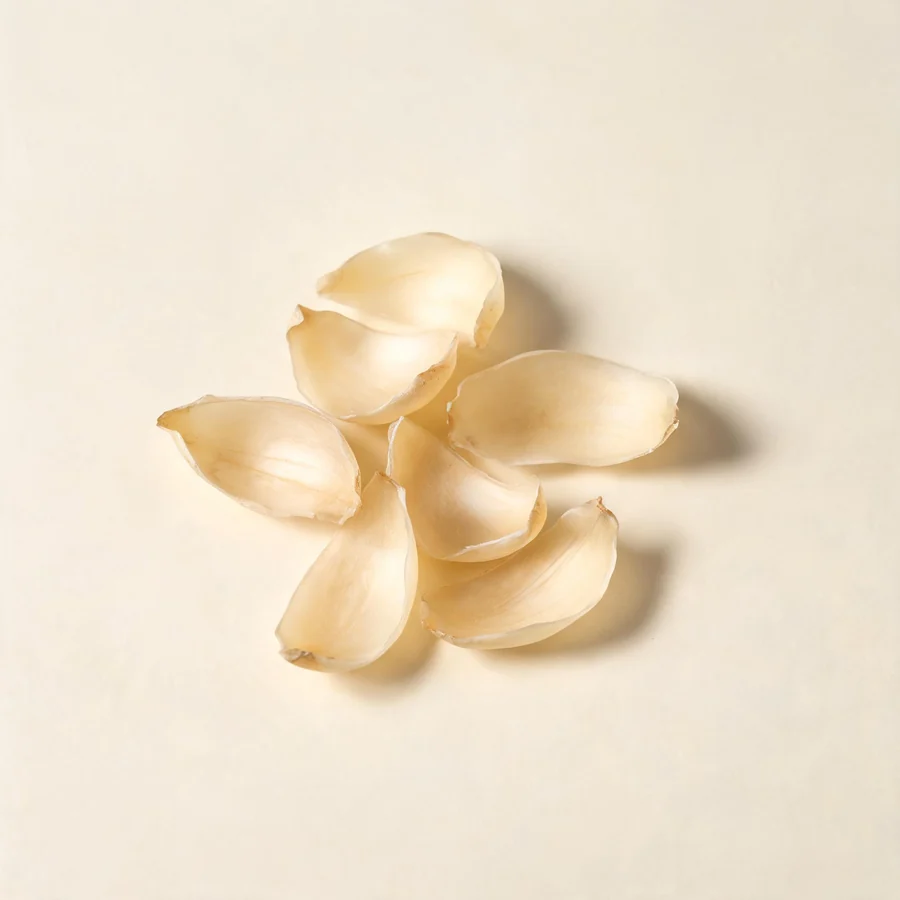
Skin profile
Where this herb sits in skin practice: the pattern it corrects, the skin signs it suits, and what it should not be used for.
Bai He is a moistening tonic for dry, thin, tight skin on a depleted background. It is not an anti-inflammatory herb, it will not settle a weeping flare, and it is stopped as soon as the tongue coat turns greasy.
Skin signs that suggest it
- Dry, thin, papery skin with fine white scaling over the shins, forearms and cheeks
- Skin that feels tight after washing and stings in cold dry air or central heating
- Night-time itch with no rash, worse in dry weather and eased by cool moisture
- A dry throat and a tickly unproductive cough alongside the skin dryness
- A red tongue with a scanty or peeling coat, and a fine rapid pulse
When it is not the right herb
Not for a wet, oozing or crusted lesion, and not for a greasy yellow tongue coating, because a moistening bulb adds to Dampness. Not while there is active infection, spreading redness or pus. Not for cold, pale, puffy skin with a weak appetite, where warming and drying is wanted instead. Not for a dryness that is also hot, red and angry, which needs cooling and blood-cooling herbs before any tonic. And not as a substitute for emollient care, which remains the mainstay of dry skin whatever the pattern.
What it does for skin
Skin-relevant actions only. Each one describes a mechanism in TCM terms and what it looks like on the skin.
Replenishes the fluid that keeps skin supple
The Lung is described as the organ that governs the skin and its hair, and its Yin is the moisture that reaches the surface. When that moisture is short the skin loses its plumpness, scales finely and feels tight, and no amount of oil on the outside corrects it. Bai He is sweet and slightly cool, and it is described as generating fluid, so it is used where dryness sits on a depleted background rather than on an inflamed one. It is given in a formula over weeks, and the change is gradual: the surface feels less tight before it looks any different.
Cools a low-grade heat that dries the surface from within
A dry skin is often dry because a mild, persistent heat is evaporating its moisture, which is why the dryness comes with warmth in the chest and palms in the evening, a dry mouth and a restless night. The bulb's slight coldness is described as clearing that deficiency heat without the harshness of the bitter-cold herbs. This is a different job from draining an acute fire: there is no red, swollen lesion to clear here, only a slow loss of moisture that leaves the surface thin and irritable.
Settles the spirit when itch and broken sleep reinforce each other
The bulb enters the Heart, and the tradition uses it for restlessness and light sleep with palpitations and a dry mouth. In skin practice the relevant version is the itch that arrives at night, wakes the person and is made worse by the broken sleep that follows. It is not a sedative and will not stop an acute itch, but as a background herb it addresses the dryness and the agitation together, which is why it appears in formulas for the dry itching skin of an exhausted or convalescent person.
Suits convalescence, dry climates and older skin
Because it is a food, the bulb is well tolerated by people who cannot take strong medicine: after a febrile illness, in a heated house in winter, and in older skin that has thinned and lost its oil. It is cooked into congee or soup at food doses in those settings, which is a reasonable way to take a moistening herb over a long period. The caution is the same at food doses as at medicinal ones: if the tongue coat turns greasy, the moisture is becoming Dampness and the bulb should stop.
Skin conditions it is used for
Mapped to the condition pages on this site. The pattern column shows what the skin is doing when this herb is the right choice.
| Condition | Pattern | Why it suits | Typical setting |
|---|---|---|---|
| Skin dryness | Body Fluids Deficiency with Lung dryness | A dry, finely scaling surface with a dry throat, a scanty tongue coat and a history of a long illness or a dry climate fits the picture of fluid that has never been replaced. The bulb is a moistening tonic rather than an emollient, so it is used inside a formula while oil or cream protects the surface from outside. It is stopped if the skin becomes greasy or the tongue coat thickens, which means the fluid is stagnating instead of being used. | Bai He Gu Jin Tang, or a modified moistening formula with Mai Men Dong and Sheng Di Huang |
| Dry and hot skin | Empty-Heat from Yin deficiency | Skin that is both dry and hot, with warmth in the palms and chest in the evening, a dry mouth and a restless night, is read as Yin that has run low so that a thin heat has nothing to hold it. The bulb's slight coldness and its moistening quality address both halves, and it is paired with herbs that cool the blood and nourish Yin. If the skin is bright red, swollen and tender, that is excess heat and a different approach entirely. | Bai He Gu Jin Tang with Sheng Di Huang and Mu Dan Pi |
| Ichthyosis | Yin and Blood Deficiency with a dry, scaled surface | The fish-scale dryness of ichthyosis is read as long-standing Yin and Blood deficiency, where the surface has been under-nourished for so long that it has thickened and split into plates. No herb reverses that, and the bulb is not presented as a cure; its role is the moistening part of a formula that also nourishes blood, working alongside emollients, which remain the mainstay. The realistic aim is a softer, less brittle surface, and the timescale is months. | Bai He Gu Jin Tang with Dang Gui and Shu Di Huang, alongside emollient care |
| Senile pruritus | Liver and Kidney Yin deficiency with dry night itch | Itch without a rash in an older person, worse at night and in winter, with dry thin skin, a dry mouth and a scanty tongue coat, is read as Yin deficiency that leaves the surface unmoistened. The bulb is a gentle background herb here, and it is combined with blood-nourishing and wind-settling herbs. Persistent itch in an older person still needs a medical look, because diabetes, thyroid disease, iron deficiency and kidney disease all cause it. | Bai He Gu Jin Tang with Dang Gui, Bai Xian Pi and Fang Feng |
| Cracked skin | Yin and Blood dryness with external wind | Heels, knuckles and lips that crack and sting are read as a surface too dry to bend, with a mild wind adding the stinging quality. The bulb supplies the moistening half of the formula while blood-nourishing herbs supply the material, and the cracks themselves need a barrier ointment. Deep cracks that bleed, or that appear in a person with diabetes, need assessment rather than a herbal prescription alone. | Bai He Gu Jin Tang with Dang Gui and Bai Shao |
Combinations for skin
Herbs it is paired with when the skin, not an internal organ, is the target.
| Partner | Ratio | Why the pair is used |
|---|---|---|
| Zhi Mu | 10 g Bai He with 6 to 9 g Zhi Mu | Anemarrhena and the lily bulb are the pair that gives the classical formula its name. The bulb moistens and settles the Heart; anemarrhena takes out deficiency heat and brings moisture to the lower body, so what has been lost is replaced while what is left over is cleared, in one movement. On skin it fits a dry hot surface with a dry throat and a poor night, not a red inflamed lesion. |
| Sheng Di Huang | 10 to 15 g of each | Raw rehmannia nourishes Yin and cools the blood while the bulb moistens the Lung and quiets the Heart, so the upper and lower sources of dryness are covered together. The pair is the core of the classical formula for Lung and Kidney Yin deficiency, and it is used for dry skin with night sweats, a dry cough and palpitations. It is a long-course pair, not a rescue for an acute flare. |
| Mai Men Dong | 10 g of each | Both are sweet, slightly cold and moistening, but ophiopogon also nourishes Stomach Yin and generates fluid, which makes it the better partner when thirst and a dry mouth dominate. With the bulb it forms a moistening pair for skin that is dry, thin and warm to touch in a person who drinks little and eats poorly. Neither herb helps a damp, greasy skin, and both are stopped if the tongue coat thickens. |
| Dang Gui | 10 g Bai He with 10 to 15 g Dang Gui | Angelica supplies blood, which is the material the surface is built from, while the bulb supplies moisture and settles the Heart. The pair is used for dry, scaly skin in a pale, tired person whose sleep is light, and it is one of the more reliable combinations for the dry itch of older skin. Blood-moving herbs are avoided in pregnancy, so this pairing is reviewed before it is used in anyone who is expecting. |
Formulas where it leads
- Bai He Gu Jin Tang (百合固金汤) - The classical formula for Lung and Kidney Yin deficiency, with the lily bulb as the herb that names it, alongside rehmannia, ophiopogon, scrophularia, peony root, angelica, fritillaria, platycodon and licorice. Its skin use is the dry, thin, tight surface that accompanies a dry cough and a dry throat, taken over weeks rather than days. It is not a formula for a weeping or infected lesion.
- Bai He Zhi Mu Tang (百合知母汤) - The two-herb formula from the Golden Cabinet for lily disease, the restlessness, confusion and low fever that follow a febrile illness. Skin practice borrows it for a dry, hot surface with disturbed sleep and a dry mouth, and it is a small, gentle formula that can be taken as a decoction or used as a soup base.
Safety for skin use
What to check before recommending or using it, including the cautions that matter most for skin patients.
Do not use, or use with caution
- Active Dampness: a greasy tongue coat, a heavy body, loose stools or a wet, oozing lesion. A moistening bulb adds to dampness, and the skin can become heavier while the digestion grows more sluggish.
- Acute infection, fever or a spreading red, hot lesion. A tonic taken during an active infection can keep the pathogen in, so the acute phase is treated first and the bulb resumed afterwards.
- Diarrhoea or a cold, weak digestion. The bulb is slightly cold and moistening, and it can loosen the stool further in someone whose digestion is already poor.
Pregnancy and breastfeeding
Generally treated as a gentle, food-level herb and eaten in soups during pregnancy without incident, but the older literature advises care, so it is best taken with a practitioner agreeing to it rather than on a long self-prescribed course. Nothing in it is known to stimulate the uterus or to harm a fetus, and old formulas use it for dryness and restlessness. While nursing it is likewise regarded as compatible at food doses, and any reaction in the infant, such as looser stools, is a reason to stop and ask.
Interactions
- Diuretic medicines. A fluid-generating herb can add in theory to the fluid shifts caused by a diuretic, and the bulb's starch content is small but not zero, so a person counting carbohydrate should account for it at food doses.
- Sedatives and antihistamines. The bulb is used traditionally for restlessness and light sleep, and although no interaction is documented, adding it to a sedative could in theory increase drowsiness. Driving and machinery are best avoided until the response is known.
- Laxatives and stool-softening medicines. Its moistening, slightly cold quality can loosen the stool, so a medicinal dose taken alongside a laxative may cause urgency or cramping.
Allergy and patch testing
Lily bulb is a food, and food allergy to it is possible though uncommon, with itching, rash, lip swelling or stomach upset after eating. Handling the fresh bulb can irritate the skin of sensitive people, so gloves are sensible when preparing it. There is no established topical preparation, and any poultice made at home is patch tested on a small area for a day before wider use.
General safety references
General references for herbal hepatotoxicity and herb-drug interactions; they are not specific to this herb.
- Review article: Herbal hepatotoxicity - an update on traditional Chinese medicine preparations. Alimentary Pharmacology & Therapeutics, 2014. PMID: 24844799.
- Interactions between herbal medicines and prescribed drugs: an updated systematic review. Drugs, 2009. PMID: 19719333.
- Warfarin and food, herbal or dietary supplement interactions: a systematic review. British Journal of Clinical Pharmacology, 2021. PMID: 32478963.
Evidence
The classical record is quoted with its source. The modern note states the level of evidence plainly.
Classical record
百合,味甘平。主邪气腹胀、心痛。利大小便,补中益气。生川谷。
Bai He is sweet and neutral in flavour. It governs pathogenic Qi with abdominal distension and heart pain; frees the stools and urine; and supplements the middle and boosts Qi. It grows in the valleys of Sichuan.
Shen Nong Ben Cao Jing (Divine Husbandman's Classic of Materia Medica), Han compilation - The oldest entry says nothing about the skin. It is a middle and bowel line, and the moistening skin use is a later reading of the same sweet, neutral, fluid-generating quality.
百合,润肺止咳,清心安神,治百合病。
Lily bulb moistens the Lungs and stops cough, clears the Heart and calms the Spirit, and treats lily disease.
Ben Cao Gang Mu (Compendium of Materia Medica), Li Shizhen, 1578 - Moistening the Lung is the clause that later writers extended to the skin, since the Lung is held to govern the surface. The restlessness of lily disease is the pattern the bulb still suits.
Modern evidence
Evidence status
- Laboratory work on lily bulb has reported antioxidant and anti-inflammatory activity in cell and animal systems, and polysaccharides from the bulb have been studied for immune effects. These are preliminary findings, and they do not show that eating or decocting the bulb improves dry skin, ichthyosis or any dermatological condition.
- No controlled clinical trial of Bai He in a skin condition was identified, and the herb is not a standard dermatological treatment in any tradition. Its skin use rests on the theory that the Lung governs the skin and on the classical moistening formulas, in which it is one of several herbs. That is a rationale, not a measured effect.
- Regulatory status: the bulb is both a food and an accepted article in the Chinese Pharmacopoeia. The information on this page describes traditional practice and the state of the evidence, and it is not a claim of proven benefit for any skin disease.
PubMed records
Selected real PubMed records for this herb's species or its constituents, chosen by species name and title relevance. They are references for the non-TCM discussion above, not proof that the herb treats any skin condition.
- Traditional uses, nutritional properties, phytochemical metabolites, pharmacological properties, and potential applications of Lilium spp.: a systematic review.. Frontiers in pharmacology, 2025. PMID: 41368573 (pharmacology or review record).
- Pectic polysaccharides from Lilium brownii and Polygonatum odoratum exhibit significant antioxidant effects in vitro.. International journal of biological macromolecules, 2024. PMID: 38123037 (pharmacology or review record).
Dose and forms
Skin-practice dosing and the preparations that suit skin complaints.
| Form | Dose and notes |
|---|---|
| Decoction | 6 to 12 g of dried scales daily in a formula for dry skin, taken over weeks rather than days. The lower end suits a first course in a person with delicate digestion, and the upper end suits established dryness with a dry cough. |
| Food and congee | 15 to 30 g of fresh or rehydrated bulb cooked with rice in a congee, or added to soup, is a food dose that can be taken for months. This is the sensible form for older skin, for convalescence and for children. |
| Honey-fried form | The honey-fried bulb, Mi Bai He, is the form chosen when the aim is the dry Lung and the dry surface, because the honey adds a moistening quality. It is not used when Dampness is present, since the honey makes it heavier still. |
The bulb is food, which is why the safe range is wide; the medicinal figure is the lower one. Fresh bulbs belong to food amounts and dried scales to the smaller therapeutic range, and both want cooking, because raw bulb can upset the stomach. What limits it is not quantity but time: a moistening herb continued for months in a damp constitution turns into Dampness, so the tongue coat is looked at each time the formula is reviewed.
Citations and further reading
Only real sources are listed: the classical materia medica passages quoted above, and the source works behind the botanical and safety statements.
- Shen Nong Ben Cao Jing (Divine Husbandman's Classic of Materia Medica), Han compilation - the sweet, neutral passage is quoted in the original above.
- Li Shizhen's Compendium of Materia Medica (Ben Cao Gang Mu), 1578 - the passage on moistening the Lung and calming the Spirit is quoted in the original above.
- Bulbus Lilii monograph, Pharmacopoeia of the People's Republic of China - accepted source, part and quality requirements.
- Modern evidence statement: based on published laboratory work on lily bulb polysaccharides, presented as a statement about the level of evidence.
- Dry skin and emollient care: standard dermatological guidance, included as context for what herbs can and cannot do.
- Botanical description and identification: botanical literature on Lilium brownii and related lilies, Liliaceae.
Educational reference for qualified practitioners. This page is not medical advice, and skin conditions should be diagnosed by a clinician before treatment.