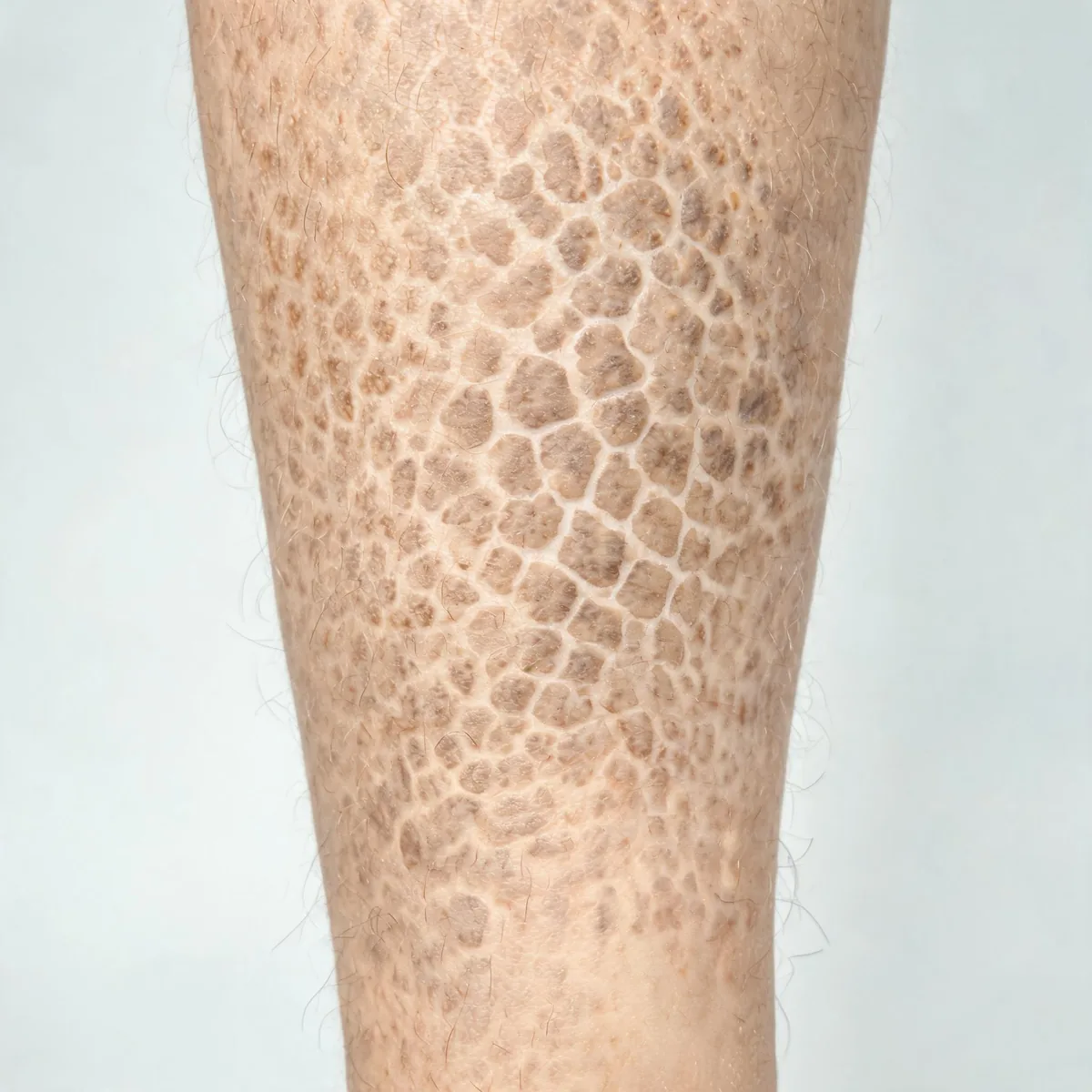
Understanding Ichthyosis
The tradition describes the skin as the outermost reflection of organ health: the Lung governs the skin and disperses fluids, while the Spleen and Stomach produce the Qi and Blood that nourish it.
Yin and Blood deficiency gives dry cracked skin with fine fish-like scales, night sweats, five-palm heat, dry mouth and dizziness. Qi and Blood deficiency gives dry rough scaly skin with a pale complexion, fatigue, palpitations and poor appetite.
Wind-Heat gives red inflamed skin with fish-scale patches, itch worse with heat, mild fever or sore throat and thirst. Damp-Heat in the Stomach and Spleen gives thick oily greasy scales with local warmth, bloating, sticky loose stools and a bitter sticky taste.
Damp-Phlegm gives heavy thick scales that feel greasy or oily, with chest stuffiness, brain fog, heavy limbs and a thick greasy coating. That is the pattern where the scales are not dry at all, which changes the treatment.
The classical literature reads the skin as the outermost report on the organs inside. The Lung governs the skin and spreads fluids across it, the Spleen and Stomach turn food into Qi and Blood, the Liver stores the Blood, and the Kidney holds the essence that keeps tissue from drying out. If any of them under-supplies the surface, the skin loses its moisture and the fish-like scaling appears, which is why the same visible problem can sit on several different roots.
Two broad situations produce it. In one there is not enough material to go round, which is the deficiency group, and the skin cracks because nothing is moistening it. In the other something is in the way, which is the dampness and phlegm group, and the scales sit on top of turbidity that blocks the small channels feeding the skin. Because many forms are inherited, the classical literature accepts that some of this is constitutional and aims to make the skin comfortable rather than to erase the tendency.
Conventional view
Ichthyosis covers a group of inherited skin disorders that leave the skin persistently dry, thickened and scaly. The commonest form, ichthyosis vulgaris, usually appears in early childhood with fine flaking scales, most obvious on the shins and arms. The diagnosis is made from the appearance of the skin and the family history. It can be uncomfortable but it is seldom dangerous, and since there is no cure, treatment is aimed at controlling the dryness and the scaling.
Conventional management depends on intensive moisturising with emollients and on keratolytics such as lactic acid or urea that soften and lift the scales. Gentle exfoliation is encouraged and harsh soaps are avoided, and the routine has to be kept up indefinitely because the scaling returns whenever it lapses.
Where the disease is more severe, an oral retinoid such as acitretin may be used to slow the turnover of skin cells. They can cause dry lips, liver irritation and raised blood lipids, so they are used under regular monitoring and reserved for disease that has not responded to topical care.
Moisturisers and keratolytics work on the surface and do not touch the internal imbalance that TCM holds responsible for the dryness. The conventional approach also treats every ichthyosis as the same defect of skin shedding, without separating the deficiency, dampness and heat patterns that TCM reads as the root of the scaling.
Selected PubMed records
Real PubMed records for the conventional discussion above, selected by condition name and title relevance. They are references, not a claim that any treatment is proven for this condition.
- Ichthyosis.. Nature reviews. Disease primers, 2023. PMID: 36658199.
- Ichthyosis vulgaris: An updated review.. Skin health and disease, 2023. PMID: 36751330.
How it connects
Ichthyosis rarely appears in isolation from a TCM perspective. The same Qi and Blood deficiency that starves the skin of moisture often weakens Lung and defensive Qi too, leaving the mucous membranes of the nose and airways vulnerable, which is why many people with ichthyosis also develop allergic rhinitis and asthma: the atopic triad is one root with three branches. Atopic dermatitis is another frequent companion, especially in children. Both share a foundation of Yin and Blood deficiency with internal Wind, but atopic dermatitis adds Damp-Heat with weeping red lesions, and when the Spleen is too weak to transform fluids the skin can show the dry scaling of ichthyosis and eczematous flares at once. Treating the shared root often improves all three. Ichthyosis rarely appears alone from a TCM view. The same Qi and Blood deficiency that starves the skin can leave the Lungs' defensive function weak, so allergic rhinitis and asthma often accompany it, and atopic dermatitis is another frequent companion, especially in children. The atopic triad is best read as one root with three branches: nourishing Blood and strengthening Qi can settle the skin, the nose and the chest together rather than treating each as a separate disease.
How it is assessed
The practitioner distinguishes dry from greasy scaling and looks at the constitutional picture.
What a practitioner looks for
- Scale type: fine dry fish-like scales suggest Blood and Yin deficiency.
- Texture: thick greasy scales suggest Damp-Heat or Damp-Phlegm.
- Redness: red inflamed patches suggest Wind-Heat.
- Red flags: infection in cracks, with pain, warmth or pus.
The examination starts on the skin. The practitioner looks at how thick the scales are, whether they are dry and firmly attached or greasy and loose, where they sit, and whether there is redness or itch. Fine fish-like plates on the shins and arms with little inflammation suggest dryness from deficient Blood and Yin, while thick oily scales with local warmth suggest damp heat instead. Seasonal behaviour and any recent illness help place the picture.
The rest of the assessment looks inward. Energy, appetite, stools, sleep, sweating and preference for warmth or coolness separate the deficient pictures from the damp ones: a pale, tired person with a weak thready pulse fits Qi and Blood deficiency, while a red tongue with a thick greasy yellow coat and a slippery rapid pulse fits damp heat. A sudden flare with sore throat, mild fever and a floating rapid pulse points to Wind-Heat settling on top of a long-standing tendency, which changes the treatment for that episode.
TCM patterns in Ichthyosis
Five patterns are recorded, and the scales themselves give the first clue. Fine, dry, firmly attached scales with cracking point to Yin and Blood deficiency, the commonest picture, often with night sweats, hot palms and a dry mouth. Where the surface is dry yet the person looks pale and worn out, with palpitations and a poor appetite, Qi and Blood deficiency fits better and the root sits in the Spleen. A red, inflamed flare with itching that heat makes worse, plus a sore throat or mild fever, is Wind-Heat arriving from outside on top of long-standing dryness. Thick, oily, yellowish scales with local warmth, bloating and sticky stools belong to damp heat in Stomach and Spleen, while heavy greasy scales with chest oppression, brain fog and a muzzy head belong to Damp-Phlegm. Those two are the patterns where the scales are greasy, not dry, and they call for drying rather than moistening.
| Pattern | Key signs | The itch | Tongue | Main formula |
|---|---|---|---|---|
| Yin and Blood Deficiency | Dry cracked skin with fine fish-like scales; Dry mouth and throat | Not specified | Body: Pale to pale-red, thin, dry and crackedCoat: Scanty or peeled | Not specified |
| Qi and Blood Deficiency | Dry rough scaly skin | Not specified | Body: Pale, possibly thin or with teeth marksCoat: Thin white | Not specified |
| Wind-Heat | Red inflamed skin with fish-scale patches; Thirst and dry mouth | Itching that worsens with heat | Body: Red at the tip and edgesCoat: Thin yellow or white turning yellow | Not specified |
| Damp-Heat in Stomach and Spleen | Thick oily greasy scales; Local warmth or redness on the skin | Not specified | Body: Red, possibly swollen with teeth marksCoat: Thick, yellow and greasy in the centre and root | Not specified |
| Damp-Phlegm | Heavy thick scales that feel greasy or oily | Not specified | Body: Pale, swollen and teeth-marked, wet-lookingCoat: Thick, white and greasy | Not specified |
Yin and Blood Deficiency
Dry cracked fish-scale skin with night sweats.
Yin and Blood are the body's cooling and moistening reserves. When they run low the skin receives neither lubrication nor nourishment, so it dries, cracks and lifts into fine fish-like scales. The internal dryness can stir up wind, which irritates the surface further and accounts for the itching, and because Yin no longer anchors the body's warmth, night sweats and heat in the palms and soles come along with it.
The tongue looks pale to pale-red, narrow, dry and cracked, with almost no coating left; the pulse reads fine and rapid. Overwork, stress, late nights, spicy and fried food, dry heated rooms and heavy sweating use up the reserves faster, while a moist environment, sleep, gentle walking and oily moisturisers help. Dang Gui Yin Zi is the formula recorded, with Dang Gui, Shu Di Huang and He Shou Wu, and the points named are SP-10 (Xuehai), SP-6 (Sanyinjiao), KI-3 (Taixi) and BL-23 (Shenshu).
Signs
- Dry cracked skin with fine fish-like scales
- Night sweats
- Heat in palms, soles and chest
- Dry mouth and throat
- Dizziness and light-headedness
Diet and lifestyle for this pattern: Focus on moistening, blood-nourishing food: bone broth, black sesame, walnuts, pear, spinach and small amounts of good quality animal protein. Avoid spicy, fried and barbecued food that generates internal Heat, sip warm water through the day, use a humidifier in dry rooms, keep exercise gentle without heavy sweating, and be asleep before eleven so Yin and Blood can regenerate.
Qi and Blood Deficiency
Dry rough scaly skin with fatigue and palpitations.
Qi and Blood are the raw materials the skin lives on. When both are low the surface is starved of moisture and nutrients and turns dry, rough and scaly. The usual origin is a Spleen too weak to extract enough from food, so the deficiency is one of production rather than of supply, and it shows as much in the person's energy as in the skin.
The tongue is pale, sometimes thin or marked by teeth, with a thin white coat, and the pulse is fine, weak and thready. Overwork, skipped meals, cold raw food and exposure to cold all make it worse, while rest, warm nourishing meals and gentle exercise rebuild it. Ba Zhen Tang is the formula recorded, with Dang Gui, Huang Qi and Bai Shao, and the points are ST-36 (Zusanli), SP-6 (Sanyinjiao) and SP-10 (Xuehai).
Signs
- Dry rough scaly skin
- Pale or sallow complexion
- Persistent fatigue and weakness
- Dizziness with poor appetite
- Heart palpitations
Diet and lifestyle for this pattern: Eat warm, cooked, nourishing food such as congee, bone broth and dark leafy greens, and avoid raw cold food that weakens the Spleen. Put rest first and avoid overwork, and keep exercise gentle such as walking to help Qi circulate.
Wind-Heat
Red inflamed fish-scale patches with heat and sore throat.
Wind-Heat arrives from outside and lodges at the surface, where it blocks the pores and stirs up inflammation. On already dry skin this produces a red, itchy flare with the fish-scale pattern standing out more sharply. That heat may travel upward as well, which is why a scratchy throat, a mild fever and thirst can accompany an episode.
The tongue shows a red tip and edges under a thin yellow coat, and the pulse is floating and rapid. Hot weather, wind exposure, spicy food and stress bring it on, while a cool room, cool drinks and rest help the body push the pathogen back out. Yin Qiao San is the formula recorded, with Jin Yin Hua, Lian Qiao, Bo He and Jing Jie, and the points used are LI-4 (Hegu), LI-11 (Quchi) and GB-20 (Fengchi), with SP-10 (Xuehai) added where the skin is hot and itchy.
Signs
- Red inflamed skin with fish-scale patches
- Itching that worsens with heat
- Mild fever or sore throat
- Thirst and dry mouth
Diet and lifestyle for this pattern: Keep cool and avoid overheating, drink plenty of fluids such as chrysanthemum or mint tea, and avoid spicy, fried and greasy food that generates more Heat. Use gentle fragrance-free moisturisers to protect the skin barrier and reduce scratching.
Damp-Heat in Stomach and Spleen
Thick oily scales with bloating and sticky stools.
When dampness and heat accumulate in the Stomach and Spleen they can spill outward to the skin, where the dampness gives thick oily scales and the heat gives local warmth and redness. It usually follows a diet heavy in greasy, spicy or sweet food that the digestion cannot process, and the same stagnation shows as bloating, a bitter or sticky taste and loose sticky stools.
The tongue body is red with a thick yellow greasy coat, heaviest at the centre and root, and the pulse is soggy and rapid, often slippery. Hot humid weather, overeating, alcohol and a sedentary routine make it worse, while cool dry weather, light meals and daily movement help. Lian Po Yin is the formula recorded, with Huang Lian and Hou Po, and the points are ST-36 (Zusanli), SP-9 (Yinlingquan) and ST-44 (Neiting).
Signs
- Thick oily greasy scales
- Local warmth or redness on the skin
- Bloating after eating
- Sticky loose bowel movements with bitter taste
Diet and lifestyle for this pattern: Avoid greasy, fried, spicy and sugary food that creates Dampness and Heat, and focus on light, easy meals such as steamed vegetables, congee and barley. Keep the skin clean and dry, exfoliate gently to lift scales before applying a light non-greasy moisturiser, and walk regularly to help the Spleen move Dampness.
Damp-Phlegm
Heavy greasy scales with chest stuffiness and brain fog.
A weak Spleen fails to transform fluids, so dampness gathers, and over time that dampness congeals into phlegm. Phlegm is thick and turbid, and when it lodges in the small collaterals that deliver nourishment to the surface, the skin is left short of moisture and Qi and produces heavy, thick, greasy scales. The same turbidity clouds the upper body, which is why the chest feels stuffy and the head muzzy.
The tongue is pale and swollen with teeth marks under a thick white greasy coat, and its surface looks wet; the pulse is slippery. Damp humid weather, greasy fried food, cold raw food and iced drinks, late eating and a sedentary day all add to it, while dry warm weather, light well-cooked meals and daily movement disperse it. Er Chen Tang is the formula recorded, with Ban Xia, Chen Pi, Fu Ling and Yi Yi Ren, and the points are ST-40 (Fenglong), ST-36 (Zusanli), SP-6 (Sanyinjiao) and BL-20 (Pishu).
Signs
- Heavy thick scales that feel greasy or oily
- Chest stuffiness or oppression
- Brain fog
- Heavy sensation in the limbs
- Thick white greasy coating
Diet and lifestyle for this pattern: Avoid cold, raw, greasy and dairy-heavy food that creates more internal Dampness. Favour warm cooked meals such as congee, steamed vegetables and a little ginger or cardamom, and keep moving gently each day so Qi moves and Phlegm does not settle.
Treatment approach
How the tradition treats ichthyosis, with the herbs, formulas and points used for it.
Principles
- Nourish Blood and Yin where the scales are dry and fine.
- Drain dampness or transform phlegm where scales are thick and greasy.
- Clear Wind-Heat where the skin is red and inflamed.
- Use emollients and keratolytics as the mainstay, since inherited ichthyosis is managed rather than cured.
- Treatment is chosen to match the scale type: nourish Yin and Blood where the plates are fine and dry, tonify Qi and Blood where the person is pale and exhausted, cool and disperse Wind-Heat during an inflamed flare, and dry dampness or transform phlegm where the scales are thick and oily. Formulas and acupuncture do most of the work, with herbal washes and oils applied directly. Overlap is common, a baseline of deficiency with an acute Wind-Heat flare for instance, so the plan is adjusted at each visit rather than fixed for the whole course.
Herbs used
Formulas
Acupoints
- SP-10 (Xuehai)
- SP-6 (Sanyinjiao)
- KI-3 (Taixi)
- BL-23 (Shenshu)
- ST-36 (Zusanli)
- LI-4 (Hegu)
- LI-11 (Quchi)
- GB-20 (Fengchi)
- SP-9 (Yinlingquan)
- ST-44 (Neiting)
- ST-40 (Fenglong)
- BL-20 (Pishu)
What to expect
- Inherited ichthyosis is lifelong and managed, not cured.
- Emollients and gentle scale removal make the largest difference.
- Secondary infection needs medical treatment.
- The tradition describes a gradual course. Tightness and itch usually ease within the first few weeks and the scaling then thins slowly, with the formula adjusted as the skin changes so that no stagnation sets in. Inherited forms respond to sustained gentle care rather than aggressive short courses, and the realistic aim is fewer flares, softer skin and fewer cracked, painful areas rather than a cure.
Safety and when to get help
Seek medical help urgently for
- Redness, swelling, warmth and pus around cracked skin.
- Fever with skin changes or rapid worsening.
- Widespread painful cracking with bleeding.
For anything severe, sudden or spreading quickly, read when a skin problem needs urgent care.
Cautions
- Do not pick or aggressively scrub scales.
- Use emollients regularly, especially after washing.
- Severe or worsening forms need dermatological care.
Using this alongside conventional care
- TCM is described as complementary to conventional care: prescribed topical treatment and emollients continue alongside herbs.
- TCM sits alongside the dermatologist's routine rather than replacing it. Emollients, keratolytics and gentle skincare continue, and both practitioners are told about everything being used. Oral retinoids such as acitretin deserve particular care, since some Chinese herbs affect liver function and the prescriber may want enzymes checked more often. Acupuncture and herbal washes applied to the skin do not clash with medication. Nothing prescribed should be stopped or reduced without the doctor who prescribed it, and the safest arrangement is one where the two practitioners know what the other is doing.
Diet and lifestyle
- Favour nourishing moistening food and adequate fluids, and reduce greasy and drying food for damp patterns.
- The general rule is to eat what builds Yin and Blood and to avoid what dries the body out. Bone broth, black sesame, walnuts, eggs, dark leafy greens, sweet potato, goji berries and pears are the reference's staples, with plenty of room-temperature water through the day. Spicy dishes, fried food, roasted nuts, alcohol and too much coffee work against the treatment, and where dampness is part of the picture, dairy, greasy meals and refined sugar are reduced. Warm cooked meals are preferred to cold raw food because they ask less of the Spleen, which is the source of the Qi and Blood the skin needs.
If you're pregnant
In pregnancy the Blood and Yin are directed toward nourishing the baby, which can deepen the deficiency behind ichthyosis, so the skin tends to dry further and scale more, particularly in the later months. Nourishing herbs are generally suitable but need care. Dang Gui Yin Zi contains Dang Gui, which in large doses can stimulate the uterus, so a modified version with less Dang Gui, or with Shu Di Huang and Gou Qi Zi in its place, may be safer. Ba Zhen Tang tends to be well tolerated because its Blood tonics are balanced by Qi tonics.
Moistening oils applied to the skin are a reasonable first step, and acupuncture is preferred to herbs in the first trimester, with Sanyinjiao (SP-6) used cautiously and no strong stimulation on the abdomen. Wind-Heat and Damp-Heat flares are managed gently: Yin Qiao San is considered safe, while the bitter-cold herbs in Lian Po Yin are best avoided unless closely supervised.
If you're breastfeeding
Most of the strategies used here are compatible with breastfeeding, but herb selection matters because some compounds pass into milk. Bitter-cold herbs such as Huang Lian and Zhi Zi can loosen an infant's stools and are avoided unless the pattern clearly calls for them and the dose is low, with milder options such as Ju Hua or Dan Dou Chi used for heat signs instead. Nourishing formulas such as Dang Gui Yin Zi and Ba Zhen Tang are generally compatible and may even help milk production, since they build Blood and Qi.
External treatment is entirely safe: a herbal bath with Dang Gui and Tao Ren can relieve scaling without reaching the baby, and acupuncture carries no risk to the infant.
If treating a child
Ichthyosis often appears in early childhood, and the vulgaris type is closely linked to an inherited Qi and Blood deficiency. A child's Spleen is still maturing, so Spleen deficiency with Damp-Phlegm is a common underlying picture, and the scales may be thick and greasy rather than simply dry, with a weak appetite, loose stools and a pale tongue that looks puffy. Doses are reduced to a quarter to a half of the adult amount by age and weight.
Er Chen Tang is a gentle choice for Damp-Phlegm, and a mild Dang Gui Yin Zi with less Dang Gui suits pure dryness from Blood deficiency. Acupressure or paediatric tui na at Zusanli (ST-36), Sanyinjiao (SP-6) and Pishu (BL-20) can replace needles, and because children describe sensations poorly, practitioners rely on the tongue and on the look of the scales. Natural oils applied to the skin remain a cornerstone of care.
If treating an elderly patient
Skin thins and dries with age, so ichthyosis often worsens in later life. The picture is nearly always Yin and Blood deficiency, frequently compounded by Kidney Yin deficiency, with fine widespread scales alongside night sweats, dryness in the eyes and a parched mouth. Doses are lowered to about two thirds of the adult amount so that a weaker digestion is not burdened, and Dang Gui Yin Zi may be strengthened with Kidney-nourishing herbs such as Shu Di Huang. Overly drying or dispersing herbs are avoided because they would deplete Yin further.
Several medicines at once are common, so the practitioner should coordinate with the other prescribers to avoid interactions. Gentle acupuncture is well tolerated, and points such as Taixi (KI-3), Shenshu (BL-23) and Sanyinjiao (SP-6) are particularly useful. Treatment runs longer here, and the goal is comfort and a better quality of life, not full resolution.
Urgent-sign guidance is based on standard sources: NHS anaphylaxis, NHS cellulitis, NHS Stevens-Johnson syndrome, NHS melanoma.
Evidence
Evidence status
Compiled for this page from the classical and modern literature; not a systematic review, so treat it as a pointer to sources rather than clinical guidance.
Evidence is limited but promising. Most studies are Chinese case series or small randomised trials. A systematic review of Chinese herbal medicine for ichthyosis found that formulas such as Dang Gui Yin Zi and Ba Zhen Tang improved skin hydration and reduced scaling compared with emollients alone, though trial quality was generally low because of small samples and absent blinding. Acupuncture and external herbal baths have also been studied, with reports of improved elasticity and reduced itch. No large-scale trial exists.
The evidence is limited and mostly Chinese. The published work is a mixture of case series and small randomised trials, and a systematic review of Chinese herbal medicine found that formulas such as Dang Gui Yin Zi and Ba Zhen Tang improved skin hydration and reduced scaling against emollients alone, though the trials were small and unblinded. Needling and herbal soaks have been examined too, with reports of better elasticity and less itch. No large multi-centre trial has appeared in the English-language literature, so the classical literature presents the evidence as supporting safety and probable benefit as an adjunct rather than as proof.
Studies often cited
Dang Gui Yin Zi and Ba Zhen Tang improved hydration and reduced scaling versus emollients alone, with low trial quality. Systematic review (as recorded in the source)
Reports of improved skin elasticity and reduced itching, without large trials. Clinical studies (as recorded in the source)
A twelve-week trial of 60 patients compared Danggui Yinzi with a topical urea cream. Scaling severity fell by 45 per cent in the herbal group against 15 per cent in the control group, skin hydration improved, and no serious adverse events were reported. Li X, Wang Y, et al. Journal of Traditional Chinese Medicine. 2014 (as recorded in the reference).
Eighty patients were randomised to acupuncture plus an herbal bath or to conventional care. After eight weeks the TCM group showed greater improvement in dryness and in quality of life scores, and the gain was still present at follow-up. Zhang H, et al. Chinese Acupuncture and Moxibustion. 2017 (as recorded in the reference).
Classical record
Scaly, rough skin and dark circles under the eyes indicate dry blood stasis internally.
- Yi Zong Jin Jian (Golden Mirror of Medicine), volume on surgical diseases. The Chinese original is not reproduced here: it could not be recovered reliably from the source record, and is not guessed.
蛇身者,谓人皮肤上如蛇皮而有鳞甲,世谓之蛇身也。此由血气痞涩,不通润于皮肤故也。
Snake body means that the skin resembles a snake's, with scales on it. It arises because blood and qi have become blocked and cannot carry moisture through to the skin.
Zhu Bing Yuan Hou Lun, volume 35, Snake Body - Classical citation: for this condition. It gives the traditional name for fish-like scaling and its explanation as obstructed nourishment reaching the skin.
Common questions
Can ichthyosis be cured?
Inherited forms are managed rather than cured. The classical literature aims to nourish Blood and Yin and reduce dryness, alongside emollient care.
Why does this page mention greasy scales?
Because one pattern, Damp-Phlegm, produces heavy greasy scales rather than dry ones - a different treatment direction.
How do I prevent infection?
Keep cracks moisturised, avoid picking, and get pain, warmth or pus reviewed.
Do herbs help?
The tradition describes constitutional treatment with gradual improvement; emollients remain the mainstay.
Can acupuncture help dry skin?
Yes. Points are chosen to build Qi and Blood, nourish Yin and clear dampness or phlegm, which is how the classical literature explains moisture being directed to the skin. Needles are very fine and placed gently, so scaly skin is not damaged, and most people find the sessions relaxing, which supports the overall aim.
Is TCM safe for children with ichthyosis?
It is often used, and gently. Doses are scaled to the child's age and weight, needling can be replaced by acupressure or paediatric tui na, and a practitioner experienced with children should lead, with the paediatrician told about any herbs.
Can I keep using my usual moisturiser?
Yes, and the classical literature encourages it. Keeping the surface moist while herbs work internally tends to give the best result, and a practitioner may add a herbal oil or wash alongside the usual products.