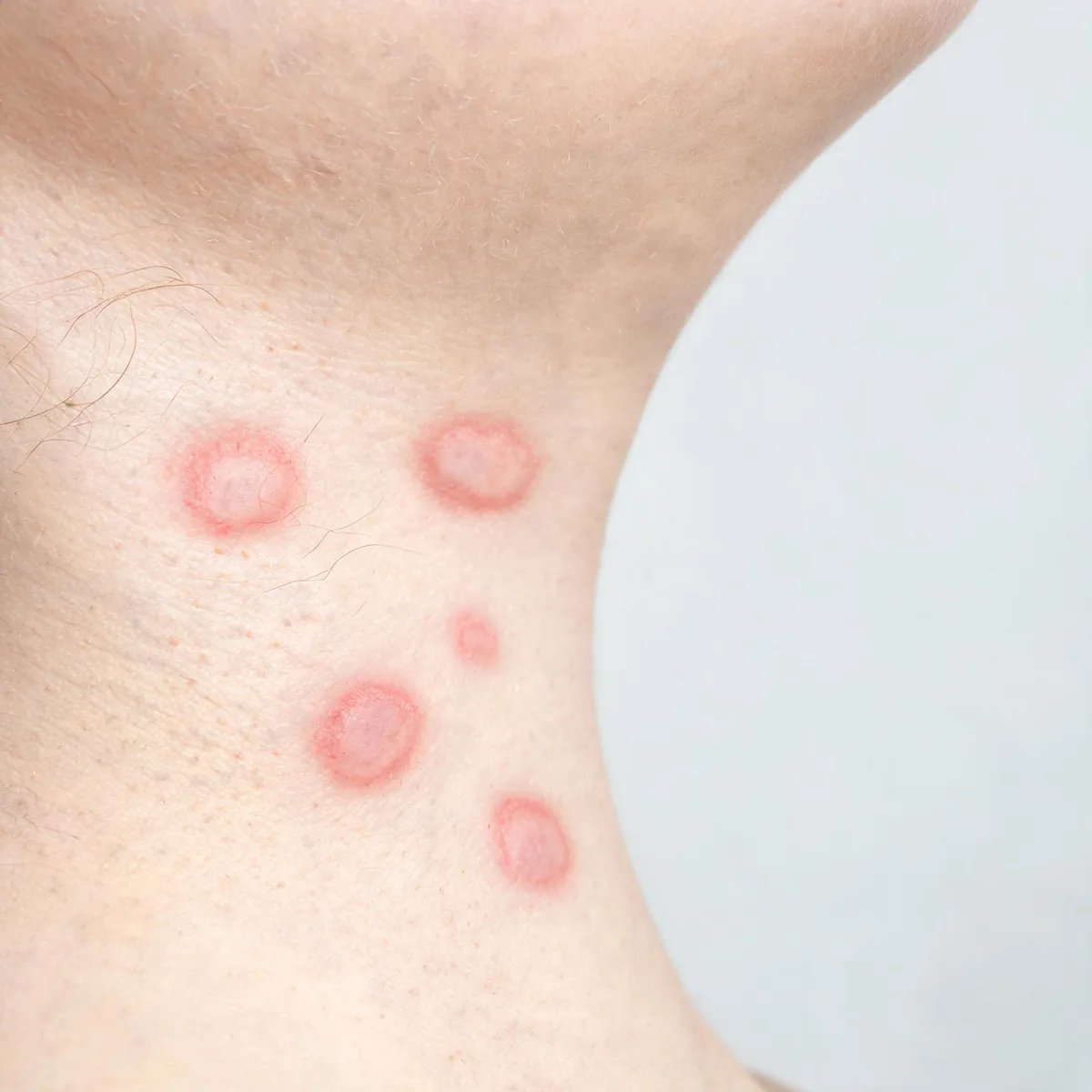
Understanding Chronic urticaria
The tradition describes chronic urticaria as a battle between protective Qi and Wind, the pathogen behind hives sudden, shifting, intensely itchy quality.
In acute hives the Wind is the main problem. In chronic hives, recurring for weeks or months, the more important question is why the defence keeps letting it in. That is why most patterns here are deficiency patterns.
Blood deficiency with external wind gives itch worse at night, dry flaking skin and a pale complexion. Protective Qi deficiency gives pale or skin-coloured wheals worse with drafts and cold, with spontaneous sweating, frequent colds and fatigue.
Ying-Wei disharmony gives hives after exposure to wind or drafts, with sweating on minimal activity and alternating chills and mild heat. Qi and Blood deficiency gives pale pink wheals with deep fatigue. Damp-Heat in the Stomach and Spleen gives red raised intensely itchy wheals triggered by rich or spicy food, with bloating. Yin and Blood deficiency gives dry itchy hives at night with night sweats and five-palm heat.
Wind is the visible actor. It rises quickly, moves from place to place, itches intensely and leaves no trace, and classical medicine reads these qualities as Wind rather than as Heat or Dampness on their own. But Wind is an opportunist: it only enters where the surface has already been left open, which is why a chronic case is never explained by the wheals alone and why the pattern always includes some failure of the body's defence.
The Wei Qi and the Ying Qi have to work as a pair. One guards the outside of the skin, the other moistens and steadies it from within, and while the pair is intact the pores open and shut at the right moments and a draft passes without consequence. When the arrangement breaks down the gate is left ajar, the body then tries to push out what has entered, and the wheal is what that effort looks like. Lung function, Spleen function and Blood all feed the arrangement, so weakness in any of them eventually shows at the surface.
Conventional view
Chronic urticaria is defined by recurrent itchy wheals that appear daily or almost daily for six weeks or longer, often with no obvious trigger. Mast cells in the skin release histamine and other chemicals, making tiny vessels leak fluid into surrounding tissue. In many cases the cause remains unknown as chronic spontaneous urticaria, though pressure, cold, heat or sunlight can be identified in some people, and diagnosis is usually from history and appearance with routine tests often normal.
Standard management begins with non-sedating antihistamines, often at up to four times the usual dose, adding H2 blockers, leukotriene receptor antagonists or short courses of oral corticosteroids for flares. Refractory cases may use the monoclonal antibody omalizumab or the immunosuppressant ciclosporin, alongside topical anti-itch lotions and trigger avoidance.
Antihistamines dampen itch and reduce wheals but do not stop outbreaks, and many patients find the hives return when they stop, while long-term or high-dose use can cause drowsiness, dry mouth and tolerance. Steroids carry well-known risks with prolonged use, omalizumab is expensive and not universally available, and conventional care treats all chronic urticaria as the same immunological event, without distinguishing a weak exterior, a hot overloaded gut or a blood deficiency leaving the skin undernourished.
Selected PubMed records
Real PubMed records for the conventional discussion above, selected by condition name and title relevance. They are references, not a claim that any treatment is proven for this condition.
- Chronic Spontaneous Urticaria: A Review.. JAMA, 2024. PMID: 39325444.
- Prevalence of chronic urticaria in children and adults across the globe: Systematic review with meta-analysis.. Allergy, 2020. PMID: 31494963.
- Chronic spontaneous urticaria and chronic inducible urticaria.. The Journal of allergy and clinical immunology, 2025. PMID: 40451490.
How it connects
Chronic urticaria rarely travels alone. When Protective Qi deficiency or Blood deficiency with External Wind is the root, the Lungs' defensive function is weakened, so allergic rhinitis and asthma often flare alongside the hives, because skin and airways are both surfaces meeting the outside world. Atopic dermatitis shares ground too: both can arise from Blood deficiency generating internal Wind and dryness, or from Damp-Heat simmering in the digestive system, with wheals or dry scaly patches as different expressions of one imbalance. Anxiety and insomnia are close companions, as Blood deficiency fails to anchor the Heart Shen and itching disturbs sleep. These overlaps matter for treatment as much as for explanation. Because the same weakness lets Wind into both skin and airways, a formula that consolidates the exterior may ease allergic rhinitis and asthma alongside the hives, and patients often notice the breathing settles as the skin does. Where anxiety and insomnia accompany the itching, calming the Blood and the Shen is part of the same task rather than a separate one, which is why a plan that only suppresses the wheals tends to disappoint.
How it is assessed
The practitioner notes the colour of the wheals, the triggers and the person constitution.
What a practitioner looks for
- Colour: pale or skin-coloured wheals suggest deficiency; red wheals suggest heat.
- Triggers: cold and drafts suggest protective Qi deficiency; food suggests damp heat in the Stomach and Spleen.
- Sweating: spontaneous sweating with frequent colds supports Ying-Wei disharmony or Qi deficiency.
- Timing: night-time itch suggests Blood or Yin deficiency.
The practitioner begins with the timing and triggers of the hives, their colour and shape, and any accompanying symptoms, then reads the tongue and pulse to name the underlying pattern, because chronic urticaria reflects a deeper imbalance than the skin alone. Hives that appear more at night, worsen with fatigue and leave dry rough skin point to Blood Deficiency with External Wind, with a pale tongue, thin coat and thin or wiry pulse, the Blood too weak to moisten the skin and anchor the body's defences.
Hives that flare after minimal wind exposure, with catching colds easily and spontaneous sweating, suggest Protective Qi Deficiency, with a pale puffy tongue, thin white coat and weak pulse, the defensive shield too weak to repel pathogens. Episodic hives with alternating chills and heat and light sweating suggest Ying-Wei Disharmony, with a normal or slightly pale tongue and a soft or slightly wiry pulse, the nutritive and protective layers out of step so the pores are unstable.
Generalised fatigue, a pale complexion, dizziness and pale hives that itch less suggest Qi and Blood Deficiency, with a pale thin tongue and a weak thready pulse. Bright red hot hives with a burning itch, worse with heat and rich food, suggest Damp-Heat in the Stomach and Spleen, with a red tongue, yellow greasy coat and slippery rapid pulse, and longstanding hives with dry skin, night heat and a red thin tongue point to Yin and Blood Deficiency.
The diagnosis also weighs the duration and severity, because an acute flare on a chronic background needs the branch calmed while the root is rebuilt, and the practitioner watches for warning features such as swelling of the lips or throat, wheezing or dizziness, which need urgent medical attention rather than a clinic appointment.
TCM patterns in Chronic urticaria
Six patterns describe chronic urticaria, divided by what is failing, not by how the skin looks. On the deficiency side, Protective Qi Deficiency gives pale wheals, spontaneous sweating and frequent colds; Ying-Wei Disharmony gives hives after drafts with chills and sensitivity to temperature change; Qi and Blood Deficiency gives pale wheals with deep fatigue; and Blood Deficiency with External Wind gives dry, itchy night-time hives with brittle nails. On the excess side, Damp-Heat settling in the Stomach and Spleen gives red, raised, itchy wheals after rich or spicy meals, with bloating and a sticky taste. Yin and Blood Deficiency sits at the depleted end, with dry hives, night sweats and warm palms and soles. These blend, since long-standing Blood deficiency often weakens the Protective Qi. The practitioner looks for the dominant trigger and wheal quality, not a single label.
| Pattern | Key signs | The itch | Tongue | Main formula |
|---|---|---|---|---|
| Blood Deficiency with External Wind | Dry flaking or rough skin | Skin itching worse at night | Body: Pale and thin, sometimes slightly dryCoat: Thin, white and a little dry | Not specified |
| Protective Qi Deficiency | Pale or skin-coloured wheals | Not specified | Body: Pale and puffy, possibly teeth-markedCoat: Thin white | Not specified |
| Ying-Wei Disharmony | Hives appear after exposure to wind or drafts | Not specified | Body: Pale-red or slightly paleCoat: Thin white and moist | Not specified |
| Qi and Blood Deficiency | Pale pink or skin-coloured wheals rather than bright red | Not specified | Body: Pale, possibly thin or with teeth marksCoat: Thin white | Not specified |
| Damp-Heat in Stomach and Spleen | Outbreaks triggered by rich greasy or spicy food | Red raised intensely itchy wheals | Body: Red, possibly swollen with teeth marksCoat: Thick, yellow and greasy in the centre and root | Not specified |
| Yin and Blood Deficiency | Not specified | Dry itchy hives worse at night | Body: Pale to pale-red, thin, dry and crackedCoat: Scanty or peeled | Not specified |
Blood Deficiency with External Wind
Night itch with dry skin and pale complexion.
Blood nourishes and anchors the skin. When it is chronically low the surface becomes dry and rough, and that dryness generates a restless internal Wind that provokes itching. The same deficiency leaves the Wei Qi unsupported at the surface, so external Wind finds an easy way in. The two Winds, one from emptiness and one from outside, produce hives that arrive suddenly, shift from place to place and itch most at night, when Blood is at its lowest ebb.
The tongue is pale and thin with a thin white, slightly dry coat; the pulse is fine, wiry at the left middle and floating at the right front. The skin feels dry and flaking, the complexion is pale or sallow, the nails are dull and brittle, and there may be dizziness or scanty menstrual blood. Cold dry weather, drafts, stress, spicy and fried food and overwork worsen it, while moisturising, a warm draft-free room, blood-nourishing food, rest and gentle movement help. Dang Gui Yin Zi is the formula for this pattern, with Dang Gui, Bai Shao, He Shou Wu, Ji Li and Fang Feng among its herbs, and Sanyinjiao (SP-6), Xuehai (SP-10), Zusanli (ST-36), Fengchi (GB-20) and Hegu (LI-4) as the points.
Signs
- Skin itching worse at night
- Dry flaking or rough skin
- Pale or sallow complexion
- Aversion to wind and drafts
- Brittle nails
Diet and lifestyle for this pattern: Eat blood-nourishing food such as dark leafy greens, red meat, liver, black sesame, goji berries and dates, and avoid spicy, greasy and deep-fried food that generates Heat and dryness. Moisturise the skin with gentle products, protect it from wind and draughts after sweating, and keep exercise gentle so it strengthens Qi without depleting Blood.
Protective Qi Deficiency
Pale wheals worse in drafts and cold, with frequent colds.
The tongue is pale and puffy, sometimes with teeth marks, under a thin white coat; the pulse is floating, empty and soggy. Spontaneous sweating that worsens with activity, a bright pale complexion, fatigue and low stamina accompany the hives. Drafts, cold, overwork, cold raw food and drinks, emotional stress and heavy sweating worsen it, while rest, warmth, warm cooked meals, gentle exercise and moxibustion help. Yu Ping Feng San tonifies Qi, secures the exterior and stops sweating, with Huang Qi, Fang Feng and Bai Zhu as its herbs and Zusanli (ST-36), Feishu (BL-13), Dazhui (DU-14) and Shenque (REN-8) as the points.
Wei Qi is the body's outer guard, and in this pattern it is simply too thin to hold the surface. Even a light draft passes through the pores, and the skin answers with pale, itchy wheals that appear and fade. Because the problem is a lack of energy rather than an excess of heat, the hives flare when the person is run down and the itch is usually mild. The same weakness explains the repeated colds, the sweating on minimal effort and the feeling of being easily chilled.
Signs
- Pale or skin-coloured wheals
- Worse with drafts and cold
- Spontaneous sweating worse with activity
- Frequent colds and infections
- Fatigue with low spirits
Diet and lifestyle for this pattern: Eat warm cooked food such as soups and stews to support Spleen Qi, and avoid raw cold food and iced drinks. Build Qi with consistent gentle exercise such as walking or tai chi without exhausting yourself, keep the neck and back covered in wind, and consider home moxibustion on Zusanli to strengthen the constitution.
Ying-Wei Disharmony
Hives after wind exposure with sweating and alternating chills.
Ying is the nourishing layer that moistens and stabilises the surface, and Wei is the defensive layer that holds the gate. When the two fall out of step the pores open and shut at the wrong times, so Wind slips in, and the wheals and itch are the result of the body trying to expel it. Sweating then depletes the Wei layer further, which makes the next draft easier to react to, and a cycle of sensitivity to temperature change establishes itself.
The tongue is pale-red or slightly pale with a thin white moist coat; the pulse is floating and moderate, sometimes floating and weak. Hives follow exposure to wind or drafts, with spontaneous sweating after little exertion, mild chills or a see-saw between chills and mild heat, generalised aching and fatigue. Sudden temperature changes, overwork, cold raw food and drinks worsen it, while a warm draft-free room, rest, sleep and warm cooked meals help. Gui Zhi Tang harmonises Ying and Wei, releases the muscle layer and disperses Wind-Cold, with Gui Zhi and Bai Shao as the named herbs and Fengmen (BL-12), Zusanli (ST-36) and Hegu (LI-4) as the points.
Signs
- Hives appear after exposure to wind or drafts
- Spontaneous sweating on minimal activity
- Mild chills or alternating chills and heat
- Generalised body aches
Diet and lifestyle for this pattern: Keep the neck and upper back out of draughts and wear layers you can add or remove as your temperature shifts. Gentle movement such as walking or tai chi builds Qi without heavy sweating, and warm cooked food supports Wei Qi better than raw, iced or greasy meals.
Qi and Blood Deficiency
Pale wheals with deep fatigue.
When both the fuel and the substance are low, the exterior has neither the force to repel Wind nor the material to repair the skin. Qi deficiency leaves the pores loosely held, so Wind enters easily; Blood deficiency leaves the skin dry and undernourished, so it itches readily. Because the body cannot drive the pathogen out, the hives return whenever reserves fall, and the person notices that outbreaks track their level of tiredness rather than any external trigger.
The tongue is pale, sometimes thin, sometimes marked by teeth on the edges, under a thin white coat; the pulse is fine and weak, especially at the right middle position. The wheals are pale, pinkish or skin-coloured rather than bright red, and come with deep fatigue on exertion, a sallow complexion and pale lips, dizziness, palpitations, broken sleep, a poor appetite and sweating without cause. Overwork, drafts, skipped meals and stress worsen it, while rest, warm cooked meals, a warm room and gentle movement help. Ba Zhen Tang tonifies Qi and Blood, often with Yu Ping Feng San added to reinforce the exterior; Dang Gui, Huang Qi, Bai Zhu and Fang Feng are the named herbs, and Zusanli (ST-36), Sanyinjiao (SP-6), Qihai (REN-6), Xuehai (SP-10) and Fengmen (BL-12) are the points.
Signs
- Pale pink or skin-coloured wheals rather than bright red
- Deep fatigue worse with exertion
- Sallow or pale complexion with pale lips
- Dizziness
Diet and lifestyle for this pattern: Build Qi and Blood with bone broth, slow-cooked stews, eggs, dark leafy greens, goji berries and a moderate amount of red meat, and avoid raw, cold and greasy food that weakens the Spleen. Rest well, keep movement gentle, protect yourself from cold and draughts, and be asleep before eleven so Blood can regenerate.
Damp-Heat in Stomach and Spleen
Red raised wheals triggered by rich or spicy food.
Rich, greasy, spicy and sweet food, taken faster than the Stomach and Spleen can process it, brews into Dampness and Heat in the middle burner. That turbid mixture cannot be transformed, so it rises and pushes outward through the skin, producing red raised wheals that itch intensely and arrive in crops after eating. The digestive signs that go with it, including bloating, a sticky or bitter taste, bad breath and loose incomplete stools, are not incidental; they are the same problem seen from the inside.
The tongue is red with a thick yellow greasy coat, most marked at the centre and root; the pulse is soggy and rapid, often slippery. Alcohol, overeating, fried and spicy food and damp humid weather aggravate it, while light bland meals, a cool room, avoiding alcohol and resting after eating help. Fang Feng Tong Sheng San releases the exterior, clears interior Heat and purges the bowels, which suits hives with bloating or constipation; Tu Fu Ling, Jin Yin Hua, Yi Yi Ren and Bai Xian Pi are the named herbs, and the points are Zusanli (ST-36), Yinlingquan (SP-9), Quchi (LI-11) and Zhongwan (REN-12).
Signs
- Red raised intensely itchy wheals
- Outbreaks triggered by rich greasy or spicy food
- Bloating after eating
- Sticky or bitter taste
Diet and lifestyle for this pattern: Eat light, easy meals and avoid greasy, fried, spicy and heavily sweetened food as well as alcohol and dairy. Favour barley, mung beans, bitter greens and lightly cooked vegetables, and stay well hydrated to help flush Dampness.
Yin and Blood Deficiency
Dry hives at night with night sweats.
Long-standing depletion of Yin and Blood removes the moisture and resilience that keep skin quiet. The surface becomes dry, and the internal Wind that rises from that dryness stirs under the skin, producing persistent hives that itch rather than burn. The low-grade heat that comes with Yin deficiency adds to the irritation, especially at night and when the body is warm, and the wheals may be faint and dry instead of raised and red.
The tongue is pale or faintly red, dry and thin, with cracks and a scanty or peeled coat; the pulse is fine and rapid, weakest at both rear positions and at the left middle. Night sweats, warmth in the palms, soles and chest, dizziness, poor memory and scanty or absent menstruation accompany the skin. Overwork, stress, spicy and fried food and hot dry weather worsen it, while a cool environment, rest, sleep and moisturising help. Yang Xue Ding Feng Tang nourishes Blood and Yin, moistens dryness and calms Wind, with Dang Gui as the named herb and Sanyinjiao (SP-6), Taixi (KI-3) and Xuehai (SP-10) as the points.
Signs
- Dry itchy hives worse at night
- Night sweats
- Warm palms, soles and chest
- Dizziness and poor memory
- Scanty or absent menstruation
Diet and lifestyle for this pattern: Choose moistening, cooling food such as pear, black sesame, honey and leafy greens, and avoid spicy, greasy and drying food that consumes Yin. Put deep rest first and keep exercise gentle and calming, such as walking or tai chi, to conserve reserves.
Treatment approach
How the tradition treats chronic urticaria, with the herbs, formulas and points used for it.
Principles
- Strengthen protective Qi and harmonise Ying and Wei in the recurring patterns, which is the core of chronic treatment.
- Nourish Blood and Yin where wheals are dry and itchy at night.
- Clear damp heat where red wheals follow food.
- Treat airway swelling as an emergency regardless of pattern.
- The two fronts are worked in parallel at first and then in sequence: Wind is calmed while the root is built, and the balance of the formula shifts as the wheals stop appearing. Because patterns commonly mix, the prescription is frequently a combined one, and it is revised whenever the tongue or the pulse changes rather than continued on the strength of the diagnosis made at the first visit.
Herbs used
Formulas
- Dang Gui Yin Zi
- Yu Ping Feng San
- Gui Zhi Tang
- Ba Zhen Tang
- Fang Feng Tong Sheng San
- Yang Xue Ding Feng Tang
Acupoints
- SP-6 (Sanyinjiao)
- SP-10 (Xuehai)
- ST-36 (Zusanli)
- GB-20 (Fengchi)
- LI-4 (Hegu)
- BL-13 (Feishu)
- DU-14 (Dazhui)
- shenque-ren-8
- BL-12 (Fengmen)
- qihai-ren-6
- SP-9 (Yinlingquan)
- LI-11 (Quchi)
- zhongwan-ren-12
- KI-3 (Taixi)
What to expect
- Chronic urticaria is described as improving over weeks to months, often with a period of gradual reduction rather than immediate clearance.
- Antihistamines remain compatible and may be reduced with medical guidance.
- Identifying and avoiding triggers improves the response.
- Itching and wheal size usually settle first, and freedom from new lesions follows more slowly. A short course may be enough for a clear excess pattern triggered by diet, whereas a deep deficiency can need several months of steady treatment with lighter maintenance through seasonal change. Improvement is measured in fewer and milder outbreaks rather than in a dramatic cure.
Safety and when to get help
Seek medical help urgently for
- Swelling of the lips, tongue or throat, or difficulty breathing - possible angioedema.
- Hives with dizziness, collapse or a widespread flare after a new medication.
- Fever with the rash.
For anything severe, sudden or spreading quickly, read when a skin problem needs urgent care.
Cautions
- Do not stop prescribed antihistamines abruptly.
- New medications should be reviewed as possible triggers.
- Chronic urticaria lasting more than six weeks needs medical follow-up.
Using this alongside conventional care
- TCM is described as complementary to conventional care: antihistamines and prescribed treatment continue alongside herbs and acupuncture.
- Most patients begin herbs while still taking antihistamines, and the aim is to reduce the need for them gradually under medical supervision rather than to stop abruptly. If ciclosporin, methotrexate or omalizumab is in use, both prescribers should know about the herbs, because some blood-nourishing and immune-modulating herbs may theoretically interact. Bring a full list of everything you take, including medicines bought over the counter and supplements, to every consultation, and treat any swelling in the lips, tongue or throat as an emergency rather than a herbal adjustment.
Diet and lifestyle
- Avoid fried, greasy and sugary food, alcohol and excess spicy food, and reduce known trigger foods.
- The general rule is warm, cooked and simple: soups, congees, stews and steamed vegetables, with fried food, sugar, alcohol and very spicy dishes reduced, and iced drinks and raw food kept to a minimum because they damp down the Spleen's digestive fire. When the wheals are red and hot, cooling foods such as mung beans, cucumber and chrysanthemum tea are useful; when they are pale and the person is tired, blood-nourishing foods such as dark leafy greens, black sesame, goji berries and a little well-cooked red meat or liver are more appropriate. A food diary is worth more than a general exclusion list, since shellfish, processed meats and fermented foods are common personal triggers.
If you're pregnant
Pregnancy makes Blood deficiency patterns more pronounced as the fetus draws on the mother's reserves, so chronic urticaria often worsens. Dang Gui Yin Zi contains Dang Gui, which in high doses can stimulate uterine contractions, so it is used cautiously or replaced by milder blood-nourishing alternatives under professional guidance, while Yu Ping Feng San is generally considered safe and gently reinforces Protective Qi.
Acupuncture is often preferred to herbs in the first trimester, but points traditionally contraindicated in pregnancy, including Sanyinjiao (SP-6), Hegu (LI-4) and lower abdominal points, must be avoided, and a qualified practitioner will choose distal points such as Zusanli (ST-36) and Quchi (LI-11) to calm Wind and relieve itch without disturbing the pregnancy.
If you're breastfeeding
Most herbs used for chronic urticaria pass into milk in very small amounts, but bitter-cold herbs such as Da Huang in Fang Feng Tong Sheng San can cause infant diarrhoea and should be avoided. Formulas that gently nourish Blood and dispel Wind, such as Dang Gui Yin Zi, are generally well tolerated at appropriate doses, and Yu Ping Feng San is safe and may even support the mother's immunity.
Acupuncture is an excellent option because it introduces no substances into the milk, and points on the limbs such as Quchi (LI-11) and Xuehai (SP-10) can reduce itching and wheals without any risk to the infant.
If treating a child
In children chronic urticaria often arises from food-triggered Damp-Heat in the Stomach and Spleen, or from a constitutionally weak Protective Qi. The hives tend to be redder and more acute with Damp-Heat, and paler and more intermittent when Qi is deficient, and diagnosis leans heavily on parental observation of triggers, timing and digestive symptoms.
Doses are a third to a half of the adult dose by age and weight, Yu Ping Feng San in paediatric granules is commonly used for prevention, acupuncture may give way to acupressure or laser acupuncture for needle-shy children, and dietary adjustment away from cold, greasy and sugary food is especially important to clear Damp-Heat and support the Spleen.
If treating an elderly patient
In older adults chronic urticaria is almost always rooted in deficiency, most often Blood deficiency with External Wind or Qi and Blood deficiency. The skin is thin, dry and poorly nourished, so wheals may be less dramatic but the itch can be severe and unrelenting, especially at night, with a pale dry tongue and a fine weak pulse.
Formulas such as Dang Gui Yin Zi and Yang Xue Ding Feng Tang suit the picture, starting at about two-thirds of the adult dose to avoid burdening a weakened Spleen. Polypharmacy means all medications must be reviewed for interactions, and acupuncture with gentle stimulation and minimal side effects is a safe option, often using points such as Zusanli (ST-36) and Sanyinjiao (SP-6) to build Qi and Blood slowly.
Urgent-sign guidance is based on standard sources: NHS anaphylaxis, NHS cellulitis, NHS Stevens-Johnson syndrome, NHS melanoma.
Evidence
Evidence status
Compiled for this page from the classical and modern literature; not a systematic review, so treat it as a pointer to sources rather than clinical guidance.
Evidence is growing but dominated by Chinese-language studies. A 2019 systematic review and meta-analysis found that herbal formulas, particularly those based on Dang Gui Yin Zi and Yu Ping Feng San, reduced wheal size and itching compared with antihistamines alone and had fewer relapses. Several randomised trials of acupuncture report effects matching or exceeding conventional medication, and mechanistic work is beginning to describe anti-inflammatory pathways.
The 2019 systematic review and meta-analysis pooled randomised trials of Chinese herbal medicine, mostly based on Yu Ping Feng San and Dang Gui Yin Zi, against antihistamines and reported smaller wheals, less itch and fewer relapses with a favourable safety profile. Acupuncture trials have shown effects comparable with conventional medication, though sample sizes are modest. A 2025 network pharmacology and experimental study on Dang Gui Yin Zi traced its action to histamine release, mast cell degranulation and inflammatory cytokines, which gives a plausible mechanism for the older clinical observations. Multi-centre trials are still lacking, so the evidence supports TCM as an adjunct rather than a replacement.
Studies often cited
Formulas based on Dang Gui Yin Zi and Yu Ping Feng San significantly reduced wheal size and itching versus antihistamines alone, with fewer relapses. 2019 systematic review and meta-analysis (as recorded in the source)
Randomised trials often report effects matching or exceeding conventional medication. Randomised controlled trials (as recorded in the source)
Network pharmacology combined with laboratory and animal experiments showed that Dang Gui Yin Zi dampens the inflammatory pathways behind chronic urticaria, curbs histamine release and mast cell degranulation, offering a mechanism for its anti-urticarial effect. Liu Y, Chen H, Zhao M, et al. Network pharmacology and experimental validation. PMC, 2025
PubMed records for the TCM evidence
Real PubMed records for the TCM clinical evidence discussed above, selected by condition name and title relevance. They are references, not proof of benefit.
- The International Guideline for the Definition, Classification, Diagnosis and Management of Urticaria.. Allergy, 2026. PMID: 41649409.
- Efficacy of Acupuncture for Chronic Spontaneous Urticaria : A Randomized Controlled Trial.. Annals of internal medicine, 2023. PMID: 37956431.
Classical record
When blood deficiency generates wind and the skin is dry and itchy, Dang Gui Yin Zi is the appropriate formula.
- Wai Ke Zheng Zong (Orthodox Manual of External Diseases), section on pruritic eruptions. The Chinese original is not reproduced here: it could not be recovered reliably from the source record, and is not guessed.
「瘾疹者,由风邪客于皮肤,与气血相搏,则起风团瘙痒,时发时止。」
Urticaria arises when wind pathogen lodges in the skin and contends with the qi and blood, raising wheals that itch and that come and go.
Zhu Bing Yuan Hou Lun, Chapter on Wind Rash - Classical citation: translated here for this page.
「血虚生风,皮肤燥痒,宜当归饮子主之。」
When blood deficiency generates wind and the skin is dry and itchy, Dang Gui Yin Zi is the appropriate formula.
Wai Ke Zheng Zong, Section on Pruritic Eruptions - Classical citation: translated here for this page.
Common questions
Why do my hives keep coming back?
The classical literature reads recurrence as protective Qi failing to hold Wind out, which is why chronic treatment focuses on strengthening the defence.
Can herbs replace antihistamines?
The tradition describes them as complementary. Antihistamines should be reduced only with medical advice.
Is chronic urticaria dangerous?
Usually not, but swelling of the lips, tongue or throat is an emergency.
Should I avoid all foods?
No. The classical literature points to rich, greasy and spicy food as triggers in the damp-heat pattern rather than recommending broad elimination.
Can acupuncture help with chronic hives?
Needling helps in two ways at once. It eases the present itch by getting Qi and Blood moving through the channels that serve the skin, and it works on the imbalance that keeps the skin reactive. Xuehai (SP-10) and Sanyinjiao (SP-6) are used to cool and nourish the blood, Qihai (REN-6) and Zusanli (ST-36) to build energy and defences, and lasting change usually needs a course of weekly sessions rather than one treatment.
How long does it take for Chinese herbs to work for urticaria?
Most people see the wheals shrink, fade and arrive less often after a fortnight or so on a formula that matches their pattern. Patterns of excess, such as Damp-Heat, may clear appreciably in four to six weeks, whereas rebuilding Blood or Qi in a deficiency pattern can take three or four months before flares stop. Daily, consistent taking matters, and stopping early usually brings the hives back.
Do I need to avoid wind and cold if I have chronic urticaria?
It depends on the pattern. If Ying-Wei Disharmony or Protective Qi Deficiency is the root, protecting the neck and exposed skin from drafts genuinely helps, because Wind enters through pores that the exterior cannot hold closed. When Damp-Heat or internal Wind from Blood deficiency is driving the hives, the weather matters less, though cold and sudden temperature change can still aggravate the skin.