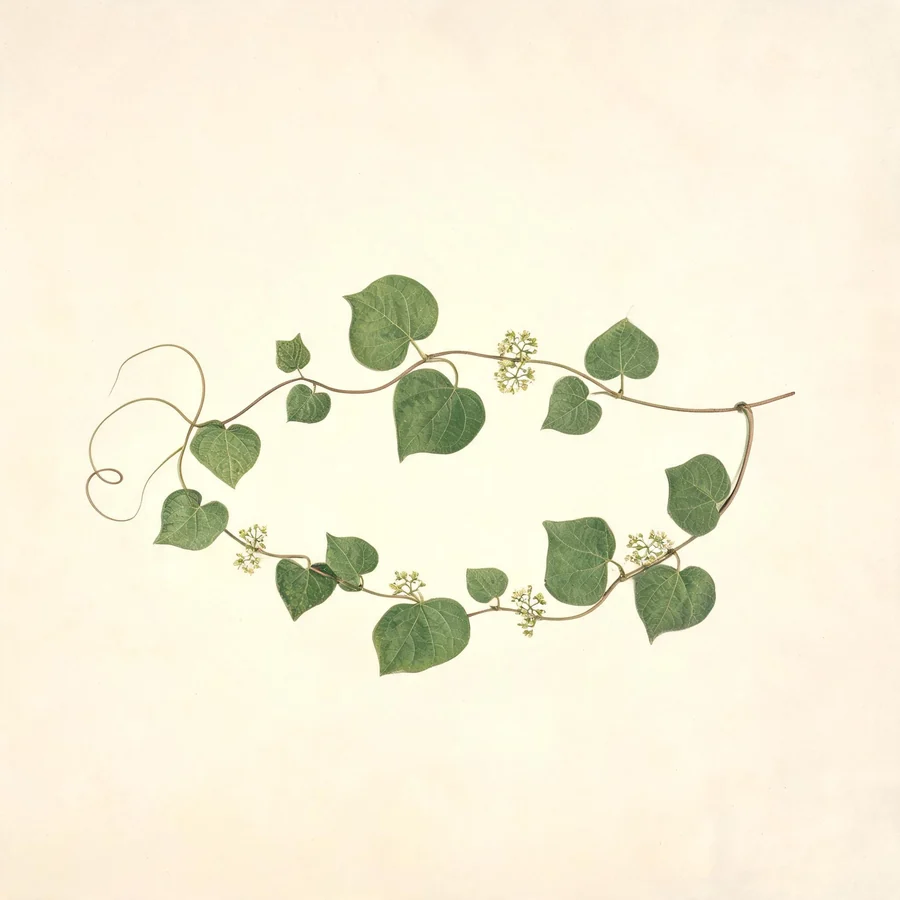
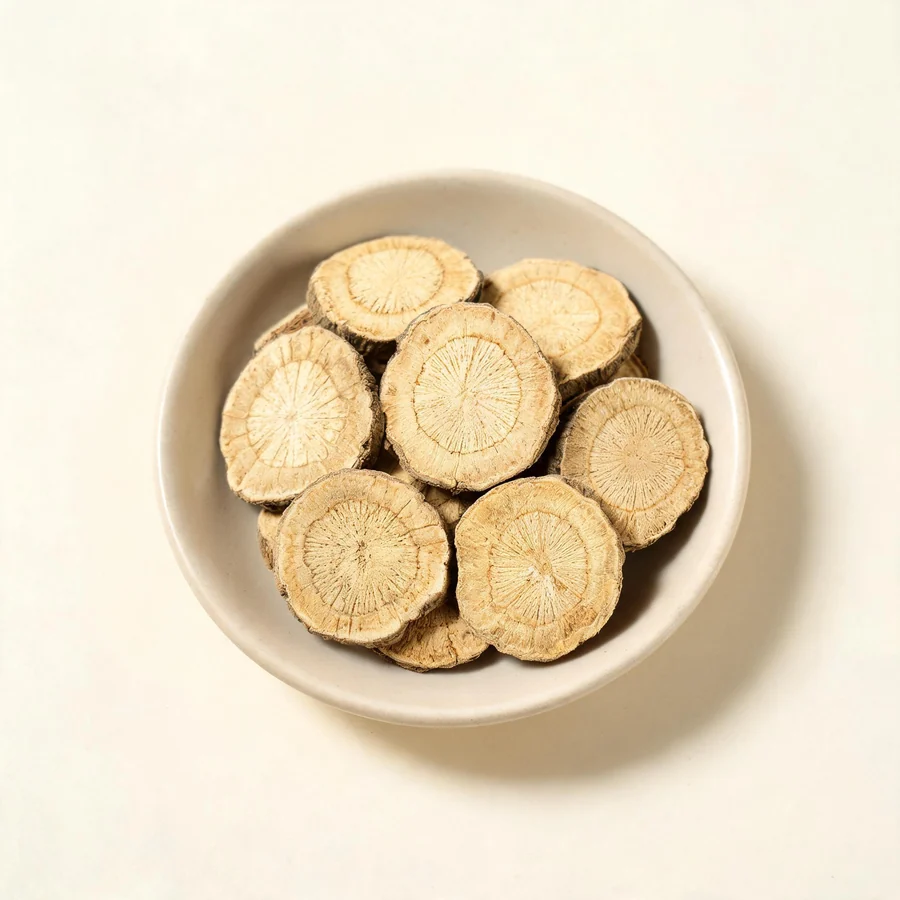
Skin profile
Where this herb sits in skin practice: the pattern it corrects, the skin signs it suits, and what it should not be used for.
Fang Ji is a cold, draining root for damp-heat that sits low: puffy, weeping, itchy legs and feet with scanty dark urine. Species identity is the safety step, the dose margin is narrow, and the course is always short.
Skin signs that suggest it
- Weeping, itchy eczema of the lower legs and feet, worse in humid weather
- Puffy, heavy legs and ankles that pit on pressure, with scanty dark urine
- Hot, red, swollen joints with redness of the skin over them
- Moist, macerated skin between the toes with an itchy, sodden surface
- A greasy yellow coating on the tongue and a slippery, rapid pulse
When it is not the right herb
Not for dry skin without dampness, and not for a dry cough, a red tongue without coating or a fine rapid pulse, where a very bitter cold herb drains fluids that are already short. Not where the puffiness arises from deficient Kidney Yang and not from damp-heat blocking the channels, since draining works against a depleted person. Not for a child, not in pregnancy, and not for anyone with heart or kidney disease without supervision. And never with material whose species is not stated: an unidentified fang ji is a bar, not a caution.
What it does for skin
Skin-relevant actions only. Each one describes a mechanism in TCM terms and what it looks like on the skin.
Drains damp-heat downward out of the skin
The root is described as opening the water passages, and in skin practice that means giving a wet, hot eruption a route out through the urine rather than trying to dry it at the surface. The picture is a lower-body rash that is worse in humid weather, with puffiness and little dark urine, and the change looked for is that the skin settles as the urine flows. It is not a surface herb and it does nothing for a rash confined to the upper body.
Reduces swelling in the lower limbs
It descends naturally and is said to be especially effective where fluid collects in the legs, ankles and feet, which is why it appears in the classical formulas for wind-water. The skin relevance is direct: tense, puffy, shiny lower legs are hard to heal and easy to break, and reducing the swelling is part of protecting the surface. Oedema with breathlessness or with one hot swollen leg is a medical matter and not a pattern to drain at home.
Clears heat from the joints and the skin over them
In heat bi the joints are red, hot and swollen, and the skin over them is warm and tight. The bitter cold clears the heat while the pungent quality is said to disperse the blockage, and it is described as reaching the fine network vessels around a joint, which is why it is chosen for small joints of the feet and hands. On the skin that shows as less redness and less of the tense, shiny look over an inflamed joint.
Clears damp-heat itch in the folds and between the toes
The classical record names scabies, tinea and worm-sores among the indications, which is the historical basis for its use in moist, itchy intertriginous skin. The reasoning is that the same damp-heat that produces swelling produces maceration and itch when it settles in a fold. It is used as part of a damp-heat formula internally rather than as a topical application, and it does not replace a topical antifungal where a fungus is actually present.
Skin conditions it is used for
Mapped to the condition pages on this site. The pattern column shows what the skin is doing when this herb is the right choice.
| Condition | Pattern | Why it suits | Typical setting |
|---|---|---|---|
| Eczema | Damp-heat eczema of the lower legs | Weeping, itchy eczema on the shins, ankles and feet, with puffiness and scanty dark urine, is the clearest skin expression of damp-heat with water not moving. The root drains that heat and fluid downward while other herbs in the formula clear the surface. It is reserved for the wet, lower-body type, not for dry lichenified eczema, and it is stopped once the ooze has settled because a draining herb has nothing left to drain. | A modified damp-heat formula with Ku Shen and Yi Yi Ren, or Fang Ji Huang Qi Tang where there is swelling with Qi deficiency |
| Red and swollen feet | Damp-heat settling in the feet (heat bi) | Feet that are red, hot, swollen and painful, with tight shiny skin over them, are read as heat bi with dampness in the lower channels, which is exactly where the herb is said to work. It clears the heat and moves the water at the same time, which is why it addresses the colour and the swelling together. A single hot swollen foot with fever needs urgent assessment, since infection and a clot both present that way. | A modified heat-bi formula with Qin Jiao and Mu Gua, or Fang Ji Fu Ling Tang where the swelling is marked |
| Swollen ankle | Pitting oedema with dampness | An ankle that pits on pressure and feels heavy, in a person with scanty urine and a greasy coating, is read as water not moving through the lower body. The root is used with Qi-supporting and Spleen-draining herbs so that the fluid moves without the person being depleted. An ankle swollen on one side only, or swelling with breathlessness, is not this pattern and needs medical assessment. | Fang Ji Huang Qi Tang, with Huang Qi and Bai Zhu |
| Skin swelling | Water spilling into the tissues | When fluid spills into the tissues the skin looks puffy, tense and slightly shiny, and the traditional name for that picture with surface signs is wind-water. The herb sends the retained water down and out, and it is nearly always paired with a Qi tonic that repairs the weakness which let the fluid collect. It is not for swelling from a blocked lymphatics or a cardiac cause without medical assessment. | Fang Ji Huang Qi Tang, or Fang Ji Fu Ling Tang where the limbs feel heavy and twitch |
| Athlete's foot | Damp-heat and maceration between the toes | The classical record names tinea and worm-sores among the indications, and the reasoning is that a sodden, itchy web space is damp-heat lodged in a fold. The herb is used internally as part of a damp-heat formula to reduce the wetness that the fungus colonises. It does not treat the fungus itself, so a topical antifungal remains the definitive treatment, and the herb is not applied to the raw, cracked web space. | A damp-heat formula with Ku Shen and Yi Yi Ren internally, alongside a topical antifungal |
| Jock itch | Damp-heat in the groin folds | A red, itchy, macerated groin with a greasy tongue and dark urine is damp-heat in a fold, and the draining action addresses the internal source rather than the surface. It is a support to proper topical treatment, and it is given for a short course because the herb is cold and drying and can upset the stomach. A rash that is spreading, blistering or secondarily infected needs review before herbs are added. | A modified Long Dan Xie Gan Tang with Fang Ji added, alongside a topical antifungal |
Combinations for skin
Herbs it is paired with when the skin, not an internal organ, is the target.
| Partner | Ratio | Why the pair is used |
|---|---|---|
| Huang Qi | 12 g Fang Ji with 15 g Huang Qi, as in the classical formula | Astragalus lifts and holds the surface while the root goes downward and drains, so water moves without the person being depleted. It is the pairing for oedema with Qi deficiency, and the tonifying herb also shields digestion from a cold bitter root. The classical proportion carries the lesson: the tonic outweighs the drainer, which is how such a formula is made safe for a depleted body. |
| Fu Ling | 9 g of each in decoction | Both move water and they do it differently: the root clears damp-heat and reaches into the channels, while poria seeps dampness out through the Spleen. Together the two drain without tiring digestion, which suits swelling with scanty urine, heaviness and a stool that tends loose. It is a common pairing for legs that swell and skin that stays moist and slow to heal. |
| Gui Zhi | 6 to 9 g Gui Zhi with 9 g Fang Ji | The pairing balances temperature: the root is bitter, cold and descending, and cinnamon twig is pungent and warming, opening the channels with warmth. It suits a mixed picture with cold and heat together, because the warmth loosens what cold has congealed and the root removes the dampness the warmth has freed. On the skin it fits a limb that is swollen and heavy but not hot throughout, with twitching or cramping. |
| Mu Gua | 9 g of each in decoction | The root removes dampness from the channels and quince relaxes and frees the sinews, so the pair suits dampness that has been in the lower limbs for years, with stiffness, cramping and heaviness and legs that feel weak on walking. It works on the tight, heavy quality that makes a swollen leg uncomfortable rather than on the swelling alone, and it belongs inside a formula. |
Formulas where it leads
- Fang Ji Huang Qi Tang (防己黄芪汤) - The classical formula for wind-water with sweating, a dislike of wind and heaviness of the limbs, built on the root with astragalus, atractylodes, liquorice, ginger and jujube. The tonifying herbs repair the surface defence that let the fluid leak, and the root drains what has already collected. It is the template for draining without weakening and the safest context in which the herb is used.
- Fang Ji Fu Ling Tang (防己茯苓汤) - A formula for water at the skin level, with swelling of the limbs, heaviness and muscle twitching, built on the root with poria, astragalus and cinnamon twig. It moves fluid that has settled into the tissues while warming the channels so that it can travel. The twitching is the clue that the picture is water and not simple weakness, and the formula is a short course with review of the swelling.
Safety for skin use
What to check before recommending or using it, including the cautions that matter most for skin patients.
Do not use, or use with caution
- Material that cannot be identified as Stephania tetrandra. Guang Fang Ji, Aristolochia fangchi, was banned and dropped from the pharmacopoeia in 2004 over nephrotoxic aristolochic acid, and its root is denser, woodier and radially marked. Ask for the species name and a certificate showing no aristolochic acid, and refuse loose material whose origin cannot be traced.
- Heart or kidney disease, and any medicine for either, without supervision. The alkaloids depress the heart and respiration in excess, and the diuretic effect alters fluid and electrolytes.
- Yin deficiency without damp-heat: a dry mouth, night sweats, a red tongue with no coating and a fine rapid pulse. A bitter cold draining herb dries what is already short.
- Weak digestion, with nausea, a poor appetite and loose stools. The fried form is gentler, but the herb is harsh on the stomach.
- Pregnancy, breastfeeding and childhood. It is avoided in all three in routine practice, and the classical warnings name prenatal Blood deficiency specifically.
Pregnancy and breastfeeding
Avoided. The classical warnings name prenatal Blood deficiency, the cold draining action is unwelcome in pregnancy, and tetrandrine relaxes smooth muscle in laboratory work, which raises a question about uterine tone that no study has answered. No safety data exist in pregnant women, so use would be a practitioner's decision in an unmistakable damp-heat pattern, using the fried form and keeping it brief. Lactation is treated the same way: the alkaloids are fat-soluble, passage into milk is plausible, levels are unmeasured, and there is no infant indication, so the herb is stopped or replaced.
Interactions
- Blood pressure medicines. Tetrandrine blocks calcium channels and lowers pressure by itself, so adding the herb to amlodipine or nifedipine can produce an additive fall with postural dizziness. Readings should be taken before the course and during it.
- Heart rhythm medicines. Tetrandrine behaves in a quinidine-like way and may add to quinidine, amiodarone or similar drugs, so the prescriber should be told the herb is in use.
- Diuretics and lithium. Water loss adds to a diuretic's effect and can shift potassium and sodium; lithium concentrations move with any change in urine output.
- Anaesthetic muscle relaxants. The curare-like alkaloids can potentiate them, so a surgical team should be told about the herb beforehand.
- Medicines handled by CYP3A4, among them some statins, calcium channel blockers and antifungals, may reach different concentrations while the herb is being taken.
Allergy and patch testing
A new rash, itching or swelling during a course should be treated as a possible reaction and the herb stopped. Because the same name has covered more than one species, a reaction may also be a reaction to the wrong root, which is another reason to record the supplier and the batch alongside the clinical notes.
General safety references
General references for herbal hepatotoxicity and herb-drug interactions; they are not specific to this herb.
- Review article: Herbal hepatotoxicity - an update on traditional Chinese medicine preparations. Alimentary Pharmacology & Therapeutics, 2014. PMID: 24844799.
- Interactions between herbal medicines and prescribed drugs: an updated systematic review. Drugs, 2009. PMID: 19719333.
- Warfarin and food, herbal or dietary supplement interactions: a systematic review. British Journal of Clinical Pharmacology, 2021. PMID: 32478963.
Evidence
The classical record is quoted with its source. The modern note states the level of evidence plainly.
Classical record
防己,味辛,平。主风寒温疟,热气诸痫,除邪,利大小便。一名解离。生川谷。
Fang Ji is acrid in flavour and balanced in nature. It governs wind-cold, warm malaria, heat conditions and the various convulsions, removes pathogenic Qi, and frees both urine and stool. It is also called Jie Li and grows in river valleys.
Shen Nong Ben Cao Jing (Divine Husbandman's Classic of Materia Medica) - The oldest entry links the root to water and to the bowels, and the alternate name is thought to describe the way the cut root separates into radiating segments.
味苦,温,无毒。主治水肿,风肿,去膀胱热,伤寒,寒热邪气,中风,手脚挛急,止泄,散痈肿,恶结,诸蜗疥癣,虫疮,通腠理,利九窍。
Bitter in flavour, warm and non-toxic. It treats water swelling and wind swelling, clears Heat from the Bladder, and is used for cold damage with alternating chills and fever, wind-stroke, cramping of the hands and feet, diarrhoea, abscesses and swellings, scabies and worm-induced sores; it opens the interstices and frees the nine orifices.
Ming Yi Bie Lu (Supplement to the Classic of Materia Medica) - This is the classical warrant for the skin use: abscess and swelling, scabies, tinea and worm-sores are named alongside the water-draining indications.
汉防己,君,味苦,有小毒。能治湿风,口面㖞斜,手足疼,散留痰,主肺气嗽喘。
Han Fang Ji is a sovereign herb, bitter in flavour and slightly toxic. It treats damp wind, deviation of the mouth and face, pain of the hands and feet, disperses retained phlegm, and governs cough and wheezing from disordered Lung Qi.
Yao Xing Lun (Discourse on the Properties of Medicines) - The first text to separate Han from Mu Fang Ji, and the source of the slightly toxic rating that governs the narrow dose.
Modern evidence
Evidence status
- The identity hazard is the established finding. A cluster of progressive kidney failure followed a weight-loss formula sold as Fang Ji in Belgium in the early 1990s; the material was Aristolochia fangchi, and aristolochic acid nephropathy is now a recognised disease with a cancer risk attached. Chinese regulators removed the Aristolochia species by 2004.
- The pharmacology of the authentic root is characterised: tetrandrine and fangchinoline are bisbenzylisoquinoline alkaloids that block calcium entry and relax smooth and skeletal muscle, which explains both the therapeutic effect and the overdose picture of tremor, limb weakness and respiratory depression.
- No controlled trial of Fang Ji in eczema or any skin condition was identified. The skin use rests on the classical indications for damp-heat and on formula-level practice, and it is the safety work rather than the efficacy work that has been done properly.
PubMed records
Selected real PubMed records for this herb's species or its constituents, chosen by species name and title relevance. They are references for the non-TCM discussion above, not proof that the herb treats any skin condition.
- History of uses, phytochemistry, pharmacological activities, quality control and toxicity of the root of Stephania tetrandra S. Moore: A review.. Journal of ethnopharmacology, 2020. PMID: 32497674 (safety record).
Dose and forms
Skin-practice dosing and the preparations that suit skin complaints.
| Form | Dose and notes |
|---|---|
| Decoction | 4.5 to 9 g of dried root from an identified Stephania tetrandra source, in a formula rather than alone. The narrow range is deliberate: the alkaloids have a small margin between effect and toxicity. |
| Ceiling | Fifteen grams appears in the record for severe oedema or an acute damp-heat picture, supervised and brief. Routine prescribing stays at or below 10 g, since a larger amount risks respiratory and cardiac suppression instead of a better result. |
| Fried form | Dry-frying suits a weak digestion or a longer course, because it moderates the cold and lessens nausea. Wine-washing, moistening the slices with rice wine before drying, is an older optional preparation. |
| Course length | A week or two for a defined damp-heat problem, then review. Long courses are not part of the herb's use, and treatment ends once swelling and ooze have settled. |
Here the species outweighs the number on the scale. Five to ten grams of verified Stephania tetrandra in decoction gives a modest alkaloid exposure, and short courses are usually tolerated; long courses are not part of its use, and untested material is refused outright. A narrow margin was already noted in the old texts, and modern accounts say the same: a little stimulates breathing and urine output, while too much suppresses both. Heart or kidney disease makes supervision essential.
Citations and further reading
Only real sources are listed: the classical materia medica passages quoted above, and the source works behind the botanical and safety statements.
- Shen Nong Ben Cao Jing (Divine Husbandman's Classic of Materia Medica), attributed compilation of the Han period - entry quoted above.
- Ming Yi Bie Lu (Supplement to the Classic of Materia Medica), Tao Hongjing, Southern and Northern Dynasties - entry quoted above.
- Yao Xing Lun (Discourse on the Properties of Medicines), Tang period - entry quoted above, and the source of the slightly toxic rating.
- Stephaniae Tetrandrae Radix monograph: Pharmacopoeia of the People's Republic of China - the accepted species and the removal of the Aristolochia species in 2004.
- Aristolochic acid nephropathy: the Belgian case series that followed a weight-loss formula, and the subsequent regulatory bans, summarised as an established safety finding.
- Modern pharmacology: tetrandrine and fangchinoline are bisbenzylisoquinoline alkaloids that block calcium entry and relax smooth and skeletal muscle, summarised as a statement about the level of evidence.
- Botany: literature on Stephania tetrandra of the Menispermaceae, and on the root characters that separate it from the Aristolochia substitutes.
Educational reference for qualified practitioners. This page is not medical advice, and skin conditions should be diagnosed by a clinician before treatment.