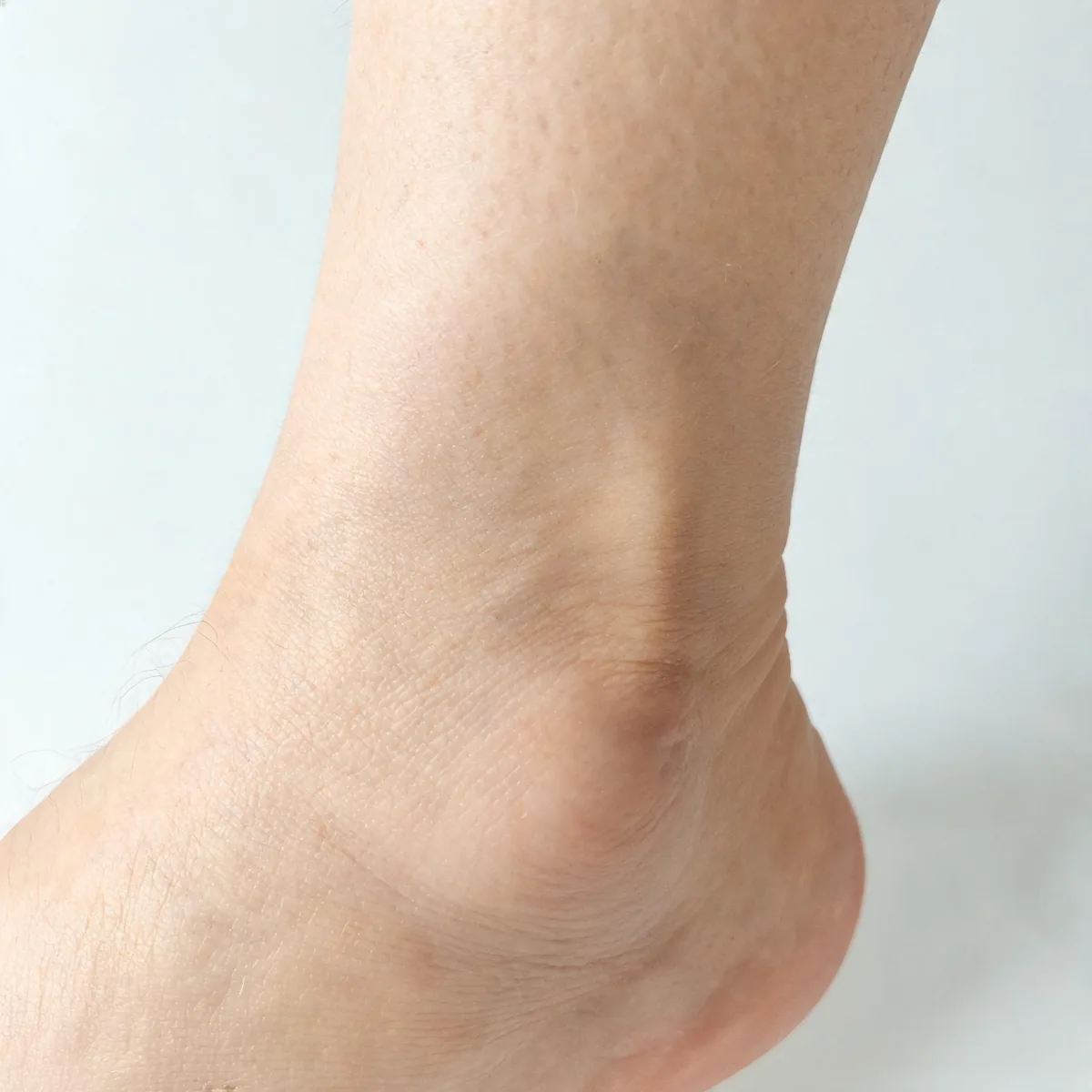
Understanding Swollen ankle
The tradition describes the ankle as a junction of several major meridians, which makes it vulnerable to blockages. Swelling appears when Qi and Blood stop moving freely or when dampness sinks into the lower limbs.
Qi and Blood stagnation after a sprain gives stabbing fixed pain with purple or dark bruising and swelling that feels firm and worsens with walking. That is the injury pattern, and the classical literature treats it as the starting point for most ankle swelling.
Dampness invading the channels gives a heavy aching swelling that stays in place, worse in damp or rainy weather, with stiffness in the morning and numb heavy limbs. There is usually no bruising.
Damp heat in the channels is the red, hot ankle: swelling that is red and hot to the touch, pain worse with warmth and better with cold, with a yellow greasy coating and dark scanty urine. That picture needs medical assessment to exclude infection or gout.
The ankle is described as a crossroads where several major meridians converge, which makes it vulnerable to blockage. Swelling appears when Qi and Blood stop moving freely or when pathogenic Dampness sinks into the lower limbs. The Spleen is the organ most responsible for transforming fluids, so when it is weak Dampness accumulates and settles in the ankles, often worsening in humid weather or after cold raw food.
After a twist or impact the picture shifts to Qi and Blood Stagnation: the local channels are disrupted, Blood pools and the ankle becomes bruised, purplish and painful on movement, with swelling from stasis rather than fluid alone. When Dampness combines with Heat the ankle turns red, hot and acutely painful, a picture common in gouty attacks and inflammatory arthritis where warmth makes it worse and cold soothes it. Distinguishing stasis, Dampness and Damp-Heat lets the practitioner reduce the swelling and correct the underlying vulnerability.
Conventional view
In Western medicine ankle swelling is usually seen as excess fluid in the soft tissues or joint. It can follow a local injury such as a sprain or fracture, inflammation from arthritis or gout, or systemic problems such as venous insufficiency, heart failure or kidney disease. Diagnosis involves examination and sometimes imaging or blood tests to establish whether the swelling is acute or chronic and what is driving it.
Treatment depends on the cause: the RICE protocol and over-the-counter NSAIDs for acute sprains, compression stockings, leg elevation and diuretics for chronic swelling from venous insufficiency, and physical therapy to restore strength and mobility after injury.
Conventional care is excellent at managing trauma and diagnosing systemic disease, but it often treats the swelling as the endpoint. Diuretics and anti-inflammatories reduce fluid without explaining why some people swell more easily or why swelling lingers after healing, and for chronic recurrent puffiness that feels heavy and worsens in damp weather the root often remains unaddressed.
Selected PubMed records
Real PubMed records for the conventional discussion above, selected by condition name and title relevance. They are references, not a claim that any treatment is proven for this condition.
- [CBO-guideline for diagnosis and treatment of the acute ankle injury. National organization for quality assurance in hospitals].. Nederlands tijdschrift voor geneeskunde, 1999. PMID: 10560560.
- The influence of the timing of surgery on soft tissue complications and hospital stay. A review of 84 closed ankle fractures.. Annales chirurgiae et gynaecologiae, 2000. PMID: 10791637.
How it is assessed
The practitioner establishes whether there was an injury, then assesses heat and colour.
What a practitioner looks for
- History: a twist or fall suggests Qi and Blood stagnation.
- Colour: bruising suggests injury; redness and heat suggest damp heat or infection.
- Weather relation: swelling worse in damp weather suggests Dampness invading the channels.
- Red flags: inability to bear weight, severe pain, fever, or a hot red swollen joint.
The history narrows the field quickly. Swelling after a sprain or blow, with bruising or a purplish colour and stabbing pain that worsens on movement, points to Qi and Blood Stagnation; the tongue may be dark or show purple spots and the pulse wiry or choppy, indicating that Blood and Qi are stuck locally.
An ankle that is puffy but not hot or red, heavy and stiff, especially in humid weather or after sitting still, points to Dampness invading the channels, with a thick greasy tongue coating and a slippery pulse. A red, hot, very painful ankle signals Damp-Heat, often with a feeling of warmth, thirst and dark urine, a red tongue with yellow greasy coating, and a rapid slippery pulse, and the joint may look visibly inflamed with a low-grade fever.
TCM patterns in Swollen ankle
Ankle swelling is treated by pattern, not by the swelling alone. Qi and Blood Stagnation follows injury: the channels are disrupted, Blood pools and the joint is bruised, purple and sharply painful. Dampness invading the channels comes from a weak Spleen or external damp, giving a heavy, puffy, stiff ankle that worsens in damp weather and feels cold rather than hot. Damp-Heat gives a red, hot, acutely painful ankle, often seen in gout or inflammatory arthritis. The three can combine, and an injury can begin as stagnation and settle into lingering Dampness if the swelling persists. The self-check above is a way into that differentiation, not a diagnosis; a practitioner confirms the pattern from the history, the skin, the tongue and the pulse.
| Pattern | Key signs | The itch | Tongue | Main formula |
|---|---|---|---|---|
| Qi And Blood Stagnation | Stabbing fixed pain at the ankle; Swelling that feels firm and worsens with walking | Not specified | Body: Purple or dark, with stasis spots; sublingual veins dark and distendedCoat: Thin white | Not specified |
| Dampness invading the Channels (Joints and Muscles) | Heavy aching swelling that stays in place | Not specified | Body: Pale or slightly swollen with teeth marksCoat: White and greasy, with an excessively moist surface | Not specified |
| Painful Obstruction due to Damp Heat in Channels | Ankle swelling red and hot to touch; Pain worse with warmth and better with cold | Not specified | Body: Red, possibly slightly swollenCoat: Yellow and greasy | Not specified |
Qi And Blood Stagnation
Swelling after a sprain with fixed stabbing pain and bruising.
When the ankle is twisted or struck, the local flow of Qi is disrupted and Blood pools instead of moving. The blockage produces swelling, a purplish bruise and a sharp fixed pain that worsens with pressure or movement, and the swelling can feel firm to the touch.
The tongue is dark purple with stasis spots and distended sublingual veins, and the pulse is wiry and choppy. Strenuous walking, cold exposure and anger or stress aggravate it, while rest and elevation, a warm compress after the first 48 hours and gentle movement help. Treatment moves Qi and Blood and dispels stasis, with Xue Fu Zhu Yu Tang as the standard formula and herbs such as Tao Ren, Hong Hua and Chuan Niu Xi, supported by points such as SP-10 and LR-3.
Signs
- Stabbing fixed pain at the ankle
- Purple or dark bruising around the joint
- Swelling that feels firm and worsens with walking
- History of a recent sprain or twist
Diet and lifestyle for this pattern: In the first 24 to 48 hours, rest, elevate the ankle and apply a cold compress; after the acute phase switch to gentle warmth to encourage circulation. Eat warming, blood-moving food such as turmeric, ginger, dark cherries and leafy greens, avoid cold or raw food that can congeal blood, and begin gentle ankle movement once pain allows to prevent stiffness.
Dampness invading the Channels (Joints and Muscles)
Heavy aching swelling worse in damp weather.
When the Spleen is weak or exposed to external damp, fluids are not transformed and heavy sticky Dampness accumulates. As a Yin pathogen it sinks to the lower limbs and settles in the ankle, clogging the channels and blocking Qi and Blood, which gives swelling, heaviness and a dull ache that feels like a wet weight, often worse in damp weather.
The tongue is pale or slightly swollen with teeth marks and a white greasy, excessively moist coating, and the pulse is soggy, possibly slow and slippery at the right guan position. Damp or rainy weather, cold exposure, sitting or standing for long periods, cold or greasy food and lack of movement aggravate it; warmth and dry weather, gentle movement, elevation, warm cooked food and warm foot soaks help. Treatment dispels Wind-Dampness and unblocks the channels, with Juan Bi Tang or Yi Yi Ren Tang and herbs such as Yi Yi Ren and Fu Ling.
Signs
- Heavy aching swelling that stays in place
- Worse in damp or rainy weather
- Limbs feel heavy and hard to move
- Joint stiffness especially in the morning
Diet and lifestyle for this pattern: Avoid cold, raw and greasy food that creates Dampness. Eat warm, cooked meals with ginger, barley and aromatic herbs such as cardamom, keep the ankle warm and dry, walk gently to help Qi flow and dry Dampness, and a warm ginger foot soak can provide relief.
Painful Obstruction due to Damp Heat in Channels
The red hot swollen ankle.
When fluids are not transformed properly, a sticky overheated mixture of Dampness and Heat can build up and travel down the channels. It settles into the ankle, which swells, turns red and feels hot, and the Heat makes the pain worse with warmth and better with cold while the Dampness leaves a heavy boggy sensation.
The tongue is red and possibly slightly swollen with a yellow greasy coating, and the pulse is slippery and rapid. Warmth and hot compresses, greasy spicy fried food, alcohol, overuse and damp weather aggravate it, while cold compresses, rest and elevation, a light cooling diet and cool weather help. Treatment clears Heat and drains Dampness while unblocking the channels, with Xuan Bi Tang or Er Miao San and herbs such as Yi Yi Ren and Fang Ji.
Signs
- Ankle swelling red and hot to touch
- Pain worse with warmth and better with cold
- Yellow greasy tongue coating
- Thirst with dark scanty urine
Diet and lifestyle for this pattern: Eat cooling, Dampness-draining food such as barley, mung beans, cucumber and watermelon, and avoid greasy, fried, spicy and rich food as well as alcohol, which create more Damp-Heat. Keep the ankle elevated and apply cold compresses to soothe heat and swelling, and gentle movement is fine while overuse and hot environments are not.
Treatment approach
How the tradition treats swollen ankle, with the herbs, formulas and points used for it.
Principles
- Exclude fracture and infection first: inability to bear weight or a hot red joint needs assessment.
- Move Qi and Blood and resolve stasis where the injury pattern is present.
- Drain dampness where the swelling is heavy and weather-sensitive.
- Clear damp heat where the ankle is red and hot.
- All treatment aims to restore the smooth flow of Qi and Blood in the local channels while addressing the root. For injury the priority is to move stagnant Blood and Qi with herbs such as Tao Ren and Hong Hua and points that invigorate the area; for Dampness it shifts to draining Dampness and strengthening the Spleen with herbs such as Yi Yi Ren and Fu Ling and points such as Yinlingquan (SP-9); where Heat is present it is cleared at the same time, often with Xuan Bi Tang or Er Miao San.
Herbs used
Formulas
Acupoints
- SP-10 (Xuehai)
- LR-3 (Taichong)
- ST-41 (Jiexi)
- BL-60 (Kunlun)
- SP-9 (Yinlingquan)
- ST-36 (Zusanli)
- SP-6 (Sanyinjiao)
- LI-11 (Quchi)
What to expect
- Sprain-related swelling is described as settling over one to three weeks with rest and treatment.
- Chronic damp swelling can persist for months if the underlying pattern is not treated.
- A hot red ankle with fever needs medical care rather than waiting.
- Most people notice some relief after the first few acupuncture sessions, but lasting improvement takes consistency. Acute injuries may settle within a week, while chronic swelling often needs four to eight weeks of weekly acupuncture and daily herbs. Progress is gradual: the swelling reduces, pain diminishes and the ankle feels more stable, and the formula is adjusted as the symptoms change.
Safety and when to get help
Seek medical help urgently for
- Sudden severe pain and swelling after injury with inability to bear weight - possible fracture or ligament tear.
- A red hot swollen ankle with fever - possible infection or gout.
- Calf pain with swelling, warmth or breathlessness - possible clot.
For anything severe, sudden or spreading quickly, read when a skin problem needs urgent care.
Cautions
- Do not massage a fresh injury vigorously or apply heat in the first 48 hours.
- Persistent swelling in one ankle needs medical review of venous and cardiac causes.
- Do not walk through severe pain to test the joint.
Using this alongside conventional care
- TCM is described as complementary to conventional care: imaging and medical assessment where injury is suspected, with herbs and acupuncture for the recovery phase.
- TCM can complement conventional care for most ankle swelling. Anyone taking NSAIDs, diuretics or blood thinners should tell both the TCM practitioner and the doctor, because herbs that invigorate Blood such as Tao Ren, Hong Hua and Dang Gui may have antiplatelet effects and caution is needed with anticoagulants. Acupuncture is generally safe alongside medication, but the whole healthcare team should be kept informed.
Diet and lifestyle
- Favour warm cooked easily digestible food, and for damp patterns reduce cold, raw and greasy food.
- Warm, cooked, easily digested food supports healing. For Dampness, reduce cold raw and greasy food, dairy and excessive sweets, which burden the Spleen and create more Dampness, and use barley, adzuki beans and lightly cooked vegetables to help drain fluid. If the ankle is red and hot, avoid spicy, fried and alcohol-rich food that adds Heat, and in all cases limiting salt can help reduce fluid retention. Ginger tea or warm water with lemon can gently promote circulation.
If you're pregnant
Swollen ankles are common in pregnancy, but the patterns on this page, especially Qi and Blood Stagnation, need extra caution. Blood-moving herbs such as Tao Ren, Hong Hua and Chuan Niu Xi are strictly avoided because they can stimulate uterine contractions and risk miscarriage, and points traditionally forbidden in pregnancy, such as Sanyinjiao (SP-6), Hegu (LI-4) and Kunlun (BL-60), must not be used.
Treatment instead uses gentle methods: mild Spleen-strengthening and Damp-draining herbs such as Bai Zhu and Fu Ling are safer, and acupressure or moxibustion on points such as Zusanli (ST-36) can help without risk. A practitioner experienced in pregnancy care should be consulted before any modality.
If you're breastfeeding
Most herbs used for ankle swelling are considered safe during breastfeeding, but strong blood-moving formulas such as Xue Fu Zhu Yu Tang should be used with caution because their active compounds can pass into milk. In Dampness patterns, Fu Ling and Yi Yi Ren are generally safe and may even support milk production by strengthening the Spleen.
If treatment is needed, a practitioner will choose milder food-grade herbs and watch the infant for digestive changes. Acupuncture remains a commonly used option because it carries no risk of transmitting substances through milk, although trial evidence in this group is limited.
If treating a child
In children a swollen ankle is almost always a sprain or fall, making Qi and Blood Stagnation the dominant pattern, though the immature Spleen means Dampness can also accumulate if the injury is not well managed. Doses are reduced to a third or a half of the adult dose by age and weight.
Children may not describe symptoms clearly, so observation of bruising, heat and reaction to touch matters. Acupuncture is often replaced by acupressure or gentle tuina on points such as ST-41 and BL-60, and external washes with Hong Hua and Ai Ye can safely reduce swelling.
If treating an elderly patient
In older people ankle swelling often sits on an underlying deficiency of Qi, Blood or Yang even when the presenting pattern is Dampness or stagnation, so strong blood-moving herbs are used judiciously to avoid depleting the body further. Formulas are often modified with tonifying herbs such as Dang Shen or Huang Qi to support the constitution.
Many older patients take multiple medicines, so herb-drug interactions must be screened. Timelines are longer, acupuncture may be preferred over strong decoctions, and gentle movement plus dietary advice to support Spleen Yang are essential.
Urgent-sign guidance is based on standard sources: NHS anaphylaxis, NHS cellulitis, NHS Stevens-Johnson syndrome, NHS melanoma.
Evidence
Evidence status
Compiled for this page from the classical and modern literature; not a systematic review, so treat it as a pointer to sources rather than clinical guidance.
The evidence is moderate for the traumatic presentation. A Cochrane review of 17 randomised trials found that acupuncture may reduce pain and swelling and improve function in the short term after acute ankle sprain compared with no treatment or sham, while rating quality moderate because of risk of bias. Swelling that is one-sided, painful or accompanies breathlessness needs assessment, since ankle swelling has cardiac, renal and venous causes.
Studies often cited
The review of 17 randomised trials found that acupuncture may reduce pain and swelling and improve function in the short term compared with no treatment or sham acupuncture, with evidence quality rated moderate because of risk of bias. Kim TH, Lee MS, Kim KH, et al. Cochrane Database of Systematic Reviews 2013, Issue 7. Art. No.: CD009065. doi:10.1002/14651858.CD009065.pub2
Classical record
For all types of water retention where swelling is below the waist, promote urination.
- Jin Gui Yao Lue (Essential Prescriptions of the Golden Cabinet), chapter on water Qi.
风寒湿三气杂至,合而为痹也。
The three Qi of wind, cold and dampness arrive together, and combined they form Bi, painful obstruction.
Huang Di Nei Jing, Su Wen, Chapter 43 (Bi Lun) - Classical citation; the translation is our own.
Common questions
Should I walk on a swollen ankle?
Not if bearing weight is severely painful. Sudden swelling with inability to bear weight needs assessment for fracture.
Is a hot red ankle dangerous?
It can be gout or infection, both of which need medical assessment.
Can herbs reduce swelling?
The tradition describes moving Qi and Blood and draining dampness, with improvement over weeks depending on the cause.
Why does it swell more in damp weather?
That pattern is described as dampness invading the channels, where swelling and stiffness worsen in damp or rainy weather.