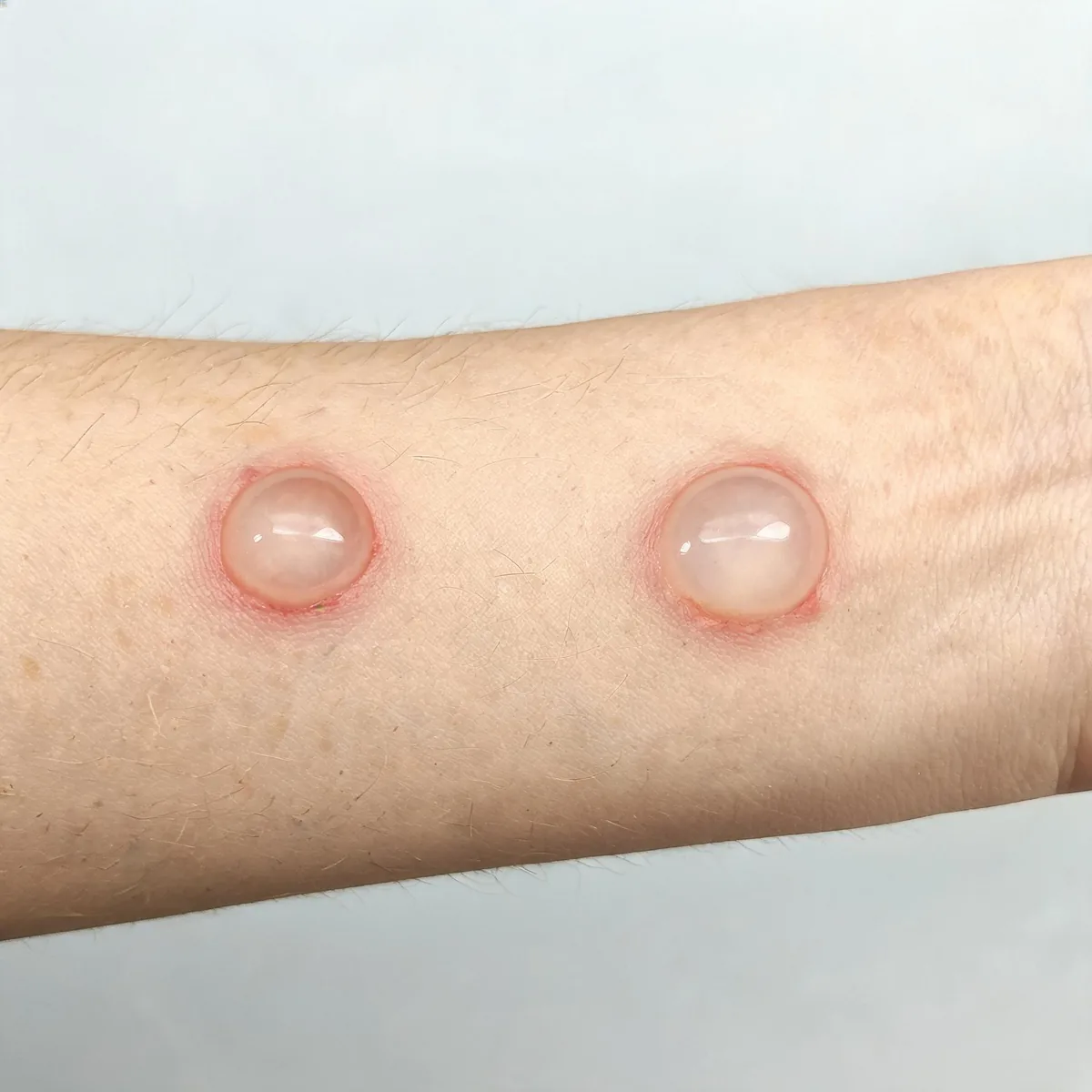
Understanding Bullous dermatitis
A naming note: the Chinese name 天疱疮 is also the term used for pemphigus, which has its own page. This page covers bullous dermatitis as described by the source, and both are kept because the source treats them separately.
The tradition describes bullous dermatitis as a dramatic outward sign of deep internal heat and dampness, involving the Lungs, Heart and Spleen.
Toxic-Heat gives sudden rapidly spreading blisters with bright red painful erosions after they burst, high fever, intense thirst and irritability. Damp-Heat in the Stomach and Spleen gives blisters that weep and itch with redness and burning, recurring rather than appearing all at once, with bloating.
Spleen deficiency with dampness gives flaccid blisters that ooze clear fluid, with thick crusts, persistent weeping, a chronic recurring course with less redness, fatigue and heaviness. Qi and Yin deficiency describes the healing phase: dry scaly peeling skin with few or no new blisters, severe fatigue, dry mouth with little desire to drink and night sweats.
The framework reads blistering as a signal from deeper organs rather than a surface fault. The Heart governs Blood and the vessels, and the Spleen governs the transformation of fluids; when Heart Fire flares and the Spleen fails to process fluids, Dampness and Heat combine, rise, and discharge through the skin as blisters that are red, hot and painful. Because the same pair of organs sits behind both the acute and the chronic picture, the staging question comes first: a sudden fiery outbreak and a slow weeping one are read as stages of a single process rather than as unrelated diseases. Rich food, alcohol and emotional stress are noted as common triggers, because each one either adds Heat or burdens the Spleen.
In the acute stage the emphasis falls on the blood level. External Heat toxin joins internal Fire, scorches the vessels and drives fluid out beneath the skin, which is why the blisters spread quickly and rupture into bright red erosions; a deep red tongue with a thick yellow coat and a rapid forceful pulse match that intensity. As the illness settles, Dampness becomes the leading factor: eruptions arrive in waves, the tongue coat turns greasy, and digestion complains with bloating and sticky stools. Left to run, the same Dampness weakens the Spleen further, so blisters turn flaccid and weep clear fluid, and after months the reserves of Qi and Yin are spent, leaving dry scaly skin and deep tiredness.
Conventional view
Bullous dermatitis refers to a group of autoimmune blistering diseases, most notably pemphigus and bullous pemphigoid, in which the immune system mistakenly attacks proteins that hold skin cells together, causing painful fluid-filled blisters on the skin and often inside the mouth, nose or throat. Diagnosis typically needs a skin biopsy and direct immunofluorescence to identify the specific antibodies, and these are chronic, potentially life-threatening conditions requiring ongoing medical management.
The mainstay of Western treatment is high-dose systemic corticosteroids such as prednisone to suppress the immune attack, often combined with steroid-sparing immunosuppressants such as azathioprine, mycophenolate mofetil or rituximab. Topical wound care, pain management and antibiotics for secondary infection are also essential, and the goal is to stop new blisters forming and let existing lesions heal.
Steroids and immunosuppressants can be life-saving, but long-term use carries significant risks including weight gain, bone loss, high blood pressure, diabetes and increased susceptibility to infection. Many patients find blisters return when medication is tapered and some achieve only partial remission, and conventional treatment does not address the constitutional imbalances of Heat, Dampness or deficiency that TCM identifies as the root, nor rebuild resilience after the acute phase.
Selected PubMed records
Real PubMed records for the conventional discussion above, selected by condition name and title relevance. They are references, not a claim that any treatment is proven for this condition.
- Dermatologic toxicities to inhibitors of cyclin-dependent kinases CDK 4 and 6: An updated review for clinical practice.. Annales de dermatologie et de venereologie, 2023. PMID: 37586898.
- Acute and recurrent vesicular hand dermatitis.. Dermatologic clinics, 2009. PMID: 19580928.
How it connects
Bullous dermatitis often appears alongside other autoimmune conditions, because the underlying terrain, a mix of Heat toxin, Dampness and Spleen deficiency, is one in which several autoimmune processes can take hold; a person with pemphigus may also develop thyroiditis or rheumatoid arthritis. Anxiety commonly accompanies it too: chronic pain, visible lesions and unpredictable flares unsettle the Heart Shen, while lingering Heat and Yin deficiency agitate the mind directly. Treating the core pattern often calms the anxiety at the same time. The clusters are read as consequences of one terrain rather than as separate illnesses. Heat toxin, Dampness and Spleen deficiency together create conditions in which several autoimmune processes can take hold, which is why pemphigus may be accompanied by thyroiditis or rheumatoid arthritis. Anxiety is explained differently: chronic pain, visible lesions and unpredictable flares unsettle the Heart Shen, and lingering Heat with Yin deficiency agitates the mind directly, so clearing the core pattern is said to calm the anxiety at the same time.
How it is assessed
The practitioner assesses spread, fluid and mucosal involvement, after medical assessment.
What a practitioner looks for
- Speed: rapid spread of blisters suggests Toxic-Heat and needs urgent care.
- Fluid: clear fluid in flaccid blisters suggests Spleen deficiency with dampness.
- Recurrence: recurring blisters with less redness suggest a chronic damp pattern.
- Red flags: widespread blistering, mucosal involvement, or difficulty swallowing.
Reading the lesion itself comes first. Tense blisters on inflamed skin that arrive in a rush and leave raw red patches when they break are read as Heat toxin at the blood level, and the practitioner will also ask about fever, thirst, irritability and constipation before confirming the reading with a deep red tongue, a thick yellow coat and a rapid forceful pulse. When the lesions arrive in crops, weep, itch and burn, with a greasy yellow coating, a sticky taste in the mouth and fullness in the upper abdomen, the reading moves to Damp-Heat in the Stomach and Spleen, and the pulse becomes soggy, rapid and slippery.
The chronic end of the spectrum is read from what the skin does between flares. Blisters that lie flat and weep a clear fluid, together with thick crusts and unremitting weeping with little redness, together with heaviness, poor appetite and loose stools, point to Spleen Deficiency with Dampness, and the tongue is pale, swollen and teeth marked with a white greasy coat. When blistering has largely stopped but the skin stays dry and scaly, with a dry mouth, night sweats and heat in the palms and soles, the picture is Qi and Yin Deficiency and the pulse is fine and rapid. The practitioner also records what makes each flare worse, since those triggers confirm which pattern is active.
TCM patterns in Bullous dermatitis
Differentiation here turns on three questions: how fast the blisters arrive, what the fluid looks like, and what the tongue and pulse show. A first, explosive crop with fever and bright red erosions is an excess picture at the blood level. Crops that keep returning with a greasy coat and digestive heaviness are Damp-Heat, where the Stomach and Spleen are as involved as the skin. Flaccid blisters that weep clear fluid over weeks belong to Spleen Deficiency with Dampness, and dry scaly skin with exhaustion after the flare has passed belongs to Qi and Yin Deficiency. These patterns are stages of one illness as much as separate pictures, so an assessment may combine two of them, for instance Heat toxin still active over an underlying Spleen weakness. Treatment is chosen for the combination actually present, and it is expected to change as the skin changes.
| Pattern | Key signs | The itch | Tongue | Main formula |
|---|---|---|---|---|
| Toxic-Heat | Sudden onset of rapidly spreading blisters; Bright red painful erosions after blisters burst | Not specified | Body: Red, often with raised red pointsCoat: Yellow, dry, sometimes thick | Not specified |
| Damp-Heat in Stomach and Spleen | Recurrent blisters rather than all at once | Blisters that weep and itch with redness and burning | Body: Red, possibly swollen with teeth marksCoat: Thick, yellow and greasy in the centre and root | Not specified |
| Spleen Deficiency with Dampness | Flaccid blisters that ooze clear fluid; Thick crusts and persistent weeping | Not specified | Body: Pale and swollen, often with teeth marks along the edgesCoat: White, greasy and moist, thick in the middle | Not specified |
| Qi and Yin Deficiency | Dry scaly peeling skin with few or no new blisters; Dry mouth and throat with little desire to drink | Not specified | Body: Red or pale-red, thin and dry, possibly crackedCoat: Thin or absent | Not specified |
Toxic-Heat
Rapidly spreading blisters with fever and painful erosions.
In this pattern the illness is carried on the blood level. Heat toxin arriving from outside meets Fire already inside, and the combined force pushes through the vessels so that fluid is driven out under the skin faster than it can be reabsorbed. That is why the blisters appear in a rush, why they are tense and widespread, and why the skin left behind is bright red and painful rather than pale. The same Heat consumes fluids, so the person is hot, intensely thirsty and restless, passing dark scanty urine and constipated.
The tongue is red with prickly thorns and a dry yellow coat, and the pulse runs rapid and forceful, often overflowing or slippery. Greasy and fried food, alcohol, hot humid weather and anger are the usual aggravating factors, while cool compresses, mung bean and watermelon, a cool room and plenty of fluid ease the picture. Qing Wen Bai Du Yin is the formula named for this presentation, with Huang Lian Jie Du Tang added when the Heat must be cleared more forcefully, and the herbs named are Shui Niu Jiao, Huang Lian and Jin Yin Hua. The points are DU-14 Dazhui, LI-11 Quchi and ST-44 Neiting.
Signs
- Sudden onset of rapidly spreading blisters
- Bright red painful erosions after blisters burst
- High fever with intense thirst
- Irritability
Diet and lifestyle for this pattern: Eat cooling, plain food such as mung bean soup, watermelon, cucumber and bitter melon. Avoid all spicy, greasy and fried food, alcohol and coffee, which add fuel to the internal fire, and rest in a cool quiet place with the skin clean and dry to guard against infection.
Damp-Heat in Stomach and Spleen
Weeping itchy blisters with redness and bloating.
Here Heat and Dampness are present in equal measure and settle in the middle burner. The Spleen fails to transform fluids, the Stomach holds Heat, and the mixture ferments and rises to the skin, so the blisters arrive in crops rather than all at once, weep, itch and burn, and the surrounding skin stays red and swollen. Because the same combination sits in the digestion, the person feels full after small meals, passes sticky incomplete stools, tastes something bitter or gluey, is thirsty without wanting to drink, and feels heavy in the limbs.
The tongue is red, sometimes swollen with teeth marks, carrying a thick yellow greasy coat at the centre and root, and the pulse is soggy, rapid and slippery. Rich, fried or spicy food, alcohol, coffee, humid weather, worry and a sedentary day all aggravate it, while light meals, a dry cool room, gentle movement and rest help. Er Miao San is named for this pattern, used alongside the main formula to dry Dampness and clear Heat, and the herbs are Huang Qin, Zhi Zi, Yin Chen and Fu Ling Pi. The points are BL-15 Xinshu, BL-20 Pishu, PC-6 Neiguan, SP-6 Sanyinjiao and ST-36 Zusanli.
Signs
- Blisters that weep and itch with redness and burning
- Recurrent blisters rather than all at once
- Bloating and fullness
- Sticky taste
Diet and lifestyle for this pattern: Avoid greasy, fried, spicy and sugary food that creates Dampness and Heat, and choose light, easy meals such as congee and steamed vegetables. Keep alcohol and coffee out while the flare is active, and gentle daily movement helps the Spleen move Qi and transform fluids.
Spleen Deficiency with Dampness
Flaccid blisters oozing clear fluid with chronic course.
The root here is weakness rather than excess. Spleen Qi that cannot transform and transport fluids lets them gather as Dampness, which seeps outward and gathers under the skin. Because there is no Fire driving it, the blisters are flaccid, the fluid is clear, and the surface forms thick sticky crusts instead of red painful erosions. The absence of redness is the clue that separates this from the Heat patterns, and the persistent weeping and the heavy exhausted body reflect a Spleen too tired to make the energy that healing needs.
The tongue is pale, swollen and teeth marked with a white greasy moist coat, and the pulse is deep and moderate, or soggy and without force. Damp humid weather, raw and cold food, dairy, greasy food, overwork and brooding make it worse, while warm dry weather, light cooked meals, gentle exercise, rest and warm ginger drinks help. Shen Ling Bai Zhu San is the core formula, with Wei Ling Tang often combined with it to dry Dampness and promote urination, and the herbs are Bai Zhu, Fu Ling and Yi Yi Ren. The points are BL-20 Pishu, ST-36 Zusanli, SP-9 Yinlingquan and SP-6 Sanyinjiao.
Signs
- Flaccid blisters that ooze clear fluid
- Thick crusts and persistent weeping
- Chronic recurring course with less redness
- Fatigue and heaviness
Diet and lifestyle for this pattern: Eat warm, cooked, easy food such as soups, congees and steamed vegetables, and avoid raw, cold, greasy and dairy-heavy food that adds Dampness. A little barley, adzuki beans and ginger gently drains it, and gentle daily movement such as walking or qigong helps dry Dampness out.
Qi and Yin Deficiency
The healing phase: dry peeling skin with severe fatigue.
This is the pattern left behind by the earlier stages. Months of Heat and fluid loss use up Qi and the moistening Yin, so the skin has little to rebuild itself with: it turns dry, scaly and fragile, and few or no new blisters appear. The depletion explains the rest of the picture as well, since without Qi there is profound tiredness and poor appetite, and without Yin the mouth and throat stay dry with little wish to drink, night sweats appear, and the palms and soles feel warm.
The tongue is red or pale red, thin and dry with little or no coat and sometimes cracked, and the pulse is fine, weak and often rapid. Overwork, stress, spicy or drying food, hot dry weather and dehydration all deepen the depletion, while rest, sleep, gentle nourishing meals and a moderate cool room support recovery. Ba Zhen Tang is the formula named for this stage, and the herbs are Xi Yang Shen, Mai Dong and Xuan Shen. The points are KI-3 Taixi, ST-36 Zusanli and REN-6 Qihai.
Signs
- Dry scaly peeling skin with few or no new blisters
- Severe fatigue and lack of strength
- Dry mouth and throat with little desire to drink
- Night sweats
Diet and lifestyle for this pattern: Choose easy, nourishing food such as congee, steamed pear and bone broth to rebuild Qi and fluids gently. Avoid spicy, fried and very drying food that further depletes Yin, put rest first, and stop gentle exercise such as walking or tai chi before you feel tired.
Treatment approach
How the tradition treats bullous dermatitis, with the herbs, formulas and points used for it.
Principles
- Medical diagnosis and treatment are essential; blistering diseases often need immunosuppression.
- Clear heat and resolve toxicity in the acute spreading picture.
- Drain dampness where blisters weep and recur.
- Support Qi and Yin in the healing phase once blistering is controlled.
- Root and branch are treated in a deliberate order: in an acute flare the branch, Heat toxin, has to be cleared first because it is what is damaging the skin, and the root, whether Spleen weakness or depleted Qi and Yin, is built up once new blistering has stopped. Formula choice follows that sequence, which is why a bitter cold prescription such as Qing Wen Bai Du Yin is not carried into the chronic phase, where Shen Ling Bai Zhu San or Ba Zhen Tang fits the picture better.
Herbs used
Formulas
- Qing Wen Bai Du Yin
- Huang Lian Jie Du Tang
- Er Miao San
- Shen Ling Bai Zhu San
- Wei Ling Tang
- Ba Zhen Tang
Acupoints
- DU-14 (Dazhui)
- LI-11 (Quchi)
- ST-44 (Neiting)
- BL-15 (Xinshu)
- BL-20 (Pishu)
- PC-6 (Neiguan)
- SP-6 (Sanyinjiao)
- ST-36 (Zusanli)
- SP-9 (Yinlingquan)
- KI-3 (Taixi)
- qihai-ren-6
What to expect
- Autoimmune blistering diseases are chronic and need long-term medical management.
- The tradition describes the healing phase responding to Qi and Yin support.
- Widespread blistering risks fluid loss and infection and needs hospital care.
- Response is expected to be uneven rather than linear: a good week is often followed by a small crop of blisters, and the trend across a month matters more than any single day. Maintenance treatment usually continues at a lower frequency for some months after the skin clears, because the underlying imbalance settles more slowly than the lesions do.
Safety and when to get help
Seek medical help urgently for
- Widespread blistering covering a large area of the body.
- Blisters in the mouth, throat or eyes, or difficulty swallowing or breathing.
- Fever, rapid spread, or skin peeling away in sheets.
For anything severe, sudden or spreading quickly, read when a skin problem needs urgent care.
Cautions
- Do not burst blisters.
- Do not stop corticosteroids or immunosuppressants abruptly.
- New blistering needs dermatological diagnosis, often with biopsy.
Using this alongside conventional care
- This page is complementary: dermatological diagnosis and prescribed immunosuppressive treatment come first, and herbs are used only with the treating team aware.
- Where conventional treatment is in place, herbs are chosen to sit alongside it rather than replace it. Blood cooling herbs such as Shui Niu Jiao and Sheng Di Huang, and Dampness draining herbs such as Fu Ling and Yi Yi Ren, are described as generally well tolerated, but because they can act on the immune response the dose of an immunosuppressant may need review as the skin improves. Steroids are never stopped abruptly, and any reduction is made slowly with the dermatologist. A full medication list, supplements included, belongs at every consultation so that interactions can be screened.
Diet and lifestyle
- Avoid spicy, greasy and fried food, and maintain fluids and protein for wound healing.
- Underneath the pattern advice, the general principle is to keep the Spleen's work light: plain cooked meals, modest portions, warm food, and nothing that arrives very hot, greasy or sweet in quantity. During a fiery flare the emphasis is cooling and draining, with mung bean soup, cucumber, watermelon and bitter greens, and no alcohol, coffee, chilli or deep fried food. Where the picture is Damp-Heat, sugar and rich sauces are reduced as well. With Spleen deficiency, congee, yams and a little lean protein are added and raw or chilled food is taken out. In the depleted stage, pears, honey and black sesame help rebuild fluids, and the classical literature notes that fluid and protein intake matter wherever blistering is widespread.
If you're pregnant
In pregnancy Qi and Blood are directed to nourish the fetus, making deficiency patterns more common. The Toxic-Heat pattern must be treated with great caution: many bitter-cold herbs such as Huang Lian and Da Huang are contraindicated because they can harm the fetus, and gentle formulas such as Qing Wen Bai Du Yin may be used with modifications under expert guidance.
Acupuncture is a safer first line, focusing on points that clear Heat without moving Blood strongly, such as Dazhui (DU-14) and Quchi (LI-11), while avoiding Sanyinjiao (SP-6) and Hegu (LI-4) in the first trimester.
If you're breastfeeding
While breastfeeding, very cold or bitter herbs can pass into milk and cause infant diarrhoea or colic, so Huang Lian and Huang Qin are used sparingly. For Damp-Heat patterns, milder herbs such as Fu Ling and Yi Yi Ren are preferred.
Acupuncture remains safe and can manage symptoms without affecting the baby, and the practitioner should always be told that the mother is nursing.
If treating a child
In children bullous dermatitis often presents with a more acute Toxic-Heat picture, with high fever and rapidly spreading blisters. The Spleen is inherently immature, so Dampness patterns are also common.
Doses are reduced to a quarter to a half of the adult dose by age and weight, and diagnosis relies heavily on observation of skin, tongue and behaviour rather than verbal reports. Treatment must be gentle to protect the developing digestive system.
If treating an elderly patient
Older adults with bullous dermatitis frequently present with Qi and Yin deficiency, as the disease depletes their reserves over time: the skin is dry, blisters are less fiery and fatigue is profound. Doses are lower, about two-thirds of the adult dose, and formulas that tonify Qi and nourish Yin, such as Ba Zhen Tang, are central, with careful monitoring for secondary infection.
Acupuncture can support energy and healing, with shorter needle retention to avoid overtaxing the patient.
Urgent-sign guidance is based on standard sources: NHS anaphylaxis, NHS cellulitis, NHS Stevens-Johnson syndrome, NHS melanoma.
Evidence
Evidence status
Compiled for this page from the classical and modern literature; not a systematic review, so treat it as a pointer to sources rather than clinical guidance.
Evidence is limited but growing. Most published work is small Chinese randomised trials or case series using formulas such as Qingwen Baidu Yin or Huanglian Jiedu Tang in acute pemphigus, reporting less blistering, faster healing and lower steroid requirements. Systematic reviews conclude that Chinese herbal medicine may be a useful adjunct to conventional therapy, with larger and better-designed trials still needed.
Two limits are worth stating plainly. Most of the published work comes from China and consists of small randomised trials or case series, usually testing one formula added to standard treatment, so the results speak to adjunctive use rather than replacement. The systematic reviews that pool them reach a cautious conclusion, that the herbs may be a useful addition to conventional care, while noting that larger and better designed trials are needed. Acupuncture has far less evidence in blistering disease, and its case rests on a plausible anti-inflammatory and immunomodulatory mechanism rather than on trial results.
Studies often cited
Small trials and case series report reduced blister formation, faster healing and lower corticosteroid requirements, with variable methodological quality. Chinese randomised trials and case series (as recorded in the source)
Conclude that Chinese herbal medicine may be useful alongside conventional treatment, while noting that larger well-designed trials are needed. Systematic reviews (as recorded in the source)
Pooled randomised trials of herbs plus corticosteroids against corticosteroids alone found fewer blisters and a shorter time to remission in the herbal groups, which supports an adjunctive role for Chinese herbal medicine. Li J, Wang Y, Zhang L, et al. Journal of Integrative Medicine. 2019.
In 60 patients with acute pemphigus, adding modified Qingwen Baidu Yin to standard therapy produced scores on the Pemphigus Disease Area Index that were significantly lower at four weeks, and new blister formation fell faster than with standard therapy alone. Zhang H, Liu M, Chen X. Chinese Journal of Dermatovenereology. 2021.
Among 48 patients with bullous pemphigoid, the group given conventional treatment plus Huanglian Jiedu Tang had significantly fewer new blisters each week and better quality of life scores across the eight week study period. Chen X, Zhou Y, Wu T. Chinese Journal of Integrated Traditional and Western Medicine. 2020.
Classical record
Tianpao chuang arises when Heart Fire flares up and Spleen Dampness follows; Dampness and Heat contend with each other and erupt on the skin.
- Wai Ke Zheng Zong (Orthodox Manual of External Medicine), chapter on sores and ulcers. The Chinese original is not reproduced here: it could not be recovered reliably from the source record, and is not guessed.
天疱疮由心火脾湿而成
Bullous sores are formed from Heart Fire together with Spleen Dampness.
Yi Zong Jin Jian (Golden Mirror of Medicine), volume 71, Tianpao Chuang - A Classical citation: ; the same passage names the two organs the pattern differentiation turns on.
Common questions
Is bullous dermatitis serious?
Yes. Widespread blistering risks fluid loss and infection, and autoimmune blistering diseases need ongoing medical treatment.
How is it diagnosed?
By dermatological assessment, often with biopsy and immunofluorescence.
Can herbs replace steroids?
No. Corticosteroids and immunosuppressants are central to autoimmune blistering disease, and stopping them abruptly is dangerous.
When is it urgent?
Widespread blistering, mucosal involvement, or difficulty swallowing or breathing.
Can TCM cure bullous dermatitis?
It cannot cure the autoimmune process in one course of treatment. The aim recorded in the classical literature is long term remission by correcting the imbalance that allows blisters to form, with fewer and milder flares and, in some cases, less reliance on conventional drugs under medical supervision.
How soon can I expect results?
Fewer new blisters are usually noticed within two to four weeks in an acute Heat pattern, while chronic patterns take four to eight weeks to show clear improvement and the skin itself can take several months to recover fully. Daily herbs and regular treatment matter more than any single formula.
Does acupuncture hurt the blistered skin?
Needles are not placed in blisters or open erosions. Points are chosen on intact skin, often on the limbs, back or abdomen, and the treatment is generally comfortable; many people find it relaxing, which also helps where stress is a trigger.
Which foods are worth avoiding with bullous dermatitis?
Spicy, greasy and deep fried food, alcohol, excessive sugar and shellfish are the ones to reduce, since they are said to add Heat and Dampness. Cooling, easily digested food such as mung beans, cucumber, watermelon and well cooked grains is favoured instead, with more specific advice following the pattern.