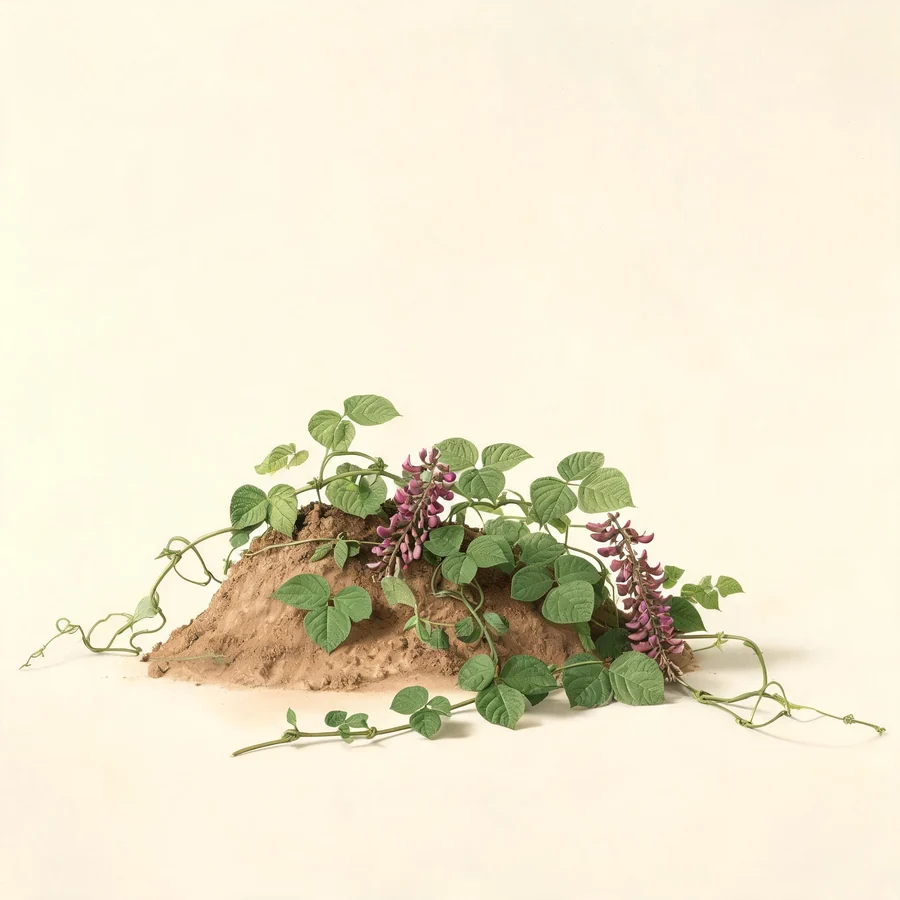
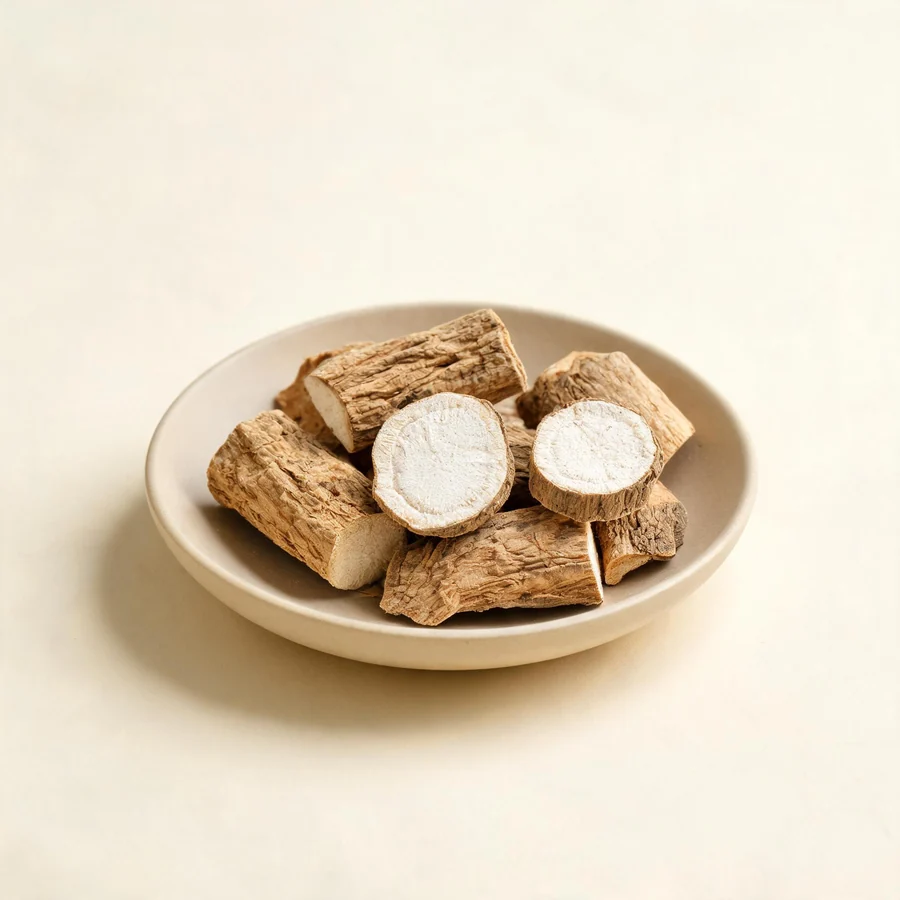
Skin profile
Where this herb sits in skin practice: the pattern it corrects, the skin signs it suits, and what it should not be used for.
Ge Gen is a directional herb: it lifts, it vents and it moistens, and its skin uses follow from those three movements. It suits the acute eruption that needs help to complete, the heat rash of a hot season and the dry, hot skin left by fever, and it is out of place in chronic dry or cold skin disease.
Skin signs that suggest it
- An eruptive rash that is slow to come out, with fever, a stiff neck and an irritable child (a rash failing to vent)
- Small red bumps in the sweat areas of a hot season, with thirst and scanty dark urine (summerheat with blocked pores)
- Hot, dry, tight skin after a fever, with thirst and a dry mouth (fluid consumed by heat)
- An itchy, red, spreading surface reaction that arrives with a feverish cold rather than settling into a fixed plaque
- A rash that looks better once it has fully emerged and worse while it is held back
When it is not the right herb
Not for chronic eczema, psoriasis or any dry, thickened plaque, where the problem lies inside the skin rather than at its surface. It is also wrong for cold-deficiency diarrhoea, for a person who already sweats heavily with a weak exterior, and for the dry, thin Yin-deficient patient, in whom a dispersing, fluid-spending action sharpens the dryness instead of relieving it. A rash that has been present for weeks has nothing left to vent.
What it does for skin
Skin-relevant actions only. Each one describes a mechanism in TCM terms and what it looks like on the skin.
Vents a rash that is failing to emerge
An eruptive rash that stays sparse and slow is read as a pathogen held at the muscle layer, and the treatment is to help it out rather than to suppress it. Ge Gen lifts and disperses at that level, so the eruption completes and the fever settles with it. The classical paediatric formulas for measles-type rashes are built on this action, and it is why the root is given early and stopped once the rash is fully out.
Releases the muscle layer and eases a tight surface
The muscle layer lies just under the skin, and heat or wind caught there produces a stiff neck and shoulders, a tight feeling across the upper back and a fever that does not sweat out. This root is the specific herb for that layer: it relaxes the tightness rather than forcing a sweat, which makes it usable in frail people and in children where a strong diaphoretic would be too much.
Generates fluids and moistens skin dried by heat
Fever, heat rash and a long hot season all spend fluid, and the skin shows it as tightness, fine scaling and a papery feel, with thirst, a dry mouth and scanty urine. Ge Gen sits at a cool rather than a cold temperature and its texture is moistening rather than cloying, so it lowers a residual fever while restoring what the fever spent. That combination is unusual among cooling herbs, most of which dry the surface as they clear.
Cools the surface in heat rash and summerheat eruptions
Prickly heat is read as sweat that cannot escape because dampness and heat have blocked the pores, and the root is used where the rash is fine, red and itchy in the skin folds and the person is hot and thirsty. It is given with herbs that clear summerheat and promote urination, and it is a mild measure for a mild problem rather than a strong intervention.
Skin conditions it is used for
Mapped to the condition pages on this site. The pattern column shows what the skin is doing when this herb is the right choice.
| Condition | Pattern | Why it suits | Typical setting |
|---|---|---|---|
| Skin rashes | An acute eruptive rash held at the muscle layer | A rash that appears with fever but never quite declares itself is the classic indication: the tradition reads the half-formed eruption as a pathogen that has not been pushed out. Ge Gen supplies the direction, and the cooling and fluid-generating actions keep the fever from drying the skin while the rash completes. It is used in the first days, not for a rash that has already been present for weeks. | A modified Sheng Ma Ge Gen Tang with Sheng Ma and Bai Shao |
| Macular rash | Faint flat erythema from heat held at the surface | A macular rash that is faint, pink and slow to brighten is read as heat sitting close to the surface rather than deep in the Blood. The root lifts it out and clears the heat at the same level, which is why it is chosen when the rash is pale and the fever low. A rash that is dark, purplish or does not fade on pressure has gone deeper and needs a blood-cooling approach instead. | Ge Gen with Sheng Ma and Jing Jie in a venting formula |
| Heat rash | Summerheat with blocked sweat and spent fluid | Prickly heat in a hot, humid season, with fine red papules in the folds, thirst and dark scanty urine, is read as summerheat that cannot escape through the skin. Ge Gen cools the surface, opens the way out and replaces the fluid lost through sweating, and it is one of the gentler options for a child or an older person in the heat. | A modified Qing Shu Yi Qi Tang with Ge Gen and Huo Xiang |
| Chickenpox | Epidemic toxin at the surface with vesicles slow to dry | Chickenpox is read as epidemic toxin entering through the mouth and nose, and in the eruptive phase the aim is to help the vesicles come out and settle rather than to drive them back. The root is used when the rash is sparse, the fever low and the child thirsty, as a mild venting and fluid-generating herb. Most cases need only supportive care, and a severe, spreading or secondarily infected eruption needs medical assessment. | A modified Yin Qiao San with Ge Gen added |
| Skin dryness | Fluid depletion after fever, with heat and thirst remaining | Skin that is tight, finely scaly and hot after an illness, with thirst, a dry mouth and scanty urine, is read as fluid spent by heat rather than as a chronic dryness of the Blood. Ge Gen is a modest herb for this: it clears the remaining heat and restores fluid, and it is given with Sheng Di Huang or Mai Men Dong when the dryness is deeper. Dryness that persists for months without heat needs a different approach. | Ge Gen with Mai Men Dong and Sheng Di Huang |
Combinations for skin
Herbs it is paired with when the skin, not an internal organ, is the target.
| Partner | Ratio | Why the pair is used |
|---|---|---|
| Sheng Ma | 6 to 9 g each | Both lift and vent, and both bring out a rash, which is why they are paired for an eruption that will not complete. Sheng Ma is the stronger lifter and also clears heat toxin, while this root opens the muscle layer and supplies fluid, so the pair covers direction and moisture at once. Sheng Ma carries the heavier cautions of the two, so the proportions are kept modest. |
| Gui Zhi | 9 to 15 g Ge Gen with 6 to 9 g Gui Zhi | Gui Zhi warms and opens the muscle layer, and the kudzu root cools what is caught there and adds fluid, a division that lets the pair serve a feverish stiff neck whether the picture runs cool or warm. It is the classical muscle-layer combination, and on skin it is used for the tight, aching surface that comes before a rash declares itself. |
| Huang Qin | 9 to 15 g Ge Gen with 6 to 10 g Huang Qin | The kudzu root lifts the clear Qi upward while Huang Qin clears the heat below it, a pairing used where a hot, damp eruption runs alongside loose, burning stools. On the skin it suits a red, weeping rash with intestinal heat, and the fluid-generating action of the root offsets some of the drying that the bitter herb produces. |
| Jin Yin Hua | 15 g Ge Gen with 10 to 15 g Jin Yin Hua | Jin Yin Hua clears heat and resolves toxin while Ge Gen vents the surface and keeps the fluid up, a combination used for a vesicular or pustular eruption in a feverish child. One herb deals with the pathogen and the other with the direction it needs to take, and neither is strong enough to be relied on alone in a severe eruption. |
Safety for skin use
What to check before recommending or using it, including the cautions that matter most for skin patients.
Do not use, or use with caution
- Spleen and Stomach deficiency-cold, with loose stools, a poor appetite and a cold abdomen. The root is cool, ascending and dispersing, and it can loosen the bowel further and leave the digestion weaker.
- A weak exterior with spontaneous sweating. Because it opens the surface, it can spend Qi and fluid in a person who already sweats without exertion or who catches cold at every exposure.
- Yin deficiency with interior heat. When someone is thin and dry, sweats at night, shows a red tongue and passes little urine, a lifting root that spends fluid can sharpen the dryness instead of relieving it.
- A rash that has already come out fully, or one that has been present for weeks. There is nothing left to vent at that stage, and the root's dispersing action only spends fluid and dries the surface it was meant to help.
Pregnancy and breastfeeding
Food-level use of the starch is not the same as a medicinal decoction, and the two should not be confused. A Tang dynasty pharmacopoeia, the Ben Cao Shi Yi, warned that raw kudzu breaks Blood and may bring on miscarriage, an old caution rather than a modern finding, but one that fits the root's dispersing action. Medicinal doses are therefore avoided in pregnancy without supervision, and the same restraint applies while breastfeeding, where the weakly oestrogenic isoflavones have not been studied for transfer into milk.
Interactions
- Warfarin and antiplatelet drugs. A review of the Pueraria isoflavones suggested that they may weaken warfarin and dual antiplatelet treatment, which is unusual for a herb and means clotting needs checking rather than assuming either direction.
- Blood sugar medicines. Puerarin appears to improve insulin sensitivity and to prompt insulin release, so the fall in glucose may be steeper than expected when metformin, a sulphonylurea or an SGLT2 inhibitor is also being taken.
- Liver-enzyme pathways. Laboratory work shows puerarin inhibiting CYP2D6 and CYP3A and inducing CYP1A2, with effects on P-glycoprotein, so levels of narrow-margin medicines could in theory shift.
- Methotrexate. Animal work recorded more deaths when the two were given together, so the pairing is best left to a supervised setting.
Allergy and patch testing
The root is a food as well as a medicine and serious allergy is rare, but it is not unknown. A rash, itching, wheeze or swelling after a dose should be treated as a possible reaction and assessed, and anyone with a known sensitivity to legumes should be cautious with concentrated extracts. Topical reactions are uncommon because the root is rarely applied to skin, and any herb-containing preparation should still be patch tested before wider use.
General safety references
General references for herbal hepatotoxicity and herb-drug interactions; they are not specific to this herb.
- Review article: Herbal hepatotoxicity - an update on traditional Chinese medicine preparations. Alimentary Pharmacology & Therapeutics, 2014. PMID: 24844799.
- Interactions between herbal medicines and prescribed drugs: an updated systematic review. Drugs, 2009. PMID: 19719333.
- Warfarin and food, herbal or dietary supplement interactions: a systematic review. British Journal of Clinical Pharmacology, 2021. PMID: 32478963.
Evidence
The classical record is quoted with its source. The modern note states the level of evidence plainly.
Classical record
主消渴,身大热,呕吐,诸痹,起阴气,解诸毒。
It governs wasting and thirsting, great heat of the body, vomiting and the painful obstruction patterns, raises the Yin Qi, and resolves all manner of toxins.
Shen Nong Ben Cao Jing (神农本草经) - Wasting and thirsting stands first in the oldest list, and the closing phrase on resolving toxins is the part later skin practice leans on.
疗伤寒中风头痛,解肌,发表,出汗,开腠理。
It treats headache in cold damage and wind strike, releases the muscle layer, expresses the exterior, induces sweating and opens the interstices.
Ming Yi Bie Lu (名医别录) - The line that establishes the muscle layer as a distinct level, sitting one step in from the surface where Ma Huang works.
麻黄乃太阳经药,兼入肺经,肺主皮毛;葛根乃阳明经药,兼入脾经,脾主肌肉。
Ma Huang is a Tai Yang channel herb that also enters the Lung, and the Lung governs skin and body hair; Ge Gen is a Yang Ming channel herb that also enters the Spleen, and the Spleen governs the muscles. Both are light and ascending in their dispersal, yet what they enter could hardly be more different.
Ben Cao Gang Mu (本草纲目), Li Shizhen - The comparison places the root in the Spleen, which governs the flesh, and separates it from the Lung-governed skin and hair.
Modern evidence
Evidence status
- Laboratory work on the isoflavones of Pueraria lobata, chiefly puerarin and daidzein, reports anti-inflammatory, antioxidant and vasodilatory activity in cell and animal models. Some of it touches mediators that also operate in skin inflammation, but laboratory activity does not establish a clinical effect.
- Clinical trial evidence for Ge Gen in skin disease is close to absent. The root has been studied mainly for cardiovascular and metabolic endpoints and for alcohol-related outcomes, and skin uses rest on the traditional record rather than on controlled trials.
- Regulatory status: the dried root is an accepted herbal substance in the Chinese Pharmacopoeia, and the starch is also a food. The statements here describe traditional practice and the state of the evidence, not proof of benefit.
PubMed records
Selected real PubMed records for this herb's species or its constituents, chosen by species name and title relevance. They are references for the non-TCM discussion above, not proof that the herb treats any skin condition.
- Induction of Melanin Synthesis by Pueraria lobata Leaves in B16 Murine Melanoma Cells and Three-Dimensional Human Skin Equivalent.. Biological & pharmaceutical bulletin, 2025. PMID: 41083361 (skin-related record).
Dose and forms
Skin-practice dosing and the preparations that suit skin complaints.
| Form | Dose and notes |
|---|---|
| Decoction (internal) | 9 to 15 g of dried root daily. Five to ten grams is enough when the aim is fluid and a mild muscle-layer fever, and fifteen to thirty grams is used for an acute stiff neck or a rash that will not come out, under supervision. |
| Roasted form | The dry-roasted root is chosen when the aim is the intestine rather than the surface, and it is the form used in Spleen-deficiency diarrhoea with thirst. The raw root is used for heat, rashes and the surface generally. |
| Course length | Days only. The root is given while the rash is emerging or the fever is fresh and stopped when the skin has settled, because it spends fluid rather than storing it. |
| Food use | The starch is eaten freely as a thickener and a drink, which is a different matter from a medicinal decoction and should not be used to justify higher medicinal doses. |
The dose is generous because the root is a food as well as a medicine, and the limiting factor is the pattern rather than toxicity. A short clinical study of kudzu extract recorded no significant adverse changes at 500 mg three times daily for seven days, and animal toxicity is very low. The high figures in the old texts reflect the weights used in the original formulas and the treatment of acute presentations, and they are not a household dose.
Citations and further reading
Only real sources are listed: the classical materia medica passages quoted above, and the source works behind the botanical and safety statements.
- Shen Nong Ben Cao Jing (Divine Husbandman's Classic of Materia Medica), attributed compilation of the Han period - classical passage quoted above.
- Ming Yi Bie Lu (Supplement to the Classic of Materia Medica), Tao Hongjing, Southern and Northern Dynasties - classical passage quoted above.
- Ben Cao Gang Mu (Compendium of Materia Medica), Li Shizhen, 1578 - classical passage quoted above.
- Ge Gen monograph: Pharmacopoeia of the People's Republic of China - source for the accepted botanical source, part used and quality requirements.
- Modern evidence statement: based on laboratory and clinical literature on puerarin and the Pueraria isoflavones, summarised as a statement about the level of evidence rather than as a cited finding.
- Botanical description and identification: botanical literature on Pueraria lobata, Fabaceae.
Educational reference for qualified practitioners. This page is not medical advice, and skin conditions should be diagnosed by a clinician before treatment.