Skin profile
Where this herb sits in skin practice: the pattern it corrects, the skin signs it suits, and what it should not be used for.
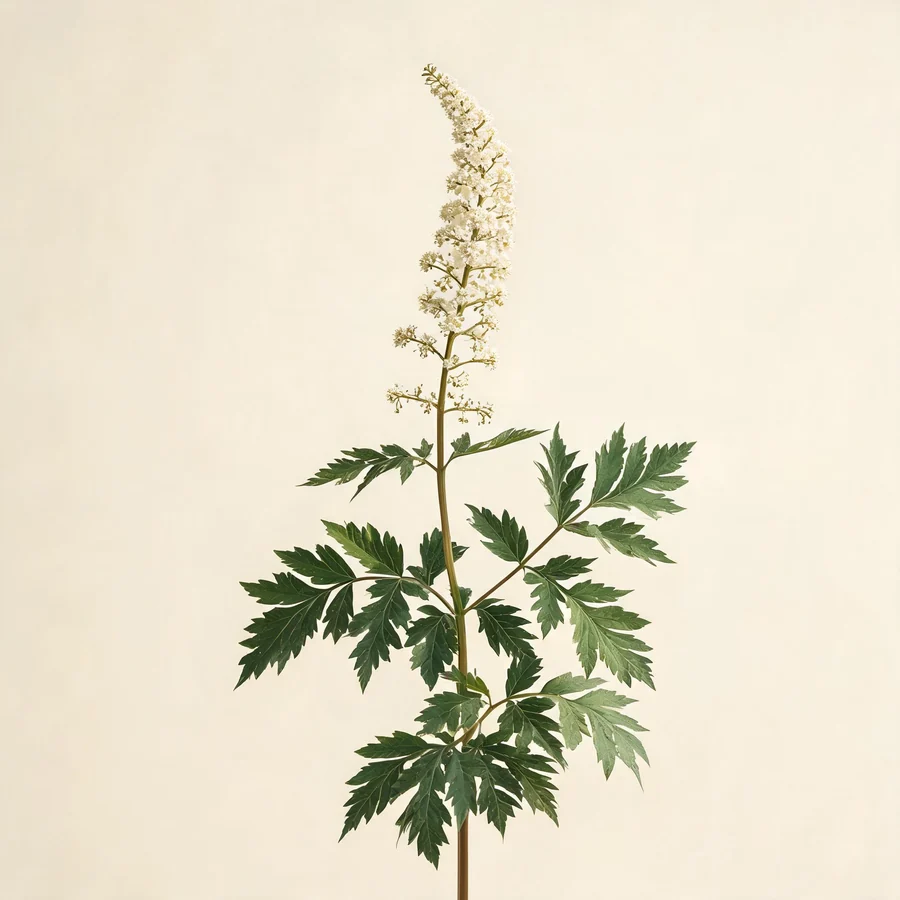
Sheng Ma is the herb for an eruption that will not finish and for heat toxin on the face. It is light, ascending and modestly cooling, so it guides rather than drives a formula, and the rhizome-only rule is the safety point to remember.
Skin signs that suggest it
- A rash that has appeared patchily, stayed faint or faded back after starting (an eruption that has not vented)
- Small red papules or flat red spots on the face, neck and upper trunk during an early febrile illness
- A hot, red, tender boil or swelling on the cheek or jaw, or around the mouth (heat toxin in the Yang Ming)
- Redness and swelling at the edge of the nose or lips with a burning, throbbing quality
- A red tongue with a yellow coating, thirst and a rapid pulse during an acute eruption
When it is not the right herb
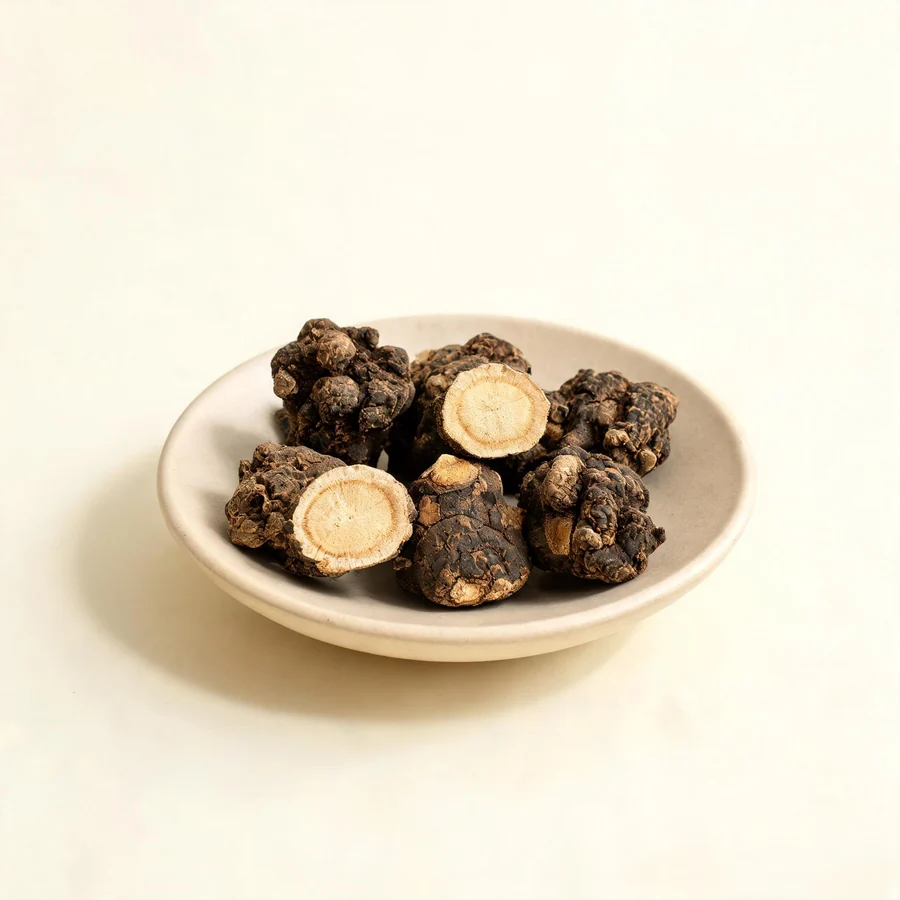
Not for an eruption that has already come out fully: the venting task is finished, and continuing to disperse is held to drive heat upward, with a tight chest or wheezing. Not for the Yin-deficient picture with floating Yang, where flushing, headache and dizziness are already present and an ascending herb makes them worse. Not for cold, pale, dry skin with no heat, and not for chronic lichenified eczema. Only the dried rhizome is used, never the whole plant.
What it does for skin
Skin-relevant actions only. Each one describes a mechanism in TCM terms and what it looks like on the skin.
Vents an eruption that has stalled
Sheng Ma is light and ascending, and that direction is the whole point when a rash is stuck at the surface. The eruption is expected to spread and complete, and when it has not, the herb opens the way for it to finish. It is given while the rash is incomplete and stopped once it has spread, and it is paired with Ge Gen, because the two together supply both the outward push and the moisture that the surface needs. On the skin this shows as a rash that finally covers the expected area and then settles.
Clears heat toxin from the face and upper body
The herb belongs to the Stomach and Large Intestine pair, the Yang Ming channels that run through the face and mouth, and it acts as a guide that carries stronger coolers to that territory. The skin picture is a boil, a hot tender swelling or a spreading red infection on the face, often with gum or mouth involvement. Its own cooling power is modest, so it is given with Huang Lian, Shi Gao or Lian Qiao rather than relied on alone. It is a short-course herb for an active, hot lesion.
Disperses early wind-heat from the surface
In the first days of a febrile illness the rash may be sparse, itchy and slow to declare itself. The acrid, dispersing quality is used to move that early wind-heat outward, usually with Jing Jie, Chan Tui or Niu Bang Zi. The aim is not to sweat the person but to let a surface eruption complete, which is why it suits a child's sparse itchy rash better than a settled chronic dermatosis. It is stopped as soon as the rash is out.
Guides other herbs to the upper body
One of the practical roles of the herb is directional. In a formula for facial skin disease it is added in a small dose to lead the other ingredients upward, and the classical texts describe it as an envoy to the Yang Ming. This is why it appears at 3 to 6 g in formulas where the cooling herbs are present at far larger weights. The small dose is deliberate, and increasing it does not make the formula stronger.
Skin conditions it is used for
Mapped to the condition pages on this site. The pattern column shows what the skin is doing when this herb is the right choice.
| Condition | Pattern | Why it suits | Typical setting |
|---|---|---|---|
| Skin Rashes | Wind-heat with an eruption that has not fully vented | A rash that comes out in patches and then stalls is read as heat held at the muscle layer with the surface not opening. Sheng Ma is chosen for that specific moment, not for rashes in general: it disperses the surface while resolving the toxin in the eruption. It is paired with Ge Gen, and the two are the classical answer to a slow, incomplete eruption. A febrile rash in a child, or any rash with breathing difficulty or drowsiness, needs medical assessment rather than a herbal decoction. | Sheng Ma Ge Gen Tang, or Ge Gen with Jing Jie and Chan Tui |
| Macular Rash | Heat at the muscle layer with a faint, slow macular eruption | Flat red spots that stay faint or spread slowly are read as heat that has not been fully expressed at the surface. The ascending dispersion helps the eruption declare itself, and the toxin-clearing action addresses the heat behind it. The pattern is an early one, with fever, thirst and a floating pulse, and the herb belongs to the days when the rash is incomplete. Once the spots are out and darkening, the treatment changes to cooling the Blood. | Sheng Ma Ge Gen Tang, with Jing Jie added where the spots itch |
| Boils | Toxic heat on the face with underlying Stomach fire | Facial boils with redness, throbbing pain and a hot sensation are read as Yang Ming heat toxin. Sheng Ma is used less for its cooling strength than for its direction, carrying Huang Lian and Shi Gao to the face and dispersing the congestion so that the lesion can drain. It also addresses the gum and mouth involvement that often accompanies this pattern. A boil with spreading redness, fever or a black centre needs medical care, and a facial boil should never be squeezed. | Qing Wei San, or Huang Lian Jie Du Tang with Sheng Ma added |
| Erysipelas | Fire toxin with a bright, spreading plaque on the head or face | The classical epidemic swelling of the head and face, with a bright red, raised and sharply bordered plaque, is the pattern in which Sheng Ma is a standard guiding herb. It carries the cooling and toxin-resolving ingredients upward and helps disperse the heat that is trapped at the surface. Modern care comes first: erysipelas needs prompt antibiotics, and the herb is an adjunct used by a practitioner alongside that treatment. The same approach is used for similar red swellings of the neck and upper trunk. | Pu Ji Xiao Du Yin |
| Skin Infection | Heat toxin spreading through the upper-body skin | Where a lesion on the face or upper body is spreading, hot and tender, with fever and a dry stool, the picture is heat toxin that has not been contained. Sheng Ma adds a dispersing, outward-directed action to a toxin-clearing formula and is used while the lesion is still spreading rather than after it has settled. It is a short-course addition, and spreading infection with fever needs urgent medical assessment, because antibiotics and sometimes drainage are the definitive treatment. | Huang Lian Jie Du Tang with Sheng Ma and Lian Qiao |
Combinations for skin
Herbs it is paired with when the skin, not an internal organ, is the target.
| Partner | Ratio | Why the pair is used |
|---|---|---|
| Ge Gen | 5 to 10 g each in decoction | The standard pair for an eruption that will not finish. Ge Gen opens the muscle layer and moistens it by generating fluids, while Sheng Ma supplies the dispersing and toxin-resolving half. Together they let an early febrile rash emerge without scorching the surface, which is the reasoning behind Sheng Ma Ge Gen Tang. The pair is used for days, not weeks, and stopped once the rash has spread. |
| Huang Lian | 3 to 6 g Huang Lian with 3 to 6 g Sheng Ma | Huang Lian is far colder and more bitter than Sheng Ma, and it is the stronger drain on Stomach fire; Sheng Ma then steers it towards the face and mouth. Neither alone covers a facial boil, a hot gum or a red swollen lip as well as the two do, and the pairing is the core of Qing Wei San. Both are cold, so the course is short and the digestion is watched; loose stools are the signal to stop. |
| Shi Gao | 15 to 30 g Shi Gao with 3 to 6 g Sheng Ma | Shi Gao is the major herb for clearing Yang Ming heat, given where fever, sweating and thirst dominate. Sheng Ma contributes direction and a toxin-resolving quality, so the two are chosen when Stomach heat shows as a facial swelling, a rash or a gum problem rather than as the four big signs on their own. The large weight of Shi Gao beside the small weight of Sheng Ma is the point: a guiding herb is not meant to be increased. |
| Chan Tui | 3 to 5 g Chan Tui with 3 to 6 g Sheng Ma | Chan Tui is light, cool and soothing, and it is chosen when an eruption itches and the eyes or voice are involved. Sheng Ma pushes the rash outward while the moult quiets the surface, which suits a child with a sparse, itchy, slow eruption. The two are used together only while the rash is incomplete; once it has spread, the moult can continue but the dispersing herb is stopped. |
Formulas where it leads
- Sheng Ma Ge Gen Tang (升麻葛根汤) - The classical venting formula for an early eruption that has not fully emerged, built on Sheng Ma and Ge Gen with Bai Shao and Gan Cao. It is given while the rash is incomplete and stopped when it has spread. The formula is a model of the surface role of the herb, and it is also the reason Sheng Ma appears in paediatric practice more often than in adult dermatology.
- Qing Wei San (清胃散) - The Stomach-fire formula in which Sheng Ma guides Huang Lian, Mu Dan Pi and Sheng Di Huang to the face and gums. It is used for a hot, swollen, painful face with gum involvement, and for the facial boils that follow the same pattern. The dose of Sheng Ma stays small, and the course is short because the cooling herbs are cold.
- Pu Ji Xiao Du Yin (普济消毒饮) - The epidemic formula for a swollen head and face with a bright red spreading plaque, in which Sheng Ma and Chai Hu act as guiding herbs for the upper body. It combines strong heat-clearing and toxin-resolving ingredients with dispersing ones, which is the pattern Sheng Ma suits. Modern treatment of erysipelas begins with antibiotics, and the formula is an adjunct.
Safety for skin use
What to check before recommending or using it, including the cautions that matter most for skin patients.
Do not use, or use with caution
- Yin deficiency with floating Yang: flushing, headache, dizziness, a red tongue with little coating and a fine rapid pulse. An ascending, dispersing rhizome adds to the upward movement rather than settling it, and this is the caution that matters most.
- A rash that has already fully erupted, or an eruption that is fading and settling. The venting task is finished, and continuing is held to drive heat upward, producing a tight chest or wheezing.
- Cold, pale, dry skin and chronic lichenified eczema with no heat. A slightly cool dispersing herb has nothing to release and can leave the skin drier.
- Whole-plant material or concentrated extracts. The saponins and the alkaloid cimicifugine in the aerial parts are the source of the overdose picture, with nausea, vomiting, headache, tremor, rigid muscle spasms, falling blood pressure and, at the extreme, delirium or failure of breathing. Only the dried rhizome is used, in short courses.
Pregnancy and breastfeeding
Pregnancy is a time to avoid Sheng Ma. Classical commentary holds that its ascending, dispersing character may unsettle the pregnancy, and laboratory work has found saponins acting on smooth muscle; a teratogenic risk has been questioned but never resolved. For skin use this means that a febrile rash in pregnancy needs medical assessment rather than a herbal decoction, and topical use is not established for the herb. Data on transfer into milk are absent, so while breastfeeding it is best left alone, or given as a minimal dose for a short time with the infant watched.
Interactions
- Antihypertensive medicines: animal studies report a fall in blood pressure and a slower heart rate, so someone on treatment for high blood pressure should have readings checked when the herb is added, particularly after a dose change.
- Liver-burdening medicines such as paracetamol in high dose, statins and certain antibiotics: rare liver injury has been reported for Cimicifuga species, so the course stays short and the prescriber is informed.
- Sedatives, benzodiazepines and alcohol: animal work reports sedative and anticonvulsant activity, so additive drowsiness is conceivable.
- Warfarin, aspirin and other antiplatelet drugs: salicylate derivatives have been reported in the herb, and clotting has been affected in either direction in different studies. Little is established at decoction strength, but the prescriber should know.
Allergy and patch testing
A reaction to Sheng Ma is possible, and a person who has reacted to another buttercup-family plant should be cautious. For a wash or a cream containing it, patch test on a small area of normal skin for 24 hours. Stop at once if the skin stings, reddens further or develops a rash, and do not continue a preparation that has caused any reaction.
General safety references
General references for herbal hepatotoxicity and herb-drug interactions; they are not specific to this herb.
- Review article: Herbal hepatotoxicity - an update on traditional Chinese medicine preparations. Alimentary Pharmacology & Therapeutics, 2014. PMID: 24844799.
- Interactions between herbal medicines and prescribed drugs: an updated systematic review. Drugs, 2009. PMID: 19719333.
- Warfarin and food, herbal or dietary supplement interactions: a systematic review. British Journal of Clinical Pharmacology, 2021. PMID: 32478963.
Evidence
The classical record is quoted with its source. The modern note states the level of evidence plainly.
Classical record
The older texts also name it Zhou Sheng Ma. It is acrid and sweet in taste and grows in the mountain valleys. It sweeps away the hundred poisons, counters the baneful influences of decay, and keeps pestilential warm disease and the poison of parasites at bay.
Shen Nong Ben Cao Jing (Divine Husbandman's Classic of Materia Medica) - The earliest entry presents the herb as a detoxifier, which is the textual root of its use on infected and poisoned skin lesions.
It treats sudden abdominal pain from malign influences, seasonal epidemic poisons, headache with chills and fever, swelling of wind origin with various toxic swellings, sore throat and mouth sores.
Ming Yi Bie Lu (Supplement to the Classic of Materia Medica) - Toxic swellings and mouth sores place the herb in upper-body heat toxin, the territory it occupies in skin practice.
It scatters macular rashes and quickens stagnant Blood. It is used when Yang has sunk and the head is dizzy, for a hollow pain in the chest and ribs, for long standing diarrhoea and for dysentery with straining, for turbid urine and for discharge, for flooding and spotting, for blood in the urine and for cold feet.
Ben Cao Gang Mu (Compendium of Materia Medica), Li Shizhen - The first sentence is the direct basis for venting a macular eruption; the rest describes the lifting and internal uses that are outside the skin edition.
Modern evidence
Evidence status
- Laboratory work on cimicifugine and the triterpene saponins reports anti-inflammatory and antimicrobial activity, but these are cell and animal studies. No controlled dermatological trial of the single herb was identified, and the skin indications rest on traditional use.
- The safety literature is more definite than the efficacy literature. Cimicifuga species have been associated with rare liver injury, and the whole-plant overdose picture is well described in toxicology; the rhizome-only rule and the dose ceiling come from that, not from trials.
- Regulatory position: the dried rhizome of Cimicifuga species is an accepted herbal substance in the Chinese Pharmacopoeia. Acceptance is a quality standard, not evidence that the herb treats a skin disease.
PubMed records
Selected real PubMed records for this herb's species or its constituents, chosen by species name and title relevance. They are references for the non-TCM discussion above, not proof that the herb treats any skin condition.
- Cimicifuga dahurica extract inhibits the proliferation, migration and invasion of breast cancer cells MDA-MB-231 and MCF-7 in vitro and in vivo.. Journal of ethnopharmacology, 2021. PMID: 33771643 (pharmacology or review record).
Dose and forms
Skin-practice dosing and the preparations that suit skin complaints.
| Form | Dose and notes |
|---|---|
| Decoction, venting a rash | 6 to 9 g of the raw rhizome in a formula, given while an eruption is incomplete and stopped once it has spread. A smaller weight is used in a child, and the course is measured in days rather than weeks. |
| Decoction, heat toxin | The classical sources give 9 to 15 g of raw rhizome for heat toxin, inside a formula with stronger cooling herbs and under supervision. The pharmacopoeial ceiling of 3 to 9 g applies to the venting and guiding roles, so the larger figure is not a home dose. |
| Rhizome only | Only the dried rhizome is medicinal. Whole-plant material, other plant parts and concentrated extracts carry far more of the saponins and the alkaloid, so they are never substituted at any dose. |
| Course length | A few days to two weeks at most, with review. Stop when the rash has fully emerged or the lesion has settled, and do not repeat unsupervised courses. |
Processing changes the job. The raw rhizome is used for heat and for venting an eruption; the honey-fried rhizome is the lifting form, which is an internal use outside this edition; the charred rhizome is for bleeding with a residual sinking picture. For skin work the raw rhizome is standard, the dose stays within the 3 to 9 g ceiling for the venting and guiding roles, and the smallest effective weight is used when the herb is present only as a guide.
Citations and further reading
Only real sources are listed: the classical materia medica passages quoted above, and the source works behind the botanical and safety statements.
- Shen Nong Ben Cao Jing (Divine Husbandman's Classic of Materia Medica), attributed compilation of the Han period - classical entry quoted above.
- Ming Yi Bie Lu (Supplement to the Classic of Materia Medica), Tao Hongjing, Southern and Northern Dynasties - classical entry quoted above.
- Ben Cao Gang Mu (Compendium of Materia Medica), Li Shizhen, 1578 - classical entry quoted above.
- Sheng Ma monograph: Pharmacopoeia of the People's Republic of China - source for the accepted rhizome, the source species and the dose range.
- Modern evidence statement: based on laboratory and toxicological literature on Cimicifuga species, summarised as a statement about the level of evidence rather than as a cited finding.
- Botanical description and identification: botanical literature on Cimicifuga dahurica and related species, Ranunculaceae.
Educational reference for qualified practitioners. This page is not medical advice, and skin conditions should be diagnosed by a clinician before treatment.