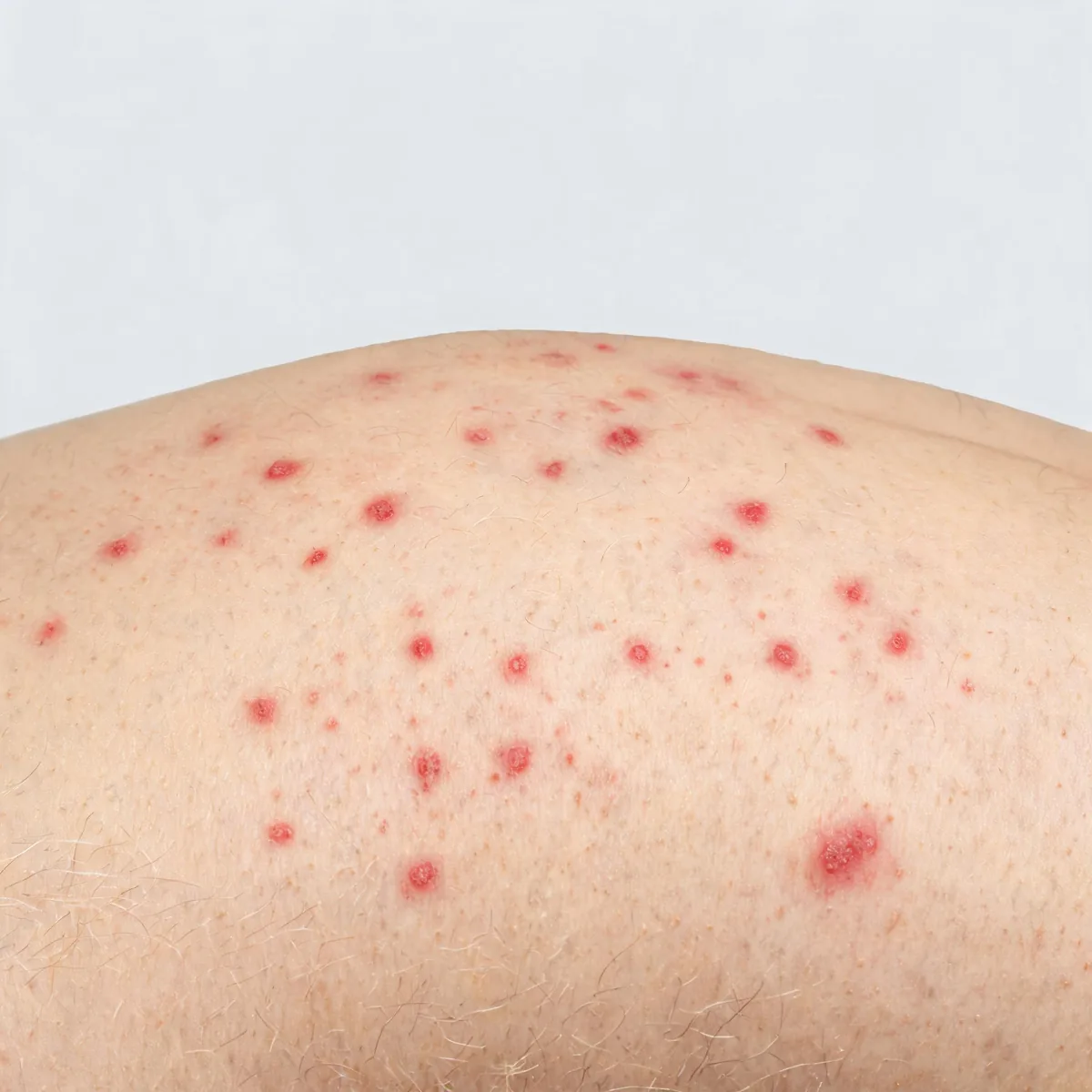
Understanding Skin rashes
The skin is described as an extension of the Lungs, which govern the body surface and its protective Qi. When Wind, Heat or Dampness invade, they disrupt that shield and a rash appears.
More often the cause is internal. A weak Spleen is said to produce dampness, an overheated Liver to stir up Wind, and a deficient Blood to leave the skin dry and vulnerable. The rash is then the visible end of an internal process rather than the whole problem.
This is why the appearance matters so much. Oozing, weeping lesions point to Damp-Heat; a bright red hot rash with sudden onset points to Heat in the Blood; itchy bumps that move around point to Wind-Heat; dry cracked skin with night itch points to Blood deficiency.
The classical literature is straightforward about urgency: a rash with breathing difficulty, facial swelling, high fever or rapid spreading is a medical emergency, and no herbal assessment should delay that.
The Lungs govern the surface and the defensive Qi that patrols it, so the skin is treated as the outer boundary of an internal system rather than as a separate organ. Wind, Heat and Dampness can strike that boundary from outside and produce a rash directly. Just as often the boundary is breached from within, by a Spleen that makes Dampness, a Liver that generates Heat and stirs Wind, or Blood too thin to hold moisture in.
That is why two rashes that look alike can be treated in opposite ways, one by draining Damp-Heat and the other by nourishing Blood and moistening dryness. The practitioner reads colour, moisture, temperature and the behaviour of the itch, then checks the tongue and pulse for the internal state that matches. The rash is the visible part of the argument, not the whole of it.
Conventional view
In Western medicine a rash is any visible change in the colour, texture or surface of the skin, with itching, redness, swelling or blistering usually alongside. The common groups include eczema, or atopic dermatitis, contact dermatitis, hives, psoriasis and fungal infection. Diagnosis rests on appearance, distribution and history, with allergy testing or a skin biopsy added when the picture is unclear. Many rashes settle on their own, but chronic and recurrent ones affect sleep, work and mood considerably.
Treatment aims at inflammation and symptom control. Topical corticosteroids reduce inflammation, emollients repair the skin barrier, oral antihistamines help with itch, and severe cases may need systemic immunosuppressants such as cyclosporine or methotrexate, or biologic drugs such as dupilumab. Phototherapy is used for some conditions, and antibiotics where infection has set in. Many of these are effective, but they are taken or applied for long periods and carry side effects.
What conventional treatment does less well is explain why a rash keeps returning. Steroids used long term thin the skin, can produce rebound flares and lose their effect, while systemic drugs carry the risk of suppressing immunity and straining organs. A single protocol is applied across very different patients, and the internal factors this framework would describe, such as weak digestion, heat in the blood or dryness from deficiency, are not part of the assessment.
Selected PubMed records
Real PubMed records for the conventional discussion above, selected by condition name and title relevance. They are references, not a claim that any treatment is proven for this condition.
- The terminology of skin disorders. Primary Care, 2000. PMID: 10815043.
How it connects
Skin rashes often appear alongside digestive complaints such as abdominal distention because both can stem from Spleen deficiency with Dampness. When the Spleen fails to transform fluids, Dampness accumulates internally, causing bloating and loose stools while overflowing into the skin as oozing recurrent rashes, and treating the Spleen often resolves both gut and skin together. Anxiety and insomnia frequently accompany rashes driven by Heat in the Blood or Yin deficiency, since Heat agitates the Heart Shen and leaves the mind restless while the Blood Heat surfaces as red itchy eruptions; in TCM calming the mind and cooling the Blood are not separate tasks. Allergic rhinitis and skin rashes also co-occur because they share an external Wind invasion mechanism, with Wind-Heat or Wind-Cold attacking the Lung and skin simultaneously. The clusters also shape the prescription. Where the gut and the skin move together, the Spleen herbs that settle bloating, Bai Zhu and Fu Ling, are treating both surfaces at once, so improvement in one is a fair sign of improvement in the other. Where restlessness and disturbed sleep accompany a red itchy rash, cooling the Blood and calming the mind are one task rather than two, and a formula such as Xi Jiao Di Huang Tang addresses the agitation and the eruption together. Where a rash keeps company with hay fever or sinus congestion, the shared Wind mechanism means a single dispersing formula such as Xiao Feng San can ease the nose and the skin, provided the underlying pattern is the same.
How it is assessed
The practitioner reads the rash first, then looks for the internal signs that explain it.
What a practitioner looks for
- Wet or dry: oozing and weeping point to Damp-Heat or Spleen deficiency; dry and cracked points to Blood or Yin deficiency.
- Colour and heat: bright red and hot suggests heat; dull, brownish or pale suggests deficiency or dampness.
- Behaviour: sudden, moving, itchy rashes are the Wind signature; fixed and deep lesions suggest stasis.
- Associated signs: digestion, thirst, bowels, sleep, and whether there is fever or systemic illness.
The examination starts with the rash itself: its colour, whether it is wet or dry, how warm it feels, where it sits, and what the itch does over the course of a day. The practitioner then asks about oozing, about what makes it better or worse, about diet, digestion, sleep and stress, and confirms the impression at the tongue and pulse. A red swollen weeping rash with a greasy yellow coat and a slippery rapid pulse is Damp-Heat, and it commonly follows rich greasy food or humid weather, often with a heavy sluggish feeling behind it.
A bright red rash that is hot when touched and may bleed indicates Heat in the Blood, with thirst, dark urine, a red tongue under a thin yellow coat and a rapid pulse showing that internal heat is stirring the blood. A sudden crop of red papules or hives that itch intensely and come and go suggests Wind-Heat, with a red tongue tip, a thin yellow coat and a floating rapid pulse, and it often follows an allergic reaction or an early infection.
Chronic dry scaly rashes that itch at night, with a pale complexion, a pale tongue under a thin white coat and a thin pulse, indicate Blood Deficiency with External Wind, where thin blood fails to nourish the skin and wind stirs the itch. A dull red or brownish rash that oozes and recurs with a poor appetite, bloating and loose stools points to Spleen Deficiency with Dampness, with a pale swollen tongue under a greasy coat and a soggy pulse. Long-standing dryness with cracking, a red tongue with little coating and a thin rapid pulse indicates Yin and Blood Deficiency. Where pus, blistering, fever and malaise appear together, Toxic-Heat is present and professional attention is needed at once.
TCM patterns in Skin rashes
Rash differentiation turns on a few observations that are easy to make and hard to fake. Moisture comes first: weeping, oozing lesions point to Dampness, whether from the environment, from diet or from a weak Spleen, while dry, flaking, cracked skin points to a shortage of Blood or Yin. Colour comes next, since bright red skin that feels hot suggests Heat, and if it bleeds or arrives suddenly the Heat is in the Blood, while dull red or brownish patches that ooze and recur suggest Dampness sitting over a weak Spleen. Itch adds a guide: itching that moves about belongs to Wind, while itching that settles and worsens at night belongs to dryness and deficiency. Timing refines it: a rash arriving with a cold or an allergen is usually exterior, while one present for months and flaring with stress is usually internal. Fever, pus or blistering points to Toxic-Heat and needs prompt assessment.
| Pattern | Key signs | The itch | Tongue | Main formula |
|---|---|---|---|---|
| Damp-Heat | Oozing weeping lesions | Intense itch worse with warmth and humidity | Body: Red, often swollen with teeth marksCoat: Yellow, greasy and thick, usually in the middle and at the root | Not specified |
| Heat in the Blood | Bright red rash that feels hot | Not specified | Body: Deep red, often with red points or pricklesCoat: Thin, yellow and dry | Not specified |
| Wind-Heat | Red bumps or hives on face and upper body; Skin warm or burning to touch | Intense hot itch that moves around | Body: Red at the tip and edgesCoat: Thin yellow or white turning yellow | Not specified |
| Blood Deficiency with External Wind | Dry flaky rough or cracked skin | Itch that comes and goes | Body: Pale and thin, sometimes slightly dryCoat: Thin, white and a little dry | Not specified |
| Spleen Deficiency with Dampness | Dull-red or brownish rash; Oozing weeping lesions | Not specified | Body: Pale and swollen, often with teeth marks along the edgesCoat: White, greasy and moist, thick in the middle | Not specified |
| Yin and Blood Deficiency | Dry flaky rough skin; Dry mouth and throat | Itch worse at night | Body: Pale to pale-red, thin, dry and crackedCoat: Scanty or peeled | Not specified |
| Toxic-Heat | High fever or burning body sensation; Red swollen painful lesions with pus | Not specified | Body: Red, often with raised red pointsCoat: Yellow, dry, sometimes thick | Not specified |
Damp-Heat
The weeping picture: oozing lesions with intense itch that worsens in warmth and humidity.
Damp-Heat forms when the Spleen cannot transform fluids, usually against a background of rich, sweet or spicy food or a humid climate. The half-processed fluid becomes a heavy turbid Dampness, Heat joins it, and the mixture steams upward and outward into the skin. Dampness clogs the pores while Heat inflames them, which gives the red, swollen, weeping rash and the intense itch.
The tongue is red with a yellow greasy coat, and the pulse is slippery and rapid. Spicy, fried or greasy food, alcohol, hot humid weather, stress and long sitting worsen it, while a cool dry environment, light easily digested meals, cooling foods such as mung beans and watermelon, gentle sweating through exercise and keeping the skin clean and dry help. Long Dan Xie Gan Tang drains the Damp-Heat, and LI-11 Quchi, SP-10 Xuehai and ST-36 Zusanli are the points.
Signs
- Oozing weeping lesions
- Intense itch worse with warmth and humidity
- Heaviness in body and head
- Poor appetite with loose sticky stools
- Dark scanty urine with thirst
Diet and lifestyle for this pattern: Avoid greasy, fried, spicy and sugary food as well as alcohol and dairy, which all generate Dampness and Heat. Favour cooling, Dampness-draining food such as mung beans, barley, cucumber and celery, keep the skin clean and dry in breathable fabrics, use gentle fragrance-free skincare, and walk or stretch lightly each day so Qi flows and the Spleen clears Dampness.
Heat in the Blood
The hot, sudden picture: a bright red rash with internal heat and a bleeding tendency.
When Heat accumulates at the blood level, it agitates the Blood and pushes it out of the vessels, so the rash comes up bright red and hot, can appear suddenly and may bleed. The same Heat consumes fluids, leaving thirst and a parched mouth, and it unsettles the mind, producing restlessness and irritability. This is a deeper level of Heat than surface inflammation, and it moves quickly.
The tongue is red with red spots or prickles under a thin yellow dry coat, and the pulse is rapid, wiry and forceful. Spicy greasy or fried food, alcohol, hot showers or weather, stress and lost sleep worsen it, while cool compresses, iced drinks, a cool quiet room, cooling foods and a calm setting relieve it. Xi Jiao Di Huang Tang is the classical example of a formula that cools the Blood and stops bleeding, and SP-10 Xuehai, LI-11 Quchi and DU-14 Dazhui are the points.
Signs
- Bright red rash that feels hot
- Sudden appearance
- Internal heat worse at night
- Intense thirst for cold drinks
- Restlessness and irritability
Diet and lifestyle for this pattern: Avoid spicy, greasy and fried food as well as alcohol and coffee, which add Heat. Eat cooling, moistening food such as cucumber, watermelon, mung bean soup and pear, keep the skin cool and avoid hot showers, and manage stress so Heat does not flare.
Wind-Heat
The moving, itchy picture: red bumps that appear suddenly after wind or an allergen.
Wind-Heat arrives from outside. It invades the surface, disrupts the Lung's ability to diffuse defensive Qi, and lodges in the pores, where it contends with the body's defence. Wind moves, so the itch wanders and the rash appears suddenly, and Heat is involved, so the skin feels warm or burning and the bumps are red. Allergens, the early stage of an infection and a sudden change of weather are common occasions for it.
The tongue tip and edges are red under a thin yellow, or white turning to yellow, coat, and the pulse is floating and rapid, felt at the surface. Wind exposure, spicy greasy or fried food, hot humid weather and stress worsen it, while cool compresses, a cool room to rest in, mint or chrysanthemum tea, and avoiding fried and spicy food relieve it. Xiao Feng San dispels the Wind and clears the Heat, and LI-11 Quchi, LI-4 Hegu and GB-20 Fengchi are the points.
Signs
- Intense hot itch that moves around
- Red bumps or hives on face and upper body
- Sudden onset after wind or allergen
- Skin warm or burning to touch
- Mild fever or sore throat
Diet and lifestyle for this pattern: Eat cooling, light food such as cucumber, mung beans and chrysanthemum tea, and avoid spicy, greasy or fried dishes that add internal Heat. Protect the skin from direct wind and sun, keep the body comfortably cool, and keep exercise gentle without overheating.
Blood Deficiency with External Wind
The dry, chronic picture: rough cracked skin with itch that shifts and worsens at night.
Skin needs nourished Blood to stay supple and to hold moisture in. When Blood is short the surface becomes dry, flaky and fragile, and that weakened barrier lets Wind enter. Wind is the pathogen that moves and changes, so the itch shifts from place to place, comes and goes, and flares in drafts or at night, when Blood withdraws inward and the surface is left drier still.
The tongue is pale and thin with a thin white, slightly dry coat, and the pulse is fine, often wiry at the left middle and floating at the right front. Dry weather and wind, overwork and stress, the night hours, raw or cold food and iced drinks, and blood loss or heavy sweating worsen it, while a warm calm environment, moisturising the skin, rest and blood-nourishing food relieve it. Dang Gui Yin Zi nourishes Blood, moistens dryness and dispels Wind, and SP-10 Xuehai, LI-11 Quchi, SP-6 Sanyinjiao and ST-36 Zusanli are the points.
Signs
- Dry flaky rough or cracked skin
- Itch that comes and goes
- Itch worse at night
- Pale or sallow complexion
- Dizziness or light-headedness
Diet and lifestyle for this pattern: Build Blood with dark leafy greens, beetroot, black sesame, red dates and small amounts of organ meat, and avoid raw cold food and iced drinks that weaken the Spleen's ability to make Blood. Shield the skin from wind and dry air with light layers and a humidifier, and keep movement gentle such as walking or tai chi so Blood circulates without depleting you.
Spleen Deficiency with Dampness
The dull oozing picture with a digestive signature.
A weak Spleen cannot transform and transport fluids, so Dampness builds up inside and then overflows into the skin. The rash that results is dull red or brownish, oozes, and keeps coming back. The digestive weakness is part of the pattern rather than a coincidence, which is why bloating, loose stools, a poor appetite and heavy limbs accompany the skin, and why the rash flares when digestion is sluggish or after a heavy meal.
The tongue is pale, swollen and marked by teeth, under a white greasy moist coat, and the pulse is soggy and slow, or slippery. Damp humid weather, overeating, heavy greasy meals, raw or cold food and iced drinks, fatigue, long sitting and stress worsen it, while a warm dry environment, small frequent cooked meals, rest, gentle walking or stretching and avoiding dairy and greasy food help. Shen Ling Bai Zhu San strengthens the Spleen and drains Dampness, and ST-36 Zusanli, SP-6 Sanyinjiao and SP-9 Yinlingquan are the points.
Signs
- Dull-red or brownish rash
- Oozing weeping lesions
- Worse after eating or when tired
- Abdominal bloating and loose stools
- Heavy limbs
Diet and lifestyle for this pattern: Favour warm, cooked, easy food such as congee, steamed vegetables and small amounts of ginger, and avoid dairy, greasy, sweet and raw cold food that burdens the Spleen. Gentle daily walking supports Spleen Qi, keep the skin clean and dry, and avoid prolonged damp or humid environments.
Yin and Blood Deficiency
The depleted picture: dry skin with night itch and signs of internal dryness.
Yin and Blood cool and moisten the body between them. When both run low the skin loses its lubrication and its nourishment together, becoming rough, cracked and very dry. The mild internal heat that comes with Yin deficiency parches the surface further and drives a severe itch that is worst at night, when Yin should be at its fullest and is not.
The tongue is pale to pale-red, thin and dry with cracks and a scanty or peeled coat, and the pulse is fine and rapid. Overwork and stress, fried or greasy spicy food, alcohol and hot weather or showers worsen it, while rest, a cool humid environment, moistening foods such as pears and sesame, and moisturising the skin relieve it. Yi Guan Jian enriches Blood while nourishing Liver and Kidney Yin, and SP-6 Sanyinjiao, KI-3 Taixi and SP-10 Xuehai are the points.
Signs
- Dry flaky rough skin
- Itch worse at night
- Pale complexion
- Dry mouth and throat
- Night sweats and warm palms and soles
Diet and lifestyle for this pattern: Eat moistening, blood-nourishing food such as black sesame, walnuts, eggs, spinach, goji berries and pear, and avoid spicy, fried or overly dry food while limiting coffee and alcohol. Gentle exercise such as walking or yoga supports circulation without depleting Yin, keep skin hydrated with natural oils, and avoid long hot showers.
Toxic-Heat
The severe picture: red swollen painful lesions with pus and systemic heat.
Toxic-Heat is Heat at its most aggressive, and it goes beyond ordinary inflammation. It arises either from a strong pathogen that has invaded or from internal Heat left to intensify until it becomes toxic. The toxin and heat surge upward into the skin and produce red, swollen, extremely painful lesions that may fill with pus and blister, while the fluids are scorched, giving high fever, intense thirst and dark scanty urine. It is a systemic state, not a local eruption.
The tongue is red with raised prickly papillae under a dry yellow coat; the pulse is forceful and rapid, often full or overflowing. Spicy greasy or fried food, alcohol, hot humid weather and stress worsen it, while cool compresses, cold drinks, cooling foods and rest relieve it. Wu Wei Xiao Du Yin and Huang Lian Jie Du Tang clear the toxin, and LI-11 Quchi, DU-14 Dazhui and SP-10 Xuehai are the points. Severe cases with fever and pus need medical assessment as well.
Signs
- High fever or burning body sensation
- Red swollen painful lesions with pus
- Intense thirst for cold drinks
- Sore throat and mouth ulcers
- Restlessness with constipation
Diet and lifestyle for this pattern: Eat cooling, detoxifying food such as mung beans, cucumber, watermelon and bitter greens, and strictly avoid alcohol, coffee, spicy dishes, fried food and shellfish, which all add fuel to the fire. Keep the skin clean and cool, do not squeeze or scratch lesions to prevent spreading the toxin, and rest, since the body's defences need energy to overcome the pathogen.
Treatment approach
How the tradition treats skin rashes, with the herbs, formulas and points used for it.
Principles
- Identify the pattern before treating: heat, dampness, wind and deficiency call for different approaches.
- In acute wet rashes, clear heat and drain dampness; avoid heavy nourishing treatment at that stage.
- In chronic dry rashes, nourish Blood and Yin and settle Wind.
- Remove any identifiable trigger, and treat breathing difficulty or spreading redness as an emergency.
- The branch is treated while it is active and the root once the flare has settled, and the balance between the two changes with the rash. An acute, wet, spreading eruption calls for clearing and draining, with cooling or drying herbs and points chosen to release the surface, and nourishing treatment is deliberately held back because it would add to the burden. A chronic, dry, settled rash calls for the opposite: Blood and Yin are built up and Wind is settled gently, with dispersing herbs kept light so they do not scatter what little the body has. Most prescriptions sit between the two, and they are revised as the rash dries, flattens or stops itching. Because several factors are usually present, a formula is modified rather than used as written, and points are drawn from both the Lung and Spleen meridians.
Herbs used
Formulas
- Long Dan Xie Gan Tang
- Xiao Feng San
- Dang Gui Yin Zi
- Shen Ling Bai Zhu San
- Yi Guan Jian
- Wu Wei Xiao Du Yin
- Huang Lian Jie Du Tang
Acupoints
- LI-11 (Quchi)
- SP-10 (Xuehai)
- ST-36 (Zusanli)
- DU-14 (Dazhui)
- LI-4 (Hegu)
- GB-20 (Fengchi)
- SP-6 (Sanyinjiao)
- SP-9 (Yinlingquan)
- KI-3 (Taixi)
What to expect
- Acute heat and wind rashes are described as settling within days to two weeks.
- Chronic dry rashes take longer, with visible change over weeks to months.
- Recurrence is expected if the internal pattern is not addressed.
- Itching usually eases before the rash itself changes, often within the first fortnight, and the skin may look briefly worse as the eruption surfaces more freely. Acute heat and wind rashes can settle within days to a week when treatment starts early, while damp and blood-heat patterns commonly need two to four weeks for a clear improvement. Deficiency patterns are the slowest, needing six to twelve weeks to rebuild reserves and hold the result. Stopping as soon as the skin looks calm is the usual reason a rash returns, so treatment is normally tapered rather than cut short, with the formula adjusted as the rash evolves and seasonal sessions used where flares are predictable.
Safety and when to get help
Seek medical help urgently for
- Difficulty breathing, or swelling of the face, tongue or throat.
- A rash with high fever, chills and body aches.
- A rapidly spreading red painful area, or blistering and peeling skin.
For anything severe, sudden or spreading quickly, read when a skin problem needs urgent care.
Cautions
- Do not delay emergency care to try herbs.
- Strong topical applications on broken skin need advice first.
- Chronic or recurrent rashes should be medically reviewed to exclude other causes.
Using this alongside conventional care
- TCM is described as complementary to conventional care: to conventional care: antihistamines and prescribed topical treatment can continue while herbs and acupuncture are added, and any change to prescribed therapy belongs with the prescriber.
- Most conventional treatment can continue while herbs and acupuncture are added, and in practice it should, because a flare is not the moment to withdraw support. Topical steroids may be reduced gradually under the prescriber's guidance as the skin settles, and antihistamines or immunosuppressants are never stopped abruptly. A few Blood-moving herbs, Dang Gui among them, may interact with anticoagulants, so a complete medication list should go to both clinicians. It also helps to tell the dermatologist that Chinese herbs are being taken, so that any overlap, interaction or duplicated effect is spotted before it causes a problem.
Diet and lifestyle
- Avoid spicy, greasy and deep-fried food, which are said to generate heat and dampness, and reduce sugar, dairy and alcohol. Cooling, light foods are favoured during an active hot rash.
- The general principle is to remove what feeds Heat and Dampness and to keep the Spleen unburdened. In practice that means limiting spicy, greasy and deep-fried food, sugar, dairy and alcohol; favouring cooling light foods such as cucumber, mung beans, bitter melon and leafy greens; drinking water and teas such as dandelion or chrysanthemum; and eating regular warm cooked meals. Any known food trigger is dropped. Pattern sharpens the advice: Damp-Heat does better without alcohol, dairy and fried food; Heat in the Blood needs cooling moistening foods and no coffee; Wind-Heat is helped by mint; Blood and Yin deficiency need building foods such as black sesame, red dates and eggs, with more moisture in the diet; and Toxic-Heat calls for cooling detoxifying foods, with alcohol, shellfish and fried dishes strictly avoided.
If you're pregnant
During pregnancy the growing baby draws heavily on maternal Blood and Yin, so depletion patterns are more common, and a dry itch that is worse at night is a typical presentation. Dang Gui Yin Zi is used with caution: Dang Gui moves blood, so the dose is lowered and the formula supervised by someone qualified. Acupuncture is the safer first choice, especially in the first three months. Patterns needing strong cooling or detoxifying treatment, among them Toxic-Heat and Heat in the Blood, are generally avoided while pregnant, since bitter-cold formulas can disturb the fetus, and Xi Jiao Di Huang Tang and Wu Wei Xiao Du Yin fall into that group. Cooling foods such as mung beans and cucumber, with gentle points LI-11 Quchi and SP-10 Xuehai, are preferred, and herbs are taken only on the advice of a practitioner experienced in pregnancy care.
If you're breastfeeding
Most topical treatment is safe while nursing, but oral herbs need more thought. Bitter-cold herbs prescribed when Damp-Heat or Toxic-Heat is present, Long Dan Cao and Huang Lian in particular, can pass into milk and may loosen an infant's stools or unsettle the digestion. Where the rash is damp and hot, gentler damp-draining herbs such as Fu Ling and Yi Yi Ren, supported by needling at ST-36 Zusanli and SP-9 Yinlingquan, are a safer substitute. Formulas that build Blood, Dang Gui Yin Zi among them, are usually well tolerated and can help postpartum recovery. Watch the baby's stool and sleep when a new formula begins, pause it if anything changes, and work with a practitioner who can protect milk supply while clearing the rash.
If treating a child
Rashes in children are usually acute and most often belong to Damp-Heat or Wind-Heat, brought on by too many sweets and fried foods or by an infection. Since the Spleen is still developing, Spleen Deficiency with Dampness also appears. Doses run from a quarter to a half of the adult amount, and gentle options are chosen over bitter-cold ones: a modified Xiao Feng San, or Shen Ling Bai Zhu San where digestion is the weak point. Because a child cannot describe what is happening, assessment leans on how the rash looks, how the child behaves, and the tongue coating, where greasiness means Dampness and a red tip means Heat. Acupressure or paediatric tui na at LI-11 Quchi and ST-36 Zusanli can take the place of needles, and cutting out dairy and sugar often helps more than anything else.
If treating an elderly patient
Older patients usually arrive with Yin and Blood Deficiency: skin that is dry, cracked, scaling and intensely itchy, with a barrier weak enough for external Wind to enter, which sets up a cycle of dryness and itch that is hard to break. Dang Gui Yin Zi or Yi Guan Jian fit the pattern, at roughly two-thirds of the usual adult dose, because a slower metabolism clears them less quickly. Many older people take several medicines, so interactions are screened carefully, and Dang Gui may strengthen the effect of anticoagulants. Needling and dietary support with sesame, pears and bone broths are often better tolerated, and the timeline is longer, with gentle nourishment doing more than aggressive cooling or drying.
Urgent-sign guidance is based on standard sources: NHS anaphylaxis, NHS cellulitis, NHS Stevens-Johnson syndrome, NHS melanoma.
Evidence
Evidence status
Compiled for this page from the classical and modern literature; not a systematic review, so treat it as a pointer to sources rather than clinical guidance.
The evidence is low to moderate and comes from urticaria and eczema. A Cochrane review of three randomised trials found acupuncture may improve symptoms and quality of life compared with medication or sham, while rating the evidence low to moderate because of small samples and risk of bias, and a meta-analysis of eight trials found acupuncture reduced itch intensity and eczema severity scores. Rashes have many causes and a new or spreading rash needs diagnosis.
The evidence is modest but has identifiable landmarks. A Cochrane review of needling for chronic urticaria located three randomised trials and concluded that symptoms and quality of life may improve compared with medication or sham, while rating the evidence low to moderate because samples were small and bias possible (Chen Y, 2016). A meta-analysis of eight trials in atopic dermatitis reported lower itch intensity and better severity scores than sham or conventional care, with quality varying between the studies (Park JG, 2015). A Cochrane review of oral Chinese herbs for atopic eczema covered ten trials, most reporting some reduction in redness, itch and disturbed sleep, though reporting and heterogeneity blocked firm conclusions and no serious adverse events were recorded (Zhang W, 2005).
Studies often cited
The review of three randomised trials found that acupuncture may improve symptoms and quality of life compared with medication or sham acupuncture, but the evidence was low to moderate quality because of small samples and risk of bias. Chen Y, et al. Cochrane Database of Systematic Reviews 2016, Issue 2. Art. No.: CD011627. doi:10.1002/14651858.CD011627.pub2
A meta-analysis of eight randomised trials found acupuncture significantly reduced itch intensity and improved eczema area and severity scores. Meta-analysis of 8 randomised trials, as recorded in the classical literature source.
A Cochrane review of oral Chinese herbs for atopic eczema included ten randomised trials. Most reported some reduction in redness, itching and disturbed sleep, though poor reporting and heterogeneity prevented firm conclusions, and no serious adverse events were recorded. Zhang W, et al. Chinese herbal medicine for atopic eczema. Cochrane Database of Systematic Reviews 2005, Issue 2. Art. No.: CD002291. 10.1002/14651858.CD002291.pub3
Classical record
Wind itching occurs when the body is deficient and invaded by Wind; Wind enters the pores and contends with the Qi and Blood, moving back and forth beneath the skin. When the pathogen is mild it cannot strike hard enough to cause pain, so there is itching only.
- Zhu Bing Yuan Hou Lun (Treatise on the Origins and Symptoms of Diseases).
黄汗之为病,身体肿,发热汗出而渴,状如风水,汗沾衣,色正黄如柏汁,脉自沉,何从得之?师曰:以汗出入水中浴,水从汗孔入得之。
Yellow sweat as a disease brings swelling of the body, fever, sweat and thirst, much like wind-water, with the sweat staining clothes the yellow of cypress juice and the pulse sunken. Asked where it comes from, the teacher says it follows bathing in water while sweating, so that water enters through the sweat pores.
Yellow sweat and water entering through the pores - Jin Gui Yao Lue (Essential Prescriptions of the Golden Coffer), chapter on water qi and dampness. Classical citation: ; the passage is the classical basis for the idea that external dampness can enter through the skin.
Common questions
Can TCM identify what is causing my rash?
It describes a pattern rather than a single cause: heat, dampness, wind or deficiency. That pattern guides treatment, while conventional assessment is still needed to exclude infection, allergy and drug reactions.
How quickly do herbs work on a rash?
The tradition describes acute heat and wind rashes settling within days to two weeks, and chronic dry rashes over weeks to months.
Is a spreading rash always urgent?
Not always, but a rash with fever, blistering, breathing difficulty or rapid spread needs same-day medical assessment.
Should I stop my antihistamine?
No. The classical literature treats them as compatible with TCM, and prescribed treatment should not be stopped abruptly.
Do I have to change what I eat?
Diet carries more weight in skin conditions than in most others. The usual advice is to cut back on spicy, greasy and sugary food, along with alcohol and dairy, all of which are held to create Dampness and Heat, and to add cooling easily digested foods such as cucumber, mung beans and leafy greens while a rash is active. Once the pattern is clear your practitioner will be more specific, since a dry deficient rash and a weeping damp one need different foods.
What can the tongue show about a rash?
The tongue reveals the internal state the rash is expressing. A red body with a greasy yellow coat points to Damp-Heat, a pale and thin tongue to Blood deficiency, and raised prickles on a red tongue to Heat in the Blood. Read together with the pulse, this narrows the pattern and separates rashes that look alike on the surface, which an examination of the skin alone cannot do.
Are herbal formulas safe for a child with eczema?
Chinese herbal formulas are generally well tolerated by children when a qualified practitioner prescribes them. Doses are scaled down carefully and gentle herbs such as Yi Yi Ren and Fu Ling are chosen rather than bitter-cold ones. Tell your practitioner about any other medicine your child takes, and have a persistent or spreading rash in a child assessed medically as well.
Will the rash return after a course of treatment?
The aim is to correct the pattern so that it returns less often and less severely, rather than to promise it never does. Once the skin is clear, a maintenance phase with occasional treatment and steady dietary habits helps keep the internal balance. Some people stay clear for years, while others need a short course each season or whenever stress and diet slip.