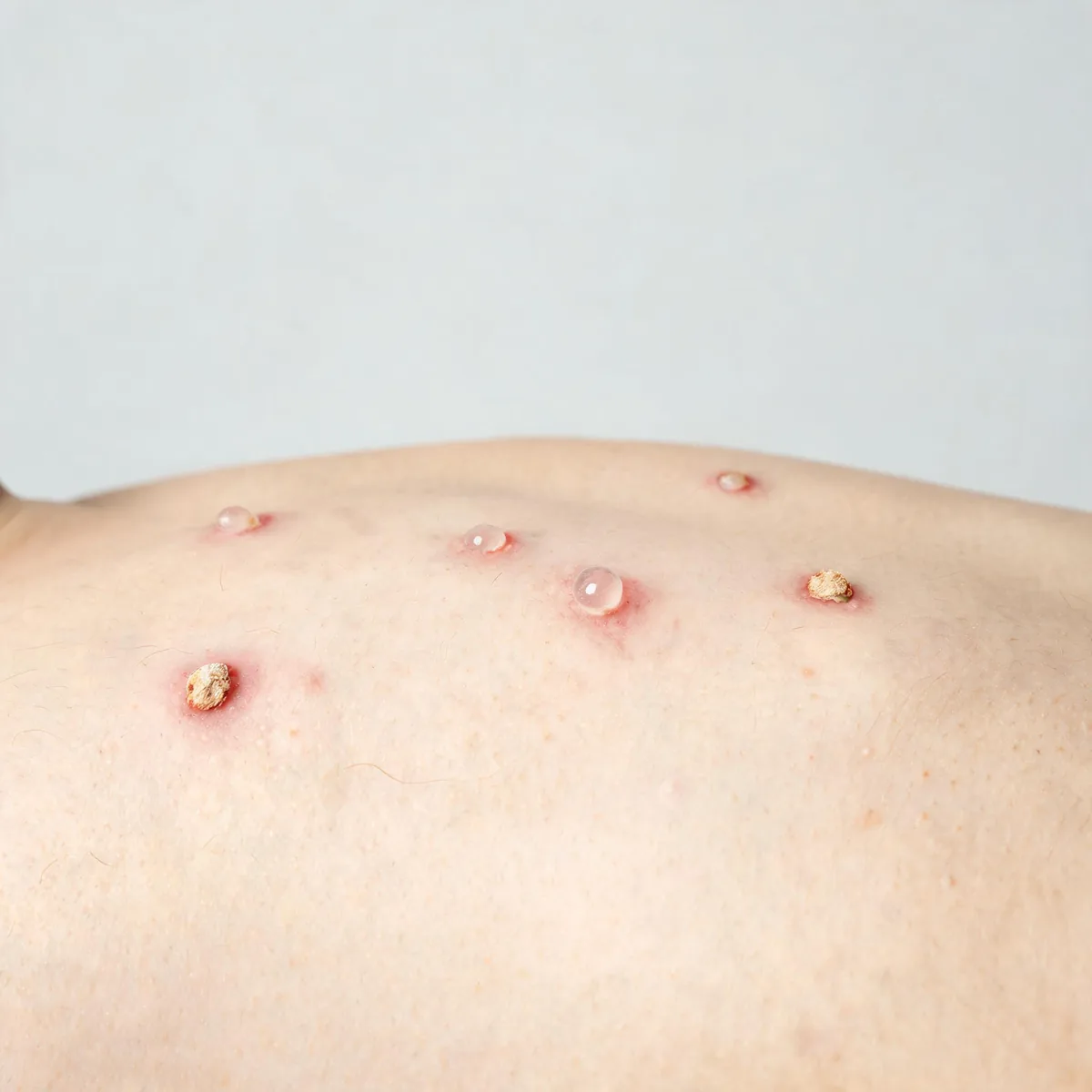
Understanding Chickenpox
The tradition describes chickenpox as an invasion of epidemic toxin, a combination of heat and dampness entering through the mouth and nose, with the Lungs as the first line of defence.
Wind-Heat invading the Lungs is the common, mild pattern: sparse vesicles with clear fluid, low-grade fever, mild cough, a scratchy throat and thirst.
Toxic-Heat gives a dense rash with large turbid vesicles, high fever, a flushed face, intense thirst and restlessness. Toxic-Heat stagnation adds pustules with thick foul-smelling pus and localised redness and pain, which means secondary bacterial infection.
Two severe patterns are described. Heat in the Pericardium gives high fever with delirium, incoherent speech or loss of consciousness, cold hands and feet despite a burning body, and convulsions - the picture of encephalitis, which is an emergency. Phlegm-Heat in the Lungs gives cough with copious thick yellow or green sputum, shortness of breath, laboured breathing and chest tightness - the picture of pneumonia.
What separates the patterns is depth. In an ordinary case the defensive Qi is strong enough to hold the pathogen at the surface, so the vesicles stay separate and clear, the fever stays low and the cough is mild; this is Wind-Heat invading the Lungs, and the approach is to release the exterior and cool the Heat gently rather than to attack it. When the toxin is stronger, or the child's response cannot contain it, the same pathogen moves inward through the Qi and Nutritive levels, the fever climbs, the lesions become dense with a dark red base, and the fluid turns cloudy. That shift is what the practitioner watches for day by day.
Two dangerous departures are recorded. If the Heat stagnates in the skin, usually because blisters have been scratched and broken, the lesions become pustular, painful and surrounded by angry red swelling, which the classical literature reads as secondary infection. If the Heat instead dives to the Pericardium, the child becomes drowsy, confused or delirious, sometimes with cold hands and feet even though the body burns; if it congeals fluids into Phlegm and obstructs the Lungs, the cough becomes severe with laboured breathing. Both are emergencies. The purpose of differentiating at all is to identify the level the illness has reached and to intercept that progression.
Conventional view
Chickenpox is a highly contagious viral illness caused by varicella-zoster, beginning with fever, fatigue and loss of appetite, then an itchy rash that passes from red spots to fluid-filled blisters to crusts, usually on the trunk, face and scalp before spreading. In healthy children it is usually mild and self-limiting over about a week, diagnosed from the rash and exposure history, while complications are more common in adults, newborns and the immunocompromised, including bacterial skin infection, pneumonia or encephalitis.
Standard care relieves symptoms and prevents complications: antivirals such as aciclovir for severe cases or high-risk patients, started early to work, calamine lotion, oatmeal baths and oral antihistamines for itch, paracetamol for fever with aspirin avoided because of Reye's syndrome, and vaccination as the main preventive measure.
Antivirals can shorten the course if given very early but do not address the underlying immune response or individual susceptibility, symptomatic measures give only temporary itch relief and may cause drowsiness, and the conventional approach treats chickenpox uniformly without considering constitution or stage. TCM differentiates patterns, so a mild case with a thin white coating calls for a different strategy from a severe one with a thick yellow coating, which may reduce the risk of the virus deepening.
Selected PubMed records
Real PubMed records for the conventional discussion above, selected by condition name and title relevance. They are references, not a claim that any treatment is proven for this condition.
- The terminology of skin disorders. Primary Care, 2000. PMID: 10815043.
How it is assessed
The practitioner assesses the density and fluid of the vesicles, plus any neurological or respiratory signs.
What a practitioner looks for
- Vesicles: sparse with clear fluid and low fever suggest Wind-Heat; dense and turbid with high fever suggest Toxic-Heat.
- Pustules: pus with local redness and pain suggests secondary bacterial infection.
- Neurological signs: delirium, convulsions or cold limbs with fever indicate Heat in the Pericardium and are an emergency.
- Respiratory signs: breathlessness and thick sputum suggest Phlegm-Heat in the Lungs.
The consultation starts with the fever and the rash together, because neither means much alone. A low fever with a stuffy or runny nose, a mild cough and a scattering of clear vesicles mostly on the trunk, with a slightly red tongue tip, a thin white or pale yellow coat and a floating rapid pulse, is the ordinary Wind-Heat picture. A fever that has spiked, intense thirst, dense lesions with a dark red base and cloudy fluid, a red tongue with a thick yellow greasy coat and a rapid slippery pulse mean the illness has deepened into Toxic-Heat and needs stronger cooling.
Local change is examined separately from the general picture. Where a few lesions among healing ones become swollen, angry and filled with pus, with a red tongue, a yellow coat and a rapid pulse, the reading is Toxic-Heat Stagnation and the aim is to resolve toxin and reduce swelling. The practitioner also checks for the two rare turns: a deep red tongue with a dry yellow coat, a rapid fine pulse and drowsiness or convulsions point to Heat in the Pericardium, while a yellow greasy coat with wheezing, laboured breathing and thick sputum points to Phlegm-Heat in the Lungs. Both are treated as medical emergencies.
TCM patterns in Chickenpox
Chickenpox is read in stages, and the stage can change within a day. A sparse rash of clear vesicles with a low fever and a mild cough is superficial Wind-Heat. Dense lesions with turbid fluid and a high fever mean the toxin has moved inward to the Qi and Nutritive levels. Pus, local swelling and pain in a few lesions mark Toxic-Heat Stagnation, where the toxin is trapped in the skin and infection has been introduced by scratching. The two remaining patterns are complications rather than stages: Heat in the Pericardium, with drowsiness, delirium or convulsions, and Phlegm-Heat in the Lungs, with wheezing and thick sputum. Fever height, the clarity of the fluid and the tongue coating are the three signs that separate them most reliably.
| Pattern | Key signs | The itch | Tongue | Main formula |
|---|---|---|---|---|
| Wind-Heat invading the Lungs | Red tongue tip with thin yellow coating | Not specified | Body: Slightly red, with a red tipCoat: Thin yellow | Not specified |
| Toxic-Heat | Dense rash with large turbid vesicles | Not specified | Body: Red, often with raised red pointsCoat: Yellow, dry, sometimes thick | Not specified |
| Toxic-Heat Stagnation | Pustular lesions with thick foul-smelling pus; Localised redness swelling and severe pain | Not specified | Body: Deep red or crimson with raised red pointsCoat: Thick, dry and yellow | Not specified |
| Heat in Pericardium | Cold hands and feet despite a burning body | Convulsions or muscle twitching | Body: Crimson, stiff or shortenedCoat: Yellow and dry or almost none | Not specified |
| Phlegm-Heat in the Lungs | Shortness of breath and laboured breathing | Not specified | Body: Red, possibly swollen at the front, with red pricklesCoat: Yellow and greasy | Not specified |
Wind-Heat invading the Lungs
The mild pattern: sparse clear vesicles with low fever and cough.
The illness begins at the surface. Wind-Heat enters through the mouth and nose and meets the Lungs, which govern the skin and the defensive Qi; the Lungs respond by pushing the pathogen outward, and that outward push is what produces the rash. Because the pathogen is still superficial, the vesicles stay separate, their fluid stays clear, and they appear first and most densely on the trunk. The accompanying cough, scratchy throat and low fever come from Lung Qi being held up rather than from deeper damage.
The tongue tip is red with a thin yellow coat and the pulse floating and rapid. Spicy or fried food, stuffy hot rooms, wind and drafts, overexertion and scratching are the aggravating factors, while cool airy rooms, cooling drinks, light food, rest and gentle sweating help. Yin Qiao San is the formula named for this stage, with Liu Yi San added to drain Dampness, and the herbs are Jin Yin Hua, Lian Qiao, Bo He, Niu Bang Zi and Hua Shi. The points are LI-4 Hegu, LU-7 Lieque, DU-14 Dazhui, GB-20 Fengchi and LI-11 Quchi.
Signs
- Sparse clear fluid-filled vesicles
- Low-grade fever
- Mild cough with scratchy throat
- Thirst
- Red tongue tip with thin yellow coating
Diet and lifestyle for this pattern: Drink plenty of cooling fluids such as water, chrysanthemum tea or mung bean soup, and eat light, easy food such as congee and steamed vegetables. Avoid spicy, greasy and fried food that worsens Heat, rest in a cool aired room, keep the skin clean to prevent secondary infection and do not scratch the blisters.
Toxic-Heat
Dense rash with turbid vesicles and high fever.
When the early exterior picture is not cleared, the pathogen deepens and turns into blazing Toxic-Heat. It now sits in the Qi and Nutritive levels, which is why the rash erupts densely across the body rather than staying on the trunk, and the Heat poisons the fluid inside the vesicles so that it becomes cloudy and turbid. The fever is high and the face flushed because the fire is consuming fluids, and the restlessness, the intense thirst for cold drinks and the dark scanty urine follow the same logic.
The tongue is red, often with prickly thorns, and carries a dry yellow coat; the pulse is rapid, slippery and forceful. Spicy or fried food, hot stuffy rooms, overexertion and scratching aggravate it, while cooling drinks and food, lukewarm baths with baking soda, a cool airy room and cool compresses ease it. Qing Wen Bai Du Yin is the formula named for this pattern, and the herbs are Jin Yin Hua, Lian Qiao, Chi Shao and Zi Cao. The points are LI-11 Quchi, LI-4 Hegu, DU-14 Dazhui and SP-10 Xuehai.
Signs
- Dense rash with large turbid vesicles
- High fever with flushed face
- Intense thirst for cold drinks
- Restlessness and irritability
- Dark scanty urine
Diet and lifestyle for this pattern: Keep the body cool and drink plenty of room-temperature water or mild mung bean soup. Avoid spicy, greasy and fried food that adds internal Heat, wear soft loose cotton, keep fingernails short, bathe in lukewarm water without harsh soap, and rest out of direct sun in an aired room.
Toxic-Heat Stagnation
Pustules with foul pus and localised pain.
This pattern is local rather than general, and it usually follows scratching. Broken skin lets bacteria in, and the body's response traps Heat and toxin at that one site, so the clear fluid of a vesicle becomes thick foul smelling pus and the surrounding skin becomes red, swollen and acutely tender. Systemic signs of Heat often accompany it, which is why the child is thirsty and restless at the same time. The classical literature treats this as a complication of the rash rather than a stage of it.
The tongue is deep red or crimson with a thick dry yellow coat and the pulse is rapid and forceful. Scratching, hot and stuffy conditions, spicy food, stress and overexertion make it worse, while a cool environment, cooling food and drink, rest, gentle cleansing and cool compresses help. Xian Fang Huo Ming Yin is the formula named for it, and the herbs are Jin Yin Hua, Chi Shao, Ye Ju Hua, Tian Hua Fen and Zao Jiao Ci. The points are LI-4 Hegu, LI-11 Quchi, DU-14 Dazhui, SP-10 Xuehai and ST-36 Zusanli.
Signs
- Pustular lesions with thick foul-smelling pus
- Localised redness swelling and severe pain
- Intense thirst for cold drinks
- Restlessness
Diet and lifestyle for this pattern: Avoid spicy, greasy and heat-producing food, drink plenty of water and eat cooling food such as watermelon, cucumber and mung bean soup. Keep the skin clean, resist scratching to prevent secondary infection, and rest in a cool aired room.
Heat in Pericardium
The emergency picture: delirium or convulsions with high fever.
This is the most serious pattern in the set. The toxic Heat is strong enough to overwhelm the body's defences and enter the Pericardium, which houses the mind, and the Shen is disturbed. That is why a high fever comes with delirium, incoherent speech or loss of consciousness rather than with an ordinary rash. The Heat also dries the fluids, which shows as a crimson stiff tongue, and it can stir internal Wind so that convulsions or muscle twitching appear. Cold hands and feet with a burning body reflect Heat trapped inside and unable to reach the limbs.
The tongue is crimson, stiff or shortened, with a dry yellow coat or almost none, and the pulse is fine and rapid. Hot rooms, spicy food and emotional upset make it worse, and cooling drinks, a cool airy room and rest help while medical help is arranged. Qing Gong Tang is the formula named for this pattern, and the herbs are Shui Niu Jiao, Lian Zi Xin and Xuan Shen. The points are BL-15 Xinshu, HT-7 Shenmen, DU-14 Dazhui and LI-11 Quchi. The classical literature is explicit that this picture needs emergency care and that herbs do not replace it.
Signs
- High fever with flushed face
- Delirium, incoherent speech or loss of consciousness
- Cold hands and feet despite a burning body
- Convulsions or muscle twitching
Diet and lifestyle for this pattern: This pattern is a medical emergency and needs urgent care rather than home treatment. While help is arranged, keep the person cool and calm in a quiet dim room, give small sips of water or mild cooling tea, and avoid heating food such as spicy and fried dishes, red meat and stimulants.
Phlegm-Heat in the Lungs
The pneumonia picture: breathlessness with thick sputum.
Here the pathogen has moved inward and congealed the body's fluids into sticky yellow Phlegm that lodges in the Lungs. The obstruction stops Lung Qi from descending, so instead of a mild cough there is copious thick yellow or green sputum, breathlessness, wheezing and a feeling of tightness in the chest. Because the Phlegm holds Heat, the face is flushed and there is thirst, and the child is restless. The classical literature reads this as the pneumonia picture and treats it as a complication that needs urgent assessment.
The tongue is red, sometimes swollen at the front, with a thick yellow greasy coat, and the pulse is slippery and rapid. Spicy and fried food, a hot stuffy room, lying flat and overexertion make it worse, while cool fresh air, sitting upright and cooling drinks help. Ma Xing Shi Gan Tang is the formula named for it, frequently paired with Huang Lian Jie Du Tang, and the herbs are Shi Gao, Huang Qin, Xing Ren and Gua Lou. The points are BL-13 Feishu, LU-5 Chize, ST-40 Fenglong and EX-B-1 Dingchuan.
Signs
- Cough with copious thick yellow or green sputum
- Shortness of breath and laboured breathing
- Wheezing or gurgling in the throat
- Chest tightness
Diet and lifestyle for this pattern: Keep the air moist with a cool-mist humidifier to soothe irritated airways, and offer small frequent sips of warm water or pear juice to thin phlegm. Strictly avoid dairy, fried food and sugar, which create Dampness and make phlegm thicker.
Treatment approach
How the tradition treats chickenpox, with the herbs, formulas and points used for it.
Principles
- Treat severe neurological or respiratory signs as an emergency, not as a pattern.
- Dispel Wind-Heat and clear toxicity in the ordinary course of the illness.
- Support the Lungs and clear phlegm where the cough is heavy.
- Prevent scratching and secondary infection, and keep the child hydrated.
- The strategy is set by depth, so the same illness may be treated with light dispersing herbs on the first day and with bitter cold detoxifying herbs on the fourth if the fever rises, and the classical literature notes that a formula may be adjusted daily while the rash is still evolving. That flexibility is the practical reason for differentiating at all in chickenpox: it lets treatment stay ahead of a pathogen that can move from the skin to the Lungs or the Pericardium within days.
Herbs used
Formulas
- Yin Qiao San
- Liu Yi San
- Qing Wen Bai Du Yin
- Xian Fang Huo Ming Yin
- Qing Gong Tang
- Ma Xing Shi Gan Tang
Acupoints
- LI-4 (Hegu)
- LU-7 (Lieque)
- DU-14 (Dazhui)
- GB-20 (Fengchi)
- LI-11 (Quchi)
- SP-10 (Xuehai)
- ST-36 (Zusanli)
- BL-15 (Xinshu)
- HT-7 (Shenmen)
- BL-13 (Feishu)
- LU-5 (Chize)
- ST-40 (Fenglong)
What to expect
- Mild chickenpox in children is described as settling over one to two weeks.
- Scabs form as the vesicles dry, and scarring is uncommon unless scratched or infected.
- Encephalitis and pneumonia are serious complications needing hospital care.
- Most children are described as improving within two or three days, with the fever settling and the itch easing, while the vesicles dry and form crusts within roughly a week; more severe patterns take longer and are reviewed more often. The course of herbs is normally completed even after the rash fades, because the aim is to clear the remaining Heat and avoid a lingering cough or a rebound.
Safety and when to get help
Seek medical help urgently for
- High fever above 39 C that does not respond to medication.
- Delirium, confusion, convulsions or unusual drowsiness.
- Breathlessness, laboured breathing, chest pain or coughing blood.
- A newborn, pregnant woman or immune-suppressed person exposed or infected.
For anything severe, sudden or spreading quickly, read when a skin problem needs urgent care.
Cautions
- Chickenpox is highly contagious until all vesicles have crusted.
- Do not give aspirin to children with chickenpox.
- Do not scratch; keep nails short and use cooling measures for itch.
Using this alongside conventional care
- This page is complementary: the illness is viral and usually self-limiting, with medical care for complications. Herbs are used for the pattern with medical agreement.
- Herbal formulas are described as compatible with conventional chickenpox care, and no direct interference with acyclovir is noted, though that is a reason to disclose every treatment to the child's doctor rather than a reason to combine them casually. Aspirin is not given to a child with chickenpox, and paracetamol is used as directed. Calamine lotion and oatmeal baths sit alongside herbs for the itch, and a full medication list should go to the TCM consultation so that interactions can be checked.
Diet and lifestyle
- Avoid spicy, greasy and fried food, and keep fluids up during fever.
- The general rule is to keep food light, moist and cooling while the rash is active, and to keep fluids going, since fever and weeping lesions both cost water. Congee, steamed vegetables, mung bean soup, watermelon, cucumber and chrysanthemum tea are the staples the classical literature names, with honeysuckle and mint teas for hydration. Spicy, greasy, fried and sugary food is removed, along with shellfish, because these are said to feed Heat and Dampness. Where there is copious Phlegm, dairy, fried food and sugar are cut back further. Cold raw food is limited if the digestion is weak, while lightly cooked vegetables with a little lean protein are fine.
If you're pregnant
Chickenpox in pregnancy poses risks to both mother and fetus, so treatment must be gentle and avoid harsh cooling or blood-moving herbs. The Wind-Heat pattern can be managed with a modified Yin Qiao San, avoiding large doses of Bo He and Niu Bang Zi, which can be too dispersing.
For Toxic-Heat, Qing Wen Bai Du Yin contains Shi Gao and many bitter-cold herbs that may harm the pregnancy, so it is used with extreme caution or replaced by milder alternatives such as Huang Lian Jie Du Tang at reduced dose, and only under expert supervision. Acupuncture is generally safe but Hegu (LI-4) and Sanyinjiao (SP-6) are traditionally avoided to prevent uterine stimulation.
If you're breastfeeding
Herbs pass into breast milk, so selection matters. Bitter-cold herbs such as Huang Lian and Huang Qin, common in Toxic-Heat formulas, can cause diarrhoea in the nursing infant, while the early Wind-Heat pattern is safely treated with Yin Qiao San, whose dispersing action is gentle.
If Toxic-Heat is severe and needs Qing Wen Bai Du Yin, breastfeeding may be paused temporarily while the herbs are taken. Acupuncture with points such as Quchi (LI-11) and Dazhui (DU-14) carries no risk to the baby, and cooling topical washes with Jin Yin Hua can help.
If treating a child
Chickenpox is overwhelmingly a paediatric illness, and patterns in children are often acute and change quickly. Wind-Heat is the most common initial presentation, with mild fever and sparse blisters, and Toxic-Heat can develop rapidly, so parents should watch for high fever and a dense rash.
Doses are typically a third to a half of the adult dose, adjusted by age and weight, so Yin Qiao San for a five-year-old is about half the adult dose. Children cannot always describe thirst or headache, so tongue and pulse diagnosis and observation of behaviour matter, and the rare Heat in the Pericardium pattern needs immediate medical attention.
If treating an elderly patient
Chickenpox is rare in older people but often more severe because immunity is weaker, and underlying Qi or Yin deficiency lets the Toxic-Heat pattern penetrate deeper into the Nutritive and Blood levels.
Treatment must balance clearing Heat with protecting Spleen and Stomach, so Qing Wen Bai Du Yin is used cautiously and often combined with herbs such as Shan Yao or Yi Yi Ren to support digestion, at about two-thirds of the adult dose. Heat in the Pericardium is a serious risk and any sign of confusion warrants urgent care, while acupuncture is well tolerated and safer than strong herbs.
Urgent-sign guidance is based on standard sources: NHS anaphylaxis, NHS cellulitis, NHS Stevens-Johnson syndrome, NHS melanoma.
Evidence
Evidence status
Compiled for this page from the classical and modern literature; not a systematic review, so treat it as a pointer to sources rather than clinical guidance.
Evidence comes mostly from Chinese studies and case series. Formulas such as Yin Qiao San and Qing Wen Bai Du Yin are reported to shorten fever, dry blisters faster and reduce itching, and a systematic review found moderate evidence of benefit with trials limited by small samples and lack of blinding. Acupuncture and acupressure have been studied as adjuncts for itch and fever with some positive results.
Read together, the record supports chickenpox herbs as a promising adjunct rather than a proven antiviral substitute: the trials are small, blinding is rare, and outcomes such as time to crusting are hard to measure objectively in young children. Higher quality randomised work is still needed before the reported benefits can be treated as established.
Studies often cited
Reported to reduce fever duration, hasten blister drying and relieve itching. Chinese studies and case series (as recorded in the source)
Found moderate evidence of benefit, limited by small sample sizes and lack of blinding. Systematic review (as recorded in the source)
Studied as adjunctive therapy with some positive results. Clinical studies (as recorded in the source)
Classical record
In Taiyin wind-warmth, warm-heat, epidemic warmth or winter-warmth, if at the beginning there is aversion to wind and cold, Gui Zhi Tang governs; if there is only heat without aversion to cold and thirst, the pungent-cool balanced formula Yin Qiao San governs.
- Wen Bing Tiao Bian (Systematic Differentiation of Warm Diseases), Upper Jiao chapter, section 4. The Chinese original is not reproduced here: it could not be recovered reliably from the source record, and is not guessed.
水痘者,由风热毒气客于腠理,搏于气血,发于皮肤,状如水疱,故名水痘。
Water pox occurs when toxic Wind-Heat Qi lodges in the spaces between skin and flesh, struggles with the Qi and Blood, and breaks out on the skin in the form of water blisters, which is how it came by the name.
Zhu Bing Yuan Hou Lun, section on Shui Dou (water pox) - A Classical citation: ; it supplies the epidemic toxin description that the whole page is built on.
Common questions
Can herbs treat chickenpox?
The tradition describes clearing Wind-Heat and toxicity for the ordinary course. Severe complications such as encephalitis or pneumonia need hospital care.
When is chickenpox dangerous?
With delirium, convulsions, breathlessness or chest pain, and in newborns, pregnancy and immune-suppressed people.
Can we still use aspirin for the fever?
No. Aspirin should not be given to children with chickenpox.
How long is it contagious?
Usually until all the vesicles have crusted over.
Can TCM prevent scarring from chickenpox?
Scarring is reduced mainly by preventing secondary infection and letting the skin heal cleanly. Herbs such as Zi Cao and Chi Shao, which clear toxic Heat and cool Blood, are used for that purpose, and keeping the lesions clean, cool and un-scratched does at least as much work as the prescription.
Can TCM be taken with an antiviral such as acyclovir?
Yes. The tradition describes the two as working by different mechanisms, with the herbs supporting the body's own response, and records no known direct interaction between the standard chickenpox herbs and acyclovir. The doctor and the TCM practitioner should both know what the child is taking.
Which foods should a child avoid during chickenpox?
Fried food, spicy dishes, chocolate and shellfish are the usual ones to remove because they are said to worsen inflammation, and cold raw food is limited where the digestion is weak. Light, easily digested food such as congee, steamed vegetables and mung bean soup is offered instead, with fluids kept up throughout.
How quickly does the itching settle?
Itching is described as easing within the first day or two once the right formula is given, because the aim is to clear the Heat from the skin rather than to dull the sensation. Cooled herbal washes, such as honeysuckle and mint tea, are used on the skin for quicker relief, and the course of herbs is continued after the itch settles so that the remaining Heat is cleared.
Can acupuncture be used for a child with chickenpox?
It can, but the technique is adapted. Practitioners commonly use acupressure, very shallow needling, ear seeds or moxibustion rather than standard needle retention, and the points are selected for their ability to cool Heat and quieten the spirit, described as easing both fever and itch. Parents often report a more comfortable and less irritable child after a session, and treatment is combined with medical advice for any complication.
Are the herbs safe for my child?
They are described as safe when a qualified practitioner prescribes them and scales the dose for the child's age and weight. The prescription is kept gentle while still addressing the particular pattern of Heat and Dampness, and among the cooling herbs used are Jin Yin Hua and Bo He. The child's doctor should know about any herbal treatment, and herbs are not given without professional guidance.