Skin profile
Where this herb sits in skin practice: the pattern it corrects, the skin signs it suits, and what it should not be used for.
He Shou Wu is a slow Blood and Essence tonic for dry, thin, aged skin, and a short external wash for itch in its raw form. The liver risk is idiosyncratic, it applies to the prepared root as well, and it governs every decision about this herb.
Skin signs that suggest it
- Dry, thin, rough skin with a dull complexion and a tendency to fine scaling
- Hair that greys or thins early, with a dry scalp and brittle nails
- Itch in older skin that is dry and pale rather than red and moist
- Dizziness on standing, a weak lower back and a weariness that no amount of sleep corrects
- A pale tongue, and a pulse that is fine and weak
When it is not the right herb
Not where the skin is red, hot, weeping or infected: this is a slow tonic, not a clearing herb, and it is the wrong tool in an acute flare. Not for a greasy tongue, a heavy chest and loose stools, since a rich root deepens dampness. Not for anyone with current or past liver disease, or already taking another medicine that strains the liver. And not for a child or a pregnant woman as a hair or skin tonic, whatever the tradition says about long life.
What it does for skin
Skin-relevant actions only. Each one describes a mechanism in TCM terms and what it looks like on the skin.
Builds Blood and Essence where the skin has thinned
The prepared root is described as filling two levels at once, which is unusual among tonics, and on the skin the result is read as tissue that has more substance: less translucency, less papery fineness over the shins and forearms, and a complexion that looks less washed out. The change is slow and it belongs to months rather than weeks, which is exactly why the liver question governs the decision. It is not a treatment for a rash.
Holds moisture in dry, rough skin
An astringent that also nourishes is said to keep what it has built rather than letting it escape, and the black bean preparation adds a mild moistening quality on top. On the skin that combination suits dryness that loses moisture quickly; internally it suits the hard, dry stool of an older person whose Blood is thin. The same astringency is the reason it is withheld whenever there is dampness that ought to discharge.
Settles wind itch when the raw root is used as a wash
The raw root has a separate external tradition, and the classical wash for itch and soreness over a wide area pairs it with Fang Feng, Bo He and Ku Shen. That use is for unbroken, itchy skin and it is short, because the raw root carries more anthraquinones than the prepared one. It is not a wash for an ulcer, for broken skin or for the face, and it does not replace internal treatment of the pattern behind the itch.
Disperses toxic swelling in the raw-root tradition
The earliest records treat the herb as a medicine for scrofula, abscess and swelling rather than as a tonic, and the raw root was used with Xuan Shen and Lian Qiao for lumps and boils. That is a short supervised use for the early, hard stage, and it has been largely displaced by safer herbs. Given the modern liver record, a raw-root course for a boil is hard to justify when alternatives exist, and the honest position is that this action is historical.
Skin conditions it is used for
Mapped to the condition pages on this site. The pattern column shows what the skin is doing when this herb is the right choice.
| Condition | Pattern | Why it suits | Typical setting |
|---|---|---|---|
| Dry skin | Blood and Essence depletion with dry, rough skin | Dry, rough, slightly scaly skin in a pale, tired person with a weak lower back is read as Blood and Essence failing to reach the surface, and the prepared root is one of the classical answers for that pattern. It is used inside a nourishing formula with angelica and goji rather than alone, and an emollient does the work at the surface. A trial of a few weeks with liver symptoms watched is the modern limit on the traditional advice. | A Blood-nourishing formula with Dang Gui and Gou Qi Zi, in the prepared form |
| Wrinkled and shrunken skin | Kidney Essence not holding, with premature ageing of the skin | Early wrinkling with thin, dry skin, loose teeth, thinning hair and an aching lower back is read as Essence not holding, which is the pattern the herb is named for. The traditional claim is that it fills the Essence while it stops the leakage, and the formula built on it is a long-term one. Modern practice has to weigh that against an idiosyncratic liver risk, so the honest framing is a limited trial with monitoring rather than an open-ended course. | Qi Bao Mei Ran Dan style formulas, in the prepared form and with liver function checked |
| Senile pruritus | Dry, pale, itchy skin in later life | Itch in older skin that is dry, pale and thin, worse in winter and after washing, is read as Blood deficiency failing to moisten the surface. The prepared root is one option in a nourishing formula, and it suits the person who is also dizzy, tired and cold. It is not for itch with redness, ooze or heat, and it does not replace the emollient that does most of the work in this condition. | A prepared-root formula with Dang Gui and Bai Shao, with an emollient used daily |
| Itchy skin with redness | Wind and damp-heat itch treated with the raw root as a wash | The external wash is the one place where the raw root is still used on the skin, and it is for widespread itch with lesions that are unbroken. The classical combination adds wind-releasing and damp-heat herbs, so the wash is doing two jobs at once. It is a short course, it is kept off the face and off broken skin, and a generalised itch that has appeared recently needs a cause looked for rather than a wash. | He Shou Wu San, used as an external wash with a formula for the underlying pattern internally |
| Boils and abscesses | Toxic swelling in the raw-root tradition | The early records list abscess, swelling and scrofula among the indications, which is the basis for the classical use of the raw root in the hard, early stage of a boil. It is included here for completeness rather than as a recommendation: the raw root carries more anthraquinones, the liver risk applies, and modern practice has better and safer options for skin infection. A boil with fever or spreading redness needs medical care. | The raw root with Xuan Shen and Lian Qiao, in a short supervised course, as a historical rather than a preferred approach |
Combinations for skin
Herbs it is paired with when the skin, not an internal organ, is the target.
| Partner | Ratio | Why the pair is used |
|---|---|---|
| Dang Gui | 10 to 12 g of each, in the prepared form | Angelica keeps Blood moving while the prepared root builds it, so the pair supplies Blood and prevents it stagnating, which is the usual objection to a pure tonic. It suits a pale, dizzy person who sleeps badly and has dry hair and dry skin, and the hard stool that comes with thin Blood in later life, where one herb moistens and the other lubricates. Both are given over weeks, with liver symptoms watched. |
| Gou Qi Zi | 10 to 15 g of each, in decoction or as a powder | Goji is the eye and Yin herb, and the prepared root is the one that supplies Essence and Blood, so the two are the standard pairing for failing eyesight, an aching lower back and dry skin in premature ageing. It is a mild, food-like combination that can be continued for months, which is how the longevity preparations were built. The liver caution attaches to the root half of the pair, not to the goji. |
| Hei Zhi Ma | Equal parts, taken as a powder or in food | Sesame is oily and moistening, which is exactly what the astringent root is not, so together they answer dry hair, a dry mouth and a dry stool in one person. Both are classed as hair-darkening substances, and the pair turns up in ordinary food as well as in prescriptions, a fair measure of how gentle the tradition considers them. Neither has been shown to return colour to hair that has already greyed. |
| Fang Feng | Equal parts in the external wash, with Ku Shen and Bo He | The classical wash combines the raw root with wind-releasing and damp-heat herbs, and the logic is that itch is wind on the surface while the root addresses the Blood beneath it. Fang Feng moves the surface, Ku Shen clears the damp-heat and Bo He cools and eases the sensation. The wash is used on unbroken skin for about a week before it is judged. |
Formulas where it leads
- He Shou Wu San (何首乌散) - A classical wash for itch and soreness spread over a wide area, made from the raw root with Fang Feng, Bo He and Ku Shen. The formula is used as a rinse or a bath for unbroken skin, and it is a short course. Because it uses the raw article, it is kept away from broken skin and from the face, and it is not used in pregnancy or in children without advice.
- Qi Bao Mei Ran Dan (七宝美髯丹) - The seven-treasure formula for early greying and thinning hair, built on the prepared root with goji, dodder, achyranthes, angelica and poria. It is the classical longevity preparation and it is taken over months, which is precisely the pattern of use that the modern liver reports concern. Any course needs a defined length, review and a plan for what happens if liver symptoms appear.
Topical use
The external use is a wash made from the raw root rather than the prepared tonic, and it comes from the classical formula for widespread itchy lesions. It is applied to unbroken, itchy skin as a rinse or a short soak, for about a week before it is judged, and it is kept away from the face, from ulcers and from broken skin. The wash avoids the liver question because almost none of it is swallowed, but the raw material is still the stronger anthraquinone article.
| Preparation | How and when it is used |
|---|---|
| External wash | Simmer 15 to 30 g of the raw root with Fang Feng, Bo He and Ku Shen in 1 litre of water for 20 minutes, then strain and cool to skin temperature. Pour it over itchy, unbroken skin in the bath or use it as a rinse, once or twice daily, and stop after a week if there is no change. |
| Localised compress | Soak clean gauze in the strained, cooled decoction and lay it on a limited itchy area for 10 to 15 minutes, once or twice daily. Keep it off the face and off broken or weeping skin, use a fresh piece of gauze each time, and discard the liquid after the session rather than storing it. |
Patch test and cautions
Patch test the wash on a small area of normal skin for 24 hours. Keep it off broken, ulcerated or infected skin, out of the eyes and off the face, and do not use it on a child or in pregnancy without advice. A wash containing Ku Shen is drying, so it is stopped as soon as the itch settles, and any new redness or burning means the preparation is not suiting the skin.
Safety for skin use
What to check before recommending or using it, including the cautions that matter most for skin patients.
Do not use, or use with caution
- Existing liver disease, or an earlier episode of liver injury from a herb or a drug. A second exposure tends to return sooner and can be worse, so an earlier injury rules the herb out for good.
- Other medicines that load the liver: high-dose paracetamol, statins, ketoconazole, isoniazid and methotrexate. The burden accumulates, so these combinations are avoided rather than merely monitored.
- Loose stools, a greasy tongue and a heavy chest. The root is rich and mildly laxative through its anthraquinones, and it deepens dampness.
- Long or open-ended courses. The regulator's warning concerns duration as much as dose, and indefinite tonic use is the pattern that produced the reported cases. Fatigue, nausea, dark urine or jaundice are stop signals at any dose.
- Children and pregnancy for a cosmetic or hair indication. Liver injury has been reported in children given commercial preparations, and a cosmetic aim does not justify that risk.
Pregnancy and breastfeeding
Best avoided. The raw article is a laxative of the anthraquinone type and has a theoretical action on the uterus, and liver risk weighs more heavily in pregnancy, when hepatic function is already changing; serious injury has been reported in pregnant women taking preparations that contained the herb. The prepared article is not automatically the safer one. A Blood tonic in pregnancy is more usually served by prepared rehmannia or angelica. In breastfeeding, anthraquinones may enter milk and loosen an infant's stool or cause colic, and the liver question has never been studied in nursing mothers.
Interactions
- Hepatotoxic medicines. The combination is avoided rather than watched: high-dose paracetamol, statins, ketoconazole, isoniazid, methotrexate and heavy drinking all add to the liver's load, and the herb has injured livers on its own.
- Anticoagulants. Anthraquinones in the raw root and a mild Blood-moving quality mean bleeding time should be reviewed for anyone taking warfarin, heparin, aspirin or clopidogrel.
- Stimulant laxatives such as senna and rhubarb. The raw root has a purgative action of the same kind, so stacking them causes cramping and electrolyte loss.
- Medicines handled by CYP1A2 and the UGT enzymes. Preliminary work suggests the stilbene glycosides affect those pathways, and the clinical importance is not settled.
Allergy and patch testing
Contact reactions to the raw root in a wash are possible, and a new rash during a course should be treated as a possible drug reaction rather than assumed to be the original skin problem. Stop and seek advice. Blistering, mucosal involvement or a rapidly spreading eruption is a reason for urgent medical assessment, and the same caution applies to any herb taken by mouth.
General safety references
General references for herbal hepatotoxicity and herb-drug interactions; they are not specific to this herb.
- Review article: Herbal hepatotoxicity - an update on traditional Chinese medicine preparations. Alimentary Pharmacology & Therapeutics, 2014. PMID: 24844799.
- Interactions between herbal medicines and prescribed drugs: an updated systematic review. Drugs, 2009. PMID: 19719333.
- Warfarin and food, herbal or dietary supplement interactions: a systematic review. British Journal of Clinical Pharmacology, 2021. PMID: 32478963.
Evidence
The classical record is quoted with its source. The modern note states the level of evidence plainly.
Classical record
It treats scrofula, disperses abscess and swelling, heals wind sores of the head and face, and is used for the five kinds of haemorrhoid, for pain in the heart, and for benefiting the Blood and Qi.
Kai Bao Ben Cao (Materia Medica of the Kai Bao Era) - The first state pharmacopoeia entry, and a reminder that the herb began as a medicine for sores and haemorrhoids rather than as a tonic.
The substance is warm in nature, bitter and astringent in taste. Bitterness supplements the Kidney and warmth supplements the Liver, and its astringency holds Essence and Qi in, so it nourishes Blood, benefits the Liver, firms the Essence, strengthens sinew and bone, and darkens beard and hair. It is neither cold nor dry, and its merit is placed above that of rehmannia and asparagus root.
Ben Cao Gang Mu (Compendium of Materia Medica): the tonic claim - Li Shizhen's promotion of the herb from a sore medicine to a leading tonic is the single most consequential sentence in its history, and it is the claim that the modern liver reports complicate.
It builds essence and Blood, darkens the hair and strengthens the sinews.
Classical materia medica, summary line - The summary that carried the hair and essence use into later practice; no single text is named for it in the record, so it is given as a traditional summary rather than as a located quotation.
Modern evidence
Evidence status
- Liver injury is the established finding. China's National Medical Products Administration issued formal safety bulletins on oral preparations of the herb, and the mechanism is idiosyncratic rather than dose-dependent: hepatitis has occurred at standard doses in a susceptible minority.
- A genetic association study identified HLA-B*35:01 as a susceptibility marker for the liver injury, which supports an immune-mediated idiosyncratic reaction. It explains the mechanism but gives no routine screening test, since the marker is common in people who never react.
- No controlled trial supports the tonic, hair or skin claims. The clinical literature is dominated by case series of harm, and laboratory work on tetrahydroxystilbene glucoside and emodin does not establish a benefit in skin or hair. A course should be framed as traditional practice with a known serious risk.
PubMed records
Selected real PubMed records for this herb's species or its constituents, chosen by species name and title relevance. They are references for the non-TCM discussion above, not proof that the herb treats any skin condition.
- Advances in Understanding the Metabolites and Metabolomics of Polygonum multiflorum Thunb: A Mini-review.. Current drug metabolism, 2021. PMID: 33261537 (pharmacology or review record).
- Hepatotoxicity of the Major Anthraquinones Derived From Polygoni Multiflori Radix Based on Bile Acid Homeostasis.. Frontiers in pharmacology, 2022. PMID: 35662717 (safety record).
Dose and forms
Skin-practice dosing and the preparations that suit skin complaints.
| Form | Dose and notes |
|---|---|
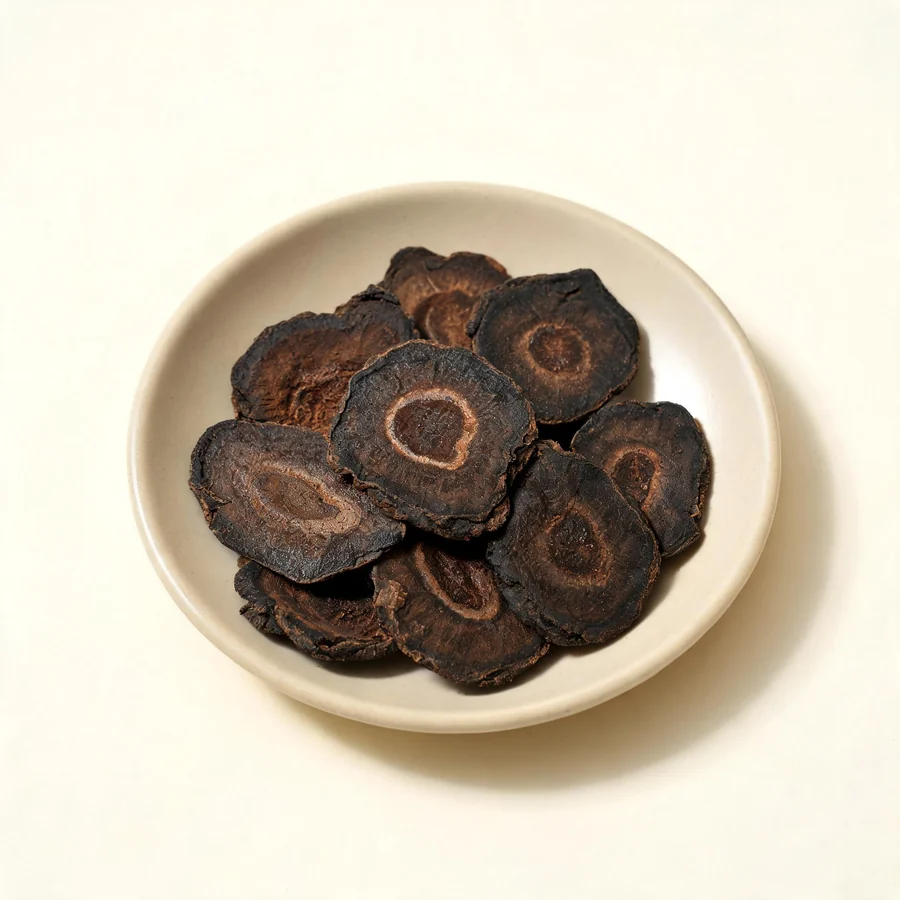
| Prepared root | 6 to 12 g a day in decoction, pills or powder, from material steamed with black bean juice. Only the prepared article is for tonic use, and a slice that is pale at the centre has been under-processed. |
| Raw root | 3 to 6 g, for a short course only and for the traditional sore, itch or laxative indications rather than for tonic use. The raw root carries the higher anthraquinone load. |
| External wash | 15 to 30 g of the raw root to 1 litre of water, strained and cooled. It is used on unbroken, itchy skin and is not applied to ulcers, to broken skin or to the face. |
| Course length and monitoring | Two to four weeks with review, and liver function tested if any symptom appears. Fatigue, nausea, dark urine or yellowing of the eyes ends the course at once. |
Quantity is not the safety variable with this root, which is what makes it unusual: the reaction is idiosyncratic, so a standard weight gives no assurance to a susceptible person. Two rules follow. Use properly prepared material and put a limit on the course, reviewing it instead of repeating it indefinitely. And if fatigue, nausea, dark urine or yellowing of the eyes appears, stop and arrange liver tests, at any dose and however long it has been tolerated.
Citations and further reading
Only real sources are listed: the classical materia medica passages quoted above, and the source works behind the botanical and safety statements.
- Kai Bao Ben Cao (Materia Medica of the Kai Bao Era), Song dynasty - entry quoted above.
- Ben Cao Gang Mu (Compendium of Materia Medica), Li Shizhen, 1578 - passage on the tonic claim quoted above.
- He Shou Wu San, classical external wash formula - composition and indication summarised above.
- Radix Polygoni Multiflori monograph: Pharmacopoeia of the People's Republic of China - accepted species, prepared form and the reduced recommended dose of the raw root.
- National Medical Products Administration safety bulletins on oral He Shou Wu preparations - the regulatory basis for the liver warning.
- HLA-B*35:01 association study on the herb and liver injury, as summarised in the pharmacology literature - cited as a safety finding, not as a claim of benefit.
- Botany: literature on Polygonum multiflorum (synonym Fallopia multiflora) of the Polygonaceae and on the black bean preparation of the root.
Educational reference for qualified practitioners. This page is not medical advice, and skin conditions should be diagnosed by a clinician before treatment.