Skin profile
Where this herb sits in skin practice: the pattern it corrects, the skin signs it suits, and what it should not be used for.
Ji Xue Teng is the gentle double herb of the Blood: it frees what has stalled and builds what is short. On the skin it is chosen for dusky, pale, cold or numbed skin, for purpura and easy bruising, for slow-healing skin and for patches that have lost pigment. It is wrong for hot, weeping or acute skin, it is avoided in pregnancy, and it belongs beside specialist care in the diseases that need it.
Skin signs that suggest it
- Easy bruising and small purplish patches on a pale, dull complexion
- Numbness, tingling or a dead feeling in the fingers and toes, with cold hands
- Fingers that go white, then dusky, in the cold, with cramping and a slow return of colour
- Depigmented patches that appeared after childbirth, illness or years of poor diet
- Skin that is bound, shiny and hard to lift over the fingers, with difficulty making a fist
- A brownish discolouration around the ankles in a person with varicose veins and dry thin skin
When it is not the right herb
Not for skin that is red, hot, swollen or weeping, and not for an acute flare in a robust, congested person: the vine is warm and it moves Blood, which is the wrong direction where heat and stasis are already active. Not for heavy or flooding periods, or for any active bleeding, unless stasis is the confirmed cause and herbs that staunch are given alongside. Not in pregnancy, and not while trying to conceive, because it activates circulation, and animal studies point to effects in early pregnancy. And not as an indefinite tonic: courses are reviewed after a few weeks, because a warm moving herb given for months can leave a dry, hot person thirstier and more irritable.
What it does for skin
Skin-relevant actions only. Each one describes a mechanism in TCM terms and what it looks like on the skin.
Frees Blood that has stalled in the small vessels
The visible sign of stalled Blood in the skin is colour that has gone wrong: dusky patches, a purplish rim around an old scar, brown staining above the ankles, or a bruise that takes weeks to fade. The vine is described as moving without breaking, which is the quality that makes it usable in thin, depleted people, and it is given with stronger movers when the stasis is fixed and painful.
Builds Blood so the surface keeps its colour and its nourishment
The stem is sweet and the tradition reads sweetness as building, so the vine is filed with the Blood tonics rather than only with the movers. On the skin the effect sought is a return of colour and of the moisture that goes with it, in the pale, tired person whose lips, nail beds and gums have lost their red. It is a slow action, judged over weeks, and it is why the herb suits chronic rather than acute skin pictures.
Unblocks the collaterals where numbness and tightness sit
The collaterals are the fine branches at the end of the channel network, and the tradition holds that when they are unfilled the skin and sinews lose feeling and suppleness. That is the reasoning behind its use in numb fingers, tight calves and bound skin, and it is why the herb is given with herbs that reach the limbs rather than with those that act on the interior. Numbness that appears suddenly, or on one side, is a medical emergency and not a pattern.
Warms cold, sluggish skin without drying it
Warm herbs that move Blood are usually drying, and dry skin is the last thing a person with poor circulation needs. This vine is warm and moistening at once, which is why it can be given through the cold months to someone whose hands are cold and whose skin is thin and papery. It is not a heating herb in the strong sense: the warmth is gentle and it is the movement, not the heat, that does most of the work.
Skin conditions it is used for
Mapped to the condition pages on this site. The pattern column shows what the skin is doing when this herb is the right choice.
| Condition | Pattern | Why it suits | Typical setting |
|---|---|---|---|
| Purpura | Blood deficiency with stasis, so Blood leaves the vessels | Purple spots that do not blanch, on a pale person with tiredness, light periods and a dull complexion, are read as Blood that is both thin and slow, leaking where the vessels are not properly held. The vine is used as the gentle member of such a formula, moving and building at once while herbs that hold the Blood, such as Huang Qi and Dang Gui, do the main work. Purpura is a sign rather than a diagnosis: a full blood count and a platelet count are needed before any of this is treated as a pattern, and a rapid crop of bruises with bleeding gums is urgent. | Gui Pi Tang with Ji Xue Teng and Mu Dan Pi |
| Vitiligo | Blood deficiency with stasis, so the skin loses its colour | The traditional reading of a pale patch that spreads slowly, in a person with a sallow face, cold hands and a thin pulse, is that the local Blood no longer reaches the surface. The vine is a supporting herb in that reasoning, chosen because it moves and nourishes without harshness, and it is given with He Shou Wu, Dang Gui and Bai Ji Li over months. No herb reliably restores pigment, the evidence for any of this is weak, and patches that are spreading quickly, or that come with other autoimmune signs, should be assessed. | With He Shou Wu, Dang Gui and Bai Ji Li in a Blood-nourishing formula |
| Skin numbness | Blood failing to fill the collaterals | Numbness that comes with cold hands, a pale face, light periods and a dull ache rather than a sharp pain is read as Blood too thin to fill the fingers and toes, moving sluggishly where it arrives at all. The vine is chosen because it does both jobs, so the limbs are fed and the flow is nudged along rather than forced. Sudden numbness, one-sided weakness, slurred speech or loss of feeling after an injury is not this pattern and needs urgent assessment; nor is the numbness of diabetes, which needs its own care. | Huang Qi Gui Zhi Wu Wu Tang with Ji Xue Teng |
| Scleroderma | Cold and stasis in the collaterals with underlying deficiency | Skin that is bound, shiny and hard to lift, with fingers that are cold and stiff and a face that has lost its lines, is read as Cold and stasis filling the fine network while the Blood behind it is short. The vine is a supporting herb in that reading, given with Huang Qi, Dan Shen and Gui Zhi, and it is never a treatment for the disease. Localised or systemic sclerosis needs a specialist team, and the herbs described here belong beside that care rather than instead of it. | Huang Qi Gui Zhi Wu Wu Tang with Ji Xue Teng and Dan Shen |
| Chilblains | Cold stasis in the digits with Blood deficiency | Red-purple, tender swellings on the toes and fingers in cold damp weather, in a person whose hands are always cold, are read as Cold that has settled into the small vessels of someone too depleted to push it out. A warm vine that moves Blood and reaches the limbs suits that reasoning, and it is given with Gui Zhi and Dang Gui. Chilblains that ulcerate, or that appear in someone with Raynaud's phenomenon or a connective tissue disease, need medical review. | Dang Gui Si Ni Tang with Ji Xue Teng |
Combinations for skin
Herbs it is paired with when the skin, not an internal organ, is the target.
| Partner | Ratio | Why the pair is used |
|---|---|---|
| Dang Gui | 10 to 15 g Dang Gui with 9 to 15 g Ji Xue Teng | Both move and nourish the Blood, and the tonic is the stronger of the two. Dang Gui supplies substance and the vine adds reach into the limbs and the fine vessels, so the pair suits a pale person with dusky hands and light periods. When the picture is dry and hot, Dang Gui is reduced and the vine kept modest, because both are warming. |
| Huang Qi | 15 to 30 g Huang Qi with 9 to 15 g Ji Xue Teng | Huang Qi gives the Qi that drives production and holds the surface, while the vine gives the substance and keeps it moving. The pair is the standard approach where a depleted person has slow-healing skin, easy bruising or low counts after treatment, and it is given for weeks. The reasoning is simple: without Blood there is nothing for the Qi to carry, and without Qi the Blood will not move. |
| Dan Shen | 9 to 15 g each | Dan Shen is cold where the vine is warm, and both free the Blood. The pair is used where stasis has a hot edge, as in purpura with a red tongue, a fast pulse and a feeling of heat, and the two balance each other so neither the cold nor the warmth dominates. Dan Shen also calms the spirit, which matters when a flushing, irritable patient cannot sleep. |
| Bai Shao | 10 to 15 g Bai Shao with 9 to 15 g Ji Xue Teng | Bai Shao nourishes the Blood and relaxes the sinews, and it makes a calm, moistening partner for the vine's gentle movement. Together they are used for cramping, tight calves and a general tension in the limbs, where the underlying problem is a failure of moisture rather than a true blockage. The pairing is common in the formulas for period pain and for the aching limbs of a depleted person. |
Formulas where it leads
- Ji Xue Teng Gao (鸡血藤膏) - The traditional preparation of the vine itself: the stems are boiled with water and the decoction reduced to a thick, sweet paste, sometimes with a little wine, and taken by the spoonful through the cold months. It is the form in which the herb was used as a household tonic in Yunnan and Guangxi, and it is the clearest expression of its double action, since a paste both nourishes and moves. It is not a treatment for a skin disease and it is not used in pregnancy.
Safety for skin use
What to check before recommending or using it, including the cautions that matter most for skin patients.
Do not use, or use with caution
- Pregnancy, and the months spent trying to conceive. The vine activates the circulation, and animal studies point to effects in early pregnancy, so it is left out rather than given at a reduced dose; the same caution applies while breastfeeding without advice.
- Heavy, flooding or prolonged bleeding, and any active bleeding. Moving more Blood in that setting is a mistake; a heavy period takes the vine only when stasis is the confirmed cause, with herbs that staunch given alongside.
- A dry, hot, depleted picture: night sweats, a dry mouth, flushing, a red tongue with little coating and a thin rapid pulse. The vine is warm, and in that picture it adds heat while doing little for the skin.
- Open-ended courses. Because the herb is gentle, a course can drift on for months; the tradition reviews after a few weeks or a few cycles instead, and reassesses whether the picture has changed.
Pregnancy and breastfeeding
Avoided. The vine moves the Blood, and animal studies describe anti-early-pregnancy effects, so the theoretical risk is not negligible. The old texts do not formally forbid it, yet modern practice leaves it out, and that judgement covers the whole of pregnancy rather than the first trimester alone. A skin problem in pregnancy that seems to need it is a reason to see a practitioner, since there are safer alternatives for most pictures.
Interactions
- Anticoagulants and antiplatelet medicines. Laboratory work shows the vine blocking platelet clumping at a specific receptor, and that is genuine pharmacology rather than a guess. Anyone taking warfarin, aspirin, clopidogrel or one of the direct oral anticoagulants should tell the prescriber before adding it, and it is stopped ahead of planned surgery and dental extraction.
- Hormonal treatments. The vine contains isoflavones with weak oestrogenic activity in laboratory work. How far that matters at decoction strength is unknown and no cases have been reported, so it is used cautiously, with the prescriber informed, in anyone taking hormone replacement or tamoxifen, and in anyone whose breast cancer was oestrogen-receptor-positive.
- Chemotherapy and other hospital treatment. Chinese hospitals give the vine with chemotherapy, most often for low blood counts, with no adverse interaction described. That reassures but does not test, so the herb belongs inside the oncology team's picture rather than being taken independently, especially in the weeks when the marrow is most suppressed.
Allergy and patch testing
Reactions are uncommon. The vine is a legume, so a person with reactions to other legumes is observed at the first dose, and a wine liniment or a herb-containing cream is patch tested for a day before wider use. Stop if the skin becomes more irritated, and treat swelling, wheeze or faintness as an emergency.
General safety references
General references for herbal hepatotoxicity and herb-drug interactions; they are not specific to this herb.
- Review article: Herbal hepatotoxicity - an update on traditional Chinese medicine preparations. Alimentary Pharmacology & Therapeutics, 2014. PMID: 24844799.
- Interactions between herbal medicines and prescribed drugs: an updated systematic review. Drugs, 2009. PMID: 19719333.
- Warfarin and food, herbal or dietary supplement interactions: a systematic review. British Journal of Clinical Pharmacology, 2021. PMID: 32478963.
Evidence
The classical record is quoted with its source. The modern note states the level of evidence plainly.
Classical record
活血,暖腰膝,已风瘫。
It quickens the Blood, warms the lower back and the knees, and halts the paralysis left by wind-stroke.
Ben Cao Gang Mu Shi Yi (Supplement to the Compendium of Materia Medica), Zhao Xuemin - Written around 1765 and the first substantial account of the vine; those few words carry its whole later reputation, and the warming and moving pairing is what a skin reader takes from them.
去瘀血,生新血,流利经脉。
Stale Blood is cleared, fresh Blood generated, and the channels and vessels kept flowing freely.
Yin Pian Xin Can (New Studies of Prepared Drugs) - A later Qing text on prepared medicines, and the plainest early statement of the double action to which later writers keep returning.
为强壮性之补血药,适用于贫血性之神经麻痹症。
A strengthening tonic for the Blood, given where anaemia brings numb limbs, and for periods that are irregular or absent, moving the Blood and easing pain together.
Xian Dai Shi Yong Zhong Yao (Modern Practical Chinese Materia Medica) - A twentieth-century clinical summary, and the point at which the vine began to be described in the vocabulary of anaemia and nerve function instead of wind and collaterals.
Modern evidence
Evidence status
- Laboratory work on the vine's flavonoids and isoflavones reports improved circulation in animal models, effects on blood formation and inhibition of platelet clumping. These are cell and animal studies, and they do not establish a benefit for any skin condition.
- Clinical evidence in skin disease is very limited. Reports of the vine raising blood counts after chemotherapy come from Chinese hospital practice and are observational, and the herb usually appears as one ingredient in a multi-herb formula. No trial of the vine alone in purpura, vitiligo or sclerosis can be relied on.
- Regulatory status: the stem is an accepted herbal substance in the Chinese Pharmacopoeia as Caulis Spatholobi, with Spatholobus suberectus named as the sole official source since 1977. This page describes traditional practice and the state of the evidence; it is not a claim of proven benefit.
PubMed records
Selected real PubMed records for this herb's species or its constituents, chosen by species name and title relevance. They are references for the non-TCM discussion above, not proof that the herb treats any skin condition.
- Plant Extracts as Skin Care and Therapeutic Agents.. International journal of molecular sciences, 2023. PMID: 37895122 (skin-related record).
- A comprehensive review: Botany, phytochemistry, traditional uses, pharmacology, and toxicology of Spatholobus suberectus vine stems.. Journal of ethnopharmacology, 2023. PMID: 37062528 (safety record).
Dose and forms
Skin-practice dosing and the preparations that suit skin complaints.
| Form | Dose and notes |
|---|---|
| Decoction (internal) | 9 to 15 g of dried stem daily in a formula, and 15 to 30 g where stasis dominates and the limbs are numb or the skin is bound. The larger figure is a practitioner dose and not a domestic one. |
| Paste | Ji Xue Teng Gao is taken by the spoonful, usually in the cold months, and is the traditional household form. The sugar, and the wine in some preparations, matter to anyone watching their intake. |
| Course length | Weeks to a few months, reviewed at intervals. The response is judged by colour, warmth, feeling in the fingers, the period itself and, where it applies, the blood count, rather than by any immediate change in the skin. |
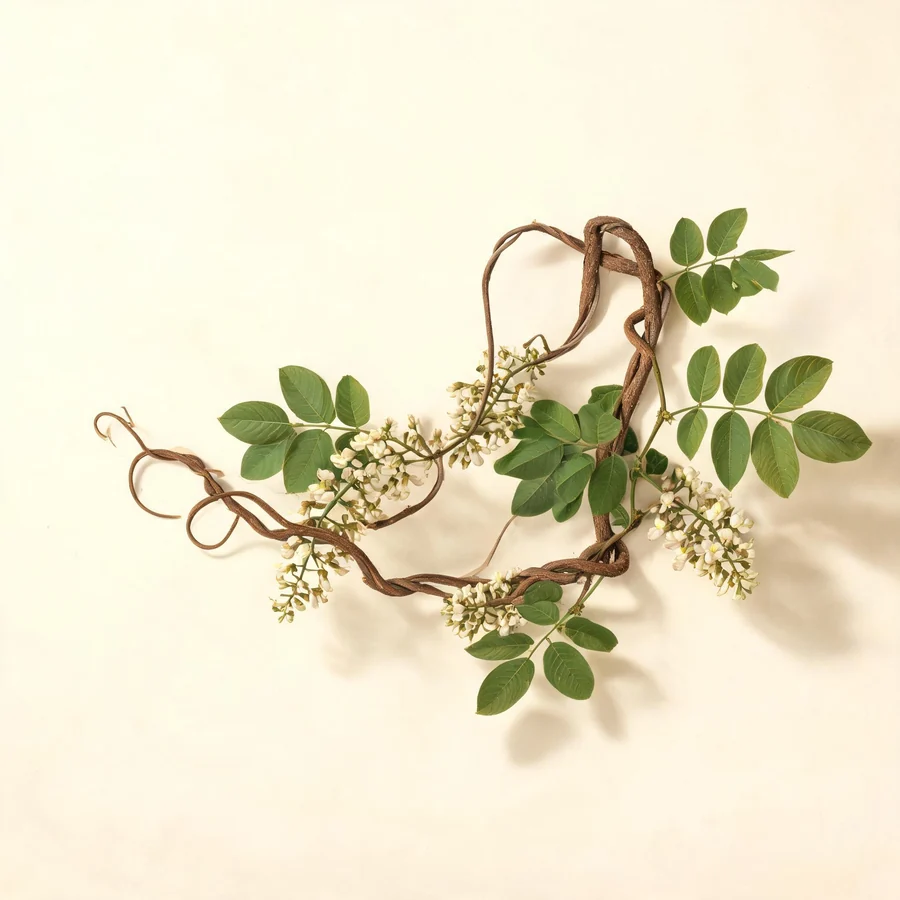
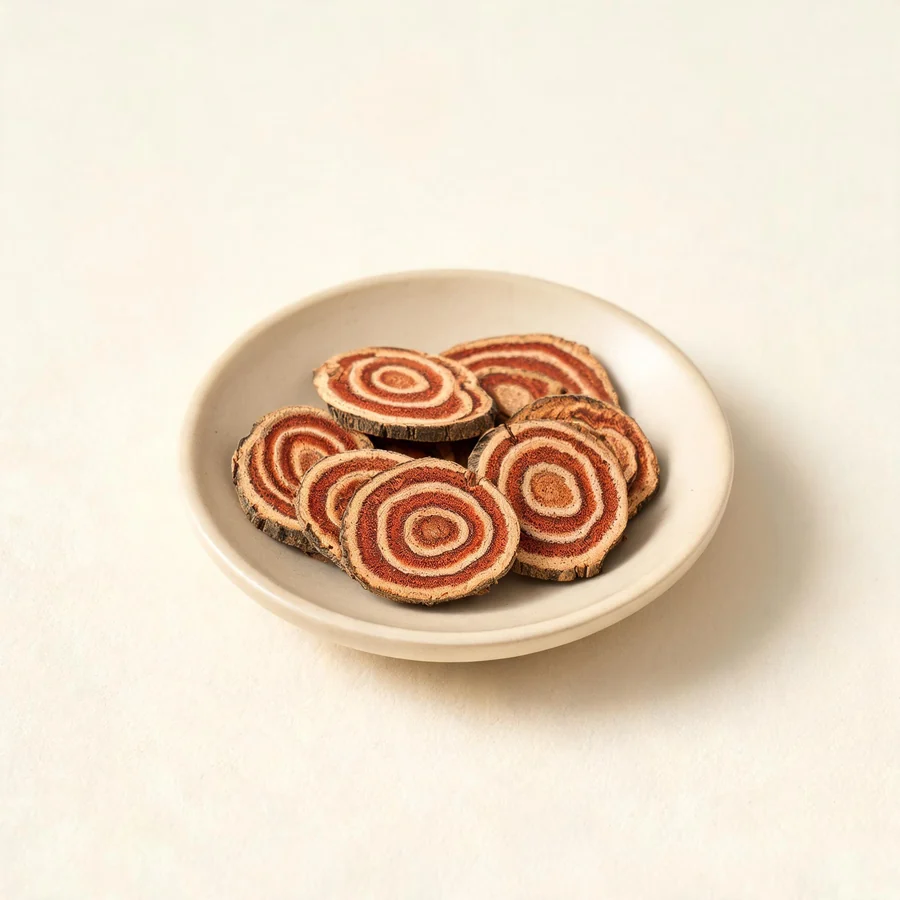
The stem is woody, so it needs time in the pot rather than a short steep, and its taste is faintly sweet and astringent, which lets it sit inside a larger prescription. The margin is wide indeed: animal work found that roughly two hundred times the therapeutic dose was tolerated, and no special preparation is required. The practical limits are situational rather than toxicological, namely pregnancy, active bleeding and blood thinners, and the course is judged by whether the colour and the circulation in the skin are improving.
Citations and further reading
Only real sources are listed: the classical materia medica passages quoted above, and the source works behind the botanical and safety statements.
- Ben Cao Gang Mu Shi Yi (Supplement to the Compendium of Materia Medica), Zhao Xuemin, around 1765 - classical entry quoted above.
- Yin Pian Xin Can (New Studies of Prepared Drugs), Qing period - classical entry quoted above.
- Xian Dai Shi Yong Zhong Yao (Modern Practical Chinese Materia Medica), twentieth century - classical entry quoted above.
- Caulis Spatholobi monograph: Pharmacopoeia of the People's Republic of China - source for the accepted botanical source and part used.
- Modern evidence statement: based on laboratory and animal literature on Spatholobus suberectus, summarised as a statement about the level of evidence rather than as a cited finding.
- Botanical description and identification: botanical literature on Spatholobus suberectus, Fabaceae.
Educational reference for qualified practitioners. This page is not medical advice, and skin conditions should be diagnosed by a clinician before treatment.