Skin profile
Where this herb sits in skin practice: the pattern it corrects, the skin signs it suits, and what it should not be used for.
Dan Shen is chosen where heat and stasis meet in the skin: fixed dusky lesions, tender nodules, raised scars, and hot swellings that have not yet pointed. Its bleeding risk, rather than any toxicity, is the fact that decides whether it can be used.
Skin signs that suggest it
- Dusky, purplish or brick-red patches that persist and feel warm to the touch
- Fixed, tender nodules or thickened plaques under the skin, including raised scars
- Hot, red, painful swellings that rise quickly, before pus has formed
- Petechiae or purpura that do not blanch, with a dark red tongue
- Persistent flushing and visible vessels over the cheeks and nose
- A dark or purple tongue with a choppy or uneven pulse
When it is not the right herb
Not for skin that is pale, cold and dry with no fixed or dusky component, and not for active bleeding or easy bruising from a clotting problem. Because it moves Blood, it is avoided in pregnancy and used cautiously around surgery. It is also a poor choice for a weak digestion, where a bitter, cool, moving root can cause loose stools.
What it does for skin
Skin-relevant actions only. Each one describes a mechanism in TCM terms and what it looks like on the skin.
Cools the Blood and clears deep heat
Where heat has gone deeper than the surface, the skin shows deep red or purplish colour, feels hot, and may be part of a picture with fever, thirst and a dark tongue. Dan Shen cools that level while its acrid quality keeps the cooled Blood from settling, so the heat is cleared without leaving a fixed patch behind. It is used in rashes that follow a fever or a medicine, and in the inflammatory phase of psoriasis.
Moves Blood and disperses stasis in lesions and scars
Fixed tender nodules, thickened plaques, keloids and dusky patches that will not fade are read as Blood that has stopped moving. Dan Shen breaks that stasis while cooling the heat that so often accompanies it, and it is one of the few movers that can be used on inflamed skin without adding heat. It is combined with Chi Shao or Tao Ren when the stasis has become firm.
Reduces swelling and disperses an early abscess
A hot, red, painful swelling that has not yet pointed is read as heat toxin bound with stagnant Blood. Cooling clears the heat while the moving action disperses the clump, which is the classical rationale for using the root on boils and early abscesses. It is an adjunct to proper wound care and antibiotics, never a replacement for them.
Settles the restlessness that drives scratching
Heat in the Blood disturbs the spirit, and the result is broken sleep, irritability and a night-time urge to scratch that makes the skin worse. Dan Shen clears that heat and calms the restlessness, which is why it appears in formulas for hot, itchy eruptions with a disturbed night. It is not a sedative and does nothing for the itch itself; it removes one of the forces that keeps a flare going.
Skin conditions it is used for
Mapped to the condition pages on this site. The pattern column shows what the skin is doing when this herb is the right choice.
| Condition | Pattern | Why it suits | Typical setting |
|---|---|---|---|
| Acne | Blood stasis with heat in the deeper lesions | Acne that has moved beyond simple papules into dusky red nodules, cysts and marks that stay for months is read as heat that has entered the Blood with stasis. Dan Shen cools the heat and disperses the clump, so it is added to a heat-clearing acne formula when the lesions are indurated rather than merely red. It does not replace treatment of the follicular infection or of a hormonal driver. | Modified Qing Wei San with Mu Dan Pi and Chi Shao |
| Rosacea | Heat and stasis in the facial vessels | Persistent redness with visible vessels, burning and a dusky rather than bright tone is read as heat held in the Blood of the face with stasis. Dan Shen addresses both halves, cooling the heat and moving the stagnant Blood that keeps the redness fixed. It is used with Mu Dan Pi and Hong Hua, while sun protection and trigger avoidance still do most of the everyday work. | Dan Shen with Mu Dan Pi, Chi Shao and Hong Hua in a facial blood-moving formula |
| Psoriasis | Blood stasis with residual heat in fixed plaques | Thick, dusky red plaques that persist in the same places, with scaling and a purple tinge, point to stasis in the Blood with heat still active. Dan Shen is added to a blood-cooling and moving formula in that phase, where the aim is to thin the plaque as well as to calm the inflammation. It is not a stand-alone treatment and does not replace topical or systemic care for severe disease. | Tao Hong Si Wu Tang with Dan Shen and Mu Dan Pi |
| Purpura | Heat in the Blood with stasis in the vessels | Purpuric spots that do not blanch, with a dark red tongue and a sense of heat, point to heat that has moved into the Blood and damaged the vessels. Dan Shen cools the Blood and disperses the stasis left in the skin, and it is given with other blood-cooling herbs. Any purpura needs medical assessment first, because the causes include conditions that no herb can address. | Liang Xue Di Huang Tang with added Dan Shen |
| Keloids | Stasis bound in the skin after injury | A firm, raised, red-purple scar that continues to grow after the wound has healed is read as stagnant Blood held in the skin. Dan Shen is used in the blood-moving approach to scars, usually with stronger stasis-breaking herbs, and the aim is to soften and flatten rather than to remove. Injections and other dermatological treatment remain the main options, and the herb is a supporting measure. | Dan Shen with Hong Hua, Tao Ren and E Zhu in a stasis-resolving formula |
| Boils | Heat toxin with stagnant Blood under the swelling | A hot, red, tender boil with a hard centre is heat toxin sitting in Blood that has stopped moving. Dan Shen cools and disperses, and the classical record names it for early abscesses, particularly on the breast. It is used with toxin-resolving herbs such as Jin Yin Hua, and a spreading infection, fever or a deep abscess needs urgent medical care. | Wu Wei Xiao Du Yin with Dan Shen and Jin Yin Hua |
Combinations for skin
Herbs it is paired with when the skin, not an internal organ, is the target.
| Partner | Ratio | Why the pair is used |
|---|---|---|
| Dang Gui | 10 g each | Dang Gui nourishes and moves, Dan Shen cools and moves, so the pair covers skin that is deficient, stagnant and slightly hot. It is used for dusky, dry patches and for old marks in a person who is pale and tired, and the nourishing side keeps the movement from becoming a slow drain. |
| San Qi | 10 g Dan Shen with 3 to 6 g San Qi | The pair pulls in two directions on bleeding. Dan Shen moves Blood and cools it, while San Qi disperses stasis yet stops bleeding, so the combination is used where stasis needs breaking without an obvious risk of haemorrhage. In skin practice it is reserved for fixed nodules or bruises with a real bleeding concern, under supervision. |
| Chi Shao | 10 g each | Both cool the Blood and move it, and they are usually given together. Chi Shao is the stronger breaker of stasis and the better herb for painful swelling, while Dan Shen adds depth of cooling and a calming quality, so the pair suits dusky inflamed lesions and tender nodules. |
| Mu Dan Pi | 10 g each | Mu Dan Pi clears heat from the Blood and vents it, while Dan Shen moves the Blood that the heat has thickened. The pair is used for hot red or purplish rashes, for rosacea and for the inflammatory phase of psoriasis, where cooling and moving have to happen together. |
| Chuan Xiong | 10 g each | Chuan Xiong is warm, pungent and rising, and Dan Shen is cool, bitter and broader in reach, so the two movers balance each other's temperature. The pair is used for dusky facial skin and fixed pain where the picture is mixed, and the warm herb supplies movement where the cool one might otherwise slow it. |
Formulas where it leads
- Tao Hong Si Wu Tang (桃红四物汤) - The Blood-moving extension of Si Wu Tang, with peach kernel and safflower added. Dan Shen fits the same intention when skin lesions are fixed and dusky, and the formula is a standard context for stasis in the skin and for old marks.
- Liang Xue Di Huang Tang (凉血地黄汤) - A blood-cooling formula for heat that has moved into the Blood, with a rash, purpura or bleeding. Dan Shen is added for its cooling and moving combination when the lesions are dark and fixed rather than bright red.
- Wu Wei Xiao Du Yin (五味消毒饮) - A toxin-resolving formula for hot, red, painful swellings and early abscesses. Dan Shen adds the blood-moving element that disperses the clump at the centre, and it is named in the classical record for early breast abscess.
Safety for skin use
What to check before recommending or using it, including the cautions that matter most for skin patients.
Do not use, or use with caution
- Active bleeding, a bleeding disorder or recent surgery. The root inhibits platelet clumping and moves Blood, so it can prolong or worsen bleeding.
- Pregnancy and trying to conceive. A strong Blood mover can stimulate the uterus, and the classical record warns that it can drop a fetus.
- No stasis: pale, cold, dry skin with no fixed or dusky lesions. Given for months to someone without stasis, a cool bitter mover is said to disperse normal Blood and unsettle the digestion.
- Weak digestion with loose stools. The bitter, cool root can sit heavily and loosen the stool further in a sensitive Stomach.
Pregnancy and breastfeeding
Avoid. Dan Shen is a strong Blood mover that can stimulate the uterus, and the classical record is explicit about the risk to a pregnancy. It is avoided in pregnancy and while trying to conceive. Recorded historical use for threatened miscarriage, where stasis had been confirmed, belongs to specialist practice rather than general care. A topical preparation is not a safe alternative either, because the concern is systemic. Breastfeeding is also avoided unless a practitioner has reviewed the case and decided it is needed, since the antiplatelet effect and the absence of studies make it a poor default.
Interactions
- Warfarin and other anticoagulants: Dan Shen has anticoagulant activity in its own right and has been reported to raise warfarin levels, with bleeding and a raised INR in published cases. Anyone on warfarin needs medical supervision before adding it.
- Antiplatelet drugs such as aspirin and clopidogrel: the additive effect on platelets raises bleeding risk, and the herb is stopped well before planned surgery or dental work.
- Digoxin: it has been reported to interfere with certain laboratory assays, so a result can look wrong and should be interpreted with the herb in mind.
- Medicines handled by liver enzymes: in animal studies the tanshinones inhibit several hepatic enzymes, so levels of drugs with a narrow therapeutic window can in theory change. This matters most for concentrated extracts.
Allergy and patch testing
Allergic reactions to Dan Shen are uncommon but reported, and they include rash and itching in people taking the herb. Any new rash while taking it should be assessed rather than assumed to be part of the original condition, and topical products containing it should be patch tested before use.
General safety references
General references for herbal hepatotoxicity and herb-drug interactions; they are not specific to this herb.
- Review article: Herbal hepatotoxicity - an update on traditional Chinese medicine preparations. Alimentary Pharmacology & Therapeutics, 2014. PMID: 24844799.
- Interactions between herbal medicines and prescribed drugs: an updated systematic review. Drugs, 2009. PMID: 19719333.
- Warfarin and food, herbal or dietary supplement interactions: a systematic review. British Journal of Clinical Pharmacology, 2021. PMID: 32478963.
Evidence
The classical record is quoted with its source. The modern note states the level of evidence plainly.
Classical record
味苦,微寒。主心腹邪气,肠鸣幽幽如走水,寒热积聚,破癥除瘕,止烦满,益气。
Bitter in taste and slightly cold. It governs wrongful Qi in the chest and abdomen, bowel sounds that run like flowing water, accumulations with alternating cold and heat, breaks up fixed and mobile masses, stops agitation and fullness, and augments Qi.
Shen Nong Ben Cao Jing (《神农本草经》), Han compilation - What strikes a modern reader is how abdominal the first entry is, and how little it says about the heart; the masses it breaks belong to the language later applied to stasis.
养血,去心腹痼疾结气,腰脊强,脚痹,除风邪留热。久服利人。
It nourishes the Blood, removes chronic illness of the chest and abdomen with bound Qi, stiffness of the lower back and spine and impediment of the legs, and clears lingering heat left behind by wind. Taken over time it benefits a person.
Ming Yi Bie Lu (《名医别录》), around 500 CE - Here the nourishing claim appears for the first time, and it is the line that later became the saying about one herb doing the work of four.
活血,通心包络,治疝痛。
It quickens the Blood, opens the Pericardium network, and treats hernia pain.
Ben Cao Gang Mu (《本草纲目》), Li Shizhen, 1578 - A handful of characters for the action, plus a single new channel; by the Ming dynasty the herb had shifted from the abdomen to the Pericardium.
Modern evidence
Evidence status
- Laboratory studies of tanshinones and salvianolic acids report anti-inflammatory, antioxidant and microcirculation effects, and some work examines their influence on platelet function and on skin inflammation. These are mainly cell and animal studies.
- Clinical trial evidence for Dan Shen in skin disease is very limited: most studies test multi-herb formulas or conditions outside the skin, and none establishes benefit in acne, rosacea or psoriasis.
- The antiplatelet and anticoagulant effects are the best documented pharmacological findings, and they are the basis of the bleeding cautions rather than of any claim about the skin.
PubMed records
Selected real PubMed records for this herb's species or its constituents, chosen by species name and title relevance. They are references for the non-TCM discussion above, not proof that the herb treats any skin condition.
- Rapid Screening of Chemical Components in Salvia miltiorrhiza with the Potential to Inhibit Skin Inflammation.. International journal of molecular sciences, 2024. PMID: 39000476 (skin-related record).
Dose and forms
Skin-practice dosing and the preparations that suit skin complaints.
| Form | Dose and notes |
|---|---|
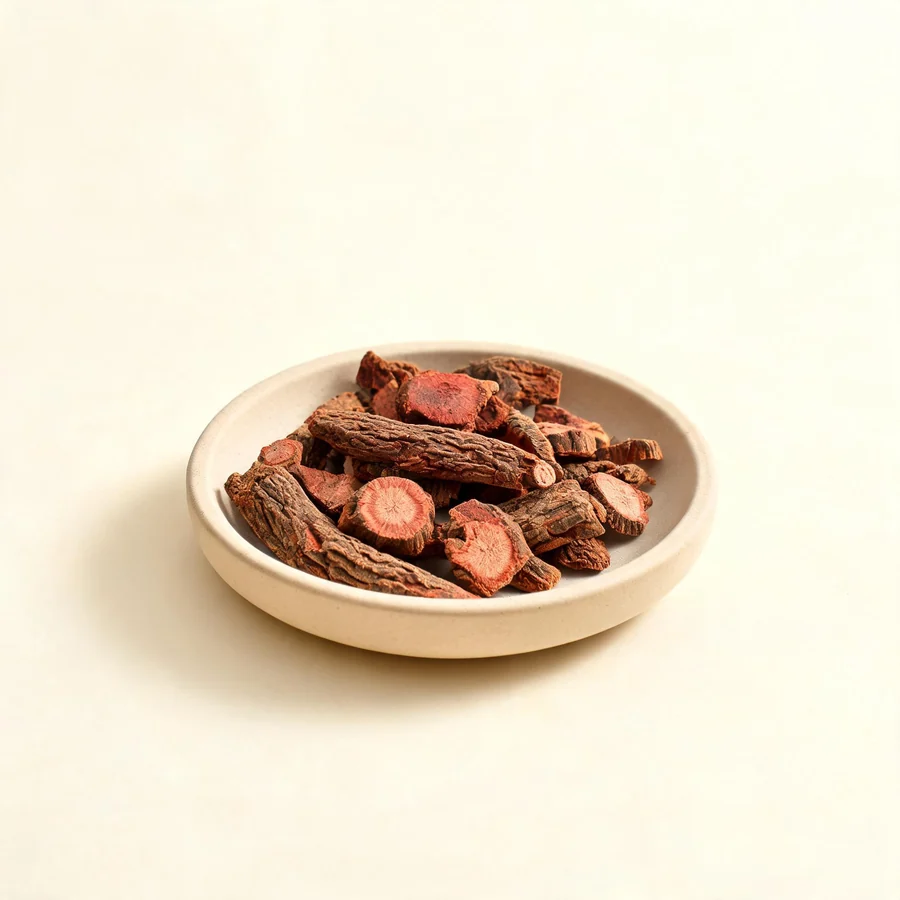
| Decoction | 10 to 15 g of dried root daily in a formula. Twelve grams is a usual starting point, and the lower end is used where the aim is cooling rather than strong movement. |
| Upper range | For severe, fixed stasis, 15 to 30 g appears in the literature, under supervision. Routine use above 15 g is not advised without a clear reason, and the dose is kept low when other Blood movers are in the formula. |
| Course length | Short courses of a few weeks, with a review of bleeding risk and of the skin response. Long courses are not usual in skin practice. |
| Form | Sliced root decocted normally. The wine-processed slice is used where its coolness needs softening for a cold digestion. |
What decides the dose is the amount of movement the pattern needs and the rest of the person's medicines, not their size. The risk here comes from the Blood-activating effect rather than from toxicity, so an anticoagulant in the medicine list changes the question from the size of the dose to whether the herb belongs at all. In skin practice the usual range is modest, because the aim is to cool and disperse rather than to break a mass.
Citations and further reading
Only real sources are listed: the classical materia medica passages quoted above, and the source works behind the botanical and safety statements.
- Shen Nong Ben Cao Jing (Divine Husbandman's Classic of Materia Medica), Han compilation - classical entry quoted above.
- Ming Yi Bie Lu (Supplement to the Classic of Materia Medica), around 500 CE - classical entry quoted above.
- Ben Cao Gang Mu (Compendium of Materia Medica), Li Shizhen, 1578 - classical entry quoted above.
- Dan Shen monograph: Pharmacopoeia of the People's Republic of China - source for the accepted botanical source, part used and quality requirements.
- Modern evidence statement: based on laboratory and review literature on tanshinones and salvianolic acids, summarised as a statement about the level of evidence rather than as a cited finding.
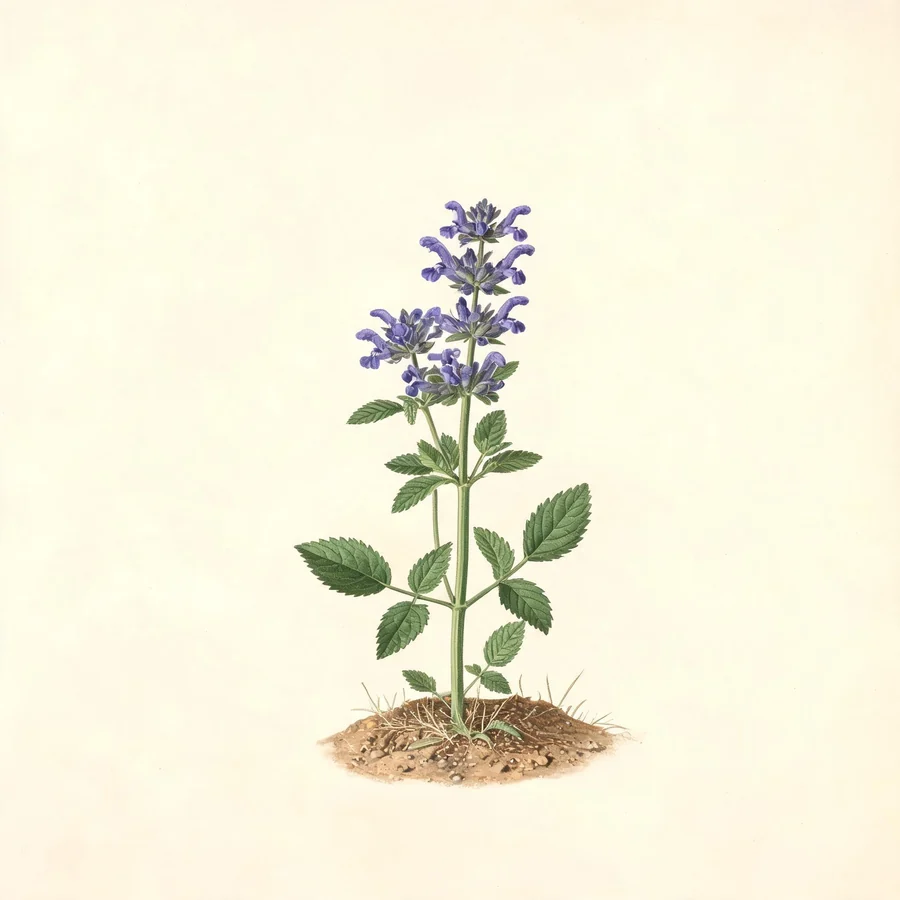
- Botanical description and identification: botanical literature on Salvia miltiorrhiza, Lamiaceae.
Educational reference for qualified practitioners. This page is not medical advice, and skin conditions should be diagnosed by a clinician before treatment.