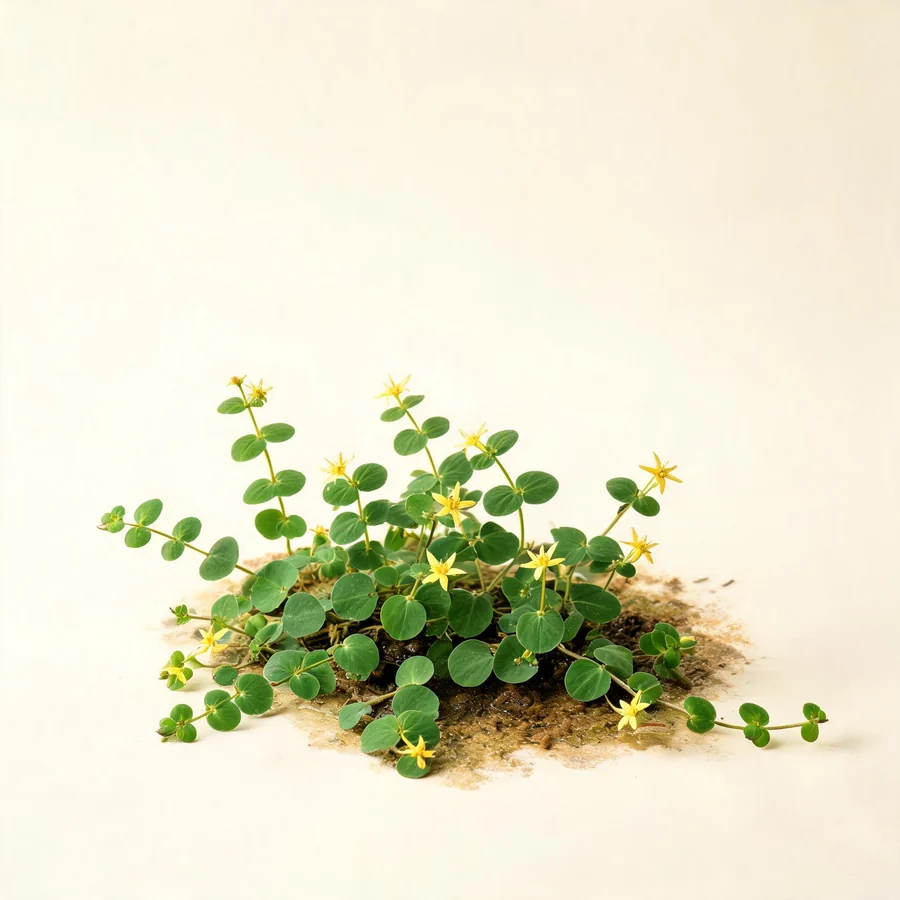
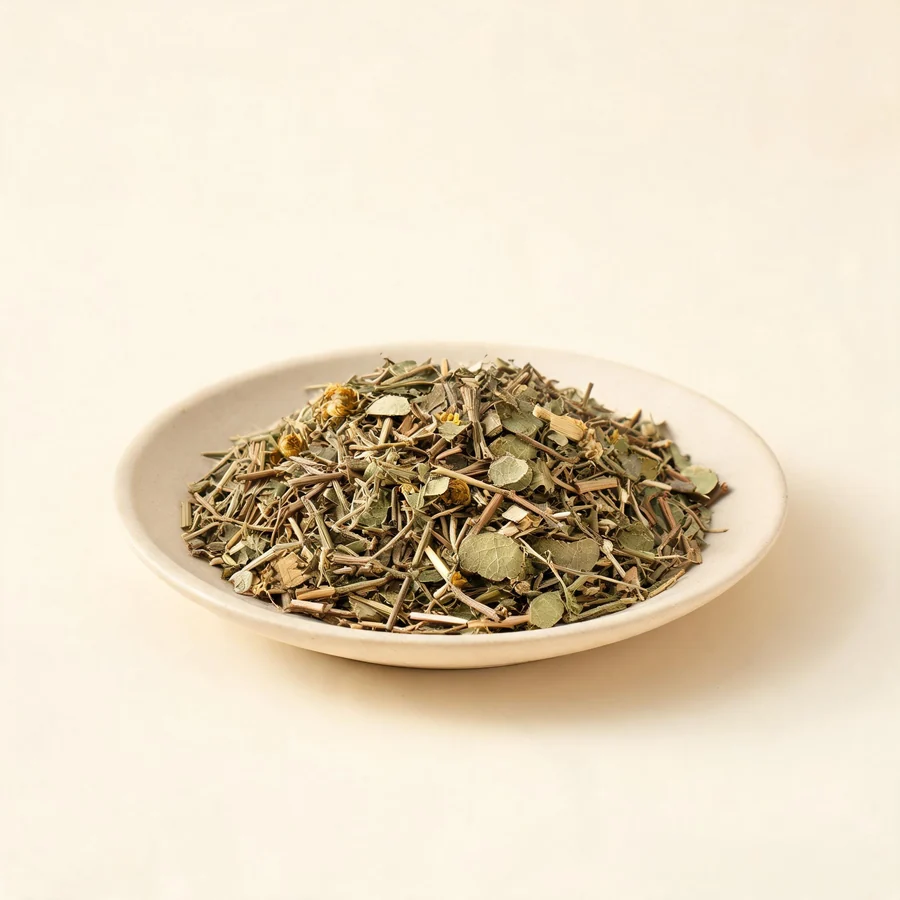
Skin profile
Where this herb sits in skin practice: the pattern it corrects, the skin signs it suits, and what it should not be used for.
Jin Qian Cao is a mild cooling herb for hot, hard swellings and crusted, weeping eruptions, and it is used as a wash as much as a decoction. It supports the stronger toxin-clearing herbs and does not replace treatment for a spreading infection.
Skin signs that suggest it
- A boil, carbuncle or early abscess that is red, hot, raised and tender (heat toxin gathering)
- A scabby, weeping eruption with a yellow crust that stings more than it itches
- Ringworm patches with a raised, itchy, scaly edge on the hands or the trunk (dampness, heat and wind in the skin)
- A hard, red swelling with general heaviness, scanty dark urine and a greasy yellow coating
- An insect bite or sting that has become red, hot and puffy
When it is not the right herb
Not for a swelling that is pale, cold and indolent, and not for a chronic ulcer with no heat in it, where a cold draining herb has nothing to clear and slows the tissue. Not for skin that is dry and thin with no moisture. The plant is cold and moves fluid downward, so it is held back where the digestion is weak or the stools are already loose. A bite or sting with spreading swelling, breathlessness or a rash elsewhere on the body needs urgent medical care, not a wash.
What it does for skin
Skin-relevant actions only. Each one describes a mechanism in TCM terms and what it looks like on the skin.
Clears heat and resolves toxin in a local swelling
It is used where a lesion is hot, red, hard and tender, which is heat concentrated enough to damage tissue. The whole plant is a mild member of the toxin-clearing group, so it supports stronger herbs such as Pu Gong Ying and Lian Qiao rather than replacing them, and it is applied as well as swallowed. Nothing in the action suggests it can sterilise an infection that needs antibiotics or drain a collection of pus.
Dries dampness so a scabby eruption settles
The salty and bland tastes are read as drawing fluid out, and the cooling takes the sting out of the heat. That combination suits the crusted, weeping stage of an eruption, where the surface is both inflamed and moist, and it is why a decoction of the plant is poured over sores and scabby patches. The drying is gentle, so it does not leave skin as tight as a bitter cold root would.
Softens a hard, early swelling
The salty taste is said to soften hardness, a principle the tradition applies chiefly to stones but also to a hard, red, unopened swelling. The reasoning is that a lesion which is tense and indurated has dampness and heat bound inside it, and a salty draining herb loosens that binding. It is a modest action and is given here as the tradition states it, not as a claim that a poultice can dissolve an abscess.
Cools and cleans the surface as a wash
The external use is old and specific: a decoction poured over sores, and the fresh plant rubbed on tinea. In practice the wash lowers surface heat, removes crust and keeps the area clean while an internal formula does its work. The effect is temporary and local, and the wash is not applied to broken, deep or spreading lesions.
Skin conditions it is used for
Mapped to the condition pages on this site. The pattern column shows what the skin is doing when this herb is the right choice.
| Condition | Pattern | Why it suits | Typical setting |
|---|---|---|---|
| Boils | Heat toxin gathering into a hard, red, tender swelling | A boil is the clearest heat-toxin lesion, and this plant has a record of being used on toxic swellings both internally and as a wash. Its strength is modest, so it is combined with a stronger toxin-clearing herb and applied to the lesion as a cooled decoction. A boil with spreading redness, fever or a dark centre, or one on the face, needs medical assessment rather than a poultice. | Jin Qian Cao with Pu Gong Ying and Lian Qiao, plus a cooled wash on the lesion |
| Skin abscess | An early abscess before pus has formed, with heat and hardness | Before a collection has formed, the aim is to settle the inflammation, and a mild draining herb used in a wash and internally is part of that attempt. Once the centre softens or pus is discharging the herb has no role, because an abscess needs drainage and, where the skin is spreading and hot, antibiotics. The distinction between an early hard swelling and a mature abscess is the whole of the judgement here. | Jin Qian Cao with Huang Qin and Pu Gong Ying, with a cooled compress while the swelling is hard |
| Tinea | Dampness, heat and wind lodged in the skin, with an itchy scaly edge | The earliest record has the plant rubbed on tinea of the hands, and the reasoning is the one the tradition uses for ringworm generally: dampness and heat in the skin that the surface cannot clear. A cooled decoction is applied to the patch while the plant is given internally as a support. Tinea is a fungal infection, so a topical antifungal is the treatment and the wash is an addition to it. | A Jin Qian Cao decoction applied to the patch, with Ku Shen and Bai Xian Pi in the wash |
| Skin infection | Mild superficial infection with heat, redness and moisture | For a small, superficial, inflamed area the plant gives a cooling wash that lifts crust and surface heat without stinging, and it is mild enough to repeat through the day. Its range stops at superficial: spreading redness, a raised temperature, tender lymph nodes or a deep wound all move the case out of it. The purpose of the wash is to clean and cool, not to treat an established infection. | A cooled Jin Qian Cao wash, with Huang Qin and Lian Qiao internally |
| Eczema | Wet, crusted Damp-Heat flare | In the oozing, crusted phase the plant is a supporting drainer: it cools, dries a little and helps the surface settle, and it is gentle enough to combine with the stronger skin herbs. It is not used in the dry, thickened phase, where it would take moisture the skin no longer has. The wash is the more useful form here, applied to a limited patch, with the decoction given inside a formula. | Jin Qian Cao within a Damp-Heat formula with Ku Shen and Bai Xian Pi |
Combinations for skin
Herbs it is paired with when the skin, not an internal organ, is the target.
| Partner | Ratio | Why the pair is used |
|---|---|---|
| Yin Chen | 15 to 30 g Jin Qian Cao with 9 to 15 g Yin Chen | Yin Chen is the aromatic bitter that leads on damp-heat, while Jin Qian Cao adds a salty draining and a mild toxin-clearing action the other lacks. On the skin they combine for an itchy, weeping, slightly yellow surface, and both can go into a wash. Yin Chen is the drier of the two, so a patch that is already tight is treated with the proportion shifted toward Jin Qian Cao. |
| Pu Gong Ying | 15 to 30 g each in a decoction | Pu Gong Ying is the standard mild herb for boils and hot swellings, and it clears heat toxin more strongly than the whole plant does. Together they cover a boil or a crop of infected spots, with a cooled wash on the lesions themselves. Both are cooling, so a cold digestion needs a lower dose and a shorter course. |
| Lian Qiao | 15 g each in a decoction | Lian Qiao vents heat outward from the surface and is a standard component of formulas for spreading red lesions, while Jin Qian Cao cools and drains underneath it. The pair addresses a hot, red, crusted patch from the surface and from the centre at once. Lian Qiao is the stronger of the two and the pair is used while the acute heat lasts. |
| Ku Shen | 15 to 30 g Jin Qian Cao with 6 to 10 g Ku Shen in a wash | Ku Shen is the stronger drying and itch-quieting herb, used where dampness and heat are producing itch and scale, and it is the usual partner for tinea and for moist itchy patches. Jin Qian Cao adds cooling and flushing without much extra drying, which keeps the wash tolerable on skin that is already tight. The mixture is applied to the affected patch rather than to the whole body. |
Topical use
The wash is the older use and the more characteristic one: a decoction poured over sores and scabby patches, or the fresh plant crushed and rubbed on a small area. It is a mild preparation used on limited areas, and it suits a crusted or weeping patch that needs cleaning and cooling. The fresh juice is dabbed on tinea and on a hot swelling in household practice.
| Preparation | How and when it is used |
|---|---|
| Cooled decoction wash | 30 to 60 g of dried herb, or twice that weight of fresh plant, is simmered in a litre of water for 20 minutes, strained and cooled. The liquid is poured over the patch, or gauze is soaked in it for a 10 minute compress, once or twice daily, and it is made fresh each day. |
| Fresh plant application | A small handful of clean fresh plant is crushed and the juice dabbed on tinea or on a single hot swelling, or the crushed herb is laid on the lesion under gauze for 15 minutes. It is not used on broken skin, and the material is discarded after one application. |
| Soak for the feet | The same decoction at room temperature is used for a 10 minute soak where the feet are affected by a moist, itchy patch with intact skin. The feet are dried carefully afterwards, particularly between the toes, and the liquid is not reused. |
Patch test and cautions
Patch test on the inner arm for 24 hours before the first proper use, since contact dermatitis has been reported from this plant. Do not apply to broken, ulcerated or spreading lesions, do not cover a treated area with an airtight dressing, and stop if the skin stings or reddens further. The wash is external only and is not kept beyond the day it is made.
Safety for skin use
What to check before recommending or using it, including the cautions that matter most for skin patients.
Do not use, or use with caution
- Spleen and Stomach deficiency-cold, with loose stools, a poor appetite and a cold abdomen. The plant is cold and drains strongly, and a long course in that picture deepens the cold and loosens the stool further.
- Kidney Yang deficiency, where the limbs are cold, the lower back aches and large volumes of pale urine are passed. Draining someone who is already losing fluid freely deepens the weakness instead of relieving a blockage.
- A lesion that is pale, cold, hard and indolent, with no heat and no moisture. There is nothing for a cold draining herb to clear, and the tissue settles more slowly.
- Known allergy to the plant, or a previous contact reaction to a herb wash. Contact dermatitis from this plant has been reported, so a first application is a patch test.
Pregnancy and breastfeeding
Use only under practitioner supervision. Classical sources list pregnancy as a caution and modern practice agrees: a cold plant with a strong downward draining action is not given without a clear reason, and the large weights used in stone treatment have no place in pregnancy. External use on a small area is a lesser exposure, but the same caution applies to a first application. During breastfeeding there are no data on transfer into milk; a short course at an ordinary dose is unlikely to matter, though the cold draining nature could reduce supply if it is taken in quantity.
Interactions
- Warfarin, aspirin, clopidogrel and heparin. The plant has shown mild antiplatelet activity in laboratory work, not enough to cause bleeding alone but enough to matter alongside these drugs, particularly around surgery, so it is usually stopped about two weeks beforehand.
- Blood pressure medicines. Laboratory work describes relaxation of vascular smooth muscle, so an antihypertensive may act more strongly than expected and readings are worth checking during a course.
- Ciclosporin and other immunosuppressants. Animal experiments report that the plant damps both the antibody and the cell-mediated sides of immunity, which is a reason to tell the prescriber before adding it for a skin infection.
- Diuretics such as furosemide or a thiazide. The plant is a genuine diuretic, so the combination can produce additive fluid and potassium loss, and electrolyte levels are checked if it is used for more than a short period.
Allergy and patch testing
Occasional contact dermatitis has been reported from this plant, and a wash is the form most likely to cause it. Patch test on the inner arm for 24 hours, keep the first area small, and stop at once if the skin becomes more irritated rather than calmer. Anyone who has reacted to another herb wash or cream should treat the first application as a test rather than a treatment.
General safety references
General references for herbal hepatotoxicity and herb-drug interactions; they are not specific to this herb.
- Review article: Herbal hepatotoxicity - an update on traditional Chinese medicine preparations. Alimentary Pharmacology & Therapeutics, 2014. PMID: 24844799.
- Interactions between herbal medicines and prescribed drugs: an updated systematic review. Drugs, 2009. PMID: 19719333.
- Warfarin and food, herbal or dietary supplement interactions: a systematic review. British Journal of Clinical Pharmacology, 2021. PMID: 32478963.
Evidence
The classical record is quoted with its source. The modern note states the level of evidence plainly.
Classical record
It dispels wind and scatters poison. A decoction is used to wash every kind of sore and scabby eruption.
Ben Cao Gang Mu Shi Yi (Supplement to the Compendium of Materia Medica), Zhao Xuemin - An eighteenth century supplement that records the external use plainly, well before the stone use was established.
It treats injuries from falls, malaria, convulsions after childbirth, abdominal abscess, toxic swellings and bleeding piles; it is rubbed on tinea of the hands, and the juice is used as a gargle for toothache.
Bai Cao Jing (Classic of a Hundred Herbs) - The earliest entry, and a reminder that the plant began as a remedy for wounds and eruptions, long before anyone used it for stones.
It treats stones in the bladder.
Anhui Materia Medica (Anhui Zhong Yao Zhi) - A short regional note that marks the shift toward the use the plant is known for today; it adds nothing to the skin record, which rests on the two entries above.
Modern evidence
Evidence status
- Laboratory work on the flavonoids in the plant, including quercetin and kaempferol derivatives, reports anti-inflammatory and antimicrobial activity in cell and animal models. The findings are the usual preliminary kind and have not been carried into a study of skin lesions in people.
- No dermatological trial of Jin Qian Cao was identified. Its clinical literature is about stones and jaundice, and where it appears in reports of skin disease it is one ingredient of a multi-herb formula or wash, so its own effect cannot be separated.
- Safety position: the herb is classed as non-toxic with a wide animal margin, a single oral dose of 50 g per kg producing no deaths or organ changes, and the adverse effect recorded in people is contact dermatitis rather than systemic harm.
PubMed records
Selected real PubMed records for this herb's species or its constituents, chosen by species name and title relevance. They are references for the non-TCM discussion above, not proof that the herb treats any skin condition.
- Quantification of promoting efficiency and reducing toxicity of Traditional Chinese Medicine: A case study of the combination of Tripterygium wilfordii hook. f. and Lysimachia christinae hance in the treatment of lung cancer.. Frontiers in pharmacology, 2022. PMID: 36339610 (safety record).
- The Effects of Lysimachia christinae Hance Extract Fractions on Endothelium-Dependent Vasodilatation.. Pharmacology, 2019. PMID: 31055581 (pharmacology or review record).
Dose and forms
Skin-practice dosing and the preparations that suit skin complaints.
| Form | Dose and notes |
|---|---|
| Decoction (internal) | 15 to 30 g daily in a formula for a hot, damp skin picture, for a short course. Larger weights belong to stone treatment under supervision and sit outside skin practice. |
| External wash | 30 to 60 g of dried herb, or twice that weight of fresh plant, simmered in a litre of water for 20 minutes, strained and cooled, for compresses or rinses once or twice daily. |
| Fresh material | The fresh plant is used at about twice the dried weight, and its juice is dabbed on tinea or on a single hot swelling. It is not applied to broken skin. |
| Course length | One to two weeks, with review. Stop when the lesion settles, or sooner if the appetite drops or the stools loosen. |
The weights look large because the whole plant is mild and much of it is water, and a wash takes more than a decoction. A gram dose is a poor guide to a wash, which is judged by the area it covers and by how the skin responds. The cold draining nature, not the weight, is what limits a course, and it is the reason a lower dose for a shorter time is preferred in anyone with a cold digestion.
Citations and further reading
Only real sources are listed: the classical materia medica passages quoted above, and the source works behind the botanical and safety statements.
- Ben Cao Gang Mu Shi Yi (Supplement to the Compendium of Materia Medica), Zhao Xuemin, eighteenth century - classical entry quoted above.
- Bai Cao Jing (Classic of a Hundred Herbs) - classical entry quoted above.
- Anhui Materia Medica (Anhui Zhong Yao Zhi) - regional entry quoted above.
- Jin Qian Cao monograph: Pharmacopoeia of the People's Republic of China - source for the accepted botanical source, the part used and quality requirements.
- Modern evidence statement: based on laboratory literature on the flavonoids of Lysimachia christinae, framed as a statement about the level of evidence rather than as a cited finding.
- Botanical description and identification: botanical literature on Lysimachia christinae, Primulaceae.
Educational reference for qualified practitioners. This page is not medical advice, and skin conditions should be diagnosed by a clinician before treatment.