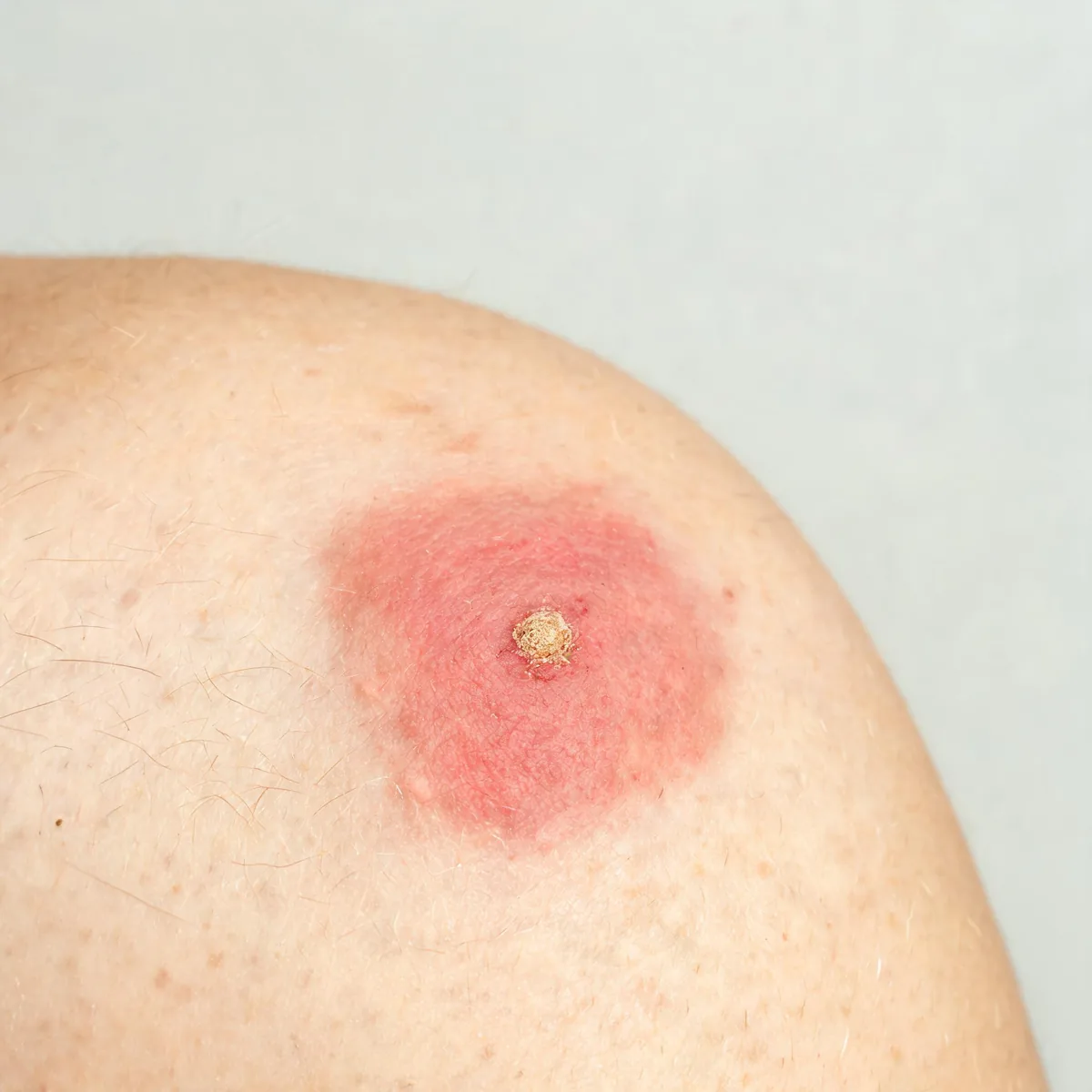
Understanding Skin infection
The skin is tied to the Lungs, which govern its opening and closing, and to the Spleen, which manages fluids and transformation.
When Wind, Heat or Dampness invade, or when internal disharmony from diet or emotion weakens the surface, pathogens take hold and a sore forms. The classical literature calls this class of sore chuang yang.
The pattern decides the picture. Toxic-Heat stagnation gives intense redness, swelling, burning pain and thick yellow pus with fever. Liver Blood stagnation gives a hard fixed nodule that is very slow to resolve and flares with stress.
Where the sore is persistent and oozing with pale swollen skin, the pattern is Spleen deficiency with dampness. Where it will not close and discharges thin watery pus in a depleted person, the pattern is Qi and Blood deficiency.
Two organs set the stage. The Lungs govern the opening and closing of the skin, and the Spleen transforms fluids and nutrients, so a surface that is poorly defended or waterlogged gives pathogens a way in. Once Wind, Heat or Dampness has entered, or internal heat and toxin have built up from diet, emotion or fatigue, the sore that appears is the visible end of that process, and its character tells the practitioner which part of the process is dominant.
The four pictures differ in what the sore is doing. A rapidly growing fiery boil with thick yellow pus is a hot acute battle; a hard fixed lump that stabs and flares with stress is Qi knotted and blood pooled; a chronic weeping sore on pale swollen skin is fluid that the Spleen cannot move; and a sore that refuses to close, its granulation pale and its discharge watery, is a body without the resources to build new tissue. Because the treatments pull in opposite directions, a cooling detoxifying formula can drain a depleted person and a strong blood-moving formula can stir up an acute hot infection, which is why the pattern comes before the prescription.
Conventional view
A skin infection begins when bacteria, fungi or viruses get past the barrier of the skin, producing redness, swelling and pain, sometimes with pus or discharge. Boils, cellulitis, abscesses and infected wounds are the common forms. The diagnosis is usually made from the appearance, with a swab or culture when the organism matters, and antibiotics or antifungals deal with most cases.
Treatment follows the pathogen and the depth: topical or oral antibiotics for bacterial infection, antifungals for fungal infection, antivirals where they exist for viral infection, and incision and drainage for an abscess. Cleaning, debridement and dressings are central to wound care. Where infection keeps returning, longer antibiotic courses are used and conditions such as diabetes or immune deficiency are looked for.
What this approach does not do is change the internal ground in which the infection took hold. A boil that returns after the course finishes, or a sore that closes slowly, is not explained by the organism alone, and long antibiotic use disturbs gut flora and encourages resistance, while a nodule driven by stress and an oozing ulcer driven by fatigue are not the same problem clinically even though both are called skin infections.
Selected PubMed records
Real PubMed records for the conventional discussion above, selected by condition name and title relevance. They are references, not a claim that any treatment is proven for this condition.
- Diabetes and infection: review of the epidemiology, mechanisms and principles of treatment.. Diabetologia, 2024. PMID: 38374451.
- Staphylococcal Skin and Soft Tissue Infections.. Infectious disease clinics of North America, 2021. PMID: 33303329.
How it connects
These pictures tend to follow one another in the same person, which is why they are met together. An acute boil may begin as Toxic-Heat Stagnation and, if it does not settle, turn into a sore that will not heal and reads as Qi and Blood Deficiency, and overlapping signs such as a red edge with a pale centre show the transition while it is happening. Diabetes and weakened immunity make any infection slower to clear and more likely to return, and a Spleen that cannot move fluids leaves the dampness that keeps a sore weeping, so treating only the sore leaves the ground ready for the next one.
How it is assessed
Diagnosis looks at the sore, the discharge, and the person carrying it.
What a practitioner looks for
- Discharge: thick yellow pus with heat suggests Toxic-Heat; thin watery discharge suggests deficiency.
- Skin around the sore: bright red and hot suggests active heat; pale and swollen suggests dampness.
- Healing behaviour: failure to close and slow granulation suggest Qi and Blood deficiency.
- Systemic signs: fever, chills, spreading redness or red streaks are red flags for urgent care.
Diagnosis starts with the sore itself: its colour, heat, swelling, the kind of pain it gives and what it is discharging. Bright redness with heat, throbbing pain and thick yellow pus, the tongue red under a greasy yellow coat and the pulse rapid and slippery, all point to Toxic-Heat Stagnation, with heat and dampness overwhelming the defences.
A hard well defined lump fixed in place, aching or stabbing and worse under stress, raises Liver Blood Stagnation, with a dark or purplish tongue showing stasis spots and a wiry choppy pulse. A sore that oozes clear or watery fluid and will not close, on skin that is not very red or hot, suggests Spleen Deficiency with Dampness, with a pale puffy tongue, a white greasy coat and a soggy slow pulse, while a non-healing ulcer that discharges thin watery pus and granulates slowly and palely points to Qi and Blood Deficiency, with a pale tongue, a thin white coat and a thin weak pulse.
TCM patterns in Skin infection
Four patterns are described, and the discharge and the surrounding skin separate them. Thick yellow pus, intense redness, swelling, burning pain and heat to the touch are the marks of Toxic-Heat Stagnation, the acute sore where heat and toxin are trapped in the skin and flesh. A nodule that is hard and fixed, aching or stabbing, with purple or darkened skin over it and a very slow course that flares with stress, is Liver Blood Stagnation, where knotted Qi has pooled the blood. Persistent oozing sores on pale swollen skin, with heaviness, bloating and loose stools, are Spleen Deficiency with Dampness. Thin watery pus or clear discharge with sluggish granulation, deep fatigue and a pale complexion is Qi and Blood Deficiency, a sore lacking the material to close. A sore can move between these pictures as it evolves, and the strongest clue at the moment of assessment decides the treatment.
| Pattern | Key signs | The itch | Tongue | Main formula |
|---|---|---|---|---|
| Toxic-Heat Stagnation | Intense redness and swelling; Severe burning pain | Not specified | Body: Deep red or crimson with raised red pointsCoat: Thick, dry and yellow | Not specified |
| Liver Blood Stagnation | Purple or darkened skin around the lump | Not specified | Body: Purple or dark with stasis spots on the sides and distended sublingual veinsCoat: Thin white | Not specified |
| Spleen Deficiency with Dampness | Persistent oozing sores with pale swollen skin | Not specified | Body: Pale and swollen, often with teeth marks along the edgesCoat: White, greasy and moist, thick in the middle | Not specified |
| Qi and Blood Deficiency | Not specified | Not specified | Body: Pale, possibly thin or with teeth marksCoat: Thin white | Not specified |
Toxic-Heat Stagnation
The active sore: intense redness, swelling, burning pain and pus.
Wind, Dampness and Heat enter from outside where the surface is weak, and inside they meet heat already generated by stress or by a diet of greasy and spicy food. The combination becomes toxic heat trapped in the skin and flesh, and because it blocks the free movement of Qi and blood the area grows red, swollen and burning. As the toxin accumulates the tissue breaks down, which is how pus and abscesses form.
The tongue is deep red with a thick dry yellow coat, and the pulse is rapid and forceful. Spicy, fried and greasy food, alcohol, anger and hot humid weather all feed it, while cooling compresses, a light bland diet and keeping the area clean and dry ease it and stop new pathogens entering. Wu Wei Xiao Du Yin and Xian Fang Huo Ming Yin are the formulas named here, with Jin Yin Hua, Pu Gong Ying and Zi Hua Di Ding among the key herbs, and the points are Quchi (LI-11), Xuehai (SP-10) and Dazhui (DU-14).
Signs
- Intense redness and swelling
- Severe burning pain
- Thick yellowish pus
- Feels hot to the touch
- High fever with thirst for cold drinks
Diet and lifestyle for this pattern: Eat cooling, non-greasy food such as mung beans, cucumber and watermelon, and avoid spicy, fried or sugary food and alcohol, which create more internal Heat and Dampness. Keep the affected area clean and dry with good ventilation so the skin can breathe.
Liver Blood Stagnation
A hard fixed nodule that resolves very slowly and flares with stress.
Emotional strain holds Liver Qi in a knot, and because Qi moves blood, blood slows where the Qi has stalled. Pooled blood congeals into a hard deep lump that aches or stabs, and the absence of fresh circulation is why such lumps take so long to soften. The nodule is often a leftover from an infection that never fully cleared, and it grumbles on rather than flaring hot.
The tongue is dark purple with stasis spots on the sides and distended sublingual veins, and the pulse is wiry and choppy, strongest at the left middle position. Anger, frustration and bottled-up feeling make it worse, as do cold and icy drinks and long stretches of sitting, while gentle warmth on the spot, warm cooked meals, light exercise and deliberate relaxation ease it. Chai Hu Shu Gan San is the formula named for this pattern, with Dang Gui and Chuan Xiong as its key herbs, and the points are Taichong (LR-3), Xuehai (SP-10), Geshu (BL-17) and Qimen (LR-14).
Signs
- Hard fixed nodule that aches or stabs
- Purple or darkened skin around the lump
- Very slow to resolve or soften
- Worsens with emotional stress
Diet and lifestyle for this pattern: Keep stress in check with regular gentle movement such as walking or tai chi. Avoid iced drinks and raw cold food that stiffen blood flow, while a little turmeric, saffron or dark leafy greens gently encourages circulation, and never squeeze or press the lump, which can make stasis deeper.
Spleen Deficiency with Dampness
Persistent oozing sores with pale swollen skin and a heavy body.
The Spleen turns food into Qi and blood and also keeps fluids moving. When it is weak the fluids are not processed and become a heavy sticky dampness which works its way into the skin, and that is why the sore oozes, the surrounding skin stays pale and puffy, and healing drags on. The same weakness explains the bloating, the loose unformed stools and the fatigue that accompanies a chronic or recurrent infection.
The tongue is pale and swollen, marked by teeth, its coat white and greasy; the pulse is soggy and slow, without force. Damp humid weather, cold raw or greasy food, overeating and irregular meals, and mental or physical overwork all worsen it, while a warm dry environment, several small warm meals a day, gentle movement each day and a clean dry dressing help. Shen Ling Bai Zhu San is the formula named here, with Bai Zhu, Fu Ling and Yi Yi Ren among the key herbs, and the points are Yinlingquan (SP-9), Zusanli (ST-36) and Sanyinjiao (SP-6).
Signs
- Persistent oozing sores with pale swollen skin
- Heaviness in body and limbs
- Bloating and loose unformed stools
- Poor appetite and fatigue
Diet and lifestyle for this pattern: Eat warm, cooked, easy food such as congee, soups and steamed vegetables, and strictly avoid cold, raw, greasy and dairy-heavy food that weakens the Spleen and creates more Dampness. Keep the affected skin clean and dry, and keep moving gently such as walking so Qi flows and internal Dampness dries.
Qi and Blood Deficiency
A sore that will not close, with thin discharge and deep fatigue.
When an infection drags on, or the person was frail to begin with, the Qi that drives healing and the Blood that builds tissue both run low. Without them the skin and muscle cannot make healthy new flesh, so the sore stays open and discharges thin watery fluid rather than thick pus, the granulation looks pale and sluggish, and the fatigue is deep and persistent rather than the tiredness of a single bad night.
The tongue is pale, sometimes thin or marked by teeth, with a thin white coat, and the pulse is fine and weak, most noticeably at the right Guan position over the Spleen. Overexertion and long standing, missed meals and cold raw food, and stress or worry all drain it further, while rest, warm nourishing soups and stews and gentle daily movement rebuild it. Ba Zhen Tang and Tuo Li Xiao Du San are the formulas named for this stage, with Huang Qi and Dang Gui as the key herbs, and the points are Zusanli (ST-36), Qihai (REN-6) and Xuehai (SP-10).
Signs
- Thin watery pus or clear discharge
- Sluggish healing and failure to close
- Persistent deep fatigue
- Pale complexion with poor appetite
- Shortness of breath
Diet and lifestyle for this pattern: Eat warm, easy, nutrient-dense food such as bone broth, congee with lean meat and cooked root vegetables, and avoid raw, cold and greasy food that taxes the Spleen. Prioritise gentle rest and short walks rather than pushing through fatigue, since rebuilding Qi and Blood takes time.
Treatment approach
How the tradition treats skin infection, with the herbs, formulas and points used for it.
Principles
- Clear heat and resolve toxicity while the sore is active and discharging.
- Move Blood and resolve stagnation where the nodule is hard and fixed.
- Strengthen the Spleen and resolve dampness where the sore persists and oozes.
- Support Qi and Blood where healing has stalled.
- The three stage sequence is the spine of the approach: disperse while the pathogen is still coming in, expel pus and toxin once it has formed, and tonify when the body has to be rebuilt. Which stage a sore is in decides the formula family, and a formula from the wrong stage does harm, since a tonifying prescription given while heat and pus are still active can prolong the infection, and a cold dispersing one given to a depleted person can delay closure. External washes and plasters follow the same order, cooling and drying early and promoting granulation later, and they are used with the internal formula rather than instead of it.
Herbs used
Formulas
- Wu Wei Xiao Du Yin
- Xian Fang Huo Ming Yin
- Chai Hu Shu Gan San
- Shen Ling Bai Zhu San
- Ba Zhen Tang
- Tuo Li Xiao Du San
Acupoints
- LI-11 (Quchi)
- SP-10 (Xuehai)
- DU-14 (Dazhui)
- LR-3 (Taichong)
- BL-17 (Geshu)
- LR-14 (Qimen)
- SP-9 (Yinlingquan)
- ST-36 (Zusanli)
- SP-6 (Sanyinjiao)
- qihai-ren-6
What to expect
- Active superficial infections are described as settling within one to two weeks with treatment.
- Slow-healing or chronic sores take longer and may need medical review of the underlying cause.
- Recurrence is expected if the underlying pattern is not treated.
- A superficial boil often shrinks and drains within three to seven days of daily herbs and acupuncture, and a stasis nodule usually takes two to four weeks to soften. Chronic pictures, where dampness keeps the sore open or deficiency has stalled repair, generally need four to eight weeks of steady treatment before closure and a fall in recurrence are clear, so it helps to judge progress over that span rather than by the day.
Safety and when to get help
Seek medical help urgently for
- Rapidly spreading redness or red streaks, which may indicate cellulitis or lymphangitis.
- High fever above 38.3 C, or chills.
- A sore with foul discharge, gas in the tissues, or severe pain out of proportion to the appearance, which needs emergency care.
For anything severe, sudden or spreading quickly, read when a skin problem needs urgent care.
Cautions
- Do not delay antibiotics for a spreading infection.
- Diabetes and immune suppression make skin infection more serious.
- Wounds that will not heal need medical review, not only topical treatment.
Using this alongside conventional care
- TCM is described as complementary to conventional care: . Infections that are spreading or accompanied by fever need antibiotics, with herbs used alongside recovery and prevention.
- Antibiotics, antifungals and antivirals continue exactly as prescribed, and herbs are added around them rather than in place of them. Blood-moving herbs such as Dang Gui and Chuan Xiong can interact with anticoagulants like warfarin, so nothing is taken without the prescriber knowing about it. On the skin, a herbal wash or cream should not be layered onto a wound already under prescription topical treatment unless both practitioners agree, and the sore itself is kept clean and reviewed. A herb list goes to every appointment, and spreading redness, fever or pain that is worse than the appearance suggests still means urgent medical care.
Diet and lifestyle
- Avoid spicy food, alcohol, deep-fried food and excess sugar during an infection, and favour cooling lightly cooked food.
- During an active infection the plate is kept bland, cooling and light. Spicy food, alcohol, deep-fried items and excess sugar are removed because they add to damp-heat and fan the sore, and the emphasis goes on lightly cooked leafy greens, cucumber, bitter melon and celery, with mung bean soup and chrysanthemum tea to clear heat. Where the infection is chronic and comes with fatigue, the direction changes: congee, bone broth and steamed fish are added to support Spleen Qi, and ice-cold drinks and raw salads are limited because they weaken the Spleen and worsen dampness. The pattern sharpens this further, with no dairy or raw cold food in Spleen deficiency with dampness, and warm nutrient-dense soups with cooked root vegetables in Qi and Blood deficiency.
If you're pregnant
Pregnancy sends blood and Qi towards the fetus, so deficiency pictures become more common, Qi and Blood Deficiency above all, and wounds close more slowly. Herbs that move blood strongly, Chuan Xiong among them, and large doses of Dang Gui are set aside because they may stimulate the uterus, and bitter cold herbs with a downward draining action can unsettle the pregnancy too. For a hot infection, a milder cooler such as Jin Yin Hua is considered the safer choice, always with supervision.
Acupuncture is often preferred, with points traditionally avoided in pregnancy such as Hegu (LI-4), Sanyinjiao (SP-6) and Kunlun (BL-60) omitted or used only with great care, and a diluted herbal wash may take the place of a strong internal formula.
If you're breastfeeding
Pu Gong Ying and Jin Yin Hua are both considered safe while nursing, and Pu Gong Ying is used for mastitis. Very bitter and cold herbs do reach breast milk and may loosen the baby's stools or upset its digestion, so they are used only where the clinical need is plain and the amount is carefully set. External applications are kept where the baby cannot take in any residue, especially on the breast, and acupuncture carries no such risk at all.
If treating a child
In children a skin infection most often appears as Toxic-Heat Stagnation: an acute red hot boil or impetigo that develops quickly. A lingering Spleen Deficiency with Dampness underneath is also common, especially where there is a history of allergy or a poor appetite, because the Spleen is still maturing. Doses are scaled down for children, between a third and a half of an adult dose, and strongly bitter or cold formulas are kept to short courses.
Where needles are not tolerated, acupressure, paediatric tui na or plum-blossom needling can be used, and dietary change matters more than usual, since sugar, dairy and greasy food directly generate dampness and heat.
If treating an elderly patient
In older people skin infections heal more slowly and more often reflect an underlying deficiency, with Qi and Blood Deficiency predominating: thin watery discharge, pale granulation and marked fatigue. Where that is the picture, Tuo Li Xiao Du San or Ba Zhen Tang often fits better than strong heat-clearing herbs, which can weaken a depleted body further. Doses are usually about two thirds of an adult dose, and every conventional medicine is checked for interaction.
Qihai (REN-6) and Zusanli (ST-36) are used to support healing capacity gently, recovery takes longer, and the aim shifts from clearing the infection to rebuilding the resources behind it.
Urgent-sign guidance is based on standard sources: NHS anaphylaxis, NHS cellulitis, NHS Stevens-Johnson syndrome, NHS melanoma.
Evidence
Evidence status
Compiled for this page from the classical and modern literature; not a systematic review, so treat it as a pointer to sources rather than clinical guidance.
The evidence is moderate and comparative. A randomised trial of 60 patients with furuncles and carbuncles found a herbal formula achieved infection resolution comparable to oral antibiotics with fewer gastrointestinal side effects, and a meta-analysis of 12 trials in over 900 patients found herbal medicine combined with conventional treatment improved outcomes. Serious or spreading skin infection still needs prompt medical care.
The third study recorded for this page extends the picture from infection to healing. In one trial, eighty people with chronic skin ulcers were assigned at random to standard wound care with or without acupuncture, and the acupuncture group showed faster wound closure and more granulation tissue at four weeks. Read alongside the trials of Wu Wei Xiao Du Yin and the meta-analysis of twelve trials in over nine hundred patients, the signal is consistent but the quality is not, because the studies are small and mostly unblinded.
Studies often cited
In a randomised trial of 60 patients with furuncles and carbuncles, the herbal group showed a comparable rate of infection resolution and a lower incidence of gastrointestinal side effects than the antibiotic group. Zhang L, Wang H, Li J. Journal of Sichuan Traditional Chinese Medicine. 2015;33(4):112-114.
Pooling 12 randomised trials with over 900 patients, herbal medicine combined with conventional treatment improved clinical outcomes compared with conventional treatment alone. Meta-analysis of 12 randomised trials, as recorded in the classical literature source.
In a randomised trial of 80 patients with chronic skin ulcers, adding acupuncture to standard wound care produced significantly faster wound closure and more granulation tissue at four weeks than standard care alone. Chen M, Liu B, Wu J. Acupuncture in Medicine. 2020;38(2):86-93.
Classical record
For the treatment of sores, first use dispersion, in the middle stage support the interior, and later use tonification.
- Wai Ke Zheng Zong (Orthodox Manual of External Medicine), Chapter 1.
诸痛痒疮,皆属于心。
Every kind of pain, itching and sore is assigned to the Heart, which is why the whole person is read and not only the lesion.
On pain, itch and sores - Classical citation: Huang Di Nei Jing Su Wen, Chapter 74, Zhi Zhen Yao Da Lun.
Common questions
Can TCM treat a skin infection on its own?
For superficial sores the tradition describes herbal treatment. For spreading infection with fever or red streaks it is complementary at best, and antibiotics come first.
Why does my sore heal so slowly?
The classical literature reads slow healing as Qi and Blood deficiency, or as dampness preventing closure, which is why the treatment changes from clearing to supporting.
When should I see a doctor?
Spreading redness, red streaks, fever or severe pain need same-day medical care.
Can herbs prevent recurrence?
The classical literature treats the underlying pattern after the acute sore settles, with the aim of reducing recurrence.
Can a skin infection be treated without antibiotics?
For many mild to moderate infections the tradition describes herbs such as Wu Wei Xiao Du Yin clearing heat and toxin while the body's own healing response does the rest. A rash of spreading redness, a high fever or fast deterioration is a different matter and needs urgent conventional care, so a qualified practitioner should assess severity before self-treatment.
How long does a boil take to heal with herbs?
A boil in the Toxic-Heat pattern usually begins to shrink and drain within three to five days of a detoxifying formula, and pain and redness settle quickly, though a large or deep one may take a week. Where boils keep returning because of an underlying deficiency, healing is measured in several weeks, since resistance has to be rebuilt.
Can acupuncture be used near an infected area?
Points are chosen away from the infection, on the arms, legs or back, and needles are never placed in an open wound or an abscess. Local work may use gentle moxibustion or a herbal plaster, but only under professional guidance.
What if the infection keeps coming back?
Recurrence points to a root that has not been corrected, whether chronic damp-heat, blood stagnation or deficient Qi and Blood is behind it. Once the acute sore has settled, the pattern behind it is treated, and many people find the cycle breaks after a course of herbs with dietary change.