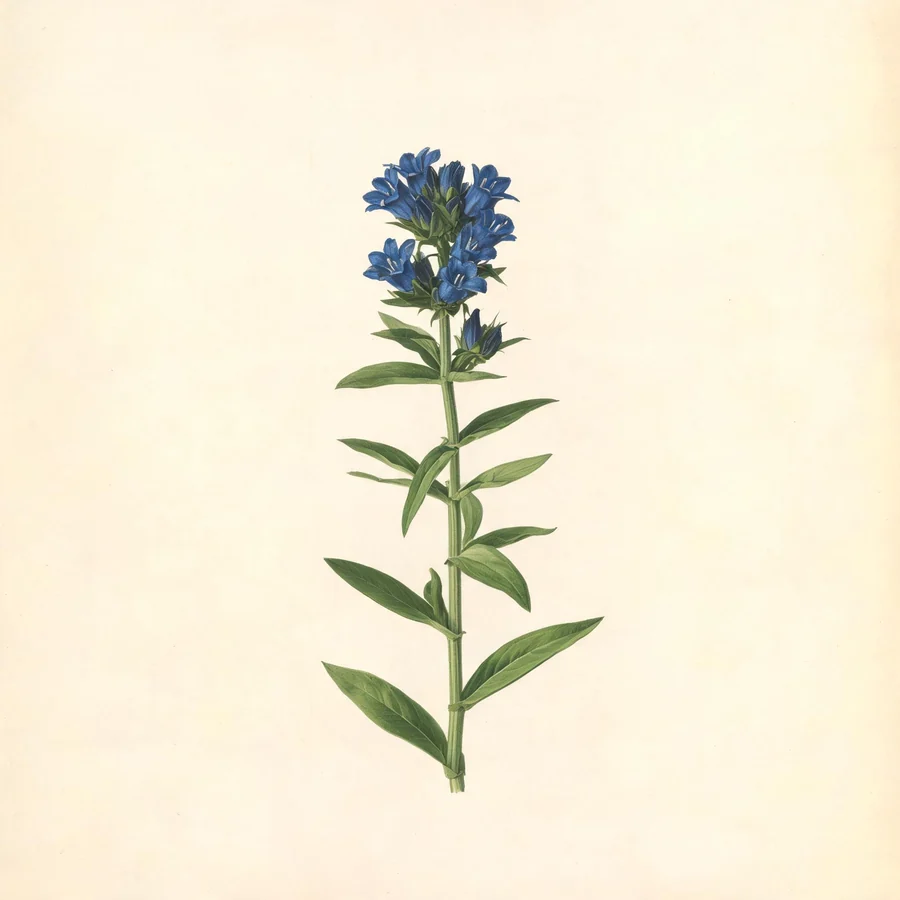
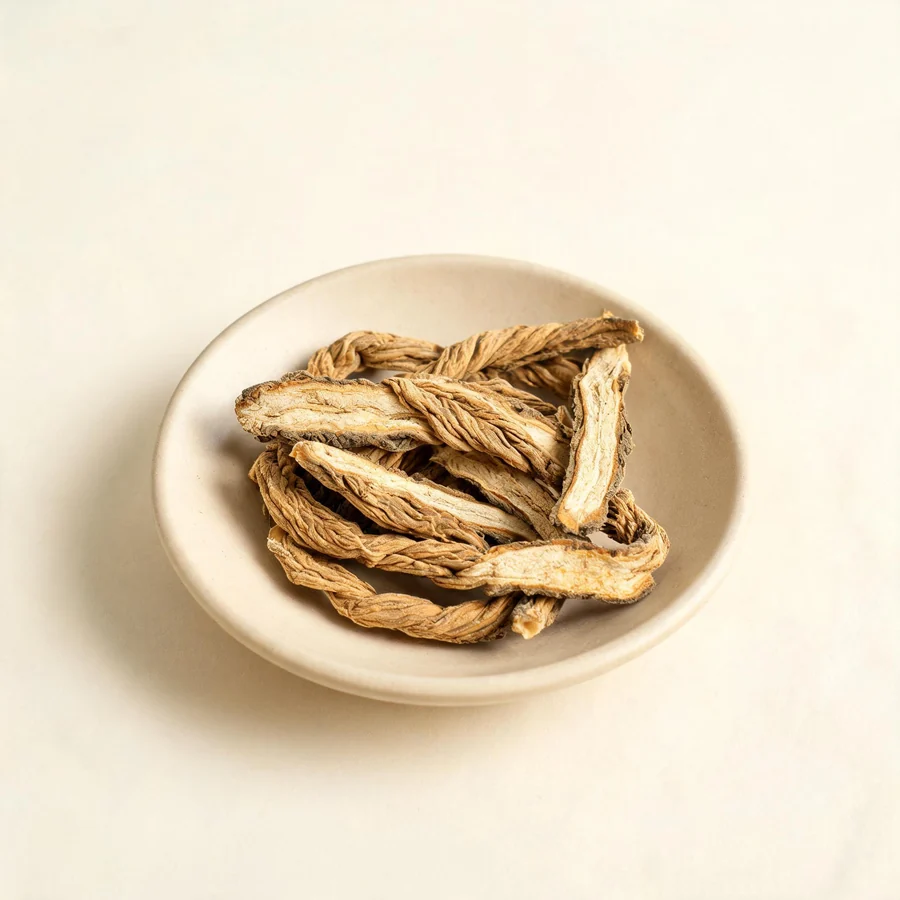
Skin profile
Where this herb sits in skin practice: the pattern it corrects, the skin signs it suits, and what it should not be used for.
Qin Jiao is for skin that is red, swollen and painful over an obstruction it cannot clear: nodules on the shins, plaques over hot joints, numb wooden skin and the dry flush of lingering heat. It moves and cools without drying, and it is rarely the leading herb for a rash on its own.
Skin signs that suggest it
- Tender red nodules on the shins, warm to touch, often with aching ankles or knees
- Red, scaly plaques sitting directly over a painful swollen joint
- Skin that is numb or wooden-feeling in a limb, with stiffness that eases as it is moved
- Flushing across the cheekbones in the afternoon, with night sweats and a dry mouth
- Aching that shifts from joint to joint and worsens in damp or cold weather
- A red tongue with a yellow coating, and a pulse that is slippery or rapid
When it is not the right herb
Not where the skin is dry, pale and cold without heat, and not where the only problem is a rash with no deeper obstruction. The root is bitter and draining, so a Spleen that is already deficient will register it as loose stools, a dull appetite and a heavy abdomen, and the dry-fried form or a Spleen-supporting partner is needed if it is to continue. It is not a treatment for a single hot swollen joint that has come on overnight, which needs a diagnosis, and it is not used in pregnancy without a practitioner's decision.
What it does for skin
Skin-relevant actions only. Each one describes a mechanism in TCM terms and what it looks like on the skin.
Moves Wind-Dampness out of the skin and the tissue beneath it
Where dampness and wind have settled in the channels, the surface over the obstruction looks and feels different: it may be puffy, slightly shiny, tender and warm, and the limb feels heavy. The root is described as moistening among drying herbs, so it moves the obstruction without parching the skin over it. That is the practical difference from warmer members of its group, which clear cold pain well and leave a dry person drier.
Cools the heat that has joined the obstruction
Redness, warmth and tenderness over a swelling mean heat has joined the dampness, and the slightly cool nature of the root is directed at that. This is the reasoning behind its use for red tender nodules on the shins and for plaques over inflamed joints, where a modern anti-inflammatory reading and a traditional one point at the same place. It is a mild cooling agent, not a fire-purging one, so it supports stronger heat-clearing herbs rather than replacing them.
Relaxes the sinews and lifts numbness in the skin
Skin that feels wooden, numb or tight over a limb, with stiffness that eases with movement, is read as Qi and Blood failing to reach the surface because the channels are obstructed. The root relaxes the sinews and opens the collaterals, and its moistening quality is the reason it is chosen over a drying Wind herb in a thin person. Numbness that comes on suddenly, or affects one side of the body, is an emergency rather than a case for a herb.
Clears the low-grade heat that dries and flushes the face
The afternoon flush, night sweats, a dry mouth and a face that looks warm and thin rather than red and inflamed are read as deficiency heat, and this root is a standard choice for that picture. On the skin the visible change is a reduction in flushing and in the dryness that accompanies it. A night sweat accompanied by fever, wasting or a cough that will not settle needs investigation, since the same signs occur in serious illness.
Skin conditions it is used for
Mapped to the condition pages on this site. The pattern column shows what the skin is doing when this herb is the right choice.
| Condition | Pattern | Why it suits | Typical setting |
|---|---|---|---|
| Erythema nodosum | Damp-heat settling in the deeper tissues of the legs | Tender red nodules on the shins, warm to the touch and worse on standing, are read as dampness and heat lodged in the deeper layers rather than in the surface. The root reaches that depth, moves the obstruction and cools it, and its affinity for the joints suits the aching ankles and knees that so often come with the nodules. The nodules usually settle on their own over weeks; a crop that keeps returning, or comes with fever or breathlessness, needs a cause identified. | A wind-damp formula with Qin Jiao, Fang Feng and heat-clearing herbs |
| Psoriatic arthritis | Blood heat in the skin with Wind-Dampness in the joints | Where plaques and painful joints appear together, two treatments have to run at once, and this root is the part that moves the joint obstruction without adding heat. It is cool rather than warm, so it does not work against the blood-cooling herbs the skin needs, and its moistening quality suits the dry thin person who often has this pattern. It is an adjunct in a formula, not the leading herb for either half. | A blood-cooling skin formula with Qin Jiao, Wei Ling Xian and Fang Feng |
| Skin numbness | Wind in the channels with Blood failing to reach the surface | Numbness, a wooden feeling and stiffness in a limb are read as obstruction in the collaterals, and the classical formula built on this root is for exactly that picture after a wind-stroke. The reasoning is that when Blood is thin the sinews go unfed, and so the treatment has to move the Wind and build the Blood in the same pass, which is why a drying herb is the wrong choice here. Sudden numbness on one side, or a facial droop, is a stroke warning and belongs to emergency care. | Da Qin Jiao Tang, with Dang Gui and Shu Di Huang |
| Red and swollen feet | Damp-heat sinking into the lower body | The feet are the lowest point, so heat and fluid collect there first, and a foot that is red, swollen and tender with a heavy feeling is read as damp-heat with obstruction. The root drains downward, enters the Stomach and Gallbladder channels, and is moistening enough to be used for weeks without cracking the skin over the swelling. A single hot swollen calf or foot needs urgent assessment, because a clot and an infection can look like this. | A damp-heat formula with Qin Jiao, Fang Ji and Yi Yi Ren |
| Dry and hot skin | Deficiency heat with dryness of the surface | Skin that is dry and warm at the same time, with flushing in the afternoon and sweat at night, is read as Yin that can no longer anchor the body's warmth. The root clears that low-grade heat without the harsh cold that would further thin an already dry person, and its nature moistens rather than parches, so the surface gains support instead of losing moisture. It is used alongside Yin-nourishing herbs rather than alone, and a persistent night sweat needs a cause looked for. | Qin Jiao Bie Jia San, or with Zhi Mu and Sheng Di Huang |
Combinations for skin
Herbs it is paired with when the skin, not an internal organ, is the target.
| Partner | Ratio | Why the pair is used |
|---|---|---|
| Fang Feng | 6 to 10 g of each | The standard Wind-Dampness pair. Fang Feng works at the surface and releases what is stuck there, while this root works deeper in the channels and sinews, and the two together cover a rash that sits over an aching joint. Fang Feng is warm and drying, so in a thin dry person the balance tips towards the gentian root. Neither is a treatment for a rash alone. |
| Wei Ling Xian | Qin Jiao 6 to 10 g with Wei Ling Xian 6 to 10 g | Both move Wind-Dampness through painful joints, but Wei Ling Xian is warm, penetrating and stronger for fixed severe pain, while this root is cooler and milder and suits heat signs, a dry constitution and joints that are red rather than cold. Using them together covers a mixed picture, one supplying warmth where the other supplies coolness. The pair is for joint pain with skin changes over the joint, not for skin disease by itself. |
| Dang Gui | 9 to 10 g of each | This pair carries a principle: treat Wind by treating the Blood, because once the Blood moves the Wind settles. The root disperses and relaxes, and angelica nourishes and moves the Blood, so the channels open and the parching that a Wind herb used alone tends to produce is avoided. On the skin it suits numbness, a dry pale limb and stiffness in someone who is thin, and it is the pairing behind the post-stroke formula. |
| Zhi Mu | Qin Jiao 6 to 9 g with Zhi Mu 6 to 10 g | A pair for heat that lingers after a fever. Anemarrhena drains heat from Lung, Stomach and Kidney while feeding Yin, and this root lifts the empty heat behind the afternoon flush and the sweat that comes at night. Neither is drying, on the traditional description, so the combination rebuilds fluid rather than consuming it, which is why it suits dry warm skin with a dry throat. |
Formulas where it leads
- Da Qin Jiao Tang (大秦艽汤) - The formula this root leads, for the milder aftermath of a wind-stroke, where the mouth pulls to one side, the tongue is stiff and the limbs are weak and numb, built on the reasoning that thin Blood fails to nourish the sinews. It pairs the root with angelica, rehmannia and other Blood-nourishing herbs so the Wind moves without the dryness. It is traditional after-care and not a treatment for a stroke, which is a medical emergency.
- Qin Jiao Bie Jia San (秦艽鳖甲散) - For steaming bone fever with night sweats and slow wasting, where turtle shell, sweet wormwood and wolfberry bark supply the nourishing and clearing work around this root. The visible skin change is the fading of the afternoon flush and of the night sweat. A fever with weight loss needs investigation before any formula is started.
Safety for skin use
What to check before recommending or using it, including the cautions that matter most for skin patients.
Do not use, or use with caution
- A cold deficient Spleen with loose stools or diarrhoea. The root is bitter and draining, so it can loosen the bowel further and dull the appetite; the dry-fried form is gentler, and Spleen-supporting herbs are added for a long course.
- Frequent urination with coldness of the lower body. Because it shifts fluid and increases urine output, this root can aggravate a case where the Kidney no longer retains what it should, and a cool draining substance runs against cold weakness below the waist.
- Long-standing pain with emaciation and general weakness. When pain comes from deficiency rather than from an obstruction, there is nothing for a dispersing agent to scatter, and it merely draws down reserves, so it is used with substantial tonics rather than alone.
- Palpitations or a slowed pulse while taking it. These are recorded effects of the root, and they are a reason to stop and seek advice rather than to continue.
Pregnancy and breastfeeding
Best avoided unless a practitioner decides otherwise. The classical record lists the root among herbs to keep out of pregnancy because it is bitter, draining and downward-moving, and there is no modern safety data that would soften that position. A woman who is pregnant and has joint pain or a skin flare should be treated with a substitute chosen by a practitioner who knows she is pregnant. In breastfeeding there is no data either; the bitter compounds may pass into milk, and a bitter taste is a plausible cause of feeding aversion.
Interactions
- Cardiac medicines. Gentianine, one of its alkaloids, lowers blood pressure and slows cardiac rate in animal experiments, so the root alongside digoxin or a similar cardiac glycoside may deepen cardiovascular depression. Anyone with a heart condition should mention it.
- Blood pressure and blood sugar medicines. The same alkaloid has shifted blood pressure and, in animal studies, raised glucose, which makes control less predictable for someone on insulin or an oral hypoglycaemic; monitoring rather than dose changing is the sensible step.
- Sedatives and alcohol. Gentianine sedates at the lower end of its range, so benzodiazepines, hypnotics, opioid analgesics and alcohol may all be felt more than expected, which matters for anyone driving or operating machinery.
Allergy and patch testing
Contact reactions to a herb in a wash or a cream are possible, though this root is rarely used on the skin directly. Patch test any preparation first and stop if the area becomes more irritated. People who react to other Gentianaceae, including the gentian bitters used in drinks, should be more cautious with an internal preparation.
General safety references
General references for herbal hepatotoxicity and herb-drug interactions; they are not specific to this herb.
- Review article: Herbal hepatotoxicity - an update on traditional Chinese medicine preparations. Alimentary Pharmacology & Therapeutics, 2014. PMID: 24844799.
- Interactions between herbal medicines and prescribed drugs: an updated systematic review. Drugs, 2009. PMID: 19719333.
- Warfarin and food, herbal or dietary supplement interactions: a systematic review. British Journal of Clinical Pharmacology, 2021. PMID: 32478963.
Evidence
The classical record is quoted with its source. The modern note states the level of evidence plainly.
Classical record
主寒热邪气,寒湿风痹,肢节痛,下水,利小便。
It governs cold and heat as pathogenic influences, cold damp wind impediment and pain in the joints of the limbs; it moves water downward and frees urination.
Shen Nong Ben Cao Jing (Divine Husbandman's Classic of Materia Medica) - The earliest entry contains both the joint use and the water-moving one, which in the tradition are two parts of clearing dampness out of the channels.
疗风,无问久新;通身挛急。
It treats Wind whether the condition is recent or long standing, and it relieves cramping and tension through the whole body.
Ming Yi Bie Lu (Supplement to the Classic of Materia Medica) - Much quoted in later herbals, and what it stresses is that no time limit applies: neither recent nor long-standing Wind is excluded.
秦艽长于养血,故能退热舒筋。治风先治血,血行风自灭,故疗风无问新久。入胃祛湿热,故小便利而黄疸愈也。
The root is skilled at nourishing Blood, which is why it clears heat and relaxes the sinews. In treating Wind one treats the Blood first, and once the Blood moves the Wind settles by itself, which is why the herb serves for Wind of any age. It enters the Stomach to remove damp-heat, so urination frees and jaundice clears.
Ben Cao Zheng Yao (Essentials of Materia Medica) - The passage that explains why a Wind herb is called moistening, and the intellectual basis for using it in a thin dry person with skin over an aching joint.
Modern evidence
Evidence status
- Laboratory work on gentiopicroside and the whole-root extract reports anti-inflammatory activity in cell and animal models, including effects on pathways relevant to joint inflammation. These are laboratory findings and not evidence of benefit in human skin disease.
- No controlled trial of this root in erythema nodosum, psoriatic arthritis or any skin condition was identified. Human literature is confined to traditional-use reviews and to formula studies in which the root is one of many ingredients.
- Regulatory status: the dried root is an accepted herbal substance in the Chinese Pharmacopoeia, which also permits three closely related Gentiana species. Cardiac symptoms, and rare renal findings with injectable preparations only, are the recorded safety concerns.
PubMed records
Selected real PubMed records for this herb's species or its constituents, chosen by species name and title relevance. They are references for the non-TCM discussion above, not proof that the herb treats any skin condition.
- Botany, traditional use, phytochemistry, pharmacology, quality control, and authentication of Radix Gentianae Macrophyllae-A traditional medicine: A review.. Phytomedicine : international journal of phytotherapy and phytopharmacology, 2018. PMID: 30097114 (pharmacology or review record).
Dose and forms
Skin-practice dosing and the preparations that suit skin complaints.
| Form | Dose and notes |
|---|---|
| Decoction | 3 to 10 g of dried root daily in a formula. Three to six grams is used when it supports stronger Wind-dampening herbs, and six to ten when it leads a formula or is aimed at deficiency heat. |
| Dry-fried form | Chao Qin Jiao, turned in a dry pan until it is lightly scorched, moderates the cool nature and the bitterness and is chosen for a sensitive stomach or for a long course. |
| Ceiling | Fifteen grams is the upper figure, under supervision, for severe impediment pain; beyond that the bitter draining quality costs more than it gives, particularly in a thin or dry person. |
| Course length | Two to four weeks with review for a joint and skin flare. A long course is given with Spleen-supporting or Yin-nourishing herbs alongside, and stopped if the stools loosen or palpitations appear. |
With this root the question is how long rather than how much. Months of a bitter draining substance in a thin body leave it drier and loosen the bowel, which explains why the larger doses sit beside herbs that support the Spleen or nourish Yin, and why the dry-fried form exists. Anyone with a heart condition should mention the herb, since palpitations and a slowed pulse have been recorded, and stopping is the right response to either.
Citations and further reading
Only real sources are listed: the classical materia medica passages quoted above, and the source works behind the botanical and safety statements.
- Shen Nong Ben Cao Jing (Divine Husbandman's Classic of Materia Medica) - the entry on wind impediment and joint pain is quoted above.
- Ming Yi Bie Lu (Supplement to the Classic of Materia Medica) - the passage on Wind of any age is quoted above.
- Ben Cao Zheng Yao (Essentials of Materia Medica) - the passage on nourishing Blood to settle Wind is quoted above.
- Radix Gentianae Macrophyllae monograph, Pharmacopoeia of the People's Republic of China - accepted species, part used and quality requirements.
- Pharmacological literature on gentiopicroside and gentianine, summarised as a statement about the level of evidence rather than as a cited finding.
- Botanical literature on Gentiana macrophylla, Gentianaceae, for identification of the dried root.
Educational reference for qualified practitioners. This page is not medical advice, and skin conditions should be diagnosed by a clinician before treatment.