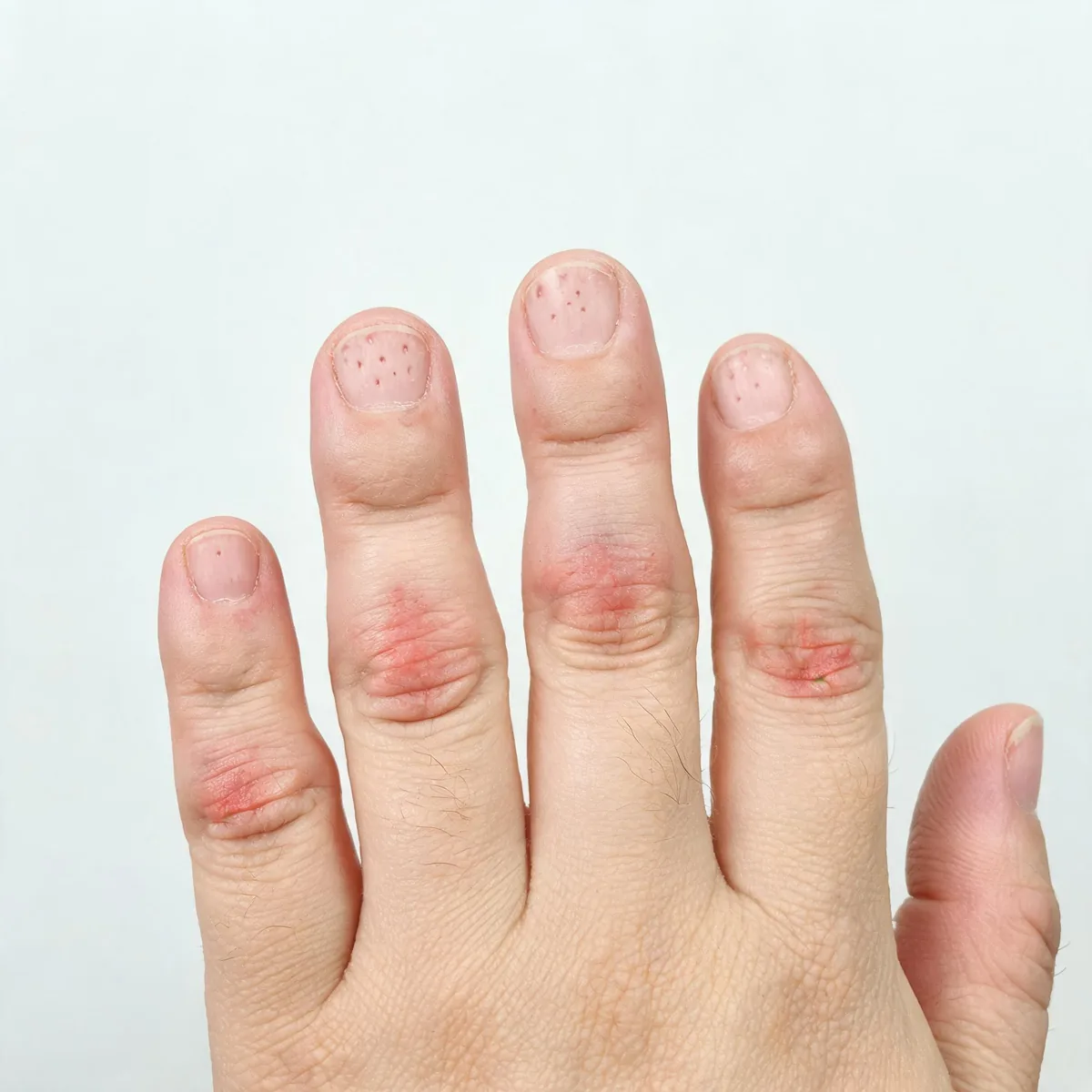
Understanding Psoriatic arthritis
The tradition describes the condition as the combination of a skin condition and a Bi syndrome, the traditional term for painful joint obstruction.
The skin plaques are read as heat, dryness or stagnation in the Blood, while the joint pain is attributed to external Wind, Cold, Damp or Heat that has lodged in the channels. That is why the same person can have hot red skin lesions and cold stiff joints at the same time.
The patterns separate by the joints. Wind-Cold-Damp gives pain and stiffness worse in cold or damp weather, swelling without redness, and pale plaques. Damp-Heat in the channels gives joints that are red, hot and swollen, better with cold, with a greasy yellow coating.
Heat invading the channels gives the most acute picture: hot swollen joints, fever, thirst and irritability. The classical literature treats this as the active inflammatory phase, which needs medical assessment alongside treatment.
The classical literature gives the condition two classical names and treats them as one. 白疕 (bái bǐ), the white-scaled eruption, and 痹 (bì), painful obstruction, are both described as the result of pathogenic factors that have entered and stayed where they do not belong. The skin expression is placed in the Blood, as heat, dryness or stagnation; the joint expression is placed in the channels, as Wind, Cold, Damp or Heat. When the protective Qi is strong the surface turns these influences away, and when it is weak they pass inward, reach the joints and block the movement of Qi and Blood, which is what produces the pain and the swelling.
What the practitioner then reads is the present state rather than a fixed label. The same joint can be cold and stiff in winter and hot and swollen during a flare, so a diagnosis taken once and kept for years would misdescribe the person. The examination is therefore repeated: the tongue is checked for colour and coating, the pulse for rate and quality, and the questions are about what makes the joints better or worse, since a joint that wants warmth and one that wants ice belong to different patterns and take different formulas.
Conventional view
Psoriatic arthritis is a long-term autoimmune condition in which joints become inflamed in someone who also has psoriasis. Any joint can be affected, with pain, swelling and stiffness, and in some people the damage becomes permanent. The diagnosis rests on the skin and nail changes, the pattern of joint involvement and, where needed, imaging or blood tests to exclude other forms of arthritis. Severity varies widely, from occasional mild flares to progressive destruction.
Treatment usually begins with non-steroidal anti-inflammatory drugs for pain and stiffness. If disease persists, disease-modifying drugs, methotrexate among them, are used to slow the damage to joints, and biologic agents aimed at particular steps in the immune response have changed the outlook for many patients. Steroid injections or short courses are used for severe flares, and physiotherapy helps keep movement.
These drugs work on inflammation and structure but not on whatever set the pattern in the first place, and they are not free of cost: gastrointestinal upset with anti-inflammatories, a higher infection risk with biologics, and a proportion of people who do not respond. Conventional care also treats psoriatic arthritis as one condition, where the classical literature separates hot, cold and damp presentations. That is the gap the classical literature claims for an individualised approach, as an addition rather than a replacement.
Selected PubMed records
Real PubMed records for the conventional discussion above, selected by condition name and title relevance. They are references, not a claim that any treatment is proven for this condition.
- EULAR recommendations for the management of psoriatic arthritis with pharmacological therapies: 2023 update.. Annals of the rheumatic diseases, 2024. PMID: 38499325.
- Efficacy and safety of pharmacological treatment of psoriatic arthritis: a systematic literature research informing the 2023 update of the EULAR recommendations for the management of psoriatic arthritis.. Annals of the rheumatic diseases, 2024. PMID: 38503473.
- Comparative efficacy and safety of bimekizumab in psoriatic arthritis: a systematic literature review and network meta-analysis.. Rheumatology (Oxford, England), 2024. PMID: 38218744.
How it connects
Psoriatic arthritis is defined by both skin psoriasis and inflammatory joint disease, so the co-occurrence of skin and joint symptoms is inherent to the condition. In TCM the same pathogenic factors, Wind, Cold, Damp and Heat, that invade the channels and cause Bi syndrome also affect the skin, giving rise to the plaques and scales, so treating the root pattern often addresses both at once. Beyond that link, people with psoriatic arthritis frequently experience anxiety and depression: chronic pain and visible lesions unsettle the Shen, leading to Liver Qi stagnation and Heart Fire, and that burden is part of the same web of imbalance. Metabolic conditions such as obesity, insulin resistance and cardiovascular disease are also common companions, pointing in TCM to Spleen deficiency generating Dampness and Phlegm that obstruct the channels.
How it is assessed
The practitioner examines both surfaces: the skin plaques and the joints.
What a practitioner looks for
- Joint temperature: hot red swollen joints suggest heat; cool joints worse in damp weather suggest Wind-Cold-Damp.
- Skin colour: pale plaques with thin scales accompany the cold pattern; bright red plaques accompany heat.
- Systemic signs: fever, thirst and irritability indicate active heat.
- Red flags: a single hot swollen joint with fever may be septic and needs urgent assessment.
The examination is built around contrasts. Deep, heavy, stiff pain that cold and damp intensify, swelling without heat, and pale plaques with thick scale point to Wind-Cold-Damp. Red, hot, swollen joints that want a cold compress, brighter plaques, a thick yellow greasy coat and a slippery rapid pulse point to damp-heat in the channels. Sudden, severe, fiery swelling with fever, a deep red tongue and a forceful rapid pulse points to heat that has invaded the channels.
Two further observations narrow the picture. The pattern of joint involvement over time matters, because pain that wanders from joint to joint suggests Wind while pain that stays in one place suggests stasis. The skin also has to be read separately from the joint, since pale plaques with dry thick scale belong with the cold pattern and bright red plaques with the hot ones, and a person can show one on the skin and the other in the joints. A single joint that is extremely hot, swollen and unable to bear weight, or a flare with high fever, is treated as possible infection until it is ruled out.
TCM patterns in Psoriatic arthritis
Three patterns are described, and they are told apart by what the joints feel like and what makes them easier. In the first, the pain is deep, heavy and stiff, the joints are swollen without being red or hot, and cold damp weather makes everything worse, which points to Wind, Cold and Damp. In the second, the joints are red, hot and swollen and a cold compress is the only thing that helps, which points to damp-heat in the channels. In the third, the inflammation arrives suddenly and fiercely, often with fever and a thirst for cold drinks, and is read as heat that has invaded the channels. The plaques usually follow the same logic, pale and thickly scaled in the cold pattern and brighter red in the hot ones. Because the picture can change between seasons and between flares, the classical literature treats the pattern as a reading of the present state, to be revised as the joints and the skin change.
| Pattern | Key signs | The itch | Tongue | Main formula |
|---|---|---|---|---|
| Painful Obstruction with Wind-Cold-Damp | Joint pain and stiffness worse in cold or damp weather; Swelling around joints without redness or heat | Not specified | Body: Pale and slightly swollen, teeth-markedCoat: White, greasy and moist | Not specified |
| Painful Obstruction due to Damp Heat in Channels | Joints red, swollen and hot to touch; Pain relieved by cold, worse with warmth | Not specified | Body: Red, possibly slightly swollenCoat: Yellow and greasy | Not specified |
| Heat invading the Channels (Joints and Muscles) | Joints red, swollen and hot; Pain relieved by cold application | Not specified | Body: Red, sometimes with red pointsCoat: Yellow, greasy or dry | Not specified |
Painful Obstruction with Wind-Cold-Damp
Cold, stiff, swollen joints without heat, with pale plaques.
Wind, Cold and Damp are described as influences that get in when the body's protective Qi is not holding the surface. Cold contracts, so channels narrow and movement becomes painful and stiff; Damp is heavy and sticky, so joints swell and feel waterlogged; Wind makes the pain wander from one joint to another. Together they slow the flow of Qi and Blood through the channels, and the skin, no longer properly supplied, produces the pale, thick-scaled plaques that accompany this pattern. The classical literature adds that obstruction left in place for years can end in lasting joint damage, which is the argument for treating it early.
The tongue is pale and slightly swollen with teeth marks and a white greasy coat, and the pulse is wiry and tight, or soggy and slow. Cold, damp and windy weather, sitting still, and raw or iced food and drink all make it worse, while warmth, gentle regular movement, dry sunny weather and warm spiced meals make it better. Juan Bi Tang is the formula named, with Qiang Huo, Jiang Huang and Fang Feng, and the points are Yanglingquan (GB-34), Zusanli (ST-36), Sanyinjiao (SP-6) and Guanyuan (REN-4), the last often warmed with moxa.
Signs
- Joint pain and stiffness worse in cold or damp weather
- Swelling around joints without redness or heat
- Heaviness, numbness or tingling in the limbs
- Pale or light-red plaques with thin scales
Diet and lifestyle for this pattern: Keep the body warm and dry, and a hot water bottle or warm bath can soothe stiff joints. Gentle daily walking or tai chi keeps Qi and Blood flowing without overstraining, and warm cooked food such as soups, stews, ginger, cinnamon and black pepper helps, while raw cold food, iced drinks and dairy can increase internal Dampness. Protect yourself from wind and rain.
Painful Obstruction due to Damp Heat in Channels
Red hot swollen joints relieved by cold.
Here dampness and heat have combined into something the tradition describes as sticky and inflammatory, and it settles into the joints and channels. The dampness supplies the heaviness, the swelling and the stiffness; the heat supplies the redness, the warmth and the sharp pain. In psoriatic arthritis this is the pattern of the flare, when the same damp-heat that drives the skin plaques also congests the joints and movement becomes badly limited.
The tongue body is red and may be a little swollen, with a greasy yellow coat, and the pulse is slippery and rapid, sometimes soggy or wiry at the middle position. Hot humid weather, greasy spicy food and alcohol, overexertion and anger all aggravate it, while cold compresses, rest, cooling food and gentle movement in water ease it. Si Miao San is the formula named, with Huang Bo, Cang Zhu, Yi Yi Ren and Chuan Niu Xi, and the points are Zusanli (ST-36), Yinlingquan (SP-9), Yanglingquan (GB-34) and Sanyinjiao (SP-6).
Signs
- Joints red, swollen and hot to touch
- Pain relieved by cold, worse with warmth
- Heavy aching sensation in the limbs
- Yellow greasy tongue coating
- Irritability with thirst
Diet and lifestyle for this pattern: Avoid greasy, spicy and deep-fried food that generates Damp-Heat. Favour cooling, light food such as cucumber, mung bean and barley, keep living space dry and cool, and consider gentle water-based exercise to move the joints without overheating.
Heat invading the Channels (Joints and Muscles)
The acute inflammatory picture with fever and hot joints.
This is the acute, full-heat picture. External heat, whether wind-heat or summer-heat, is described as entering directly and lodging in the channels and joints, producing a sudden and intense stagnation. The joints turn red and swollen and are painfully hot, and the whole body may run hot with it: fever, thirst for cold drinks, restlessness and dark scanty urine. The classical literature treats it as the pattern that needs the quickest response, because the heat has overwhelmed the body rather than settled quietly in one channel.
The tongue is red with a yellow coat, greasy or dry, sometimes with red prickles, and the pulse is rapid and slippery, possibly overflowing and forceful at the guan positions. Heat, saunas, hot weather, alcohol, spicy and fried food, overexertion and warm compresses all push it further, while cold compresses, cooling food and drink and rest reduce it. Bai Hu Jia Gui Zhi Tang is the formula named, with Shi Gao, Zhi Mu and Gui Zhi, and the points are Quchi (LI-11), Hegu (LI-4), Neiting (ST-44) and Dazhui (DU-14).
Signs
- Joints red, swollen and hot
- Pain relieved by cold application
- Fever with thirst for cold drinks
- Irritability and restlessness
Diet and lifestyle for this pattern: During an acute flare, rest the affected joints and apply cool rather than ice-cold compresses. Eat plenty of cooling food such as cucumber, watermelon and mung beans, and strictly avoid alcohol, spicy dishes and fried or greasy food that add internal Heat.
Treatment approach
How the tradition treats psoriatic arthritis, with the herbs, formulas and points used for it.
Principles
- Clear heat and drain dampness where joints are hot and swollen.
- Dispel Wind-Cold-Damp where joints are cool and stiff.
- Address the Blood level for the skin component at the same time, since the two are read as one process.
- Protect the joints: untreated inflammation can cause lasting damage, so medical treatment comes first.
- The root and the branch are treated in one prescription. Expelling the pathogenic factor is the branch, and supporting the Spleen, Liver and Kidney is the root, because those systems govern the body's resistance to invasion and its ability to keep fluids and Blood moving. That is why a warming formula such as Juan Bi Tang may be modified with tonics, and why a cooling formula such as Si Miao San is supported by herbs that protect digestion rather than used alone for months.
Herbs used
Formulas
Acupoints
- GB-34 (Yanglingquan)
- ST-36 (Zusanli)
- SP-6 (Sanyinjiao)
- guanyuan-ren-4
- SP-9 (Yinlingquan)
- LI-11 (Quchi)
- LI-4 (Hegu)
- ST-44 (Neiting)
- DU-14 (Dazhui)
What to expect
- The tradition describes joint pain and stiffness improving over weeks to months with treatment.
- Skin and joint responses may move at different speeds.
- Permanent joint damage is a reason not to delay conventional treatment.
- Joint stiffness often eases within the first few sessions while the skin lags behind, so the plaques are the last thing to change and should not be used to judge the first month. Sessions usually run once or twice a week at the start, then every two weeks or monthly once things settle, with the tongue and pulse checked at each visit because internal change shows there before it shows in the joint.
Safety and when to get help
Seek medical help urgently for
- Sudden severe joint pain with high fever, which may indicate a septic joint.
- Rapidly worsening skin with widespread pustules or peeling.
- Chest pain or breathlessness.
For anything severe, sudden or spreading quickly, read when a skin problem needs urgent care.
Cautions
- Do not stop disease-modifying drugs without medical advice.
- Herbs that move Blood require care alongside anticoagulants.
- Joint damage progresses silently; regular medical review is part of care.
Using this alongside conventional care
- TCM is described as complementary to conventional care: disease-modifying and anti-inflammatory treatment continues alongside herbs and acupuncture.
- Powerful blood-moving and heat-clearing herbs can add to the effect of anticoagulants and immunosuppressants, so a full medication list belongs in the first consultation. Acupuncture has few interactions and is used alongside biologics and disease-modifying drugs. Corticosteroids are never stopped abruptly; any reduction is agreed with the prescribing doctor, and both practitioners should know what the other is doing.
Diet and lifestyle
- Favour warm cooked food and reduce what is said to generate damp heat.
- Warm cooked food is the baseline: soups, stews and steamed vegetables, with turmeric and ginger where the pattern is cold. Raw and iced food and drink are reduced because they constrict the channels and stiffen the joints, and sugar, alcohol and greasy food because they generate the dampness and heat that fuel a flare. In the hot patterns the emphasis shifts towards cooling food such as cucumber, mung bean and barley, and in the cold pattern towards warming spices, with dairy reduced where dampness is prominent.
If you're pregnant
Pregnancy shifts treatment towards gentle methods, with acupuncture preferred to herbs, particularly in the first trimester. Juan Bi Tang is avoided for the Wind-Cold-Damp pattern because of its blood-moving herbs, Dang Gui and Jiang Huang among them; moxibustion at Zusanli (ST-36) and Guanyuan (REN-4) and gentle needling at Yanglingquan (GB-34) are suggested instead. Si Miao San is avoided for the damp-heat pattern because Chuan Niu Xi can stimulate the uterus, and mild cooling herbs or needling at Quchi (LI-11) and Yinlingquan (SP-9) are used in its place.
Any herbal treatment in pregnancy belongs with a practitioner experienced in it, and the obstetric team should know what is being taken.
If you're breastfeeding
Most herbs are considered compatible with breastfeeding, but bitter-cold ones such as Huang Bo in Si Miao San can pass into milk and cause loose stools or colic in the baby. Where the damp-heat pattern is present the dose of Huang Bo may be reduced, or acupuncture used instead. Juan Bi Tang is generally regarded as safe for the cold-damp pattern, with attention to any digestive upset in the infant, and acupuncture avoids the question altogether.
If treating a child
In children the joint signs often dominate: fewer plaques, and more inflammation where tendons attach to bone. Doses are usually between a half and two thirds of an adult's, scaled by age and weight. Juan Bi Tang can be given as paediatric granules for the cold pattern, and Si Miao San for the hot one with both Huang Bo and Cang Zhu reduced. Fewer needles and shorter sessions are usual, and dietary care, especially avoiding cold and greasy food, is emphasised to protect the developing Spleen.
If treating an elderly patient
Older patients often show deficiency underneath the obstruction, with Kidney and Liver involvement: joints that are painful and stiff but less red or hot, and plaques that are drier and thicker. Treatment then has to support the deficiency while clearing the obstruction, so Juan Bi Tang may be modified with tonifying herbs such as Du Zhong or Xu Duan, and Si Miao San is used cautiously with Yin-nourishing herbs to prevent dryness. Doses are lower, acupuncture may be less frequent, and interactions with common medicines for pain and inflammation are checked.
Urgent-sign guidance is based on standard sources: NHS anaphylaxis, NHS cellulitis, NHS Stevens-Johnson syndrome, NHS melanoma.
Evidence
Evidence status
Compiled for this page from the classical and modern literature; not a systematic review, so treat it as a pointer to sources rather than clinical guidance.
The evidence is guideline-based and largely indirect. A national evidence-based guideline standardises pattern differentiation for psoriasis and psoriatic arthritis, and a review summarises the formulas, points and mechanisms in current use. There is little trial evidence specific to the arthritic component, so claims should stay modest and conventional rheumatological care remains the foundation.
The classical literature is candid about the limits. The 2013 guideline supplies a standard method of pattern differentiation and treatment, but the trial evidence behind it consists of small randomised studies of moderate quality, and the 2024 review of TCM treatment for psoriatic arthritis reaches a similar conclusion: pattern differentiation, formulas and acupuncture are described in detail while the clinical evidence remains thin and heterogeneous. Neither source claims that herbs reverse joint damage, and both position treatment as an adjunct to rheumatological care.
Studies often cited
The 2013 guideline from the China Academy of Chinese Medical Sciences standardises pattern differentiation for psoriasis and psoriatic arthritis, including Wind-Cold-Damp, Damp-Heat and Blood-Heat pictures, and recommends formulas and acupuncture points, making it a foundational reference for TCM management. China Academy of Chinese Medical Sciences. Evidence-based clinical practice guideline for psoriasis vulgaris (Bai Bi) in Chinese medicine. 2013.
The review summarises current TCM approaches to psoriatic arthritis, covering pattern differentiation, herbal formulas and acupuncture, and discusses the clinical evidence and mechanisms behind them. Research progress on traditional Chinese medicine treatment of psoriatic arthritis. Traditional Chinese Medicine. 2024;13(12):442272273.
PubMed records for the TCM evidence
Real PubMed records for the TCM clinical evidence discussed above, selected by condition name and title relevance. They are references, not proof of benefit.
- The role of smoking in psoriasis.. Postepy dermatologii i alergologii, 2024. PMID: 38784922.
- Integrative Network Toxicology, Machine Learning, Single-Cell Analysis, scTenifoldKnk-Based Virtual Knockout, and Molecular Docking Suggest a Potential Molecular Link Between Aspartame and Rheumatoid Arthritis Involving HLA-DRB1.. International journal of molecular sciences, 2026. PMID: 42450069.
Classical record
When wind, cold and dampness combine and invade, they cause Bi syndrome (painful obstruction).
- Huang Di Nei Jing, Su Wen, Chapter 43, On Bi.
白疕,其状白色,搔之則白屑出,痒如虫行。
Bai Bi appears as white patches; when they are scratched, white scales come away and the itching feels as though insects are crawling.
Zhu Bing Yuan Hou Lun, Volume 35, Skin Diseases - Classical citation: which uses this passage as the earliest description of the scaly plaques that accompany the joint disease.
Common questions
Can herbs treat the joints as well as the skin?
The classical literature treats both, but psoriasis arthritis needs conventional disease-modifying treatment to prevent permanent joint damage. Herbs are complementary.
Why are my joints cold while my skin is red?
The skin is read as Blood heat and the joints as a separate Wind-Cold-Damp obstruction, which is why both are treated.
Is one hot swollen joint an emergency?
It can be a septic joint. That needs urgent medical assessment.
Will treatment stop joint damage?
This page makes no such claim. Preventing damage is the reason conventional treatment should not be delayed.
How long until I see improvement?
Joint stiffness and pain often ease within three to four weeks of consistent treatment, while visible change in the plaques usually takes six to eight weeks. Acute flares tend to respond faster. Because the aim is to correct the underlying pattern, the fuller benefit is described as building over several months rather than arriving at once.
Can I keep taking my biologic while having treatment?
Usually yes. Formulas and needling are described as a complement to conventional treatment, but a few herbs can interact with immunosuppressants, so the rheumatologist and the TCM practitioner both need a complete list of medicines and supplements. Nothing prescribed should be stopped or adjusted without the prescribing doctor's agreement.
What foods should I avoid?
Greasy and fried food, excess alcohol, sugar and dairy are the usual recommendations, because they are said to generate dampness and heat. Where the pattern is cold and damp, raw and chilled food can worsen stiffness. A warm, cooked, whole-food diet is a reasonable starting point, with the details adjusted to the pattern.
Is psoriatic arthritis curable with TCM?
No. The classical literature is explicit that the autoimmune tendency is not cured. What is claimed is a reduction in how often and how severely flares occur, better pain control and improved quality of life, with long stretches in which the joints are comfortable and the skin is clear. The aim is management rather than eradication.