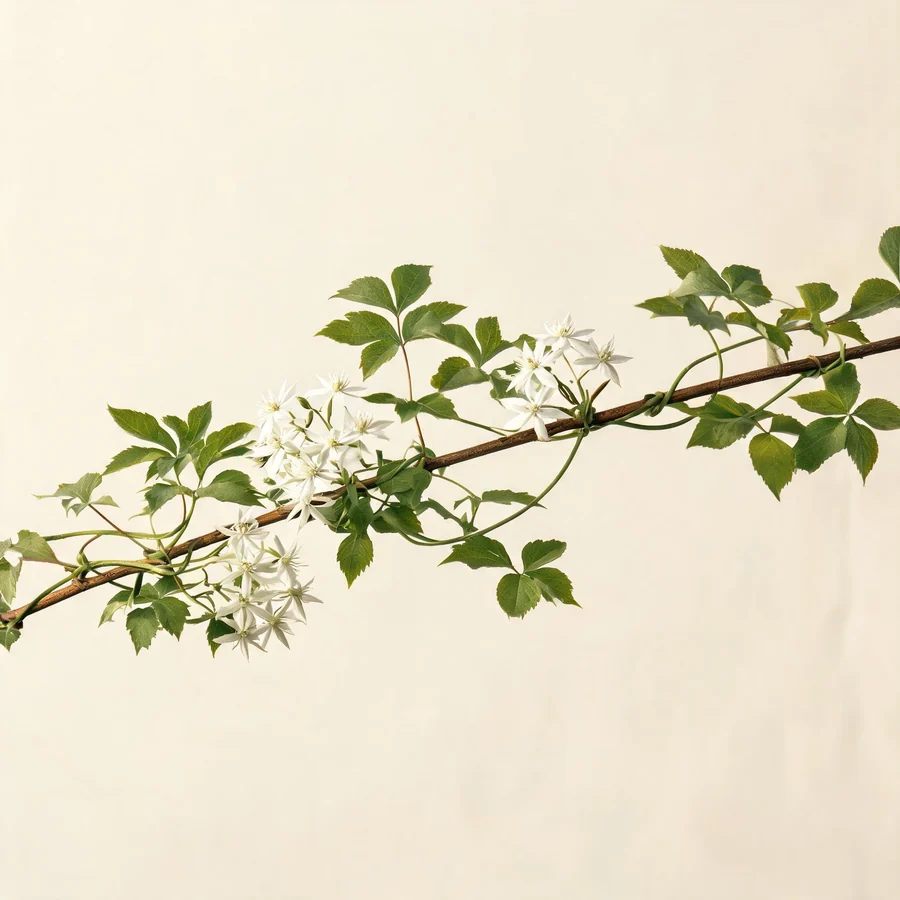
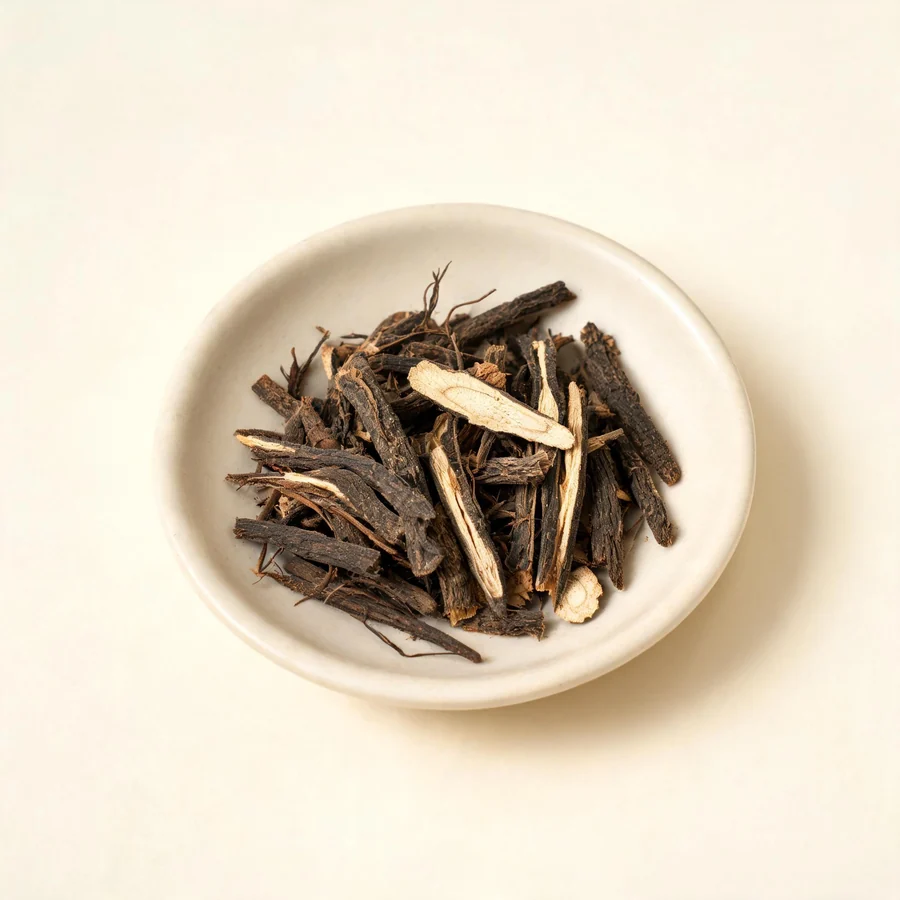
Skin profile
Where this herb sits in skin practice: the pattern it corrects, the skin signs it suits, and what it should not be used for.
Wei Ling Xian is for skin that is obstructed rather than inflamed: itch that wanders, plaques that have hardened, and patches that have gone numb or tight. It is warm and drying, so it is kept away from red weeping lesions, and its force is why it is used in short courses as an assistant rather than as a leading herb.
Skin signs that suggest it
- Itch that moves around the body, crawls under the skin and comes and goes with damp or cold weather, with little rash to see between attacks.
- Patches that have thickened and gone leathery or hard after months of rubbing, where the surface feels bound down and cannot be pinched up.
- A limb that feels wooden, heavy or numb, with stiffness that eases as it is moved and returns after rest.
- Skin over an aching joint that looks puffy, pale and tight, or a foot that swells in humid weather.
- A white or greasy coating on the tongue and a pulse that feels tight, wiry or deep.
When it is not the right herb
Not for skin that is red, hot, weeping or infected, where a warm drying root adds heat and leaves the surface cracked. Not for thin, dry, pale skin in someone whose Blood is deficient, because a dispersing herb spends what is already short. Not in pregnancy, not for young children outside specialist care, and not as an open-ended course. Any wash is kept off broken or ulcerated skin, and the fresh plant is not handled, since it can blister skin on contact.
What it does for skin
Skin-relevant actions only. Each one describes a mechanism in TCM terms and what it looks like on the skin.
Dispels Wind and Dampness from the surface
Wind in the skin is read from movement: itch that travels, wheals that appear and fade, a rash that changes shape overnight. Dampness is read from heaviness, puffiness and a preference for dry weather. This root is described as driving both out of the channels, and the visible result is that the itch settles and the surface stops feeling soggy or restless. It works best in the subacute stage, after the angry red flare has passed and what remains is a stubborn, migrating itch.
Opens channels that have closed
Where Qi and Blood stop reaching a patch of skin, the surface goes numb, cool, wooden or tight, and the tradition reads that as obstruction in the collaterals rather than a lack of supply. The root is one of the strongest openers in the materia medica, and it is used where the numbness is fixed and the limb feels heavy. Sudden numbness on one side of the body, a facial droop or slurred speech is a stroke warning and needs emergency care, not a herb.
Softens what has hardened
In the tradition a salty taste softens hardness and a moving, dispersing force breaks up what has consolidated, which is why a leathery plaque, a hard nodule or a callused patch is treated with it. On the skin the aim is to make the plaque thinner and more supple so that the surrounding tissue can move again. This is slow work and it is done in a formula, usually with herbs that move Blood, because hardened skin is rarely obstruction alone.
Guides other herbs to the limbs and the surface
The root is often the smallest item in a prescription, added so that the rest of the formula arrives where it is needed. That directing role is why it appears in washes and in formulas for the lower leg, the foot and the skin over a joint, and why it is paired with herbs that treat the whole body rather than the surface alone. It contributes little on its own at that dose, and judging it as a stand-alone treatment misses the point of how it is used.
Skin conditions it is used for
Mapped to the condition pages on this site. The pattern column shows what the skin is doing when this herb is the right choice.
| Condition | Pattern | Why it suits | Typical setting |
|---|---|---|---|
| Chronic urticaria | Wind and Dampness lodged in the channels, with wheals that come and go | Hives that appear in one place and fade in another are the clearest picture of Wind in the skin, and when they keep returning over months the tradition also looks for Dampness holding them in place, with heaviness, a greasy coating and a flare in humid weather. The root is used as an assistant that moves the Wind out and opens the channels it has been sitting in. It is not the leading herb in that formula, and it does not replace the search for a trigger, which matters most when the wheals come with swelling of the lips or throat. | A Wind-Damp formula with Wei Ling Xian, Fang Feng and Cang Zhu |
| Itchy skin | Wind-Damp itch with no fixed lesion and no heat | Itch without much rash, which moves, worsens at night and in damp weather, and leaves the skin looking normal or faintly puffy, is read as Wind riding on Dampness. The root moves the Wind and dries the Dampness at the same time, and it is chosen when the skin is neither red nor weeping, since a warm drying herb would be wrong in either case. Itch that comes with weight loss, jaundice, a new medicine or a rash that will not heal needs a diagnosis before any herb is considered. | A Wind-Damp itch formula, or a dilute wash with Wei Ling Xian and Ku Shen |
| Skin numbness | Obstruction in the collaterals, with Qi and Blood not reaching the surface | Numbness means the skin is not being reached, and the tradition separates a failure of supply from a block in the path. This root is for the blocked version: the numbness is fixed, the limb feels heavy, the skin may be cool, and there may be aching in the joint above it. Its channel-opening force is the reason it appears in formulas for numbness after a stroke, always alongside herbs that build Qi and Blood rather than instead of them. Numbness that starts suddenly or affects one whole side is an emergency. | A collateral-opening formula with Huang Qi, Dang Gui and Wei Ling Xian |
| Neurodermatitis | Wind-Damp with static Blood in a thickened, lichenified plaque | A plaque that has been rubbed and scratched for years is thick and leathery, marked by a mesh of white lines, and the tradition reads it as Wind-Damp that has been joined by Blood that no longer moves. A warm dispersing root addresses the obstruction while blood-moving herbs address the stasis, and the two together are what make a plaque softer and less irritable. The itch of neurodermatitis is driven by the scratch cycle, so the herb is only part of the treatment and habit reversal matters as much. | A blood-moving, Wind-dispelling formula with Wei Ling Xian and Dan Shen |
| Skin tightness | Obstruction of the channels, with flow blocked rather than supply low | Skin can feel tight because it is short of Blood and fluid, or because what is there cannot reach it. This root belongs only to the second case, where the skin is tight over a limb that also feels heavy or numb and where the tightness eases with movement and warmth. Using it in the dry deficient type makes matters worse, because a dispersing herb takes away the little moisture the surface has. The distinction is made on the tongue, the pulse and the history rather than on the feel of the skin alone. | A channel-opening formula with Wei Ling Xian, Dang Gui and Bai Shao |
Combinations for skin
Herbs it is paired with when the skin, not an internal organ, is the target.
| Partner | Ratio | Why the pair is used |
|---|---|---|
| Qin Jiao | 6 to 10 g of each | The standard pair for painful obstruction, and the reason it matters on a skin page is balance. Qin Jiao is cooler and moistening while this root is warmer and drying, so together they move an obstruction in a person who would be parched by the warmer herb alone. The pair is used where the skin over an aching joint is puffy and tender and where the ache shifts between joints. Neither herb is a treatment for a rash by itself. |
| Cang Zhu | 10 g of each | Cang Zhu dries Dampness where it is made, in the middle burner, and this root drives out the Dampness that has already settled in the channels and the skin. The combination is for the person whose legs are heavy and whose skin is puffy, with a greasy coating and a sluggish appetite, so that the source and the deposit are treated in one prescription. It is a warming pair and is used where the lesion shows no active heat. |
| Fang Feng | 6 to 10 g of each | Fang Feng releases Wind at the surface and this root moves it out of the channels underneath, which covers an itch that both wanders over the body and settles in the limbs. The pairing is common in washes and in formulas for hives and for itch without rash. Both herbs are dispersing, so a thin dry person needs a Blood-nourishing partner rather than a larger dose of either. |
| Dang Gui | 9 to 12 g Dang Gui with 6 to 10 g Wei Ling Xian | Treat Wind by treating the Blood, because Wind settles once the Blood moves properly. Dang Gui nourishes and moves Blood while the root opens the channels, and the pair is the standard way to use a drying, dispersing herb in someone thin and dry without leaving the skin drier than before. It suits numb, pale, stiff skin and the aftermath of a plaque that has been slow to settle. |
Topical use
The root has a long history as an external wash for itch, numbness and hard skin, and the wash is the safer route for a herb that is mildly irritant when taken in quantity. A decoction is made, strained and cooled, then used as a compress or a short soak on limited areas of intact skin. It is for skin that is itchy, tight or numb rather than red and weeping, and it is stopped as soon as the surface becomes drier or more irritated than before.
| Preparation | How and when it is used |
|---|---|
| Cooled decoction compress | Simmer 15 to 30 g of dried root in about 600 ml of water for 20 minutes, strain, and cool to skin temperature. Apply with clean gauze to the itchy or tight area for 10 minutes once a day, and make a fresh batch each time rather than keeping the liquid. |
| Short soak for hands and feet | Use a weaker decoction in a basin for numb or hard skin of the feet, for 10 minutes at most. Keep the water warm rather than hot, dry the skin thoroughly afterwards, and do not soak skin that is cracked, ulcerated or infected. |
| Patch test first | Dab a little of the cooled liquid on the inner forearm and wait 24 hours. A red, itchy or blistered patch means the preparation is not for that person, and this matters more than usual here, since the fresh plant is a known cause of blistering contact dermatitis. |
Patch test and cautions
Do not apply to broken, ulcerated or infected skin, and keep the liquid away from the eyes, the mouth and the genitals. Stop at once if burning, stinging or spreading redness develops, and do not cover a treated area with an occlusive dressing. A wash does not sterilise anything, so an infected or spreading lesion needs medical assessment rather than a stronger decoction.
Safety for skin use
What to check before recommending or using it, including the cautions that matter most for skin patients.
Do not use, or use with caution
- Pregnancy. The root is contraindicated because its coursing, penetrating action could disturb the fetus, and the classical texts name pregnancy explicitly. There is no skin complaint for which a self-chosen course is appropriate during pregnancy.
- Blood deficiency with dry, thin skin, and pain or tightness that comes from deficiency rather than obstruction. A forceful dispersing herb spends what is already short and leaves the skin drier and the person more tired.
- A weak or cold digestion, with loose stools, a poor appetite and a cold abdomen. The root is warm and drying and can irritate the gut, and long use is thought to drain the body's qi, which is why courses are kept short.
- Children, and anyone with a known allergy to Clematis or to the buttercup family. Children clear these irritant saponins less well, and handling the fresh plant can raise blisters on normal skin.
Pregnancy and breastfeeding
Avoid. The classical texts place pregnancy among the states in which the root is forbidden, and the explanation they give is its coursing, penetrating character, which moves strongly through the channels. Laboratory work on its saponins has shown effects on smooth muscle, including a possible action on the uterus, and no modern safety data would soften the traditional position. Nor is this a herb to balance against a modest dose. During breastfeeding the same caution applies, and a wash on a small area is the least risky option if a practitioner judges one necessary.
Interactions
- Anticoagulants and antiplatelet medicines. The root has shown anti-inflammatory activity in laboratory work and is described as promoting circulation, so an additive effect on bleeding is possible in theory. Anyone taking warfarin, aspirin or a similar medicine should report unusual bruising and should not start a course quietly.
- Blood pressure and blood sugar medicines. Animal work reports a lowering effect on both, so the combination could overshoot, and the same work describes an antidiuretic effect, so it can oppose a diuretic instead of adding to it. Monitoring is the sensible step rather than a change of dose.
- Tea. Several classical formulas state that tea is to be avoided while the root is taken, on the reasoning that tea cools and descends while the herb warms and disperses. The rule is traditional rather than tested, but it costs nothing to follow during a short course.
Allergy and patch testing
Contact dermatitis is the reaction to know about. The fresh plant contains protoanemonin, which blisters skin on handling, and a prepared wash can still irritate. Patch test any external preparation for 24 hours, keep it to a small area, and stop if the skin becomes more irritated rather than calmer. People who react to other members of the buttercup family should be more cautious still, and a previous reaction to a herb-containing wash is a reason to avoid this one.
General safety references
General references for herbal hepatotoxicity and herb-drug interactions; they are not specific to this herb.
- Review article: Herbal hepatotoxicity - an update on traditional Chinese medicine preparations. Alimentary Pharmacology & Therapeutics, 2014. PMID: 24844799.
- Interactions between herbal medicines and prescribed drugs: an updated systematic review. Drugs, 2009. PMID: 19719333.
- Warfarin and food, herbal or dietary supplement interactions: a systematic review. British Journal of Clinical Pharmacology, 2021. PMID: 32478963.
Evidence
The classical record is quoted with its source. The modern note states the level of evidence plainly.
Classical record
It governs the various Wind patterns, frees the five storing organs, disperses cold stagnation in the abdomen, clears phlegm and water that has long gathered in the chest, and treats masses and knotted swellings, stale pus and foul fluids, cold aching of the low back and knees, and injuries from falls.
Kai Bao Ben Cao (Materia Medica of the Kai Bao Era) - Its first systematic list of indications, and the origin of the mass and swelling uses that later support the work on hardened skin.
Its character is fierce and rapid. It travels without taking up residence and opens and frees the twelve channels, and it governs Wind, Dampness and Phlegm that block the channels and cause wandering pain like gout, sore swollen joints, or numbness.
Yao Pin Hua Yi (Collected Explanations of Materia Medica) - The clearest statement that the root is for obstruction which moves or settles in the channels, the basis of its use for numb and wandering skin complaints.
Wei speaks of its fierceness and ling xian of how numinous its effect is. Its qi is warm and its taste slightly acrid and salty. The acrid disperses qi and the salty drains water, so in Wind-Damp and phlegm-fluid complaints a person of strong qi obtains quick results. Its nature is broadly coursing and draining, and long use may damage the true qi, so those whose qi is weak should not take it.
Ben Cao Gang Mu (Compendium of Materia Medica), Li Shizhen - Li Shizhen explains the name and states the central restriction in one passage, which is why the skin use is short and always inside a formula.
Modern evidence
Evidence status
- Laboratory studies of Clematis saponins and of the whole-root extract report anti-inflammatory and analgesic activity in cell and animal models. No clinical trial of the root in urticaria, numbness or any skin condition was identified, so the skin uses described here rest on the traditional record rather than on demonstrated benefit.
- The safety literature is more substantial than the efficacy literature. Protoanemonin, which is produced when ranunculin is released from bruised plant tissue, is the irritant behind the blistering contact dermatitis reported from handling the fresh plant, and the dried root is graded as slightly toxic in the Chinese Pharmacopoeia.
- Identity is a practical problem. The root is commonly adulterated with the fibrous root of a different medicine, and the pharmacopoeia accepts more than one Clematis species. Slices that cannot be identified to species should not be assumed to behave like the standard article.
PubMed records
Selected real PubMed records for this herb's species or its constituents, chosen by species name and title relevance. They are references for the non-TCM discussion above, not proof that the herb treats any skin condition.
- Renal toxic ingredients and their toxicology from traditional Chinese medicine.. Expert opinion on drug metabolism & toxicology, 2016. PMID: 26670420 (safety record).
- Uses, chemical compositions, pharmacological activities and toxicology of Clematidis Radix et Rhizome- a Review.. Journal of ethnopharmacology, 2021. PMID: 33476714 (safety record).
Dose and forms
Skin-practice dosing and the preparations that suit skin complaints.
| Form | Dose and notes |
|---|---|
| Decoction (internal) | 6 to 10 g of dried root daily inside a formula, which is the lower half of the ordinary range and the sensible place to start for a skin complaint. Ten to fifteen grams is used for stubborn channel obstruction under supervision, and it is not a dose to take on your own judgement. |
| External wash | 15 to 30 g simmered in water for a compress or a short soak. The root is not swallowed by this route, but the concentration still needs reducing for thin or sensitive skin, and a patch test comes first. |
| Course length | Under a fortnight, with review. The root spends rather than supplements, and continuing it past the point where the itch has settled buys nothing and costs moisture and qi. |
The wine-processed root, moistened with rice wine and stir-fried until dry, is the form usually chosen for the channels and is reported to be kinder to the stomach, while the raw root is stronger and more irritant. Because the effect depends on reaching the surface, the wash and the internal formula are often used together for a limited period, and the root is nearly always the assistant rather than the leading herb. Digestive upset, nausea or a cold loose bowel are reasons to stop and review rather than to add another herb.
Citations and further reading
Only real sources are listed: the classical materia medica passages quoted above, and the source works behind the botanical and safety statements.
- Kai Bao Ben Cao (Materia Medica of the Kai Bao Era), compiled in the Song dynasty - the entry on Wind, masses and joint pain is quoted above.
- Yao Pin Hua Yi (Collected Explanations of Materia Medica) - the passage on travelling through the twelve channels is quoted above.
- Ben Cao Gang Mu (Compendium of Materia Medica), Li Shizhen, 1578 - the entry on the name and the restriction on long use is quoted above.
- Wei Ling Xian monograph, Pharmacopoeia of the People's Republic of China - accepted Clematis species, part used, toxicity grading and quality requirements.
- Toxicological and dermatological literature on protoanemonin and ranunculin, summarised as a statement about contact irritation rather than as a cited trial.
- Botanical literature on Clematis chinensis, Ranunculaceae, for identification of the dried root and rhizome.
Educational reference for qualified practitioners. This page is not medical advice, and skin conditions should be diagnosed by a clinician before treatment.