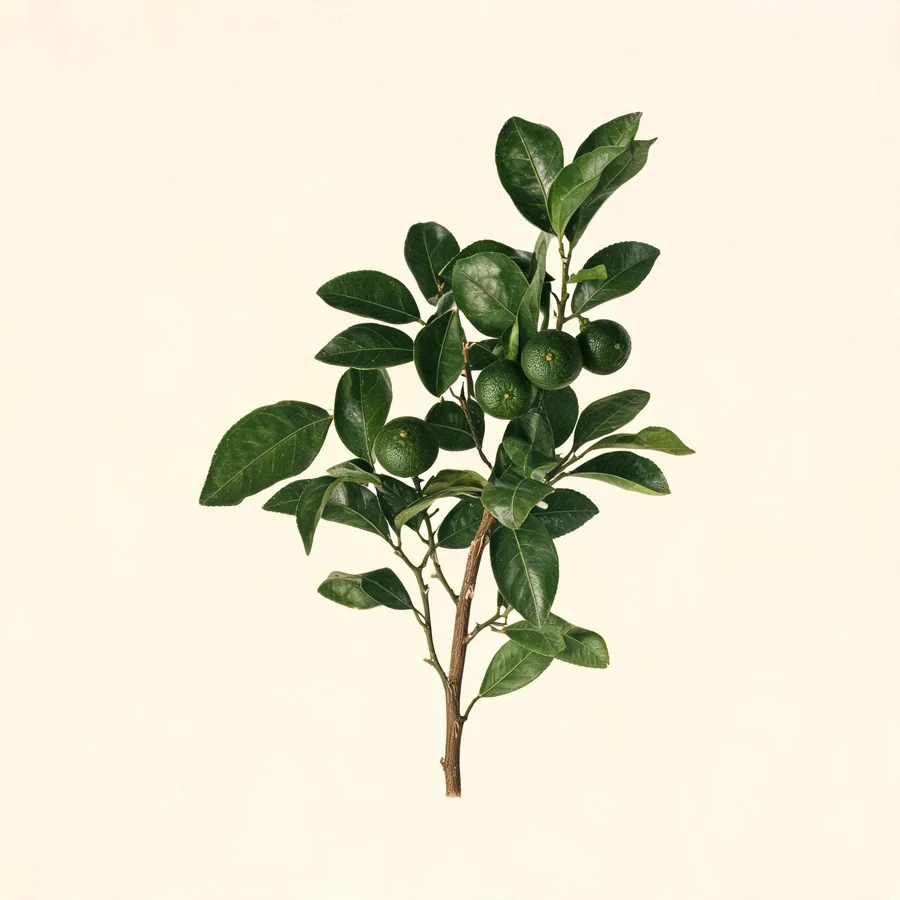
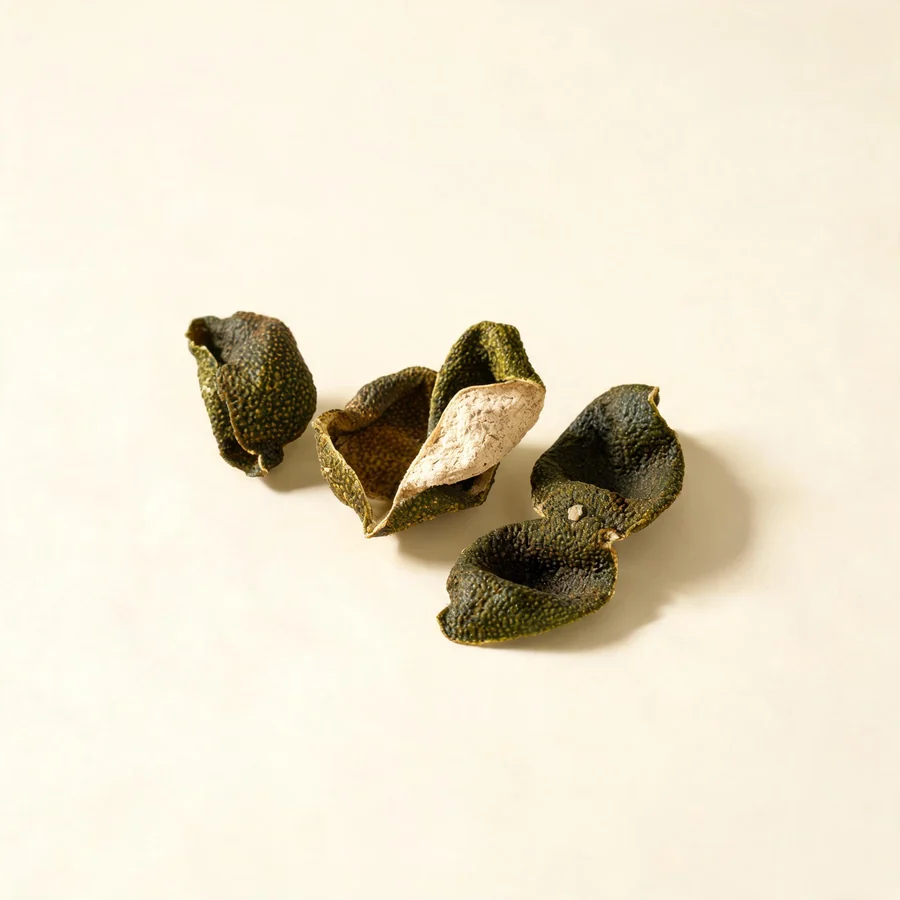
Skin profile
Where this herb sits in skin practice: the pattern it corrects, the skin signs it suits, and what it should not be used for.
Qing Pi does not treat skin directly: it breaks the stagnation that shows as dull colour, brown patches and stress-linked flares. It is strong medicine, used briefly and always beside a tonic.
Skin signs that suggest it
- Brown or grey-brown patches on the cheeks and forehead that deepen with stress and poor sleep
- A dull or dusky complexion with no glow, and dark circles that do not clear with rest
- Rib-side tightness, sighing and a lump-in-the-throat feeling alongside the skin change
- Breast distension and tenderness before a period, with itching or a rash on the breast skin
- A wiry pulse, and a tongue that may be dusky or tinged purple at the edges
When it is not the right herb
Not for a person who is already depleted: fatigue, a poor appetite, loose stools, a pale tongue and a weak pulse are reasons to avoid it, or to use it only beside a tonic. Not for a hot, red, weeping lesion, where it has no role. Not in pregnancy, because the direction of its action is downward and breaking. Not for a dry, thin, itchy skin with a scanty coat, which it would dry further. And not as a long course: two to four weeks with review is the usual limit.
What it does for skin
Skin-relevant actions only. Each one describes a mechanism in TCM terms and what it looks like on the skin.
Breaks the stagnation behind pigmentation
Melasma and other pigmentary patches are read in this tradition as Qi and blood that have stopped moving in the face, often after years of constraint, poor sleep or grief. The peel is described as breaking that stagnation rather than gently moving it, and it is used with blood-moving and blood-nourishing herbs. The expectation is modest and slow: the patch may lighten and stop deepening over months, and no herb removes it.
Clears the dull, dusky look that follows long constraint
A face that has lost its light, with a grey or dusky cast and shadows under the eyes, is read as Qi that has stalled until blood began to slow behind it. The peel starts the Qi moving so blood can follow, and peony root, chuanxiong or safflower is added once the duskiness is established. It is a supporting herb there, and the aim is a return of colour, not a cosmetic whitening.
Settles stress-driven flares on the breast and chest skin
Itch, rash or tenderness on the breast skin that worsens before a period or during a stressful stretch is read as Liver Qi stagnation with a little heat, and the peel is paired with herbs that soothe the Liver and clear the channel. Its action is on the pattern that drives the flare, not on the skin surface, and a rash that is red, weeping or infected needs its own treatment. Breast change that is new or one-sided needs examination first.
Moves Qi so that Dampness and Phlegm do not settle
When Qi stops, fluid pools, and pooled fluid thickens into Phlegm that shows as a doughy, puffy quality or a discrete nodule. The peel's secondary drying and phlegm-dispersing action addresses that stage, and it is used with fritillaria or pinellia. It is a weaker softener than the seaweeds and is included for the stagnation rather than for the mass itself.
Skin conditions it is used for
Mapped to the condition pages on this site. The pattern column shows what the skin is doing when this herb is the right choice.
| Condition | Pattern | Why it suits | Typical setting |
|---|---|---|---|
| Melasma | Liver Qi Stagnation with blood that has slowed | Patchy brown pigment on the cheeks and forehead in a person with rib-side tightness, sighing and a wiry pulse is the textbook Liver Qi stagnation presentation, and melasma is the skin condition where it is most often read. The peel breaks the stagnation while blood-moving and blood-nourishing herbs do the slower work, and it is used for a defined course. Sun protection remains the single most effective measure, and no formula replaces it. | Xiao Yao San, modified with Qing Pi and Chi Shao |
| Skin pigmentation | Liver Qi Stagnation with Qi and blood stasis | Pigment that has settled without heat or inflammation, in a person whose mood and digestion both react to stress, fits the stagnation reading. The peel is the forceful mover in the formula, and it is paired with a tonic so that Qi is replaced as it is spent. Pigment that is new, spreading, irregular or changing colour needs a dermatological opinion before it is treated as a pattern. | Xiao Yao San with Qing Pi, Dan Shen and Bai Shao |
| Dark face | Qi stagnation leading to blood stasis in the face | A dull, dark or greyish cast with a dry, lustreless surface is read as stagnation that has gone on into blood stasis. Because moving Qi is what allows blood to move, the peel is given first in the formula, with blood-moving herbs and a tonic beside it. It supports rather than leads, and the traditional expectation is a slow return of colour over months. | Xue Fu Zhu Yu Tang, modified with Qing Pi |
| Breast pruritus | Liver Qi Stagnation that has turned into heat in the channel | Itch on the breast skin with distension, tenderness and irritability around the period is read as constraint in the Liver channel that has begun to heat. The peel soothes the channel and moves the Qi, and cooling herbs handle the heat; neither is used without examining the skin first. A persistent, one-sided or discharging breast change needs medical assessment, and a herbal formula is not the place to start. | Dan Zhi Xiao Yao San, modified with Qing Pi |
| Spider veins | Liver blood stagnation with a little heat | Fine visible vessels on the face or legs in a person with a dusky complexion, a wiry pulse and long-standing constraint are read as blood stasis in the small vessels. The peel is included to move the Qi that should be driving the blood, and it accompanies blood-moving herbs. It does not remove vessels, and any change is slow and partial; a sudden crop of vessels, or one that bleeds, needs assessment. | Xue Fu Zhu Yu Tang with Qing Pi and Chi Shao |
Combinations for skin
Herbs it is paired with when the skin, not an internal organ, is the target.
| Partner | Ratio | Why the pair is used |
|---|---|---|
| Chen Pi | 3 to 6 g of each | The same fruit at two stages: the green peel breaks stagnation in the Liver, and the mature peel regulates the Spleen and Stomach more gently. One is harsher and moves downward, the other is gentler and stays in the middle, so the pair covers a pattern where constraint and poor digestion sit together. Neither is interchangeable for the other. |
| Chai Hu | 3 to 6 g Qing Pi with 6 to 10 g Chai Hu | Bupleurum and the green peel both work on the Liver, yet they pull in opposite directions: bupleurum lifts constrained Qi up and out, while the peel splits it and sends it down. Opening the same blockage from above and below is the reason they are seen together in rib-side pain, and in formulas where the tightness sits low but the mood is frustrated and sighing. |
| Xiang Fu | 3 to 6 g Qing Pi with 6 to 10 g Xiang Fu | Cyperus is the broad, mild member of the pair; the green peel supplies the force where breadth alone has not shifted anything. Stubborn stagnation with genuine pain is their territory, particularly breast fullness before a period and period pain, and the peel is kept to a small share so the combination does not drain the person. |
| Bai Shao | 3 to 6 g Qing Pi with 10 to 15 g Bai Shao | Peony root nourishes blood and softens the Liver, and the green peel breaks the stagnation that the peony is calming. This is the classical answer to the peel's main danger, which is that it spends Qi a person cannot spare, and it is the pairing to use when the stagnation is real but the constitution is thin. |
Formulas where it leads
- Xiao Yao San (逍遥散) - The gentle formula for Liver Qi stagnation with Spleen deficiency, built on bupleurum, peony, angelica, atractylodes, poria and licorice. The green peel is not in the original and is added when the stagnation is stubborn and the pigment or the dusky complexion has appeared, so the base formula supplies the nourishment the peel would otherwise spend.
- Xue Fu Zhu Yu Tang (血府逐瘀汤) - The formula for blood stasis in the chest and upper body, used in skin practice for a dusky, lustreless face and for pigment that has become fixed. The green peel appears in some modifications to move the Qi ahead of the blood, and the whole formula is given for weeks rather than months.
Safety for skin use
What to check before recommending or using it, including the cautions that matter most for skin patients.
Do not use, or use with caution
- Liver and Spleen Qi deficiency: tiredness, a poor appetite, unformed stools and a weak pulse. A peel that breaks Qi leaves such a person more exhausted, so it is left out or given beside a tonic.
- Pregnancy. Most practitioners avoid it during pregnancy unless a particular blockage demands it, and then only briefly and at a low dose. Its direction is downward and breaking, the reverse of what gestation requires, and laboratory studies of the peel have shown action on uterine muscle.
- Old age, thinness and a weak constitution. A Ming commentary advises against it in such people, since a forceful dispersing herb overwhelms a body with no reserves, and the same applies to anyone who sweats easily.
- Heat with a red tongue and a bitter taste. A warm, acrid peel adds to heat rather than relieving it, so cooling Liver-soothing herbs are used instead.
Pregnancy and breastfeeding
Not used in pregnancy unless a practitioner prescribes it for a specific blockage. It is not among the herbs absolutely forbidden at that time, but its downward, breaking direction runs against what gestation requires, and laboratory studies of the peel have shown action on uterine muscle. A short low-dose course under supervision is the most that can be justified. No safety data exist for breastfeeding: the volatile oil and bitter constituents may enter milk, so a course is kept short and stopped if the baby becomes unsettled.
Interactions
- Antacids that contain aluminium. Organic acids in the peel can bind with aluminium hydroxide, so the doses are separated by about two hours instead of being taken together.
- Antibiotics cleared through the urine, such as sulphonamides and aminoglycosides. Acidic constituents may shift urinary pH enough to change how fast these drugs leave the body, which matters most where kidney function is reduced.
- Decongestants and other pressor drugs. The peel contains synephrine, a mild alpha adrenergic stimulant, so taking it with a decongestant could add to the cardiovascular effect; anyone with high blood pressure or an arrhythmia should tell the prescriber.
- Blood-pressure medicines. The concern is additive dizziness rather than altered drug handling, so pressure is checked while a course is running.
Allergy and patch testing
Citrus peel can cause contact dermatitis, and the volatile oil is the usual culprit, so handling the dried peel or a decoction should be followed by washing the hands. A person with a known citrus allergy, or a reaction to a citrus-containing cream, should avoid the herb. A topical preparation made at home is patch tested for a day before it is used more widely.
General safety references
General references for herbal hepatotoxicity and herb-drug interactions; they are not specific to this herb.
- Review article: Herbal hepatotoxicity - an update on traditional Chinese medicine preparations. Alimentary Pharmacology & Therapeutics, 2014. PMID: 24844799.
- Interactions between herbal medicines and prescribed drugs: an updated systematic review. Drugs, 2009. PMID: 19719333.
- Warfarin and food, herbal or dietary supplement interactions: a systematic review. British Journal of Clinical Pharmacology, 2021. PMID: 32478963.
Evidence
The classical record is quoted with its source. The modern note states the level of evidence plainly.
Classical record
青橘皮,其色青气烈,味苦而辛……陈皮浮而升,入脾肺气分,青皮沉而降,入肝胆气分。一体二用,物理自然也。
The green peel is green in colour and fierce in qi, bitter and acrid to taste. Chen Pi is buoyant and rises into the qi aspect of the Spleen and Lungs; Qing Pi is heavy and sinks into the qi aspect of the Liver and Gallbladder. A single plant serves two purposes, which is simply the nature of things.
Ben Cao Gang Mu (Compendium of Materia Medica), Li Shizhen, 1578 - The clearest classical statement of the difference between the two peels, and the source of the contrast used throughout this page.
青皮,性最酷烈,削坚破滞是其所长,然误服之,立损人真气。凡欲施用,必与人参、术、芍药等补脾药同用,必不可单行也。
Its nature is the harshest of all. Splitting hard masses and breaking through stagnation are what it does best, yet taken wrongly it injures a person's true qi at once. It should always be given with Spleen tonics such as ginseng, Atractylodes or peony root, and never on its own.
Ben Cao Jing Shu (Commentary on the Classic of Materia Medica) - The classical basis for the caution repeated here, written by a physician who used the herb and respected its force.
Modern evidence
Evidence status
- Laboratory work on the peel has reported antioxidant and anti-inflammatory activity, and its flavonoids and volatile oil have been studied in cell systems. Synephrine, a constituent of the peel, has been examined for its adrenergic effects. None of this establishes a benefit for melasma, pigmentation or any skin condition.
- No controlled clinical trial of Qing Pi in a skin condition was identified. Pigmentary disorders are usually studied in multi-herb formulas, where the contribution of a single peel cannot be separated, and melasma trials generally combine herbs with sun protection and topical treatment. The skin use here rests on the Liver-stagnation rationale, not on measured outcomes.
- Regulatory status: the peel is an accepted article in the Chinese Pharmacopoeia. The quality question is species and ripeness, because sweet orange and citron peel are sold as substitutes. What this page describes is traditional practice and the state of the evidence, not a claim of proven benefit.
PubMed records
Selected real PubMed records for this herb's species or its constituents, chosen by species name and title relevance. They are references for the non-TCM discussion above, not proof that the herb treats any skin condition.
- Evaluation of Skin Anti-aging Potential of Citrus reticulata Blanco Peel.. Pharmacognosy research, 2016. PMID: 27365982 (skin-related record).
Dose and forms
Skin-practice dosing and the preparations that suit skin complaints.
| Form | Dose and notes |
|---|---|
| Decoction | 3 to 6 g a day for mild Liver Qi constraint, 6 to 10 g where food stagnation, a fixed pigmentary patch or breast fullness is present. It goes into a formula with a tonic, not on its own. |
| Short course | Two to four weeks is the usual span before review. Running on because the first week helped is exactly how the depletion the classical writers warn of comes about. Fifteen grams is used briefly for a severe accumulation, and anything above ten is paired with a tonifying herb. |
| Processed forms | Vinegar-fried peel is chosen when Liver and pain are the target, since the sour taste is said to carry the action into the blood level. Dry-fried peel suits a picture that includes the Stomach, and charred peel a weak person with food stagnation. |
How long it is given matters far more than how many grams. The peel belongs to a bounded stretch of treatment, and the pattern should have shifted by the end of it; if the tightness comes back, the useful question is what is keeping the Qi stuck, not how to repeat the same pushing. Vinegar preparation is the version for pigment and pain, and a tonic should sit in the same formula once the course passes a fortnight.
Citations and further reading
Only real sources are listed: the classical materia medica passages quoted above, and the source works behind the botanical and safety statements.
- Ben Cao Gang Mu (Compendium of Materia Medica), Li Shizhen, 1578 - the passage contrasting the green and mature peels is quoted in the original above.
- Ben Cao Jing Shu (Commentary on the Classic of Materia Medica) - the passage on the peel's harshness and the need for a tonic is quoted in the original above.
- Pericarpium Citri Reticulatae Viride monograph, Pharmacopoeia of the People's Republic of China - accepted source, part and quality requirements.
- Melasma and pigmentary disorders: standard dermatological guidance on sun protection, included as context for what herbs can and cannot do.
- Modern evidence statement: based on published laboratory work on citrus flavonoids and synephrine, presented as a statement about the level of evidence.
Educational reference for qualified practitioners. This page is not medical advice, and skin conditions should be diagnosed by a clinician before treatment.