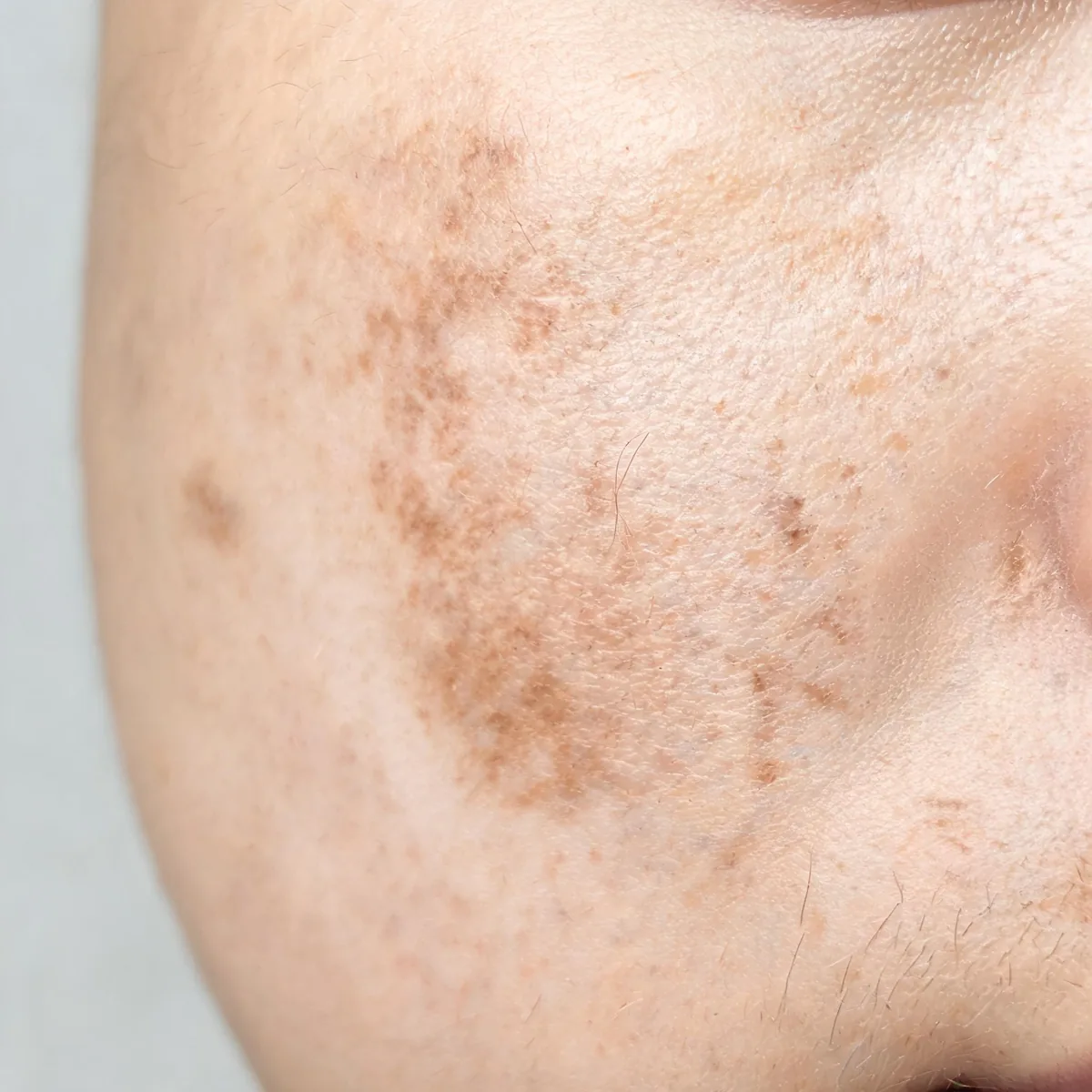
Understanding Skin pigmentation
A name note recorded rather than resolved: this page and the Melasma page both carry the Chinese name 黄褐斑 (huáng hè bān) and both describe facial pigment. The source treats them separately, so both are built here.
The tradition describes the condition as a sign that Qi, Blood and body fluids are not flowing smoothly and the face is not receiving proper nourishment, almost always involving the Liver, Spleen and Kidneys.
Liver Qi stagnation gives deep or light brown patches on the cheeks or forehead, worsened by emotional stress, with rib-side distension and irritability. Qi and Blood stagnation gives deep brown to purplish patches with clear well-defined edges, fixed chest or rib pain and painful periods with clots.
Spleen deficiency with dampness gives dull-brown or grey-brown patches with ill-defined borders, a sallow lacklustre complexion, heaviness and fatigue. Kidney and Liver Yin deficiency gives dark brown irregularly shaped patches with dizziness, ringing in the ears, low back soreness and night sweats.
What links the three organs is direction. The face is the most exposed part of the body and the first to show when supply fails: Qi stagnation keeps Blood from arriving, dampness muddies what does arrive, and deficiency heat dries the surface from within. The patch records traffic rather than a local fault, which is why treating the surface alone tends to disappoint.
The mechanisms also differ in speed. Stagnation from stress can darken a patch within weeks of a difficult period and lighten again when the pressure lifts. Dampness from a struggling Spleen accumulates slowly and produces a dull, blurry stain that shifts with digestion and weather. Yin depletion is slowest of all, arriving with age, illness or years of late nights, and it answers to sustained nourishment rather than to short courses.
A practitioner therefore asks about mood and menstruation, appetite and stools, sleep, backache and hearing, and reads tongue and pulse to decide which mechanism leads. Mixed pictures are the rule: long-standing stress often ends in stasis, and stasis in time depletes the Blood the face depends on.
Conventional view
In Western medicine facial pigmentation of this kind is melasma: symmetrical brown to grey-brown patches on the chin, upper lip, forehead and cheeks, far more common in women and often appearing during pregnancy or while taking hormonal contraception, though men develop it too. The cause is not fully understood, with ultraviolet exposure, hormonal change and genetic background all contributing, and overactive melanocytes deposit excess melanin in the skin.
Management turns on two things, blocking melanin production and blocking ultraviolet light. Strict sun protection accompanies topical agents such as hydroquinone, often combined with tretinoin and a mild steroid, or with vitamin C, kojic acid or azelaic acid. Stubborn cases may be offered peels, dermabrasion, or laser and light therapy, with a risk of post-inflammatory hyperpigmentation, particularly in darker skin.
Topical treatment can fade the patches, but melasma returns readily once treatment stops or after even brief sun exposure, and hydroquinone can irritate or, over long use, leave a bluish discolouration. Procedures are costly and variable in result, and neither approach addresses the internal tendency that makes melanocytes overreact. That is the gap the TCM account of stagnation, dampness and deficiency heat is trying to fill, aiming to reduce pigment formation rather than bleach what is already there.
Selected PubMed records
Real PubMed records for the conventional discussion above, selected by condition name and title relevance. They are references, not a claim that any treatment is proven for this condition.
- Skin Pigmentation Types, Causes and Treatment-A Review.. Molecules (Basel, Switzerland), 2023. PMID: 37375394.
How it connects
In TCM facial pigmentation is rarely an isolated skin problem: it often signals deeper imbalance, particularly in the Liver and Spleen. Because the same Liver Qi stagnation that causes facial pigmentation also disrupts emotional regulation, anxiety, irritability and anger frequently accompany the skin changes, and stagnant Qi creates chest tightness and distension in the flanks that many people describe alongside it. When Liver Qi stagnation persists it may affect the Spleen's digestive function, leading to abdominal bloating and distension, which explains why pigmentation often appears with digestive complaints. The stagnation of Qi and Blood that darkens the face can also obstruct the uterus, causing menstrual irregularities such as amenorrhoea, and treating the root Liver or Spleen imbalance often resolves both skin and accompanying symptoms. Two clusters stand out. The first is emotional and menstrual: the same constrained Liver Qi that darkens the cheeks also produces irritability, anxiety, breast tenderness and irregular or painful periods, and the same stasis that fixes a patch can obstruct the uterus. The second is digestive: when Spleen function falters and dampness accumulates, bloating and distension accompany the duller patches. Treating the Liver or the Spleen at the root is expected to settle skin and complaint together rather than one at a time.
How it is assessed
The practitioner examines the patches and the constitutional picture, having first checked that the spot is not suspicious.
What a practitioner looks for
- Borders: clear well-defined edges suggest stagnation; ill-defined patches suggest Spleen deficiency.
- Stress relation: patches worsening with stress suggest Liver Qi stagnation.
- Constitutional signs: dizziness and night sweats suggest Yin deficiency.
- Red flags: a spot that changes, bleeds, itches or crusts needs medical review.
Examination starts with the patch itself: how deep the brown runs, whether the edge is sharp or fades into surrounding skin, and whether it has changed lately. Deep, crisp edges point to stasis, a soft blurry border to dampness, and a dark irregular shape with dryness to depletion. Dermatological review comes first when a spot has changed shape, bled or crusted, because pigmentation is a diagnosis of exclusion.
Stress-driven patches arrive with chest tightness, sighing, irritability and breast tenderness before a period; the tongue is red, its coating thin, and the pulse wiry. Where the colour has deepened to purple-brown with a crisp edge and stabbing rib-side pain, Blood is stuck rather than merely stalled, the tongue is darker and sometimes purplish, and the pulse is choppy. Both are excess pictures and both move faster than deficiency ones.
Dull grey-brown patches with a blurry edge, a sallow complexion, heaviness, bloating and loose stools indicate a weak Spleen labouring with dampness, with a pale greasy tongue and a soft, fine pulse. Dark irregular patches with dizziness, tinnitus, a sore lower back and night sweats indicate Kidney and Liver Yin depletion, with a red dry uncoated tongue and a deep, thread-like pulse. The first needs drying and strengthening, the second moistening and settling.
TCM patterns in Skin pigmentation
Four patterns account for most facial pigmentation, and what separates them is the border, the colour and the company a patch keeps. A patch that darkens with stress, with either a blurry or a sharp edge but no digestive complaint, is usually Liver Qi stagnation, and it may progress to Qi and Blood stagnation as the colour moves towards purple and the edge hardens. A dull grey-brown stain with a fading border, a sallow face, heaviness after eating and loose stools belongs to Spleen deficiency with dampness. Dark, irregular patches in someone who is dizzy, wakes sweating and has a sore lower back point to Kidney and Liver Yin deficiency, the deepest and slowest of the four. The treatments point in opposite directions, one group moving and cooling, the other warming, drying or deeply moistening, so tongue, pulse and trigger history decide which leads when features overlap.
| Pattern | Key signs | The itch | Tongue | Main formula |
|---|---|---|---|---|
| Liver Qi Stagnation | Not specified | Not specified | Body: Normal or slightly dark, with red or purple sidesCoat: Thin white | Not specified |
| Qi And Blood Stagnation | Stabbing or fixed chest and rib pain; Painful periods with dark clots | Not specified | Body: Purple or dark, with stasis spots; sublingual veins dark and distendedCoat: Thin white | Not specified |
| Spleen Deficiency with Dampness | Not specified | Not specified | Body: Pale and swollen, often with teeth marks along the edgesCoat: White, greasy and moist, thick in the middle | Not specified |
| Kidney and Liver Yin Deficiency | Not specified | Not specified | Body: Red, thin and dry, often crackedCoat: Little or none; the tongue may look peeled | Not specified |
Liver Qi Stagnation
Brown patches on cheeks or forehead worsened by stress.
The Liver keeps Qi spreading evenly, and emotion is what most often interrupts it. Held frustration leaves Qi bunched in the chest and flanks, and Blood cannot reach the face in the volume the skin expects. Pigment settles where flow is poorest, on the cheeks and forehead, and it darkens each time a new wave of stress arrives, which is why the patch seems to follow the patient's diary.
The tongue is normal or slightly dark with red or purple sides and a thin white coat, and the pulse is wiry, taut as a plucked string, at the left middle position. Stress, spicy and fried food, alcohol and broken sleep aggravate it, while calm, gentle exercise, warmth on the rib area and chrysanthemum or rose tea relieve it. Xiao Yao San is the formula named, with Chai Hu, Bai Shao and Xiang Fu, and LR-3 Taichong, SP-6 Sanyinjiao and GB-14 Yangbai are the points used to move the Qi and reach the face.
Signs
- Deep or light brown patches on cheeks or forehead
- Worsened by emotional stress
- Distension or bloating along the ribs and flanks
- Irritability and mood swings
Diet and lifestyle for this pattern: Make stress management a daily priority, with gentle movement such as tai chi, yoga or a short walk keeping Liver Qi moving. Sip chrysanthemum or rosebud tea to soothe the Liver, eat plenty of leafy greens, cucumber and celery, and avoid greasy, fried or spicy food that can turn stagnation into Heat.
Qi And Blood Stagnation
Deep brown to purplish patches with clear edges and fixed pain.
When Qi has been stalled long enough, Blood follows into stasis. A patch that was pale brown turns purple-brown and sharply outlined, because stagnant Blood settles where it pools, and the face loses the even tone that free circulation gives it. Fixed stabbing pain in the chest or ribs, worse under pressure, and periods that pass dark clots are the same stasis showing elsewhere.
The tongue is purple or dark with stasis spots and a thin white coat, and the pulse is wiry and choppy. Cold, greasy and raw food, a sedentary day and swallowed anger all deepen it, while movement, warmth on the lower abdomen, warm cooked meals and emotional release help. Tao Hong Si Wu Tang is the formula, with Tao Ren and Hong Hua as the herbs that break the stasis, and SP-10 Xuehai, LR-3 Taichong and SP-6 Sanyinjiao as the points, the last especially when patches darken before a period.
Signs
- Deep brown to purplish patches with clear defined edges
- Stabbing or fixed chest and rib pain
- Painful periods with dark clots
Diet and lifestyle for this pattern: Eat warm, lightly cooked meals with blood-nourishing food such as dark leafy greens, beetroot and goji berries, and avoid cold, raw and greasy food that congeals Blood. A daily walk or gentle stretching keeps Qi and Blood moving, and deep breathing or journalling releases emotional tension before it turns into stagnation.
Spleen Deficiency with Dampness
Dull grey-brown patches with blurred edges and a sallow complexion.
A Spleen that cannot transform food and fluids creates two problems at once: too little Qi and Blood to brighten the face, and a surplus of dampness that drifts upward and settles as a stain. The colour is dull rather than dark, grey-brown rather than brown, and the border dissolves into the surrounding skin. Because the deficiency is digestive in origin, the face is only one of the places it shows.
Expect a pale, swollen tongue with teeth marks and a white greasy, moist coat, and a pulse that is soggy and slow, soft at the right Guan and slippery when dampness is heavy. Cold, greasy and raw food, humid weather, irregular meals and overwork make it worse, while warm cooked meals, dry weather, regular eating, gentle exercise and rest relieve it. Shen Ling Bai Zhu San is the formula, with Bai Zhu, Fu Ling and Yi Yi Ren, and BL-20 Pishu, ST-40 Fenglong, SP-6 Sanyinjiao, ST-36 Zusanli and SP-10 Xuehai are the points that strengthen, drain and move.
Signs
- Dull-brown or grey-brown patches with ill-defined borders
- Sallow lacklustre complexion
- Heaviness in body and limbs
- Fatigue and poor appetite
Diet and lifestyle for this pattern: Favour warm, cooked, easy food such as congee, soups and steamed vegetables, and avoid cold, raw, greasy and dairy-heavy meals that create Dampness. Include Spleen-strengthening food such as yam, millet, ginger and Job's tears, eat regular meals without overeating, and keep moving gently such as walking or tai chi to drain Dampness, while managing stress and getting adequate rest.
Kidney and Liver Yin Deficiency
Dark irregular patches with dizziness and night sweats.
The Liver stores Blood and the Kidney stores Essence, and the two decline together. With the deep reserves low, the face loses its lustre and deficiency heat rises, drying the skin and leaving dark, irregular marks that look older than the surrounding tissue. This is the pattern of years rather than weeks, and it usually arrives with night sweats, a sore back, tinnitus and eyes that feel dry by evening.
The tongue is red and thin, cracked, with little or no coating and a dry surface, and the pulse is fine, rapid and wiry, weak at the left Chi position. Late nights, overwork, spicy and fried food, hot dry weather and prolonged stress deplete it further, while early nights, cooling moistening foods and gentle exercise slow the loss. Liu Wei Di Huang Wan is the formula, with Shu Di Huang, Gou Qi Zi and Nu Zhen Zi, and KI-3 Taixi, BL-23 Shenshu and LR-5 Ligou are the points that replenish the source and regulate the channel.
Signs
- Dark brown irregularly shaped patches
- Dizziness and ringing in the ears
- Low back and knee soreness
- Night sweats and heat in palms and soles
Diet and lifestyle for this pattern: Eat Yin-nourishing food such as black sesame, walnuts, goji berries, mulberries and pear, and avoid spicy, fried and drying food that consumes fluids. Prioritise deep rest, be in bed before eleven, and protect the skin from the sun daily.
Treatment approach
How the tradition treats skin pigmentation, with the herbs, formulas and points used for it.
Principles
- Have any changing or suspicious spot assessed before treating pigmentation.
- Move Liver Qi where patches follow stress.
- Move Blood and resolve stasis where patches are deep with clear edges.
- Strengthen the Spleen or nourish Yin according to the deficiency found, with sun protection throughout.
- The pattern decides the method, but the aim is constant: restore flow and nourishment to the face so that pigment stops being laid down. Excess pictures are moved and cooled, deficiency pictures are warmed, strengthened or moistened, and the two are combined when a chronic case has produced both. Points on the body regulate the organs, while fine needles placed on the face draw circulation through the patch itself.
Herbs used
Formulas
Acupoints
- LR-3 (Taichong)
- SP-6 (Sanyinjiao)
- GB-14 (Yangbai)
- SP-10 (Xuehai)
- BL-20 (Pishu)
- ST-40 (Fenglong)
- ST-36 (Zusanli)
- KI-3 (Taixi)
- BL-23 (Shenshu)
- LR-5 (Ligou)
What to expect
- The tradition describes gradual change over months, not weeks.
- Pigment may lighten rather than clear completely.
- Recurrence follows sun exposure and hormonal change.
- Lightening is gradual and begins at the edge of a patch rather than at its centre, and the surrounding skin usually looks healthier before the pigment fades. Stress and sun can darken a patch temporarily without meaning the treatment has failed, and deficiency patterns need months rather than weeks before the change holds.
Safety and when to get help
Seek medical help urgently for
- A pigmented spot that changes shape, colour or size.
- A spot that bleeds, itches or crusts.
- New dark spots with systemic symptoms.
For anything severe, sudden or spreading quickly, read when a skin problem needs urgent care.
Cautions
- Any changing mole needs dermatological assessment first.
- Sun protection is essential during treatment.
- Pregnancy requires practitioner review before internal herbs.
Using this alongside conventional care
- TCM is described as complementary to conventional care: prescribed topical treatment and sun protection continue alongside herbs.
- Sunscreen and gentle skincare continue throughout, because ultraviolet exposure can undo in a day what weeks of treatment has gained, and prescription topicals such as hydroquinone or tretinoin are continued with both practitioners informed, since some herbs increase photosensitivity and demand stricter protection. Aggressive laser treatment or deep chemical peels are best postponed while herbs are active unless both clinicians agree, and no prescribed medicine should be stopped without the prescriber's advice.
Diet and lifestyle
- Favour warm easily digestible food that does not create dampness or heat, such as steamed vegetables and whole grains.
- Warm, easily digested food that neither creates dampness nor stirs heat is the base: steamed vegetables, congee, lean protein and whole grains, with alcohol, coffee, spicy and deep-fried food and excess cold or raw food reduced, and water taken at room temperature. Pattern adds the detail. Leafy greens, cucumber and celery with rose or chrysanthemum tea suit stagnation; warm lightly cooked meals with beetroot and goji berries suit stasis; congee, yam, millet and Job's tears with regular meal times suit a weak Spleen; and black sesame, walnuts, mulberries and pear suit Yin depletion.
If you're pregnant
Melasma is so common in pregnancy that it is nicknamed the mask of pregnancy. In TCM terms it reflects added stagnation of Qi and Blood as the growing fetus weighs on the channels, and the Kidney Yin depletion that pregnancy tends to bring, so the two pictures seen most often are Liver Qi stagnation and a Kidney Yin that has run low.
Herbal treatment needs great caution. Formulas that strongly move Blood, Tao Hong Si Wu Tang among them, are contraindicated, since Tao Ren and Hong Hua may stimulate the uterus. Milder options, such as Liu Wei Di Huang Wan or Xiao Yao San modified in some versions to leave out Dang Gui, are gentler, though still requiring a qualified prescriber. Acupuncture is the safer route, with LI-4 Hegu, SP-6 Sanyinjiao and lower abdominal points avoided, and gentle gua sha on the face and herbal masks applied to the skin are often preferred.
If you're breastfeeding
Patches often persist or deepen after birth as the body readjusts, and most TCM treatment is compatible with breastfeeding provided nothing that passes into milk and could affect the infant is used. Strong Blood-moving herbs such as Tao Ren, Hong Hua and E Zhu are generally left out, and nourishing, gently harmonising formulas such as Liu Wei Di Huang Wan or a modified Xiao Yao San are preferred.
Acupuncture is highly compatible, and can address Liver Qi constraint or a weak Spleen without risk to the baby. Masks made with Bai Fu Ling or with Bai Zhu are also generally fine, and sleep and stress care matter because the postpartum period tends to worsen stagnation.
If treating an elderly patient
In older patients the patches usually stem from Kidney Yin deficiency with chronic Blood stagnation, and tend to be darker and more irregular, the mark of years of Essence loss. Treatment nourishes Yin and gently moves Blood at lower doses so that digestion is not overloaded, and because older patients often take several medicines, herb-drug interactions need careful screening.
Liu Wei Di Huang Wan may be paired with a gentle mover such as Dan Shen, while a strong herb such as Hong Hua is used sparingly. Needling is well tolerated here, and dietary support with black sesame, goji berries and walnuts reinforces the Kidney Yin.
Urgent-sign guidance is based on standard sources: NHS anaphylaxis, NHS cellulitis, NHS Stevens-Johnson syndrome, NHS melanoma.
Evidence
Evidence status
Compiled for this page from the classical and modern literature; not a systematic review, so treat it as a pointer to sources rather than clinical guidance.
The evidence is moderate for melasma, which is the most studied pigmentation disorder. A meta-analysis of randomised trials found that acupuncture significantly reduced melasma area and severity scores compared with sham acupuncture or conventional treatment, with a consistent effect across protocols, though some included studies were of moderate quality. Other forms of pigmentation are less well studied.
The trials behind that conclusion are mostly small and drawn from a single centre, and few have been repeated by independent groups or published in English, which is why reviewers call for larger multicentre studies with proper blinding. Herbal research is thinner and largely Chinese-language, often pairing a formula with a topical agent so that the herb's own contribution cannot be isolated. It is the consistency of direction, together with long clinical use, that supports the recommendation rather than the strength of any single trial.
Studies often cited
Pooled randomised trial data showed that acupuncture significantly reduced melasma area and severity scores compared with sham acupuncture or conventional treatments, with a consistent effect across different acupuncture protocols, although the quality of some included studies was moderate. Chien TJ, Liu CY, Chang CJ, Fang CJ. Evidence-Based Complementary and Alternative Medicine. 2017;2017:1-11.
PubMed records for the TCM evidence
Real PubMed records for the TCM clinical evidence discussed above, selected by condition name and title relevance. They are references, not proof of benefit.
- Targeting Melasma: Innovations in Pigment Deposition and Photoaging in Cosmetic Dermatology.. Journal of cosmetic dermatology, 2026. PMID: 41508749.
- Mechanism, Formulation, and Efficacy Evaluation of Natural Products for Skin Pigmentation Treatment.. Pharmaceutics, 2024. PMID: 39204367.
Classical record
Blackish spots occur when water deficiency fails to control fire, and weak blood fails to nourish the flesh, causing fire dryness to form black spots.
- Wai Ke Zheng Zong (Orthodox Manual of External Medicine), chapter on blackish spots.
面尘者,谓面上有尘埃之色也。
Face dust describes a dusty cast to the complexion; the cause is stagnant Qi and Blood failing to reach and nourish the skin.
Zhu Bing Yuan Hou Lun, Volume 27, Section on Facial Pigmentation - Classical citation: (Zhu Bing Yuan Hou Lun, Volume 27, Section on Facial Pigmentation); the short Chinese original is quoted as the classical literature gives it.
Common questions
Is this the same as melasma?
The source uses the same Chinese name for both pages. This page covers facial pigmentation generally; the Melasma page covers the patterned form. Both are built.
Can herbs lighten patches?
The tradition describes treating the underlying Liver, Spleen or Kidney pattern, with slow change over months.
When should I worry about a spot?
If it changes shape, colour or size, or bleeds, itches or crusts.
Is sun protection necessary?
Yes. Both frameworks treat sun exposure as a major driver, so protection is part of treatment.
How long does treatment take to show on the skin?
Most people notice something within four to eight weeks, though it is usually the sleep, digestion or mood that changes first. Excess patterns related to stress can lighten relatively quickly, while deficiency patterns may need three to six months. What makes the difference is steady treatment and rigorous sun protection, because a single unprotected day can undo progress.
Do I have to change my diet?
Diet supports rather than drives the treatment. The broad advice is to cut back on greasy, spicy and very cold food, which worsen dampness and stagnation, and to favour warming cooked dishes, green vegetables and gentle Liver and Spleen supporters such as chrysanthemum or rose tea and lightly cooked greens. Your practitioner will tailor this to your pattern.
Can I keep using my normal skincare and sunscreen?
Yes: gentle cleansers, moisturisers and mineral sunscreens are fine and the sunscreen is essential. What is best avoided during herbal treatment is harsh chemical peeling and strong bleaching cream, because some herbs make the skin more sensitive. Let your TCM practitioner know about every topical you are prescribed, and tell your dermatologist that you are taking herbs.
Will the patches come back afterwards?
Treating the internal tendency makes recurrence less likely than with topical treatment alone, but if the original drivers return, whether stress, diet or hormonal change, the pigment can return with them. Many people keep the skin clear with periodic sessions and a few habits kept in place, particularly sun protection.