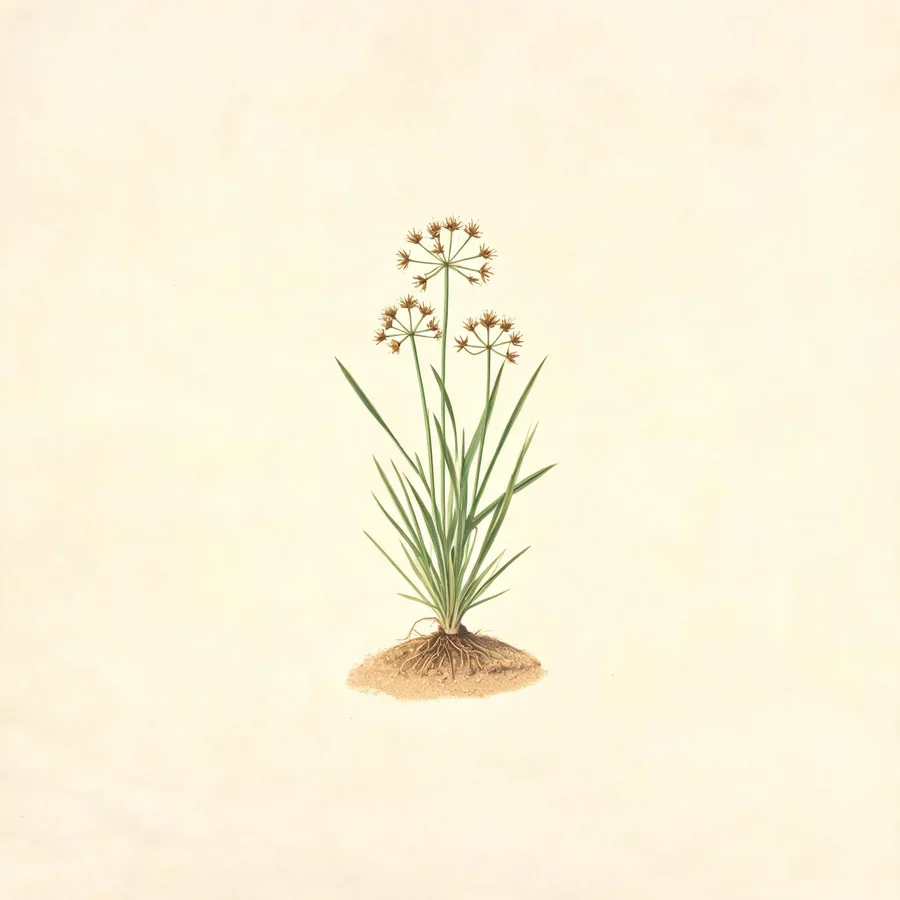
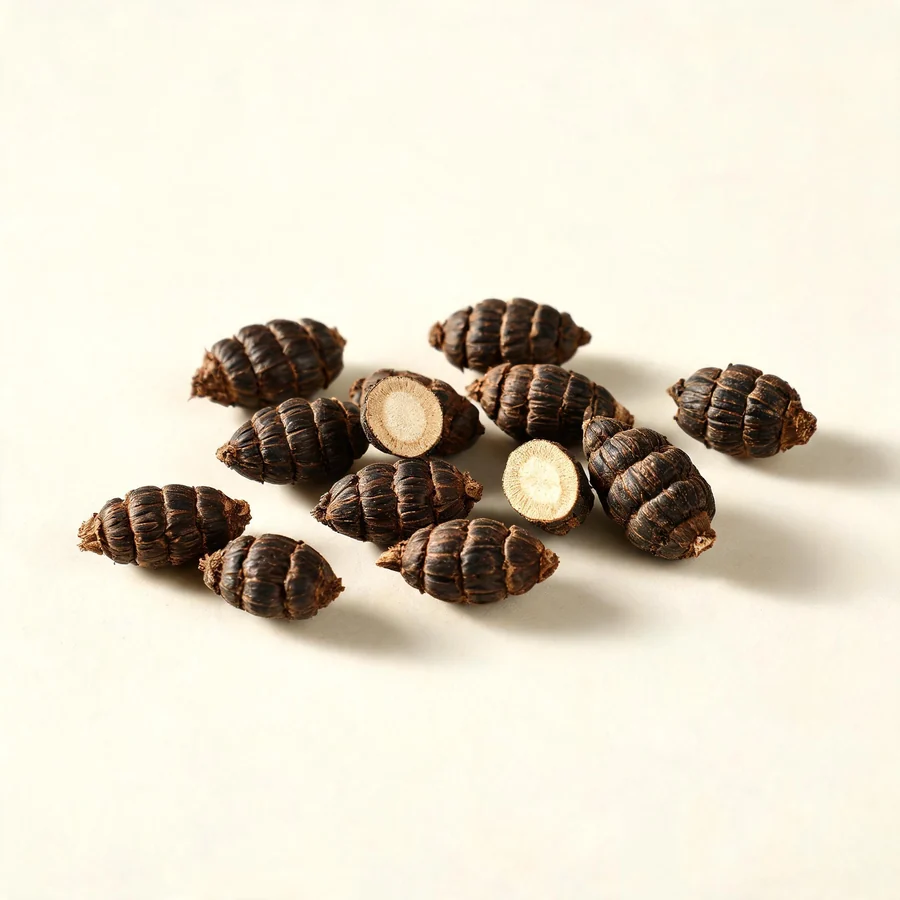
Skin profile
Where this herb sits in skin practice: the pattern it corrects, the skin signs it suits, and what it should not be used for.
Xiang Fu is chosen when the timing of the skin problem is emotional: it flares with stress, tracks the cycle, or appears in someone who holds tension in the jaw and shoulders. It is not a treatment for the lesion, and it does not replace antihistamines, emollients or sun protection; its job is to remove the constraint that keeps the problem returning.
Skin signs that suggest it
- Flares that follow stress, frustration, grief or a run of broken sleep
- Skin trouble that alternates with a tight chest, sighing and fullness under the ribs
- Wheals that appear and move during an emotional stretch, with a wiry pulse
- Brown patches across the cheeks and forehead in a tense, clench-jawed person
- Thickened, leathery plaques in an area the person cannot stop scratching
- Spots along the jaw and chin that arrive before a period, with breast tenderness
When it is not the right herb
Not for depletion without stagnation: pale, tired, dry skin in someone with no distension, no sighing and no wiry pulse will not benefit, and moving Qi in that state deepens the tiredness. Not for Yin deficiency with night sweats, thirst and a tongue that is red and peeled, where its dispersing quality adds to the dryness. It is avoided in pregnancy and in heavy bleeding where Qi is failing to hold the Blood in. And it is the wrong herb for a single hot, red, weeping lesion, which needs clearing rather than moving.
What it does for skin
Skin-relevant actions only. Each one describes a mechanism in TCM terms and what it looks like on the skin.
Frees Liver Qi so stress-driven flares lose their trigger
Constraint is the pattern behind a large share of relapsing skin trouble, and its signature is timing: the skin worsens under pressure and improves on holiday. Xiang Fu restores the smooth flow that stress interrupts, and it is given with Chai Hu and Bai Shao. The effect is on the pattern rather than on the plaque, and it is judged over weeks.
Releases the Qi that is holding Blood, so plaques stop thickening
An itch produces a scratch and a scratch produces a plaque, and a plaque that keeps thickening is read as Qi stagnation that has slowed the Blood beneath it. The rhizome belongs to the group the tradition calls Qi herbs working within the Blood, so it addresses the movement that has stalled rather than breaking the stasis itself. It is paired with Chuan Xiong or Dan Shen when the plaque is dusky and firm.
Lifts constraint from the face and lets pigment settle
Pigmentation across the face is read as Qi and Blood not moving freely through it, and the pattern is often visible in the person as much as the skin: tight shoulders, a held jaw, sighing. Xiang Fu is a standard component of the formulas used for it, with Dang Gui, Bai Shao and Mu Dan Pi. Sun protection remains the single measure that most affects the outcome.
Settles Wind that arises from constraint
Wheals that come and go with emotional weather are read as Wind generated by stagnation rather than by an outside pathogen. Moving Qi removes the internal condition the Wind is using, and the rhizome is combined with wind-diffusing herbs such as Fang Feng. It is a supporting herb here, and antihistamines remain the first-line treatment for urticaria.
Regulates the cycle so premenstrual skin flares ease
Acne and eczema that flare in the week before a period are read as Qi and Blood congesting and then releasing. Because the rhizome both moves Qi and regulates the flow, it addresses the cycle that the flare follows. It is used with Dang Gui and Bai Shao in the second half of the cycle, and any change in the cycle itself needs assessment.
Skin conditions it is used for
Mapped to the condition pages on this site. The pattern column shows what the skin is doing when this herb is the right choice.
| Condition | Pattern | Why it suits | Typical setting |
|---|---|---|---|
| Melasma | Liver Qi stagnation with Blood stasis in the face | Pigment that deepens with stress and sits symmetrically on the cheeks and forehead is read as Qi and Blood moving poorly through the face. Xiang Fu frees the Qi, and it is given with herbs that move and nourish the Blood. It is a slow measure, and daily sun protection does more than any herb. | Xiao Yao San with Mu Dan Pi and Bai Shao |
| Neurodermatitis | Qi stagnation holding Blood in a scratched plaque | The thickened, leathery plaque is the end point of a long itch-scratch cycle, and the pattern behind it is usually constraint with Blood stasis. The rhizome moves the Qi that keeps the area congested, and it is used with Chuan Xiong and Dan Shen while the plaque softens. Breaking the scratch habit and using an emollient matter as much as the prescription. | Xue Fu Zhu Yu Tang with Xiang Fu and Chai Hu |
| Chronic urticaria | Wind arising from Liver Qi constraint | Wheals that return over months, worse in tense periods and moving around the body, are read as internal Wind fed by stagnation. Xiang Fu is a supporting herb in a formula that diffuses Wind and settles the surface, and it is chosen when the emotional trigger is obvious. Antihistamines remain the first-line treatment, and swelling of the lips or throat is an emergency. | Xiao Feng San with Chai Hu and Xiang Fu |
| Acne | Liver Qi stagnation with a premenstrual flare | Spots that cluster on the jaw and chin and arrive before a period, in someone with breast tenderness and irritability, are read as Qi and Blood congesting in the Liver channel. Xiang Fu moves the Qi so the congestion has somewhere to go, and it is used with Mu Dan Pi and Bai Shao in the premenstrual phase. It is not the herb for a face that is hot, red and greasy all month. | Xiao Yao San with Mu Dan Pi and Bai Shao |
| Psoriasis | Qi stagnation with Blood stasis in a fixed plaque | A plaque that stays in one place, is dusky or violaceous and thickens rather than spreads is read as Blood stasis with Qi stagnation behind it, often with an emotional trigger at the onset. Xiang Fu contributes movement rather than cooling, and it sits in the blood-moving part of the formula. Psoriasis that is bright red and spreading is a Heat picture and calls for different herbs. | Tao Hong Si Wu Tang with Xiang Fu and Chuan Xiong |
Combinations for skin
Herbs it is paired with when the skin, not an internal organ, is the target.
| Partner | Ratio | Why the pair is used |
|---|---|---|
| Chai Hu | 6 to 10 g each | Chai Hu releases Liver Qi outward and upward while Xiang Fu spreads it through the body, so the pair covers constraint that has settled in the chest as well as in the skin. It is the core of the stress-related skin prescription, and the two are given together in the formula for the six constraints. Chai Hu is the lighter of the two and is reduced when the person is dry. |
| Dang Gui | 6 to 10 g each | Dang Gui nourishes Blood and keeps it moving, and the rhizome governs the Qi that steers it, so a stuck cycle is treated at both levels. The pair appears where painful or irregular periods run alongside the skin problem, usually in equal weights. The tonic half stops the Qi mover from spending Blood the person cannot spare. |
| Chuan Xiong | 6 to 10 g Xiang Fu with 3 to 6 g Chuan Xiong | Both belong to the Qi herbs that work within the Blood: the rhizome releases the Qi gripping it, and Chuanxiong sets the Blood in motion. The pair suits dusky, thickened plaques and a band-like tightness across the chest. Headache formulas set two parts of the rhizome to one of Chuanxiong, and skin practice keeps that balance. |
| Bai Shao | 6 to 10 g each | Bai Shao nourishes Blood and softens the Liver, which is the other half of the same problem: Qi that sticks because the Blood is too thin to give it purchase. The pair is gentle enough for a long course and is used for dry, tense skin with a wiry pulse. It is the combination at the heart of the formula for the six constraints, where the two are balanced against Chai Hu. |
Formulas where it leads
- Xiao Yao San (逍遥散) - The formula for Liver Qi constraint with Blood deficiency, and the usual home for Xiang Fu in skin practice: stress-related flares, premenstrual spots, facial pigment and tense, dry skin. The rhizome supplies the movement while Dang Gui and Bai Shao supply what the movement needs.
- Chai Hu Shu Gan San (柴胡疏肝散) - A stronger Qi-moving formula for constraint that has produced distension and pain. In skin practice it is used when tightness across the chest and rib-side is marked and the skin flares with it, and it is given for shorter periods than the gentler formulas.
Safety for skin use
What to check before recommending or using it, including the cautions that matter most for skin patients.
Do not use, or use with caution
- Depletion without stagnation: pale, tired skin in someone with no distension, no sighing and no wiry pulse. A Qi-moving herb in that state deepens fatigue, and any use should be brief and supported by tonics.
- Yin deficiency with dryness and Heat: night sweats, thirst and a tongue that is red with almost no coat. The dispersing quality can add to the dryness, and the skin is likely to feel tighter rather than calmer.
- Pregnancy: the rhizome moves Qi and has mild Blood-moving properties, so it is avoided, particularly in the first trimester. Bleeding in pregnancy needs assessment rather than a herb.
- Heavy menstrual bleeding without stagnation: where the loss is due to Qi not holding the Blood in, moving Qi can increase it rather than regulate it.
Pregnancy and breastfeeding
Avoided. The rhizome moves Qi and has mild Blood-moving properties, and classical authors warn that scattering Qi can disturb the Qi holding a pregnancy firm, and several sources place it on the list of herbs to be avoided. Even so, a practitioner may use it at a reduced dose for a strongly constrained person, though that belongs to clinical judgement rather than to household use. Breastfeeding data are sparse, and standard doses for a short, guided period are the sensible position.
Interactions
- Warfarin, aspirin and clopidogrel: the rhizome moves the Blood mildly, so a theoretical rise in bleeding risk is worth raising with the prescriber before a course begins.
- Blood pressure medicines: laboratory work describes vessel relaxation, so combining it with a calcium channel blocker or another pressure-lowering drug could in theory reduce pressure further than intended. Dizziness on standing is the sign to watch.
- Diabetes medicines: some studies report a mild glucose-lowering effect, so readings should be watched in anyone treated for diabetes.
- Prescribed medicines for low mood: no interaction is established, but the herb is often taken for the same reason as an antidepressant, and the prescriber should know. Stopping prescribed treatment in favour of a herb is not advised.
Allergy and patch testing
Contact reactions to herb-containing creams and washes are well recognised, though this rhizome is more often taken internally than applied. Allergy to the sedge family is unusual. Sulphur-fumigated material can irritate the airways and the skin, so slices that smell sharp or chemical should be discarded.
General safety references
General references for herbal hepatotoxicity and herb-drug interactions; they are not specific to this herb.
- Review article: Herbal hepatotoxicity - an update on traditional Chinese medicine preparations. Alimentary Pharmacology & Therapeutics, 2014. PMID: 24844799.
- Interactions between herbal medicines and prescribed drugs: an updated systematic review. Drugs, 2009. PMID: 19719333.
- Warfarin and food, herbal or dietary supplement interactions: a systematic review. British Journal of Clinical Pharmacology, 2021. PMID: 32478963.
Evidence
The classical record is quoted with its source. The modern note states the level of evidence plainly.
Classical record
Its nature is level rather than cold, and its fragrance lets it penetrate. The acrid taste disperses, the slight bitterness descends and the slight sweetness harmonises. Taken raw it rises to the chest and reaches the skin; prepared it goes down to the Liver and Kidneys and out to the low back and feet. It is the commander of Qi disorders and the leading marshal in women's medicine.
Ben Cao Gang Mu (Compendium of Materia Medica), Li Shizhen - The line that reaches the skin is the classical basis for using the rhizome on surface problems, and it explains why the raw form is chosen for the upper body.
It clears heat from the chest and enriches the skin and hair. Taken over a long period it benefits the person, adds to Qi and encourages the growth of hair on the face.
Ming Yi Bie Lu (Supplement to the Classic of Materia Medica) - The oldest notice of the rhizome, written under its earlier name sha cao, and the one naming skin and hair outright.
It regulates the Qi within the Blood, opens constraint, relaxes the middle, helps food descend and stops vomiting.
Dian Nan Ben Cao (Materia Medica of Yunnan) - The Qi-within-Blood idea stated plainly, which is the reasoning behind using it for dusky, thickened plaques.
Modern evidence
Evidence status
- Laboratory studies of Cyperus rotundus extracts and their volatile oils report anti-inflammatory, analgesic and smooth-muscle-relaxing activity. These are mainly animal and cell experiments, and none of them demonstrates a skin benefit in people.
- Clinical trial evidence for the rhizome in skin disease is essentially absent; it appears inside multi-herb formulas whose effects cannot be attributed to one ingredient. The case for using it rests on the traditional pattern rather than on trial data.
- Regulatory status: the rhizome is an accepted herbal substance in the Chinese Pharmacopoeia, which sets a minimum volatile oil content. This page describes traditional practice and the state of the evidence; it does not claim proven benefit.
PubMed records
Selected real PubMed records for this herb's species or its constituents, chosen by species name and title relevance. They are references for the non-TCM discussion above, not proof that the herb treats any skin condition.
- Plants in traditional medicine with special reference to Cyperus rotundus L.: a review.. 3 Biotech, 2018. PMID: 30002998 (pharmacology or review record).
- Cyperus rotundus L.: Traditional uses, phytochemistry, and pharmacological activities.. Journal of ethnopharmacology, 2015. PMID: 26297840 (pharmacology or review record).
- Effect of ethanolic extract of Cyperus rotundus L. against isoprenaline induced cardiotoxicity.. Indian journal of experimental biology, 2016. PMID: 30084568 (safety record).
Dose and forms
Skin-practice dosing and the preparations that suit skin complaints.
| Form | Dose and notes |
|---|---|
| Decoction | 6 to 10 g of dried rhizome daily. The lower end suits mild constraint, the upper end is for marked premenstrual or rib-side distension, and doses above 15 g are a practitioner's measure rather than a routine one. |
| Vinegar-prepared | The vinegar form is the usual choice for the Liver and for skin use, because the preparation is thought to carry the action inward and towards the Blood. It is the form named in most prescriptions for facial pigment and for stress-related flares. |
| Decoction timing | The volatile oils carry much of the action, so the crushed rhizome is added for the last ten minutes rather than boiled from the start. |
| Course length | Weeks, reviewed against sleep, mood and the cycle as well as the skin. Prolonged high-dose use is linked with mild rises in liver enzymes, so a long course is monitored rather than assumed safe. |
The preparation matters as much as the weight. Raw rhizome is chosen for the upper body and the surface, the vinegar form for the Liver and for pigment, while the charred form stops bleeding rather than moving Qi and has no place in skin work. Because the aromatic oils escape with prolonged boiling, the timing of the addition changes the result more than a gram or two.
Citations and further reading
Only real sources are listed: the classical materia medica passages quoted above, and the source works behind the botanical and safety statements.
- Ben Cao Gang Mu (Compendium of Materia Medica), Li Shizhen, 1578 - classical entry quoted above.
- Ming Yi Bie Lu (Supplement to the Classic of Materia Medica), Tao Hongjing, Southern and Northern Dynasties - classical entry quoted above.
- Dian Nan Ben Cao (Materia Medica of Yunnan), Lan Mao, 1436 - classical entry quoted above.
- Xiang Fu monograph: Pharmacopoeia of the People's Republic of China - source for the accepted botanical source, part used and volatile oil requirement.
- Modern evidence statement: based on laboratory and review literature on Cyperus rotundus, summarised as a statement about the level of evidence rather than as a cited finding.
- Botanical description: botanical literature on Cyperus rotundus, Cyperaceae.
Educational reference for qualified practitioners. This page is not medical advice, and skin conditions should be diagnosed by a clinician before treatment.