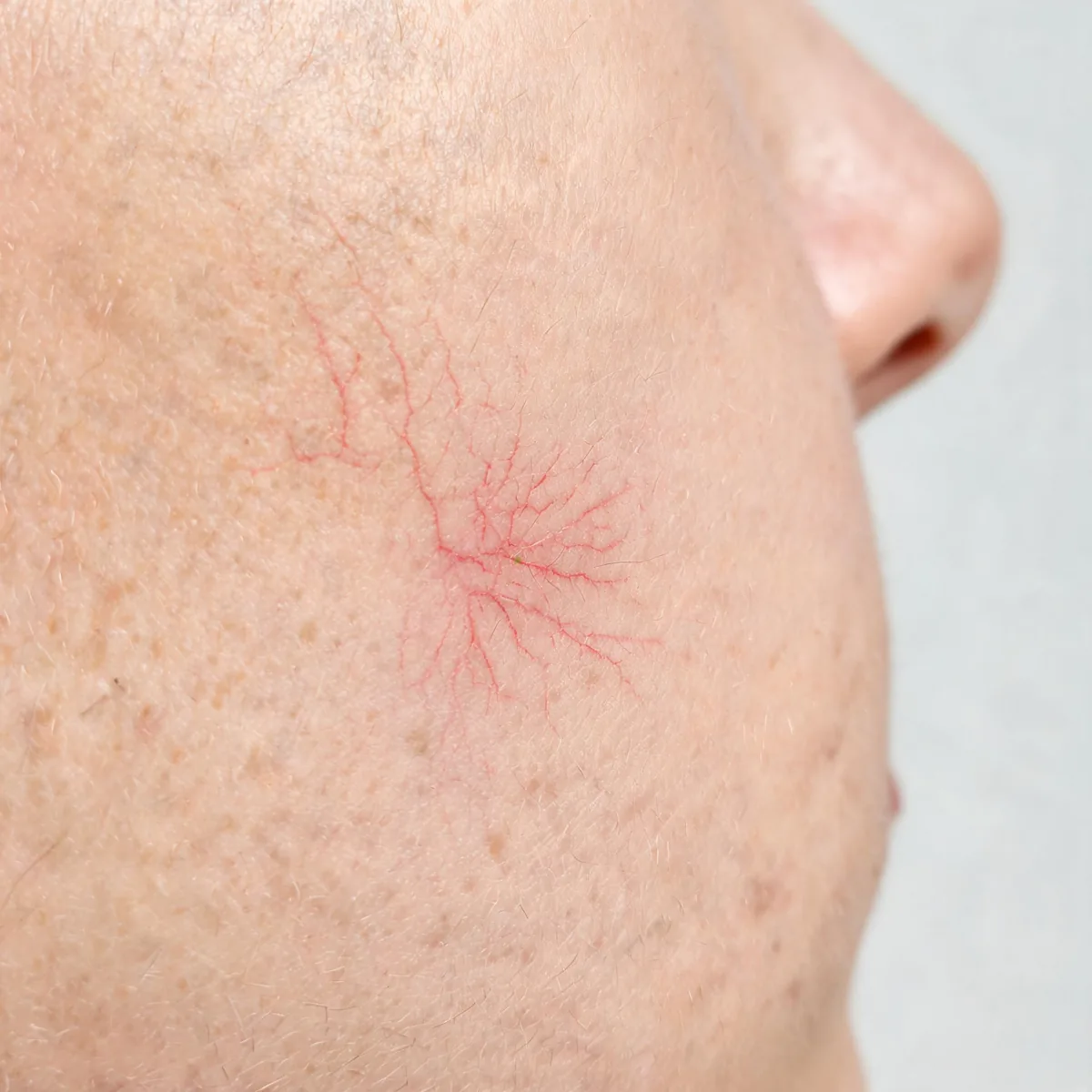
Understanding Spider veins
The tradition describes spider veins as a problem of blood and vessel health, tied closely to the Liver role of keeping Qi and Blood flowing smoothly.
When stress, frustration or hormonal shifts cause Liver Qi to stagnate, blood flow becomes sluggish and pools in the small vessels under the skin. Blood stagnation with heat gives bright red veins with a central pulsating point and fixed stabbing pain.
Heat in the Blood gives a general sensation of internal heat with red skin eruptions alongside the veins, and sometimes nosebleeds or heavy periods. Damp-Heat in the Liver adds rib-side distension, a bitter taste and dark yellow urine.
Kidney Yin deficiency with Empty-Heat is described for veins on the face, neck or upper chest, with night sweats and malar flush. Spleen deficiency with dampness gives the veins alongside loose stools, bloating and fatigue.
Read one telangiectasia closely and it tells a story about pressure and containment. A capillary wall is among the thinnest membranes in the body, and it is the first structure to register strain when flow behind it accelerates while the tissue holding it loses tone. TCM therefore asks two things of every visible vessel: whether the force driving blood through it is heat or simple congestion, and whether the wall itself is firm or fragile. A hot bright centre with fine radiating legs answers the first way; a faint bluish web on pale skin in someone who always feels the cold answers the second.
Three organs share that wall. The Liver supplies the push that keeps blood in motion, the Spleen supplies the tone that keeps it inside the vessel, and the Kidney reserve supplies the cooling fluid that stops movement from becoming friction. When any one of them slips, the same outward sign appears: a vessel that has lost the balance between flow and hold. This is why the classical literature warns against treating the skin alone. Cooling a Liver that is merely congested leaves a fragile Spleen wall untouched, and nourishing a Kidney that is already cool does nothing for blood that is stuck and overheated.
Conventional view
In conventional medicine spider veins, or telangiectasias, are small widened vessels sitting close to the surface, visible as fine red or purple lines and web-like clusters. They are most often found on the face and legs and are usually a cosmetic concern rather than a disease. Causes include inheritance, sun exposure, ageing, hormonal change in pregnancy or menopause, rosacea, and in some cases liver disease. The diagnosis is made by looking; imaging or blood tests are reserved for cases where a deeper cause is suspected.
Treatment is directed at the visible vessel. Laser therapy and intense pulsed light heat and close the small vessels, sclerotherapy injects an irritant solution that makes them collapse, and electrocautery is used for fine facial marks. Creams can temporarily tone down redness but do not remove the vessel. Sun protection is advised to limit new ones. Several sessions are often needed, and the result is cosmetic: the underlying tendency to form new vessels remains.
That is the gap TCM addresses. Conventional care removes what is visible and stops there, while TCM asks why this person's vessels are dilating and treats that. It also explains the pattern-blindness of the cosmetic approach, since a hot red lesion and a faint purple web in a tired patient are handled identically by a laser but call for opposite herbal strategies. Where the two are combined, the procedure deals with existing vessels and the pattern work reduces the rate at which new ones appear.
Selected PubMed records
Real PubMed records for the conventional discussion above, selected by condition name and title relevance. They are references, not a claim that any treatment is proven for this condition.
- Varicose veins.. Circulation, 2014. PMID: 25114187.
How it connects
Spider veins rarely appear in isolation: in TCM they are a visible marker of deeper Liver and Blood disharmony. The same Liver Blood Stagnation or Damp-Heat in the Liver that makes the tiny vessels dilate often disrupts the smooth flow of Qi in the abdomen, leading to bloating and distention, and when Damp-Heat accumulates it can also cause a bitter sticky taste and loss of appetite. As liver function becomes more compromised, fluid metabolism is affected and ascites may develop alongside the spider veins. This clustering reflects a single root pattern, and treating the Liver stagnation and clearing Damp-Heat often improves both the skin lesions and the digestive symptoms together. The clustering is not coincidental. The Liver channel runs through the ribs and the abdomen as well as to the skin, so the congestion that widens a surface vessel also slows the movement of Qi below the diaphragm. Bloating, distension and a bitter sticky taste therefore arrive with the veins, and nausea or a poor appetite follow when the Damp-Heat reaches the Stomach. As liver function falls further, fluid handling suffers and ascites can appear. Treating the Liver stagnation and clearing the Damp-Heat often eases the digestive complaints and the skin signs in step, which is why they are assessed as one picture.
How it is assessed
The practitioner notes where the veins are, how they feel, and what else is happening.
What a practitioner looks for
- Location: face, neck and upper chest suggest Yin deficiency with Empty-Heat; legs suggest damp heat or stagnation.
- Sensation: fixed stabbing pain suggests stagnation with heat.
- Associated signs: rib-side distension and a bitter taste suggest Liver damp heat; malar flush and night sweats suggest Yin deficiency.
- Liver review: sudden many veins, jaundice or abdominal swelling need prompt medical assessment.
Colour is where a consultation usually begins, then site, then the company the veins keep. Bright red vessels with a palpable centre and skin that feels warm suggest heat sitting in the blood, so the practitioner looks for a red tongue with a yellow coat and a rapid pulse. Dark purple webs, a dull ache that stays in one place and a long history of frustration point instead to blood that has stalled in the Liver channel. Pale barely visible vessels in someone who is always tired and feels the cold suggest that the wall itself is undernourished rather than overloaded.
The excess pictures are separated by moisture and by where the heat has settled. Heat in the Blood gives a dry burning quality with possible nosebleeds, bleeding gums or unusually heavy menstruation, a crimson tongue and a forceful rapid pulse. Damp-Heat in the Liver adds heaviness and stickiness, a bitter taste, dark urine and a coating that is thick, yellow and greasy, and the veins often sit alongside rib-side distension. Liver Blood Stagnation is the one pattern where heat may be absent altogether: the pain is fixed and stabbing under the ribs, menstrual blood is dark with clots, and the pulse is wiry and choppy like a knife drawn over bamboo.
Deficiency looks quieter and is easier to overlook. When Kidney Yin has run low and empty heat blazes, the vessels are fine and appear across the face and neck and over the upper chest, with night sweats, hot palms and soles, a malar flush and a tongue that is red, thin and often bare of coating; the pulse is fine and rapid and weakest at the rear positions. Spleen Deficiency with Dampness produces veins against a background of bloating, loose stools and heaviness, with a pale puffy tongue showing teeth marks and a soft slowed pulse. Either way the practitioner also checks for anything needing medical review, because a sudden crop of veins on the chest or back, yellowing of the eyes or abdominal swelling is not a matter for herbs alone.
TCM patterns in Spider veins
Six patterns account for most spider veins, and four observations separate them: colour, warmth, site, and what else the person notices. Bright red with a hot centre means heat in the blood. Dark purple with a fixed ache means stasis. Both together are common, because blood that stops moving overheats and heat that thickens blood slows it further. Site narrows the field. Face, neck and upper chest with night sweats and a dry mouth mean a Kidney reserve that has run low. Trunk veins with rib-side fullness, a bitter taste and a greasy coating mean Damp-Heat in the Liver. Legs with heaviness and loose stools point to a Spleen failing to transform fluids. A wiry choppy pulse with a dusky spotted tongue supports stasis; a fine rapid pulse with a peeled tongue supports deficiency. Mixed pictures are the rule.
| Pattern | Key signs | The itch | Tongue | Main formula |
|---|---|---|---|---|
| Blood Stagnation with Heat | Bright red spider veins with a central pulsating point; Fixed stabbing pain worse at night | Not specified | Body: Reddish-purple, with stasis spots and dark sublingual veinsCoat: Thin, dry and yellow | Not specified |
| Liver Blood Stagnation | Fixed stabbing pain in the rib area | Not specified | Body: Purple or dark with stasis spots on the sides and distended sublingual veinsCoat: Thin white | Not specified |
| Heat in the Blood | Red skin rashes alongside the veins | Not specified | Body: Deep red, often with red points or pricklesCoat: Thin, yellow and dry | Not specified |
| Damp-Heat in the Liver | Pain and distension along the ribs | Not specified | Body: Red with redder sidesCoat: Yellow and greasy | Not specified |
| Kidney Yin Deficiency With Empty-Heat Blazing | Not specified | Not specified | Body: Red, thin and dry, often crackedCoat: Little or none | Not specified |
| Spleen Deficiency with Dampness | Not specified | Not specified | Body: Pale and swollen, often with teeth marks along the edgesCoat: White, greasy and moist, thick in the middle | Not specified |
Blood Stagnation with Heat
Bright red veins with a pulsating point and fixed stabbing pain.
Blood that stops moving in a small vessel generates friction, and friction becomes heat. The heat pushes harder against the capillary wall, the wall yields, and a bright red lesion with a pulsating centre and fine radiating legs appears. Because the stasis remains, the vessel stays open instead of closing again, and the colour deepens as the congestion ages. This is why the spots favour sites where flow is already slow, and why they are often warmer to the touch than the surrounding skin.
The tongue is reddish-purple with purple spots and distended veins beneath it under a thin dry yellow coat, and the pulse is choppy and rapid, often wiry at the left Guan position. Alcohol, spicy food, hot weather and lost sleep all feed the heat, while stress tightens Liver Qi and worsens the pooling. Cooling food, cold compresses and rest draw heat out of the blood, and gentle movement keeps it from settling. Xue Fu Zhu Yu Tang is the usual choice, with Di Dang Tang reserved for deep stasis carrying strong heat signs. Tao Ren, Hong Hua and Chi Shao are the blood movers, and SP-10 Xuehai, LR-3 Taichong, LI-4 Hegu and LI-11 Quchi make up the point prescription.
Signs
- Bright red spider veins with a central pulsating point
- Fixed stabbing pain worse at night
- Internal heat in palms, soles or chest
- Irritability
Diet and lifestyle for this pattern: Favour cooling, blood-nourishing food such as cucumber, celery, mung beans and dark leafy greens, and avoid alcohol, spicy food and excessive red meat, which can add Heat and thicken the Blood. Gentle daily walking or yoga keeps blood flowing smoothly, and manage stress with regular relaxation, since emotional tension worsens both stasis and Heat.
Liver Blood Stagnation
Dark purplish veins with rib-side pain and clotty periods.
The Liver is responsible for keeping Qi and blood in steady motion. Emotional strain, frustration or a hormonal shift constrains that motion, Qi collects, and blood behind it slows until it pools in the smallest vessels beneath the skin. The result is a dark purplish web that does not fade, and because the congestion sits in the Liver's own territory it usually travels with rib-side tightness, frequent sighing and irregular periods.
The tongue is dark purple with stasis spots along the sides and a thin white coat, and the pulse is wiry and choppy. Cold and raw food congeal blood, greasy meals add Dampness that obstructs it further, and long sitting lets it settle, while warmth on the abdomen, light warm meals and gentle exercise release it. Xue Fu Zhu Yu Tang is the formula named here, working through Tao Ren, Hong Hua and Chuan Xiong, and the points are LR-3 Taichong to free the Liver, SP-10 Xuehai to move blood, and LI-4 Hegu paired with Taichong as the Four Gates.
Signs
- Dark purplish spider veins
- Fixed stabbing pain in the rib area
- Dark menstrual blood with clots
- Irritability with frequent sighing
Diet and lifestyle for this pattern: Eat warm, light meals and include blood-moving food such as turmeric, hawthorn and black vinegar, and avoid cold, raw and greasy food that can congeal blood. Gentle walking or tai chi helps Qi and Blood flow, and manage stress with breathing or meditation to keep Liver Qi from stagnating.
Heat in the Blood
Internal heat with red eruptions and a bleeding tendency.
Heat trapped at the blood level behaves differently from heat on the surface. It agitates the blood rather than the skin, driving it outward with enough force to stretch the finest vessels, which is why the marks are bright red and often accompanied by small bleeds. Pregnancy, hormonal swings, spicy food and sustained frustration all raise that internal temperature. The vessels are not simply dilated; they are being pushed from within, and the walls weaken as the pressure continues.
The tongue is red with red spots or prickles and a thin dry yellow coat, while the pulse runs rapid, often wiry or slippery. Hot weather, fried food, coffee and alcohol sharpen the picture, while a cool room, plenty of plain water and rest ease it. The formula named for this pattern is the classical blood-cooling prescription that clears heat and stops bleeding, supported by Chi Shao and Mu Dan Pi. SP-10 Xuehai, LI-11 Quchi and LR-3 Taichong are used to cool the blood and settle the Liver.
Signs
- Internal heat worse at night
- Thirst for cold drinks
- Red skin rashes alongside the veins
- Possible nosebleeds, gum bleeding or heavy periods
Diet and lifestyle for this pattern: Steer clear of spicy, greasy and fried food as well as alcohol and coffee, which all add Heat to the Blood. Build meals around cooling, moistening food such as cucumber, watermelon, mung beans and leafy greens, keep the living space cool and calm, and practise gentle stress relief such as slow walking or meditation so emotional Heat does not flare.
Damp-Heat in the Liver
Rib-side distension with a bitter taste and dark urine.
Dampness and heat make an awkward pair: the dampness makes the heat cling, and the heat makes the dampness thick. When alcohol, rich food or chronic frustration overload the Liver, its free flow falters and the mixture settles in the small vessels near the surface, widening them into red marks. Because the same congestion sits in the Liver and Gallbladder, the skin change rarely travels alone; rib-side distension and a bitter taste belong to the same picture.
The tongue is red with redder sides and a yellow greasy coating, and the pulse is wiry, slippery and rapid. Alcohol, fried and spicy food and hot humid weather all add to the burden, while cooling damp-resolving food, plenty of water and a dry environment ease it. Gan Lu Xiao Du Dan is the formula given for this pattern, with Yin Chen, Huang Qin and Zhi Zi clearing and draining. LR-3 Taichong, LR-2 Xingjian and SP-9 Yinlingquan address the Liver and the dampness together.
Signs
- Pain and distension along the ribs
- Bitter taste in the mouth
- Dark yellow urine
- Yellow greasy coating
Diet and lifestyle for this pattern: Avoid alcohol, greasy fried food and spicy dishes that brew Damp-Heat internally. Eat plenty of cooling, Dampness-resolving vegetables such as cucumber, celery and mung beans, keep the living space dry, and avoid prolonged exposure to hot humid environments.
Kidney Yin Deficiency With Empty-Heat Blazing
Veins on face, neck or chest with night sweats and malar flush.
The body's deepest cooling reserve is Kidney Yin, and when it thins, the warm Yang it normally anchors drifts upward. That drifting warmth is not true excess heat but a deficiency sign, which is why it produces fine fragile vessels rather than the bright lesions of blood heat. It typically arrives with age, chronic illness or years of late nights and overwork, and it shows on the upper body because heat rises.
The tongue is red, thin and dry with little or no coating and possible cracks, and the pulse is fine and rapid, weakest at the rear positions. Late nights, overwork, hot food and coffee spend the reserve further, while rest, a dark quiet room and cooling moistening foods such as goji berries, pear, black sesame and kidney beans rebuild it. Zhi Bai Di Huang Wan is the formula, carrying Shu Di Huang, Zhi Mu, Huang Bo, Shan Zhu Yu and Mu Dan Pi. KI-3 Taixi, KI-6 Zhaohai, SP-6 Sanyinjiao and KI-2 Rangu nourish Yin and clear the empty heat.
Signs
- Spider veins on face, neck or upper chest
- Night sweats
- Five-palm heat
- Malar flush
- Low back soreness with tinnitus
Diet and lifestyle for this pattern: Avoid spicy, greasy and hot-natured food as well as alcohol and coffee, which can flare empty heat. Eat cooling, moistening food such as pear, black sesame, kidney beans and goji berries, prioritise rest and avoid overwork, especially late nights, which deplete Yin further, and choose gentle activity such as restorative yoga or walking to support Yin without overheating.
Spleen Deficiency with Dampness
Veins with loose stools, bloating and heaviness.
A Spleen that cannot transform food and fluids produces two problems at once: less Qi and blood are made, and what is made arrives with Dampness attached. The Dampness obstructs the small vessels, while the shortfall of blood leaves their walls soft and poorly maintained. The combination is what makes the veins visible, and it explains why they appear in people who are tired, bloated and prone to loose stools rather than in those who look overheated.
The tongue is pale and swollen with teeth marks, a white greasy coating and a moist surface, and the pulse is soggy and slowed, soft under the fingers. Cold and raw food, overeating, worry and damp weather all weaken the Spleen further, while warm cooked meals, rest after eating and gentle daily movement support it. Shen Ling Bai Zhu San is the formula named, built on Bai Zhu and Fu Ling, and ST-36 Zusanli, SP-9 Yinlingquan and REN-12 Zhongwan are used to strengthen the middle and drain the dampness.
Signs
- Loose or unformed stools
- Abdominal bloating after eating
- Heaviness in body and limbs
- Poor appetite with fatigue
Diet and lifestyle for this pattern: Eat warm, cooked food such as soups, stews and congee, and avoid cold, raw and greasy food that burdens the Spleen. Eat at regular times without overeating, and keep up gentle daily walking so Qi flows without overtaxing the body.
Treatment approach
How the tradition treats spider veins, with the herbs, formulas and points used for it.
Principles
- Move Liver Qi and Blood, which is the common thread in most patterns.
- Clear heat where the veins are bright, painful and accompanied by heat signs.
- Nourish Yin where veins appear on the face and upper chest with night sweats.
- Support the Spleen where dampness and digestive signs are present.
- Root and branch are separated before a formula is chosen. The branch is the visible vessel, addressed through points that cool or move blood locally; the root is the organ imbalance that keeps recreating it, addressed through the daily formula. Where stasis and heat coexist, as they usually do, the two are treated in proportion rather than in sequence, and that proportion is adjusted as the tongue and pulse change.
Herbs used
Formulas
- Xue Fu Zhu Yu Tang
- Di Dang Tang
- Gan Lu Xiao Du Dan
- Zhi Bai Di Huang Wan
- Shen Ling Bai Zhu San
Acupoints
- SP-10 (Xuehai)
- LR-3 (Taichong)
- LI-4 (Hegu)
- LI-11 (Quchi)
- LR-2 (Xingjian)
- SP-9 (Yinlingquan)
- KI-3 (Taixi)
- KI-6 (Zhaohai)
- SP-6 (Sanyinjiao)
- KI-2 (Rangu)
- ST-36 (Zusanli)
- zhongwan-ren-12
What to expect
- The tradition describes the underlying pattern improving over months; visible veins may reduce but are not guaranteed to disappear.
- New crops are expected if the pattern and its triggers are not addressed.
- Sudden many veins or signs of liver disease need medical review.
- Progress is rarely linear. Veins may look fainter for a few weeks and then darken during a stressful period, a cold snap or the premenstrual days, and that fluctuation is expected rather than a failure of treatment. Once new vessels have stopped forming across several cycles, many people continue a lighter maintenance formula or occasional acupuncture to hold the gain.
Safety and when to get help
Seek medical help urgently for
- Sudden appearance of many spider veins, especially on the chest or back, which may reflect liver disease.
- Spider veins with yellowing of the skin or eyes, abdominal swelling, or easy bruising.
- A vein that becomes painful, hot and swollen.
For anything severe, sudden or spreading quickly, read when a skin problem needs urgent care.
Cautions
- Do not treat visible veins as purely cosmetic without checking for liver disease
- Alcohol and hormone-related factors should be reviewed
- Compression and medical treatment of venous disease should not be delayed.
Using this alongside conventional care
- TCM is described as complementary to conventional care: medical assessment of venous and liver health comes first, with herbs used alongside for the constitutional pattern.
- Laser therapy, intense pulsed light and sclerotherapy close visible vessels, and herbs and acupuncture run alongside them without conflict in most cases. Two practical points matter. Procedures are usually scheduled before a session rather than immediately after, because blood-moving herbs can increase bruising and skin sensitivity for a few days. And the underlying tendency decides recurrence, so treating the pattern while the cosmetic work is done gives the best chance that new vessels stay away. Anyone with a diagnosed liver condition should have care coordinated with their treating physician, since spider naevi can be the first visible sign of a liver problem that needs monitoring.
Diet and lifestyle
- Avoid alcohol, spicy food, greasy fried food and excess sugar, and favour cooling light food.
- The general principle is to keep blood cool and moving without thickening it. Fried food, alcohol, chillies and sugar add heat or Dampness and are the first to remove, while dark leafy greens, cucumber and celery, mung beans, and a modest amount of lean protein support vessel tone and suit almost every pattern. Pattern detail then modifies the base: with stasis, add turmeric, hawthorn and black vinegar and avoid cold raw food; with Damp-Heat, reduce dairy and rich dishes and keep meals light and slightly bitter; with Spleen deficiency, cook everything and eat at regular times; with Kidney Yin deficiency, favour pear, black sesame and goji berries and keep late nights to a minimum.
If you're pregnant
Spider veins are common in pregnancy because rising oestrogen and a larger blood volume load the surface vessels, which in TCM reads as heat entering the blood or Liver Qi held under pressure. Most fade after delivery, and the appearance itself is not dangerous. Treatment during pregnancy is cautious: the strong blood movers found in formulas such as Xue Fu Zhu Yu Tang, including Tao Ren and Hong Hua, are avoided because they can stimulate the uterus.
Acupuncture is the safer first line and can gently free Liver Qi through LR-3 Taichong and, with care, LI-4 Hegu, without the strong moving action of the herbs. Any internal prescription should come from a practitioner experienced in both TCM and obstetrics, and self-treatment is not advisable while pregnant. Sudden crops of new veins, yellowing of the eyes or abdominal swelling need medical review rather than herbal treatment.
If you're breastfeeding
After childbirth the body often carries both blood deficiency and leftover stasis, so veins may persist or appear for the first time. The question here is what passes into milk. Herbs that move blood and clear heat, Chi Shao, Tao Ren and Mu Dan Pi among them, are used sparingly, since they can loosen an infant's stools or cause digestive upset, and doses are generally lower than usual.
A version of Xue Fu Zhu Yu Tang modified so that the moving herbs are reduced and Dang Gui is added is the kind of compromise a practitioner might make, always under close supervision. Acupuncture carries no such risk and is often the main treatment during this period. Cosmetic work on the visible vessels is usually deferred until breastfeeding has finished, and any such plan should be discussed with the practitioner first.
If treating a child
Spider veins are uncommon in childhood and always warrant a proper medical review to exclude liver disease. When they do occur, the pattern is usually Spleen Deficiency with Dampness or a constitutional weakness of Liver and Kidney Yin, because a child's digestion is immature and Dampness accumulates easily.
Treatment rests on diet and gentle methods such as paediatric tuina or non-needle acupuncture, and herbs are given at a quarter to a half of the adult dose. A specialist in paediatric TCM should guide any prescription, and self-treatment with adult formulas is not appropriate for a child.
If treating an elderly patient
In older adults the veins usually sit on a background of Kidney Yin Deficiency with Empty-Heat, or of long-standing Liver Blood Stagnation, because Yin and Blood decline with age and the vessel walls lose support. Treatment is gentler and slower, with doses around two thirds of the standard adult amount.
Zhi Bai Di Huang Wan is often preferred to a strong blood-moving formula, since aggressive stasis-breaking can cause dizziness and fatigue in someone already depleted. Medication review matters as much as the prescription, because several blood-invigorating herbs increase the effect of anticoagulants. Points are chosen for gentle Kidney tonification and mild movement of Liver Qi rather than to provoke a strong reaction.
Urgent-sign guidance is based on standard sources: NHS anaphylaxis, NHS cellulitis, NHS Stevens-Johnson syndrome, NHS melanoma.
Evidence
Evidence status
Compiled for this page from the classical and modern literature; not a systematic review, so treat it as a pointer to sources rather than clinical guidance.
The evidence is indirect and comes from liver disease rather than from cosmetic spider veins. A review of blood-moving formulas in cirrhosis reported improvement in spider naevi and other signs of portal hypertension in 60 to 80 percent of cases, suggesting improved microcirculation. That is a different clinical situation from benign facial or leg veins, and the review is not a controlled trial.
The strongest signal comes from cirrhosis research rather than from cosmetic studies. A review published in 2024 examined blood-activating and stasis-removing therapy for liver cirrhosis. Drawing on Chinese clinical studies of formulas such as Xue Fu Zhu Yu Tang, it reported that spider naevi and other signs of portal hypertension improved in a large share of treated patients, although the trials were designed around liver function and portal pressure rather than around the veins themselves. Small samples, absent blinding and Chinese-language publication all limit what can be concluded, and no trial has yet taken the appearance of spider veins as its primary endpoint. Evidence for acupuncture is thinner still and rests largely on clinical experience.
Studies often cited
A review of Chinese clinical studies using formulas such as Xue Fu Zhu Yu Tang in cirrhosis reported improvement in spider naevi and other signs of portal hypertension in 60 to 80 percent of cases, proposing improved liver microcirculation as the mechanism. Clinical application progress of promoting blood circulation and removing blood stasis in TCM treatment of liver cirrhosis, 2024.
The review analysed multiple Chinese clinical studies of blood-activating formulas such as Xue Fu Zhu Yu Tang in liver cirrhosis and reported that spider naevi, along with other signs of portal hypertension, improved in 60 to 80 percent of cases, suggesting that moving Blood and resolving stasis can reduce their appearance by improving liver microcirculation. Clinical application progress of promoting blood circulation and removing blood stasis in TCM treatment of liver cirrhosis. Chinese Medicine (Zhong Yi Xue). 2024;13(9):5227-2095. https://pdf.hanspub.org/tcm2024139_52272095.pdf
Classical record
血痣者,乃肝經怒火鬱結,其形初起色紅如痣,漸大如豆,揩之血流。
Blood moles come from anger held in the Liver channel: at first they look like a red mole, then they grow until they are as big as a bean and bleed when rubbed.
Wai Ke Zheng Zong, Volume 4, Blood Moles - Classical citation: which uses the passage to read a visible vascular mark as Liver Qi constraint rather than as a purely local skin problem.
Common questions
Are spider veins a sign of liver disease?
Usually not, but a sudden crop of many veins on the chest or back, especially with jaundice or easy bruising, needs medical liver assessment.
Can herbs remove them?
The classical literature treats the underlying stagnation or deficiency. It does not promise the veins will disappear, and cosmetic treatments remain a separate option.
Why do they appear on the face?
Face, neck and upper chest veins are described as Kidney Yin deficiency with Empty-Heat, which is why night sweats and malar flush are asked about.
Is alcohol a factor?
The classical literature names alcohol as a contributor to damp heat in the Liver pattern.
Can acupuncture clear the veins themselves?
Acupuncture alone rarely erases vessels that are already there, and it is not chosen for that. What it does is correct the imbalance that keeps producing them: needling moves Qi and blood, clears heat and strengthens the organs involved, which tends to stop new vessels forming and slowly reduces how prominent existing ones look. Some practitioners also place points near the visible vessels to improve circulation there, which supports the fading process.
Does diet really matter here?
Diet is part of treatment because certain foods feed the heat or Dampness behind the veins. Alcohol, chillies, fried food and sugar are the usual ones to cut. Beyond that the advice follows the pattern: cooling blood-nourishing foods such as dark greens, cucumber and celery, mung beans suit most people, warm cooked meals suit a weak Spleen, and dairy and rich dishes are best reduced when Damp-Heat is present.
Is TCM useful when sun damage or ageing is the cause?
Yes, though for a different reason than a cosmetic procedure. Sun and age deplete Yin and Blood, so the vessels lose support and dilate more easily. Nourishing Yin, rebuilding Blood and clearing any heat that has built up addresses that susceptibility rather than the single vessel, which is why treatment aims at the skin's resilience from within and can reduce both existing and future marks.
Can I have laser treatment while on herbs?
Yes, in most cases the two work well together: the laser closes the visible vessel and herbs and acupuncture address the tendency behind it. Tell both the dermatologist and the TCM practitioner about everything you are taking, and mention any blood-moving herbs, since they can raise skin sensitivity and bruising after a procedure. Spacing a needling session and a laser appointment by a few days is a common precaution.
Why does the practitioner ask about vein colour?
Colour is one of the most useful clues. Bright red points to heat in the blood, dark purple or bluish suggests stasis, and pale faint vessels with tiredness and pale skin hint at blood deficiency. It is never read alone: the practitioner sets colour against site, warmth, tongue and pulse before deciding which pattern is dominant.
Do the herbs have side effects?
Formulas are matched to the pattern and are generally well tolerated. Blood-moving herbs can loosen the stools or cause mild digestive change in the first week or two, which usually settles. The important caution is interaction: Dang Gui and Chuan Xiong can strengthen the effect of blood thinners, so any anticoagulant or antiplatelet medication must be declared before a prescription is written.